Fiction cannot be reduced to mere falsehood (William T. Vollmann)

Most literary critics agree that fiction cannot be reduced to mere falsehood. Well-crafted protagonists come to life, pornography causes orgasms, and the pretense that life is what we want it to be may conceivably bring about the desired condition. Hence religious parables, socialist realism, Nazi propaganda. And if this story likewise crawls with reactionary supernaturalism, that might be because its author longs to see letters scuttling across ceilings, cautiously beginning to reify themselves into angels. For if they could only do that, then why not us?

From William T. Vollmann’s novel Europe Central.

Violin Player — Gerrit Dou

And doesn’t the parable possess greater integrity? (William T. Vollmann)

And doesn’t the parable possess greater integrity, greater righteousness we might almost say, than any other literary form? For its many conventions weave a holy covenant between the reader, who gets the mystification he craves in a bonbon-sized dose, and the writer, whose absence renders him divine. Granted, those very stringencies sometimes telescope events into dreamlike absurdity.

From William T. Vollmann’s novel Europe Central.

(restored to the horror of his situation).

restored

“Holy Thursday” — William Blake

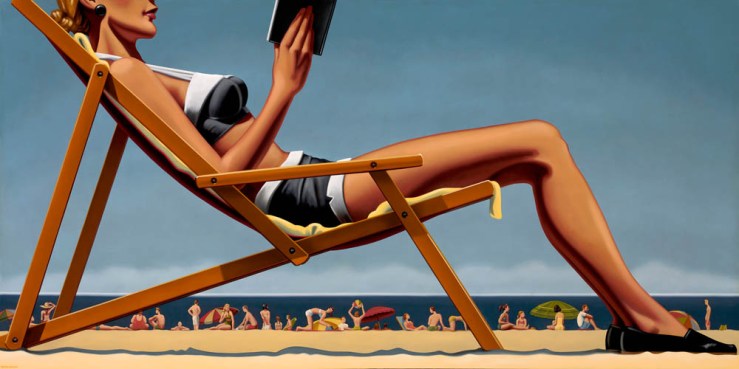
Why Not — Kenton Nelson

Nelson_Competition

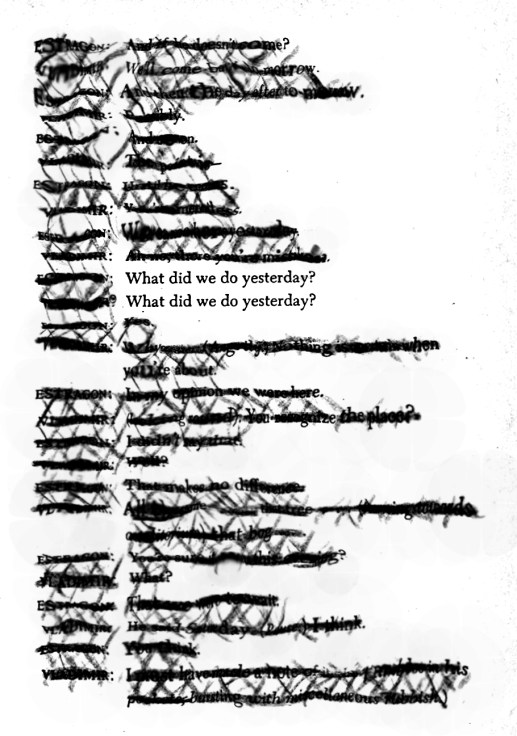
What did we do yesterday? / What did we do yesterday?

sb

Jorge Luis Borges, Forgeries, and Book Theft

jlb

Fascinating story today at The Paris Review about a first edition of Jorge Luis Borges’s early poems stolen—and then returned (perhaps?)—to the National Library of Argentina. Forgeries, facsimiles, and book thefts! The following paragraph points out that Borges himself was once director of the library:

The National Library is as old as Argentina: it was created in 1810, together with the first national government, and its first director was Mariano Moreno, one of the greatest national heroes and the founder of the country’s first newspaper. The library was, at one point, something to be proud of, and Borges’s name is inextricably linked to its history; he was its director for eighteen years, between 1955 and 1973. By then, books were already disappearing from its shelves. When asked whether this was true, he replied, in typical fashion, “I can’t tell whether books are being stolen, because I’m blind.”

Read the essay.

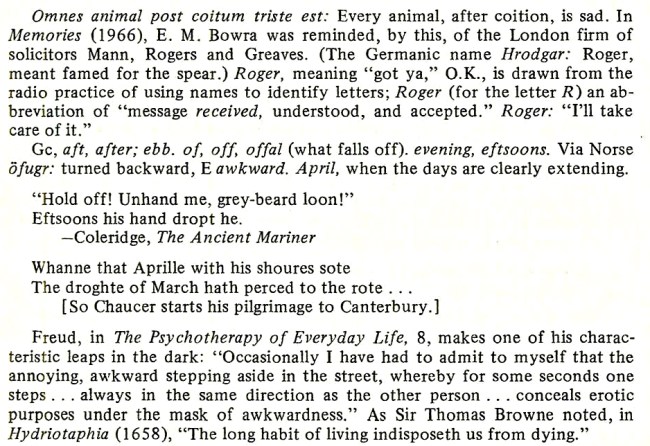
Every animal, after coition, is sad.

etym


From Joseph T. Shipley’s The Origin of English Words: A Discursive Dictionary of Indo-European Roots. I’ve found the book indispensable for years now—its discursiveness is a lunatic joy to get lost in. Anyway, the above passages extend/unwind from the root ap/apo; I found it while looking up the eytmology of poseur.

Mystic Allegory or Tea — Maurice Denis

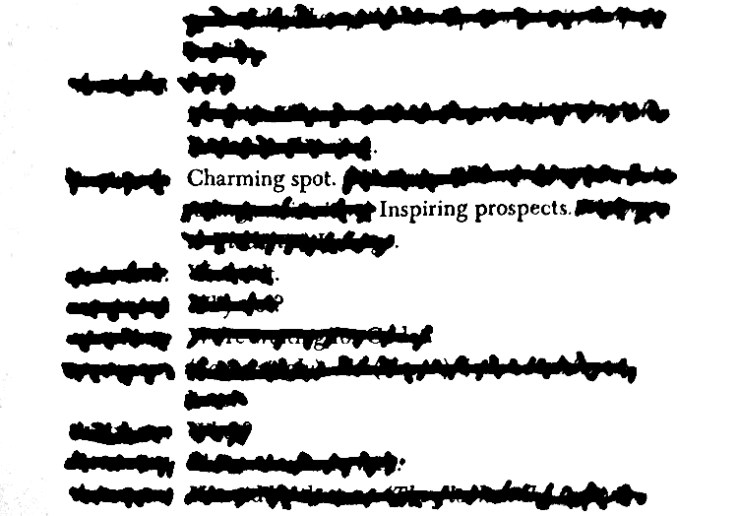
Charming spot. / Inspiring prospects.

charm

Portrait of a Young Lady — Alfred Stevens

“Finally, feverishly, I read this book that I would love to have written” (Vollmann’s Europe Central in Binet’s HHhH)

I, too, am transfixed—because I’m reading Europe Central by William T. Vollmann, which has just appeared in French. Finally, feverishly, I read this book that I would love to have written, and I wonder, reading the endless first chapter, how long he’ll keep it up, this style, this incredible tone. In fact, it lasts only eight pages, but those eight pages are magical, with phrases streaming past as in a dream, and I understand nothing, and understand everything. This is perhaps the first time that the voice of history has resounded so perfectly, and I am struck by this revelation: history is a prophet who says “We.” The first chapter is entitled “Steel in Motion,” and I read: “In a moment steel will begin to move, slowly at first, like troop trains pulling out of their stations, then more quickly and ubiquitously, the square crowds of steel-helmed men moving forward, flanked by rows of shiny planes; then tanks, planes and other projectiles will accelerate beyond recall.” And, further on: “Serving the sleepwalker’s rapture, Göring promises that five hundred more rocket-powered planes will be ready within a lightning-flash. Then he runs out for a tryst with the film star Lida Baarova.” The Czech. When I quote an author, I must be careful to cut my quotations every seven lines. No longer than seven lines. Like spies on the telephone: no more than thirty seconds, so they can’t track you down. “In Moscow, Marshal Tukhachevsky announces that operations in a future war will unfold as broad maneuver undertakings on a massive scale. He’ll be shot right away. And Europe Central’s ministers, who will also be shot, appear on balconies supported by nude marble girls, where they utter dreamy speeches, all the while listening for the ring of the telephone.” In the newspaper, somebody explains to me that this is an account of “slow-burning intensity,” a novel that is “more fantastical than historical,” the reading of which “requires a psychoanalytic listening.” I understand. I will remember. So … where was I?

From Laurent Binet’s novel HHhH.

I need to slam out a review of HHhH, which I loved.
People are bloody ignorant apes.

20140414-140032.jpg

St. Anthony with a Donor — Mabuse

The Kindly Ones is simply “Houellebecq does Nazism” (From Laurent Binet’s HHhH)

A poster on an Internet forum expresses the opinion that Max Aue, Jonathan Littell’s protagonist in The Kindly Ones, “rings true because he is the mirror of his age.” What? No! He rings true (for certain, easily duped readers) because he is the mirror of our age: a postmodern nihilist, essentially. At no moment in the novel is it suggested that this character believes in Nazism. On the contrary, he displays an often critical detachment toward National Socialist doctrine—and in that sense, he can hardly be said to reflect the delirious fanaticism prevalent in his time. On the other hand, this detachment, this blasé attitude toward everything, this permanent malaise, this taste for philosophizing, this unspoken amorality, this morose sadism, and this terrible sexual frustration that constantly twists his guts … but of course! How did I not see it before? Suddenly, everything is clear. The Kindly Ones is simply “Houellebecq does Nazism.”

From Laurent Binet’s novel HHhH; English Translation by Sam Taylor.

Enjoyed the novel tremendously.

I’m not sure if Binet’s remarks (or, Binet’s narrator, who is Binet-performing-author-as-narrator) are exactly a literary dis or not (I’m pretty sure he’s dissing Littell, but unsure how Houellebecq fits in there, or what).

(My thoughts on The Kindly Ones; my thoughts on Houellebecq’s The Elementary Particles).

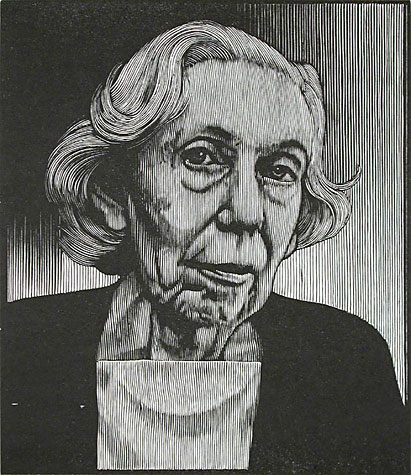
Eudora Welty — Barry Moser

moser-welty