A Study of ‘Katia Reading’ — Hisaji Hara

“Five common methods by which sex gains an entrance into literature” (William H. Gass)

So I shall, keeping one in each of my four pockets while one is in my mouth, describe five common methods by which sex gains an entrance into literature . . . as through French doors and jimmied windows thieves break in upon our dreams to rape our women, steal our power tools, and vandalize our dreams. The commonest, of course, is the most brazen: the direct depiction of sexual material— thoughts, acts, wishes; the second involves the use of sexual words of various sorts, and I shall pour one of each vile kind into the appropriate porches of your ears , for pronounc-ing and praising print to the ear is what the decently encouraged eye does happily. The third can be considered, in a sense, the very heart of indirection, and thus the essence of the artist’s art— displacement: the passage of the mind with all its blue elastic ditty bags and airline luggage f r o m steamy sexual scenes and sweaty bodies to bedrooms with their bedsteads, nightstands, water-glasses, manuals of instruction, thence to sheets and pillowcases, hence to dents in these, and creases, stains and other cries of passion which have left their prints , and finally to the painted chalk-white oriental face of amorously handled air and mountains,, lewdly entered lakes. The fourth I shall simply refer to now as the skyblue eye (somewhere, it seems to me, there should be a brief pinch of suspense), and the fifth, well, it’s really what I’m running into all my inks about, so I had better mention it: the use of language like a lover . . . not the language of love, but the love of language, not matter, but meaning, not what the tongue touches, but what it forms, not lips and nipples, but nouns and verbs.

From William H. Gass’s essay-novel On Being Blue: A Philosophical Inquiry.

Dreadful privation. / Merely smile.

dreadful

The Painter in his Workshop — Gerrit Dou

Mrs. Carl Meyer and Her Children — John Singer Sargent

“Some worm or other lay squirming before being devoured by the hen that humans were going to eat” (Clarice Lispector)

Daddy’s typewriter was tapping out tac-tac..tac-tac-tac… The clock chimed brightly ting-ting… ting-ting… The silence dragged out zzzzzzz. The wardrobe was saying what? clothes — clothes — clothes. No, no. Between the clock, the typewriter and the silence there was an ear listening out, large, flesh-pink and dead. The three sounds were connected by the light of day and by the rustling of tiny leaves on the tree as they joyfully rubbed against each other.

Resting her head against the cold, shiny window-pane, she looked into the neighbour’s yard, at the great world of the chickens-that-did-not-know-they-were-about-to-die. And as if it were right under her nose, she could smell the warm, beaten earth, so fragrant and dry, where she knew perfectly well, she knew perfectly well that some worm or other lay squirming before being devoured by the hen that humans were going to eat.

There was a grand moment, motionless and quite hollow inside. She opened her eyes wide and waited. Nothing happened. Blank. But suddenly with a shudder they wound up the day and they began to function once again, the typewriter tapping, father’s cigarette giving off smoke, silence, tiny leaves, plucked chickens, brightness, things restored to life and as impatient as a kettle on the boil. All that was missing was the ting-ting of the clock which gave so much pleasure. She closed her eyes, pretended to hear it chime, and to the rhythm of that imaginary music, she went up on the tips of her toes. She executed three dance steps, so light and ethereal.

Then suddenly she looked at everything with displeasure, as if she had eaten far too much of that concoction. ‘Hey, hey, hey…’, she murmured wearily and then thought to herself: what will happen now now now? And in the fraction of time that followed, nothing ever happened if she went on waiting for something to happen if you get my meaning? She pushed away this awkward thought, distracting herself with a movement of her bare foot on the dusty wooden floor. She rubbed her foot, looking sideways at her father, awaiting his impatient and nervous smile. But nothing happened. Nothing. It’s difficult to suck in people like the vacuum cleaner does.

— Daddy, I’ve invented a poem.

The first five paragraphs of Clarice Lispector’s novel Near to the Wild Heart.

No one ever suffers but you.

20140410-104232.jpg

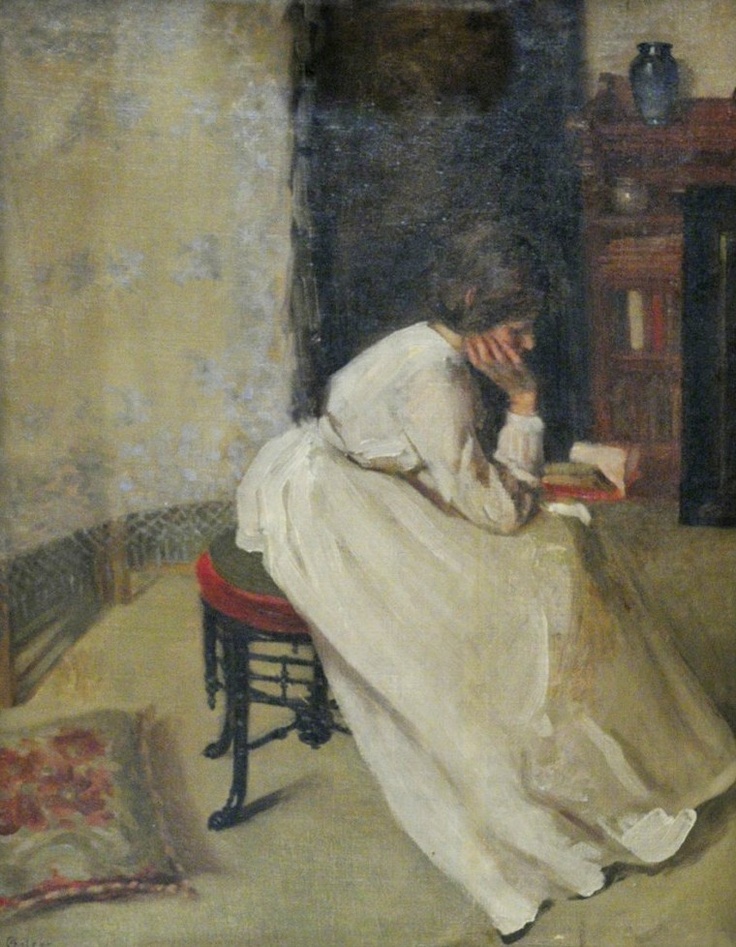
Girl Reading a Book — Emma Eilers

GIRL

Nothing to be done.

20140409-151256.jpg

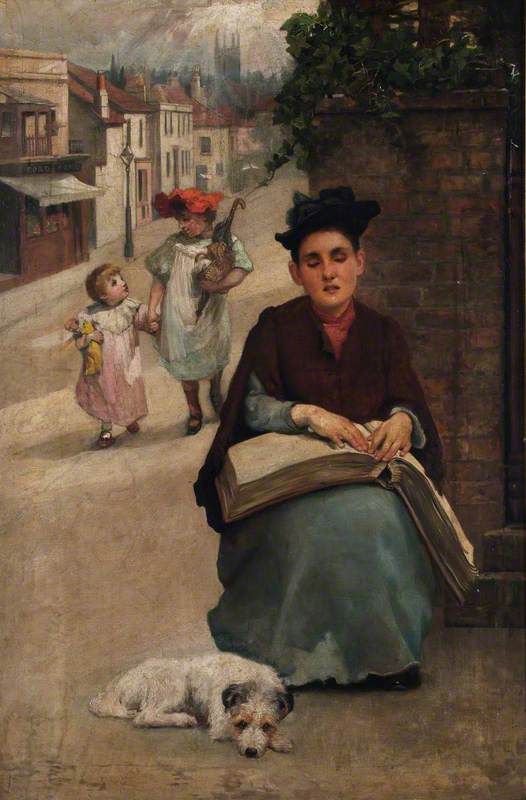
Blind Girl — Beatrice Offor

blind girl

“Beckett is a very blue man” (William H. Gass)

Remember how the desperate Molloy proceeds:

I took advantage of being at the seaside to lay in a store of sucking stones. They were pebbles but I call them stones I distrutibed them equally between my four pockets, and sucked them turn and turn about. This raised a problem which I first solved in the following way. I had say sixteen stones, four in each of my four pockets these being the two pockets of my trousers and the two pockets of my greatcoat. Taking a stone from the right pockct of my greatcoat, and putting it in mv mouth , I replaced it in the right pocket of my greatcoat bv a stone from the right pocket of my trousers, which I replaced by a stone from the left pocket of my trousers, which I replaced by a stone from the left pocket of my greatcoat, which I replaced by the stone which was in my mouth, as soon as I had fin-ished sucking it. Thus there were still four stones in each of my four pockets , but not quite the same stones…. But this solution did not satisfy me fully. For it did not escape me that, by an extraordinary hazard, the four stones circulating thus might always be the same four. In which case, far from sucking the sixteen stones turn and turn about, I was really only sucking four, always the same, turn and turn about.

Beckett is a very blue man, and this is a very blue passage.

From William H. Gass’s On Being Blue: A Philosophical Inquiry (and of course, Samuel Beckett’s Molloy).

“I am learning to see.” (Rilke)

Have I said it already? I am learning to see. Yes, I’m beginning. It is still going badly. But I want to make use of my time.

For instance, I never realized how many faces there are. There are lots of people but still more faces, for everyone has several. There are people who wear a face for years, of course it wears out, gets dirty, cracks in the folds, stretches like a glove one has worn on a journey. Those are thrifty, simple people: they don’t change it, they don’t even have it cleaned. It’s good enough, they maintain, and who can convince them otherwise? The question does arise, since they have several faces, what do they do with the others? They keep them in reserve. Their children will get to wear them. But it also happens that their dogs wear them when they go out. And why not? Face is face.

Other people put on their faces with uncanny rapidity, one after the other, and wear them out. At first it seems to them as if they have them forever, but they are barely forty and this one is already the last. That of course has its tragic side. They are not used to take care of faces, they run through the last one in a week, there are holes in it, in many places it is as thin as paper, and then slowly what’s underneath emerges, the not-face, and they walk around with that.

From The Notebooks of Malte Laurids Brigge. Translated by Burton Pike.

Blue Girl Reading — Frederick C. Frieseke

blue girl

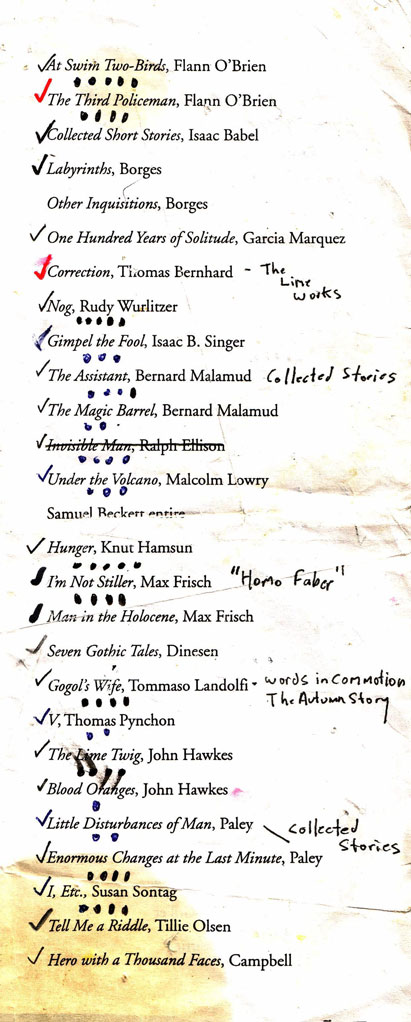
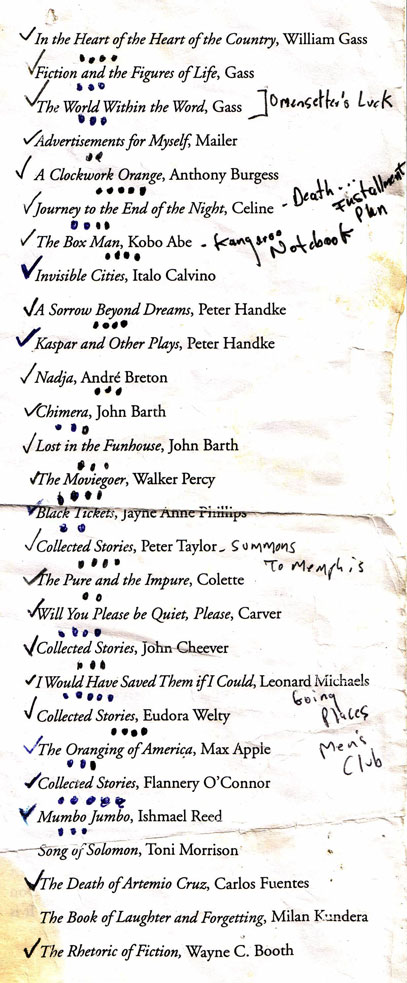
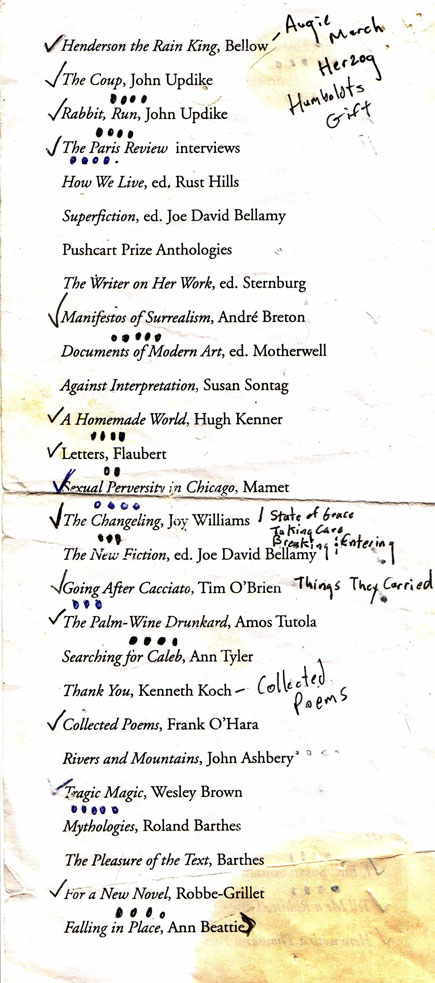
Donald Barthelme’s Book Recommendations

barthelme_1a barthelme_2a barthelme_3a

Sure–okay, sure, you’ve seen this before (or maybe not), I know I have (I’ve even posted it before). But today is D. Barthelme’s birthday (he’s dead of course), and I’ve read or reread (or, more accurately read) most of his stuff (sans The King, which I’ve been saving) over the past year. Anyway, this here list comes via Kevin Moffett who got it off DB’s former student, Padgett Powell, when he (that is Moffett) was finishing up at my alma mater, the University of Gators (where Powell continues to teach today, having replaced Harry Crews, RIP). Anyway (again with that transition!), check out Moffett’s original share-piece at The Believer; he describes Gainesville’s Friends of the Library Sale, which was always fun. I got a copy of John Barth’s Chimera there (on the list, natch), among other books, but I didn’t get any Barthelme. I’ve read 31 of the 81 books on the list (this includes fantastically awarding myself the “Samuel Beckett entire” entry but hell man I think it’s been counted as one work here (at least by Moffett?), which maybe it should be but no I haven’t read all of Beckett but hell I’ve read a lot, if not enough, but anyway (again!)–31).

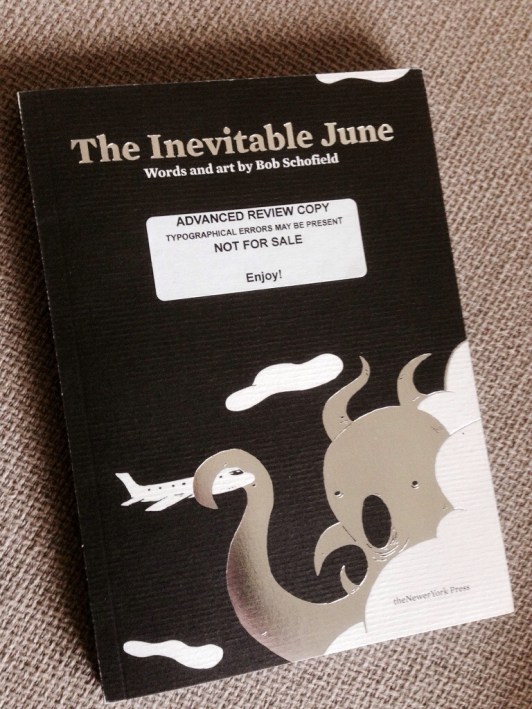
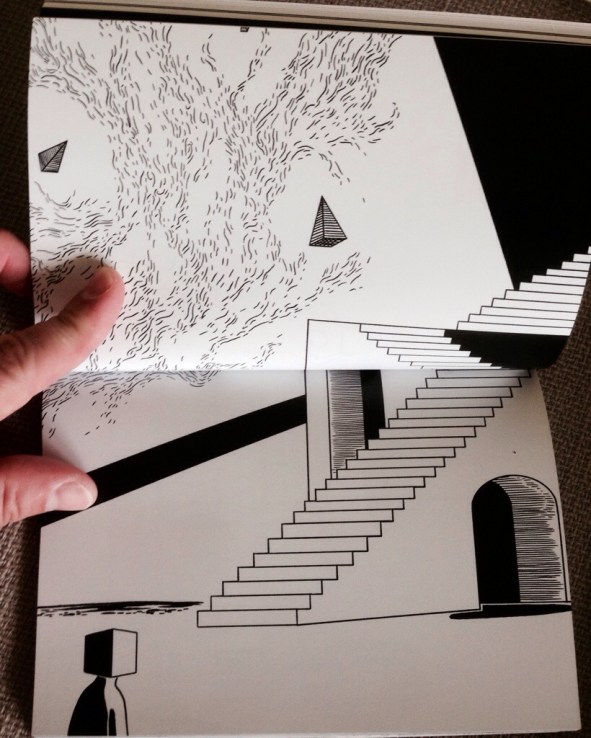
The Inevitable June (Book Acquired, 3.31.2014)

20140407-144637.jpg

20140407-160351.jpg

20140407-144655.jpg

20140407-160358.jpg

Portrait of Emile Zola — Edouard Manet