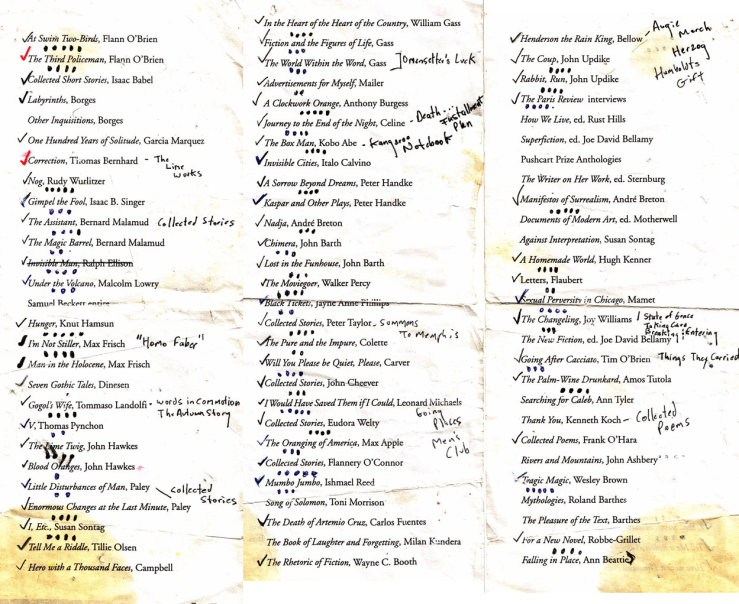
I have heard Donald referred to as essentially a writer of the American 1960’s. It may be true that his alloy of irrealism and its opposite is more evocative of that fermentatious decade, when European formalism had its belated flowering in North American writing, than of the relatively conservative decades since. But his literary precursors antedate the century, not to mention its 60’s, and are mostly non-American. ”How come you write the way you do?” a Johns Hopkins apprentice writer once asked him. ”Because Samuel Beckett already wrote the way he did,” Barthelme replied. He then produced for the seminar his ”short list”: five books he recommended to the attention of aspiring American fiction writers. No doubt the list changed from time to time; just then it consisted of Rabelais’s ”Gargantua and Pantagruel,” Laurence Sterne’s ”Tristram Shandy,” the stories of Heinrich von Kleist, Flaubert’s ”Bouvard and Pecuchet” and Flann O’Brien’s ”At Swim-Two-Birds” – a fair sample of the kind of nonlinear narration, sportive form and cohabitation of radical fantasy with quotidian detail that mark his own fiction. He readily admired other, more ”traditional” writers, but it is from the likes of these that he felt his genealogical descent.
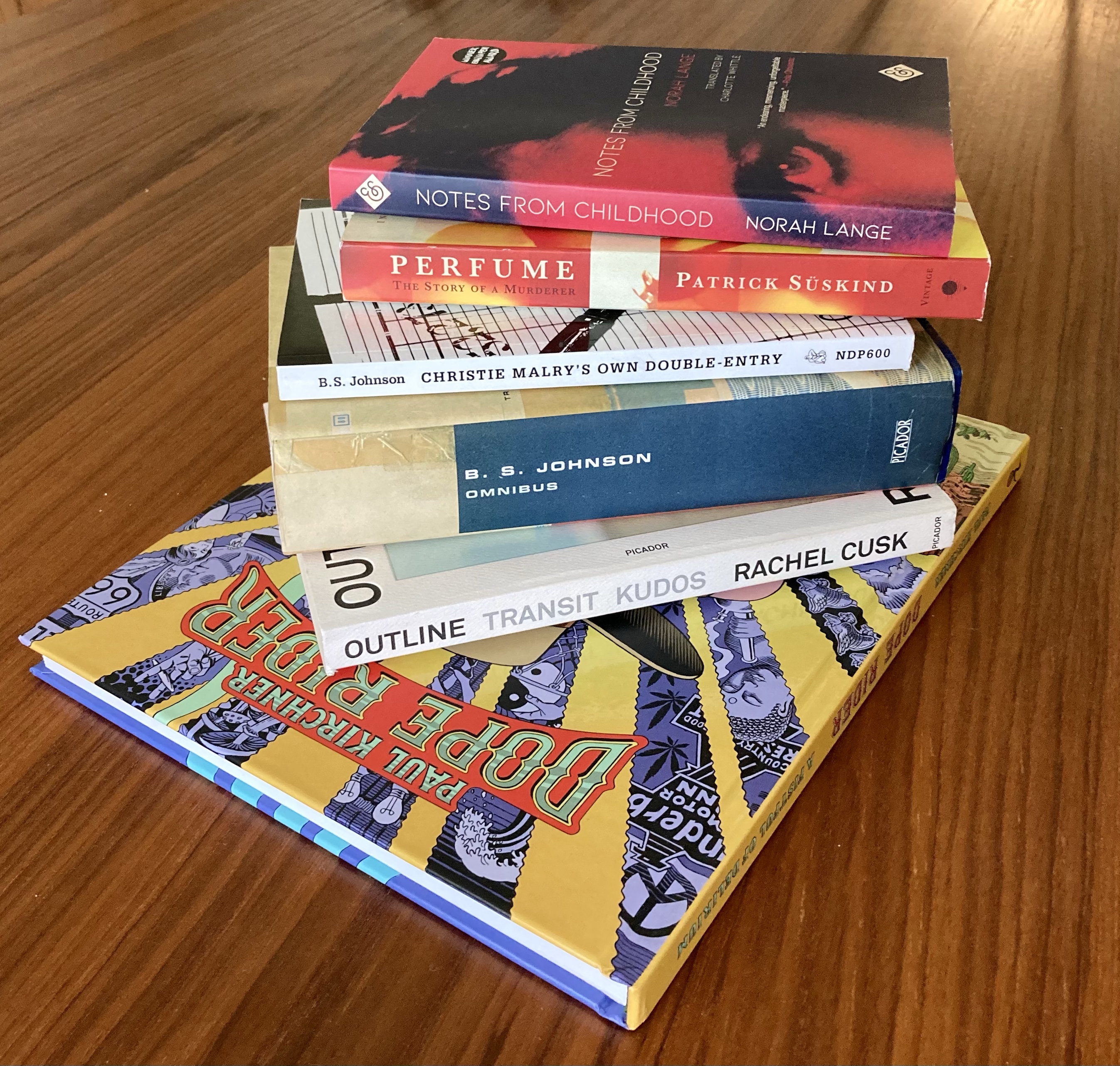
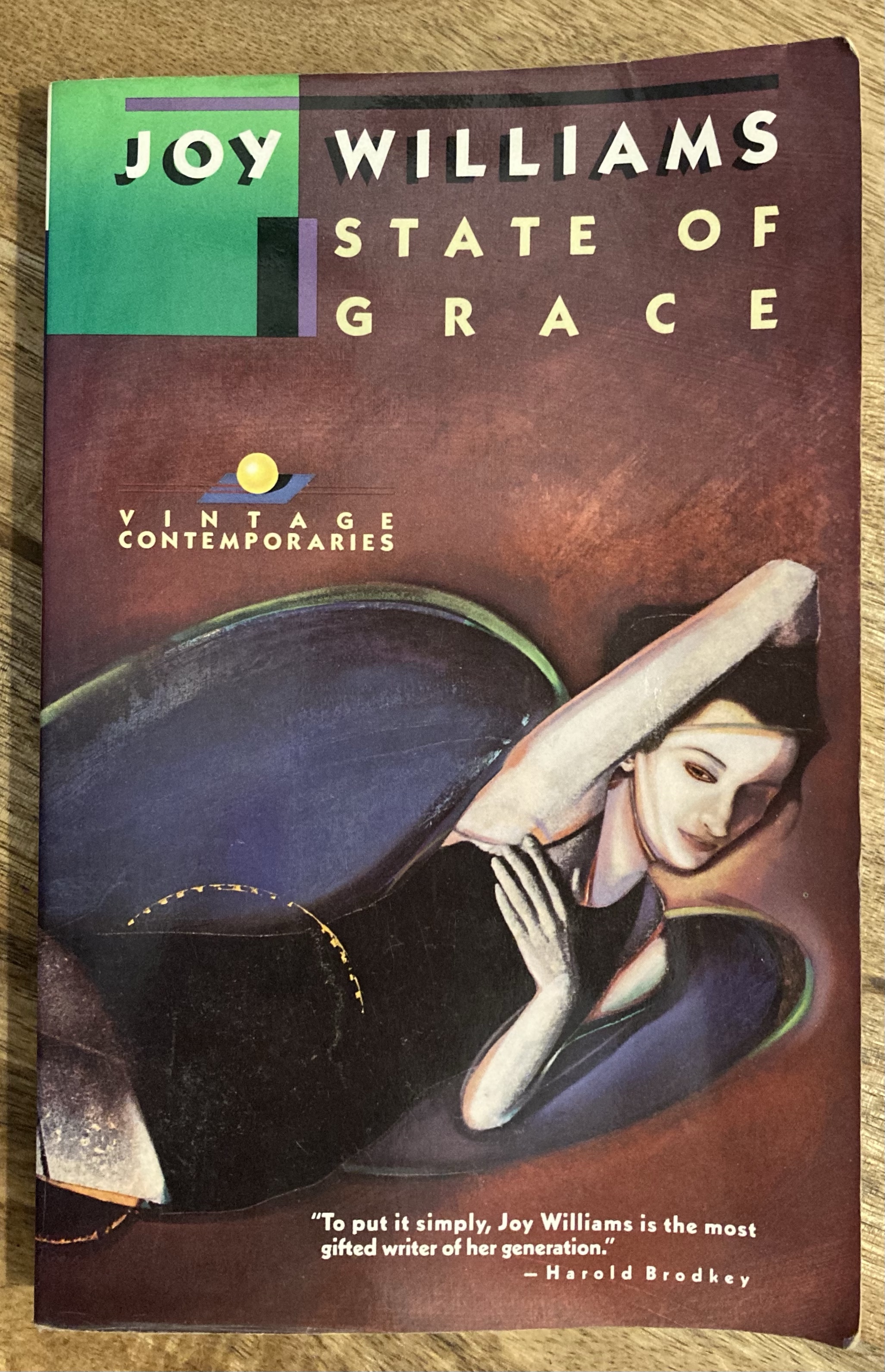
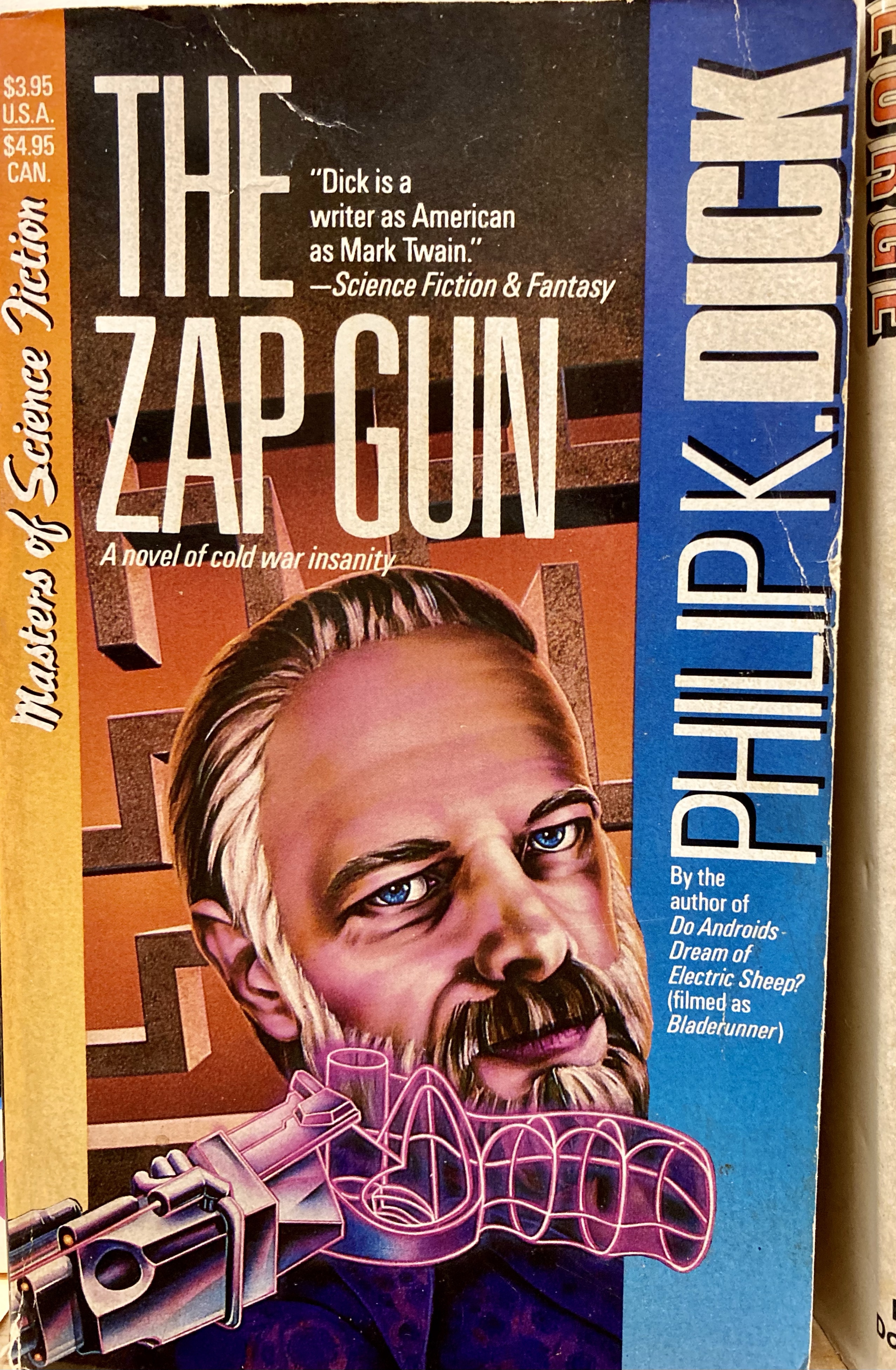
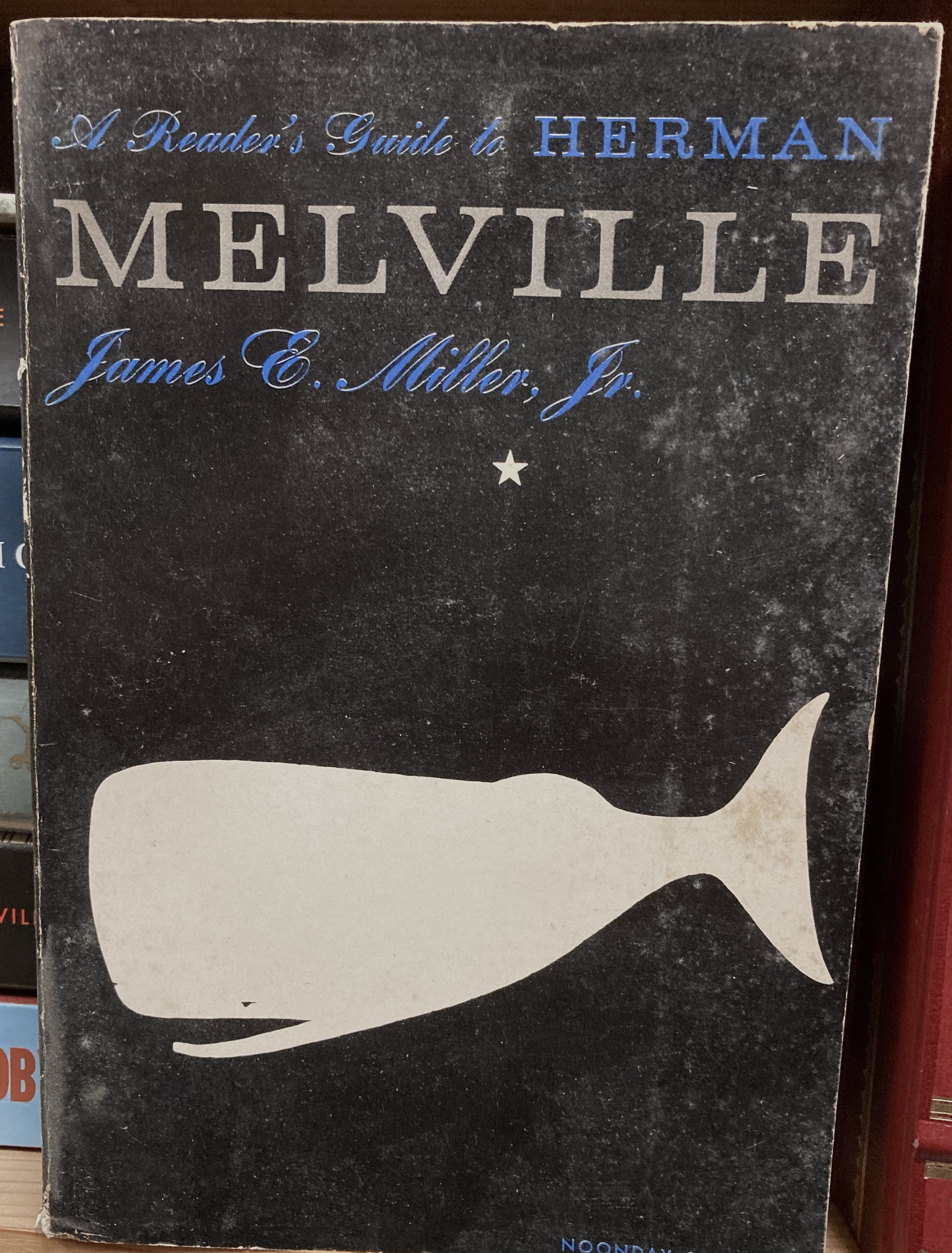
The last little bit of Spring trickles away here in North Florida, where beautiful days with highs of 82℉ promise to turn into burning sweaty hell in the next week or two. The Spring 2021 semester is behind me, and I’ve found a lot more time to read. So, re: pic, bottom to top:
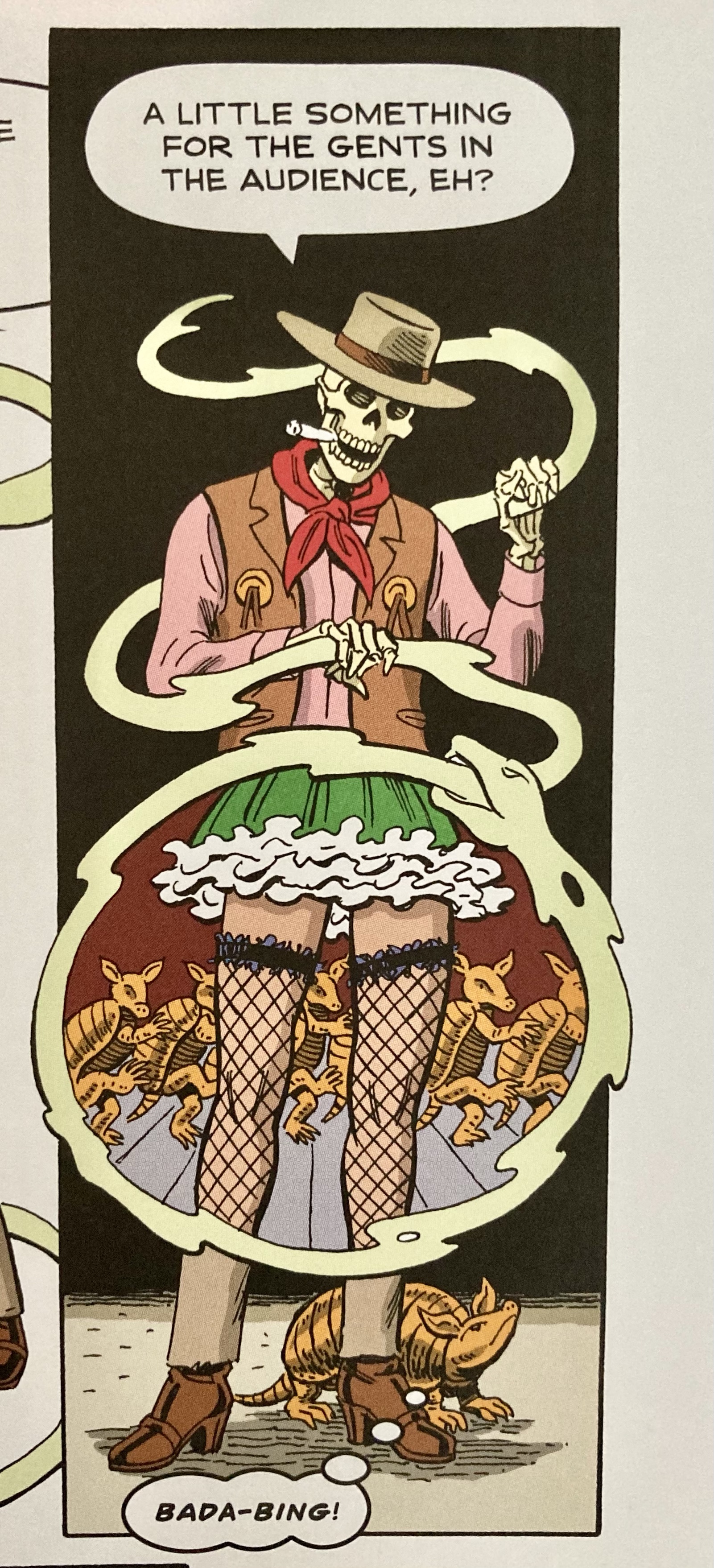
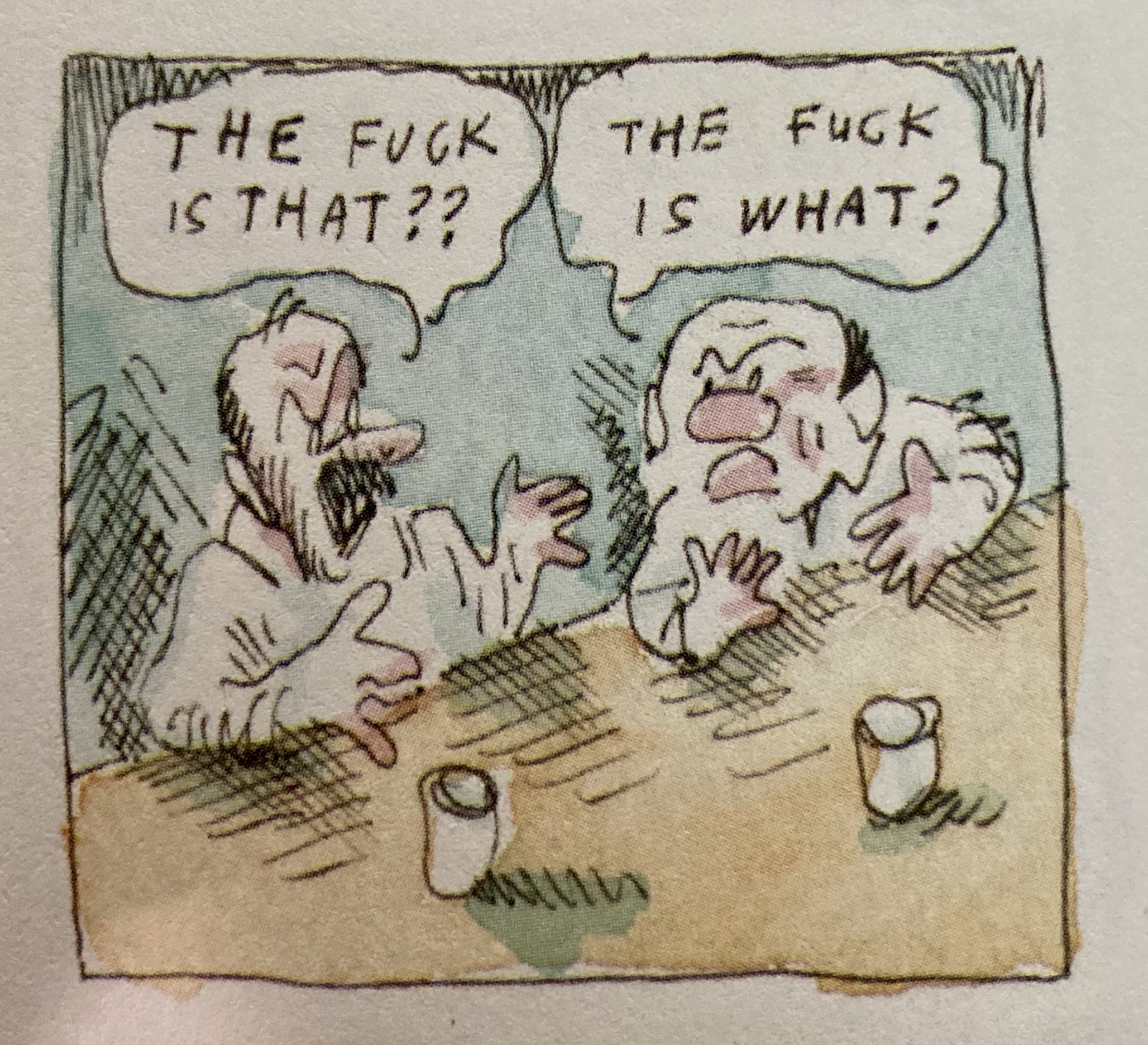
Paul Kirchner’s latest collection Dope Rider: A Fistful of Delerium is dope goofy gorgeousness. I’ve been taking it a page a day or so and am about to run out of the stash. I hope to have a review of it soon (maybe in The Comics Journal, where I reviewed Kirchner’s last collection, Hieronymus & Bosch).
Paul Kirchner
I also read some comix by Drew Lerman, and wrote about them here.
Drew Lerman
I picked up Rachel Cusk’s much-lauded novel Outline a few weeks ago at a Friends of the Library Sale. It was not for me. The flat, “tell-don’t-show” style didn’t bother me—indeed the prose is very “readable” (whatever that means)—but I found myself rolling my eyes a lot. A lot of smart people like this novel (and the trilogy it initiates), so maybe I fundamentally misread it. And in fairness, the whole contemporary autoficiton thing has left me cold, with the possible exception of Elena Ferrante’s so-called Neopolitan Novels, which I loved.
I read four B.S. Johnson novels in something of a blur. Johnson was an English avant-gardiste writing primarily in the 1960s. I wrote a bit about some of the novels here. Christie Malry’s Own Double-Entry ended up being my favorite, with Albert Angelo a close second. I thought Trawl was extremely tedious. I broke down and ordered a copy of his “novel in a box,” The Unfortunates—maybe I’ll muster the energy for something bigger on Johnson.
I’m a little over half way through Patrick Suskind’s Perfume (trans. by John E. Woods), and I really dig it—it feels like a long time since I’ve read a good ole fashioned historical novel told in the third-person omniscient/free indirect style. Set in France in the mid-1700’s, Perfume is the story of Jean-Baptiste Grenouille, a perfume genius, a freak, a murderer. I’d seen Tom Twyker’s film adaptation years ago, but the novel is richer, taking us deeper into Grenouille’s strange mind. Great stuff.
I recently finished Norah Lange’s fragmentary memoir, Notes from Childhood (trans. by Charlotte Whittle). It’s a propulsive and rich read, a loving but unsentimental, magical without a trace of whimsy. I wrote about it a bit here.
Today, 8 May 2021, is Thomas Ruggles Pynchon’s 84th birthday. Some of us nerds celebrate the work of one of the world’s greatest living authors with something called Pynchon in Public Day. In the past I’ve rounded up links to Pynchon stuff on Biblioklept and elsewhere. Last year, that weird pandemic year, I finally finished all of Pynchon’s novels. I’d been “saving” Bleeding Edge for a while, but broke down and read it that spring. Having read all eight Pynchon novels (a few more than once), I’ll offer some quick scattershot thoughts.
I reread Pynchon’s first novel for the first time last month and found it far more achieved than I had remembered. For years I’ve always recalled it as a dress rehearsal for the superior and more complex Gravity’s Rainbow. And while V. certainly points in GR’s direction, even sharing some characters, it’s nevertheless its own entity. I first read V. as a very young man, and as I recall, thought it scattershot, zany, often very funny, but also an assemblage of set pieces that fail to cohere. Rereading it two decades later I can see that there’s far more architecture to its plot, a twinned, yoyoing plot diagrammed in the novel’s title. The twin strands allow Pynchon to critique modernism on two fronts, split by the world wars mark the first half of the twentieth century. It’s a perfect starting point for anyone new to Pynchon, and its midpoint chapter, “Mondaugen’s Story,” is as good as anything else he’s written.
The Crying of Lot 49 (1966)
Pynchon’s shortest novel is not necessarily his most accessible: Crying is a dense labyrinth to get lost in. At times Pynchon’s second novel feels like a parody of L.A. detective noir (a well he’d return to in Inherent Vice), but there’s plenty of pastiche going on here as well. For example, at one point we are treated to a Jacobean revenge play, The Courier’s Tragedy, which serves as a kind of metatextual comment on the novel’s plot about a secret war between secret armies of…letter carriers. The whole mailman thing might seem ridiculous, but Pynchon’s zaniness is always doubled in sinister paranoia: The Crying of Lot 49 is a story about how information is disseminated, controlled, and manipulated. Its end might frustrate many readers. We never get to hear the actual crying of lot 49 (just as we never discover the “true” identity of V in V.): fixing a stable, centered truth is an impossibility in the Pynchonverse.
Unbelievably rich, light, dark, cruel, loving, exasperating, challenging, and rewarding, Pynchon’s third novel is one of a handful of books that end up on “difficult novel” lists that is actually difficult. The difficulty though has everything to do with how we expect a novel to “happen” as we read—Gravity’s Rainbow is an entirely new thing, a literature that responds to the rise of mass media as modernist painters had to respond to the advent of photography and moving pictures. The key to appreciating and enjoying Gravity’s Rainbow, in my estimation, is to concede to the language, to the plasticity of it all, with an agreement with yourself to immediately reread it all.
Vineland (1990)
It took Pynchon a decade and a half to follow up Gravity’s Rainbow. I was a boy when Vineland came out—it was obviously nowhere on my radar (I think my favorite books around this time would probably have been The Once and Future King, The Lord of the Rings trilogy, and likely a ton of Dragonlance novels). I do know that Vineland was a disappointment to many fans and critics, and I can see why. At the time, novelist David Foster Wallace neatly summed it up in a letter to novelist Jonathan Franzen: “I get the strong sense he’s spent 20 years smoking pot and watching TV.” Vineland is angry about the Reagan years, but somehow not angry enough. The novel’s villain Brock Vond seems to prefigure the authoritarian police detective Bigfoot Bjornsen of Inherent Vice, but Pynchon’s condemnation of Vond never quite reconciles with his condemnation of the political failures of the 1960s. Vineland is ultimately depressing and easily my least-favorite Pynchon novel, but it does have some exquisite prose moments.
If Mason & Dixon isn’t Pynchon’s best book, it has to be 1A to Gravity’s Rainbow’s 1. The novel is another sprawling epic, a loose, baggy adventure story chronicling Charles Mason and Jeremiah Dixon’s Enlightenment effort to survey their bit of the Western World. Mason & Dixon presents an initial formal challenge to its reader: the story is told in a kind of (faux) 18th-century vernacular. Diction, syntax, and even punctuation jostle the contemporary ear. However, once you tune your ear to the (perhaps-not-quite-so-trustworthy) tone of Rev. Wicks Cherrycoke (who tells this tall tall tale), Mason & Dixon somehow becomes breezy, jaunty, even picaresque. It’s jammed with all sorts of adventures: the talking Learned English Dog, smoking weed with George Washington, Gnostic revelations, Asiatic Pygmies who colonize the missing eleven days lost when the British moved from the Julian to the Gregorian calendar…Wonderful stuff. But it’s really the evocation of a strange, hedged, incomplete but loving friendship that comes through in Mason & Dixon.
Oof. She’s a big boy. At over a thousand pages, Against the Dayis Pynchon’s longest novel. Despite its size, I think Against the Day is the best starting point for Pynchon. It offers a surprisingly succinct and clear summation of his major themes, which might be condensed to something like: resist the military-industrial-entertainment-complex, while also showing off his rhetorical power. It’s late period Pynchon, but the prose is some of his strongest stuff. The songs are tight, the pastiche is tighter, and the novel’s epic sweep comes together in the end, resolving its parodic ironies with an earnest love that I believe is the core of Pynchon’s worldview. I forgot to say what it’s about: It’s about the end of the nineteenth century, or, more accurately, the beginning of the twentieth century.
Inherent Vice is a leaner work than its two predecessors, but could stand to be leaner still. The book pushes towards 400 pages but would probably be stronger at 200—or 800. I don’t know. In any case, Inherent Vice is a goofy but sinister stoner detective jaunt that frags out as much as its protagonist, PI Doc Sportello. Paul Thomas Anderson’s film adaptation finds its way through those fragments to an end a bit different from Pynchon’s original (which is closer to an echo of the end of The Crying of Lot 49)—PTA’s film finds its emotional resolution in the restoration of couple—not the main couple, but adjacent characters—an ending that Pynchon pulled in his first novel V.
While Bleeding Edge was generally well received by critics, it’s not as esteemed as his major works. I think that the novel is much, much better than its reputation though (even its reputation among Pynchon fans. Pynchon retreads some familiar plot territory—this is another detective novel, like Crying and Inherent Vice—but in many ways he’s doing something wholly new here: Bleeding Edge is his Dot Com Novel, his 9/11 Novel, and his New York Novel. It’s also probably his domestic novel, and possibly (dare I?) his most autobiographical, or at least autobiographical in the sense of evoking life with teenagers in New York City, perhaps drawing on material from his own life with wife and son in the city. It’s good stuff, but I really hope we get one more.
Ann Quin’s third novel Passages (1969) ostensibly tells the story of an unnamed woman and unnamed man traveling through an unnamed country in search of the woman’s brother, who may or may not be dead.
The adverb ostensibly is necessary in the previous sentence, because Passages does not actually tell that story—or it rather tells that story only glancingly, obliquely, and incompletely. Nevertheless, that is the apparent “plot” of Passages.
Quin is more interested in fractured/fracturing voices here. Passages pushes against the strictures of the traditional novel, eschewing character and plot development in favor of pure (and polluted) perceptions. There’s something schizophrenic about the voices in Passages. Interior monologues turn polyglossic or implode into elliptical fragments.
Quin repeatedly refuses to let her readers know where they stand. Indeed, we’re never quite sure of even the novel’s setting, which seems to be somewhere in the Mediterranean. It’s full of light and sea and sand and poverty, and the “political situation” is grim. (The woman’s brother’s disappearance may or may not have something to do with the region’s political instability.)
Passage’s content might be too slippery to stick to any traditional frame, but Quin employs a rhetorical conceit that teaches her reader how to read her novel. The book breaks into four unnamed chapters, each around twenty-five pages long. The first and third chapters find us loose in the woman’s stream of consciousness. The second and fourth chapters take the form of the man’s personal journal. These sections contain marginal annotations, which might be meant to represent actual physical annotations, or perhaps mental annotations–the man’s stream of consciousness while he rereads his journal.
Quin’s rhetorical strategy pays off, particularly in the book’s Sadean climax. This (literal) climax occurs at a carnivalesque party in a strange mansion on a small island. We see the events first through the woman’s perception, and then through the man’s. But I’ve gone too long without offering any representative language. Here’s a passage from the woman’s section, just a few paragraphs before the climax. To set the stage a bit, simply know that the woman plays voyeur to a bizarre threesome:
Mirrors faced each other. As the two turned, approached. Slower in movement in the centre, either side of him, turning back in the opposite direction to their first movement. Contours of their shadows indistinct. The first mirror reflected in the second. The second in the first. Images within images. Smaller than the last, one inside the other. She lay on the floor, wrists tied together. She bent back over the chair. He raised the whip, flung into space.
Later, the man’s perception of events at the party both clarify and cloud the woman’s account. As you can see in the excerpt above, the woman frequently refuses to qualify her pronouns in a way that might stabilize identities for her reader. Such obfuscation often happens in the course of a sentence or two:
I ran on, knowing I was being followed. She came to the edge, jumped into expanding blueness, ultra violet tilted as she went towards the beach. We walked in silence.
The woman’s I becomes a She and then merges into a We. The other half of that We is a He, the follower (“He later threw the bottle against the rocks”), but we soon realize that this He is not the male protagonist, but simply another He that the woman has taken as a one-time lover.
The woman frequently takes off somewhere to have sex with another man. At times the sex seems to be part of her quest to find her brother; other times it’s simply part of the novel’s dark, erotic tone. The man is undisturbed by his lover’s faithlessness. He is passive, depressive, and analytical, while she is manic and exuberant. Late in the novel he analyzes himself:
How many hours I waste lying in bed thinking about getting up. I see myself get up, go out, move, drink, eat, smile, turn, pay attention, talk, go up, go down. I am absent from that part, yet participating at the same time. A voyeur in all senses, in my actions, non-actions. What a delight it might be actually to get up without thinking, and then when dressed look back and still see myself curled up fast asleep under the blankets.
The man longs for a kind of split persona, an active agent to walk the world who can also gaze back at himself dormant, passive.
This motif of perception and observation echoes throughout Passages. Consider one of the man’s journal entries from early in the book:
Above, I used an image instead of text to give a sense of what the journal entries and their annotations look like. Here, the man’s annotation is a form of self-observation, self-analysis.
Other annotations dwell on describing myths or artifacts (often Greek or Talmudic). In a “December” entry, the man’s annotation is far lengthier than the text proper. The main entry reads:
I am on the verge of discovering my own demoniac possibilities and because of this I am conscious I am not alone with myself.
Again, we see the fracturing of identity, consciousness as ceaseless self-perception. The annotation is far more colorful in contrast:
An ancient tribe of the Kouretes were sorcerers and magicians. They invented statuary and discovered metals, and they were amphibious and of strange varieties of shape, some like demons, some like men, some like fishes, some like serpents, and some had no hands, some no feet, some had webs between their fingers like gees. They were blue-eyed and black-tailed. They perished struck down by the thunder of Zeus or by the arrows of Apollo.
Quin’s annotations dare her reader to make meaning—to put the fragments together in a way that might satisfy the traditional expectations we bring to a novel. But the meaning is always deferred, always slips away. Passages collapses notions of center and margin. As its title suggests, this is a novel about liminal people, liminal places.
The results are wonderfully frustrating. Passages is abject, even lurid at times, but also rich and even dazzling in moments, particularly in the woman’s chapters, which read like pure perception, untethered by traditional narrative expectations like causation, sequence, and chronology.
As such, Passages will not be every reader’s cup of tea. It lacks the sharp, grotesque humor of Quin’s first novel, Berg, and seems dead set at every angle to confound and even depress its readers. And yet there’s a wild possibility in Passages. In her introduction to the new edition of Passages recently published by And Other Stories, Claire-Louise Bennett tries to capture the feeling of reading Quin’s novel:
It’s difficult to describe — it’s almost like the omnipotent curiosity one burns with as an adolescent — sexual, solipsistic, melancholic, fierce, hungry, languorous — and without limit.
Bennett, whose anti-novel Pond bears the stamp of Quin’s influence, employs the right adjectives here. We could also add disorienting, challenging, abject and even distressing. While clearly influenced by Joyce and Beckett, Quin’s writing in Passages seems closer to William Burroughs’s ventriloquism and the hollowed-out alienation of Anna Kavan’s early work. Passages also points towards the writing of Kathy Acker, Alasdair Gray, and João Gilberto Noll, among others. But it’s ultimately its own weird thing, and half a century after its initial publication it still seems ahead of its time. Passages is clearly Not For Everyone but I loved it. Recommended.
Ann Quin’s 1964 novel Bergbegins with one of the best opening lines I’ve ever read:
A man called Berg, who changed his name to Greb, came to a seaside town intending to kill his father…
This opening line encapsulates the plot of Berg, its terminal ellipses pointing to the radical indecision that propels the novel’s central oedipal conflict—will Berg do it? Can he actually kill his father?
The “seaside town” mentioned in the opening line is presumably Brighton, where Quin was born and died. Quin’s Brighton is hardly a holiday-goer’s paradise though. Grimy and seedy, claustrophobic and cold, it’s populated by carousers and vagabonds. There’s a raucous, sinister energy to Quin’s seaside setting; her Brighton is a combative hamlet pinned against the monstrous swelling sea.
While we sometimes find ourselves in this seaside town’s drunken dancehalls, shadowy train stations, or under grubby piers, most of Berg takes place in a dilapidated boarding house. Here, Alistair Berg (going by Greb) has taken a room adjacent the room his father Nathaniel lives in with his younger mistress Judith. Nathan and Judith’s apartment is a strange horror of antiques and taxidermy beasts. Berg’s apartment is full of the wigs and hair tonics he ostensibly sells for a living. It’s all wonderfully nauseating.
Through the thin wall between these two spaces, Berg hears his father and mistress fight and fuck. He attends both animal grunting and human speech, an imaginative voyeur, and is soon entangled in their lives, as neatly summarized in a letter to his mother Edith, the fourth major character who is never-present yet always-present in the novel. Writing to thank Edith for a food parcel she’s mailed him (Berg is a mama’s boy), he reports:
How are you? Everything here is fine. I’ve seen my father, but so far haven’t revealed who I really am (how Dickensian can one get, and what can I really put—that he’s been fucking another woman next door, and probably a dozen others besides over the past fifteen years, is about to go on tour with some friend in a Vaudeville show, trailing a dummy around, that he’s in love with a budgie…?) Somehow I think you’re better off without him, he seems a bit the worse for wear, not at all like the photograph, or even like the ones you already have of him, and he still hasn’t any money, as far as I can make out he’s sponging left right and centre.
After promising to return home in time for Christmas, Berg signs off with this ambiguous and oedipal ending: “Meanwhile—meanwhile—well I’m going to fuck her too…”
As the novel progresses, the relationships tangle into a Freudian field day: Berg and his father Nathaniel; Berg and his mother; Berg and Judith; Judith and Nathaniel; Nathaniel and Edith. Desire is a funny floating thing in Berg, which plays at times like a horror story and at times like a demented closet farce. As the narrative voice tells us at one point, “no one is without a fetish or two.”
Berg’s desire to kill his father is explored, although his rationale is muddy. Certainly, Edith, whose voice ventriloquizes Berg’s memory, helps spur Berg’s oedipal impulse: “There you see that’s your father who left us both,” she tells him as a boy, pointing to a photograph, adding, “you’ll have to do a lot to overcome him Aly before I die.” So much is loaded into that word overcome. Quin’s novel is precise in its ambiguities, evoking a feeling of consciousness in turmoil.
Berg’s turmoil is indeed the central thrust of the novel. He can’t decide to patricide. Berg works through the justifications for murder, ultimately trying to root out the impetus of his desire to kill his father. “Of course it’s ridiculous to think the whole thing is simply a vehicle for revenge, or even resentment—hardly can it be called personal, not now, indeed I have never felt so objective,” he tells himself at one point, sounding like one of Poe’s maniacs. Quin’s narrative affords him several opportunities to go through with the murder, but, in the novel’s first half anyway, he stalls. “Yes, that’s what it amounts to, decide rather than desire,” he proclaims.
Like Prince Hamlet, Berg is terribly indecisive, spending much of the novel vacillating between action and inaction, letting his consciousness fly through every imaginative possibility. Indeed, the main setting of Berg is not really Brighton or the boarding house, but Alistair Berg’s mind. And yet consciousness is his biggest curse: “Definitely the supreme action is to dispose of the mind, bring reality into something vital, felt, seen, even smelt. A man of action conquering all.” Later, he tells us that “The conscience only sets in when one is static,” coaxing himself toward action. Berg aspires to more than Eliot’s Prufrock. He desires to be more than an attendant lord to swell a progress, start a scene or two.
Indeed, Berg is author, director, and star in this drama of his own creation—he just has to finally follow the call to action. When he finally does snap the mental clapperboard, he comes into the possession—or at least believes he comes into the possession—of his own agency: “How separated from it all he felt, how unique too, no longer the understudy, but the central character as it were, in a play of his own making.”
Throughout Berg, Quin employs a free-indirect style that emphasizes her character’s shifting consciousness. Whatever “reality” Berg experiences is thoroughly mediated by memories of his mother’s voice and his own projections and fantasies. Consider the shift from “he” to “I” in these two sentences:
Half in the light he stood, a Pirandello hero in search of a scene that might project him from the shadow screen on to which he felt he had allowed himself to be thrown. If I could only discover whether cause and effect lie entirely in my power.
Perhaps his dramatic flair comes from his father, a vaudevillian ventriloquist whose most prized possession is a dummy. The dummy is the tragicomic symbol at the heart of Berg, a totem of the way that other voices might inhabit our mouths and drive our desires in bizarre directions. Berg, desirer of the power to cause and effect, often sees others around him as mere props. “She’s not unlike a display dummy really,” he thinks about Judith, who accuses him as someone who’s “always playing a part.” Hefting (what he believes to be) his father’s body, Berg, “aware of the rubbery texture of the flesh,” thinks, “ah well the old man had never been a flesh and blood character really.”
Berg is both victim and hero in a mental-play that he aspires to make real. Consider this wonderful passage that collapses Berg’s monomania, prefigurations of guilt, and dramatic impulses into a courtroom trial:
Alistair Berg, alias Greb, commercial traveller, seller of wigs, hair tonic, paranoiac paramour, do you plead guilty? Yes. Guilty of all things the human condition brings; guilty of being too committed; guilty of defending myself; of defrauding others; guilty of love; loving too much, or not enough; guilty of parochial actions, of universal wish-fulfilments; of conscious martyrdom; of unconscious masochism. Idle hours, fingers that meddle. Alistair Charles Humphrey Greb, alias Berg, you are condemned to life imprisonment until such time you may prove yourself worthy of death.
Berg’s guilt fantasies are bound up in a sense of persecution as well as his notion that he is the real hero of this (his) world, in his belief that he is above “the rest of the country’s cosy mice in their cages of respectability”:
A parasite living on an action I alone dared committing, how can they possibly convict, or even accuse one who’s faced reality, not only in myself, but the whole world, that world which had been rejected, denounced, leaving a space they hardly dared interpreting, let alone sentence.
Although Berg takes place primarily in Our Boy Berg’s consciousness, Quin leavens the fantasy with a hearty ballast of concrete reality. Consider this icky sexual encounter between Berg and Judith, which involves hair tonic and a nosy landlady:
Berg shrank back, bringing Judith with him, she taking the opportunity of pressing closer; sticky, the tonic now drying—gum from a tree—almost making it impossible for Berg to tear himself away. He felt Judith’s warmth, her soft wet tongue in his ear, soon she became intent on biting all available flesh between hairline and collar. But the landlady’s demanding voice made her stop. Berg sank back, while Judith squirmed above him. But as soon as the landlady seemed satisfied that no one was about and closed the door, Judith began licking his fingers. He pulled sharply away, until he lay flat on the floor, his head resting against something quite soft. Judith began wiping his clothes down with a large handkerchief that distinctly smelt of wet fur and hard-boiled sweets. He tried getting up, but she leaned over him, and in the half light he saw her lips curl almost—yes almost—he could swear in a sneer, a positive leer, or was he mistaken and it was only the lustful gaze of a frustrated woman? He jerked sideways. Judith fell right across the body.
Ah, yes — “the body” — well, does Berg carry out his patricide? Of course, in his imagination, a million times—but does his mental-play map onto reality? Do you need to know? Read the book.
Read the book. There’s nothing I can do in this review that approaches the feeling of reading Ann Quin’s Berg. I can make lame comparisons, saying that it reminds me of James Joyce’s Ulysses (in its evocations of loose consciousness), or David Lynch’s Blue Velvet (in its oedipal voyeuristic griminess), or Luis Buñuel’s The Exterminating Angel (for its surreal humor and dense claustrophobia). Or I can point out how ahead of her time Quin was, how Berg bridges modernism to postmodernism while simply not giving a fuck about silly terms like modernism and postmodernism. Or I can smuggle in big chunks of Quin’s prose, as I’ve sought to do, and which I’ll do again, like, here, in this big passage wherein our hero dreams:
Two white-foaming horses with female heads and hooves of fire, with strands of golden mane—honey cones—bore him across a silken screen of sky, over many islands that floated away, and became clouds, a landscape of snow stretching below, and above a canopy of gold. But a harsh voice needled him, pin-pricked his heart, and three drops of blood poured out, extended across the canopy. From this whirlpool a shape formed, then a massive head appeared, without eyes. He turned to the horses, but they were now toads, squat and squeaking, leaping into the hissing pool. The face grew, the mouth opened, swallowing everything, nearer and nearer, until he felt himself being sucked in, down, down and yet farther down, into quicksands of fire and blood, only the dark mass left, as though the very centre of the earth had been reached. The sun exploded between his eyes. He stood up, practically hurling the rug over his shoulder, and jogged towards the station.
Or I can repeat: Read the book.
Of course Berg is Not for Everyone. Its savage humor might get lost on a first read, which might make the intense pain that underwrites the novel difficult to bear. Its ambiguities necessitate that readers launch themselves into a place of radical unknowing—the same space Berg himself enters when he comes to a seaside town, intending to kill his father.
But I loved reading Berg; I loved its sticky, grimy sentences, its wriggly worms of consciousness. I wanted more, and I sought it out, picking up The Unmapped Country, a collection of unpublished Quin stuff edited by Jennifer Hodgson and published by And Other Stories, the indie press that reissued Berg. Hodgson is also a guest on the Blacklisted Podcast episode that focuses on Berg. That episode offers a rallying ringing endorsement, if you need voices besides mine. The Blacklisted episode also features a reading of most of novelist Lee Rourke’s 2010 appreciation for Ann Quin’s Berg.(Rourke had championed online as early as 2007.) Rourke should be commended for being ahead of the curve on resurfacing a writer who feels wholly vital in our own time. He concludes his 2010 piece, “Berg should be read by everyone, if only to give us a glimpse of what the contemporary British novel could be like.” Read the book.
Quin wrote three other novels before walking into the sea in 1973 and never coming back. Those novels are Three (1966), Passages (1969), and Tripticks (1972). I really hope that And Other Stories will reissue these in the near future. Until then: Read the book.
[Ed. note—Biblioklept first published this review in the summer of 2019.]
The nice people at Contra Mundum continue to put out new Charles Baudelaire translations. Paris Spleen is out in a new translation from Rainer J. Hanshe. A little taste:
I wish I could get drunk on virtue. I’ll settle for wine.
Here’s Contra Mundum’s blurb:
In the 1850s, ancien and Haussmannian Paris clash, giving birth to a violent disjunction. At that moment in time, an other present is born, a new history, like Baudelaire’s poet freely abandoning his halo on the macadam. The laurel crown has been discarded; the pastoral poet is dead; classical lyric poetry is dead. The steam-driven, gaslit, electrically-charged poet is born. “Retreat Academic Muse!,” Baudelaire commands, “I don’t care about that old stutterer.”
With Paris Spleen, we move toward a new rhythm, a rhythm born of the pace, speed, and reality of a metropolis hitherto never seen or experienced. It is the rhythm of the street, of the swift-moving eye, of overloaded senses and hyper-perception, of newspapers and optical devices. Baudelaire’s life spans the essential birth of whole new forms of technology, including steam locomotives, gas light, and electricity, not to speak of the typewriter and the Daguerreotype. The dandy sees and moves with the coming speed of light. His life is one lived in the midst of illumination, mechanics, and simulacra.
Baudelaire’s Paris is a place of experience, a metropolis that spawns unique and particular realities, a kaleidoscope of visions and mirror of alternative societies. The grist of his poems is not ancient Greece or the Renaissance. As he stated in the so-called preface to Paris Spleen, it is especially from frequenting great cities, from the crossroads of their innumerable relations, that the haunting ideal of the prose poem was born. Our flâneur wanders swiftly through crowds, in contact, but anonymous, extracting from the city material to forge his new ars poetica, like a bricolage artist.
The future is called forth. The street is the new Olympus; the phantasmagoric city is a big harlot whose infernal charm continually rejuvenates the poet. The ironic, infernal beacon is the totem of the new age: the age of dissonance, the age of artificial paradises. “I love you, O infamous capital!” the poet exults.
Here is Paris Spleen, an invitation to voyage, to have the entirety of Baudelaire’s Paris enter into our flesh and for us to undergo contagion, if our spleens can handle it.
They were entering Fairing’s Parish, named after a priest who’d lived topside years ago. During the Depression of the ’30s, in an hour of apocalyptic well-being, he had decided that the rats were going to take over after New York died. Lasting eighteen hours a day, his beat had covered the breadlines and missions, where he gave comfort, stitched up raggedy souls. He foresaw nothing but a city of starved corpses, covering the sidewalks and the grass of the parks, lying belly-up in the fountains, hanging wrynecked from the streetlamps. The city—maybe America, his horizons didn’t extend that far—would belong to the rats before the year was out. This being the case, Father Fairing thought it best for the rats to be given a head start—which meant conversion to the Roman Church. One night early in Roosevelt’s first term, he climbed downstairs through the nearest manhole, bringing a Baltimore Catechism, his breviary and, for reasons nobody found out, a copy of Knight’s Modern Seamanship. The first thing he did, according to his journals (discovered months after he died) was to put an eternal blessing and a few exorcisms on all the water flowing through the sewers between Lexington and the East River and between Eighty-sixth and Seventy-ninth Streets. This was the area which became Fairing’s Parish. These benisons made sure of an adequate supply of holy water; also eliminated the trouble of individual baptisms when he had finally converted all the rats in the parish. Too, he expected other rats to hear what was going on under the upper East Side, and come likewise to be converted. Before long he would be spiritual leader of the inheritors of the earth. He considered it small enough sacrifice on their part to provide three of their own per day for physical sustenance, in return for the spiritual nourishment he was giving them.
Accordingly, he built himself a small shelter on one bank of the sewer. His cassock for a bed, his breviary for a pillow. Each morning he’d make a small fire from driftwood collected and set out to dry the night before. Nearby was a depression in the concrete which sat beneath a downspout for rainwater. Here he drank and washed. After a breakfast of roast rat (“The livers,” he wrote, “are particularly succulent”) he set about his first task: learning to communicate with the rats. Presumably he succeeded. An entry for 23 November 1934 says:
Ignatius is proving a very difficult student indeed. He quarreled with me today over the nature of indulgences. Bartholomew and Teresa supported him. I read them from with me today over the nature of indulgences. Bartholomew and Teresa supported him. I read them from the catechism: “The Church by means of indulgences remits the temporal punishment due to sin by applying to us from her spiritual treasury part of the infinite satisfaction of Jesus Christ and of the superabundant satisfaction of the Blessed Virgin Mary and of the saints.”
“And what,” inquired Ignatius, “is this superabundant satisfaction?”
Again I read: “That which they gained during their lifetime but did not need, and which the Church applies to their fellow members of the communion of saints.”
“Aha,” crowed Ignatius, “then I cannot see how this differs from Marxist communism, which you told us is Godless. To each according to his needs, from each according to his abilities.” I tried to explain that there were different sorts of communism: that the early Church, indeed, was based on a common charity and sharing of goods. Bartholomew chimed in at this point with the observation that perhaps this doctrine of a spiritual treasury arose from the economic and social conditions of the Church in her infancy. Teresa promptly accused Bartholomew of holding Marxist views himself, and a terrible fight broke out, in which poor Teresa had an eye scratched from the socket. To spare her further pain, I put her to sleep and made a delicious meal from her remains, shortly after sext. I have discovered the tails, if boiled long enough, are quite agreeable.
Evidently he converted at least one batch. There is no further mention in the journals of the skeptic Ignatius: perhaps he died in another fight, perhaps he left the community for the pagan reaches of Downtown. After the first conversion the entries begin to taper off: but all are optimistic, at times euphoric. They give a picture of the Parish as a little enclave of light in a howling Dark Age of ignorance and barbarity.
Rat meat didn’t agree with the Father, in the long run. Perhaps there was infection. Perhaps, too, the Marxist tendencies of his flock reminded him too much of what he had seen and heard above ground, on the breadlines, by sick and maternity beds, even in the confessional; and thus the cheerful heart reflected by his late entries was really only a necessary delusion to protect himself from the bleak truth that his pale and sinuous parishioners might turn out no better than the animals whose estate they were succeeding to. His last entry gives a hint of some such feeling:
When Augustine is mayor of the city (for he is a splendid fellow, and the others are devoted to him) will he, or his council, remember an old priest? Not with any sinecure or fat pension, but with true charity in their hearts? For though devotion to God is rewarded in Heaven and just as surely is not rewarded on this earth, some spiritual satisfaction, I trust, will be found in the New City whose foundations we lay here, in this Iona beneath the old foundations. If it cannot be, I shall nevertheless go to peace, at one with God. Of course that is the best reward. I have been the classical Old Priest—never particularly robust, never affluent—most of my life. Perhaps
The journal ends here. It is still preserved in an inaccessible region of the Vatican library, and in the minds of the few old-timers in the New York Sewer Department who got to see it when it was discovered. It lay on top of a brick, stone and stick cairn large enough to cover a human corpse, assembled in a stretch of 36-inch pipe near a frontier of the Parish. Next to it lay the breviary. There was no trace of the catechism or Knight’s Modern Seamanship.
“Maybe,” said Zeitsuss’s predecessor Manfred Katz after reading the journal, “maybe they are studying the best way to leave a sinking ship.”
The stories, by the time Profane heard them, were pretty much apocryphal and more fantasy than the record itself warranted. At no point in the twenty or so years the legend had been handed on did it occur to anyone to question the old priest’s sanity. It is this way with sewer stories. They just are. Truth or falsity don’t apply.
“He wants to help Angel kill the alligators,” Kook told her. Profane was asleep, lying diagonal on the seat.
In this dream, he was all alone, as usual. Walking on a street at night where there was nothing but his own field of vision alive. It had to be night on that street. The lights gleamed unflickering on hydrants; manhole covers which lay around in the street. There were neon signs scattered here and there, spelling out words he wouldn’t remember when he woke.
Somehow it was all tied up with a story he’d heard once, about a boy born with a golden screw where his navel should have been. For twenty years he consults doctors and specialists all over the world, trying to get rid of this screw, and having no success. Finally, in Haiti, he runs into a voodoo doctor who gives him a foul-smelling potion.
He drinks it, goes to sleep and has a dream. In this dream he finds himself on a street, lit by green lamps. Following the witch-man’s instructions, he takes two rights and a left from his point of origin, finds a tree growing by the seventh street light, hung all over with colored balloons. On the fourth limb from the top there is a red balloon; he breaks it and inside is a screwdriver with a yellow plastic handle. With the screwdriver he removes the screw from his stomach, and as soon as this happens he wakes from the dream. It is morning. He looks down toward his navel, the screw is gone. That twenty years’ curse is lifted at last. Delirious with joy, he leaps up out of bed, and his ass falls off.
Margaret Lucas Cavendish, Duchess of Newcastle-upon-Tyne was born to a wealthy aristocratic family who took the royalist side in the English Civil War. She spent her teen years attending the exiled Queen Henrietta Maria as a handmaiden. She soon married William Cavendish, the Marquess of Newcastle (and a steadfast royalist), and lived with him in exile in Antwerp. During this time, she began writing and publishing strange volumes on various topics—science, fashion, language, wit, and the act of writing itself. Her eccentric writing mirrored her eccentric habits. Simultaneously shy and fame-hungry, often depressed or elated and manic, Cavendish earned and maintained a notorious reputation over her lifetime.
Danielle Dutton somehow condenses Cavendish’s starbright life into a slim 160 pages in her novel Margaret the First. This imaginative near-biography borrows from Cavendish’s own writings as well as an essay on Cavendish by Virginia Woolf. Woolf thought Cavendish a cautionary tale. In A Room of One’s Own, Woolf describes her as a brilliant but uneducated woman who “frittered her time away scribbling nonsense and plunging ever deeper into obscurity and folly.” Dutton captures that reputation early in the novel: “Mad Madge,” goes the cry among a crowd of onlookers at the novel’s outset (the crowd includes the diarist Samuel Pepys). However, Dutton is far more sympathetic toward Margaret, conjuring for us a natural composer. Consider these lines from Margaret the First’s opening paragraph:
She made the world her book, took a piece of coal and marked a blank white wall. Later, she made sixteen smaller books: untitled, sewn with yarn. Her girlhood heroes were Shakespeare, Ovid, Caesar. She wrote them in beside thinking-rocks and humming-shoes and her favorite sister, Catherine, who starred in all but five. Snow fell fast as she sat by the nursery fire; ink to paper, then she sewed. The last book told a tale of hasty gloom, teeming with many shades of green: emerald, viridian, a mossy black. In it we meet a miniature princess who lives in a seashell castle and sleeps in sheets woven from the eyelids of doves.
Dutton roped me in with “tale of hasty gloom,” but the images in that last sentence—sheets woven from the eyelids of doves!—propelled my reading on.
We see here Cavendish as a creator of both books and her own world. Dutton’s narrator notes Cavendish—or shall I use Margaret here?—Dutton’s narrator notes that our protagonist not only writes her books, but sews them. The image of creation as fashion—as literally fashioning objects and ideas—repeats throughout Margaret the First. Margaret tells her patient older husband William that “dressing is the poetry of women.” She finds near-epiphanic inspiration in a masquerade costume worn by Christina, Queen of Sweden, who dresses as an Amazon warrior, baring her breasts to the entire court. Later she wonders, “why must grammar be like a prison for the mind? Might not language be as a closet full of gowns? Of a generally similar cut, with a hole for the head and neck to pass, but filled with difference and a variety of trimmings so that we don’t grow bored?”
Critics of Cavendish attacked her spelling and grammar; Woolf declared her “crack-brained and bird-witted.” Dutton’s portrait though gives us something closer to Emily Dickinson or William Blake. Margaret’s an eccentric who turns her eccentricity into a strange new art that resisted grammar that would be “a prison for the mind.”
And yet Dutton is never too-beholden to her subject. We are never told that Margaret is a genius; rather, Dutton attunes us to Margaret’s own singular perceptions—we feel flashes of genius, but also feel Margaret’s frustrated inability to harness that genius into a form that seventeenth-century England can recognize. She is always at the margin of the circle, too eccentric to orbit neatly with the intellectual luminaries whom she encounters.
We also feel the tinges of Margaret’s melancholic mental instability. Alone in a carriage, she retreats into her mind’s eye:
I found myself in an unknown universe, whirling far into space. African servants, dogs in hats, platonic ideals, sparkling conversation, and ivy-coated quadrangles with womanizing captains, dueling earls, actors. I met Father Cyprien de Gamache, her majesty’s wily confessor; William, a poet, who claimed to be Shakespeare’s son; and a giggling dwarf called Jeffry, who’d been presented to the queen in a pie. I met the ladies-in-waiting, too, who hardly looked my way, busy as they were, bickering over who went where and when, who wore what and when, who fetched what and why, who said what and to whom, and who gave her the right to say that.
Tellingly, the cluttered images in Margaret’s fantasy dissolve into the too-banal reality of the grammar of manners: who can wear what, who can say what, and so on. To cop a phrase from Blake, those “mind-forg’d manacles” are hard to break. Indeed, mind-forg’d manacles tend to break those who resist them. “Much Madness is divinest Sense,” Emily Dickinson noted, but also pointed out that those who resist the grammar of manners are “straightway dangerous -/ And handled with a Chain.”
Margaret avoids the chain, and if the world is a bit too much for her to bear at time, she fashions it into Something Else. This is the joy of Margaret the First. Dutton could have crafted the tale as a tragedy, but instead she gives us something else—something rich, generative, imagistic, occasionally unsettling, and ultimately deeply endearing. Highly recommended.
I. In this riff, Chapter 135, “The Chase—Third Day” and the Epilogue of Moby-Dick.
The beginning of the end begins, “The morning of the third day dawned fair and fresh” — we are in the tranquil pacified Pacific, beautiful blue, the calm site of a coming calamity.
II. After calling for news of the White Whale, Ahab riffs to himself on the wind. The wind is an apparently concrete force that operates with abstract agency. The wind is a kind of fate, an invisible entity that both propels and repels objects of the phenomenal world:
Would now the wind but had a body; but all the things that most exasperate and outrage mortal man, all these things are bodiless, but only bodiless as objects, not as agents. There’s a most special, a most cunning, oh, a most malicious difference! And yet, I say again, and swear it now, that there’s something all glorious and gracious in the wind.
III. Ahab glimpses his folly: “I’ve oversailed him,” he mutters about Moby Dick, continuing, “How, got the start? Aye, he’s chasing me now; not I, him—that’s bad; I might have known it, too. Fool!”
The fool there is of course a bit of self-talk Ahab directs to his self-same self.
IV. This final chapter is full of self-talk. Starbuck’s inner monologue turmoils, “I misdoubt me that I disobey my God in obeying him!” Ahab swears to meet Moby Dick, “Forehead to forehead…this third time”; we enter the final private thoughts of Stubb and Flask (but never the pagan harpooneers).
As always, my question remains—
How does Ishmael bear witness to these voices?
V. In a potent soliloquy, Ahab’s sentimentality takes over. He addresses the vast ocean, “the same to Noah as to me.” He seems to portend his own demise, and is distracted momentarily by the “lovely leewardings” that “must lead somewhere—to something else than common land, more palmy than the palms.” But he won’t escape: “Leeward! the white whale goes that way; look to windward, then; the better if the bitterer quarter. But good bye, good bye, old mast-head!”
By the end of the soliloquy Ahab is again convinced — or maybe not wholly convinced, but nevertheless affirming — of his impending victory. He addresses the masthead anew: “We’ll talk to-morrow, nay, to-night, when the white whale lies down there, tied by head and tail.”
VI. Ahab rejects two final calls to remain and retreat. The first is Starbuck’s:
“Some men die at ebb tide; some at low water; some at the full of the flood;—and I feel now like a billow that’s all one crested comb, Starbuck. I am old;—shake hands with me, man.”
Their hands met; their eyes fastened; Starbuck’s tears the glue.
Starbuck’s tears the glue! What a line!
The second entreaty I take to be Ahab’s other first mate, the mad cabinboy Pip:
“Oh, my captain, my captain!—noble heart—go not—go not!—see, it’s a brave man that weeps; how great the agony of the persuasion then!”
“Lower away!”—cried Ahab, tossing the mate’s arm from him. “Stand by the crew!”
“The sharks! the sharks!” cried a voice from the low cabin-window there; “O master, my master, come back!” But Ahab heard nothing; for his own voice was high-lifted then; and the boat leaped on.
Ahab rejects all fellow-feeling here. His monomaniacal voice overtakes all bandwidth, drowning out any sensation of otherness.
VII. The sharks follow Ahab’s boat like “vultures hover over the banners of marching regiments in the east”; as usual, Melville is not shy about slathering on the foreshadowing. He enlists Starbuck’s help; the Christian mate remarks that this, “the third evening,” be “the end of that thing—be that end what it may.”
VIII. Meanwhile, Ahab repeats pagan Fedallah’s pagan prophecy: “Drive, drive in your nails, oh ye waves! to their uttermost heads drive them in! ye but strike a thing without a lid; and no coffin and no hearse can be mine:—and hemp only can kill me! Ha! ha!”
Those dashes, those exclamations—that madness!
IX. Moby Dick then resurfaces, all veils, rainbows, milk:
A low rumbling sound was heard; a subterraneous hum; and then all held their breaths; as bedraggled with trailing ropes, and harpoons, and lances, a vast form shot lengthwise, but obliquely from the sea. Shrouded in a thin drooping veil of mist, it hovered for a moment in the rainbowed air; and then fell swamping back into the deep. Crushed thirty feet upwards, the waters flashed for an instant like heaps of fountains, then brokenly sank in a shower of flakes, leaving the circling surface creamed like new milk round the marble trunk of the whale.
Our boy Moby Dick sets to violence, dashing the boats of Daggoo and Queequeg.
X. The violent spectacle culminates in the most gruesome imagery within Moby-Dick. We learn the fated fate of fated Fedallah:
Lashed round and round to the fish’s back; pinioned in the turns upon turns in which, during the past night, the whale had reeled the involutions of the lines around him, the half torn body of the Parsee was seen; his sable raiment frayed to shreds; his distended eyes turned full upon old Ahab.
XI. Ahab commands his sailors to remain rowing after the White Whale, despite the downed lieutenants and zombified harpooneer. He threatens them:
Down, men! the first thing that but offers to jump from this boat I stand in, that thing I harpoon. Ye are not other men, but my arms and my legs; and so obey me.—
Ahab, who has repeated the idea that his mates are but mechanicalthings throughout the novel, here spells out his distance from human sympathy, his complete fascistic capitulation. “Ye are not other men” is the exact opposite of the Gospels’ injunction to do unto others. Ahab fails Starbuck’s moral test—and Ishmael’s.
XII. Ahab sees his pagan harpooneers and wrecked mates return to The Pequod to repair boats and rearm:
…he saw Tashtego, Queequeg, and Daggoo, eagerly mounting to the three mast-heads; while the oarsmen were rocking in the two staved boats which had but just been hoisted to the side, and were busily at work in repairing them. One after the other, through the port-holes, as he sped, he also caught flying glimpses of Stubb and Flask, busying themselves on deck among bundles of new irons and lances. As he saw all this; as he heard the hammers in the broken boats; far other hammers seemed driving a nail into his heart. But he rallied. And now marking that the vane or flag was gone from the main-mast-head, he shouted to Tashtego, who had just gained that perch, to descend again for another flag, and a hammer and nails, and so nail it to the mast.
I’ve quoted at length because I think our eyes should be trained on Tashtego, the Native American twice now denied his proper place. He was the first to raise a whale on The Pequod’s voyage (denied by Stubb), and the first to raise Moby Dick (denied by Ahab). Tash will be the last to go down with the ship, nailing a new banner to its highest mast.
XIII. Meanwhile, the sharks chew and chomp at the oarsmen’s oars in Ahab’s whaleboat, to the point “that the blades became jagged and crunched, and left small splinters in the sea, at almost every dip.”
They row on.
XIV. Ahab’s boat comes about and he darts “his fierce iron, and his far fiercer curse into the hated whale.” Three of his oarsmen are knocked from the boat, and only two return, although the one who bobs asea is reported “still afloat and swimming.”
This third castaway is Ishmael.
XV. Moby Dick then attacks The Pequod, “bethinking it—it may be—a larger and nobler foe.”
(“‘The whale! The ship!’ cried the cringing oarsmen.”)
XVI. The White Whale destroys The Pequod, and Melville takes us into the last lungfuls of language from the three mates, Starbuck, Stubb, and Flask. These are mini-monologues that Moby Dick’s ensuing vortex will swamp to oblivion.
“My God, stand by me now!” beseeches Starbuck; “Stand not by me, but stand under me, whoever you are that will now help Stubb,” Stubb non-prays, before praying against this “most mouldy and over salted death”— he’d prefer “cherries! cherries! cherries!” And Flask? “Cherries? I only wish that we were where they grow.” Poor Flask then think of his dear mama, before the ship fails.
XVII. Moby Dick wrecks The Pequod. The crew (in Ishmael’s telling) bears witness:
…all their enchanted eyes intent upon the whale, which from side to side strangely vibrating his predestinating head, sent a broad band of overspreading semicircular foam before him as he rushed. Retribution, swift vengeance, eternal malice were in his whole aspect, and spite of all that mortal man could do, the solid white buttress of his forehead smote the ship’s starboard bow, till men and timbers reeled. Some fell flat upon their faces. Like dislodged trucks, the heads of the harpooneers aloft shook on their bull-like necks. Through the breach, they heard the waters pour, as mountain torrents down a flume.
XVIII. As Ahab watches the disaster, he comes to understand Fedallah’s prophecy: “The ship! The hearse!—the second hearse!” cried Ahab from the boat; “its wood could only be American!”
XIX. And then—
Ahab’s final speech:
Oh, now I feel my topmost greatness lies in my topmost grief. Ho, ho! from all your furthest bounds, pour ye now in, ye bold billows of my whole foregone life, and top this one piled comber of my death! Towards thee I roll, thou all-destroying but unconquering whale; to the last I grapple with thee; from hell’s heart I stab at thee; for hate’s sake I spit my last breath at thee. Sink all coffins and all hearses to one common pool! and since neither can be mine, let me then tow to pieces, while still chasing thee, though tied to thee, thou damned whale! Thus, I give up the spear!
Ahab is knocked from the boat, and hanged in hemp and hate.
XX. The Pequod sinks, but
the pagan harpooneers still maintained their sinking lookouts on the sea. And now, concentric circles seized the lone boat itself, and all its crew, and each floating oar, and every lance-pole, and spinning, animate and inanimate, all round and round in one vortex, carried the smallest chip of the Pequod out of sight.
The final image is devastating: Tashtego nails a seahawk to the mast. Again, forgive me for quoting at length:
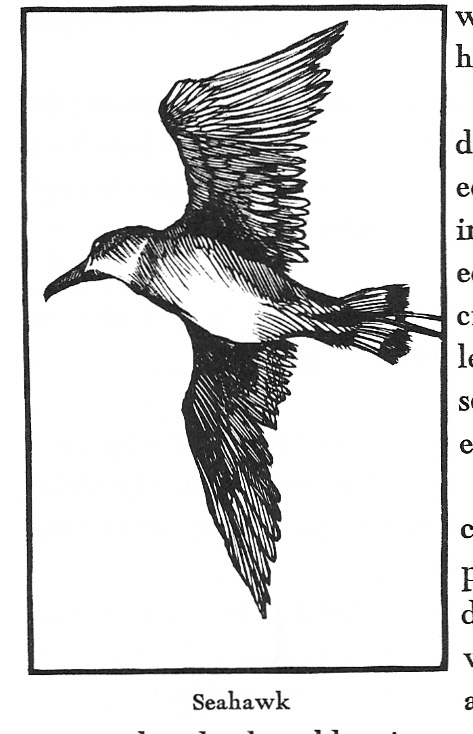
…as the last whelmings intermixingly poured themselves over the sunken head of the Indian at the mainmast…a red arm and a hammer hovered backwardly uplifted in the open air, in the act of nailing the flag faster and yet faster to the subsiding spar. A sky-hawk that tauntingly had followed the main-truck downwards from its natural home among the stars…now chanced to intercept its broad fluttering wing between the hammer and the wood; and simultaneously feeling that ethereal thrill, the submerged savage beneath, in his death-gasp, kept his hammer frozen there; and so the bird of heaven, with archangelic shrieks, and his imperial beak thrust upwards, and his whole captive form folded in the flag of Ahab, went down with his ship, which, like Satan, would not sink to hell till she had dragged a living part of heaven along with her, and helmeted herself with it.
What an image!
(I have nothing to add here.)
XXI (Excepting, I would add: I think Melville loads so much in this near-final image of his big book. There are only two paragraphs after this one: a scant sentence that’s basically an exhalation from the image of a submerged Tashtego nailing a hawk to the mast of the sinking Pequod—and then the Epilogue. The Pequod takes its name from an extinct Native American tribe. Tashtego is doubly-denied his due as the First to raise whale. Melville seems to point back to America’s founding as a genocidal project here. I probably need to reread the book again, I now realize. Or maybe read some commenters on this matter that I’ve yet to read. I hate to stick this thought in parentheses, as it’s the thing that interests me the most at the end of this reread—Tashtego the Indian, I mean.)
XXII. And so well the end of the end, the Epilogue.
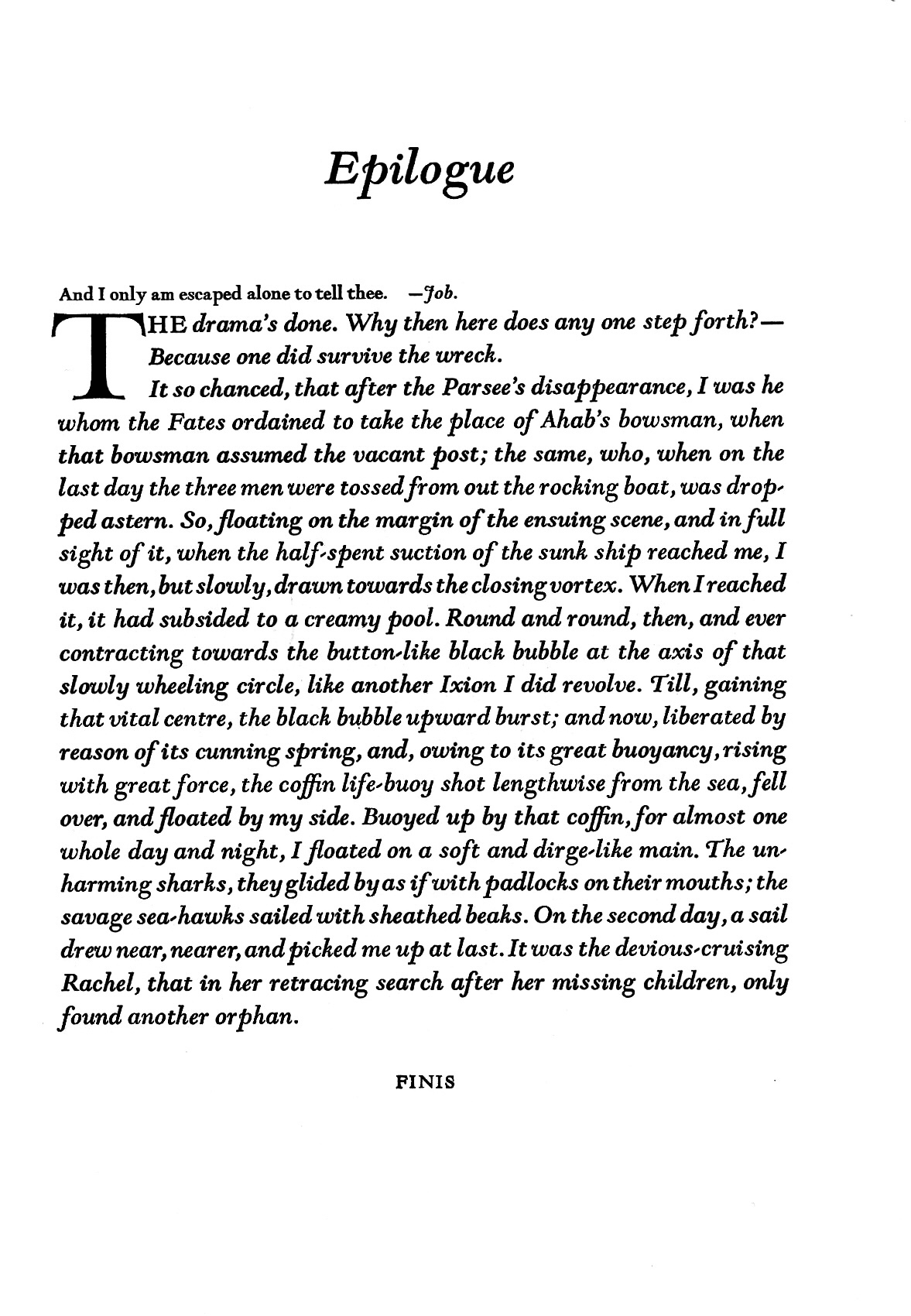
Here it is in the Arion Press edition I read this time through:
XXIII. Ishmael survives, “floating on the margin of the ensuing scene, and in full sight of it.”
What a position! To be both marginal and omnipresent, both at edge and center to the drama, comedy, tragedy of it all!
The notation from the Book of Job is everything here—the disaster is only a disaster if there is one to bear witness to it. Otherwise, disaster is simply a phenomenological event in nature—random, stochastic, energy, mass, and matter moving without meaning.
Ahab pretends at a great searcher for meaning, but he fixes his search on vengeance. “Madness!” Starbuck chides (if Starbuck could chide) — “To be enraged with a dumb thing, Captain Ahab, seems blasphemous.” Ahab has read too deep, read too twisted—he’s a bad reader, a mutant reader, an overreader—but he’s failed repeatedly to read the souls and faces of his fellows.
XXIV. The final curse and blessing is upon Ishmael though. He names himself at the novel’s famous outset — “Call me Ishmael” — a call that likens him to Hagar’s outcast son. At its end, he likens himself to another outcast, “another Ixion,” all the while circling into a vortex of nature, meaning, language—all the forces that would swallow him. (He’s Melville’s maddened howl here.)
Ishmael floats on “a soft and dirgelike main,” bobbing alive on Queequeg’s coffin, the strange lifebuoy of his strange bedfellow, until he’s saved by The Rachel—the ship Ahab had earlier denied—which still cruises for a lost son. He is not the lost son, but he has been lost, and is here saved by The Rachel’s “retracing search after her missing children” — a retracing, a rereading, a rewriting — one that surfaces the wailing of only another orphan.
Ahab has posed one question throughout the book: “Hast seen the White Whale?”
That is the only viewpoint that matters to him—a viewpoint that can point him toward vengeance.
He gets to answer his own question:
“There she blows!—there she blows! A hump like a snow-hill! It is Moby Dick!”
And then the chase begins.
III. Ahab demands of his lookouts whether or not they sighted Moby Dick first. Tashtego claims that he, “saw him almost that same instant, sir, that Captain Ahab did,” but Ahab denies this (much as Stubb takes credit for the first whale The Pequod sights much earlier in the novel).
Ahab is ever-dominant: “Not the same instant; not the same—no, the doubloon is mine, Fate reserved the doubloon for me. I only; none of ye could have raised the White Whale first.”
Ahab’s “I only” condenses his monomania to three syllables.
Ahab’s monomania turns his rhetoric into a series of repetitions through which he tunes himself to the rhythm of the whale:
“There she blows!—there she blows!—there she blows! There again!—there again!” he cried, in long-drawn, lingering, methodic tones, attuned to the gradual prolongings of the whale’s visible jets.
IV. Ahab and his mates set to their boats to chase the White Whale—only Starbuck remains, as previously commanded by Ahab. Omnipresent Ishmael, shows us Ahab seeing Moby Dick: “He saw the vast, involved wrinkles of the slightly projecting head beyond.” And then, in a remarkable passage, we get what I think is Ishmael seeing Moby Dick, or Ishmael seeing Moby Dick as he wished Ahab could see Moby Dick:
A gentle joyousness—a mighty mildness of repose in swiftness, invested the gliding whale. Not the white bull Jupiter swimming away with ravished Europa clinging to his graceful horns; his lovely, leering eyes sideways intent upon the maid; with smooth bewitching fleetness, rippling straight for the nuptial bower in Crete; not Jove, not that great majesty Supreme! did surpass the glorified White Whale as he so divinely swam.
The whale here is godlike. But remember that Ahab would strike the sun, would cast down the Titans.
V. Ahab and his men continue to hunt the godlike whale “through the serene tranquillities of the tropical sea”; Moby Dick ducks and dives, refusing them the sight of “the full terrors of his submerged trunk.”
Soon though, eagle-eyed Tashtego spies the sign of the whale’s re-emergence:
“The birds!—the birds!” cried Tashtego.
In long Indian file, as when herons take wing, the white birds were now all flying towards Ahab’s boat; and when within a few yards began fluttering over he water there, wheeling round and round, with joyous, expectant cries. Their vision was keener than man’s; Ahab could discover no sign in the sea.
Melville seems to underline a few points here—Tashtego raises a whale for the third time—here, by spying the herons, which our author notes travel in “Indian file” and by noting that this “Indian file” sounds the alarm for the whale. They can see more deeply than Ahab.
VI. But Ahab soon does see something, but only because it rises up to meet him from the ocean’s depths: “It was Moby Dick’s open mouth and scrolled jaw.”
But it’s just the first day of the chase in this novel of tripled trios. Ahab’s not done yet, even though “The glittering mouth yawned beneath the boat like an open-doored marble tomb.” There’s some foreshadowing for you!
VII. Ahab escapes on this first day, although his boat does not—Moby Dick chomps it to pieces. All sailors are saved too, although Ahab shows more concern for the harpoon he forged earlier aboard The Pequod (it’s saved too).
Moral Starbuck declares the business of the wrecked boat an ill omen, but Ahab won’t read the signs that way:
Omen? omen?—the dictionary! If the gods think to speak outright to man, they will honorably speak outright; not shake their heads, and give an old wives’ darkling hint.—Begone! Ye two are the opposite poles of one thing; Starbuck is Stubb reversed, and Stubb is Starbuck; and ye two are all mankind; and Ahab stands alone among the millions of the peopled earth, nor gods nor men his neighbors!
VIII. Ch. 134, “The Chase—Second Day.”
And so the second day.
It starts out with an enthusiastically-received mistake. The lookout calls out that he’s sighted Moby Dick, rousing the crew into a kind of mad fury; Ahab’s monomania inspirits them all:
The hand of Fate had snatched all their souls; and by the stirring perils of the previous day; the rack of the past night’s suspense; the fixed, unfearing, blind, reckless way in which their wild craft went plunging towards its flying mark; by all these things, their hearts were bowled along. The wind that made great bellies of their sails, and rushed the vessel on by arms invisible as irresistible; this seemed the symbol of that unseen agency which so enslaved them to the race.
“They were one man, not thirty,” notes Ishmael, in another satanic inversion of the earlier oversoul blending the men have experienced. We are now in the mode of blood, a reversal of “the very milk and sperm of kindness.”
IX. But Ahab chastises the men: “ye have been deceived; not Moby Dick casts one odd jet that way, and then disappears.” Ahab ascends the rigging himself, and quickly sights the White Whale again. “Aye, breach your last to the sun, Moby Dick!” he brags, setting out again in a restored boat (and again leaving Starbuck on The Pequod).
X. A complex battle ensues. All three harpooneers manage to lance Moby Dick, but “in his untraceable evolutions, the White Whale so crossed and recrossed, and in a thousand ways entangled the slack of the three lines now fast to him, that they foreshortened, and, of themselves, warped the devoted boats towards the planted irons in him.” The image evokes to me a kind of elegant wild writing. Moby Dick crossing and recrossing the lines, warping and weaving the material of which he is the unknowable center.
Moby Dick rewrites the violence Ahab seeks to wreak upon him. The men’s lances become “corkscrewed in the mazes of the line,” and Ahab’s only recourse is to edit. He takes a knife to the lines attached to his boat. But Ahab causes an unintended effect—although he’s freed from the whale, the other boats are not, and “the more involved boats of Stubb and Flask” are dashed…together like two rolling husks on a surf-beaten beach.”
XI. Moby Dick then destroys Ahab’s second boat. The particular paragraph is an astounding piece of rhetoric, a single sentence of 141 words, fourteen commas, seven em dashes, and four semicolons. And it begins with While—Melville tries to make his rhetoric do what film does, to situate his sentences as movement, sound, simultaneity. His goal is to set a scene impossible for an eye to take in and comprehend in a simple glance—the wreck of the boats, the struggle of Stubb, Flask, and their men—condensed perhaps most neatly in the phrase which occurs right in the middle of the paragraph—
—in that wild simultaneousness of a thousand concreted perils,—
(Those dashes do so much work, forcefully connecting and separating the elements of Melville’s tangled, disastrous paragraph of a sentence.)
XII. And well so what happened in that wild simultaneousness of a thousand concreted peril?
—Ahab’s yet unstricken boat seemed drawn up towards Heaven by invisible wires,—as, arrow-like, shooting perpendicularly from the sea, the White Whale dashed his broad forehead against its bottom, and sent it, turning over and over, into the air; till it fell again—gunwale downwards—and Ahab and his men struggled out from under it, like seals from a sea-side cave.
XIII. The men, including Ahab, are returned to The Pequod. But Ahab’s “ivory leg had been snapped off, leaving but one short sharp splinter.”
Ahab then musters the men and finds Fedallah missing; Stubb attests that the Parsee was dragged down in the tangles of Ahab’s lines. Ahab is the author of Fedallah’s death. He goes full King Lear:
My line! my line? Gone?—gone? What means that little word?—What death-knell rings in it, that old Ahab shakes as if he were the belfry. The harpoon, too!—toss over the litter there,—d’ye see it?—the forged iron, men, the white whale’s—no, no, no,—
(Etc.)
Ahab’s “line” here points in multiple directions—the concrete harpoon line, the genealogical futurity of his familial line; his “line” as an author.
XIV. Ahab’s mad monologue pushes Starbuck over the edge. “Great God! but for one single instant show thyself,” Starbuck implores, perhaps echoing Melville’s own metaphysical misgivings. “In Jesus’ name no more of this,” he implores, ending his own rejoining monologue by declaiming it, “Impiety and blasphemy to hunt him more!”
XV. Ahab’s ego overwhelms in the end though. He concedes that “of late” he’s felt “strangely moved” to Starbuck’s thinking, but then trips into his own fury:
Ahab is for ever Ahab, man. This whole act’s immutably decreed. ’Twas rehearsed by thee and me a billion years before this ocean rolled. Fool! I am the Fates’ lieutenant; I act under orders. Look thou, underling! that thou obeyest mine.—Stand round me, men. Ye see an old man cut down to the stump; leaning on a shivered lance; propped up on a lonely foot. ’Tis Ahab—his body’s part; but Ahab’s soul’s a centipede, that moves upon a hundred legs. I feel strained, half stranded, as ropes that tow dismasted frigates in a gale; and I may look so. But ere I break, ye’ll hear me crack; and till ye hear that, know that Ahab’s hawser tows his purpose yet. Believe ye, men, in the things called omens? Then laugh aloud, and cry encore! For ere they drown, drowning things will twice rise to the surface; then rise again, to sink for evermore. So with Moby Dick—two days he’s floated—tomorrow will be the third. Aye, men, he’ll rise once more,—but only to spout his last! D’ye feel brave men, brave?
In which Ahab’s hat is stolen by “one of those red-billed savage sea-hawks which so often fly incommodiously close round the manned mast-heads of whalemen in these latitudes,” and the crew reads it, almost to a man, as an ill omen.
At the chapter’s outset, our Ishmael is in a meta-textual mood, pushing the quest’s doom into the foreground. He tells us that “all other whaling waters [are] swept” — we are in the penultimate triplet chapters:
In this foreshadowing interval too, all humor, forced or natural, vanished. Stubb no more strove to raise a smile; Starbuck no more strove to check one. Alike, joy and sorrow, hope and fear, seemed ground to finest dust, and powdered, for the time, in the clamped mortar of Ahab’s iron soul.
III. Ahab and Fedallah (who has foretold the doom of the ship he crews on) both keep to the deck at all times. Ahab declares that he will take the nailed doubloon, omphalos of both ship and novel — “‘I will have the first sight of the whale myself,’—he said. ‘Aye! Ahab must have the doubloon.'” Fedallah is a silent impenetrable gaze: “his wan but wondrous eyes did plainly say—We two watchmen never rest.”
IV. Ahab, as I’ve contended so many times, is monocular reader. Our one-legged monomaniacal despot of a captain can only watch and read for his dread mission. Unlike diverse, large-hearted Ishmael, there is no diversity in Ahab’s gaze/reading. He reads for one purpose, and all signs are symbols portending the fulfillment of that purpose.
As the sea-hawk approaches, Ahab’s gaze is upon the sea, not heavenward. We learn that the sea-hawk,
darted a thousand feet straight up into the air; then spiralized downwards, and went eddying again round his head.
But with his gaze fixed upon the dim and distant horizon, Ahab seemed not to mark this wild bird; nor, indeed, would any one else have marked it much, it being no uncommon circumstance; only now almost the least heedful eye seemed to see some sort of cunning meaning in almost every sight.
The crew of The Pequod reads the event as the foreshadow of disaster, whether the spectacle is simply a dark omen—the leader’s crown revoked from upon high—or simply the physical reality of their captain losing his hat because his attention was focused in only one direction.
V. Ch. 131, “The Pequod Meets the Delight.”
In which The Pequod encounters its last meeting with another ship—and another Nantucket ship—a “most miserably misnamed” The Delight:
Upon the stranger’s shears were beheld the shattered, white ribs, and some few splintered planks, of what had once been a whale-boat; but you now saw through this wreck, as plainly as you see through the peeled, half-unhinged, and bleaching skeleton of a horse.
I mean, c’mon. White ribs, bleaching skeleton of a horse, etc. It’s really the seeing through in the previous paragraph I’m interested in. Our Ishmael attends the world with the perspective of a ghost who sees through the world’s wreck.
VI. Ahab repeats his famous question (for the last time):
“Hast seen the White Whale?”
“Look!” replied the hollow-cheeked captain from his taffrail; and with his trumpet he pointed to the wreck.
“Hast killed him?”
“The harpoon is not yet forged that ever will do that,” answered the other, sadly glancing upon a rounded hammock on the deck, whose gathered sides some noiseless sailors were busy in sewing together.
Ahab shows off the harpoon he forged with Perth but captain and crew of The Delight remain morosely unimpressed. They bury at sea the last of five sailors they lost in battle with Moby Dick—the other four bodies were lost in the fight.
Ahab turns away from the scene.
And yet—
As Ahab now glided from the dejected Delight, the strange life-buoy hanging at the Pequod’s stern came into conspicuous relief.
“Ha! yonder! look yonder, men!” cried a foreboding voice in her wake. “In vain, oh, ye strangers, ye fly our sad burial; ye but turn us your taffrail to show us your coffin!”
Again—it’s an overdetermined affair, this Moby-Dick.
Show us your coffin!
VII. Ch. 132, “The Symphony.”
The whole thing is about to collapse.
In which Starbuck almost convinces Ahab to change course and save the souls of The Pequod.
“The Symphony” is another sad, sad chapter. “It was a clear steel-blue day,” the chapter begins, and then unfolds in short descriptions of pacific beauty. We are reminded of the peaceful air about The Pequod—that the violent rage at the heart of the novel is carried there by men, by their chieftan Ahab. But the dumb world will not attend our own woes:
Oh, immortal infancy, and innocency of the azure! Invisible winged creatures that frolic all round us! Sweet childhood of air and sky! how oblivious were ye of old Ahab’s close-coiled woe!
Again, Ishmael portrays Ahab in a sympathetic cast.
VIII. Ahab monologues at Starbuck, a sympathetic ear. He laments the forty years he’s spent asea:
Oh, Starbuck! it is a mild, mild wind, and a mild looking sky. On such a day—very much such a sweetness as this—I struck my first whale—a boy-harpooneer of eighteen! Forty—forty—forty years ago!—ago! Forty years of continual whaling! forty years of privation, and peril, and storm-time! forty years on the pitiless sea! for forty years has Ahab forsaken the peaceful land, for forty years to make war on the horrors of the deep! Aye and yes, Starbuck, out of those forty years I have not spent three ashore.
Are these Ahab’s last rites? A sad confession before the crack of doom (with those mythic numbers foregrounded, forty and three)? I think so.
(And, as always—
How does Ishmael witness this dialogue?)
IX. But Ahab’s confession does not lead to redemption. Language carries him away, and as always the ineffable nearly overwhelms him—he contests the unnameable:
What is it, what nameless, inscrutable, unearthly thing is it; what cozening, hidden lord and master, and cruel, remorseless emperor commands me; that against all natural lovings and longings, I so keep pushing, and crowding, and jamming myself on all the time; recklessly making me ready to do what in my own proper, natural heart, I durst not so much as dare? Is Ahab, Ahab? Is it I, God, or who, that lifts this arm? But if the great sun move not of himself; but is as an errand-boy in heaven; nor one single star can revolve, but by some invisible power; how then can this one small heart beat; this one small brain think thoughts; unless God does that beating, does that thinking, does that living, and not I.
Ahab the philosopher is a thing of despair:
By heaven, man, we are turned round and round in this world, like yonder windlass, and Fate is the handspike. And all the time, lo! that smiling sky, and this unsounded sea!
Starbuck, “blanched to a corpse’s hue with despair,” steals away. But Fedallah remains at his unvacant post, eyes focused on the water.
I. In this riff, Chapters 118 and 119 of Moby-Dick.
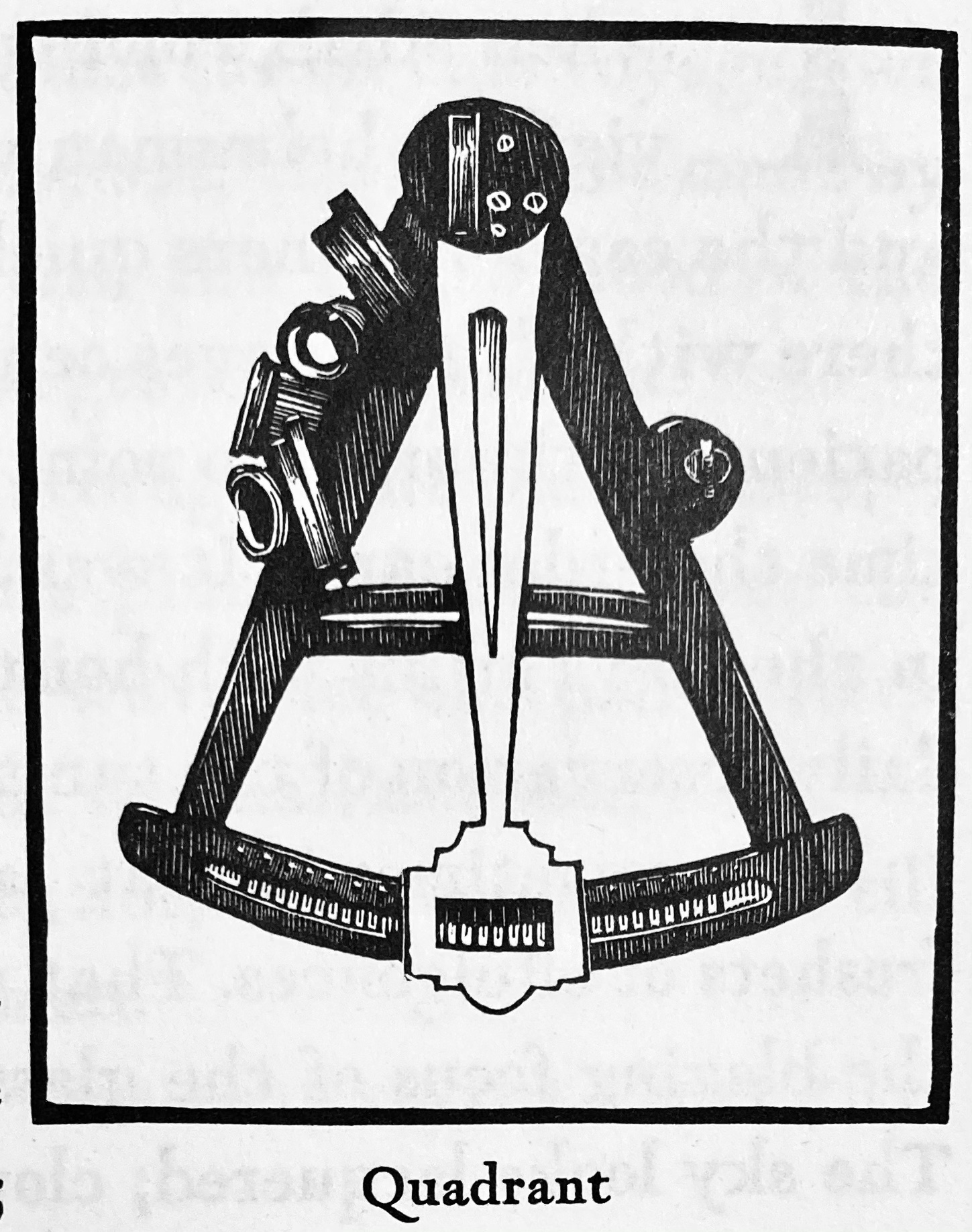
II. Ahab has already gone mad before The Pequod sets sail on this particular voyage, but Ch. 118, “The Quadrant,” feels like a tipping point where his madness spills a bit too outside of himself. Starbuck has already expressed his mortification for their revenge mission, but it’s not until the end of “The Quadrant” that he seems to fully comprehend the depth of Ahab’s madness:
“I have sat before the dense coal fire and watched it all aglow, full of its tormented flaming life; and I have seen it wane at last, down, down, to dumbest dust. Old man of oceans! of all this fiery life of thine, what will at length remain but one little heap of ashes!”
What prompts this strange, deathly, foreboding analogy? A monomaniacal monologue from Ahab, of course.
III. Starbuck—and physical foil to Starbuck’s metaphysical moralizing, Stubb—witness Ahab castigate his quadrant in a fury, trampling upon it “with his live and dead feet” alike.
Ahab’s anger comes down again to the limitations of reading, of knowing through the signs and symbols of the world. Gazing at “its numerous cabalistical contrivances,” he censures the device as a “Foolish toy! babies’ plaything of haughty Admirals, and Commodores, and Captains.”
For Ahab, this navigation tool does not measure up: “what after all canst thou do, but tell the poor, pitiful point, where thou thyself happenest to be on this wide planet, and the hand that holds thee: no! not one jot more!” He curses the “vain toy,” which can attest where he is, but cannot find him the object of his murderous desire, Moby Dick.
Moby-Dick illustration by Barry Moser
IV. Ch. 119, “The Candles.”
The titular candles here are the three masts of The Pequod, which, struck by lightning during a typhoon, catch on fire. Hence, Ahab’s ship doubles Ahab’s body, which has been afflicted with its own lightning scar.
The scene is bombastic, and Ahab attends it in a kind of prayer-like reverie. He delivers another monologue that indirectly echoes Starbuck’s undelivered admonition that Ahab might end “a heap of ashes”:
“Oh! thou clear spirit of clear fire, whom on these seas I as Persian once did worship, till in the sacramental act so burned by thee, that to this hour I bear the scar; I now know thee, thou clear spirit, and I now know that thy right worship is defiance. … In the midst of the personified impersonal, a personality stands here…Oh, thou clear spirit, of thy fire thou madest me, and like a true child of fire, I breathe it back to thee.”
Here, Melville—or is it Ishmael?—delivers stage directions:
[Sudden, repeated flashes of lightning; the nine flames leap lengthwise to thrice their previous height; Ahab, with the rest, closes his eyes, his right hand pressed hard upon them.]
V. Ahab at this point is full-on crazy. He directly addresses the lightning and fire, in which he finds a kind of power unconstrained by maps and charts, a force that no quadrant might locate. He vows to read the lightning, to find meaning by groping in blindness, a thing of ashes:
“I own thy speechless, placeless power; said I not so? Nor was it wrung from me; nor do I now drop these links. Thou canst blind; but I can then grope. Thou canst consume; but I can then be ashes. Take the homage of these poor eyes, and shutter-hands. I would not take it. The lightning flashes through my skull; mine eye-balls ache and ache; my whole beaten brain seems as beheaded, and rolling on some stunning ground.
Ahab continues to read the lightning with his eyes closed. He claims that he is darkness, the dark that affords the light its position through opposition, and goes so far as to claim the lightning as his father:
Oh, oh! Yet blindfold, yet will I talk to thee. Light though thou be, thou leapest out of darkness; but I am darkness leaping out of light, leaping out of thee! The javelins cease; open eyes; see, or not? There burn the flames! Oh, thou magnanimous! now I do glory in my genealogy. But thou art but my fiery father; my sweet mother, I know not.
But mother? Sweet mother, I know not: “Oh, cruel! what hast thou done with her?”
Again—Moby-Dick is a novel of orphans wailing.
And fathers? Well, they’re out there, in the natural phenomena, I guess—symbols are all Ahab needs to father him.
VI. Ahab’s series of satanic inversions continues. He envies the lightning’s “unbegotten…unbegun” singularity. He also evokes in his anti-prayer the “unsuffusing thing beyond thee, thou clear spirit, to whom all thy eternity is but time.” Ahab tries to read god through this “clear spirit”: “Through thee, thy flaming self, my scorched eyes do dimly see it” — but dimly here does so much work. Ahab is a failed transcendentalist.
VII. He reads in the fire another orphan, another outcast figuration of himself (and Ishmael, and the others who crew The Pequod):
Oh, thou foundling fire, thou hermit immemorial, thou too hast thy incommunicable riddle, thy unparticipated grief. Here again with haughty agony, I read my sire. Leap! leap up, and lick the sky! I leap with thee; I burn with thee; would fain be welded with thee; defyingly I worship thee!”
Ahab now dominates not just The Pequod, but the voice of the novel itself. He reads the lightning, worships the fire, and finds not solace but the confirmation of his vengeance in its clarifying spirit.
I did a Big Clean a weekend or two past, including a thorough dusting of shelves. I always try to purge titles that I know I’ll never read, reread, or that I have no real attachment to. I filled a box with about 25 books, mostly novels, mostly paperbacks, and took it to my favorite used bookstore.
There, I found to my joy Joy Williams’s first novel State of Grace in my beloved preferred ugly Vintage Contemporaries edition. (I loved Williams’s collection Taking Care, which I read as a VC edition.) I’ve got a big stack of newly-published novels that I need to get to once I finish rereading Whale-Book, but who knows. Maybe I’ll get to it sometime before summer.
The fated heroine of this bleak but beautifully‐crafted first novel may well be the final, perfected archetype of all the “sad ladies”: that formidably fashionable sorority which has impinged on the past decade or so of American fiction. But I’ll remember Kate Jackson; I’ll reread her stubbornly depressing story, picking out those cleverly‐hidden but ever‐present clues of grace. Kate is no simple “slice‐of‐despair” character; her sad story becomes, through the author’s skill and intention, transsubstantiated into significant myth. This book is neither a self‐indulgent journal of despair, nor journalism of despair. It is premeditated, articulate, artistic—a novel.
As always, I browsed. Here are some covers that caught my eye, but I did not leave with them–just these photos:
This trio of chapters introduces the carpenter, who proves a strange foil to Ahab.
Moby-Dick illustration by Barry Moser
II. Ch. 106, “Ahab’s Leg.”
Moby-Dick is a phallic novel, full of thrusts, jabs, ejaculations, and sperm sperm sperm. “Ahab’s Leg” reinforces this theme through negation. Melville (or is it Ishmael?) underscores here the notion that Ahab has been symbolically castrated by Moby Dick; this symbolic castration leads to Ahab’s revenge quest—the monomaniacal captain seeks to reassert his power through domination. (It’s all a dick swingin’ contest.)
III. The symbolic castration repeats when Ahab quits The Samuel Enderby, and endures “some small violence to his own person.” We learn that in the jostling of the boat, “his ivory leg had received a half-splintering shock.” This second figurative castration actually follows a near-literal one though:
For it had not been very long prior to the Pequod’s sailing from Nantucket, that he had been found one night lying prone upon the ground, and insensible; by some unknown, and seemingly inexplicable, unimaginable casualty, his ivory limb having been so violently displaced, that it had stake-wise smitten, and all but pierced his groin; nor was it without extreme difficulty that the agonizing wound was entirely cured.
And yet it’s clear that the wound is still not entirely cured. Ahab seeks to repair his phallic wound by way of a phallic spearing of the White Whale.
IV. The chapter continues down a stranger path. Ishmael, with his all-access pass to consciousness, relates that Ahab, reflecting on his woes, decries that, “all miserable events do naturally beget their like.” The text continues, dwelling on sodomy, hell, and the perpetuation of grief:
Yea, more than equally, thought Ahab; since both the ancestry and posterity of Grief go further than the ancestry and posterity of Joy. For, not to hint of this: that it is an inference from certain canonic teachings, that while some natural enjoyments here shall have no children born to them for the other world, but, on the contrary, shall be followed by the joy-childlessness of all hell’s despair; whereas, some guilty mortal miseries shall still fertilely beget to themselves an eternally progressive progeny of griefs beyond the grave; not at all to hint of this, there still seems an inequality in the deeper analysis of the thing. For, thought Ahab, while even the highest earthly felicities ever have a certain unsignifying pettiness lurking in them, but, at bottom, all heartwoes, a mystic significance, and, in some men, an archangelic grandeur; so do their diligent tracings-out not belie the obvious deduction. To trail the genealogies of these high mortal miseries, carries us at last among the sourceless primogenitures of the gods; so that, in the face of all the glad, hay-making suns, and soft cymballing, round harvest-moons, we must needs give in to this: that the gods themselves are not for ever glad. The ineffaceable, sad birth-mark in the brow of man, is but the stamp of sorrow in the signers.
The depressive, fatalistic tone here is pure Ahab–if Ishmael’s expansive over-soul touches the paragraph, it does so in opposition. (What an amazing passage.)
V. Ch. 107, “The Carpenter.”
A nice little chapter describing the ship’s carpenter, who is a sort of Swiss army knife of a man:
He was like one of those unreasoning but still highly useful, multum in parvo, Sheffield contrivances, assuming the exterior—though a little swelled—of a common pocket knife; but containing, not only blades of various sizes, but also screw-drivers, cork-screws, tweezers, awls, pens, rulers, nail-filers, countersinkers. So, if his superiors wanted to use the carpenter for a screw-driver, all they had to do was to open that part of him, and the screw was fast: or if for tweezers, take him up by the legs, and there they were.
He sets about crafting Ahab a new leg.
VI. Ch. 108, “Ahab and the Carpenter.”
Melville (Ishmael?) again turns his novel into a Shakespearian play, complete with stage directions. The carpenter files away at the ivory leg-to-be, while the blacksmith bangs about in the background. He sneezes as he files away at the crutch he creates.
Ahab enters, invoking the carpenter as a Promethean figure:
“Well, manmaker!”
The carpenter then sets about to measure for Ahab’s leg. Ahab sticks his stump into a vice (an implicitly sexual image). The carpenter warns him about the vice’s grip, but Ahab is malevolently jocular. He then directly invokes Prometheus;
No fear; I like a good grip; I like to feel something in this slippery world that can hold, man. What’s Prometheus about there?—the blacksmith, I mean—what’s he about?
V. Ahab essentially ignores the carpenter’s plain answers, and instead begins soliloquizing. Again, he’s monovocal in stereophonic world:
I do deem it now a most meaning thing, that that old Greek, Prometheus, who made men, they say, should have been a blacksmith, and animated them with fire; for what’s made in fire must properly belong to fire; and so hell’s probable.
VI. Ahab’s monomania crests: He sets about to become the Prometheus in the scene—but a commander Prometheus, an artistic director. His idealized “complete man” reveals more of Ahab’s singular vision—a vision that precludes all other perspectives. He conjures a heartless giant–an intellectual giant:
Hold; while Prometheus is about it, I’ll order a complete man after a desirable pattern. Imprimis, fifty feet high in his socks; then, chest modelled after the Thames Tunnel; then, legs with roots to ’em, to stay in one place; then, arms three feet through the wrist; no heart at all, brass forehead, and about a quarter of an acre of fine brains; and let me see—shall I order eyes to see outwards? No, but put a sky-light on top of his head to illuminate inwards. There, take the order, and away.
Ahab’s ideal man has no outward-seeing eyes–there is no perspective at all here except that which will “illuminate inwards.” He mentions no mouth.
VII. Ahab finally quits the carpenter’s shop, and the poor old man begins his own monologue. He repeats the key word queer ten times over in his evocation of Ahab:
Well, well, well! Stubb knows him best of all, and Stubb always says he’s queer; says nothing but that one sufficient little word queer; he’s queer, says Stubb; he’s queer—queer, queer; and keeps dinning it into Mr. Starbuck all the time—queer—sir—queer, queer, very queer.
And who is queer Ahab’s bedfellow?
Yes, now that I think of it, here’s his bedfellow! has a stick of whale’s jaw-bone for a wife!
In these chapters, Ishmael (again) describes the business of rendering oil and etcetera from a whale’s corpse. The chapters show again Ishmael’s push-pull narration style, vacillating between the physical/commercial and the metaphysical/philosophical.
Look—I’m gonna quote the hell out of this chapter. Ish and his fellows set to a big ole tub of sperm, by which he means, of course, spermaceti, the vital stuff found in an organ in the sperm whale’s head; the vital stuff that energizes and lights Ishmael’s world. On that self-same sperm:
It had cooled and crystallized to such a degree, that when, with several others, I sat down before a large Constantine’s bath of it, I found it strangely concreted into lumps, here and there rolling about in the liquid part. It was our business to squeeze these lumps back into fluid. A sweet and unctuous duty! No wonder that in old times this sperm was such a favourite cosmetic. Such a clearer! such a sweetener! such a softener! such a delicious molifier! After having my hands in it for only a few minutes, my fingers felt like eels, and began, as it were, to serpentine and spiralise.
The next sentence—a full paragraph—is something else:
As I sat there at my ease, cross-legged on the deck; after the bitter exertion at the windlass; under a blue tranquil sky; the ship under indolent sail, and gliding so serenely along; as I bathed my hands among those soft, gentle globules of infiltrated tissues, woven almost within the hour; as they richly broke to my fingers, and discharged all their opulence, like fully ripe grapes their wine; as I snuffed up that uncontaminated aroma,—literally and truly, like the smell of spring violets; I declare to you, that for the time I lived as in a musky meadow; I forgot all about our horrible oath; in that inexpressible sperm, I washed my hands and my heart of it; I almost began to credit the old Paracelsan superstition that sperm is of rare virtue in allaying the heat of anger; while bathing in that bath, I felt divinely free from all ill-will, or petulance, or malice, of any sort whatsoever.
The sentence above: 161 words, eleven semicolons, fourteen commas, one dash, and of course, one final period. In these words and characters—halts and stops, connections and jumps—Ishmael converts his pain, his “horrible oath,” his drastic hypos, his desire to go about knocking the hats off men, his general misanthropy—he converts all of this into a moment of transcendence.
The moment of transcendence extends into a kind of spermy mindmeld:
Squeeze! squeeze! squeeze! all the morning long; I squeezed that sperm till I myself almost melted into it; I squeezed that sperm till a strange sort of insanity came over me; and I found myself unwittingly squeezing my co-laborers’ hands in it, mistaking their hands for the gentle globules. Such an abounding, affectionate, friendly, loving feeling did this avocation beget; that at last I was continually squeezing their hands, and looking up into their eyes sentimentally; as much as to say,—Oh! my dear fellow beings, why should we longer cherish any social acerbities, or know the slightest ill-humor or envy! Come; let us squeeze hands all round; nay, let us all squeeze ourselves into each other; let us squeeze ourselves universally into the very milk and sperm of kindness.
Here, I think is the the grand thesis of Moby-Dick.
III. But no. That’s not the thesis. That’s the grand ecstatic epiphany of joy, which Ishmael deflates in the next paragraph:
Would that I could keep squeezing that sperm for ever! For now, since by many prolonged, repeated experiences, I have perceived that in all cases man must eventually lower, or at least shift, his conceit of attainable felicity; not placing it anywhere in the intellect or the fancy; but in the wife, the heart, the bed, the table, the saddle, the fireside, the country; now that I have perceived all this, I am ready to squeeze case eternally. In thoughts of the visions of the night, I saw long rows of angels in paradise, each with his hands in a jar of spermaceti.
Locate the epiphany elsewhere than the intellect or the fancy then: wife, bed, saddle, etc.
—Say it, no ideas but in things—, wrote William Carlos Williams not quite a century later.
IV. Ishmael turns from ideas to things. He lists some of the other magic potions in the sperm whale’s body: white-horse, plum pudding, slobgollion, gurry, and nippers.
The chapter ends with Ish describing the process by which a spademan and gaffman cut the whale into pieces. It’s a mechanical, thingy business, one that points back to the reason for Ahab’s revenge quest:
This spade is sharp as hone can make it; the spademan’s feet are shoeless; the thing he stands on will sometimes irresistibly slide away from him, like a sledge. If he cuts off one of his own toes, or one of his assistants’, would you be very much astonished? Toes are scarce among veteran blubber-room men.
Toes are scarce, but perhaps not as vital as legs.
V. Ch. 95, “The Cassock.”
Another short chapter on a long subject. Ishmael describes-but-not-defines “a very strange, enigmatical object . . . lying along lengthwise in the lee scuppers.” His description is an accumulation of negations:
Not the wondrous cistern in the whale’s huge head; not the prodigy of his unhinged lower jaw; not the miracle of his symmetrical tail; none of these would so surprise you, as half a glimpse of that unaccountable cone,—longer than a Kentuckian is tall, nigh a foot in diameter at the base, and jet-black as Yojo, the ebony idol of Queequeg.
And what is that enormous jet black cone? A “grandissimus, as the mariners call it.”
It’s the whale’s dick, natch.
Moby-Dick illustration by Barry Moser
Ishmael compares it to the idol “found in the secret groves of Queen Maachah in Judea” — the Asherah pole — and points out that “King Asa, her son, did depose her, and destroyed the idol, and burnt it for an abomination.”
This is a phallic book full of castrations, cuttings off both figurative and literal.
VI. Ch. 96, “The Try-Works”
Another chapter initially focused on the practical business of whaling. In this case, we learn about the try-works, where blubber is cooked down to oil. I’ll let Moser’s illustration stand in here:
Moby-Dick illustration by Barry Moser
And here:
The chapter ends though in a great metaphysical rush, as Ish goes from things back to ideas:
The truest of all men was the Man of Sorrows, and the truest of all books is Solomon’s, and Ecclesiastes is the fine hammered steel of woe. “All is vanity.” ALL. This wilful world hath not got hold of unchristian Solomon’s wisdom yet. But he who dodges hospitals and jails, and walks fast crossing graveyards, and would rather talk of operas than hell; calls Cowper, Young, Pascal, Rousseau, poor devils all of sick men; and throughout a care-free lifetime swears by Rabelais as passing wise, and therefore jolly;—not that man is fitted to sit down on tomb-stones, and break the green damp mould with unfathomably wondrous Solomon.
The chapter concludes with a puzzling set of metaphors:
There is a wisdom that is woe; but there is a woe that is madness. And there is a Catskill eagle in some souls that can alike dive down into the blackest gorges, and soar out of them again and become invisible in the sunny spaces. And even if he for ever flies within the gorge, that gorge is in the mountains; so that even in his lowest swoop the mountain eagle is still higher than other birds upon the plain, even though they soar.
VII. Ch. 97, “The Lamp.”
In this very short (three-paragraph) chapter, Ishmael notes that whalemen light their lamps from the oil of the animals they hunt.
VIII. Ch. 98, “Stowing Down and Clearing Up.”
A chapter about cleaning up. Ish declares that, “were it not for the tell-tale boats and try-works, you would all but swear you trod some silent merchant vessel, with a most scrupulously neat commander. The unmanufactured sperm oil possesses a singularly cleansing virtue.” In other words, despite all the butchery, blood, and bits involved, there’s something in the whale itself that purifies the decks after a good scrub down.
The chapter ends with Ishmael recognizing the mechanical repetition of his business though—no wonder the Modernists revived Moby-Dick!
Yet this is life. For hardly have we mortals by long toilings extracted from this world’s vast bulk its small but valuable sperm; and then, with weary patience, cleansed ourselves from its defilements, and learned to live here in clean tabernacles of the soul; hardly is this done, when—There she blows!—the ghost is spouted up, and away we sail to fight some other world, and go through young life’s old routine again.
Oh! the metempsychosis! Oh! Pythagoras, that in bright Greece, two thousand years ago, did die, so good, so wise, so mild; I sailed with thee along the Peruvian coast last voyage—and, foolish as I am, taught thee, a green simple boy, how to splice a rope!