Doubts of all things earthly, and intuitions of some things heavenly | Moby-Dick reread, riff 21

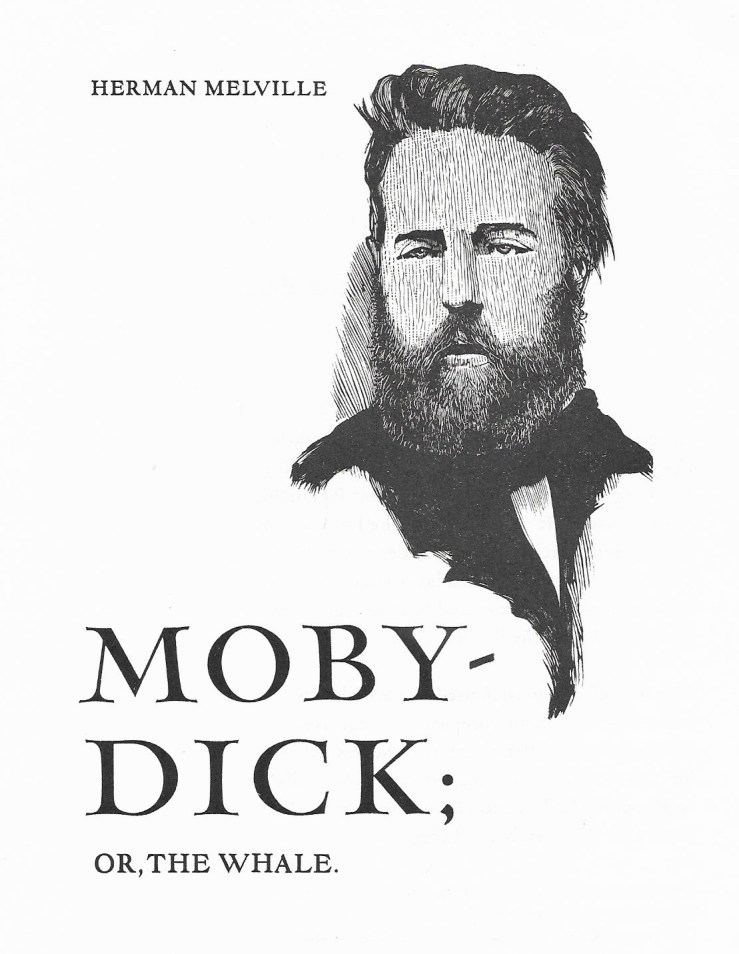
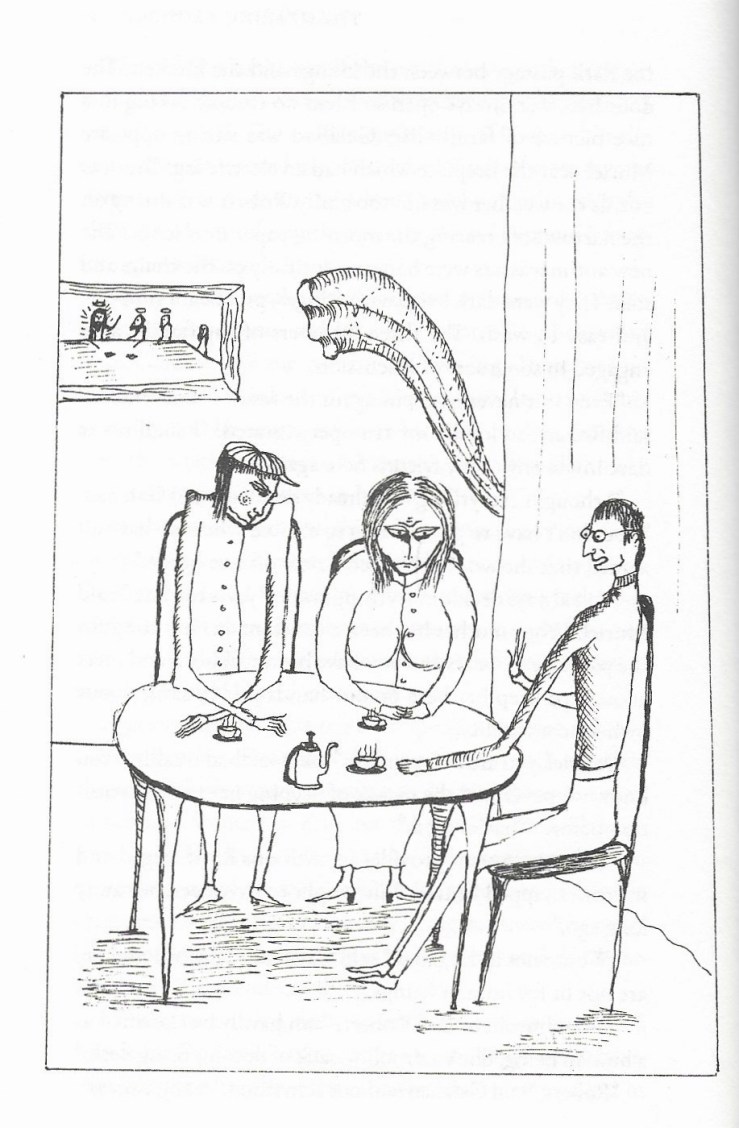
Moby-Dick illustration by Barry Moser

I. In this riff: Chapters 84-86 of Moby-Dick.

II. Ch. 84, “Pitchpoling.”

Another chapter that starts out horny and ends in death.

Our Man Ish lets us know that many whalers love to “grease the bottom” of their boats to make them run faster against the water, for “oil is a sliding thing.” Queequeg greases up his boat’s keel, “rubbing in the unctuousness…in obedience to some particular presentiment.” The presentiment presents in yet another whale sighting. Tashtego spears one, but it nevertheless starts to evade the whale boats. The solution? Pitchpoling:

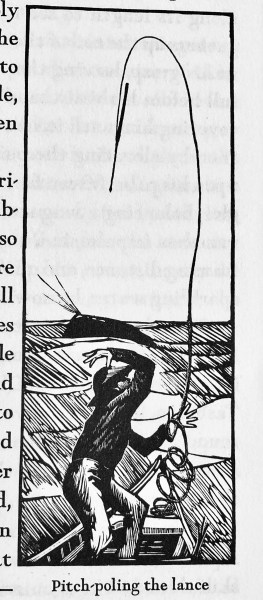
Of all the wondrous devices and dexterities, the sleights of hand and countless subtleties, to which the veteran whaleman is so often forced, none exceed that fine manœuvre with the lance called pitchpoling. Small sword, or broad sword, in all its exercises boasts nothing like it. It is only indispensable with an inveterate running whale; its grand fact and feature is the wonderful distance to which the long lance is accurately darted from a violently rocking, jerking boat, under extreme headway. Steel and wood included, the entire spear is some ten or twelve feet in length; the staff is much slighter than that of the harpoon, and also of a lighter material—pine. It is furnished with a small rope called a warp, of considerable length, by which it can be hauled back to the hand after darting.

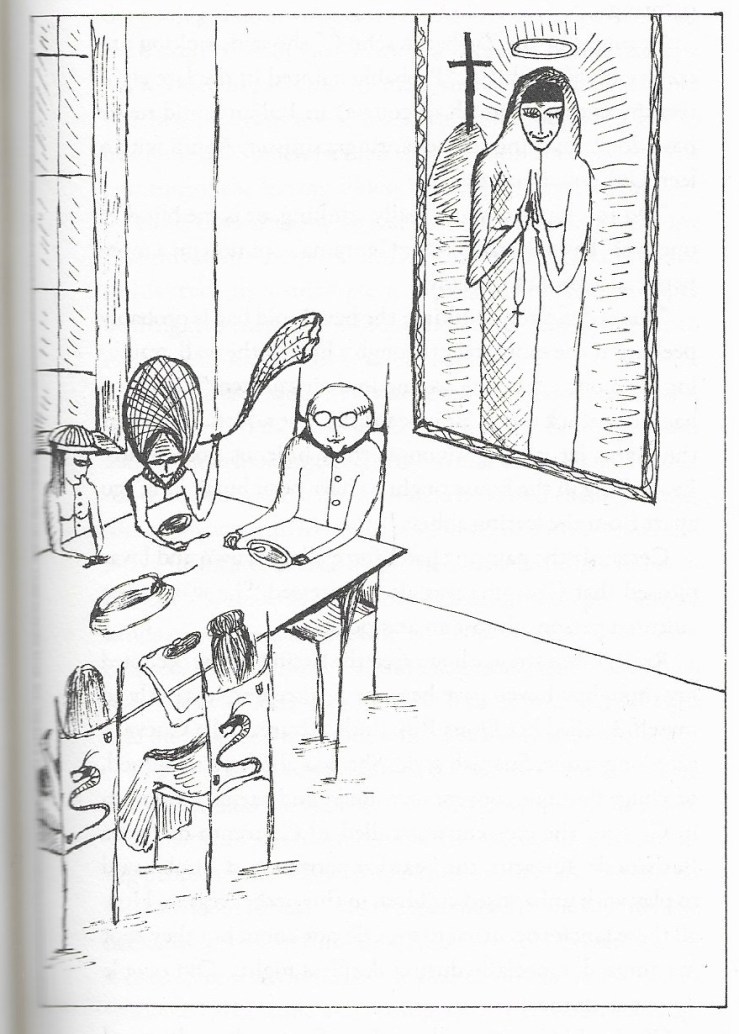
Moby-Dick illustration by Barry Moser

Stubb executes the pitchpole lancing with success, and celebrates his kill in a fit of patriotic bloodlust:

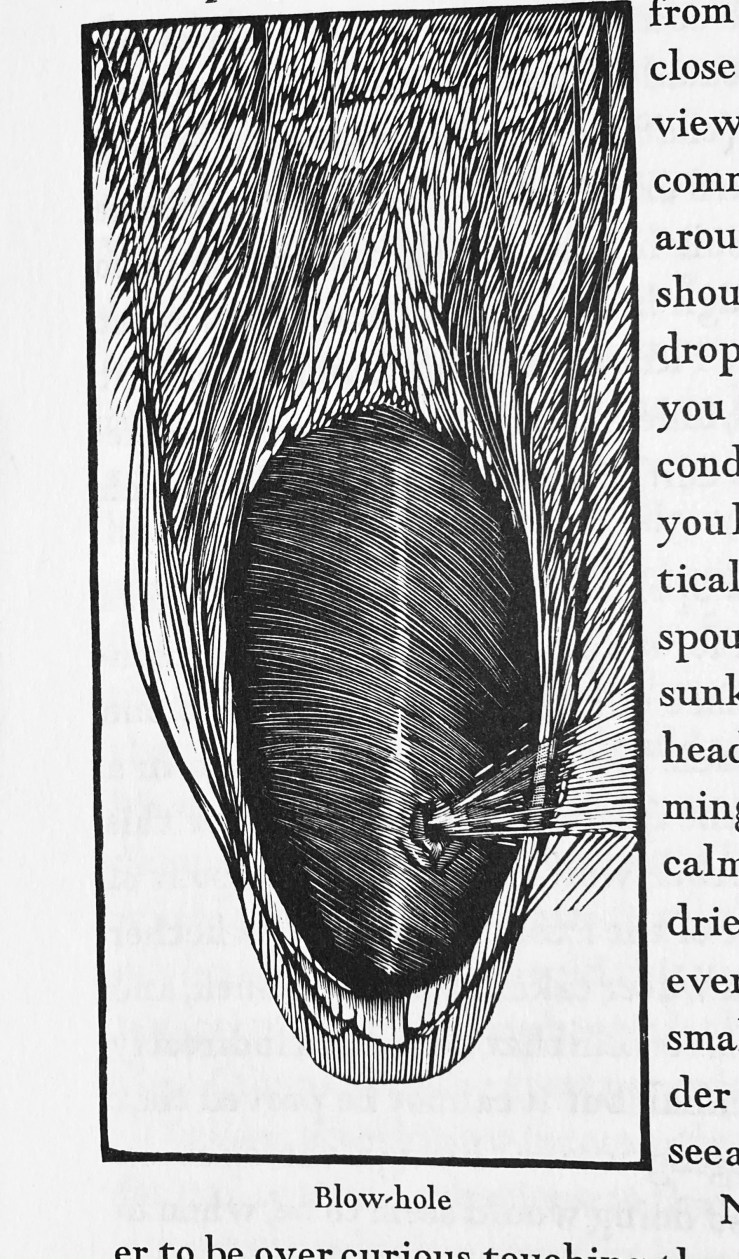
“That drove the spigot out of him!” cried Stubb. “’Tis July’s immortal Fourth; all fountains must run wine today! Would now, it were old Orleans whiskey, or old Ohio, or unspeakable old Monongahela! Then, Tashtego, lad, I’d have ye hold a canakin to the jet, and we’d drink round it! Yea, verily, hearts alive, we’d brew choice punch in the spread of his spout-hole there, and from that live punch-bowl quaff the living stuff.”

Stubb has proven himself a callous soul to this point. He is a jocular anti-Starbuck—and an anti-Ishmael, perhaps—and his suggestion that his crew “quaff the living stuff” from the whale he’s just lanced seems particularly cruel against the sympathetic portrait of whales that Ishmael has sketched over the last few chapters. He’s a figurative bloodsucker here, drawn first as a zany comic, but in a deeper reading, he is the Ugly American.

III. Ch. 85, “The Fountain.”

Here, Ishmael puts on his scientist’s cap again to puzzle out whether the whale spouts water or air.

He begins in an exacting mode, giving us the current date and time in the voyage:

…down to this blessed minute (fifteen and a quarter minutes past one o’clock P.M. of this sixteenth day of December, A.D. 1850), it should still remain a problem, whether these spoutings are, after all, really water, or nothing but vapor—this is surely a noteworthy thing.

(My darling wife’s birthday is December 16, although this has no bearing on this chapter, even if it bears a bit on my riff. In any case, Ishmael gives us a chance to get our temporal bearings here. Unless I’m wrong, the date suggests that The Pequod is almost a year out from its initial departure from Nantucket on Christmas Day of the preceding year.)

IV. “The Fountain” is one of those chapters (of which there are many) that might turn readers off from Moby-Dick—and yet it’s the sort of chapter that underlines the novel’s excellence. Ishmael is on a quest to know an unknowable thing, to describe it, analyze it, evaluate it, synthesize it into his own consciousness, and, perhaps ultimately thereby define it. Ch. 85 sees him at that task: “Still, we can hypothesize, even if we cannot prove and establish. My hypothesis is this: that the spout is nothing but mist.”

As always though, Ishmael’s own prejudices in favor of “the great inherent dignity and sublimity of the Sperm Whale” color any hypotheses he might draw. Indeed, for Ishmael, the sperm whale is a figure of genius:

He is both ponderous and profound. And I am convinced that from the heads of all ponderous profound beings, such as Plato, Pyrrho, the Devil, Jupiter, Dante, and so on, there always goes up a certain semi-visible steam, while in the act of thinking deep thoughts.

Ishmael finds—or, maybe more accurately projects—a fellow thinker of deep thoughts in the great whale. He tells us that

While composing a little treatise on Eternity, I had the curiosity to place a mirror before me; and ere long saw reflected there, a curious involved worming and undulation in the atmosphere over my head. The invariable moisture of my hair, while plunged in deep thought, after six cups of hot tea in my thin shingled attic, of an August noon; this seems an additional argument for the above supposition.

The lines are both ironic, metatextual, but also sincere and sweet. Of course our man Ish might spy a bit of mist in his tiny humid attic—but could it not also be the physical manifestation of his own genius of the metaphysical—his “little treatise on Eternity” (by which paradoxical title I take to mean Moby-Dick).

In the end of the chapter, Ishmael tries to reconcile his physics with is metaphysics:

Doubts of all things earthly, and intuitions of some things heavenly; this combination makes neither believer nor infidel, but makes a man who regards them both with equal eye.

(The line again recalls John Keats’s notion of Negative Capability.)

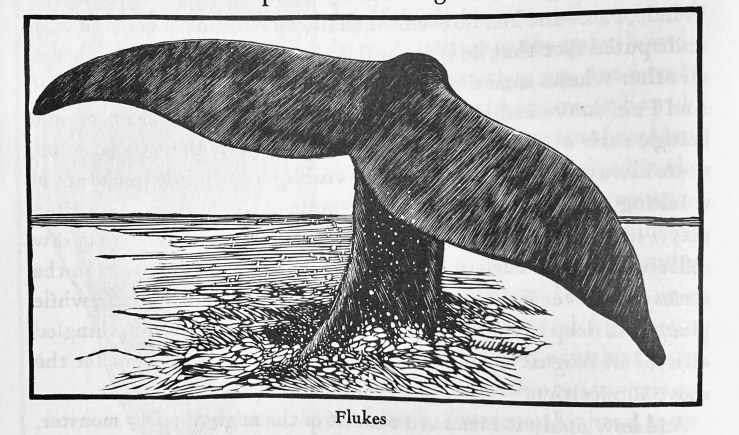
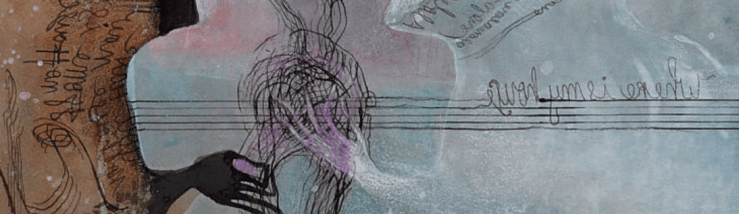
Moby-Dick illustration by Barry Moser

V. Ch. 86, “The Tail.”

Our boy Ish is all about the tail here:

Other poets have warbled the praises of the soft eye of the antelope, and the lovely plumage of the bird that never alights; less celestial, I celebrate a tail.

This chapter sees Ishmael again playing scientist, but also aesthete. His first problem is to figure out just where, exactly, the tail of the whale begins. (In Ch. 90, “Heads or Tails,” he will concede that, in the whale, like the apple, “there is no intermediate remainder” between head or tail—the part that is not head is tail and the part that is not tail is head.)

VI. (Ishmael is more concerned, ultimately, with the power of the tail—and I don’t think Melville is above some punning symbolism here. We are a’whaling and wailing, and tailing and telling tales.)

VII. Every-horny Ishmael is horny (natch) for the whale tail:

Real strength never impairs beauty or harmony, but it often bestows it; and in everything imposingly beautiful, strength has much to do with the magic. Take away the tied tendons that all over seem bursting from the marble in the carved Hercules, and its charm would be gone. As devout Eckerman lifted the linen sheet from the naked corpse of Goethe, he was overwhelmed with the massive chest of the man, that seemed as a Roman triumphal arch. When Angelo paints even God the Father in human form, mark what robustness is there. And whatever they may reveal of the divine love in the Son, the soft, curled, hermaphroditical Italian pictures, in which his idea has been most successfully embodied; these pictures, so destitute as they are of all brawniness, hint nothing of any power, but the mere negative, feminine one of submission and endurance, which on all hands it is conceded, form the peculiar practical virtues of his teachings.

Our boy Ish might be a bit hot and bothered for Michelangelo’s Sistine God!


There are some enterprises in which a careful disorderliness is the true method | Moby-Dick reread, riff 20

I. In this riff: Chapters 81-83 of Moby-Dick.

II. Ch. 81, “The Pequod meets The Virgin.”

In this long chapter, the crew of a German whaler called the Jungfrau (virgin), hail The Pequod. The Jungfrau’s captain Derick De Deer begs some whale oil from the Nantucket ship, and Ishmael notes the irony, although he also notes that “what in the Fishery is technically called a clean [ship] (that is, an empty one), [is] well deserving the name of Jungfrau or the Virgin.”

Just as The Pequod shares some oil for Captain De Deer’s lamp, a pod of whales is sighted, and both ships lower boats, entering into competition to lance the largest and slowest of the whales, who swims “many fathoms in the rear…a huge, humped old bull [who] seemed afflicted with the jaundice, or some other infirmity.”

Ishmael notes that it’s possible that this old whale is an outsider to the pod: “Whether this whale belonged to the pod in advance, seemed questionable; for it is not customary for such venerable leviathans to be at all social. Nevertheless, he stuck to their wake…” Stubb points out that the old whale has “lost his tiller,” and the crew soon spot the missing limb.

…the cause of his devious wake in the unnatural stump of his starboard fin. Whether he had lost that fin in battle, or had been born without it, it were hard to say.

We have here another double for mad Ahab.

III. The race between the two crews carries out in a mix of comedy and pathos. The mates of The Pequod, Stubb and Flask, provide comic bravado as they encourage their boats to row harder (“Don’t ye love sperm? There goes three thousand dollars, men!—a bank!—a whole bank!” yaps Flask).

IV. First mate Starbuck and Ishmael offer more empathy and respect for the aged whale. Consider this portrait Ishmael paints:

As the boats now more closely surrounded him, the whole upper part of his form, with much of it that is ordinarily submerged, was plainly revealed. His eyes, or rather the places where his eyes had been, were beheld. As strange misgrown masses gather in the knot-holes of the noblest oaks when prostrate, so from the points which the whale’s eyes had once occupied, now protruded blind bulbs, horribly pitiable to see. But pity there was none. For all his old age, and his one arm, and his blind eyes, he must die the death and be murdered, in order to light the gay bridals and other merry-makings of men, and also to illuminate the solemn churches that preach unconditional inoffensiveness by all to all.

Ishmael’s final sentence here doubly damns aesthetics and religion, suggesting that the “merry-makings of men” are underwritten in blood and murder—no matter if we “preach unconditional inoffensiveness by all to all.”

V. When they dart the beast, its agitated body rolls around, revealing an infected wound:

Still rolling in his blood, at last he partially disclosed a strangely discoloured bunch or protuberance, the size of a bushel, low down on the flank.

“A nice spot,” cried Flask; “just let me prick him there once.”

“Avast!” cried Starbuck, “there’s no need of that!”

But humane Starbuck was too late. At the instant of the dart an ulcerous jet shot from this cruel wound, and goaded by it into more than sufferable anguish, the whale now spouting thick blood, with swift fury blindly darted at the craft, bespattering them and their glorying crews all over with showers of gore, capsizing Flask’s boat and marring the bows. It was his death stroke.

The bloody shower is more foreshadowing. Or maybe it’s just the everyday business of whaling.

VI. When the crew of The Pequod cut into the whale, they find “the entire length of a corroded harpoon…imbedded in his flesh, on the lower part of the bunch before described.” Ishmael notes that finding spears in whales is not wholly unusual, but then gives us a more dramatic detail:

But still more curious was the fact of a lance-head of stone being found in him, not far from the buried iron, the flesh perfectly firm about it. Who had darted that stone lance? And when? It might have been darted by some Nor’ West Indian long before America was discovered.

Ishmael here posits the whale’s primeval primacy.

VII. Ch. 81 converts its bloody business back into comedy at the end. The Jungfrau mistakes a fin-back whale for a sperm whale—but fin-backs are a “species of uncapturable whales, because of its incredible power of swimming.” Ishmael notes that “Derick and all his host were now in valiant chase of this unnearable brute.” He knows what Derick does not know: that the Jungfrau’s ” bold, hopeful chase” is actually a doomed, hopeless case. Ishmael ends with a wry punchline: “Oh! many are the Fin-Backs, and many are the Dericks, my friend.”

VIII. Ch. 82, “The Honor and the Glory of Whaling.”

In this chapter our boy Ish, as always, is horny for whaling.

IX. In another metatextual opening, Ish begins by calling attention to his discursive narrative style: “There are some enterprises in which a careful disorderliness is the true method.” He then proceeds to chronicle the “many great demi-gods and heroes, prophets of all sort” who are part of the whaling fraternity (noting that he is “transported with the reflection” that he belongs, “though but subordinately,” to this grand company).

X. It strikes me now that Ch. 82 is another of Moby-Dick’s stand-alone chapters, and that it would actually make a fine introduction to anyone wanting to dip their toe into its mass. Read it here.

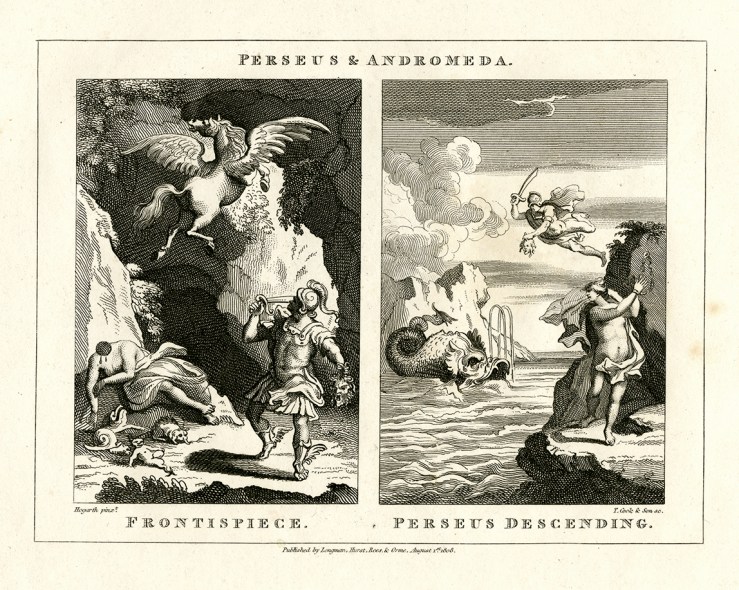
Perseus & Andromeda illustrations by William Hogarth

XI. Anyway—

Ever-largehearted-and-often-bombastic Ishmael lards his chapter with every stripe of whalemen, including:

“The gallant Perseus, a son of Jupiter…the first whaleman…”

St. George of “that famous story of St. George and the Dragon; which dragon I maintain to have been a whale…”

Hercules, “that antique Crockett and Kit Carson—that brawny doer of rejoicing good deeds, [who] was swallowed down and thrown up by a whale…”

Jonah (natch)

and

“Vishnoo [who] became incarnate in a whale, and sounding down in him to the uttermost depths, rescued the sacred volumes.”

“Perseus, St. George, Hercules, Jonah, and Vishnoo! there’s a member-roll for you! What club but the whaleman’s can head off like that?” our jocular boy concludes jocularly.

XII. Ch. 83, “Jonah Historically Regarded.”

Way back in Ch. 9, “The Sermon,” Melville—via Ishmael, via Father Mapple—retold the biblical story of Jonah. Here, that story is squared against the knowledge of whalemen—and one dubious sailor in particular, a certain Sag-Harbor—who remain dubious of “this historical story of Jonah and the whale.” Ishmael points out though that “there were some sceptical Greeks and Romans, who, standing out from the orthodox pagans of their times, equally doubted the story of Hercules and the whale, and Arion and the dolphin; and yet their doubting those traditions did not make those traditions one whit the less facts, for all that.”

Ishmael tries to refute Sag-Harbor and the other Nantuckeers’ arguments against the veracity of Jonah’s voyage in the whale. Ish points out that “a German exegetist supposes that Jonah must have taken refuge in the floating body of a dead whale—even as the French soldiers in the Russian campaign turned their dead horses into tents, and crawled into them.” He also suggests that it’s possible “that when Jonah was thrown overboard from the Joppa ship, he straightway effected his escape to another vessel near by, some vessel with a whale for a figure-head…possibly called The Whale…”

Ultimately though, Ishmael is unable to scientifically explain how Jonah traveled from the coast of Joppa to Ninevah in just three days. He concludes then that, “this very idea of Jonah’s going to Nineveh via the Cape of Good Hope [is] a signal magnification of the general miracle.” 

Our boy Ish is a believer.

A very precious perishing | Moby-Dick reread, riff 19

Moby-Dick illustration by Barry Moser

I. In this riff: Chapters 76-80 of Moby-Dick.

II. Ch. 76, “The Battering-Ram.”

Yet another hyphenated chapter title; yet another horny chapter title.

In this chapter, the titular battering ram is the sperm whale’s head—or, more accurately, the middle space of its huge head, that “dead, blind wall, without a single organ or tender prominence of any sort whatsoever.” Ishmael implores us to consider “this whole enormous boneless mass…as one wad.”

Ish continues, pointing out that the whale’s brain—and consciousness? soul?—are protected by this battering ram:

Now, mark. Unerringly impelling this dead, impregnable, uninjurable wall, and this most buoyant thing within; there swims behind it all a mass of tremendous life…So that when I shall hereafter detail to you all the specialities and concentrations of potency everywhere lurking in this expansive monster; when I shall show you some of his more inconsiderable braining feats; I trust you will have renounced all ignorant incredulity, and be ready to abide by this; that though the Sperm Whale stove a passage through the Isthmus of Darien, and mixed the Atlantic with the Pacific, you would not elevate one hair of your eye-brow. For unless you own the whale, you are but a provincial and sentimentalist in Truth.

That’s a long paragraph! Forgive! Ish ends it thus:

But clear Truth is a thing for salamander giants only to encounter; how small the chances for the provincials then? What befell the weakling youth lifting the dread goddess’s veil at Lais?

This last allusion refers to a Friedrich von Schiller poem, “The Veiled Image at Sais.” Isis’ veil here recalls the “hooded” whale heads aboard The Pequod. The “weakling youth” is forever mortified at this dare for truth. From Merivale’s translation:

But what he saw, or what did there befall,

His lips disclosed not.

Ever from his heart

Was fled the sweet serenity of life,

And the deep anguish dug the early grave:

“Woe, woe to him”—such were his warning words,

Answering some curious and impetuous brain,

“Woe—for she never shall delight him more!

Woe,—woe to him who treads through guilt to Truth!

III. Ch. 77, “The Great Heidelburgh Tun.”

“Now comes the Baling of the Case,” declares Ishmael, and then proceeds to explain how the “most precious of all his oily vintages…the highly-prized spermaceti, in its absolutely pure, limpid, and odoriferous state” shall be extracted from the sperm whale’s head. He tells us that,

A large whale’s case generally yields about five hundred gallons of sperm, though from unavoidable circumstances, considerable of it is spilled, leaks, and dribbles away, or is otherwise irrevocably lost in the ticklish business of securing what you can.

Moby-Dick is a Freudian field day.

IV. Ch. 78, “Cistern and Buckets.”

The Pequod’s crew, led by Tashtego, begin extracting the spermaceti from the whale’s head. The whole thing is a very phallic business:

Towards the end, Tashtego has to ram his long pole harder and harder, and deeper and deeper into the Tun, until some twenty feet of the pole have gone down.

Get a bucket and a mop.

In this slippery business, our man Tash falls into the hole in the whale’s head. Daggoo jumps into action, but the whale’s head falls from all but one hook, echoing “The Monkey-Rope,” the perilous, tenuous link of life between fellows. Luckily—repeating his actions way back in Ch. 13, “Wheelbarrow,” superhero Queequeg saves the day. Proud wife Ishmael proclaims, “my brave Queequeg had dived to the rescue.”

Tash’s rescue is announced as another resurrection in this novel of resurrections: “we saw an arm thrust upright from the blue waves; a sight strange to see, as an arm thrust forth from the grass over a grave.” Zombie vibes! It’s a tough resurrection though: “Tashtego was long in coming to, and Queequeg did not look very brisk.”

The rescue is coded as a birth scene:

And thus, through the courage and great skill in obstetrics of Queequeg, the deliverance, or rather, delivery of Tashtego, was successfully accomplished, in the teeth, too, of the most untoward and apparently hopeless impediments; which is a lesson by no means to be forgotten. Midwifery should be taught in the same course with fencing and boxing, riding and rowing.

The chapter ends with Ishmael praising the notion of drowning in a whale’s tun of spermaceti:

…had Tashtego perished in that head, it had been a very precious perishing; smothered in the very whitest and daintiest of fragrant spermaceti; coffined, hearsed, and tombed in the secret inner chamber and sanctum sanctorum of the whale.

V. Ch. 79, “The Prairie.”

Ishmael turns to pseudoscience: “To scan the lines of his face, or feel the bumps on the head of this Leviathan; this is a thing which no Physiognomist or Phrenologist has as yet undertaken.” By the end of the chapter though, Ish insists that “Physiognomy, like every other human science, is but a passing fable.” Still, his project remains the same—we are to read the whale—and the mystery of the whale—as Moby-Dick’s main text. He gives us the head: “I but put that brow before you. Read it if you can.”

VI. Ch. 80, “The Nut.”

Pseudoscience continues with phrenology, which Ish uses as a description, but not an answer to his driving question, What is the whale. “The Nut” concludes with the hump:

This august hump, if I mistake not, rises over one of the larger vertebræ, and is, therefore, in some sort, the outer convex mould of it. From its relative situation then, I should call this high hump the organ of firmness or indomitableness in the Sperm Whale. And that the great monster is indomitable, you will yet have reason to know.

Things I have been reading that are not Moby-Dick

img_6979

I have been rereading Moby-Dick.

I have also been reading things that are not Moby-Dick. 

I have been reading emails.

I have been reading and very much enjoying Anakana Schofield’s novel Bina. I should have finished it by now—there’s just one remaining section—but I’ve been reading it exclusively in the bathtub. And I only take baths on Sunday. But I did not, unlike the narrator of Squeeze’s wonderful ditty “Up the Junction”,  take a bath on Sunday. (After I get the weight of Moby-Dick off my conscience I will write a review.)

I have been reading student writing.

I have been reading more emails.

I have been rereading lots of (so-called) early American literature. I am teaching a course in early American literature for the first time in a long time, and I have read again, for the first time in a long time, stuff like A Short Account of the Destruction of the Indies by Bartolomé de Las Casas, and The Interesting Narrative of the Life of Olaudah Equiano; or, Gustavus Vassa, the African, Written by Himself and A Narrative of the Captivity and Restoration of Mrs. Mary Rowlandson. America is founded in blood and bounding, violence and strange hope.

I have been reading Twitter.

I have been reading Reddit.

(I cannot remember the last book review I read.)

I have been reading bits of The Posthumous Works of Thomas Pilaster by Éric Chevillard (translated from the French by Chris Clarke) and I like it so far.

I have been reading more student writing.

I have been reading news articles, particularly English-language news articles from non-U.S. news organizations; particularly articles focused on U.S. politics.

I have been reading poetry on the internet, somewhat at random. 

I have not been reading Ann Quin’s novel Passages—it just showed up the other day—but it will be the next novel I read (after Moby-Dick; after Bina), and I am very excited about it. 

I have been reading Wikipedia articles, very much at random. (Is there a greater 21st-century novel?)

I have not been reading the audiobook recording of Cormac McCarthy’s novel Blood Meridian narrated by Richard Poe. I have been falling asleep to it every night for the past forty or so nights. I set an hour timer and either fall asleep in five, ten, twenty minutes or not at all. One night I listened to the novel’s final third. Some nights I wonder into it disoriented—Where are we? Other nights I’m thrilled at the particular episode we start with—too thrilled. I’m supposed to be asleep. Last night I listened to most of Ch. 8—the bit in the bar where Toadvine, Bathcat, and the kid go drink in a bar and are accosted by an old man who declares that he two is “Texas.” A guy gets stabbed in the shadows, but remains moaning. Where would he go? The chapter ends with the Apache attacking, but I don’t recall getting there. What the fuck is wrong with me that I find Blood Meridian a comforting soporific to send me to my slumbers?

I have been reading Moby-Dick.


The mystic-marked whale remains undecipherable | Moby-Dick reread, riff 17

Moby-Dick illustration by Barry Moser

I. In this riff: Chapters 61-73 of Moby-Dick.

II. Ch. 61, “Stubb Kills a Whale.”

In this chapter, Stubb kills a whale.

III. Ch. 62, “The Dart.”

In this chapter, Ishmael argues that harpooneers should not have to row so that their throwing arms are not fatigued when the time comes to lance a whale.

Moby-Dick illustration by Barry Moser

IV. Ch. 63, “The Crotch.”

Ishmael begins this chapter by noting his propensity toward a discursive narrative style: “Out of the trunk, the branches grow; out of them, the twigs. So, in productive subjects, grow the chapters.”

He then suggests that “The crotch alluded to on a previous page deserves independent mention.”

I’m reminded of the time I made a list of smutty-sounding chapter titles in Moby-Dick.

V. Ch. 64, “Stubb’s Supper.”

Stubb eats some of that whale he killed a few chapters back.

Moby-Dick illustration by Barry Moser

VI. Ch. 65, “The Whale as a Dish.”

Ishmael riffs on eating whales—sperm whales in particular—and concedes that they are generally too unctuous for the palates of landlubbers. He’s all for eating the brains:

In the case of a small Sperm Whale the brains are accounted a fine dish. The casket of the skull is broken into with an axe, and the two plump, whitish lobes being withdrawn (precisely resembling two large puddings), they are then mixed with flour, and cooked into a most delectable mess, in flavor somewhat resembling calves’ head, which is quite a dish among some epicures…

VII. Ch. 66, “The Shark Massacre.”

Sharks eat at Stubb’s whale too, which has been tied to the side of The Pequod overnight. Queequeg kills some of the sharks, and hoists one on deck to take its skin. It almost bites his hand off.

VIII. Ch. 67, “Cutting In.”

Another one of Ishmael’s technically-oriented chapters, with little in the way of philosophy. He describes the process by which the crew strips the blubber from the whale.

Moby-Dick illustration by Barry Moser

IX. Ch. 68, “The Blanket.”

Another one of Ishmael’s philosophically-oriented chapters. Here, he ponders, “what and where is the skin of the whale?” Ishmael notes that over the whale’s blubber there is an “infinitely thin, transparent substance, somewhat resembling the thinnest shreds of isinglass.” He says that this “isinglass,” when dried, makes a good bookmark for his “whale-books”

It is transparent, as I said before; and being laid upon the printed page, I have sometimes pleased myself with fancying it exerted a magnifying influence. At any rate, it is pleasant to read about whales through their own spectacles, as you may say.

Ultimately though, this isinglass is but the “skin of the skin” and the whale’s blubber is his “blanket.”

It is telling that Ishmael reads whale books through a whale lens. Indeed, his whole mission is to read the whale, and in “The Blanket” he turns the whale’s body into a text beyond his ciphering, noting that the body of the sperm whale is “all over obliquely crossed and re-crossed with numberless straight marks in thick array.” He continues::

But these marks do not seem to be impressed upon the isinglass substance above mentioned, but seem to be seen through it, as if they were engraved upon the body itself. Nor is this all. In some instances, to the quick, observant eye, those linear marks, as in a veritable engraving, but afford the ground for far other delineations. These are hieroglyphical; that is, if you call those mysterious cyphers on the walls of pyramids hieroglyphics, then that is the proper word to use in the present connexion. By my retentive memory of the hieroglyphics upon one Sperm Whale in particular, I was much struck with a plate representing the old Indian characters chiselled on the famous hieroglyphic palisades on the banks of the Upper Mississippi. Like those mystic rocks, too, the mystic-marked whale remains undecipherable.

X. Ch. 69, “The Funeral.”

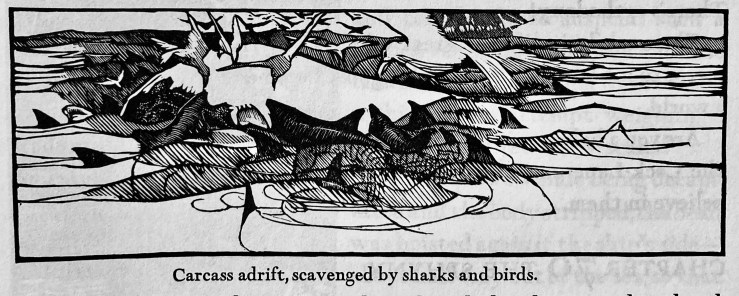
The whale’s corpse is cut loose to endure the mocking “funeral” of every scavenger of the sea and sky.

Thus, while in life the great whale’s body may have been a real terror to his foes, in his death his ghost becomes a powerless panic to a world.

Are you a believer in ghosts, my friend? There are other ghosts than the Cock-Lane one, and far deeper men than Doctor Johnson who believe in them.

The last two lines of the chapter—quoted above—again point to the idea that perhaps our Ish is himself a ghost.

Moby-Dick illustration by Barry Moser

XI. Ch. 70, “The Sphynx.”

The crew decapitated Stubb’s whale and kept it on deck. In another one of those How is Ishmael witnessing this wait is he like a ghost or something? scenes, Ish manages to overhear Captain Ahab’s batshit soliloquy to the dead head:

It was a black and hooded head; and hanging there in the midst of so intense a calm, it seemed the Sphynx’s in the desert. “Speak, thou vast and venerable head,” muttered Ahab, “which, though ungarnished with a beard, yet here and there lookest hoary with mosses; speak, mighty head, and tell us the secret thing that is in thee. Of all divers, thou hast dived the deepest. That head upon which the upper sun now gleams, has moved amid this world’s foundations. Where unrecorded names and navies rust, and untold hopes and anchors rot; where in her murderous hold this frigate earth is ballasted with bones of millions of the drowned; there, in that awful water-land, there was thy most familiar home. Thou hast been where bell or diver never went; hast slept by many a sailor’s side, where sleepless mothers would give their lives to lay them down. Thou saw’st the locked lovers when leaping from their flaming ship; heart to heart they sank beneath the exulting wave; true to each other, when heaven seemed false to them. Thou saw’st the murdered mate when tossed by pirates from the midnight deck; for hours he fell into the deeper midnight of the insatiate maw; and his murderers still sailed on unharmed—while swift lightnings shivered the neighboring ship that would have borne a righteous husband to outstretched, longing arms. O head! thou hast seen enough to split the planets and make an infidel of Abraham, and not one syllable is thine!”

XII. Ch. 71, “The Jeroboam’s Story.”

Ahab’s interrogation of the whale’s head is cut short when the call goes up that another ship—the aptly named Jeroboam—is in hailing distance. Our boy Ahab just has to get some news about his White Whale.

The crew of The Jeroboam elect to keep their distance from The Peqoud. Their Captain Mayhew suggests they have a plague of some kind on board, but it becomes evident that the plague might be a kind of madness. The crew of Mayhew’s ship are under the sway of a Shaker sailor who believes himself to be the Archangel Gabriel. Anyway, it turns out that The Jeroboam has encountered Moby Dick; in fact, Mayhew’s chief mate Macey died hunting the great beast—all while Gabriel chanted prophecies of doom. Symbolically underlining the foreshadowing in this episode, The Pequod carries aboard a letter for Macey from his wife, who does not yet know she is a widow. And in even more symbolic foreshadowing, when Starbuck attempts to pass the letter to Mayhew,

…as if by magic, the letter suddenly ranged along with Gabriel’s eager hand. He clutched it in an instant, seized the boat-knife, and impaling the letter on it, sent it thus loaded back into the ship. It fell at Ahab’s feet. Then Gabriel shrieked out to his comrades to give way with their oars, and in that manner the mutinous boat rapidly shot away from the Pequod.

To steal a line from Melville’s later short masterpiece Bartleby: “Dead letters! does it not sound like dead men?”

XIII. Ch. 72, “The Monkey-Rope.”

In this chapter—another chapter with a hyphenated title!—in this chapter, Ishmael goes back to some technical business of whaling, explaining that while hauling in Stubb’s whale, Queequeg had to insert the blubber hook into the whale—which means he had to be over the side of the boat, on the whale itself. In this process, Queequeg and Ishmael are connected by a “monkey-rope” — a rope tethering the two between belts.

“It was a humorously perilous business for both of us,” Ishmael notes, a line that again underscores Moby-Dick’s compounding — hyphenating — modes of comedy and terror. The chapter also again reminds us that Ish and Queeg are like a married couple: “for better or for worse, we two, for the time, were wedded.” As is often the case, Ishmael goes into a philosophical reverie:

So strongly and metaphysically did I conceive of my situation then, that while earnestly watching his motions, I seemed distinctly to perceive that my own individuality was now merged in a joint stock company of two; that my free will had received a mortal wound; and that another’s mistake or misfortune might plunge innocent me into unmerited disaster and death. …still further pondering, I say, I saw that this situation of mine was the precise situation of every mortal that breathes; only, in most cases, he, one way or other, has this Siamese connexion with a plurality of other mortals.

XIV. Ch. 73, “Stubb and Flask Kill a Right Whale; and Then Have a Talk over Him.”

In this chapter, Stubb and Flask kill a right whale and then have a talk over him.

Moby-Dick illustration by Barry Moser

The great Leviathan is that one creature in the world which must remain unpainted to the last | Moby-Dick reread, riff 15

I. In this riff: Ch. 55, 56, and 57 of Moby-Dick.

Each of these chapters concerns graphic—artistic and scientific—depictions of whales. Ishmael dwells mostly upon the failure of artists to truthfully represent the whale, but also concedes that the task is near impossible. Nevertheless, Ish attests that he “shall ere long paint to you as well as one can without canvas, something like the true form of the whale as he actually appears to the eye of the whaleman…”

II. Ch. 55, “Of the Monstrous Pictures of Whales.”

Ishmael avers that erroneous depictions of whales are likely based in antiquity: “It may be that the primal source of all those pictorial delusions will be found among the oldest Hindoo, Egyptian, and Grecian sculptures.” He goes on,

Now, by all odds, the most ancient extant portrait anyways purporting to be the whale’s, is to be found in the famous cavern-pagoda of Elephanta, in India. …The Hindoo whale referred to, occurs in a separate department of the wall, depicting the incarnation of Vishnu in the form of leviathan, learnedly known as the Matse Avatar. But though this sculpture is half man and half whale, so as only to give the tail of the latter, yet that small section of him is all wrong. It looks more like the tapering tail of an anaconda, than the broad palms of the true whale’s majestic flukes.

I couldn’t locate an image of Ish’s Elaphanta icon, but here’s an unsigned depiction of Vishnu in this form from an 1816 portfolio of “deities, mendicants and ritual scenes such as a wedding and cremation.”

III. (Barry Moser, who illustrated the edition of Moby-Dick I’m rereading, wisely stayed away from most of these “picture” episodes.)

IV. Let us continue:

It is Guido’s picture of Perseus rescuing Andromeda from the sea-monster or whale. Where did Guido get the model of such a strange creature as that?

–and–

Nor does Hogarth, in painting the same scene in his own “Perseus Descending,” make out one whit better.

–and–

Then, there are the Prodromus whales of old Scotch Sibbald

–and—

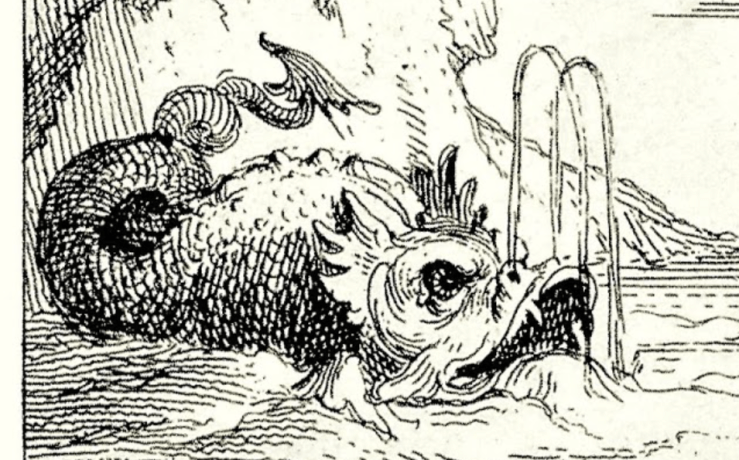
Jonah’s whale, as depicted in the prints of old Bibles and the cuts of old primers.

Jonah, 1585 by Antonius Wierix

–and–

 In old Harris’s collection of voyages there are some plates of whales extracted from a Dutch book of voyages, A.D. 1671, entitled “A Whaling Voyage to Spitzbergen in the ship Jonas in the Whale, Peter Peterson of Friesland, master.” In one of those plates the whales, like great rafts of logs, are represented lying among ice-isles, with white bears running over their living backs. In another plate, the prodigious blunder is made of representing the whale with perpendicular flukes.

–and–

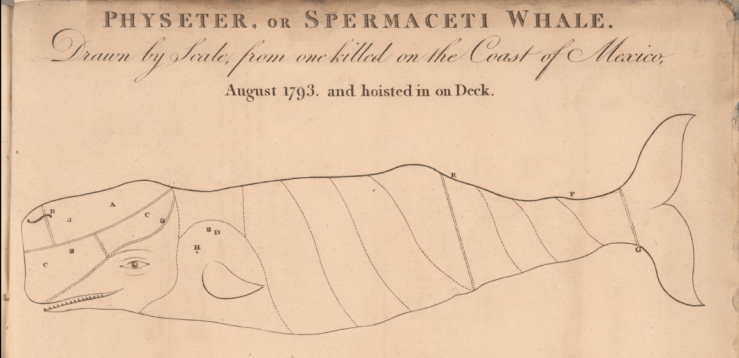
Then again, there is an imposing quarto, written by one Captain Colnett, a Post Captain in the English navy, entitled “A Voyage round Cape Horn into the South Seas, for the purpose of extending the Spermaceti Whale Fisheries.” In this book is an outline purporting to be a “Picture of a Physeter or Spermaceti whale, drawn by scale from one killed on the coast of Mexico, August, 1793, and hoisted on deck.”

–and–

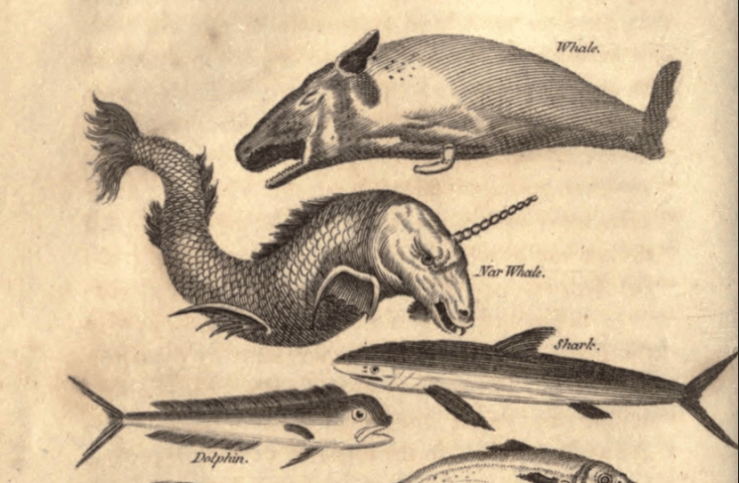
Look at that popular work “Goldsmith’s Animated Nature.” In the abridged London edition of 1807, there are plates of an alleged “whale” and a “narwhale.” I do not wish to seem inelegant, but this unsightly whale looks much like an amputated sow; and, as for the narwhale, one glimpse at it is enough to amaze one, that in this nineteenth century such a hippogriff could be palmed for genuine upon any intelligent public of schoolboys.

–and–

Then, again, in 1825, Bernard Germain, Count de Lacépède, a great naturalist, published a scientific systemized whale book, wherein are several pictures of the different species of the Leviathan.

–and–

But the placing of the cap-sheaf to all this blundering business was reserved for the scientific Frederick Cuvier, brother to the famous Baron. In 1836, he published a Natural History of Whales, in which he gives what he calls a picture of the Sperm Whale. Before showing that picture to any Nantucketer, you had best provide for your summary retreat from Nantucket. In a word, Frederick Cuvier’s Sperm Whale is not a Sperm Whale, but a squash.

V. Ishmael then forgives these artists’ failures:

But these manifold mistakes in depicting the whale are not so very surprising after all. Consider! Most of the scientific drawings have been taken from the stranded fish; and these are about as correct as a drawing of a wrecked ship, with broken back, would correctly represent the noble animal itself in all its undashed pride of hull and spars. …The living whale, in his full majesty and significance, is only to be seen at sea in unfathomable waters; and afloat the vast bulk of him is out of sight…

VI. Ishmael then reminds us that the whale is a sort of metaphysical thing: “For it is one of the more curious things about this Leviathan, that his skeleton gives very little idea of his general shape,” unlike, say, Jeremy Bentham.

VII. Ishmael’s first pictorial chapter ends his chapter with a warning of sorts:

For all these reasons, then, any way you may look at it, you must needs conclude that the great Leviathan is that one creature in the world which must remain unpainted to the last. True, one portrait may hit the mark much nearer than another, but none can hit it with any very considerable degree of exactness. So there is no earthly way of finding out precisely what the whale really looks like. And the only mode in which you can derive even a tolerable idea of his living contour, is by going a whaling yourself; but by so doing, you run no small risk of being eternally stove and sunk by him. Wherefore, it seems to me you had best not be too fastidious in your curiosity touching this Leviathan.

Ishmael’s warning points—again—to The Pequod’s impending doom.

VIII. Ch. 56, “Of the Less Erroneous Pictures of Whales, and the True Pictures of Whaling Scenes.”

Ishmael:

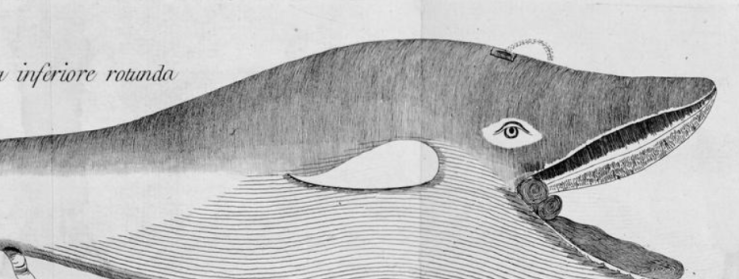
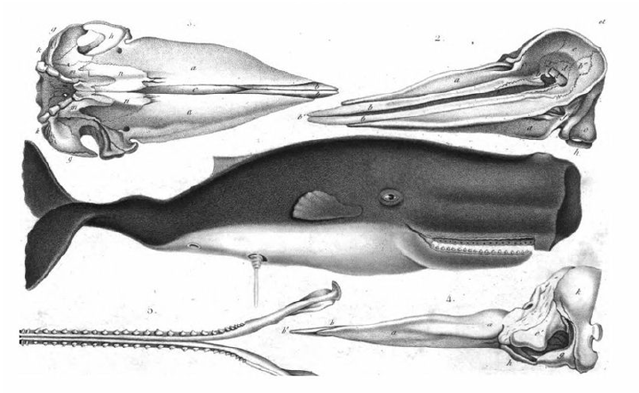
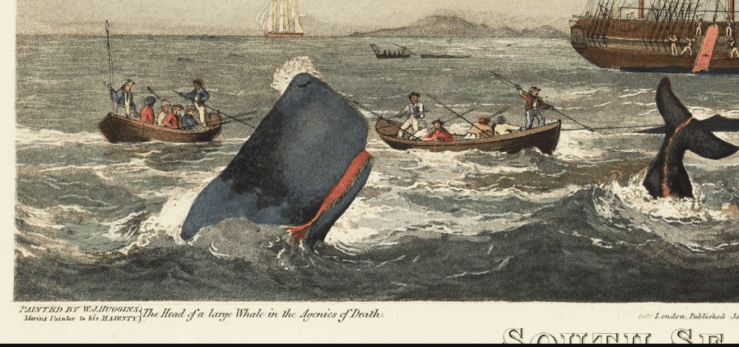
I know of only four published outlines of the great Sperm Whale; Colnett’s, Huggins’s, Frederick Cuvier’s, and Beale’s. In the previous chapter Colnett and Cuvier have been referred to. Huggins’s is far better than theirs; but, by great odds, Beale’s is the best.

Here is a detail from W.J. Huggin’s South Sea Whale Fishery (1825):

–and from Beale’s volume—

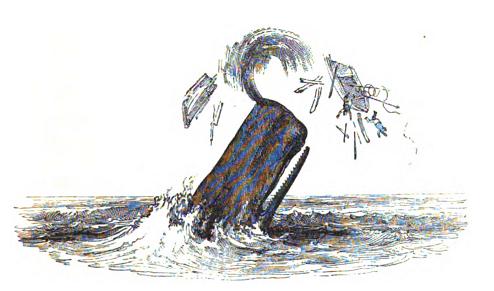
Ishmael then mentions William Scoresby, whose disastrous depictions also likely helped inform the imagery at the climax of Moby-Dick:

Ishmael is also very fond of two engravings from Ambroise Lous Garneray, the second of which he describes thus—

In the second engraving, the boat is in the act of drawing alongside the barnacled flank of a large running Right Whale, that rolls his black weedy bulk in the sea like some mossy rock-slide from the Patagonian cliffs. His jets are erect, full, and black like soot; so that from so abounding a smoke in the chimney, you would think there must be a brave supper cooking in the great bowels below. Sea fowls are pecking at the small crabs, shell-fish, and other sea candies and maccaroni, which the Right Whale sometimes carries on his pestilent back. And all the while the thick-lipped leviathan is rushing through the deep, leaving tons of tumultuous white curds in his wake, and causing the slight boat to rock in the swells like a skiff caught nigh the paddle-wheels of an ocean steamer. Thus, the foreground is all raging commotion; but behind, in admirable artistic contrast, is the glassy level of a sea becalmed, the drooping unstarched sails of the powerless ship, and the inert mass of a dead whale, a conquered fortress, with the flag of capture lazily hanging from the whale-pole inserted into his spout-hole.

I think it must be this–

IX. Ch. 57, “Of Whales in Paint; in Teeth; in Wood; in Sheet-Iron; in Stone; in Mountains; in Stars.”

I wrote above that Barry Moser pretty much stays out of these pictorial chapters, but he does include this lovely little illustration in Ch. 57:

Moby-Dick illustration by Barry Moser

On scrimshaw:

Throughout the Pacific, and also in Nantucket, and New Bedford, and Sag Harbor, you will come across lively sketches of whales and whaling-scenes, graven by the fishermen themselves on Sperm Whale-teeth, or ladies’ busks wrought out of the Right Whale-bone, and other like skrimshander articles, as the whalemen call the numerous little ingenious contrivances they elaborately carve out of the rough material, in their hours of ocean leisure.

(So I just spent the last half hour looking for this tiny little scrimshaw pocket knife I bought when I was ten years old in Honolulu — it was the winter of 1989 and we were going home-not-really-home to Florida for Christmas from Dunedin, New Zealand. We got to spend a few days in Honolulu and I bought a “scrimshaw” knife in the market. “Like Moby-Dick,” my father said, or something like that. I know the knife is here somewhere, in some box or crate, squirreled away, more beautiful in my mind’s eye than an iPhone pic could capture.)

X. These three chapters end with Ishmael’s reaffirmation to go a’whaliln’ — to see for himself, and not through, to quote Walt Whitman, “take things at second or third hand, not look through the eyes of the dead, nor feed on the spectres in books.”

Our boy Ish ends the chapter horny for life:

With a frigate’s anchors for my bridle-bitts and fasces of harpoons for spurs, would I could mount that whale and leap the topmost skies, to see whether the fabled heavens with all their countless tents really lie encamped beyond my mortal sight!


A certain wondrous, inverted visitation of one of those so called judgments of God which at times are said to overtake some men | Moby-Dick reread, riff 14

I. In this riff: Ch. 54 of Moby-Dick, “The Town Ho’s Story.”

II. “The Town Ho’s Story” comes not-exactly halfway through Moby-Dick.

At almost 8,000 words, it’s the longest chapter in the novel. For a sense of comparison, Melville’s novella Bartleby is about 14,000 words long. Indeed, “The Town Ho’s Story” reads like a long short story at times, but one without the conceptual scope of a novella.

III. Or maybe “without the conceptual scope of a novella” is incorrect. The plot of “The Town-Ho’s Story” anticipates Melville’s great late novella Billy Budd. Its handsome hero Steelkilt anticipates Baby Budd, and its villain Radney prefigures uglyassed Claggart. However, Ch. 54 ultimately fits into the strange shape of Moby-Dick, offering an alternate version of the novel’s catastrophic climax.

IV. Ch. 54 culminates with an attack on Moby Dick! But it’s the Town-Ho’s attack, not the Pequod’s! Which brings me to—

V. (Actually, before I get there, let me just address it: Yes, “The Town-Ho’s Story” is a salacious title to our modern ears. It is but one of many smutty sounding chapter titles in Moby-Dick.)

VI. So like well–which brings me to the narratological framing of “The Town-Ho’s Story”:

The Pequod meets The Town-Ho, a whale ship “manned almost wholly by Polynesians.”

There is a reason for this majority crew.

Ishmael informs us that the true Town-Ho’s story is “the private property of three confederate white seamen of that ship,” and that “one of whom, it seems, communicated it to Tashtego with Romish injunctions of secrecy.” Our harpooneer might have been sworn to secrecy—“injunctions of secrecy” and that hedging expression “it seems” points to Moby-Dick’s central acentered ambiguity—-

—–but Ishmael, ever the witness, notes that “the following night Tashtego rambled in his sleep, and revealed so much of it in that way, that when he was wakened he could not well withhold the rest.” The Pequod’s crew keeps the story from Ahab and his mates. Labor vs. management:

To some the general interest in the White Whale was now wildly heightened by a circumstance of the Town-Ho’s story, which seemed obscurely to involve with the whale a certain wondrous, inverted visitation of one of those so called judgments of God which at times are said to overtake some men. This latter circumstance, with its own particular accompaniments, forming what may be called the secret part of the tragedy about to be narrated, never reached the ears of Captain Ahab or his mates.

But, above—the reason for a majority Polynesian crew? Well, the Town-Ho fell on disastrous times.

VII. But again, the framing is what most intrigues me here. This story is told by three whites on the Town-Ho to the Native American harpooneer Tashtego, who reveals much of it in his sleep–to Ishmael? Or, rather, that is what Ishmael tells us. But Ishmael also tells us that

For my humor’s sake, I shall preserve the style in which I once narrated it at Lima, to a lounging circle of my Spanish friends, one saint’s eve, smoking upon the thick-gilt tiled piazza of the Golden Inn.

We have a story inside a story inside a dream inside a story inside an epic encyclopedic novel that may or may not be told from the perspective of a ghost.

VIII. (But—if Ishmael tells this story to living auditors, is he actually a ghost, or a proper survivor of the wreck of the Pequod? Or are his auditors in turn spirits as well, taking the measure of storytelling at their leisure?)

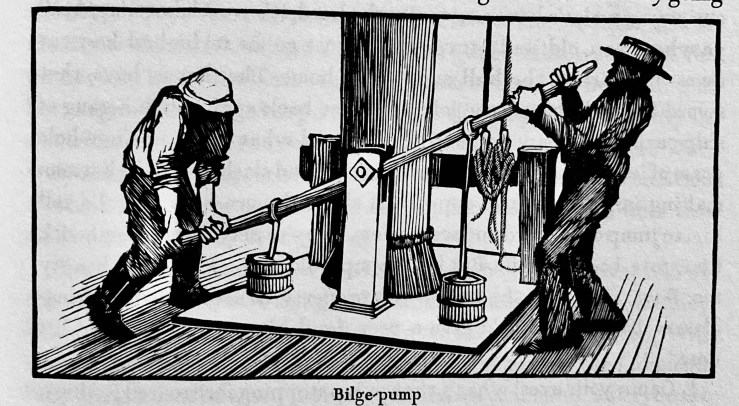
IX. There is but one Barry Moser illustration for this chapter in the edition I am reading. It depicts some dudes at the pumps—

X. The pumps are one of the major conflicts in “The Town-Ho’s Story.” The ship springs a leak and has to be pumped (more phallic language in this oh-so-phallic novel); the pumping accelerates the conflict between Radney and Steelkit, which eventually explodes into mutiny and suppression—and all that egotism is overwhelmed by a sighting of that great whale Moby Dick! They chase the monster and lose:

…Radney was tossed over into the sea, on the other flank of the whale. He struck out through the spray, and, for an instant, was dimly seen through that veil, wildly seeking to remove himself from the eye of Moby Dick. But the whale rushed round in a sudden maelstrom; seized the swimmer between his jaws; and rearing high up with him, plunged headlong again, and went down.

There’s no amount of pumping that will revive the drowned sailor.

But he lives on in Ishmael’s storytelling.

Your identity comes back in horror | Moby-Dick reread, riff 10

Moby-Dick illustration by Barry Moser

I. In this riff: Chapters 33-35 of Moby-Dick.

II. (Re: Above—I just finished Ch. 36 of Moby-Dick, “The Quarter-Deck,” which is like, too good. Too loaded. Ahab erupts. Up until now I’d just been riffing on what I’d read, trying to keep it simple, but “The Quarter-Deck” needs its own riff.)

III. Ch. 33, “The Specksnyder.”

Specksnyder is a strange word. Ishmael tells us that, “Literally this word means Fat-Cutter; usage, however, in time made it equivalent to Chief Harpooneer.” Its provenance is anglicized Dutch—another splicing in a novel of splices.

IV. Ch. 33 follows a pattern (initiates a pattern?) common to Moby-Dick: Ishmael begins his chapter with some facts and descriptions specific to whaling (in this case, the business of the Specksnyder), only to zoom out (or is it zoom in?) to larger philosophical matters.

V. In this case, those larger philosophical matters concern the psychological temperament of those who would assume the mantle of leadership. Ishmael notes that moody Ahab eschews the “shallowest assumption” of “elated grandeur.” Our captain is no faker, fraud, humbug, or poseur — “the only homage he ever exacted, was implicit, instantaneous obedience.”

VI. But Ishmael, ever the hedger of bets, ever the ghost who trades in double negatives, warns us that despite his leadership qualities, “even Captain Ahab was by no means unobservant of the paramount forms and usages of the sea…that behind those forms and usages, as it were, he sometimes masked himself; incidentally making use of them for other and more private ends than they were legitimately intended to subserve.” Foreshadowing!

VII. Ch. 34, “The Cabin-Table.”

Another chapter that begins with ship’s business but expands toward grander abstractions. Those abstractions help to shade and characterize Ahab, who has yet to give his first grand speech (that’s in Ch. 36, “The Quarter-Deck”). The ship’s business also points again to obeisance and command. We learn who descends to eat first, a kind of alpha dog Darwinism reconfigured as sea law. Ahab and his three mates go to table in silence. Starbuck is next to go to dinner after his captain. Flask is last: “hilarious little Flask enters King Ahab’s presence, in the character of Abjectus, or the Slave.” Then the three harpooneers eat, noisy, ravenous.

The two most interesting things about this chapter for me on this reread:

a. It is composed in the present tense, beginning: “It is noon.” While Ishmael has shifted into the present tense many times before, unless I am mistaken, this particular whole-chapter shift is a first. And—

b. We have another moment in the narrative where Ishmael witnesses behaviors, viewpoints, events that he should not be able to see. In other words, Ishmael, a lowly seaman has no business at the cabin table.

“The Cabin-Table” is another early moment in M-D that calls into question Ishmael’s witnessing—is he a ghost survivor, a kind of time traveler of consciousnesses? A spy or voyeur, peeking through holes? Or is it just a book, and this is how books work?

Moby-Dick illustration by Barry Moser

VIII. Ch. 35, “The Mast-Head.”

Man does Melville love hyphens. Hyphens in the title, hyphens in the chapter, hyphens at suppertime.

IX. Again we have a chapter that starts with some description and history of whaling and ship business. Ishmael waxes at length about assuming watch at the top of the mast-head, making sure to bring up ancient Egypt (always!), the Tower of Babel, Louis Bonaparte, Childe Harold, George Washington (et al.).

X. But again, Ish moves from particulars to abstraction. “The Mast-Head” reads as both an endorsement of and a warning against romantic transcendentalism. (This is a tale of ambiguities, hedging, and double double double negatives.)

XI. Ish relates the reveries to be had atop the mast-head. A watcher on the watery world will quickly lose a sense of self. His ego will fold into something grander, yet grander without clear object. In short, transcendentally-overwhelmed by horizonless horizons, he will forget to sight the whales he hunts.

In such cases, a watcher might be remonstrated:

‘Why, thou monkey,’ said a harpooneer to one of these lads, ‘we’ve been cruising now hard upon three years, and thou hast not raised a whale yet. Whales are scarce as hen’s teeth whenever thou art up here.’

But we sense that Ishmael was the dreaming lad

Perhaps they were; or perhaps there might have been shoals of them in the far horizon; but lulled into such an opium-like listlessness of vacant, unconscious reverie is this absent-minded youth by the blending cadence of waves with thoughts, that at last he loses his identity; takes the mystic ocean at his feet for the visible image of that deep, blue, bottomless soul, pervading mankind and nature; and every strange, half-seen, gliding, beautiful thing that eludes him; every dimly-discovered, uprising fin of some undiscernible form, seems to him the embodiment of those elusive thoughts that only people the soul by continually flitting through it. In this enchanted mood, thy spirit ebbs away to whence it came; becomes diffused through time and space; like Wickliff’s sprinkled Pantheistic ashes, forming at last a part of every shore the round globe over.

What a sentence! I thought about getting in there for a minute, but hell…what a sentence.

XII. (The word “vacant” above points towards Moby-Dick’s devastating “Epilogue,” where survivor (?) Ishmael assumes the “vacant post” of bowsman.)

XIII. But back to the marvelous conclusion of Ch. 35. Ishmael describes a moment of transcendence, of ego-loss, even ego-death. And then what happens:

There is no life in thee, now, except that rocking life imparted by a gently rolling ship; by her, borrowed from the sea; by the sea, from the inscrutable tides of God. But while this sleep, this dream is on ye, move your foot or hand an inch; slip your hold at all; and your identity comes back in horror. Over Descartian vortices you hover. And perhaps, at mid-day, in the fairest weather, with one half-throttled shriek you drop through that transparent air into the summer sea, no more to rise for ever. Heed it well, ye Pantheists!

Your identity comes back in horror.

Yeah, damn, heed. 


No more my splintered heart and maddened hand were turned against the wolfish world | Riff 4 on rereading Herman Melville’s Moby-Dick (A Bosom Friend/Nightgown/Biographical/Wheelbarrow)

Moby-Dick illustration by Barry Moser

I. “A Bosom Friend” (Ch. 10)  is another one of the remarkable key early chapters of Moby-Dick. It twins Ch. 4, “The Counterpane,” book-ending Ishmael’s Wild New Bedford Nights with Queequeg.

II. While Ishmael’s largehearted acceptance and quick love for Queequeg probably does not seem as eccentric to contemporary readers as it might have been to Melville’s 1851 audience, it’s nevertheless an enduring emblem of Moby-Dick’s expansive spirit.

“Better sleep with a sober cannibal than a drunken Christian,” Ish intones in Ch. 3; by Ch. 10, he admiringly attests that, “Queequeg was George Washington cannibalistically developed.” In a curt but not impolite dismissal of his own culture’s moral compass, Ish declares he’ll, “try a pagan friend…since Christian kindness has proved but hollow courtesy.” Like Huck Finn, another American prototype who wishes to escape into the wild, Ishmael will always value raw truth over empty artifice.

III. There are so many good lines in “A Bosom Friend,” but I think this must be my favorite:

…I began to be sensible of strange feelings. I felt a melting in me. No more my splintered heart and maddened hand were turned against the wolfish world.

Ishmael claims that Queequeg, a “soothing savage” has “redeemed” the world for him.

IV. It is more than possible (and so much has been written on M-D that I’m sure much has been made on the topic) that Ish (and Melville) has (have) taken what might be a complex and nuanced character in Queequeg and othered it into a flat projection screen.

Ishmael, who finds “no civilized hypocrisies and bland deceits” in Queeg, might be accused of turning his bosom friend into a romanticized avatar of Ish’s own desire for a noble “savage” unconstrained by the dictates of Christian morality. However, the events of the novel and its developed characterization of Queequeg do not merit such a facile reading (or is my estimation at this point).

V. Indeed—and to jump ahead, maybe—in Ch. 12, “Biographical,” we learn Queequeg’s origin story.

Queeg is a prince of “Rokovoko, an island far away to the West and South.”

Pause a moment, and look it up, seek it out.

(Wait! “It is not down in any map; true places never are.”)

Queequeg desires to travel the world in the hopes of advancing his culture, and, like so many folks in M-D, runs away to sea (to see). However, his time on whaleboats and in ports of the western world soon soon reveal to him that “it’s a wicked world in all meridians.”

He decides to “die a pagan.”

VI. Notably and necessarily, Queequeg’s “Biographical” chapter is delivered entirely in Ishmael’s voice (unlike Ch. 9, “The Sermon,” where Father Mapple overtakes the narrative).

Queequeg is always a linguistic outsider in M-D—and indeed, an outsider in general, an outsider among outsiders—but also a superhuman superhero, as the events of Ch. 13, “The Wheelbarrow,” show.

VII. I seem to be skipping around, so, fine, okay—

—in “The Wheelbarrow,” Ish and Queeg take a packet schooner from New Bedford to Nantucket, where they plan to join a whaling ship’s crew. On the schooner, one of the several “boobies and bumpkins” aboard mocks Queequeg. Queeg catches ahold of the redneck and tosses him playfully into the air, leaving him shaken but unhurt. Captain, crew, and passengers threaten the “devil” outsider, but chaos erupts when the main-sail’s boom sets loose due because of high winds. The boom knocks the redneck into the ocean. Others panic; Queeg calmly secures the spar dives into the ocean, and rescues his mocker: “The poor bumpkin was restored,” Ishmael remarks. He then tells us that “From that hour I clove to Queequeg like a barnacle; yea, till poor Queequeg took his last long dive,” foreshadowing that not all are to be resurrected in Moby-Dick.

VIII. (Or, alternately—all are to be resurrected in Moby-Dick, but only through Ishmael’s wailing tale.)

IX. But I have skipped around so much—back to Ch. 10, “A Bosom Friend.” In one of the more-remarked upon moments in the book, Ish and Queeg tie the knot after a good smoke:

…he pressed his forehead against mine, clasped me round the waist, and said that henceforth we were married; meaning, in his country’s phrase, that we were bosom friends; he would gladly die for me, if need should be. In a countryman, this sudden flame of friendship would have seemed far too premature, a thing to be much distrusted; but in this simple savage those old rules would not apply.

X. Ishmael then, through a kind of tortuous logic, describes why he, “a good Christian; born and bred in the bosom of the infallible Presbyterian Church,” “must turn idolator” and pray to Queeg’s pagan idol. It’s what God would want him to do, see? Ishmael’s logic is predicated on two simple principles:

–He is “to do to my fellow man what I would have my fellow man to do to me”

and

–“Queequeg is my fellow man”

For me, the remarkable part of Ishmael’s commitment to Queequeg isn’t the first Jesusian imperative to do unto others—it is, in other terms, to recognize the other as a fellow man.This recognition is the moral imperative of Moby-Dick.

XI. And then a sweet ending: “Thus, then, in our hearts’ honeymoon, lay I and Queequeg—a cosy, loving pair.”

XII. “Nightgown,” Ch. 11, is a short chapter where something remarkable and likely inexplicable occurs: Ishmael and Queequeg learn to communicate.

And not just communicate at the level of base transaction or simple need, but rather share philosophical and even aesthetic viewpoints, as born out in the details of Queequeg’s story in Ch. 12, “Biographical.” Again, we might criticize Ishmael as ventriloquizing Queequeg, painting his own broad romantic visions over the possibility of a complex and nuanced character that Melville can’t muster. But I ultimately believe—or at least, I believe up until now on this reread—that Ish and Queeg’s accelerated ability to communicate points to an aspirational transcendental horizon, post-culture, post-language.

XIII. “Nightgown” also has one of my favorite moments in Moby-Dick, a little riff by Ishmael that anticipates the deconstruction of oppositions we later locate in the work of late twentieth-century language theorists:

We felt very nice and snug, the more so since it was so chilly out of doors; indeed out of bed-clothes too, seeing that there was no fire in the room. The more so, I say, because truly to enjoy bodily warmth, some small part of you must be cold, for there is no quality in this world that is not what it is merely by contrast. Nothing exists in itself. If you flatter yourself that you are all over comfortable, and have been so a long time, then you cannot be said to be comfortable any more. But if, like Queequeg and me in the bed, the tip of your nose or the crown of your head be slightly chilled, why then, indeed, in the general consciousness you feel most delightfully and unmistakably warm.

XIV. (As a final note—I remembered this passage in Thanksgiving, 2020, after receiving a very sad text message from my aunt, who we would not be seeing that year, after having not seen her for July 4th—like so many other people feeling the smallbig losses of the year, of the absences of festival and visitation—but also feeling those traditions of festival and visitation so much dearer and warmer in their absence. Nothing exists in itself.)

All these things are not without their meanings | Riff 3 on rereading Herman Melville’s Moby-Dick (Breakfast/The Street/The Chapel/The Pulpit/The Sermon)

I. Chapters 5 through 8 of Moby-Dick are all pretty short and showcase the novel’s ever-shifting moods. Ch. 5, “Breakfast,” brims with humor and energy, which extends through Ch. 6, “The Street.” However, by the time we get off the street and into “The Chapel” (Ch. 7), Ishmael takes a sober, somber turn, meditating on death. Ch. 8, “The Pulpit,” continues the serious, philosophical tone, setting the stage for Father Mapple to take over the narrative in Ch. 9, “The Sermon.”

II. “Breakfast” begins with Ishmael forgiving the landlord Peter Coffin for “skylarking with me not a little in the matter of [Ish’s] bedfellow,” Queequeg. Ish values the humor:

…a good laugh is a mighty good thing, and rather too scarce a good thing; the more’s the pity. So, if any one man, in his own proper person, afford stuff for a good joke to anybody, let him not be backward, but let him cheerfully allow himself to spend and be spent in that way. And the man that has anything bountifully laughable about him, be sure there is more in that man than you perhaps think for.

“Breakfast” has a bustling comic energy. Ish describes the various whalemen setting down to eat: “a brown and brawny company, with bosky beards; an unshorn, shaggy set, all wearing monkey jackets for morning gowns.” (I encourage you to read that line aloud.) We also get the spectacle of Queequeg, “cool as an icicle,” eating bloody beefsteaks at the head of the table—with his harpoon no less!

Moby-Dick illustration by Barry Moser

III. The comedic energy carries out into “The Street.” Here, Ishmael describes for us a carnival of cultures in New Bedford, a pavement teeming with “Feegeeans, Tongatobooarrs, Erromanggoans, Pannangians, and Brighggians” as well as “other sights still more curious, certainly more comical.” He gently mocks “the green Vermonters and New Hampshire men,” who head to New Bedford “athirst for gain and glory in the fishery,” pointing out their tendencies to overdress: “No town-bred dandy will compare with a country-bred one—I mean a downright bumpkin dandy.” Ish’s portrait of New Bedford extends to a description of its wealth and its beautiful homes, parks—and women. We get the sense that he’s over those “hypos” he was suffering in the novel’s opening chapter—or, rather, he’s intoxicated by the newness of his adventure.

IV. The atmospheric shift in “The Chapel,” is announced with a change in weather: “The sky had changed from clear, sunny cold, to driving sleet and mist.” Ishmael makes his way to a church peopled by “a small scattered congregation of sailors, and sailors’ wives and widows.” (A “scattered congregation” strikes me as an oxymoron.)

In strong contrast to the babble and verve of the two preceding chapters, in the chapel “muffled silence reigned, only broken at times by the shrieks of the storm.”

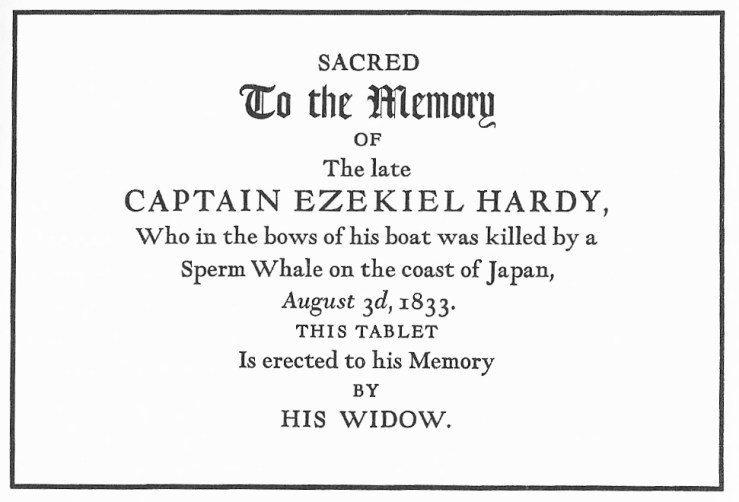
Ishmael gazes upon marble placards memorializing dead sailors, sailors who never returned, and reflects,

Oh! ye whose dead lie buried beneath the green grass; who standing among flowers can say—here, here lies my beloved; ye know not the desolation that broods in bosoms like these. What bitter blanks in those black-bordered marbles which cover no ashes! What despair in those immovable inscriptions! What deadly voids and unbidden infidelities in the lines that seem to gnaw upon all Faith, and refuse resurrections to the beings who have placelessly perished without a grave.

The line “refuse resurrections” calls back to Ch. 4, “The Counterpane,” where Ishmael gives us a rare glimpse into his past. Punished as a child to a kind of small death on the summer solstice (okay, he’s made to go to bed early)—the punished Ish hopes for a “resurrection” from his fate and is visited by some “nameless, unimaginable, silent form or phantom,” an ineffable something that simultaneously signals dread and hope.

Ishmael’s morbid pondering turns philosophical:

…how it is that we still refuse to be comforted for those who we nevertheless maintain are dwelling in unspeakable bliss; why all the living so strive to hush all the dead; wherefore but the rumor of a knocking in a tomb will terrify a whole city. All these things are not without their meanings.

And then in bit of foreshadowing of the book’s catastrophic conclusion, our narrator, thinking of the countless sailors lost and dead at sea, indulges in a bit of self-talk: “Yes, Ishmael, the same fate may be thine.”

V. “The Pulpit” isn’t a particularly memorable chapter, but it serves a significant rhetorical purpose. “The Chapel” gives us some of Ish’s most melancholy philosophizin’, culminating in self-talk about his own death. It’s an introspective, insular chapter; indeed, even as Ishmael furnishes us the details of the memorial placards, he confesses that he does “not pretend to quote.” Ish’s concern is ultimately not for the concrete particulars but for the abstract—the unnamed and unknown dead.

“The Pulpit” refocuses the narrative gaze, moving from Ishmael’s introspection to the imagery of Father Mapple ascending the stage to deliver his sermon.

VI. “The Sermon” is one of many chapters of Moby-Dick that can be read independent of the novel proper. It is one of my favorite chapters. Up until this point, we’ve largely been in Ishmael’s head, and the spare voices we get—a few lines of pidgin from Queequeg, some bantering with Peter Coffin—have the feel of reported speech. In “The Sermon” though, Ish’s consciousness gives way to Father Mapple’s. Mapple retells the story of Jonah in rapt detail, bringing “this book, containing only four chapters—four yarns—” to vivid life. His Jonah is a sympathetic deject on the run who finds himself resurrected in the belly of a whale.

Mapple’s sermon quickly edges out any of Ishmael’s stage directions, flowing out uninterrupted for paragraphs. It usurps the voice of the novel, prefiguring Ahab, whose voice will dominate in future chapters. Ghostly Ishmael seems to fall into the background of his own adventure at times, and “The Sermon” is an early rhetorical example of this phenomenon.

As Mapple’s sermon comes to its conclusion, Ishmael returns to the narrative, but he’s still at a distance, still a mechanical describer of sights and sounds, not an analyzer or thinker here.

And it’s the final line of the chapter that stuck out to me the most in this reread:

He said no more, but slowly waving a benediction, covered his face with his hands, and so remained kneeling, till all the people had departed, and he was left alone in the place.

If he is truly alone, then how does Ishmael witness his solitude?

The great flood-gates of the wonder-world swung open | Riff 1 on rereading Herman Melville’s Moby-Dick (Etymology/Extracts/Loomings)

Moby-Dick illustration by Barry Moser


I. I last reread Herman Melville’s 1851 novel Moby-Dick in full way back in 2013.

II. I’ve read chunks and excerpts of it over the intermittent seven years though—there’s always some bit in it that calls to me, prompted by events personal, political, cultural. I read Melville’s 1846 novel Typee during the beginning of 2020’s quarantine, and knew I’d need to reread M-D in full sooner than later.

III. (Why later, why now? I guess I made this kinda sorta tacit promise to myself not to reread in 2020—to expand my palate, to go past all the Dead White Guys.)

IV. I started Moby-Dick this afternoon. I read the two opening salvos, “Etymology” and “Extracts,” and then the first chapter, “Loomings.”

V. (I have read that some folks skip the “Extracts”: No.)

VI. I started Moby-Dick in an edition that I bought years ago but haven’t actually read: the California UP/Arion Press edition with Barry Moser illustrations. It’s lovely—grand, generous, rich on the page.

VII. So I’ve probably read “Etymology” more than any other section of M-D. It was certainly the section I messed around with for years before reading the actual novel in full. The etymology has supposedly been given to the author of M-D — HM? Ishmael? Some other ghost — by a “pale Usher” (not Poe’s), “threadbare in coat, heart, body, and brain…” The poor fellow “loved to dust his old grammars; it somehow mildly reminded him of his mortality.”

VIII. I don’t dwell on the pale Usher, but I’ve long found the next line of “Etymology” fascinating. It’s a quote attributed to the sixteenth-century English author Richard Hakluyt:

While you take in hand to school others, and to teach them by what name a whale-fish is to be called in our tongue, leaving out, through ignorance, the letter H, which almost alone maketh up the signification of the word, you deliver that which is not true.

A former teacher of mine, A. Samuel Kimball (who I am forever indebted to for teaching me to read again) made much of this citation. For Kimball, the foregrounding of the “H” calls attention to one of Melville’s central themes: whaling as wailing—Moby-Dick as a wail, a grief, maybe a resistance to the infanticidal, genocidal scope of American culture. Ishmael, an orphan, goes to sea to resist his suicide-impulse on a ship named after a near-extinct tribe of American Indians. Ishmael, whose very name is marks him, at least in the KJV context Melville was working within, as the rejected son of the patriarch Abraham. In the novel’s last moments, Ishmael is saved (is he though?) by the ship the Rachel, which, “in her retracing search after her missing children, only found another orphan.”

IX. (Whale-wail / whiteness-witness. Etc. etc.)

X. And those “Extracts,” supplied by a “burrower and grub-worm of a poor devil of a Sub-Sub” — who’s the dom?

XI. I remembered the “Extracts” more fondly than I experienced them.

I just really wanted to get into Ishmael’s head (voice). (And then get out of it, into the drama of Ahab and His Whale.)

XII. And so I got into Ishmael’s head (voice).

XIII. “Loomings” is such a great, great, perfect chapter, and the joy in re-reading Melville is having already worked out most of the plot kinks. Instead of dwelling on What is happening? you can experience What is.

XIV. (I always forget how terribly sad poor Ish is at the outset of M-D. He’s depressed, suffering from hypos, the spleen. He’s not just suicidal, he’s homicidal, wanting to step in the street and knock people’s hats off.)

XV. One of the fascinating things about Moby-Dick, at least in my memory of it, which maybe I’ll expand upon in riffs on this reread, is how little we get to know Ishmael. Like his wanderer namesake, he’s an outsider who, despite taking us in to his tale, nevertheless keeps us out: We know very little about his past or his future, and his present (by which I mean Moby-Dick) is mediated in voyeurism, questioning, and philosophy.

XVI. And “Loomings” — well, what a great title, maybe obvious, but great — the indistinct coming into view, but also the mount of the warp, the initial move in a great tapestry: Moby-Dick.

XVII. I’ll close on the closing line of “Loomings,” which point to the great wonder-world to come, and the grand hooded phantom at the end of Ishmael’s journey:

By reason of these things, then, the whaling voyage was welcome; the great flood-gates of the wonder-world swung open, and in the wild conceits that swayed me to my purpose, two and two there floated into my inmost soul, endless processions of the whale, and, mid most of them all, one grand hooded phantom, like a snow hill in the air.

Happy New Year! // Some books I’ll try to read/re-read in 2021

Happy New Year!

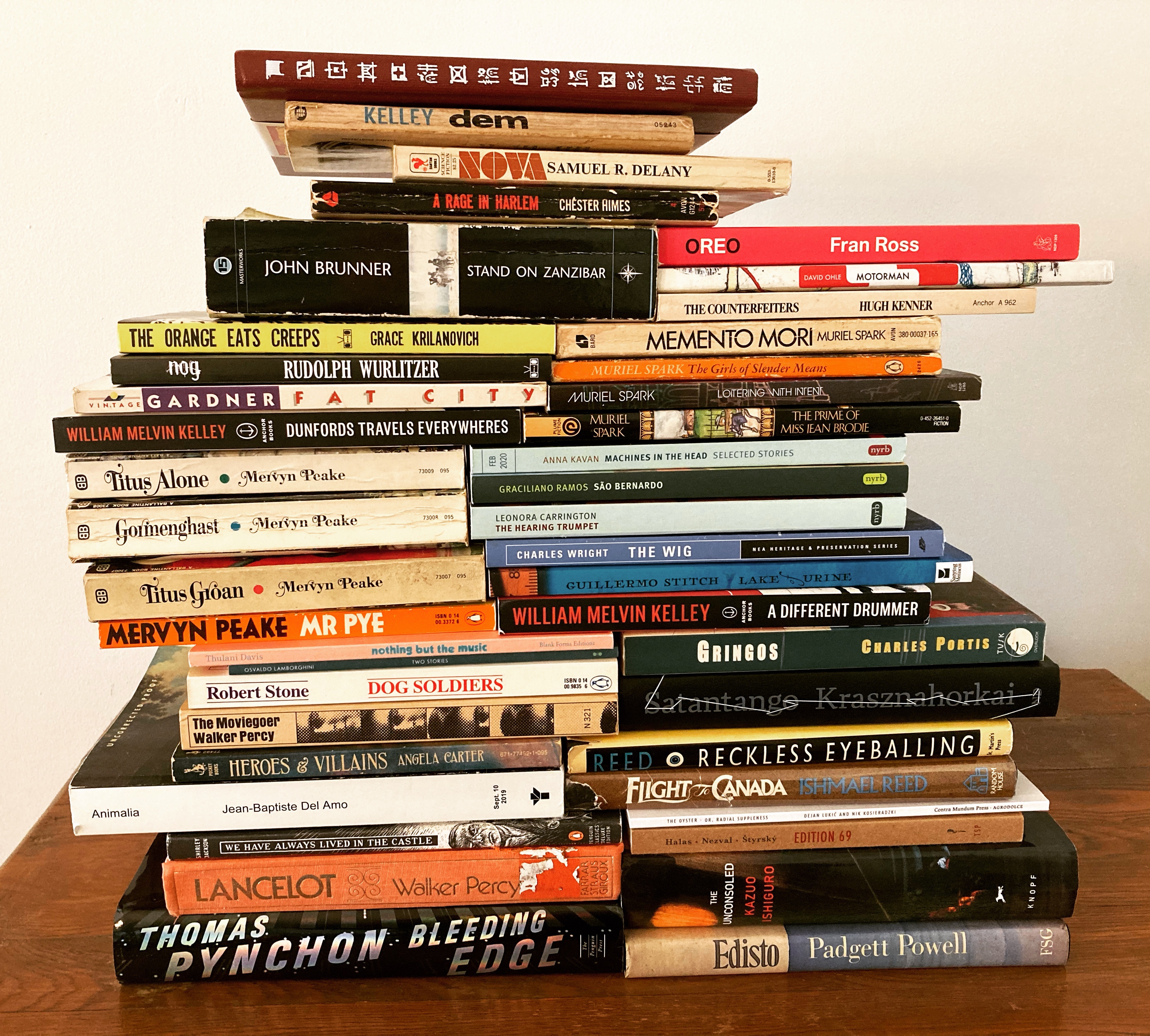
Time for the cliched “Stuff I May or May Not Read This Year” post!

Bottom to top–

A Frolic of His Own is the only Gaddis I haven’t read. I read the first fifty or so pages a few years ago, but got distracted with something else.

I haven’t re-read Moby-Dick in a few years, but I found myself sifting through it a bit at the end of 2020. Time for a re-read, sooner than later.

I’ll continue the Walker Percy reading with The Last Gentleman.

I actually finished Chester Himes’s The Real Cool Killers about 45 minutes ago—it’s a wonderful mix of breezy brutality and brutal humor. This one had an unexpectedly sweet ending. More Himes in 2021.

I’ve been reading through Anakana Schofield’s novel in “warnings,” Bina, and I really dig it so far—very different stuff. It reminds me a bit of Claire-Louise Bennett’s Pond or Helen DeWitt’s The Last Samurai or David Markson’s Wittgenstein’s Mistress, but also unlike those things.

I read a bunch of Muriel Spark in 2020 and I aim to read more in 2021. The ones I have (unread) by her are Robinson and A Far Cry from Kensington.

I also look forward to Azareen Van der Vliet Oloomi’s short novel Fra Keeler as well.

I hope this year is better for all of us than the last one. Peace and love &c.

Annotations on a list of books I read in full in 2020

2d27b454-7e45-4ffc-8faf-1c2ba9bda56a


Flight to Canada, Ishmael Reed

A frenetic, zany achronological satire of the American Civil War. I wrote about it here.

We Have Always Lived in the Castle, Shirley Jackson

Jackson gives us a quasi-idyllic-but-also-dystopian world delivered through narrator Merricat, an insane witch whom I adored. Merricat hates with beautiful intensity. The novel’s premise, prose, and mood are more important than its plot, which is littered with trapdoors, smoke and mirrors, and gestures toward some kind of greater gothic paranoia. It’s a slim novel that feels like 300 pages of exposition have been cut away, leaving only mystery, aporia, ghostly traces of maybe-answers.

Titus Groan, Mervyn Peake

The first of Mervyn Peake’s strange castle (and then not-castle trilogy (not really a trilogy, really)), Titus Groan is weird wonderful grotesque fun. Inspirited by the Machiavellian antagonist Steerpike, Titus Groan can be read as a critique of the empty rituals that underwrite modern life. It can also be read for pleasure alone.

926 Years, Tristan Foster and Kyle Coma-Thompson

The blurb on the back of 926 Years describes the book as “twenty-two linked stories,” but it read it not so much as a collection of connected tales, but rather as a kind of successful experimental novel, a novel that subtly and reflexively signals back to its own collaborative origin. My review is here.

Anasazi, Mike McCubbins and Matt Bryan

One of the best books I read (and reread) all year. The joy of Anasazi is sinking into its rich, alien world, sussing out meaning from image, color, and glyphs. This graphic novel has its own grammar. Bryan and McCubbins conjure a world reminiscent of Edgar Rice Burroughs’ Martian novels, Charles Burns’ Last Look trilogy, Kipling’s Mowgli stories, as well as the fantasies of Jean Giraud.

Machines in the Head, Anna Kavan

I have a longish review here.

Machines in the Head was the first book I was able to write about after the onset of the Great Quarantine of 2020.

Gormenghast, Mervyn Peake

Probably the best novel in Peake’s trilogy, Gormenghast is notable for its psychological realism, surreal claustrophobia, and bursts of fantastical imagery. We finally get to know Titus, who is a mute infant in the first novel, and track his insolent war against tradition and Steerpike. The novel’s apocalyptic diluvian climax is amazing.

Gringos, Charles Portis

Gringos was the last of Portis’s five novels. I read the other four greedily last year, and pulled them all out when he passed away in February. I started in on Gringos, casually, then just kept reading. Sweet and cynical, spiked with strange heroism, strange grace, and very, very funny, Gringos might just be my favorite Portis novel. But I’d have to read them all again to figure that out.

Titus Alone, Mervyn Peake

A beautiful mess, an episodic, picaresque adventure that breaks all the apparent rules of the first two books. The rulebreaking is fitting though, given that Our Boy Titus (alone!) navigates the world outside of Gormenghast—a world that doesn’t seem to even understand that a Gormenghast exists (!)—Titus Alone is a scattershot epic. Shot-through with a heavy streak of Dickens, Titus Alone never slows down enough for readers to get their bearings. Or to get bored. There’s a melancholy undercurrent to the novel. Does Titus want to get back to his normal—to tradition and the meaningless lore and order that underwrote his castle existence? Or does he want to break quarantine? 

The Wig, Charles Wright

Hilarious stuff. I read most of it on a houseboat in Jekyll Island, right before lockdown.

Nog, Rudolph Wurlitzer

 Rudolph Wurlitzer’s 1969 cult novel Nog is druggy, abject, gross, and shot-through with surreal despair, a Beat ride across the USA. Wurlitzter’s debut novel is told in a first-person I that constantly deconstructs itself, then reconstructs itself, then wanders out into a situation that atomizes that self again.

I should’ve loved it, but I didn’t.

I reviewed it here.

Herman Melville, Elizabeth Hardwick

Typee, Herman Melville

Like a lot of people I was going out of my mind in April of 2020. Elizabeth Hardwick’s lit-crit bio of Melville isn’t necessarily great, but she does work in big fat slices of his texts, making it a kind of comfort read. It also led me to read Typee for the first time, a horny and good novel.

Fade Out, Rudolph Wurlitzer

I liked it more than Nog and wrote about it here.

Welcome Home, Lucia Berlin

A slight and unfinished collection of memoir-slices that will appeal to those already familiar with Berlin’s autofiction.

Reckless Eyeballing, Ishmael Reed

Reed’s 1986 novel skewers Reaganism, but there’s a marked shift from the surreal elastic slapstick anger of Reed’s earlier novels (like 1972’s Mumbo Jumbo). That elastick anger starts to harden into something far more bitter, harder to chew on.

Lake of Urine, Guillermo Stitch

A very weird book. I felt awful that I could never muster a proper review of it. Weird book, indie press, all that. I felt less bad when Dwight Garner praised it in The New York Times. What is Lake of Urine? That was my trouble in reviewing it. The plot is, uh, wild, to say the least. Zany, elastic, slapstick, and often surreal, Stitch’s novel is all over the place. He seems to do whatever he wants on each page with a zealous energy that’s difficult to describe. Great stuff.

Mr. Pye, Mervyn Peake

I recall enjoying it but thinking, Oh, this isn’t Gormenghast stuff.

Bleeding Edge, Thomas Pynchon

I wrote about it here. What may end up being the last Pynchon novel was also the last one I read. It turned out to be much, much better than I thought it would be. It also made me very, very sad. It reminded me of our huge ideological failure after 9/11, an ideological failure we are watching somehow fail even more today.

São Bernando,Graciliano Ramos; translation by Padma Viswanathan

I enjoyed São Bernardo  mostly for the narrator’s voice (which reminded me very much of Al Swearengen of Deadwood). Through somewhat nefarious means, Paulo Honorio takes over the run-down estate he used to toil on, restores it to a fruitful enterprise, screws over his neighbors, and exploits everyone around him. He decries at one point that “this rough life…gave me a rough soul,” which he uses as part confession and part excuse for his failure to evolve to the level his younger, sweeter wife would like him to. São Bernardo is often funny, but has a mordant, even tragic streak near its end. Ultimately, it’s Honorio’s voice and viewpoint that engages the reader. He paints a clear and damning portrait of himself and shows it to the reader—but also shows the reader that he cannot see himself.

The Unconsoled, Kazuo Ishiguro

Kazuo Ishiguro’s The Unconsoled is over 500 pages but somehow does not read like a massive novel, partly, I suppose, because the novel quickly teaches you how to read the novel. The key for me came about 100 pages in, when the narrator goes to a showing of 2001: A Space Odyssey starring Clint Eastwood and Yul Brynner. There’s an earlier reference to a “bleeper” that stuck out too, but it’s at the precise moment of this alternate 2001 that The Unconsoled’s just-slightly-different universe clicked for me. Following in the tradition of Kafka’s The Castle, The Unconsoled reads like a dream-fever set of looping deferrals. Our narrator, Ryder, is (apparently) a famous pianist who arrives at an unnamed town, where he is to…do…something?…to help restore the town’s artistic and aesthetic pride. (One way we know that The Unconsoled takes place in an alternate reality is that people care deeply about art, music, and literature.) However, Ryder keeps getting sidetracked, entangled in promises and misunderstanding, some dark, some comic, all just a bit frustrating. There’s a great video game someone could make out of The Unconsoled—a video game consisting of only side quests perhaps. Once the reader gives in to The Unconsoled’s looping rhythms, there’s an almost hypnotic pleasure to the book. Its themes of family disappointment, artistic struggle, and futility layer like musical motifs, ultimately suggesting that the events of the novel could take place entirely in Ryder’s consciousness, where he orchestrates all the parts himself. Under the whole thing though is a very conventional plot though—think a Kafka fanfic version of Waiting for Guffman.

The Counterfeiters, Hugh Kenner

I wanted to like it a lot more than I did.

Animalia, Jean-Baptiste Del Amo; translation by Frank Wynne

Animalia begins in rural southwest France at the end of the nineteenth century, and ends at the end of the twentieth century, chronicling the hardships of a family farm. The preceding sentence makes the novel sound possibly hokey: No, Animalia is a visceral, naturalistic, and very precise rendering of humans as animals. I had to read Animalia in stages, essentially splitting its four long chapters into novellas. Animalia made me physically ill at times. It’s an excellent novel.

The Prime of Miss Jean Brodie, Muriel Spark

Loved it! Can’t believe I hadn’t read Spark until 2020. Went on a binge.

The Girls of Slender Means, Muriel Spark

I liked it even more than Prime. Slender Means unself-consciously employs postmodern techniques to paint a vibrant picture of what the End of the War might feel like. The climax coincides with the bombings of Hiroshima and Nagasaki, the title takes on a whole new meaning, and the whole thing unexpectedly ends in a negative religious epiphany.

Loitering with Intent, Muriel Spark

My favorite of the four I read by Spark this year: funny, mean, angry postmodern perfection.

Memento Mori, Muriel Spark

A novel that about aging, memory, loss, and coming to terms with death. I was surprised to learn that this was Spark’s third novel, and that she would’ve been around 41—my age—when it was published. Most of the characters are over seventy, and Spark inhabits their consciousnesses with a level of acuity that surprised me. The weakest of the four I read, but still good.

Cherry, Nico Walker

I initially liked Walker’s war-drug-crime-romance-autoficition Cherry–the sentences are zappers and the wry, deadpan delivery approximates an imitation of Denis Johnson. Halfway through the charm starts to wear off; its native ugliness fails to compel, even Walker keeps pushing for the sublime in each chapter, only to puncture it in some way. I probably would’ve liked it at 20.

Skin Folk, Nalo Hopkinson

A mixed bag of fantasy and sci-fi stories based on Caribbean myth, some more successful than others. “A Habit of Waste” and “Slow Cold Chick” are standouts.

Zeroville, Steve Erickson

An excellent novel about film. Does in fiction what Peter Biskind’s history of New Hollywood, Easy Riders, Raging Bulls could not. Zeroville’s unexpectedly-poignant ending transcends the novel’s parodic parameters. It makes you want to go to the movies.

Citizen, Claudine Rankine

A discursive prose-poem-memoir-essay on racism, erasure, bodies, and more. I read it in two afternoons. Highly recommended.

The Divers’ Game, Jesse Ball

I kept waiting for the chapters of Ball’s “novel” to explicitly tangle together, but they never did. One of the very few cases where I feel there should be more pages in a book.

Nova, Samuel R. Delany

I couldn’t make it through Delany’s cult favorite Dhalgren a few years back, but Nova was easier sledding. The book is a riff on Moby-Dick, tarot, monoculture, and the grail quest. It’s jammed with ideas and characters, and if it never quite coheres into something transcendent, it’s a fun quick read (even if the ending, right from the postmodern metatextual playbook is too clever by half).

Zac’s Drug Binge, Dennis Cooper

I don’t know if Dennis Cooper’s gif novels are really novels or something else. I’m not sure if putting this gif novel on a list of books I read is any different than adding, say, a list of paintings by Mu Pan that I viewed over the year. The inclusion of ZDB also helps highlight the artificiality of a numbered list of books read in a year. (I know this list isn’t numbered, but it’s countable. I think it’s fifty-seven or fifty-eight.) It took me maybe 10 or 15 minutes to “read” ZBD while novels by Ishiguro, Pynchon, and Brunner are like 500 pages. The Ishiguro is actually pretty “easy” to read though, in a way that Zac’s Drug Binge is not. The Brunner is much “easier” than the many, many stories I read this year in The Complete Gary Lutz. The Lutz is 500 pages, and I read more of those pages than I did of some of the shorter works listed here like Rankine’s Citizen or Ball’s The Divers’ Game—but I didn’t “finish” the Lutz (and I don’t want to ever “finish” the Lutz), so its not on the list. Ditto Brian Dillon’s essay collection Suppose a Sentence, another collection that I’ve used to cleanse my palate between books. I could probably do a whole post on books like that (John Domini’s The Sea-God’s Herb, the Charles Portis Miscellany, The Minus Times Collected, etc. etc.)

You can read Zac’s Drug Binge here (and, uh, careful who you’re around if you click this link!).

Oreo, Fran Ross

Loved loved loved Oreo. The novel is thoroughly overlooked as a metafictional masterpiece. In my review, I wrote:

“Fran Ross’s 1974 novel Oreo is an overlooked masterpiece of postmodern literature, a delicious satire of the contemporary world that riffs on race, identity, patriarchy, and so much more. Oreo is a pollyglossic picaresque, a metatextual maze of language games, raps and skits, dinner menus and vaudeville routines. Oreo’s rush of language is exuberant, a joyful metatextual howl that made me laugh out loud. Its 212 pages galloped by, leaving me wanting more, more, more.”

A Different Drummer, William Melvin Kelley

I read it after Oreo…Oreo is neon zany polyglossic hijinks, crackling, zipping, and zapping. Kelley’s first novel, despite its rotating set of viewpoints (and conceit of an invented Southern state), was much more down to earth—modernist, not postmodernist—rendered in rusty oranges, dusty browns, muted greens. I enjoyed Kelley’s later novels dem and Dunfords Travels Everywheres more, but A Different Drummer could be his best book. I wrote about it here.

A Rage in Harlem, Chester Himes

Gonna read more Himes in 2021. Any tips? I loved loved loved it.

dem, William Melvin Kelley

From my review:

“As its subheading attests, dem is, like Drummer, a take on white people viewing black people, and over a half-century after its publication, many of the tropes Kelley employs here still ring painfully true. His “hero,” Mitchell Pierce is a lazy advertising executive, bored with his wife, a misogynist who occasionally longs to return to the “wars in Asia.” He’s also deeply, profoundly racist; structurally racist; the kind of racist who does not think of his racism as racism. At the same time, Kelley seems to extend little parcels of sympathy to Pierce, even as he reveals the dude to be a piece of shit, as if to say, What else could he end up being in this system but a piece of shit?“

Sátántangó, László Krasznahorkai; translation by George Szirtes

Years ago I put Sátántangó on a list of books I started the most times without finishing.  This summer I listened to the audiobook version while I painted the interior of my house. The novel’s postmodern ending made me pick up the physical copy I acquired like eight years ago, making Sátántangó the only novel I re-read this year.

Edition 69, Jindřich Štyrský, Vítězslav Nezval, František Halas, and Bohuslav Brouk; translation by Jed Slast

Hey yo you like horny Czech interwar surrealism?

Lancelot, Walker Percy

The first Percy I read, and so far, my favorite–a postmodern Gothic screed against postmodernity. I reviewed it here.

The Moviegoer, Walker Percy

Percy’s first novel is probably much better than I credited in my review, but I was disappointed after the claustrophobic zany madness of Lancelot. I think if The Moviegoer were the first Percy I read it would have been the last.

Dunfords Travels Everywheres, William Melvin Kelley

My favorite of the three Kelley novels I read this year.

Edisto, Padgett Powell

 I read most of Padgett Powell’s 1984 debut Edisto in a few sittings, settling down easily into its rich evocation of a strange childhood in the changing Southern Sea Islands. I’d always been ambivalent about Powell, struggling and failing to finish some of his later novels (Mrs. Hollingsworth’s Men; The Interrogative Mood), but Edisto captured me from its opening lines. The story takes two simple tacks–it’s a coming of age tale as well as a stranger-comes-to-town riff. Powell’s sentences are lively and invigorating; they show refinement without the wearing-down of being overworked. The book is fresh, vital.

When I finished Edisto, I thought I’d go for some more early Padgett. I picked up his second novel, A Woman Named Drown, started it that afternoon, and put it down 70 pages later the following afternoon. There wasn’t a single sentence that made me want to read the next sentence. Worse, it was turning into an ugly slog, a kind of attempt to refine Harry Crews’s dirty south into something closer to grimy eloquence. I like gross stuff, but this wasn’t my particular flavor.

The Orange Eats Creeps, Grace Krilanovich

I remember buying this book very clearly. The yellow spine called to me; the fact it was a Two Dollar Radio title; the title itself; and then, the blurb from Steve Erickson. From my review:

“Krilanovich’s novel is coated in brown-grey paste, an accumulation of scum and cum and blood, a vampiric solution zapped by orange bolts of sex, pain, drugs, and rocknroll. It’s a riot grrrl novel, a psychobilly novel, a crustgoth novel. It’s a fragmented, ugly, revolting mess and I loved it. The Orange Eats Creeps is ‘A vortex of a novel,’ as Steve Erickson puts it in his introduction, that will alternately suck in or repel readers.”

The Silence, Don DeLillo

In my unkind review, I wrote:

“The Silence is a slim disappointment, a scant morality play whose thinly-sketched characters speak at (and not to) each other liked stoned undergrads. At least it’s short.”

Motorman, David Ohle

David Ohle’s lean mean mutant Motorman is a dystopia carved from strange stuff. Ohle’s cult novel leaves plenty of room for the reader to wonder and wander around in. Abject, spare, funny, and depressing, Motorman sputters and jerks on its own nightmare logic. Its hapless hero Moldenke anti-quests through an artificial world, tumbling occasionally into strange moments of agency, but mostly lost and unillusioned in a broken universe. I loved it.

Two Stories, Osvaldo Lamborghini; translation by Jessica Sequeira

Not sure if I found a book so baffling all year.

Stand on Zanzibar, David Brunner

John Brunner’s big fat dystopian novel Stand on Zanzibar frankly overwhelmed me and then sorta underwhelmed me there at the end. This sci-fi classic is a big weird shaggy dog that managed to predict the future in all kinds of ways, and it’s mean and funny, but it’s also bloated and booming, the kind of novel that sucks all the air out of the room. It’s several dozen essays dressed up as sci-fi adventure—not a bad deal in and of itself—but there’s very little space left for the reader

Fat City, Leonard Gardner

Fat City is about an “old” boxer (he’s not thirty) on the way out of his career and a young boxer on the rise. (Rise here is a really suspect term.) I really can’t believe I was 41 when I read this. I should’ve read it at 20. I wouldn’t have understood it the same way, of course, and the biggest sincerest compliment I can pin on the novel is that I would’ve loved it at 20 but I know that I would’ve appreciated it more 20 years later. There are plenty of novels that I read and think, Hmm, would’ve loved this years ago, but now, nah, but Fat City is wonderful. It’s a boxing story, sure, but it’s really a book about bodies breaking down, aging, getting stuck in dreams and fantasies. Gardner’s only novel (!) is simultaneously mock-tragic and real tragic, pathetic and moving, and very very moving. Great stuff.

Dog Soldiers, Robert Stone

I read Robert Stone’s Dog Soldiers on the late David Berman’s recommendation) and loved it. Set at the end of the Vietnam War, Dog Soldiers is about a heroin deal going sideways. The CIA is involved, some twisted Hollywood folks, and a fallen cult leader. Everyone’s a bit grimy. I guess it comes from the Hemingway tree, or really, maybe, the Stephen Crane tree—Denis Johnson’s tree, Leonard Gardner’s tree, Raymond Carver’s tree, etc. It reminded me a lot of Johnson’s Angels (and, to some extent, Tree of Smoke), but also Russell Banks’s 1985 novel Continental Drift—and Gardner’s Fat City.

Dog Soldiers gets better and better and ends with an ecstatic punchline—a big Fuck you to God in the whirlwind. Great stuff.

Nothing but the Music, Thulani Davis

In my review, I wrote:

“Nothing but the Music cooks raw joy and raw pain into something sublime. I like poems best when they tell stories, and Davis is a storyteller. The poems here capture place and time, but most of all sound, sound, rhythm, and sound. Lovely stuff.”

Love in the Ruins, Walker Percy

Loved this one—more in line with the madness of Lancelot than the ennui of The Moviegoer, Love in the Ruins posits a USA falling apart to reveal there never was a center.

The Hearing Trumpet, Leonora Carrington

From my review:

“Leonora Carrington’s novel The Hearing Trumpet begins with its nonagenarian narrator forced into a retirement home and ends in an ecstatic post-apocalyptic utopia “peopled with cats, werewolves, bees and goats.” In between all sorts of wild stuff happens. There’s a scheming New Age cult, a failed assassination attempt, a hunger strike, bee glade rituals, a witches sabbath, an angelic birth, a quest for the Holy Grail, and more, more, more.”

The Oyster, Dejan Lukic and Nik Kosieradzki

I still need to write a proper review of this one. It’s something between an essay and a prose-poem and an aesthetic object.

Heroes and Villains, Angela Carter

One of Carter’s earlier novels, Heroes and Villains takes place in a post-apocalyptic world where caste lines divide the Professors, the Barbarians, and the mutant Out People. After her Professor stronghold is raided, Marianne is…willingly abducted?…by the barbarian Jewel. Marianne goes to live with the Barbarians, and ends up in a weird toxic relationship with Jewel, marked by rape and violence. Heroes and Villains throws a lot in its pot—what is consent? what is civilization? what is language?—but it’s a muddled, psychedelic mess in the end.

Just Us, Claudia Rankine

A short, sometimes painful read, Just Us is a mix of essaying and poetry that documents the horrors of the past few years against the backdrop of the horrors of all American history, all in a personal, moving way.

Lolly Willowes, Sylvia Townsend Warner

Starts subtle and ends sharp. A mix of satire and earnestness, purely modern, wonderful stuff. Our hero surmises at the end that Satan might actually be quite stupid. I love her.


[Ed. note–some of the language of these annotations has been recycled from previous posts.]

Chester Himes/Azareen Van der Vliet Oloomi (Books acquired, 28 Dec. 2020)

Picked up Chester Himes’s The Real Cool Killers and Azareen Van der Vliet Oloomi’s Fra Keeler today. I did not find the novel I was looking for but I found these.

Here’s publisher Dorothy’s blurb for Fra Keeler:

 …a man purchases a house, the house of Fra Keeler, moves in, and begins investigating the circumstances of the latter’s death. Yet the investigation quickly turns inward, and the reality it seeks to unravel seems only to grow more strange, as the narrator pursues not leads but lines of thought, most often to hideous conclusions.

I loved the first Chester Himes novel I read, A Rage in Harlem. Here’s Anthony Bucher’s somewhat dismissive non-review in the 6 Sept. 1959 issue of The New York Times:

I think I’ll be on the loving side, but we’ll see.

It’s Boxing Day (Gravity’s Rainbow)

Inside the bowl, the two goldfish are making a Pisces sign, head-to-tail and very still. Penelope sits and peers into their world. There is a little sunken galleon, a china diver in a diving suit, pretty stones and shells she and her sisters have brought back from the sea.

Aunt Jessica and Uncle Roger are out in the kitchen, hugging and kissing. Elizabeth is teasing Claire in the hallway. Their mother is in the W.C. Sooty the cat sleeps in a chair, a black thundercloud on the way to something else, who happens right now to look like a cat. It’s Boxing Day. The evening’s very still. The last rocket bomb was an hour ago, somewhere south. Claire got a golliwog, Penelope a sweater, Elizabeth a frock that Penelope will grow into.

The pantomime Roger took them all to see this afternoon was Hansel and Gretel. Claire immediately took off under the seats where others were moving about by secret paths, a flash of braid or of white collar now and then among the tall attentive uncles in uniform, the coat-draped backs of seats. On stage Hansel, who was supposed to be a boy but was really a tall girl in tights and smock, cowered inside the cage. The funny old Witch foamed at the mouth and climbed the scenery. And pretty Gretel waited by the Oven for her chance. . . .

Then the Germans dropped a rocket just down the street from the theatre. A few of the little babies started crying. They were scared. Gretel, who was just winding up with her broom to hit the Witch right in the bum, stopped: put the broom down, in the gathering silence stepped to the footlights, and sang:

Oh, don’t let it get you,

It will if they let you, but there’s

Something I’ll bet you can’t see—

It’s big and it’s nasty and it’s right over there,

It’s waiting to get its sticky claws in your hair!

Oh, the greengrocer’s wishing on a rainbow today,

And the dustman is tying his tie . . .

And it all goes along to the same jolly song,

With a peppermint face in the sky!

“Now sing along,” she smiled, and actually got the audience, even Roger, to sing:

With a peppermint face in the sky-y,

And a withered old dream in your heart,

You’ll get hit with a piece of the pie-ie,

With the pantomime ready to start!

Oh, the Tommy is sleeping in a snowbank tonight,

And the Jerries are learning to fly—

We can fly to the moon, we’ll be higher than noon,

In our polythene home in the sky. . . .

Pretty polythene home in the sky,

Pretty platinum pins in your hand—

Oh your mother’s a big fat machine gun,

And your father’s a dreary young man. . . .

(Whispered and staccato):

Oh, the, man-a-ger’s suck-ing on a corn-cob, pipe,

And the bank-ers are, eat-ing their, wives,

All the world’s in a daze, while the orchestra plays,

So turn your pockets and get your surprise—

Turn your pockets and get-your surpri-ise,

There was nobody there af-ter all!

And the lamps up the stairway are dying,

It’s the season just after the ball . . .

Oh the palm-trees whisper on the beach somewhere,

And the lifesaver’s heaving a sigh,

And those voices you hear, Boy and Girl of the Year,

Are of children who are learning to die. . . .

From Thomas Pynchon’s 1973 novel Gravity’s Rainbow.

On Christmas Eve the little pig is secretly killed (Frazer’s The Golden Bough)

On Christmas Eve in some parts of the Esthonian island of Oesel they bake a long cake with the two ends turned up. It is called the Christmas Boar, and stands on the table till the morning of New Year’s Day, when it is distributed among the cattle. In other parts of the island the Christmas Boar is not a cake but a little pig born in March, which the housewife fattens secretly, often without the knowledge of the other members of the family. On Christmas Eve the little pig is secretly killed, then roasted in the oven, and set on the table standing on all fours, where it remains in this posture for several days. In other parts of the island, again, though the Christmas cake has neither the name nor the shape of a boar, it is kept till the New Year, when half of it is divided among all the members and all the quadrupeds of the family. The other half of the cake is kept till sowing-time comes round, when it is similarly distributed in the morning among human beings and beasts. In other parts of Esthonia, again, the Christmas Boar, as it is called, is baked of the first rye cut at harvest; it has a conical shape and a cross is impressed on it with a pig’s bone or a key, or three dints are made in it with a buckle or a piece of charcoal. It stands with a light beside it on the table all through the festal season. On New Year’s Day and Epiphany, before sunrise, a little of the cake is crumbled with salt and given to the cattle. The rest is kept till the day when the cattle are driven out to pasture for the first time in spring. It is then put in the herdsman’s bag, and at evening is divided among the cattle to guard them from magic and harm. In some places the Christmas Boar is partaken of by farm-servants and cattle at the time of the barley sowing, for the purpose of thereby producing a heavier crop.

From Sir James George Frazer’s The Golden Bough.

A review of Leonora Carrington’s surreal novel The Hearing Trumpet

Leonora Carrington’s novel The Hearing Trumpet begins with its nonagenarian narrator forced into a retirement home and ends in an ecstatic post-apocalyptic utopia “peopled with cats, werewolves, bees and goats.” In between all sorts of wild stuff happens. There’s a scheming New Age cult, a failed assassination attempt, a hunger strike, bee glade rituals, a witches sabbath, an angelic birth, a quest for the Holy Grail, and more, more, more.

Composed in the 1950s and first published in 1974, The Hearing Trumpet is new in print again for the first time in nearly two decades from NYRB. NYRB also published Carrington’s hallucinatory memoir Down Below a few years back, around the same time as Dorothy issued The Complete Stories of Leonora Carrington. Most people first come to know Carrington through her stunning, surreal paintings, which have been much more accessible (because of the internet) than her literature. However, Dorothy’s Complete Stories brought new attention to Carrington’s writing, a revival continued in this new edition of The Hearing Trumpet.

Readers familiar with Carrington’s surreal short stories might be surprised at the straightforward realism in the opening pages of The Hearing Trumpet. Ninety-two-year-old narrator Marian Leatherby lives a quiet life with her son and daughter-in-law and her tee-vee-loving grandson. They are English expatriates living in an unnamed Spanish-speaking country, and although the weather is pleasant, Marian dreams of the cold, “of going to Lapland to be drawn in a vehicle by dogs, woolly dogs.” She’s quite hard of hearing, but her sight is fine, and she sports “a short grey beard which conventional people would find repulsive.” Conventional people will soon be pushed to the margins in The Hearing Trumpet.

Marian’s life changes when her friend Carmella presents her with a hearing trumpet, a device “encrusted with silver and mother o’pearl motives and grandly curved like a buffalo’s horn.” At Carmella’s prompting, Marian uses the trumpet to spy on her son and daughter-in-law. To her horror, she learns they plan to send her to an old folks home. It’s not so much that she’ll miss her family—she directs the same nonchalance to them that she affords to even the most surreal events of the novel—it’s more the idea that she’ll have to conform to someone else’s rules (and, even worse, she may have to take part in organized sports!).

The old folks home is actually much, much stranger than Marian could have anticipated:

First impressions are never very clear, I can only say there seemed to be several courtyards , cloisters , stagnant fountains, trees, shrubs, lawns. The main building was in fact a castle, surrounded by various pavilions with incongruous shapes. Pixielike dwellings shaped like toadstools, Swiss chalets , railway carriages , one or two ordinary bungalows, something shaped like a boot, another like what I took to be an outsize Egyptian mummy. It was all so very strange that I for once doubted the accuracy of my observation.

The home’s rituals and procedures are even stranger. It is not a home for the aged; rather, it is “The Institute,” a cult-like operation founded on the principles of Dr. and Mrs. Gambit, two ridiculous and cruel villains who would not be out of place in a Roald Dahl novel. Dr. Gambit (possibly a parodic pastiche of George Gurdjieff and John Harvey Kellogg) represents all the avarice and hypocrisy of the twentieth century. His speech is a satire of the self-important and inflated language of commerce posing as philosophy, full of capitalized ideals: “Our Teaching,” “Inner Christianity,” “Self Remembering” and so on. Ultimately, it’s Gambit’s constricting and limited patriarchal view of psyche and spirit that the events in The Hearing Trumpet lambastes.

Marian soon finds herself entangled in the minor politics and scheming of the Institute, even as she remains something of an outsider on account of her deafness. She’s mostly concerned with getting an extra morsel of cauliflower at mealtimes—the Gambits keep the women undernourished. She eats her food quickly during the communal dinner, and obsesses over the portrait of a winking nun opposite her seat at the table:

Really it was strange how often the leering abbess occupied my thoughts. I even gave her a name, keeping it strictly to myself. I called her Doña Rosalinda Alvarez della Cueva, a nice long name, Spanish style. She was abbess, I imagined, of a huge Baroque convent on a lonely and barren mountain in Castile. The convent was called El Convento de Santa Barbara de Tartarus, the bearded patroness of Limbo said to play with unbaptised children in this nether region.

Marian’s creative invention of a “Doña Rosalinda Alvarez della Cueva” soon somehow passes into historical reality. First, she receives a letter from her trickster-aid Carmella, who has dreamed about a nun in a tower. “The winking nun could be no other than Doña Rosalinda Alvarez della Cueva,” remarks Marian. “How very mysterious that Carmella should have seen her telepathically.” Later, Christabel, another member/prisoner of the Institute helps usher Marian’s fantasy into reality. She confirms that Marian’s name for the nun is indeed true (kinda sorta): “‘That was her name during the eighteenth century,’ said Christabel. ‘But she has many many other names. She also enjoys different nationalities.'”

Christabel gives Marian a book entitled A True and Faithful Rendering of the Life of Rosalinda Alvarez and the next thirty-or-so pages gives way to this narrative. This text-within-a-text smuggles in other texts, including a lengthy letter from a bishop, as well as several ancient scrolls. There are conspiracies afoot, schemes to keep the Holy Grail out of the hands of the feminine power the Abbess embodies. There are magic potions and an immortal bard. There is cross-dressing and a strange monstrous pregnancy. There are the Knights Templar.

Carrington’s prose style in these texts-within-texts diverges considerably from the even, wry calm of Marian’s narration. In particular, there’s a sly control to the bishop’s letter, which reveals a bit-too-keen interest in teenage boys. These matryoshka sections showcase Carrington’s rhetorical range while also advancing the confounding plot. They recall The Courier’s Tragedy, the play nested in Thomas Pynchon’s 1965 novel The Crying of Lot 49. Both texts refer back to their metatexts, simultaneously explicating and confusing their audiences while advancing byzantine plot points and arcane themes.

Indeed, the tangled and surreal plot details of The Hearing Trumpet recall Pynchon’s oeuvre in general, but like Pynchon’s work, Carrington’s basic idea can be simplified to something like—Resistance to Them. Who is the Them? The patriarchy, the fascists, the killers. The liars, the cheaters, the ones who make war in the name of order. (One resister, the immortal traveling bard Taliesin, shows up in both the nested texts and later the metatext proper, where he arrives as a postman, recalling the Trystero of The Crying of Lot 49.)

The most overt voice of resistance is Marian’s best friend Carmella. Carmella initiates the novel by giving Marian the titular hearing trumpet, and she acts as a philosophical foil for her friend. Her constant warning that people under seventy and over seven should not be trusted becomes a refrain in the novel. Before Marian is shipped off to the Institution, Carmella already plans her escape, a scheme involving machine guns, rope, and other implements of adventure. Although she loves animals, Carmella is even willing to kill any police dogs that might guard the Institution and hamper their escape:

Police dogs are not properly speaking animals. Police dogs are perverted animals with no animal mentality. Policemen are not human beings so how can police dogs be animals?

Late in the novel, Carmella delivers perhaps the most straightforward thesis of The Hearing Trumpet:

It is impossible to understand how millions and millions of people all obey a sickly collection of gentlemen that call themselves ‘Government!’ The word, I expect, frightens people. It is a form of  planetary hypnosis, and very unhealthy. Men are very difficult to understand… Let’s hope they all freeze to death. I am sure it would be very pleasant and healthy for human beings to have no authority whatever. They would have to think for themselves, instead of always being told what to do and think by advertisements, cinemas, policemen and parliaments.

Carmella’s dream of an anarchic utopia comes to pass.

How?

Well, there’s a lot to it, and I’d hate to spoil the surrealist fun. Let’s just say that Marian’s Grail quest scores a big apocalyptic win for the Goddess, thanks to “an army of bees, wolves, seven old women, a postman, a Chinaman, a poet, an atom-driven Ark, and a werewoman.” No conventional normies who might find Marian’s beard repulsive here.

With its conspiracy theories within conspiracy theories and Templar tales, The Hearing Trumpet will likely remind many readers of Umberto Eco’s 1988 novel Foucault’s Pendulum (or one of its ripoffs). The Healing Trumpet’s surreal energy also recalls Angela Carter’s 1972 novel The Infernal Desire Machines of Doctor Hoffman. And of course, the highly-imagistic, ever-morphing language will recall Carrington’s own paintings, as well as those of her close friend Remedios Varo (who may have been the basis for Carmella), and their surrealist contemporaries (like Max Ernst) and forebears (like Hieronymus Bosch).

This new edition of The Hearing Trumpet includes an essay by the novelist Olga Tokarczuk (translated by Antonia Lloyd-Jones) which focuses on the novel as a feminist text. (Tokarczuk also mentions that she first read the novel without knowing who Carrington was). The new edition also includes black and white illustrations by Carrington’s son, Pablos Weisz Carrington (I’ve included a few in this review). As far as I can tell, these illustrations seem to be slightly different from the illustrations included in the 2004 edition of The Hearing Trumpet published by Exact Change. That 2004 edition has been out of print for ages and is somewhat hard (or really, expensive) to come by (I found a battered copy few years ago for forty bucks). NYRB’s new edition should reach the wider audience Carrington deserves.

Some readers will find the pacing of The Hearing Trumpet overwhelming, too frenetic. It moves like a snowball, gathering images, symbols, motifs into itself in an ever-growing, ever-speeding mass. Other readers may have difficulty with its ever-shifting plot. Nothing is stable in The Hearing Trumpet; everything is liable to mutate, morph, and transform. Those are my favorite kinds of novels though, and I loved The Hearing Trumpet—in particular, I loved its tone set against its imagery and plot. Marian’s narration is straightforward, occasionally wry, but hardly ever astonished or perplexed by the magical and wondrous events she takes part in. There’s a lot I likely missed in The Hearing Trouble—Carrington lards the novel with arcana, Jungian psychology, magical totems, and more more more—but I’m sure I’ll find more the next time I read it. Very highly recommended.