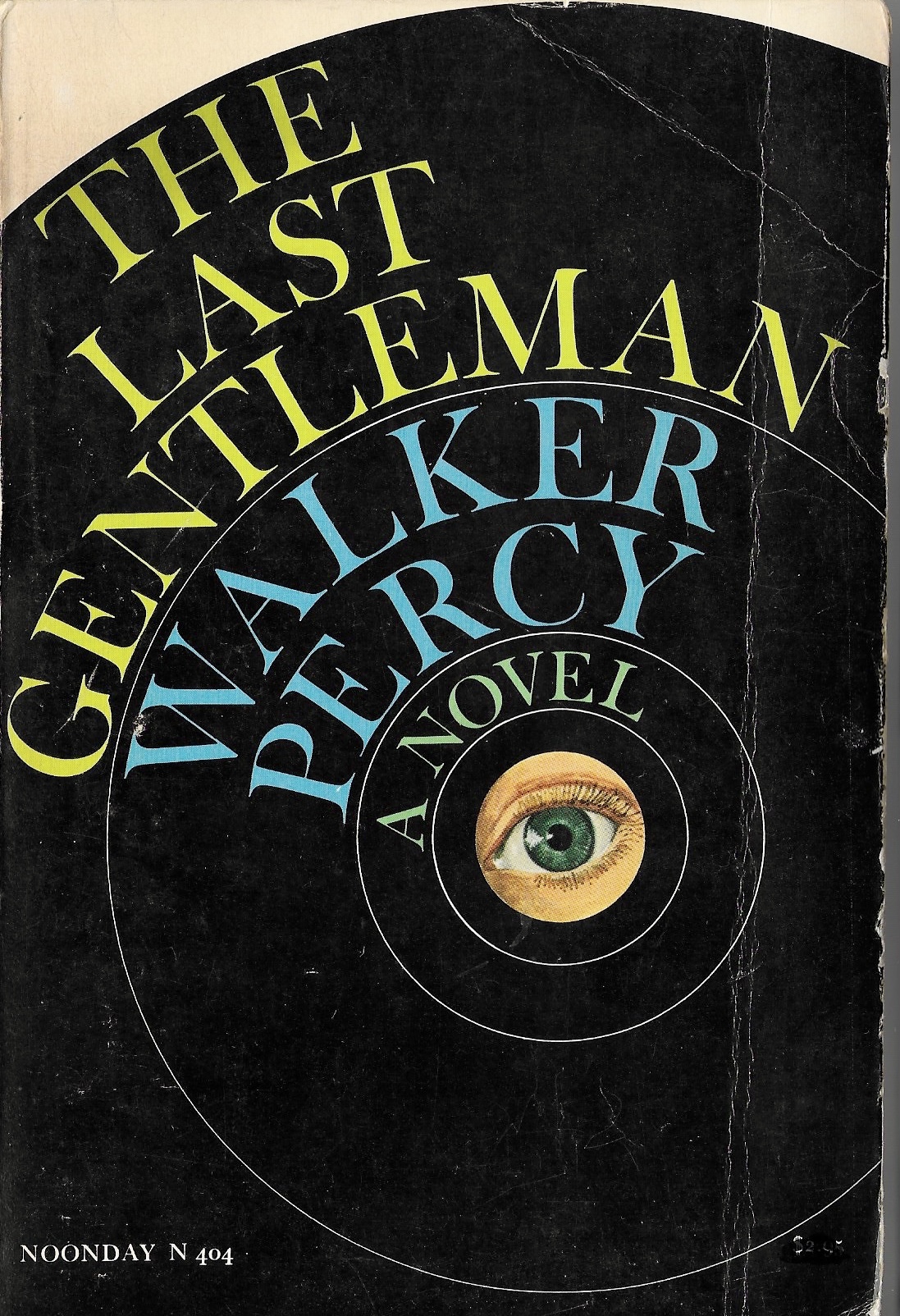
I jumped enthusiastically into Walker Percy’s first novel The Moviegoer (1961) last week. I read his fourth novel Lancelot (1977) earlier this month. I loved Lancelot. I did not love The Moviegoer.
The Moviegoer is narrated by John Bickerson “Binx” Bolling, who works as a stockbroker in a suburb outside of New Orleans. A Korean War vet, Binx has never quite lived up to the aristocratic mantle his family expected of him. He should’ve been a doctor, a lawyer, that sort of thing. Instead, Binx ambles amiably (and sometimes not-so amiably) through a vague existence, searching for “the wonder.”
Binx is semi-determined not to be “distracted from the wonder,” an attendance to the possibility of spiritual transcendence. In Walker’s postwar American South, commercial culture and modern manners slowly suffocate spirit. Binx is a would-be philosopher attempting, usually unsuccessfully, to find a dram of wonder in a desacralized world. He fools around with his secretaries, reads novels, checks in on his earthy mother, and has drawn out philosophical conversations with the aunt who raised him after his father’s early death. His aunt too sees the fall of her world, her South—its long drawn out decline into the Big Modern New.
Binx is also deeply intimate with his aunt’s stepdaughter, his stepcousin Kate. (Note the Gothic tinge here, a semi-incestuous plot in this novel full of semi-themes and semi-plots.) Modern malaise is the theme of The Moviegoer, and Kate suffers her malaise far more intensely than Binx or anyone else. Semi-suicidal and prone to bouts of mania, she finds an anchor in Binx. But Binx is a loose anchor, a semi-anchor, a little anchor:
It is not a bad thing to settle for the Little Way, not the big search for the big happiness but the sad little happiness of drinks and kisses, a good little car and a warm deep thigh.”
The Moviegoer is full of sad little happinesses: bourbon in paper cups, dips in the Gulf of Mexico, moviegoing, natch. Binx’s post-aristocratic malaise is a privileged, horny malaise. A half-century after The Moviegoer’s publication, Binx’s ennui reads as blinkered, solipsistic, reactionary even. There’s a casual, even temperate sexism and racism to his worldview, which I suppose we might expect out of a midcentury novel by a white male. Binx seems unable or unwilling to regard the humanity of other humans as equal to his own deeply felt humanity. But he’s gentle (and even ironically genteel) in his outlook.
That outlook: the ennui in The Moviegoer is mostly polite and mostly well-mannered. And horny. Unlike the manic, dark, zany vitriol of his later novel Lancelot, the humor of Percy’s debut is lightly ironic, droll, even a touch whimsical at times. It’s almost lethargic. But I suppose a certain lethargy is to be expected from a novel that takes malaise as a theme.
Still, there are moments that puncture the malaise in The Moviegoer. In an earlyish section of the novel, Binx riffs on the classic This I Believe radio program (presumably the one hosted by Edward R. Murrow). Binx pokes gentle polite loving fun at the program in general, before proffering his own short essay:
“Here are the beliefs of John Bickerson Bolling, a moviegoer living in New Orleans,” it began, and ended, “I believe in a good kick in the ass. This—I believe.”
And yet just one line later Binx vacillates back, the conscience of tradition echoing in his grandfather’s phrase:
I soon regretted it, however, as what my grandfather would have called “a smart-alecky stunt” and I was relieved when the tape was returned. I have listened faithfully to This I Believe ever since.
Percy’s—excuse me Binx’s—anger immediately collapses—or maybe reconstitutes into—respect for for tradition and a resigned faithful commitment to listening.
But anger eventually boils over, even if Percy is quick to remove the pot from the burner. Very late in the novel, Binx delivers the closest thing in The Moviegoer to a rant:
Today is my thirtieth birthday and I sit on the ocean wave in the schoolyard and wait for Kate and think of nothing. Now in the thirty-first year of my dark pilgrimage on this earth and knowing less than I ever knew before, having learned only to recognize merde when I see it, having inherited no more from my father than a good nose for merde, for every species of shit that flies —my only talent—smelling merde from every quarter, living in fact in the very century of merde, the great shithouse of scientific humanism where needs are satisfied, everyone becomes an anyone, a warm and creative person, and prospers like a dung beetle, and one hundred percent of people are humanists and ninety-eight percent believe in God, and men are dead, dead, dead; and the malaise has settled like a fall-out and what people really fear is not that the bomb will fall but that the bomb will not fall—on this my thirtieth birthday, I know nothing and there is nothing to do but fall prey to desire.
The passage reads false to me, from the corny “dark pilgrimage” (Oh no! Your thirties!) to the aristocratic substitution merde to the complaint against humanism to the ultimate had-too-many-drinks-at-the-dinner-party pose that, Yeah, come come nuclear bomb. And does poor little rich boy Binx really want to fall prey to desire?
Ah! Prey to desire! Existential dread! A call to human feeling, an anxiety of the individual caught between the wonder and the flesh, the spirit and all that horny ennui. For a novel set in New Orleans at Mardi Gras, The Moviegoer is light on fun. Percy, via Binx, repeatedly insists that this is all serious business, even as the light irony drolly undercuts the novel’s core message. Binx comes off as a party guest eager to get along gently, afraid of the potential menace under his surface, but also incapable of accepting the menace under everyone else’s surface.
I wanted more menace. The Moviegoer, like its antecedent, Camus’s The Stranger, seems pointed toward howls of execration—but even if Binx might wish to howl at the absurd, he can’t.
From its opening paragraphs, The Moviegoer’s tone reminded me strongly of Camus’s 1942 novel The Stranger. I loved The Stranger when I was sixteen, appreciated it when I reread it at twenty for a course on existential literature, and have had the good sense to let it alone since. Those howls of execration at the end have always stuck with me. But I know I’ve changed over the past two decades, and I revere my memories of the book. I’d hate to find fault.
The preceding paragraph is perhaps a rough draft of the following statement: I think I would’ve loved The Moviegoer if I had read it when I was much younger. This isn’t a knock on Percy’s prose, the novel’s voice, or the loose, lilting plot. I appreciated all those elements. The problem is me. The problem is that I already read The Stranger so long ago. And also so long ago—The Plague and The Fall and Nausea. And Waiting for Godot, and Invisible Man. And Hemingway and Salinger and Heller’s Catch-22, which The Moviegoer beat to win the 1962 National Book Award.
And then a few weeks ago, as a significantly older guy, I read Percy’s later novel, Lancelot.
Published in the late 1970s, Lancelot reads like a postmodern Gothic. It’s a parody of Southern gentility and movie-making, a riff on cultural incest, a howling execration of the century preceding it. It’s a ranting monologue worthy of Thomas Bernhard, more Notes from Underground than The Stranger, rough, mean, wild. It’s possible to read Lancelot as the weird dark cursed sequel to The Moviegoer, its sinister postmodern zaniness exploding the former novel’s mannered modernism.
If I was ultimately disappointed in The Moviegoer, it’s likely because I read Lancelot first. I wanted more of that dark weird flavor, that mad ranting fervor. The Moviegoer has its moments, and likely has more that I missed. I found the last line unexpectedly moving: “It is impossible to say.” (Nevermind the referent of that “It.” Suffice to say that we have found ourselves at Ash Wednesday.) But then Percy—or maybe his editors?—appended a goddamned epilogue to the whole affair, almost ruining the novel.
(It’s possible that I’ve fundamentally misread The Moviegoer, that I’ve missed something profound in it, that I’ve read in earnest what was meant in irony, that I’ve skated over wells of depth that seemed otherwise shallow.)
Anyway. Should I read another Percy novel? I’ll admit that Love in the Ruins (1971) seems far more interesting than the famous novel, this one, the one I’m ostensibly “reviewing.” Given the strength of Lancelot, I’ll give it a shot.