Book Shelves #36, 9.02.2012


20120902-101430.jpg

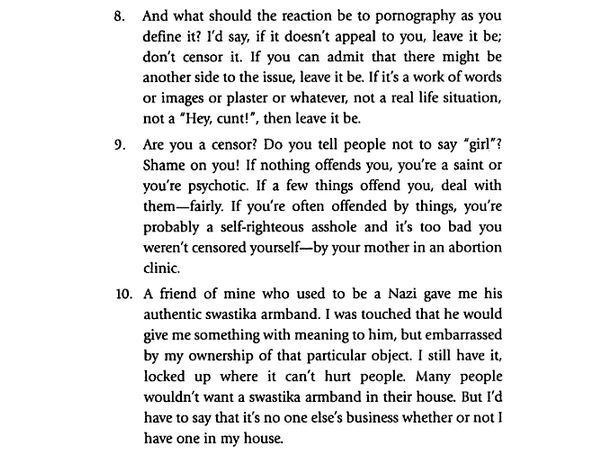
Book shelves series #36, thirty-sixth Sunday of 2012

Continuing the corner book shelf in the family room.

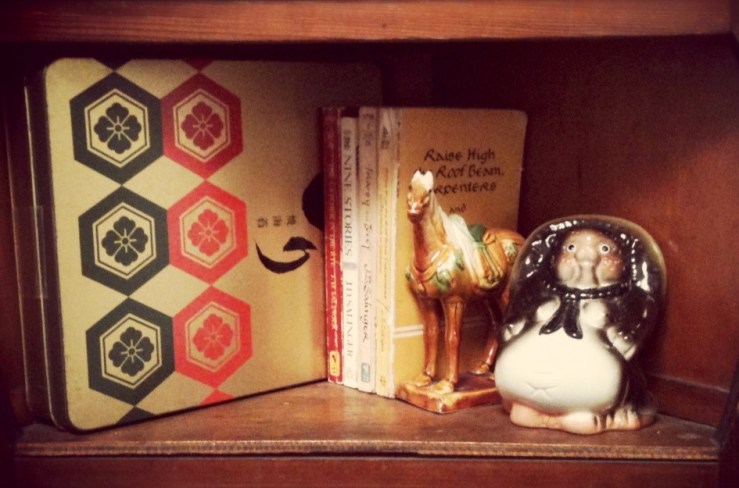
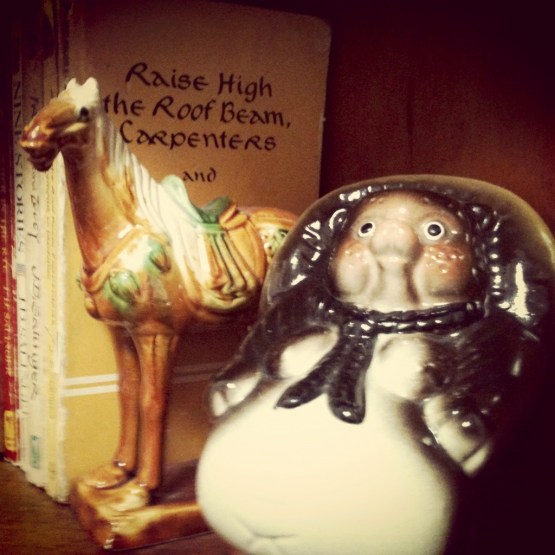
The bookends are tschotskes from a ¥100 shop; we bought them years ago in Tokyo.

Not particularly fancy but they have a sentimental value. (The big guy is a tanuki, if you’re unfamiliar).

The tin on the far left is filled with miscellaneous papers, old stickers, other small bricabrac.
 

20120902-101437.jpg

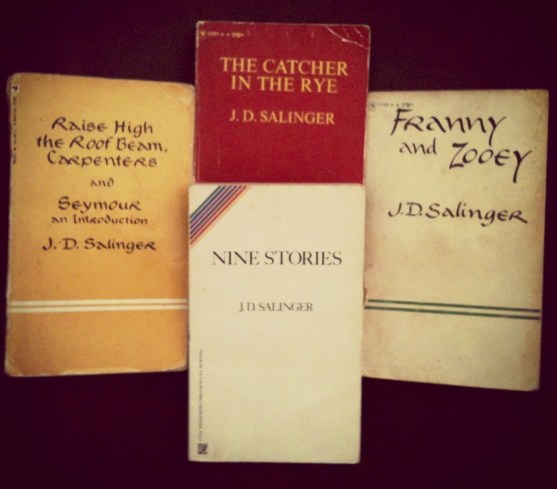
Only four books on this shelf—the more-or-less complete works of J.D. Salinger, in gloriously ratty mass paperback editions:
20120902-101444.jpg

Not sure if these are my wife’s or mine—probably a mix of both. I stole most of these from my high school.

The Catcher in the Rye was as important to me as any other book, I suppose. I wrote about it here.

Nine Stories contains some of Salinger’s most disciplined stuff.

It took me years to finally find the discipline to read Seymour, which is probably the best thing he wrote.


“A Little Fable” — Franz Kafka


“Alas,” said the mouse, “the whole world is growing smaller every day. At the beginning it was so big that I was afraid, I kept running and running, and I was glad when I saw walls far away to the right and left, but these long walls have narrowed so quickly that I am in the last chamber already, and there in the corner stands the trap that I must run into.”

“You only need to change your direction,” said the cat, and ate it up.

–Franz Kafka’s “A Little Fable”


Malcolm Lowry’s “Big Books,” as Reported by David Markson


From “Malcolm Lowry: A Remininiscence,” the final chapter of David Markson’s Malcolm Lowry’s Volcano, a study of Under the Volcano:

His big books, however, would at the moment remain these: Moby-DickBlue Voyage, the Grieg, Madame Bovary, Conrad (particularly The Secret Agent), O’Neill, Kafka, much of Poe, Rimbaud, and of course Joyce and Shakespeare. The Enormous Room is a favorite, as is Nightwood. Kierkegaard and Swedenborg are the philosophers most mentioned, and in another area William James and Ouspensky. Also Strindberg, Gogol, Tolstoy.

Lifting a Maupassant from the shelf (nothing has been said of the man before this): “He is a better writer than you think.”


Guy Debord on “Consumable Pseudocyclical Time”


Consumable pseudocyclical time is spectacular time, both in the narrow sense as time spent consuming images and in the broader sense as image of the consumption of time. The time spent consuming images (images which in turn serve to publicize all the other commodities) is both the particular terrain where the spectacle’s mechanisms are most fully implemented and the general goal that those mechanisms present, the focus and epitome of all particular consumptions. Thus, the time that modern society is constantly seeking to “save” by increasing transportation speeds or using packaged soups ends up being spent by the average American in watching television three to six hours a day. As for the social image of the consumption of time, it is exclusively dominated by leisure time and vacations — moments portrayed, like all spectacular commodities, at a distance and as desirable by definition. These commodified moments are explicitly presented as moments of real life whose cyclical return we are supposed to look forward to. But all that is really happening is that the spectacle is displaying and reproducing itself at a higher level of intensity. What is presented as true life turns out to be merely a more truly spectacular life.

Guy Debord, section 153 of The Society of the Spectacle