Sade’s Parallel Duplications

From Roland Barthes’ “Life of Sade,” a short biography of The Marquis de Sade. Translated from the French by Richard Miller.  Read the entire essay at Supervert (or here over the next few days, parceled out over 22 sections)—

8. We need only read the Marquis’s biography after having read his work to be convinced that he has put part of his work into his life — and not the opposite, as so-called literary science would have us believe. The “scandals” of Sade’s life are not “models” of analogous situations drawn from his books. Real scenes and fantasized scenes are not directly related; all are no more than parallel duplications, more or less powerful (stronger in the work than in life), of a scene that is absent, unfigured, but not inarticulated, whose site of infiguration and articulation can only be writing: Sade’s work and his life traverse this writing area on an equal footing.

Wherever He Goes, He Provokes the Terrified Dismay of the Guardians of Order

From Roland Barthes’ “Life of Sade,” a short biography of The Marquis de Sade. Translated from the French by Richard Miller.  Read the entire essay at Supervert (or here over the next few days, parceled out over 22 sections)—

7. The Lady President of Montreuil was objectively responsible for her son-in-law’s persecutions during the entire first years of his life (perhaps she loved him? One day, someone told the Marquise that the Lady President “loved M. de Sade to distraction”). The impression we have of her character, however, is one of continual fear: fear of scandal, of “difficulties.” Sade seems to have been a triumphant, troublesome victim; like a spoiled child, he is continually “teasing” (teasing is a sadistic passion) his respectable and conformist relations; wherever he goes, he provokes the terrified dismay of the guardians of order: everyone responsible for his confinement at the fort of Miolans (the King of Sardinia, the minister, the ambassador, the governor) is obsessed by the possibility of his escape — which does not fail to occur. The couple he forms with his persecutors is an aesthetic one: it is the malicious spectacle of a lively, elegant animal, both obsessed and inventive, mobile and tenacious, continually escaping and continually returning to the same area, while the giant mannequins, stiff, timorous, pompous, quite simply attempt to contain him (not punish him: this will only come later).

Household Sadism

From Roland Barthes’ “Life of Sade,” a short biography of The Marquis de Sade. Translated from the French by Richard Miller.  Read the entire essay at Supervert (or here over the next few days, parceled out over 22 sections)—

6. Household Sadism: at Marseilles, Sade wants Marianne Lavergne to whip him with a parchment beater with bent pins which he takes from his pocket. The girl quails before so exclusively functional an object (like a surgical instrument), and Sade orders the maidservant to bring a heather broom; this utensil is more familiar to Marianne and she has no hesitation in employing it to strike Sade across the buttocks.

Read the Opening Paragraphs of Denis Johnson’s Forthcoming Novella Train Dreams

The opening paragraphs of Denis Johnson’s forthcoming novella Train Dreams (via)—

In the summer of 1917 Robert Grainier took part in an attempt on the life of a Chinese laborer caught, or anyway accused of, stealing from the company stores of the Spokane International Railway in the Idaho Panhandle.

Three of the railroad gang put the thief under restraint and dragged him up the long bank toward the bridge under construction fifty feet above the MoyeaRiver. A rapid singsong streamed from the Chinaman voluminously. He shipped and twisted like a weasel in a sack, lashing backward with his one free fist at the man lugging him by the neck. As this group passed him, Grainier, seeing them in some distress, lent assistance and found himself holding one of the culprit’s bare feet. The man facing him, Mr. Sears, of Spokane International’smanagement, held the prisoner almost uselessly by the armpit and was the only one of them, besides the incomprehensible Chinaman, to talk during the hardest part of their labors: “Boys, I’m damned if we ever see the top of this heap!” Then we’re hauling him all the way? was the question Grainier wished to ask, but he thought it better to save his breath for the struggle. Sears laughed once, his face pale with fatigue and horror. They all went down in the dust and got righted, went down again, the Chinaman speaking in tongues and terrifying the four of them to the point that whatever they may have had in mind at the outset, he was a deader now. Nothing would do but to toss him off the trestle.

They came abreast of the others, a gang of a dozen men pausing in the sun to lean on their tools and wipe at sweat and watch this thing. Grainier held on convulsively to the Chinaman’s horny foot, wondering at himself, and the man with the other foot let loose and sat down gasping in the dirt and got himself kicked in the eye before Grainier took charge of the free-flailing limb. “It was just for fun. For fun,” the man sitting in the dirt said, and to his confederate there he said, “Come on, Jel Toomis, let’s give it up.” “I can’t let loose,” this Mr. Toomis said, “I’m the one’s got him by the neck!” and laughed with a gust of confusion passing across his features. “Well, I’ve got him!” Grainier said, catching both the little demon’s feet tighter in his embrace. “I’ve got the bastard, and I’m your man!”

The party of executioners got to the midst of the last completed span, sixty feet above the rapids, and made every effort to toss the Chinaman over. But he bested them by clinging to their arms and legs, weeping his gibberish, until suddenly he let go and grabbed the beam beneath him with one hand. He kicked free of his captors easily, as they were trying to shed themselves of him anyway, and went over the side, dangling over the gorge and making hand-over-hand out over the river on the skeleton form of the next span. Mr. Toomis’s companion rushed over now, balancing on a beam, kicking at the fellow’s fingers. The Chinaman dropped from beam to beam like a circus artist downward along the crosshatch structure. A couple of the work gang cheered his escape, while others, though not quite certain why he was being chased, shouted that the villain ought to be stopped. Mr. Sears removed from the holster on his belt a large old four-shot black-powder revolver and took his four, to no effect. By then the Chinaman had vanished.

Section 5, “Life of Sade” — Roland Barthes’ Short Biography of The Marquis de Sade

From Roland Barthes’ “Life of Sade,” a short biography of The Marquis de Sade. Translated from the French by Richard Miller.  Read the entire essay at Supervert. (or here over the next few days, parceled out over 22 sections)—

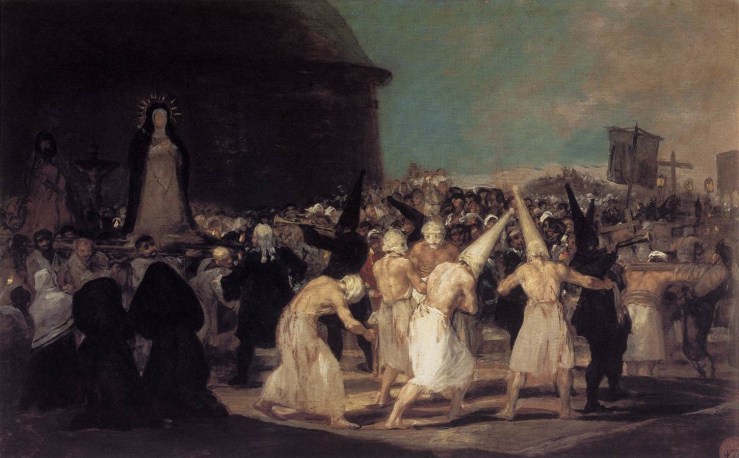
5. Sade likes theater costumes (forms which make the role); he wore them in his own daily life. When whipping Rose Keller, he disguises himself as a flogger (sleeveless vest over a naked torso; kerchief around the head as is worn by young Japanese cooks as they swiftly cut up live eels); later on, he prescribes for his wife the mourning costume she must wear for visiting a captive, unhappy husband: Dress as dark in color as possible, the bosom covered, “a large, very large bonnet without the hair it covers being dressed in any way, merely combed, a chignon, no braids.”

Section 4, “Life of Sade” — Roland Barthes’ Short Biography of The Marquis de Sade

From Roland Barthes’ “Life of Sade,” a short biography of The Marquis de Sade. Translated from the French by Richard Miller.  Read the entire essay at Supervert. (or here over the next few days, parceled out over 22 sections)—

4. On Easter Sunday, 1768, at 9 A.M., on the Place des Victoires, accosting Rose Keller, a beggar (whom he was to whip several hours later in her house at Arcueil), the young Sade (twenty-eight years of age) was wearing a gray redingote, carrying a cane, a hunting knife — and a white muff. (Thus, at a time when the I.D. photograph was nonexistent, it is a paradox that the police report reveals the signifier in its description of the suspect’s clothing: such as this delicious white muff, an article obviously donned to satisfy the principle of tact which seems always to have presided over the Marquis’s sadistic activity — but not necessarily over that of sadists).

Section 3, “Life of Sade” — Roland Barthes’ Short Biography of The Marquis de Sade

From Roland Barthes’ “Life of Sade,” a short biography of The Marquis de Sade. Translated from the French by Richard Miller.  Read the entire essay at Supervert. (or here over the next few days, parceled out over 22 sections)—

3. In the spring of 1779, when Sade was imprisoned at Vincennes, he received a letter telling him that the orchard at La Coste was dazzling: cherry trees in bloom, apple trees, pear trees, hop bine, grapes, not to mention the burgeoning cypresses and oaks. For Sade, La Coste was a multiple, a total site; first, a Provençal site, the site of origin, of Return (throughout the first part of his life, Sade, although a fugitive, hunted, continued to return there, flouting prudence); next: an autarchic site, a miniature and total society over which he was the master, the unique source of his income, the site for study (his library was there), the site for theater (they acted comedies), and the site for debauchery (Sade had servants, young peasant girls, young secretaries, brought in for séances at which the Marquise was also present). If, therefore, Sade kept returning to La Coste after his restless travels, it was not for the elevated purpose of purification in the countryside that impels the gangster in The Asphalt Jungle to return to die at the gate to the farm where he was born; as always, it had a plural, super-determined, probably contradictory meaning.


Section 2, “Life of Sade” — Roland Barthes’ Short Biography of The Marquis de Sade

From Roland Barthes’ “Life of Sade,” a short biography of The Marquis de Sade. Translated from the French by Richard Miller.  Read the entire essay at Supervert. (or here over the next few days, parceled out over 22 sections)—

2. People living today in Saint-Germain-des-Prés must remember that they are living in a degenerate Sadian area. Sade was born in a room of the Hôtel de Condé, i.e., somewhere between the Rue Monsieur-le-Prince and the Rue de Condé; he was baptized in Saint-Sulpice; in 1777 he was arrested under a lettre de cachet at the Hôtel de Danemark, Rue Jacob (the very street where the French edition of this book is published), and from there brought to the prison dungeon at Vincennes.

Section 1, “Life of Sade” — Roland Barthes’ Short Biography of The Marquis de Sade

From Roland Barthes’ “Life of Sade,” a short biography of The Marquis de Sade. Translated from the French by Richard Miller.  Read the entire essay at Supervert. (or here over the next few days, parceled out over 22 sections)—

1. Etymological chain: Sade, Sado, Sadone, Sazo, Sauza (village of Saze). Again, lost in this lineage, the evil letter. In attaining the accursed name, brilliantly formulated (it has engendered a common noun), the letter that, as we say in French, zebras, fustigates, the z, has given way to the softest of dentals.


Book Acquired, 8.29.2011

20110829-021552.jpg

Got a finished copy of Chad Harbach’s (n+1) début novel The Art of Fielding today; the book comes out next week from Little, Brown & Company. Their description—

At Westish College, baseball star Henry Skrimshander seems destined for the big leagues until a routine throw goes disastrously off course. In the aftermath of his error, the fates of five people are upended. Henry’s life’s purpose is called into question. Guert Affenlight, the college’s president, has fallen helplessly, unexpectedly in love. Owen Glass, Henry’s gay roommate, becomes swept up in a dangerous affair. Mike Schwartz, the team captain, realizes he guides Henry’s career at the expense of his own. And Pella Affenlight, Guert’s daughter, returns to Westish to start a new life after an ill-fated marriage. As the season counts down to its climax, these five confront their deepest hopes, anxieties, and secrets, and help one another to find their true paths. Written with boundless intelligence, and filled with the tenderness of youth, The Art of Fielding is an expansive, warmhearted novel about ambition and its limits, about family and friendship and love, and about commitment—to oneself and to others.


Read “Town of Cats,” a Story by Haruki Murakami

Today, The New Yorker shares “Town of Cats,” a short story by Haruki Murakami. First paragraph—

At Koenji Station, Tengo boarded the Chuo Line inbound rapid-service train. The car was empty. He had nothing planned that day. Wherever he went and whatever he did (or didn’t do) was entirely up to him. It was ten o’clock on a windless summer morning, and the sun was beating down. The train passed Shinjuku, Yotsuya, Ochanomizu, and arrived at Tokyo Central Station, the end of the line. Everyone got off, and Tengo followed suit. Then he sat on a bench and gave some thought to where he should go. “I can go anywhere I decide to,” he told himself. “It looks as if it’s going to be a hot day. I could go to the seashore.” He raised his head and studied the platform guide.

At that point, he realized what he had been doing all along.

Fun fact: I used to live in Shin-Koenji, right near Koenji, and I took the Chuou to work every day.