
My mom brought over a bunch of stuff tonight including a collection of early ’70s Doonesbury strips in a four volume box set. I guess this was my dad’s? I’ve never understood a single Trudeau strip, ever, although I haven’t read one in years.


My mom brought over a bunch of stuff tonight including a collection of early ’70s Doonesbury strips in a four volume box set. I guess this was my dad’s? I’ve never understood a single Trudeau strip, ever, although I haven’t read one in years.
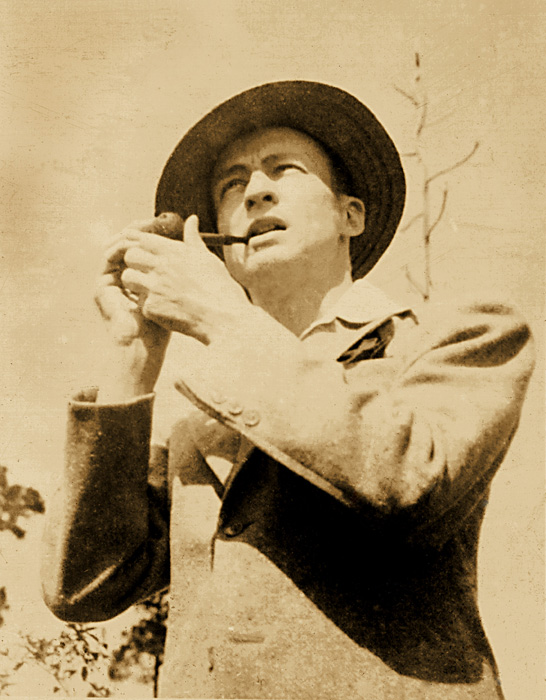
Stetson Kennedy died today at 94 in his native city, Jacksonville, FL.
Kennedy began his career collecting folklore throughout the South in 1937 after leaving the University of Florida. Kennedy worked for the Works Progress Administration’s Florida Writers’ Project, traveling with Zora Neale Hurston to collect oral histories and folk tales from both black and white Floridians alike. In the 1940s, Kennedy worked for the Atlanta office of the CIO. He also infiltrated the Ku Klux Klan in the 1940s and ’50s, exposing many of the racist organization’s secrets and alerting the world to the intrinsic injustice of the Jim Crow system in Southern states.
When Kennedy ran (quite unsuccessfully) for Governor of Florida in 1952, Woody Guthrie wrote the song “Stetson Kennedy” to support his good friend (Wilco and Billy Bragg put the lyrics to music decades later). Kennedy’s anti-Jim Crow, early Civil Rights platform didn’t win him much popularity throughout the state, and when his home in Fruit Cove was firebombed, he moved to France. It was there that the philosopher Jean-Paul Sartre published Kennedy’s The Jim Crow Guide—but the book was too controversial for US publication, despite multiple translations across Europe. Even more incendiary was Kennedy’s expose The Klan Unmasked (1954), which helped to undermine the organization’s secret authority in the South.
Just as Kennedy’s contribution to the Civil Rights movement cannot be underestimated, neither can his work in collecting and preserving Florida folklore (as well as Southern folklore in general). Kennedy helped found the Florida Folklore Society and also served as president, and volumes like Palmetto County and Grits and Grunts: Folkloric Key West will remain staples of Florida folk culture. In 2009, Kennedy bequeathed his papers and personal library to the Civic Media Center in Gainesville, FL, a nonprofit info center and alternative library devoted to human rights, environmental protection, and other causes. Kennedy was closely involved with the CMC since its inception in 1993.
Kennedy was a vibrant fount of cultural and historical force, a man who worked his entire, long life not just to preserve folklore and its history, but also to show the radical place that folk culture occupies throughout time, linking core human values from generation to generation. Stetson Kennedy will live through his legacy.
Kennedy’s website sheds light on his final moments—
He was with his wife and stepdaughter, He was in no pain. And as recently as 4 days ago he was lucid and talking. The doctor, checking his mental faculties asked him questions “where are you from”, Kennedy replied, “The planet Earth”
Stetson’s wishes were for a party and not a funeral. A luncheon at Beluthahatchee will be held October 1st.
Kennedy on This American Life.
Read a 2011 interview with Kennedy in Vice Magazine.
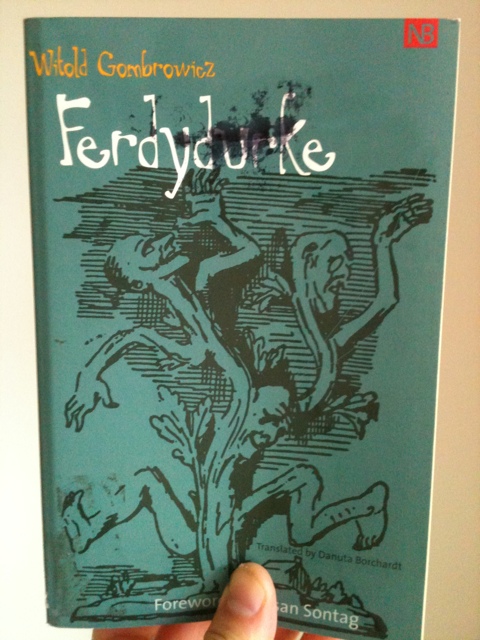
Double—or triple, really, Witold Gombrowicz grabs at the bookstore today. I love this cover for Ferdydurke (even the ink stain doesn’t really detract too much from its plain elegance). Intro is by Sontag! Should this be my next step after Trans-Atlantyk?
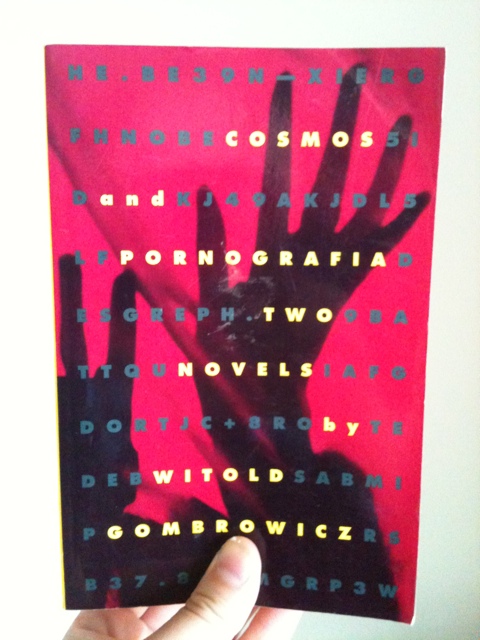
Also picked up this Grove Press edition that collects both Cosmos and Pornografia. I’m not a fan of omnibus editions in general, but, hey, why pass up a chance to pick up a used copy of what is likely a not-so-easy-to-find book.
You’ll need this—

A bunch of these—

Lots of these—

—and/or these—

Some of this—
 And some of this—

Never hurts to have one of these around too—

It’s also a good idea to fill up the tub with water (Galifianakis and ducklings optional)—

In all seriousness though, good luck and stay safe.
In Chapter 18 of her novel Their Eyes Were Watching God, Zora Neale Hurston imagines a hurricane descending on the Everglades as a cosmic monster. Her description comes in part from accounts of the 1928 Great Lake Okeechobee Hurricane—
Ten feet higher and far as they could see the muttering wall advanced before the braced-up waters like a road crusher on a cosmic scale. The monstropolous beast had left his bed. Two hundred miles an hour wind had loosed his chains. He seized hold of his dikes and ran forward until he met the quarters; uprooted them like grass and rushed on after his supposed-to- be conquerors, rolling the dikes, rolling the houses, rolling the people in the houses along with other timbers. The sea was walking the earth with a heavy heel.
F. Scott Fitzgerald puts his imagination to work. From Notebooks—
BACKWOOD NAMES.
Olsie, Hassie, Goba, Bleba, Onza, (Ozma—my own), Retha, Otella, Tatrina, Delphia, Wedda, Zannis, Avaline, Burtryce, Chalme, Glenola, Turla, Verlie, Legitta, Navilla, Oha, Verla, Blooma, Inabeth, Versia, Gomeria, Valaria, Berdine, Olabeth, Adelloyd.
I’ll be upfront: I don’t care for the music of The Decemberists. I’ve tried, after being told repeatedly how “deep” or “clever” or “literate” the lyrics are, and how good the music is—but it all strikes me as awfully bland stuff, like someone’s shitty take on R.E.M.
Anyway, I do very much like David Foster Wallace’s novel Infinite Jest, the “inspiration” (yes, I’ll put the word in suspicious quotation marks) behind The Decemberists’ new music video for “Calamity Song.” Here’s their singer/songwriter Colin Meloy (via NPR)—
I wrote “Calamity Song” shortly after I’d finished reading David Foster Wallace’s epic Infinite Jest. The book didn’t so much inspire the song itself, but Wallace’s irreverent and brilliant humor definitely wound its way into the thing. And I had this funny idea that a good video for the song would be a re-creation of the Enfield Tennis Academy’s round of Eschaton — basically, a global thermonuclear crisis re-created on a tennis court — that’s played about a third of the way into the book. Thankfully, after having a good many people balk at the idea, I found a kindred spirit in Michael Schur, a man with an even greater enthusiasm for Wallace’s work than my own. With much adoration and respect to this seminal, genius book, this is what we’ve come up with. I can only hope DFW would be proud.
I’m not going to conjecture whether Wallace would be proud or not. That seems like total asshole move. But, I am interested in seeing a filmed version of Eschaton, and I do like Michael Schur’s show Parks and Recreation. So I’m going to watch the video now—unmuted and everything—and then post a reaction. Here’s the vid—
Okay. Nice production values, I guess. I think that’s the band, right? I like it when bands are in their own videos and “act.” I guess they’re playing the older ETA kids who are watching the game this Interdependence Day. The singer is Pemulis, that seems clear. It snows in the Escahton episode, but it looks like only some rain here. I like the Otis P. Lord kid, but I don’t know if the other kids look right. This is weak criticism, I know. Hmmm. The song . . . well, I’m not into this song, but I guess it’s pleasant enough. It’s terribly competent. Bits of it sound like a sped up version of R.E.M.’s “Talk About the Passion.” Some of the lyrics seem to reference or play off of Infinite Jest maybe—like “Year of the Something Something” or something.
I don’t know. What can I say here? I hope no one tries to make a movie out of Infinite Jest. It was all I could do to fast forward through most of Jim from The Office’s movie of Hideous Men.
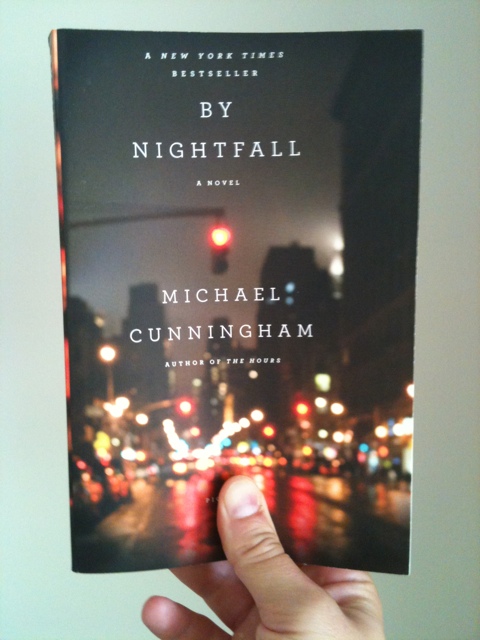
In the mail today: Michael Cunningham’s By Nightfall, in trade paperback from the good folks at Picador. From novelist Jeanette Winterson’s review of the hardback edition, printed last year in the NYT—
Cunningham has taken on the classic plot of the uninvited or unexpected stranger or guest whose arrival brings chaos, self-knowledge, tragedy, the ruin of one kind of life that may or may not lead to something better. It’s a story we know from variants as classic as Shakespeare’s “Twelfth Night” to Mark Twain’s “Mysterious Stranger” to contemporary versions like “The Accidental” by Ali Smith. Cunningham is drawn to simple, potent plots (think of the triptych in “The Hours”), saving his energy for the hearts and minds, the groins and guts, of his characters. Yet he makes you turn the pages. He tells a story here, but not too much of a story. You aren’t deadened by detail; you’re eager to know what happens next.
Cunningham writes so well, and with such an economy of language, that he can call up the poet’s exact match. His dialogue is deft and fast. The pace of the writing is skilled — stretched or contracted at just the right time. And if some of the interventions on art are too long — well, too long for whom? For what? Good novels are novels that provoke us to argue with the writer, not just novels that make us feel magically, mysteriously at home.A novel in which everything is perfect is a waxwork. A novel that is alive is never perfect.
From the entry “All Subjects with Fresán,” in Bolaño’s collection Between Parentheses, a list of stuff the late writer talked about with his good friend, which includes (as usual) plenty of references to writers, poets, directors—and some funny jokes as well. Read part of Fresán’s essay “The Savage Detective” — it was the piece that first got me to go pick up a Bolaño. Here’s the list—
1) The Latin American hell that, especially on weekends, is concentrated around some Kentucky Fried Chicken or McDonald’s.
2) The doings of Buenos Aires photographer Alfredo Garofano, childhood friend of Rodrigo and how a friend of mine and of anyone with the least bit of discernment.
3) Bad translations.
4) Serial killers and mass murders.
5) Prospective leisure as the antidote to prospective poetry.
6) The vast number of writers who should retire after writing their first book or their second or their third or their fourth or their fifth.
7) The superiority of the work of Basquiat to that of Haring, or vice versa.
8 ) The works of Borges and the works of Bioy.
9) The advisability of retiring to a ranch in Mexico near a volcano to finish writing The Turkey Buzzard Trilogy.
10) Wrinkles in the space time continuum.
11) The kind of majestic women you’ve never met who come up to you in a bar and whisper in your ear that they have AIDS (or that they don’t).
12) Gombrowicz and his conception of immaturity.
13) Philip K. Dick, whom we both unreservedly admire.
14) The likelihood of a war between Chile and Argentina and its possible and impossible consequences.
15) The life of Proust and the life of Stendhal.
16) The activities of some professors in the United States.
17) The sexual practices of titi monkeys and ants and great cetaceans.
18) Colleagues who must be avoided like limpet mines.
19) Ignacio Echevarria, whom both of us love and admire.
20) Some Mexican writers liked by me and not by him, and some Argentine writers like by me and not by him.
21) Barcelonan manners.
22) David Lynch and the prolixity of David Foster Wallace.
23) Chabon and Palahniuk, whom he likes and I don’t.
24) Wittgenstein and his plumbing and carpentry skills.
25) Some twilit dinners, which actually, to the surprise of the diner, become theater pieces in five acts.
26) Trashy TV game shows.
27) The end of the world.
28) Kubrick’s films, which Fresán loves so much that I’m beginning to hate them.
29) The incredible war between the planet of the novel-creatures and the planet of the story beings.
30) The possibility that when the novel awakes from its iron dreams, the story will be there.

A passage from Witold Gombrowicz’s incomparable (and I use that word in a literal sense here) novel Trans-Atlantyk. Context: Upon learning of the Nazi’s invasion of his native Poland, our hero Gombrowicz has decided not to return to Europe and instead take his chances in Argentina. He watches the ship depart—
Then would I fain have fallen on my knees! Albeit I did not fall at all, just quietly began to Curse, Damn mightily but only to Myself: “Sail, sail, you Compatriots, to your People! Sail to that holy Nation of yours haply Cursed! Sail to that St. Monster Dark, dying for ages yet unable to die! Sail to your St. Freak, cursed by all Nature, ever being born and still Unborn! Sail, sail, so he will not suffer you to Live or Die but keep you for ever between Being and Non-being. Sail to your St. Slug that she may ever the more Enslime you.” The ship turned aslant now and was moving off so this I likewise say: “Sail to that Madman, to that St. Bedlamite of yours—oh, haply Cursed—so that he may Torment, Torture you by those leaps and frenzies of his, drown you in blood, howl at you and by his Howling howl you out, by Torturing torture you, Children of yours, wives, to Death, to Agony—in agony himself, in the agonies of Madness Madden you, O’ermadden you!” With this Curse, turning my back on the ship, I entered the Town.
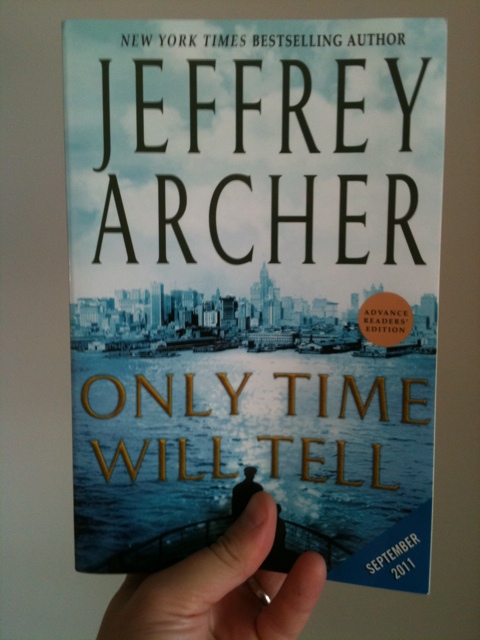
In the mail today, an ARC of Jeffrey Archer’s forthcoming novel Only Time Will Tell. Publisher’s description—
From the internationally bestselling author of Kane and Abel and A Prisoner of Birth comes Only Time Will Tell, the first in an ambitious new series that tells the story of one family across generations, across oceans, from heartbreak to triumph.
The epic tale of Harry Clifton’s life begins in 1920, with the words “I was told that my father was killed in the war.” A dock worker in Bristol, Harry never knew his father, but he learns about life on the docks from his uncle, who expects Harry to join him at the shipyard once he’s left school. But then an unexpected gift wins him a scholarship to an exclusive boys’ school, and his life will never be the same again.
As he enters into adulthood, Harry finally learns how his father really died, but the awful truth only leads him to question, was he even his father? Is he the son of Arthur Clifton, a stevedore who spent his whole life on the docks, or the firstborn son of a scion of West Country society, whose family owns a shipping line?
This introductory novel in Archer’s ambitious series The Clifton Chronicles includes a cast of colorful characters and takes us from the ravages of the Great War to the outbreak of the Second World War, when Harry must decide whether to take up a place at Oxford or join the navy and go to war with Hitler’s Germany. From the docks of working-class England to the bustling streets of 1940 New York City, Only Time Will Tell takes readers on a journey through to future volumes, which will bring to life one hundred years of recent history to reveal a family story that neither the reader nor Harry Clifton himself could ever have imagined.
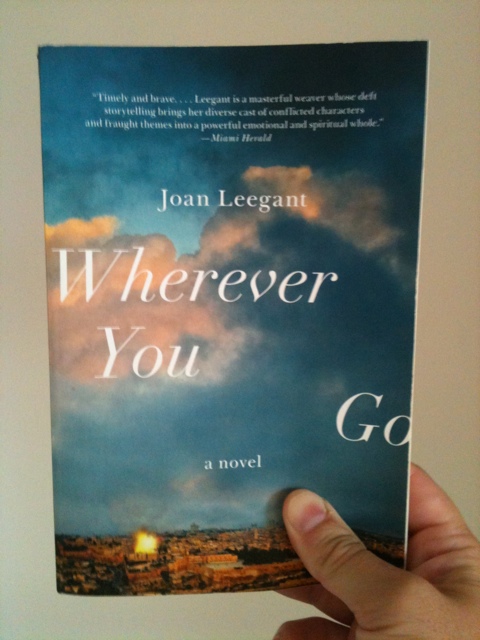 Joan Leegant’s novel Wherever You Go showed up in today’s mail. Publisher’s description—
“In this sweeping and beautifully written novel, Joan Leegant weaves together three lives caught in the grip of a volatile and uncompromising faith. Yona Stern has traveled to Jerusalem from New York to make amends with her sister, a stoic mother of five dedicated to the hard-line settlement cause. Mark Greenglass, a gifted Talmud teacher and former drug dealer saved by religion, has lost his passion and wonders if he’s done with God. Enter Aaron Blinder, an unstable college dropout with a history of failure who finds a home on the radical fringe of Israeli society. Emotionally gripping and unmistakably timely, Wherever You Go tells the story of three Americans in Israel and the attractions–and dangers– of Jewish extremism, and its threat to the modern democratic state.”

In general, I dislike reviews that frontload context—get to the book, right? So here’s a short review of Ernest Hemingway’s The Garden of Eden: it is stranger than most of what Hemingway wrote, by turns pleasant, uncomfortable, bewildering, and beautiful. And readable. It’s very, very readable. Young people (or older folks; let’s not be prejudiced) working their way through Hemingway shouldn’t put The Garden of Eden on the back-burner in favor of his more famous works, and anyone who might have written off Hemingway as unreflective macho bravado should take a look at some of the strange gender games this novel has to offer. So, that’s a recommendation, okay?
Now on to that context, which I think is important here. See, The Garden of Eden is one of those unfinished novels that get published posthumously, put together by editors and publishers and other book folk, who play a larger role than we like to admit in the finished books we get from living authors anyway. For various reasons, cultural, historical, etc., we seem to favor the idea of the Singular Artistic Genius who sculpts beauty and truth out of raw Platonic forms that only he or she can access (poor tortured soul). The reality of how our books get to us is a much messier affair, and editors and publishers and even literary studies departments in universities have a large hand in this process, one we tend to ignore in favor of the charms of a Singular Artistic Genius. There’s a fascinating process there, but also a troubling one. Editing issues complicate our ideals of (quite literally) stable authority—is this what the author intended?, we ask (New Critics be damned!). David Foster Wallace and Michael Pietsch, Raymond Carver and Gordon Lish, Franz Kafka and Max Brod, Mary Shelley and Percy Shelley . . . not to mention Shakespeare, Chaucer, Beowulf, The Bible, Homer, etc. etc. etc. But you’re here to read about The Garden of Eden, right gentle reader? Mea culpa. I’ve been blathering away. Let me turn the reins over to the estimable talents of E.L. Doctorow, who offers the following context in his 1986 review of the book in The New York Times—
Since Hemingway’s death in 1961, his estate and his publishers, Charles Scribner’s Sons, have been catching up to him, issuing the work which, for one reason or another, he did not publish during his lifetime. He held back ”A Moveable Feast” out of concern for the feelings of the people in it who might still be alive. But for the novel ”Islands in the Stream” he seems to have had editorial misgivings. Even more deeply in this category is ”The Garden of Eden,” which he began in 1946 and worked on intermittently in the last 15 years of his life and left unfinished. It is a highly readable story, if not possibly the book he envisioned. As published it is composed of 30 short chapters running to about 70,000 words. A publisher’s note advises that ”some cuts” have been made in the manuscript, but according to Mr. Baker’s biography, at one point a revised manuscript of the work ran to 48 chapters and 200,000 words, so the publisher’s note is disingenuous. In an interview with The New York Times last December, a Scribners editor admitted to taking out a subplot in rough draft that he felt had not been integrated into the ”main body” of the text, but this cut reduced the book’s length by two-thirds.
So, yeah. The version we have of The Garden of Eden is heavily cut, and also likely heavily arranged. But that’s what editors do, and this is the book we have (for now, anyway—it seems like on the year of its 25th anniversary of publication, and the 50th anniversary of Hemingway’s death that Scribner should work toward putting out an unedited scholarly edition) — so I’ll talk about that book a bit.
The Garden of Eden tells the story of a few months in the lives of a young newlywed couple, David Bourne, an emerging novelist, and his wife Catherine, a trust fund baby flitting about Europe. The novel is set primarily on the French Riviera, in the thin sliver of high years between the two big wars. David and Catherine spend most of their days in this Edenic setting eating fine food and making love and swimming and riding bikes and fishing. And drinking. Lots and lots of drinking. Lots of drinking. It all sounds quite beautiful—h0w about a taste?
On this morning there was brioche and red raspberry preserve and the eggs were boiled and there was a pat of butter that melted as they stirred them and salted them lightly and ground pepper over them in the cups. They were big eggs and fresh and the girl’s were not cooked quite as long as the young man’s. He remembered that easily and he he was happy with his which he diced up with the spoon and ate with only the flow of the butter to moisten them and the fresh early morning texture and the bite of the coarsely ground pepper grains and the hot coffee and the chickory-fragrant bowl of café au lait.
Hemingway’s technique throughout the novel is to present the phenomenological contours of a heady world. It’s lovely to ride along with David and Catherine, rich and free and beautiful.
Their new life together is hardly charmed, however. See, Catherine gets a haircut—
Her hair was cropped as short as a boy’s. It was cut with no compromises. It was brushed back, heavy as always, but the sides were cut short and the ears that grew close to her head were clear and the tawny line of her hair was cropped close to her head and smooth and sweeping back. She turned her head and lifted her breasts and said, “Kiss me please.” . . .
“You see, she said. “That’s the surprise. I’m a girl. But now I’m a boy too and I can do anything and anything and anything.”
“Sit here by me,” he said. “What do you want, brother.”
David’s playful response—calling his wife “brother”—covers up some of his shock and fear, but it also points to his underlying curiosity and gender confusion. And indeed, Catherine’s new haircut licenses her to “do anything and anything and anything” — beginning with some strange bed games that night—
He had shut his eyes and he could feel the long light weight of her on him and her breasts pressing against him and her lips on his. He lay there and felt something and then her hand holding him and searching lower and he helped with his hands and then lay back in the dark and did not think at all and only felt the weight and the strangeness inside and she said, “Now you can’t tell who is who can you?”
“No.”
“You are changing,” she said. “Oh you are. You are. Yes you are and you’re my girl Catherine. Will you change and be my girl and let me take you?”
“You’re Catherine.”
“No. I’m Peter. You’re my wonderful Catherine. You’re my beautiful, lovely Catherine. You were so good to change. Oh thank you, Catherine, so much. Please understand. Please know and understand. I’m going to make love to you forever.”
David, partial stand-in for Hemingway, transforms into a girl who feels “something” during sex with Catherine (or, ahem, Peter)—note that that “something” has no clear referent. As their gender inverting games continue (much to David’s horror), Hemingway’s usually concrete language retreats to vague proforms without referents, “it”s without antecedents; his usually precise diction dissolves in these scenes, much as the Bournes’ marriage dissolves each time Catherine escalates the gender inversion. David gives her the nickname “Devil,” as if she were both Eve and Serpent in their Garden. Catherine’s transformations continue as she cuts her hair back even more, and sunbathes all the time so that she can be as dark as possible. She dyes her hair a silver blonde and makes David get his hair cut and dyed the same.
The bizarre behavior (shades of Scott and Zelda?) culminates in Catherine introducing another woman into the marriage. Marita falls in love with both David and Catherine, but her lesbian sex with Catherine only accelerates the latter’s encroaching insanity. David is initially radically ambivalent to the ménage à trois proposed by his wife; he has the good sense to see that a three-way marriage is ultimately untenable and that his wife is going crazy. He vacillates between hostility and love for the two women, but eventually finds a support system in Marita as it becomes increasingly apparent (to all three) that Catherine is depressed and mentally unstable, enraged that David has ceased to write about the pair’s honeymoon adventures on the Riviera. Catherine has been bankrolling David; jealous of good reviews from his last novel, she insists that he write only their story, but David would rather write “the hardest story” he knows—the story of his childhood in East Africa with his father, a big game hunter.
In some of the most extraordinary passages of The Garden of Eden, David writes himself into his boyhood existence, trailing a bull elephant with his father through a jungle trek. David has spotted the elephant by moonlight, prompting his father and his father’s fellow tracker and gun bearer Juma to hunt the old beast. As they trail the animal, David begins to realize how horrible the hunt is, how cruel it is to kill the animal for sport. The passages are somewhat perplexing given Hemingway’s reputation as a hunter. Indeed, this is one of the major features of The Garden of Eden: it repeatedly confounds or complicates our ideas about Hemingway the man’s man, Hemingway the writer, Hemingway the hunter. David describes the wounded, dying elephant—
They found him anchored, in such suffering and despair that he could no longer move. He had crashed through the heavy cover where he had been feeding and crossed a path of open forest and David and his father had run along the heavily splashed blood trail. Then the elephant had gone on into thick forest and David had seen him ahead standing gray and huge against the trunk of a tree. David could only see his stern and then his father moved ahead of him and he followed and they came alongside the elephant as though he was a ship and David saw the blood coming from his flanks and running down his sides and then his father raised his rifle and fired and the elephant turned his head with the great tusks moving heavy and slow and looked at them and when his father fired the second barrel the elephant seemed to sway like a felled tree and came smashing down toward them. But he was not dead. He had been anchored and now he was down with his shoulder broken. He did not move but his eye was alive and looked at David. He had very long eyelashes and his eye was the most alive thing David had ever seen.
David succeeds in writing this “hard” story, and the passages are remarkable in their authenticity—David’s story is a good story, the highlight of the book perhaps; it’s not just Hemingway telling us that David wrote a great story, we actually get to experience the story itself as well as the grueling process by which it was made. Hemingway and his surrogate David show us—make us experience—how difficult writing really is, and then share the fruit of that labor with us. These scenes raise the stakes of The Garden of Eden, revealing how serious David is when he remarks (repeatedly) that the writing is the most important thing—that it outweighs love, it surpasses his marriage. These realizations freight the climax of the novel all the more heavily, but I will avoid anymore spoilers.
The Garden of Eden has some obvious flaws. Marita is underdeveloped at best for such an important character, and her love for David and Catherine remains unexplored, and in fact barely remarked upon. The biggest problem with the book is its conclusion, which feels too pat, too obvious for such a strange, amorphous book. It is here that the presence of an editorial hand seems clearest, to the extent that I wonder if the short little chapter that concludes the novel wasn’t cobbled together from a few stray sentences throughout the manuscript. But The Garden of Eden, despite some shortcomings, is a book well worth reading. The novel complicates not just Hemingway’s reputation, but also our sense of Hemingway’s sense of himself. Recommended.
From §19 of David Foster Wallace’s The Pale King:
‘I have no idea what we do. As citizens we cede more and more of our autonomy, but if we the government take away citizens’ freedom to cede their autonomy we’re now taking away their autonomy. It’s a paradox. Citizens are constitutionally empowered to choose to default and leave the decisions to corporations and a government we expect to control them. Corporations are getting better and better at seducing us into thinking the way they think—of profits as the telos and responsibility as something to be enshrined in symbol and evaded in reality. Cleverness as opposed to wisdom. Wanting and having instead of thinking and making. We cannot stop it. I suspect what’ll happen is that there will be some sort of disaster—depression, hyperinflation—and then it’ll be showtime: We’ll either wake up and retake our freedom or we’ll fall apart utterly. Like Rome—conqueror of its own people.’
(This is the second paragraph; read the first here (or, like, buy the book)).
I want to write about this chapter against the backdrop of America’s current political/social/cultural climate—the so-called “debate” about government’s role, individual responsibility, our corporate welfare state, etc. What I want to write I am having a hard time writing. For one, the issue seems so big, so slippery, so oily, so recent, so indigestible. For another, I feel like Wallace’s chapter is so smart and engaging on its own that I shouldn’t be messing with it when I really don’t have anything smart or engaging to say about it.
I guess what I really want is for people to read it, or at least parts of it, so I’ll be posting bits of it over the next week or two, with occasional comments.
If I can’t be analytic about §19 of The Pale King, perhaps I can at least offer a rough description:
The chapter is one of the longer ones in the novel at 20 pages, although it’s hardly the longest.
The chapter is probably set in early 1980 (or possible late 1979).
The chapter is probably set in a stuck elevator, probably as the result of a power failure, as the lights seem to be off.
The chapter is written entirely as a dialogue, mainly (solely?) between three IRS agents: Glendenning, DeWitt, and someone referred to as ‘X.’
The chapter references The Excorist, which might have been intended to be (or maybe is?) a motif in The Pale King.
The chapter discusses the cultural upheaval of the 1960s and early ’70s, and links this upheaval to the dawning conservatism of the Reagan years (which obviously have not yet happened in terms of the chapter’s timeline, but which one of the interlocutors nevertheless perspicaciously anticipates).
The dialogue (Socratic, if I’m feeling analytic) traces the tension between individual freedom, individual liberty, and the role of the government as an arbiter of civic life.
I’ll end with the somewhat generic definition of “civics” the chapter offers—
‘Civics is the branch of political science that quote concerns itself with citizenship and the rights and duties of US citizens.’
And there we go—that conflict between rights and duties.
 Biblioklept