Mirror Scene, Blood of a Poet (Jean Cocteau)

A List of Irish Heroes from James Joyce’s Ulysses

One of my favorite passages in Ulysses (it’s from the “Cyclops” chapter, episode 12)—

He wore a long unsleeved garment of recently flayed oxhide reaching to the knees in a loose kilt and this was bound about his middle by a girdle of plaited straw and rushes. Beneath this he wore trews of deerskin, roughly stitched with gut. His nether extremities were encased in high Balbriggan buskins dyed in lichen purple, the feet being shod with brogues of salted cowhide laced with the windpipe of the same beast. From his girdle hung a row of seastones which dangled at every movement of his portentous frame and on these were graven with rude yet striking art the tribal images of many Irish heroes and heroines of antiquity, Cuchulin, Conn of hundred battles, Niall of nine hostages, Brian of Kincora, the Ardri Malachi, Art MacMurragh, Shane O’Neill, Father John Murphy, Owen Roe, Patrick Sarsfield, Red Hugh O’Donnell, Red Jim MacDermott, Soggarth Eoghan O’Growney, Michael Dwyer, Francy Higgins, Henry Joy M’Cracken, Goliath, Horace Wheatley, Thomas Conneff, Peg Woffington, the Village Blacksmith, Captain Moonlight, Captain Boycott, Dante Alighieri, Christopher Columbus, S. Fursa, S. Brendan, Marshal Mac-Mahon, Charlemagne, Theobald Wolfe Tone, the Mother of the Maccabees, the Last of the Mohicans, the Rose of Castille, the Man for Galway, The Man that Broke the Bank at Monte Carlo, The Man in the Gap, The Woman Who Didn’t, Benjamin Franklin, Napoleon Bonaparte, John L. Sullivan, Cleopatra, Savourneen Deelish, Julius Caesar, Paracelsus, sir Thomas Lipton, William Tell, Michelangelo, Hayes, Muhammad, the Bride of Lammermoor, Peter the Hermit, Peter the Packer, Dark Rosaleen, Patrick W. Shakespeare, Brian Confucius, Murtagh Gutenberg, Patricio Velasquez, Captain Nemo, Tristan and Isolde, the first Prince of Wales, Thomas Cook and Son, the Bold Soldier Boy, Arrah na Pogue, Dick Turpin, Ludwig Beethoven, the Colleen Bawn, Waddler Healy, Angus the Culdee, Dolly Mount, Sidney Parade, Ben Howth, Valentine Greatrakes, Adam and Eve, Arthur Wellesley, Boss Croker, Herodotus, Jack the Giantkiller, Gautama Buddha, Lady Godiva, The Lily of Killarney, Balor of the Evil Eye, the Queen of Sheba, Acky Nagle, Joe Nagle, Alessandro Volta, Jeremiah O’Donovan Rossa, Don Philip O’Sullivan Beare. A couched spear of acuminated granite rested by him while at his feet reposed a savage animal of the canine tribe whose stertorous gasps announced that he was sunk in uneasy slumber, a supposition confirmed by hoarse growls and spasmodic movements which his master repressed from time to time by tranquillising blows of a mighty cudgel rudely fashioned out of paleolithic stone.


Robert Seydel’s ‘Songs of S.’

Siglio_Maybe-S_Seydel-8

S., locked in a room, is singing. He is surrounded by dust and books about the South Pole, animals, “Paleolithic Masters,” and poetry. He lives around the corner from Emily Dickinson, another shut-in, who visits S. “in form of a bee.” And he sings and sings; in fact, he writes, “songs / dominating / everything / now –,” ending the line with hisfamous neighbor’s signature dash.

I was lucky enough to study with Robert Seydel at Hampshire College from 2008 – 2011, when he died suddenly of a heart attack. ‘Songs of S.’ is a book of Robert’s poetry and drawings that was recently published by Siglio Press and Ugly Duckling Presse. You can read the rest of my brief review over at The Improbable.

A drinking game called Prince (Gravity’s Rainbow)

One day Slothrop gets a chance to check this out. Seems Dodson-Truck is a chess fanatic. Down in the bar one afternoon he gets around to asking Slothrop if he plays.
“Nope,” lying, “not even checkers.”
“Damn. I’ve hardly had time till now for a good game.”
“I do know a game,” has something of Tantivy been sheltering inside all this time? “a drinking game, it’s called Prince, maybe the English even invented it, cause you have those princes, right? and we don’t, not that that’s wrong understand, but everybody takes a number, a-and you start off the Prince of Wales has lost his tails, no offense now, the numbers going clockwise around the table, and number two has found them, clockwise from that Prince, or whatever number he wants to call out actually, he, that’s the Prince, six or anything, see, you pick a Prince first, he starts it off, then that number two, or whoever that Prince called, sez, but first he goes, the Prince does, Wales, tails, two sir, after saying that about how that Prince of Wales has lost his tails, and number two answers, not I, sir—”
“Yes yes but—” giving Slothrop a most odd look, “I mean I’m not quite sure I really see, you know, the point to it all. How does one win?”
“Ha! How does one win, indeed. “One doesn’t win,” easing into it, thinking of Tantivy, one small impromptu counter-conspiracy here, “one loses. One by one. Whoever’s left is the winner.”
“It sounds rather negative.”
“Garçon.”


From Thomas Pynchon’s novel Gravity’s Rainbow.

An Excerpt From An Excerpt of Han Kang’s The Vegetarian

I crammed my feet into my recently purchased shoes, which were too narrow and pinched uncomfortably, threw open the front door and ran out. I checked whether the lift was going to go all the way up to the top floor, and then dashed down three flights of stairs. Only once I’d managed to jump on the underground train as it was just about to leave did I have time to take in my appearance, reflected in the dark carriage window. I ran my fingers through my hair, did up my tie, and attempted to smooth out the creases in my shirt. My wife’s unnaturally serene face, her incongruously firm voice, surfaced in my mind.

I had a dream—she’d said that twice now. Beyond the window, in the dark tunnel, her face flitted by—her face, but unfamiliar, as though I was seeing it for the first time. However, as I had thirty minutes in which to concoct an excuse for my client that would justify my lateness, as well as putting together a draft proposal for today’s meeting, there was no time for mulling over the strange behavior of my even-stranger wife.

Having said that, I told myself that somehow or other I had to leave the office early today (never mind that in the several months since I’d switched to my new position there hadn’t been a single day where I’d got off before midnight), and steeled myself for a confrontation.

Dark woods. No people. The sharp-pointed leaves on the trees, my torn feet. This place, almost remembered, but I’m lost now. Frightened. Cold. Across the frozen ravine, a red barn-like building. Straw matting flapping limp across the door. Roll it up and I’m inside, it’s inside. A

long bamboo stick strung with great blood-red gashes of meat, blood still dripping down. Try to push past but the meat, there’s no end to the meat, and no exit. Blood in my mouth, blood-soaked clothes sucked onto my skin.

Somehow a way out. Running, running through the valley, then suddenly the woods open out. Trees thick with leaves, springtime’s green light. Families picnicking, little children running about, and that smell, that delicious smell. Almost painfully vivid. The babbling stream, people spreading out rush mats to sit on, snacking on kimbap. Barbecuing meat, the sounds of singing and happy laughter.

But the fear. My clothes still wet with blood. Hide, hide behind the trees. Crouch down, don’t let anybody see. My bloody hands. My bloody mouth. In that barn, what had I done? Pushed that red raw mass into my mouth, felt it squish against my gums, the roof of my mouth, slick with crimson blood.

Chewing on something that felt so real, but couldn’t have been, it couldn’t. My face, the look in my eyes . . . my face, undoubtedly, but never seen before. Or no, not mine, but so familiar . . . nothing makes sense. Familiar and yet not . . . that vivid, strange, horribly uncannyfeeling.

(via.)

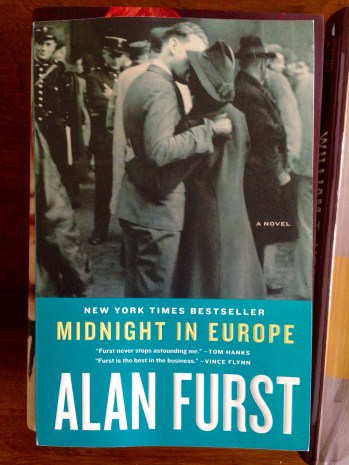
Midnight in Europe (Book acquired, some time in February 2015)

IMG_5139

Alan Furst’s Midnight in Europe is out next week in paperback from Random House. Their blurb:

Paris, 1938. As the shadow of war darkens Europe, democratic forces on the Continent struggle against fascism and communism, while in Spain the war has already begun. Alan Furst, whom Vince Flynn has called “the most talented espionage novelist of our generation,” now gives us a taut, suspenseful, romantic, and richly rendered novel of spies and secret operatives in Paris and New York, in Warsaw and Odessa, on the eve of World War II.

Cristián Ferrar, a brilliant and handsome Spanish émigré, is a lawyer in the Paris office of a prestigious international law firm. Ferrar is approached by the embassy of the Spanish Republic and asked to help a clandestine agency trying desperately to supply weapons to the Republic’s beleaguered army—an effort that puts his life at risk in the battle against fascism.

Joining Ferrar in this mission is a group of unlikely men and women: idealists and gangsters, arms traders and aristocrats and spies. From shady Paris nightclubs to white-shoe New York law firms, from brothels in Istanbul to the dockyards of Poland, Ferrar and his allies battle the secret agents of Hitler and Franco. And what allies they are: there’s Max de Lyon, a former arms merchant now hunted by the Gestapo; the Marquesa Maria Cristina, a beautiful aristocrat with a taste for danger; and the Macedonian Stavros, who grew up “fighting Bulgarian bandits. After that, being a gangster was easy.” Then there is Eileen Moore, the American woman Ferrar could never forget.

In Midnight in Europe, Alan Furst paints a spellbinding portrait of a continent marching into a nightmare—and the heroes and heroines who fought back against the darkness.

Newton’s Diary — Amy Judd

amy_judd_large_17

The official lie (Gravity’s Rainbow)

What did Caesar really whisper to his protégé as he fell? Et tu, Brute, the official lie, is about what you’d expect to get from them—it says exactly nothing. The moment of assassination is the moment when power and the ignorance of power come together, with Death as validator. When one speaks to the other then it is not to pass the time of day with et-tu-Brutes. What passes is a truth so terrible that history—at best a conspiracy, not always among gentlemen, to defraud—will never admit it. The truth will be repressed or in ages of particular elegance be disguised as something else. What will Rathenau, past the moment, years into a new otherside existence, have to say about the old dispensation? Probably nothing as incredible as what he might have said just as the shock flashed his mortal nerves, as the Angel swooped in…

From Thomas Pynchon’s novel Gravity’s Rainbow.

Paris Red (Book acquired some time in February, 2015)

IMG_5138

Maureen Gibbon’s novel Paris Red is forthcoming (April 2015) in hardback from W.W. Norton. Their blurb:

For readers of Girl with a Pearl Earring, a luminous and evocative novel of Édouard Manet’s muse.

Paris, 1862. A young girl in a threadbare dress and green boots, hungry for experience, meets the mysterious and wealthy artist Édouard Manet. The encounter will change her—and the art world—forever.

At seventeen, Victorine Meurent abandons her old life to become immersed in the Parisian society of dance halls and cafés, meeting writers and artists like Baudelaire and Alfred Stevens. As Manet’s model, Victorine explores a world of new possibilities and stirs the artist to push the boundaries of painting in his infamous portrait Olympia, which scandalizes even the most cosmopolitan city.

Manet becomes himself because of Victorine. But who does she become, that figure on the divan?

Intense, erotic, and beautifully wrought, Paris Red evokes the unconventional love story of a painter and his muse that changed the history of art.

The extinction of the dodo (Pynchon’s Gravity’s Rainbow)

He left the dodoes to rot, he couldn’t endure to eat their flesh. Usually, he hunted alone. But often, after months of it, the isolation would begin to change him, change his very perceptions—the jagged mountains in full daylight flaring as he watched into freak saffrons, streaming indigos, the sky his glass house, all the island his tulipomania. The voices—he insomniac, southern stars too thick for constellations teeming in faces and creatures of fable less likely than the dodo—spoke the words of sleepers, singly, coupled, in chorus. The rhythms and timbres were Dutch, but made no waking sense. Except that he thought they were warning him… scolding, angry that he couldn’t understand. Once he sat all day staring at a single white dodo’s egg in a grass hummock. The place was too remote for any foraging pig to’ve found. He waited for scratching, a first crack reaching to net the chalk surface: an emergence. Hemp gripped in the teeth of the steel snake, ready to be lit, ready to descend, sun to black-powder sea, and destroy the infant, egg of light into egg of darkness, within its first minute of amazed vision, of wet downstirred cool by these south-east trades… . Each hour he sighted down the barrel. It was then, if ever, he might have seen how the weapon made an axis potent as Earth’s own between himself and this victim, still one, inside the egg, with the ancestral chain, not to be broken out for more than its blink of world’s light. There they were, the silent egg and the crazy Dutchman, and the hookgun that linked them forever, framed, brilliantly motionless as any Vermeer. Only the sun moved: from zenith down at last behind the snaggleteeth of mountains to Indian ocean, to tarry night. The egg, without a quiver, still unhatched. He should have blasted it then where it lay: he understood that the bird would hatch before dawn. But a cycle was finished. He got to his feet, knee and hip joints in agony, head gonging with instructions from his sleeptalkers droning by, overlapping, urgent, and only limped away, piece at right shoulder arms.

Continue reading “The extinction of the dodo (Pynchon’s Gravity’s Rainbow)” →

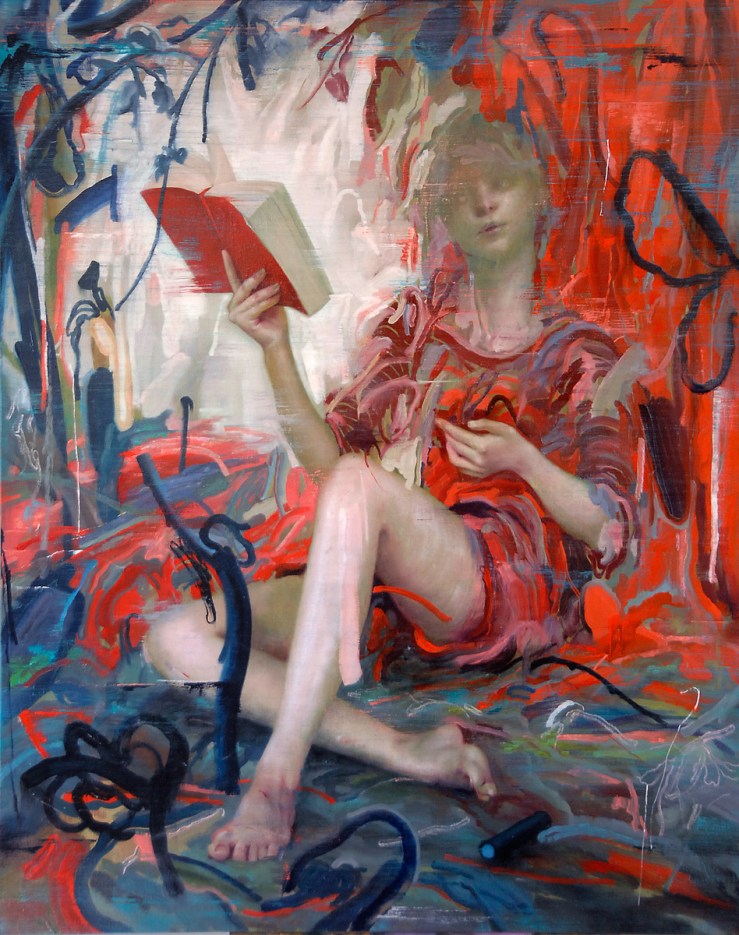
Reader — James Jean

tumblr_mr59qa3Iba1s213u5o1_1280

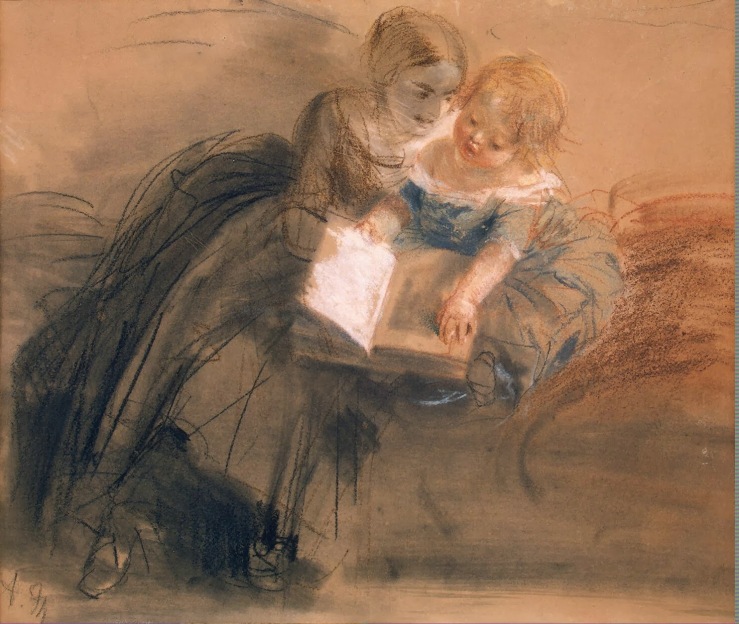
Young Woman Reading with Child — Adolph von Menzel

000000000000000000000000000000000000000

Six Notes from Nathaniel Hawthorne’s Note-Books

Imitators of original authors might be compared to plaster casts of marble statues, or the imitative book to a cast of the original marble.


For a child’s story,–the voyage of a little boat made of a chip, with a birch-bark sail, down a river.


Fourier states that, in the progress of the world, the ocean is to lose its saltness, and acquire the taste of a peculiarly flavored lemonade.


How pleasant it is to see a human countenance which cannot be insincere,–in reference to baby’s smile.


The best of us being unfit to die, what an inexpressible absurdity to put the worst to death!


“Is that a burden of sunshine on Apollo’s back?” asked one of the children,–of the chlamys on our Apollo Belvedere.

From Nathaniel Hawthorne’s American Note-Books.

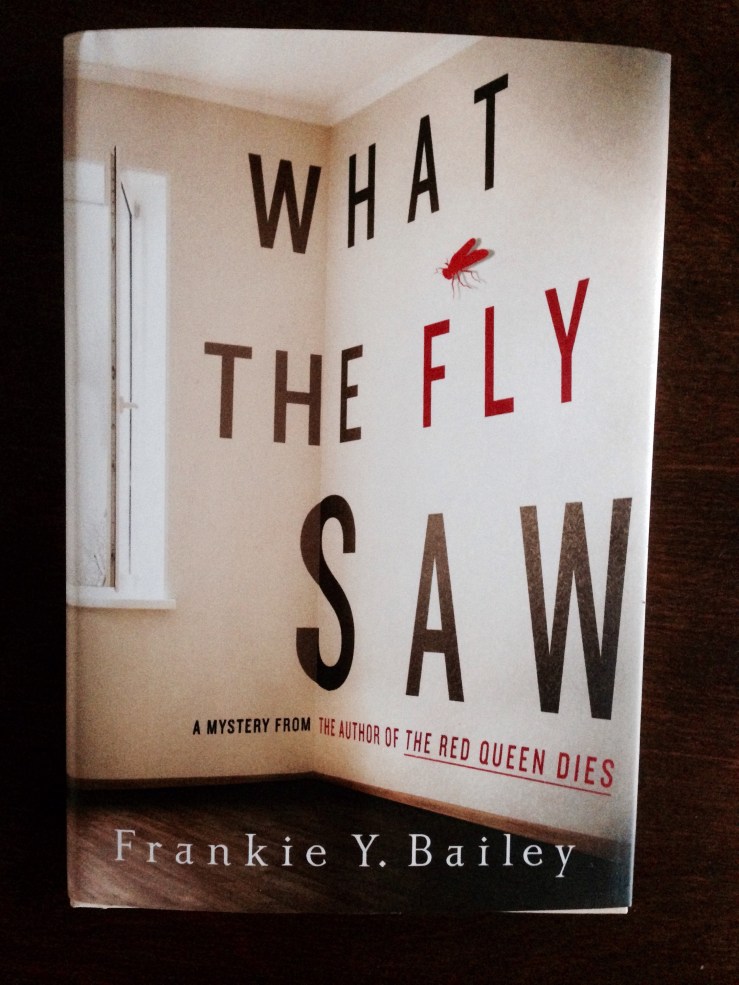
What the Fly Saw (Book acquired, some time in February 2015)

IMG_5098

Frankie Y. Bailey’s What the Fly Saw. Blurb from the author’s site:

The morning after a blizzard that shut down the city, funeral director Kevin Novak is found dead in the basement of his funeral home. The arrow sticking out of his chest came from his own hunting bow. A loving husband and father and an active member of a local megachurch, Novak had no known enemies. His family and friends say he had been depressed because his best friend died suddenly of a heart attack and Novak blamed himself. But what does his guilt have to do with his death? Maybe nothing, maybe a lot. The minister of the megachurch, the psychiatrist who provides counseling to church members, or the folksy Southern medium who irritates both men – one of these people may know why Novak was murdered. Detective Hannah McCabe and her partner, Mike Baxter, sort through lies and evasions to find the person who killed their “Cock Robin,” But McCabe is distracted by a political controversy involving her family, unanswered questions from another high-profile case, and her own guilt when a young woman dies after McCabe fails to act.


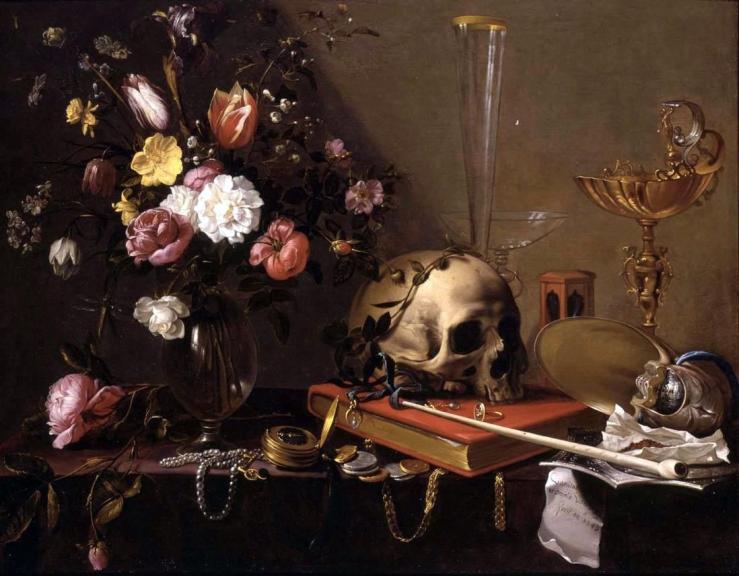
Small Bouquet and Skull — Adriaen van Utrecht

tumblr_lun3mnsEhb1r5569zo1_1280