See Wise Blood, John Houston’s Adaptation of Flannery O’Connor’s Novel

Read “Peter,” A Very Short Story by Willa Cather

“Peter”

by Willa Cather

“No, Antone, I have told thee many times, no, thou shalt not sell it until I am gone.”

“But I need money; what good is that old fiddle to thee? The very crows laugh at thee when thou art trying to play. Thy hand trembles so thou canst scarce hold the bow. Thou shalt go with me to the Blue to cut wood to-morrow. See to it thou art up early.”

“What, on the Sabbath, Antone, when it is so cold? I get so very cold, my son, let us not go to-morrow.”

“Yes, to-morrow, thou lazy old man. Do not I cut wood upon the Sabbath? Care I how cold it is? Wood thou shalt cut, and haul it too, and as for the fiddle, I tell thee I will sell it yet.” Antone pulled his ragged cap down over his low heavy brow, and went out. The old man drew his stool up nearer the fire, and sat stroking his violin with trembling fingers and muttering, “Not while I live, not while I live.”

Five years ago they had come here, Peter Sadelack, and his wife, and oldest son Antone, and countless smaller Sadelacks, here to the dreariest part of south-western Nebraska, and had taken up a homestead. Antone was the acknowledged master of the premises, and people said he was a likely youth, and would do well. That he was mean and untrustworthy every one knew, but that made little difference. His corn was better tended than any in the county, and his wheat always yielded more than other men’s.

Of Peter no one knew much, nor had any one a good word to say for him. He drank whenever he could get out of Antone’s sight long enough to pawn his hat or coat for whiskey. Indeed there were but two things he would not pawn, his pipe and his violin. He was a lazy, absent minded old fellow, who liked to fiddle better than to plow, though Antone surely got work enough out of them all, for that matter. In the house of which Antone was master there was no one, from the little boy three years old, to the old man of sixty, who did not earn his bread. Still people said that Peter was worthless, and was a great drag on Antone, his son, who never drank,  and was a much better man than his father had ever been. Peter did not care what people said. He did not like the country, nor the people, least of all he liked the plowing. He was very homesick for Bohemia. Long ago, only eight years ago by the calendar, but it seemed eight centuries to Peter, he had been a second violinist in the great theatre at Prague. He had gone into the theatre very young, and had been there all his life, until he had a stroke of paralysis, which made his arm so weak that his bowing was uncertain. Then they told him he could go. Those were great days at the theatre. He had plenty to drink then, and wore a dress coat every evening, and there were always parties after the play. He could play in those days, ay, that he could! He could never read the notes well, so he did not play first; but his touch, he had a touch indeed, so Herr Mikilsdoff, who led the orchestra, had said. Sometimes now Peter thought he could plow better if he could only bow as he used to. He had seen all the lovely women in the world there, all the great singers and the great players. He was in the orchestra when Rachel played, and he heard Liszt play when the Countess d’Agoult sat in the stage box and threw the master white lilies. Once, a French woman came and played for weeks, he did not remember her name now. He did not remember her face very well either, for it changed so, it was never twice the same. But the beauty of it, and the great hunger men felt at the sight of it, that he remembered. Most of all he remembered her voice. He did not know French, and could not understand a word she said, but it seemed to him that she must be talking the music of Chopin. And her voice, he thought he should know that in the other world. The last night she played a play in which a man touched her arm, and she stabbed him. As Peter sat among the smoking gas jets down below the footlights with his fiddle on his knee, and looked up at her, he thought he would like to die too, if he could touch her arm once, and have her stab him so. Peter went home to his wife very drunk that night. Even in those days he was a foolish fellow, who cared for nothing but music and pretty faces.

It was all different now. He had nothing to drink and little to eat, and here, there was nothing but sun, and grass, and sky. He had forgotten almost everything, but some things he  remembered well enough. He loved his violin and the holy Mary, and above all else he feared the Evil One, and his son Antone.

The fire was low, and it grew cold. Still Peter sat by the fire remembering. He dared not throw more cobs on the fire; Antone would be angry. He did not want to cut wood tomorrow, it would be Sunday, and he wanted to go to mass. Antone might let him do that. He held his violin under his wrinkled chin, his white hair fell over it, and he began to play “Ave Maria.” His hand shook more than ever before, and at last refused to work the bow at all. He sat stupefied for a while, then arose, and taking his violin with him, stole out into the old sod stable. He took Antone’s shot-gun down from its peg, and loaded it by the moonlight which streamed in through the door. He sat down on the dirt floor, and leaned back against the dirt wall. He heard the wolves howling in the distance, and the night wind screaming as it swept over the snow. Near him he heard the regular breathing of the horses in the dark. He put his crucifix above his heart, and folding his hands said brokenly all the Latin he had ever known, “Pater noster, qui in cælum est.” Then he raised his head and sighed, “Not one kreutzer will Antone pay them to pray for my soul, not one kreutzer, he is so careful of his money, is Antone, he does not waste it in drink, he is a better man than I, but hard sometimes. He works the girls too hard, women were not made to work so. But he shall not sell thee, my fiddle, I can play thee no more, but they shall not part us. We have seen it all together, and we will forget it together, the French woman and all.” He held his fiddle under his chin a moment, where it had lain so often, then put it across his knee and broke it through the middle. He pulled off his old boot, held the gun between his knees with the muzzle against his forehead, and pressed the trigger with his toe.

In the morning Antone found him stiff, frozen fast in a pool of blood. They could not straighten him out enough to fit a coffin, so they buried him in a pine box. Before the funeral Antone carried to town the fiddle-bow which Peter had forgotten to break. Antone was very thrifty, and a better man than his father had been.

The Mahogany Tree, May 21, 1892


J.G. Ballard on Fear of a Boring Planet (and Surrealism)

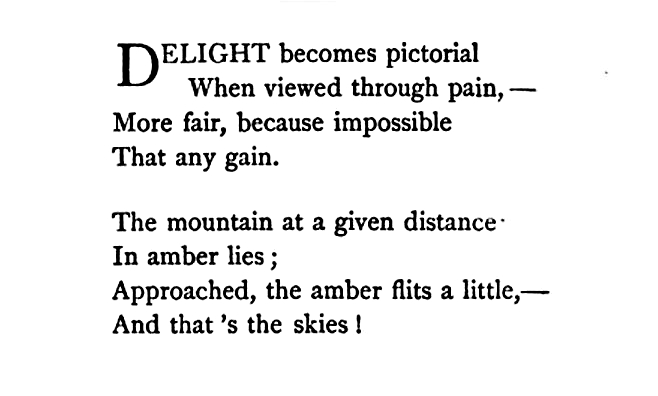
“Delight becomes pictorial” — Emily Dickinson

delight

Reading, rereading, trying to read

20131226-142706.jpg

“the familiar story of virgin birth on December twenty-fifth, mutilation and resurrection” (William Gaddis)

His father seemed less than ever interested in what passed around him, once assured Wyatt’s illness was done. Except for the Sunday sermon, public activities in the town concerned him less than ever. Like Pliny, retiring to his Laurentine villa when Saturnalia approached, the Reverend Gwyon avoided the bleak festivities of his congregation whenever they occurred, by retiring to his study. But his disinterest was no longer a dark mantle of preoccupation. A sort of hazardous assurance had taken its place. He approached his Sunday sermons with complaisant audacity, introducing, for instance, druidical reverence for the oak tree as divinely favored because so often singled out to be struck by lightning. Through all of this, even to the sermon on the Aurora Borealis, the Dark Day of May in 1790 whose night moon turned to blood, and the great falling of stars in November 1833, as signs of the Second Advent, Aunt May might well have noted the persistent non-appearance of what she, from that same pulpit, had been shown as the body of Christ. Certainly the present members of the Use-Me Society found many of his references “unnecessary.” It did not seem quite necessary, for instance, to note that Moses had been accused of witchcraft in the Koran; that the hundred thousand converts to Christianity in the first two or three centuries in Rome were “slaves and disreputable people,” that in a town on the Nile there were ten thousand “shaggy monks” and twice that number of “god- dedicated virgins”; that Charlemagne mass-baptized Saxons by driving them through a river being blessed upstream by his bishops, while Saint Olaf made his subjects choose between baptism and death. No soberly tolerated feast day came round, but that Reverend Gwyon managed to herald its grim observation by allusion to some pagan ceremony which sounded uncomfortably like having a good time. Still the gray faces kept peace, precarious though it might be. They had never been treated this way from the pulpit. True, many stirred with indignant discomfort after listening to the familiar story of virgin birth on December twenty-fifth, mutilation and resurrection, to find they had been attending, not Christ, but Bacchus, Osiris, Krishna, Buddha, Adonis, Marduk, Balder, Attis, Amphion, or Quetzalcoatl. They recalled the sad day the sun was darkened; but they did not remember the occasion as being the death of Julius Caesar. And many hurried home to closet themselves with their Bibles after the sermon on the Trinity, which proved to be Brahma, Vishnu, and Siva; as they did after the recital of the Immaculate Conception, where the seed entered in spiritual form, bringing forth, in virginal modesty, Romulus and Remus.

If the mild assuasive tones of the Reverend offended anywhere, it was the proprietary sense of his congregation; and with true Puritan fortitude they resisted any suggestion that their bloody sacraments might have known other voices and other rooms. They could hardly know that the Reverend’s powers of resistance were being taxed more heavily than their own, where he withstood the temptation to tell them details of the Last Supper at the Eleusinian Mysteries, the snake in the Garden of Eden, what early translators of the Bible chose to let the word ‘thigh’ stand for (where ancient Hebrews placed their hands when under oath), the symbolism of the Triune triangle and, in generative counterpart so distressing to early fathers of the Church, the origin of the Cross.

From William Gaddis’s novel The Recognitions.


Journal entry, December 25, 1854 (Nathaniel Hawthorne)

December 25th.–Commodore P—- called to see me this morning,–a brisk, gentlemanly, offhand, but not rough, unaffected, and sensible man, looking not so elderly as he ought, on account of a very well made wig. He is now on his return from a cruise in the East Indian seas, and goes home by the Baltic, with a prospect of being very well received on account of his treaty with Japan. I seldom meet with a man who puts himself more immediately on conversable terms than the Commodore. He soon introduced his particular business with me,–it being to inquire whether I would recommend some suitable person to prepare his notes and materials for the publication of an account of his voyage. He was good enough to say that he had fixed upon me, in his own mind, for this office; but that my public duties would of course prevent me from engaging in it. I spoke of Herman Melville, and one or two others; but he seems to have some acquaintance with the literature of the day, and did not grasp very cordially at any name that I could think of; nor, indeed, could I recommend any one with full confidence. It would be a very desirable task for a young literary man, or, for that matter, for an old one; for the world can scarcely have in reserve a less hackneyed theme than Japan.

This is a most beautiful day of English winter; clear and bright, with the ground a little frozen, and the green grass along the waysides at Rock Ferry sprouting up through the frozen pools of yesterday’s rain. England is forever green. On Christmas Day, the children found wall-flowers, pansies, and pinks in the garden; and we had a beautiful rose from the garden of the hotel grown in the open air. Yet one is sensible of the cold here, as much as in the zero atmosphere of America. The chief advantage of the English climate is that we are not tempted to heat our rooms to so unhealthy a degree as in New England.

I think I have been happier this Christmas than ever before,–by my own fireside, and with my wife and children about me,–more content to enjoy what I have,–less anxious for anything beyond it in this life. My early life was perhaps a good preparation for the declining half of life; it having been such a blank that any thereafter would compare favorably with it. For a long, long while, I have occasionally been visited with a singular dream; and I have an impression that I have dreamed it ever since I have been in England. It is, that I am still at college,–or, sometimes, even at school,–and there is a sense that I have been there unconscionably long, and have quite failed to make such progress as my contemporaries have done; and I seem to meet some of them with a feeling of shame and depression that broods over me as I think of it, even when awake. This dream, recurring all through these twenty or thirty years, must be one of the effects of that heavy seclusion in which I shut myself up for twelve years after leaving college, when everybody moved onward, and left me behind. How strange that it should come now, when I may call myself famous and prosperous!–when I am happy, too!

From Nathaniel Hawthorne’s English Note-Books.


Read “The Fir-Tree,” Hans Christian Andersen’s Depressing Story About the Existential Fate of a Christmas Tree

“The Fir-Tree” by Hans Christian Andersen

Far down in the forest, where the warm sun and the fresh air made a sweet resting-place, grew a pretty little fir-tree; and yet it was not happy, it wished so much to be tall like its companions— the pines and firs which grew around it. The sun shone, and the soft air fluttered its leaves, and the little peasant children passed by, prattling merrily, but the fir-tree heeded them not. Sometimes the children would bring a large basket of raspberries or strawberries, wreathed on a straw, and seat themselves near the fir-tree, and say, “Is it not a pretty little tree?” which made it feel more unhappy than before. And yet all this while the tree grew a notch or joint taller every year; for by the number of joints in the stem of a fir-tree we can discover its age. Still, as it grew, it complained, “Oh! how I wish I were as tall as the other trees, then I would spread out my branches on every side, and my top would over-look the wide world. I should have the birds building their nests on my boughs, and when the wind blew, I should bow with stately dignity like my tall companions.” The tree was so discontented, that it took no pleasure in the warm sunshine, the birds, or the rosy clouds that floated over it morning and evening. Sometimes, in winter, when the snow lay white and glittering on the ground, a hare would come springing along, and jump right over the little tree; and then how mortified it would feel! Two winters passed, and when the third arrived, the tree had grown so tall that the hare was obliged to run round it. Yet it remained unsatisfied, and would exclaim, “Oh, if I could but keep on growing tall and old! There is nothing else worth caring for in the world!” In the autumn, as usual, the wood-cutters came and cut down several of the tallest trees, and the young fir-tree, which was now grown to its full height, shuddered as the noble trees fell to the earth with a crash. After the branches were lopped off, the trunks looked so slender and bare, that they could scarcely be recognized. Then they were placed upon wagons, and drawn by horses out of the forest. “Where were they going? What would become of them?” The young fir-tree wished very much to know; so in the spring, when the swallows and the storks came, it asked, “Do you know where those trees were taken? Did you meet them?”

The swallows knew nothing, but the stork, after a little reflection, nodded his head, and said, “Yes, I think I do. I met several new ships when I flew from Egypt, and they had fine masts that smelt like fir. I think these must have been the trees; I assure you they were stately, very stately.”
“Oh, how I wish I were tall enough to go on the sea,” said the fir-tree. “What is the sea, and what does it look like?”

“It would take too much time to explain,” said the stork, flying quickly away.

“Rejoice in thy youth,” said the sunbeam; “rejoice in thy fresh growth, and the young life that is in thee.”

And the wind kissed the tree, and the dew watered it with tears; but the fir-tree regarded them not. Continue reading “Read “The Fir-Tree,” Hans Christian Andersen’s Depressing Story About the Existential Fate of a Christmas Tree”

“In drear-nighted December” — John Keats

“In drear-nighted December” by  John Keats

In drear-nighted December,
Too happy, happy tree,
Thy branches ne’er remember
Their green felicity:
The north cannot undo them
With a sleety whistle through them;
Nor frozen thawings glue them
From budding at the prime.

In drear-nighted December,
Too happy, happy brook,
Thy bubblings ne’er remember
Apollo’s summer look;
But with a sweet forgetting,
They stay their crystal fretting,
Never, never petting
About the frozen time.

Ah! would ’twere so with many
A gentle girl and boy!
But were there ever any
Writhed not at passed joy?
The feel of not to feel it,
When there is none to heal it
Nor numbed sense to steel it,
Was never said in rhyme.

“Christmas Night with Satan” — John Fox, Jr.

“Christmas Night with Satan” by John Fox, Jr.

No night was this in Hades with solemn-eyed Dante, for Satan was only a woolly little black dog, and surely no dog was ever more absurdly misnamed. When Uncle Carey first heard that name, he asked gravely:

“Why, Dinnie, where in h—-,” Uncle Carey gulped slightly, “did you get him?” And Dinnie laughed merrily, for she saw the fun of the question, and shook her black curls. “He didn’t come f’um THAT PLACE.”

Distinctly Satan had not come from that place. On the contrary, he might by a miracle have dropped straight from some Happy Hunting- Ground, for all the signs he gave of having touched pitch in this or another sphere. Nothing human was ever born that was gentler, merrier, more trusting or more lovable than Satan. That was why Uncle Carey said again gravely that he could hardly tell Satan and his little mistress apart. He rarely saw them apart, and as both had black tangled hair and bright black eyes; as one awoke every morning with a happy smile and the other with a jolly bark; as they played all day like wind-shaken shadows and each won every heart at first sight—the likeness was really rather curious. I have always believed that Satan made the spirit of Dinnie’s house, orthodox and severe though it was, almost kindly toward his great namesake. I know I have never been able, since I knew little Satan, to think old Satan as bad as I once painted him, though I am sure the little dog had many pretty tricks that the “old boy” doubtless has never used in order to amuse his friends.

“Shut the door, Saty, please,” Dinnie would say, precisely as she would say it to Uncle Billy, the butler, and straightway Satan would launch himself at it—bang! He never would learn to close it softly, for Satan liked that—bang!

If you kept tossing a coin or marble in the air, Satan would keep catching it and putting it back in your hand for another throw, till you got tired. Then he would drop it on a piece of rag carpet, snatch the carpet with his teeth, throw the coin across the room, and rush for it like mad, until he got tired. If you put a penny on his nose, he would wait until you counted, one—two— THREE! Then he would toss it up himself and catch it. Thus, perhaps, Satan grew to love Mammon right well, but for another and better reason than that he liked simply to throw it around—as shall now be made plain. Continue reading ““Christmas Night with Satan” — John Fox, Jr.”

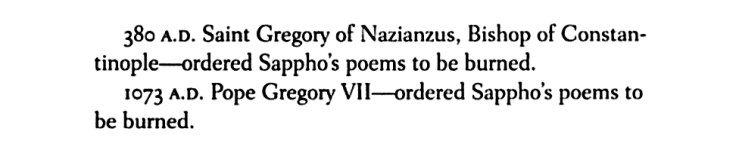
Burning Sappho (David Markson)

dm

“Patricide: Patricide is a bad idea” (Donald Barthelme)

Patricide: Patricide is a bad idea, first because it is contrary to law and custom and second because it proves, beyond a doubt, that the father’s every fluted accusation against you was correct: you are a thoroughly bad individual, a patricide! — member of a class of persons universally ill-regarded. It is all right to feel this hot emotion, but not to act upon it. And it is not necessary. It is not necessary to slay your father, time will slay him, that is a virtual certainty. Your true task lies elsewhere. Your true task, as a son, is to reproduce every one of the enormities touched upon in this manual, but in attenuated form. You must become your father, but a paler, weaker version of him. The enormities go with the job, but close study will allow you to perform the job less well than it has previously been done, thus moving toward a golden age of decency, quiet, and calmed fevers. Your contribution will not be a small one, but “small” is one of the concepts that you should shoot for. If your father was a captain in Battery D, then content yourself with a corporalship in the same battery. Do not attend the annual reunions. Do not drink beer or sing songs at the reunions. Begin by whispering, in front of a mirror, for thirty minutes a day. Then tie your hands behind your back for thirty minutes a day, or get someone else to do this for you. Then, choose one of your most deeply held beliefs, such as the belief that your honors and awards have something to do with you, and abjure it. Friends will help you abjure it, and can be telephoned if you begin to backslide. You see the pattern, put it into practice. Fatherhood can be, if not conquered, at least “turned down” in this generation — by the combined efforts of all of us together.

From Donald Barthelme’s novel The Dead Father.

“A Luckless Santa Claus” — F. Scott Fitzgerald

“A Luckless Santa Claus” by F. Scott Fitzgerald

Miss Harmon was responsible for the whole thing. If it had not been for her foolish whim, Talbot would not have made a fool of himself, and–but I am getting ahead of my story.

It was Christmas Eve. Salvation Army Santa Clauses with highly colored noses proclaimed it as they beat upon rickety paper chimneys with tin spoons. Package laden old bachelors forgot to worry about how many slippers and dressing gowns they would have to thank people for next day, and joined in the general air of excitement that pervaded busy Manhattan.

In the parlor of a house situated on a dimly lighted residence street somewhere east of Broadway, sat the lady who, as I have said before, started the whole business. She was holding a conversation half frivolous, half sentimental, with a faultlessly dressed young man who sat with her on the sofa. All of this was quite right and proper, however, for they were engaged to be married in June.

“Harry Talbot,” said Dorothy Harmon, as she rose and stood laughing at the merry young gentleman beside her, “if you aren’t the most ridiculous boy I ever met, I’ll eat that terrible box of candy you brought me last week!”

“Dorothy,” reproved the young man, “you should receive gifts in the spirit in which they are given. That box of candy cost me much of my hard earned money.”

“Your hard earned money, indeed!” scoffed Dorothy. “You know very well that you never earned a cent in your life. Golf and dancing–that is the sum total of your occupations. Why, you can’t even spend money, much less earn it!”

“My dear Dorothy, I succeeded in running up some very choice bills last month, as you will find if you consult my father.”

“That’s not spending your money. That’s wasting it. Why, I don’t think you could give away twenty-five dollars in the right way to save your life.”

“But why on earth,” remonstrated Harry, “should I want to give away twenty-five dollars?”

“Because,” explained Dorothy, “that would be real charity. It’s nothing to charge a desk to your father and have it sent to me, but to give money to people you don’t know is something.”

“Why, any old fellow can give away money,” protested Harry.

“Then,” exclaimed Dorothy, “we’ll see if you can. I don’t believe that you could give twenty-five dollars in the course of an evening if you tried.”

“Indeed, I could.”

“Then try it!” And Dorothy, dashing into the hall, took down his coat and hat and placed them in his reluctant hands. “It is now half-past eight. You be here by ten o’clock.”

“But, but,” gasped Harry.

Dorothy was edging him towards the door.

“How much money have you?” she demanded.

Harry gloomily put his hand in his pocket and counted out a handful of bills.

“Exactly twenty-five dollars and five cents.”

“Very well! Now listen! These are the conditions. You go out and give this money to anybody you care to whom you have never seen before. Don’t give more than two dollars to any one person. And be back here by ten o’clock with no more than five cents in your pocket.”

“But,” declared Harry, still backing towards the door, “I want my twenty-five dollars.”

“Harry,” said Dorothy sweetly, “I am surprised!” and with that, she slammed the door in his face.

“I insist,” muttered Harry, “that this is a most unusual pro- ceeding.”

He walked down the steps and hesitated.

“Now,” he thought, “Where shall I go?”

He considered a moment and finally started off towards Broad- way. He had gone about half a block when he saw a gentleman in a top hat approaching. Harry hesitated. Then he made up his mind, and, stepping towards the man, emitted what he intended for a pleasant laugh but what sounded more like a gurgle, and loudly vociferated, “Merry Christmas, friend!” Continue reading ““A Luckless Santa Claus” — F. Scott Fitzgerald”

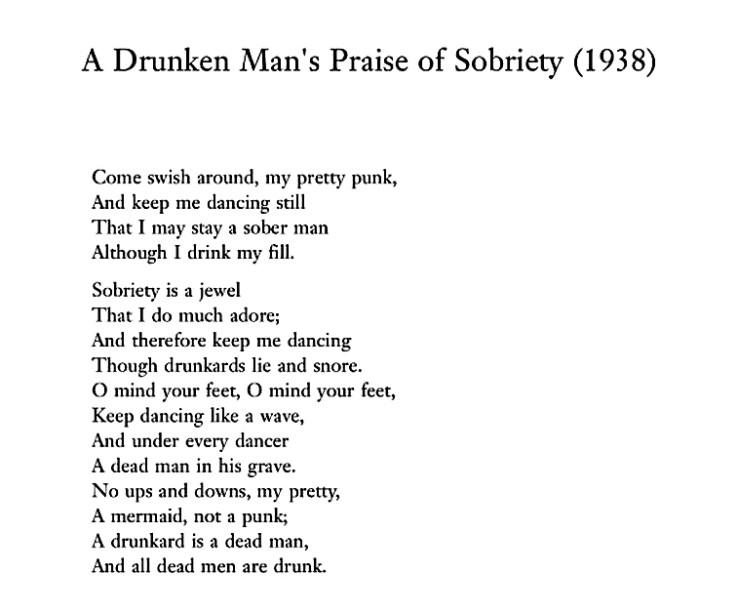
“A Drunken Man’s Praise Of Sobriety” — W.B. Yeats

yeats

“The Poem That Took The Place Of A Mountain” — Wallace Stevens

“The Poem That Took The Place Of A Mountain” by Wallace Stevens

There it was, word for word,
The poem that took the place of a mountain.

He breathed its oxygen,
Even when the book lay turned in the dust of his table.

It reminded him how he had needed
A place to go to in his own direction,

How he had recomposed the pines,
Shifted the rocks and picked his way among clouds,

For the outlook that would be right,
Where he would be complete in an unexplained completion:

The exact rock where his inexactness
Would discover, at last, the view toward which they had edged,

Where he could lie and, gazing down at the sea,
Recognize his unique and solitary home.


“To find a lost father” (Donald Barthelme)

To find a lost father: The first problem in finding a lost father is to lose him, decisively. Often he will wander away from home and lose himself. Often he will remain at home but still be “lost” in every true sense, locked away in an upper room, or in a workshop, or in the contemplation of beauty, or in the contemplation of a secret life. He may, every evening, pick up his gold-headed cane, wrap himself in his cloak, and depart, leaving behind, on the coffee table, a sealed laundry bag in which there is an address at which he may be reached, in case of war. War, as is well known, is a place at which many fathers are lost, sometimes temporarily, sometimes forever. Fathers are frequently lost on expeditions of various kinds (the journey to the interior). The five best places to seek this kind of lost father are Nepal, Rupert’s Land, Mount Elbrus, Paris, and the agora. The five kinds of vegetation in which fathers most often lose themselves are needle-leaved forest, broad-leaved forest mainly evergreen, broad-leaved forest mainly deciduous, mixed needle-leaved and broad-leaved forest, and tundra. The five kinds of things fathers were wearing when last seen are caftans, bush jackets, parkas, Confederate gray, and ordinary business suits. Armed with these clues then, you may place an advertisement in the newspaper: Lost, in Paris, on or about February 24, a broad-leaf-loving father, 6’ 2”, wearing a blue caftan, may be armed and dangerous, we don’t know, answers to the name Old Hickory. Reward. Having completed this futile exercise, you are then free to think about what is really important. Do you really want to find this father? What if, when you find him, he speaks to you in the same tone he used before he lost himself? Will he again place nails in your mother, in her elbows and back of the knee? Remember the javelin. Have you any reason to believe that it will not, once again, flash through the seven-o’clock-in-the-evening air? What we are attempting to determine is simple: Under what conditions do you wish to live? Yes, he “nervously twiddles the stem of his wineglass.” Do you wish to watch him do so on into the last quarter of the present century? I don’t think so. Let him take those mannerisms, and what they portend, to Borneo, they will be new to Borneo. Perhaps in Borneo he will also nervously twiddle the stem of, etc., but he will not be brave enough to manufacture, there the explosion of which this is a sign. Throwing the roast through the mirror. Thrusting a belch big as an opened umbrella into the middle of something someone else is trying to say. Beating you, either with a wet, knotted rawhide, or with an ordinary belt. Ignore that empty chair at the head of the table. Give thanks.

From Donald Barthelme’s novel The Dead Father.

“The Ogre of Rashomon”

“The Ogre of Rashomon”

Retold by Yei Theodora Ozaki

Long, long ago in Kyoto, the people of the city were terrified by accounts of a dreadful ogre, who, it was said, haunted the Gate of Rashomon at twilight and seized whoever passed by. The missing victims were never seen again, so it was whispered that the ogre was a horrible cannibal, who not only killed the unhappy victims but ate them also. Now everybody in the town and neighborhood was in great fear, and no one durst venture out after sunset near the Gate of Rashomon.

Now at this time there lived in Kyoto a general named Raiko, who had made himself famous for his brave deeds. Some time before this he made the country ring with his name, for he had attacked Oeyama, where a band of ogres lived with their chief, who instead of wine drank the blood of human beings. He had routed them all and cut off the head of the chief monster.

This brave warrior was always followed by a band of faithful knights. In this band there were five knights of great valor. One evening as the five knights sat at a feast quaffing SAKE in their rice bowls and eating all kinds of fish, raw, and stewed, and broiled, and toasting each other’s healths and exploits, the first knight, Hojo, said to the others:

“Have you all heard the rumor that every evening after sunset there comes an ogre to the Gate of Rashomon, and that he seizes all who pass by?”

The second knight, Watanabe, answered him, saying:

“Do not talk such nonsense! All the ogres were killed by our chief Raiko at Oeyama! It cannot be true, because even if any ogres did escape from that great killing they would not dare to show themselves in this city, for they know that our brave master would at once attack them if he knew that any of them were still alive!”

“Then do you disbelieve what I say, and think that I am telling you a falsehood?” Continue reading ““The Ogre of Rashomon””