“Defending Walt Whitman” — Sherman Alexie

“Defending Walt Whitman,” a poem by Sherman Alexie

Basketball is like this for young Indian boys, all arms and legs
and serious stomach muscles. Every body is brown!
These are the twentieth-century warriors who will never kill,
although a few sat quietly in the deserts of Kuwait,
waiting for orders to do something, to do something.

God, there is nothing as beautiful as a jumpshot
on a reservation summer basketball court
where the ball is moist with sweat,
and makes a sound when it swishes through the net
that causes Walt Whitman to weep because it is so perfect.

Continue reading ““Defending Walt Whitman” — Sherman Alexie”

The Miracles of Leopold Bloom

A passage from “Circe,” my favorite chapter of Ulysses–

BLOOM: Shoot him! Dog of a christian! So much for M’Intosh!

(A cannonshot. The man in the macintosh disappears. Bloom with his sceptre strikes down poppies. The instantaneous deaths of many powerful enemies, graziers, members of parliament, members of standing committees, are reported. Bloom’s bodyguard distribute Maundy money, commemoration medals, loaves and fishes, temperance badges, expensive Henry Clay cigars, free cowbones for soup, rubber preservatives in sealed envelopes tied with gold thread, butter scotch, pineapple rock, billets doux in the form of cocked hats, readymade suits, porringers of toad in the hole, bottles of Jeyes’ Fluid, purchase stamps, 40 days’ indulgences, spurious coins, dairyfed pork sausages, theatre passes, season tickets available for all tramlines, coupons of the royal and privileged Hungarian lottery, penny dinner counters, cheap reprints of the World’s Twelve Worst Books: Froggy And Fritz (politic), Care of the Baby (infantilic), 50 Meals for 7/6 (culinic), Was Jesus a Sun Myth? (historic), Expel that Pain (medic), Infant’s Compendium of the Universe (cosmic), Let’s All Chortle (hilaric), Canvasser’s Vade Mecum (journalic), Loveletters of Mother Assistant (erotic), Who’s Who in Space (astric), Songs that Reached Our Heart (melodic), Pennywise’s Way to Wealth (parsimonic). A general rush and scramble. Women press forward to touch the hem of Bloom’s robe. The Lady Gwendolen Dubedat bursts through the throng, leaps on his horse and kisses him on both cheeks amid great acclamation. A magnesium flashlight photograph is taken. Babes and sucklings are held up.)

THE WOMEN: Little father! Little father!

THE BABES AND SUCKLINGS:

Clap clap hands till Poldy comes home,
Cakes in his pocket for Leo alone.

(Bloom, bending down, pokes Baby Boardman gently in the stomach.)

BABY BOARDMAN: (Hiccups, curdled milk flowing from his mouth) Hajajaja.

BLOOM: (Shaking hands with a blind stripling) My more than Brother! (Placing his arms round the shoulders of an old couple) Dear old friends! (He plays pussy fourcorners with ragged boys and girls) Peep! Bopeep! (He wheels twins in a perambulator) Ticktacktwo wouldyousetashoe? (He performs juggler’s tricks, draws red, orange, yellow, green, blue, indigo and violet silk handkerchiefs from his mouth) Roygbiv. 32 feet per second. (He consoles a widow) Absence makes the heart grow younger. (He dances the Highland fling with grotesque antics) Leg it, ye devils! (He kisses the bedsores of a palsied veteran) Honourable wounds! (He trips up a fit policeman) U. p: up. U. p: up. (He whispers in the ear of a blushing waitress and laughs kindly) Ah, naughty, naughty! (He eats a raw turnip offered him by Maurice Butterly, farmer) Fine! Splendid! (He refuses to accept three shillings offered him by Joseph Hynes, journalist) My dear fellow, not at all! (He gives his coat to a beggar) Please accept. (He takes part in a stomach race with elderly male and female cripples) Come on, boys! Wriggle it, girls!

Download Chamber Four’s New Literary Magazine, C4

Chamber Four has a new literary magazine called C4. You can get the inaugural issue in several formats here.

The Matchmaker of Kenmare — Frank Delaney

Frank Delaney’s new novel The Matchmaker of Kenmare is set against the dramatic backdrop of Europe in 1943. Its narrator is Ben McCarthy (returning from Delaney’s previous novel Venetia Kelly’s Traveling Show), who lets the story unfold in the style of a memoir. Ben’s wife Venetia Kelly has mysteriously disappeared. To assuage his anxiety, Ben begins collecting folklore Irish folklore as part of a government project. In the process, he comes into contact with the titular matchmaker, Kate Begley. The two soon form a close bond, and Kate does everything in her power to aid the grieving narrator. The plot turns when a U.S. intelligence officer named Charles Miller enters the picture. He strikes up a romance with Kate, but their relationship is tested when he asks her — and Ben — to use their country’s neutral status to travel through enemy territory in order to find a man the American’s need before D-Day. Their mission soon turns to finding the man Kate believes she loves, a plot doubled in Ben’s search for his wife Venetia. The Matchmaker of Kenmare, new in hardback from Random House, will appeal to those who enjoy sweeping, richly detailed historical romances with a literary bent.

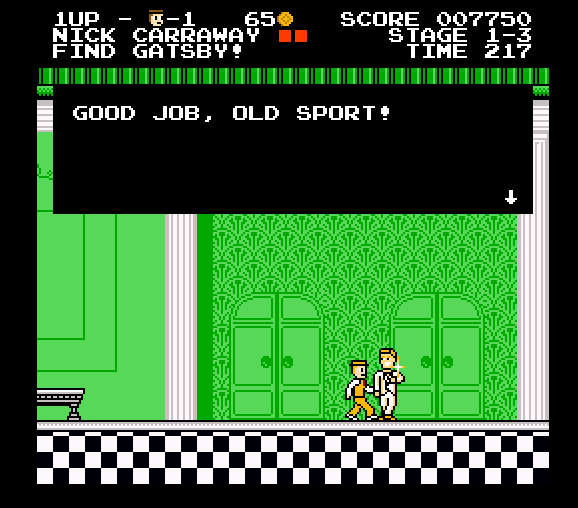
The Great Gatsby for NES

Brilliant game sure to waste too much of your time — The Great Gatsby for NES.

The Clown — Heinrich Böll

The titular figure in Heinrich Böll’s 1963 novel The Clown is Hans Schnier, a man whose personal and professional life is burning down around him as he howls in (often hilarious) despair. During a performance at a third-rate venue, Hans purposefully injures his knee and retreats to Bonn, where he holes up in his small apartment and makes angry desperate phone calls (and tries not to drink too much brandy) as he reflects on his past.

His common-law wife Marie has returned to the conservative Catholicism she was raised on, and subsequently left Hans; even worse, shes’ taken up with a bourgeois hack named Zupfner. Marie and Hans initially came together as teens, sexing it up in their provincial German town. After scandalizing all the decent ex-Nazis in town, they retreat to the comparatively cosmopolitan city of Bonn and begin a life (in sin) together, traveling from venue to venue and performance to performance as Hans’s career grows.

It becomes clear through the course of The Clown — which is essentially Hans’s long, angry rant against complacent conformity — that Marie is merely an object for Hans, a romantic idealization. He repeatedly tells us that she doesn’t get his art–

I don’t believe there is anyone in the world who understands a clown, even one clown doesn’t understand another, envy and jealousy always enter into it. Marie came close to understanding me, but she never quite understood me. She always felt that as a “creative person” I must be “deeply interested in absorbing as much culture as possible.” She was wrong.

Hans is always the outsider, even to the woman he loves. Still, Marie represents both comfort and some sense of continuity for this traveling artist whose life is basically a series of hotels, train rides, and performances. Without her, Hans is lost, adrift without an anchor, pure vitriol aimed at a society he rebukes at every turn. Consider his parents, for instance, rich Protestants with a penchant for providing patronage to middling writers — Hans’s hate for them is almost metaphorical, a hate that extends to their religion and their complicity in the evils of WWII. While The Clown is a highly personal story, the tale of an artistic soul tortured in the absence of his love, it’s also an indictment of postwar Germany, a milieu all-too ready to whitewash its sins in the easy absolution of cheap religion.

At times the nuances of The Clown’s argument against the conformist postwar German culture were lost on me. Hans’s many references to the particular rhythms and contrasts of Teutonic Protestants and Catholics were beyond my ken. Still, this rarely detracted from my enjoyment or involvement in the novel. Its caustic bite and extreme depression is tempered by ironic humor and expansive knowledge. Here’s an early passage in the book that I think shows off these attributes and obsessions while highlighting a bizarre metaphysical conceit that I don’t know how to properly work into this review–

I felt sick. I forgot to say that not only do I suffer from depression and headaches but a I also have another, almost mystical peculiarity: I can detect smells over the telephone.  . . . I had to get up and clean my teeth. Then I gargled with some of the cognac that was left, laboriously removed my makeup, got into bed again, and thought of Marie, of Christians, of Catholics, and contemplated the future. I thought of the gutters I would lie in one day. For a clown approaching fifty there are only two alternatives: gutter or palace. I had no faith in the palace, and before reaching fifty I had somehow to get through another twenty-two years.

So we learn that our hero is only in his late twenties, yet already romanticizes a dramatic life of failure; he sees himself as the failed artist down in the gutter, perhaps dreaming of the stars. And he can smell through the phone!

At its core, The Clown is a searing attack on hypocrisy, one grounded in a sense of time and place. And it’s this grounding that gives the book the weight — the concreteness of truth — to transcend its postwar setting and remain relevant today in a world where language, religion, and custom all provide societies and their institutions a kind of metaphysical escape hatch to avoid squarely assessing the gaps between mantra and action. Hans shows us that it takes a jester to truthfully comment on the absurdity of modernity; it’s the trickster whose pantomimes tap into the most mundane gestures to expose the intricate ways these gestures might disguise ugly, banal, or even evil intentions. Great stuff.

The Clown is new in print again from Melville House.

“I hide myself within my flower” — Emily Dickinson

A poem by Emily Dickinson–

I HIDE myself within my flower,

That wearing on your breast,

You, unsuspecting, wear me too—

And angels know the rest.


I hide myself within my flower,

That, fading from your vase,

You, unsuspecting, feel for me

Almost a loneliness.

“The novel, so unanimously acclaimed, was called Twilight” — An Excerpt from Roberto Bolaño’s 2666

The following excerpt of Roberto Bolaño’s 2666 is more or less self-contained, or at least as self-contained as anything in that labyrinth. It’s the summary of a character named Ansky’s novel; Hans Reiter (aka Archimboldi) is reading Ansky’s diaries while hiding during the war–

The novel, so unanimously acclaimed, was called Twilight and its plot was very simple: a boy of fourteen abandons his family to join the ranks of the revolution. Soon he’s engaged in combat against Wrangel’s troops. In the midst of battle he’s injured and his comrades leave him for dead. But before the vultures come to feed on the bodies, a spaceship drops onto the battlefield and takes him away, along with some of the other mortally wounded soldiers. Then the spaceship enters the stratosphere and goes into orbit around Earth. All of the men’s wounds are rapidly healed. Then a very thin, very tall creature, more like a strand of seaweed than a human being, asks them a series of questions like: how were the stars created? where does the universe end? where does it begin? Of course, no one knows the answers. One man says God created the stars and the universe begins and ends wherever God wants. He’s tossed out into space. The others sleep. When the boy awakes he finds himself in a shabby room, with a shabby bed and a shabby wardrobe where his shabby clothes hang. When he goes to the window he gazes out in awe at the urban landscape of New York. But the boy finds only misfortune in the great city. He meets a jazz musician who tells him about chickens that talk and probably think.

“The worst of it,” the musician says to him, “is that the governments of the planet know it and that’s why so many people raise chickens.”

The boy objects that the chickens are raised to be eaten. The musician says that’s what the chickens want. And he finishes by saying:

“Fucking masochistic chickens, they have our leaders by the balls.”

He also meets a girl who works as a hypnotist at a burlesque club, and he falls in love. The girl is ten years older than the boy, or in other words twenty-four, and although she has a number of lovers, including the boy, she doesn’t want to fall in love with anyone because she believes that love will use up her powers as a hypnotist. One day the girl disappears and the boy, after searching for her in vain, decides to hire a Mexican detective who was a soldier under Pancho Villa. The detective has a strange theory: he believes in the existence of numerous Earths in parallel universes. Earths that can be reached through hypnosis. The boy thinks the detective is swindling him and decides to accompany him in his investigations. One night they come upon a Russian beggar shouting in an alley. The beggar shouts in Russian and only the boy can understand him. The beggar says: I fought with Wrangel, show some respect, please, I fought in Crimea and I was evacuated from Sevastopol in an English ship. Then the boy asks whether the beggar was at the battle where he fell badly wounded. The beggar looks at him and says yes. I was too, says the boy. Impossible, replies the beggar, that was twenty years ago and you weren’t even born yet.

Then the boy and the Mexican detective set off west in search of the hypnotist. They find her in Kansas City. The boy asks her to hypnotize him and send him back to the battlefield where he should have died, or accept his love and stop fleeing. The hypnotist answers that neither is possible. The Mexican detective shows an interest in the art of hypnosis. As the detective begins to tell the hypnotist a story, the boy leaves the roadside bar and goes walking under the night sky. After a while he stops crying.

He walks for hours. When he’s in the middle of nowhere he sees a figure by the side of the road. It’s the seaweedlike extraterrestrial. They greet each other. They talk. Often, their conversation is unintelligible. The subjects they address are varied: foreign languages, national monuments, the last days of Karl Marx, worker solidarity, the time of the change measured in Earth years and stellar years, the discovery of America as a stage setting, an unfathomable void—as painted by Dore—of masks. Then the boy follows the extraterrestrial away from the road and they walk through a wheat field, cross a stream, climb a hill, cross another field, until they reach a smoldering pasture.

In the next chapter, the boy is no longer a boy but a young man of twenty-five working at a Moscow newspaper where he has become the star reporter. The young man receives the assignment to interview a Communist leader somewhere in China. The trip, he is warned, is extremely difficult, and once he reaches Peking, the situation may be dangerous, since there are lots of people who don’t want any statement by the Chinese leader to get out. Despite these warnings, the young man accepts the job. When, after much hardship, he finally gains access to the cellar where the Chinese leader is hidden, the young man decides that not only will he interview him, he’ll also help him escape the country. The Chinese leader’s face, in the light of a candle, bears a notable resemblance to that of the Mexican detective and former soldier under Pancho Villa. The Chinese leader and the young Russian, meanwhile, come down with the same illness, brought on by the pestilence of the cellar. They shake with fever, they sweat, they talk, they rave, the Chinese leader says he sees dragons flying low over the streets of Peking, the young man says he sees a battle, perhaps just a skirmish, and he shouts hurrah and urges his comrades onward. Then both lie motionless as the dead for a long time, and suffer in silence until the day set for their flight.

Each with a temperature of 102 degrees, the two men cross Peking and escape. Horses and provisions await them in the countryside. The Chinese leader has never ridden before. The young man teaches him how. During the trip they cross a forest and then some enormous mountains. The blazing of the stars in the sky seems supernatural. The Chinese leader asks himself: how were the stars created? where does the universe end? where does it begin? The young man hears him and vaguely recalls a wound in his side whose scar still aches, darkness, a trip. He also remembers the eyes of a hypnotist, although the woman’s features remain hidden, mutable. If I close my eyes, thinks the young man, I’ll see her again. But he doesn’t close them. They make their way across a vast snow-covered plain. The horses sink in the snow. The Chinese leader sings. How were the stars created? Who are we in the middle of the boundless universe? What trace of us will remain?

Suddenly the Chinese leader falls off his horse. The young Russian examines him. The Chinese leader is like a burning doll. The young Russian touches the Chinese leader’s forehead and then his own forehead and understands that the fever is devouring them both. With no little effort he ties the Chinese leader to his mount and sets off again. The silence of the snow-covered plain is absolute. The night and the passage of stars across the vault of the sky show no signs of ever ending. In the distance an enormous black shadow seems to superimpose itself on the darkness. It’s a mountain range. In the young Russian’s mind the certainty takes shape that in the coming hours he will die on that snow-covered plain or as he crosses the mountains. A voice inside begs him to close his eyes, because if he closes them he’ll see the eyes and then the beloved face of the hypnotist. It tells him that if he closes his eyes he’ll see the streets of New York again, he’ll walk again toward the hypnotist’s house, where she sits waiting for him on a chair in the dark. But the Russian doesn’t close his eyes. He rides on.

The Sunset Limited — Cormac McCarthy

thesunsetlimited

Cormac McCarthy’s The Sunset Limited is a lean, spare dialectic between two characters named simply “Black” and “White.” Black, a recovering addict who found Jesus in prison, saves White, an aging professor, who attempts to kill himself by jumping in front of a commuter train, the Sunset Limited. Black keeps White in his apartment, probing the older man’s justification for suicide. White makes it very clear that he intends to finish the job the moment he can leave Black’s apartment, leading Black to stall the professor through argument and storytelling. As such, Black sustains most of the book’s driving questions about morality, redemption, and love for one’s fellows, until near the end, when White unleashes a tirade of nihilism. As the story charges to its climactic conclusion, it becomes clear that it is not just White’s soul at stake, but also Black’s own spirituality.

The cover of The Sunset Limited attests that the book is “A Novel in Dramatic Form,” a conceit that may divide many of McCarthy’s admirers. The language here is precise and visceral, loaded with meaningful ideas yet also utterly concrete. McCarthy’s grasp of colloquial diction shines through these two voices, carrying the story forward in a hurtling momentum with minimal stage directions. Still, some readers may feel cheated out of McCarthy’s rich prose in this bare story (they need only to pick up Blood Meridian or The Road or All the Pretty Horses, of course). I found the story engaging, poignant, dark, and often surprisingly funny, and I read it in one taut sitting. The Sunset Limited is not the starting place for those interested in McCarthy, but fans who’ve yet to read it will probably enjoy it quite a bit. I’m already anticipating a second reading. Highly recommended.

(Editorial note: Biblioklept originally posted this review on February 14th, 2009. We run it again today to coincide with HBO’s debut of a feature film adaptation of McCarthy’s play).

“Hamlet Is a Human Being, but He Is a Son Only” — James Joyce Explains Why Ulysses Is the Most “Complete Man” in Literature

From Frank Budgen’s Conversations with Joyce (1934)

Hamlet is a human being, but he is a son only. Ulysses is son to Laertes, but he is father to Telemachus, husband to Penelope, lover of Calypso, companion in arms of the Greek warriors around Troy and King of Ithaca. He was subjected to many trials, but with wisdom and courage came through them all. Don’t forget that he was a war dodger who tried to evade military service by simulating madness. He might never have taken up arms and gone to Troy, but the Greek recruiting sergeant was too clever for him and, while he was ploughing the sands, placed young Telemachus in front of his plough. But once at the war the conscientious objector became a jusqu’auboutist. When the others wanted to abandon the siege he insisted on staying till Troy should fall.

A jusqu’auboutist is one who sticks it out to the end.

See the Trailer for the HBO Production of Cormac McCarthy’s The Sunset Limited

The Sunset Limited premieres Saturday, February 12th on HBO. Read our review of the book here.

“Life, Friends, Is Boring” — John Berryman

The Paris Review Will Publish Roberto Bolaño’s The Third Reich; Read an Excerpt Now

Beginning with its next issue, The Paris Review will serialize Roberto Bolaño’s “lost manuscript,” The Third Reich. The Wall Street Journal’ Speakeasy blog has a (very short) excerpt. An excerpt of that excerpt–

“Poor man,” I heard Hanna say.

I asked to whom she was referring; I was told to take a closer look without being obvious about it. The rental guy was dark, with long hair and a muscular build, but the most noticeable thing about him by far was the burns—I mean burns from a fire, not the sun—that covered most of his face, neck, and chest, and which he displayed openly, dark and corrugated, like grilled meat or the crumpled metal of a downed plane.

“Poem For People That Are Understandably Too Busy To Read Poetry” — Stephen Dunn

“Poem For People That Are Understandably Too Busy To Read Poetry” by Stephen Dunn–
Relax. This won’t last long.
Or if it does, or if the lines
make you sleepy or bored,
give in to sleep, turn on
the T.V., deal the cards.
This poem is built to withstand
such things. Its feelings
cannot be hurt. They exist
somewhere in the poet,
and I am far away.
Pick it up anytime. Start it
in the middle if you wish.
It is as approachable as melodrama,
and can offer you violence
if it is violence you like. Look,
there’s a man on a sidewalk;
the way his leg is quivering
he’ll never be the same again.
This is your poem
and I know you’re busy at the office
or the kids are into your last nerve.
Maybe it’s sex you’ve always wanted.
Well, they lie together
like the party’s unbuttoned coats,
slumped on the bed
waiting for drunken arms to move them.
I don’t think you want me to go on;
everyone has his expectations, but this
is a poem for the entire family.
Right now, Budweiser
is dripping from a waterfall,
deodorants are hissing into armpits
of people you resemble,
and the two lovers are dressing now,
saying farewell.
I don’t know what music this poem
can come up with, but clearly
it’s needed. For it’s apparent
they will never see each other again
and we need music for this
because there was never music when he or she
left you standing on the corner.
You see, I want this poem to be nicer
than life. I want you to look at it
when anxiety zigzags your stomach
and the last tranquilizer is gone
and you need someone to tell you
I’ll be here when you want me
like the sound inside a shell.
The poem is saying that to you now.
But don’t give anything for this poem.
It doesn’t expect much. It will never say more
than listening can explain.
Just keep it in your attache case
or in your house. And if you’re not asleep
by now, or bored beyond sense,
the poem wants you to laugh. Laugh at
yourself, laugh at this poem, at all poetry.
Come on:

Good. Now here’s what poetry can do.

Imagine yourself a caterpillar.
There’s an awful shrug and, suddenly,
You’re beautiful for as long as you live.

RIP Brian Jacques

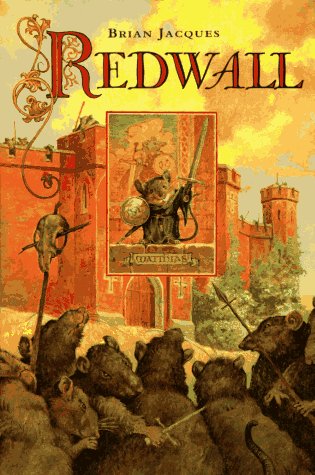
Brian Jacques, author of the Redwall series of novels beloved by young readers around the world died this weekend at 71. Jacques published 21 books in the Redwood series during his lifetime, with a new book scheduled for later this year. I still remember picking up the first (and second) Redwall novel in my school’s library when I was ten years old. Jacques’s world of anthropomorphic mice pitted against evil rats (there were other fauna of course) helped lead me to books by Tolkien, Lloyd Alexander, and eventually Watership Down. RIP.

“The Starlight on Idaho” — Denis Johnson

The Vintage Book of American Women Writers

In her introduction to The Vintage Book of American Women Writers, editor Elaine Showalter suggests that “the main reason women do not figure in American literary history is because they have not been the ones to write it.” Showalter sought to amend the fact that women writers, even those who were praised in their own era, “tended to disappear from literary history and national memory” in her earlier volume A Jury of Her Peers, a comprehensive history of American women writers from 1650 to 2000. History though is not enough — Showalter continues in her introduction: “Finally, we need a canon of outstanding women writers over the past four centuries both to organize their history and to begin the arguments that keep literary discussion alive.” The Vintage Book of American Women Writers aims to be that canon, or at least to be a volume of that canon, collecting writing by American women from the past 360 years. And while Showalter admits that “it cannot claim to be comprehensive,” the trade paperback is impressively hefty at over 800 pages, showcasing the work of 79 authors.

Many of these authors will be familiar (hopefully) to anyone who didn’t sleep through his or her American lit class in high school. The volume begins with several selections from the Puritan poet Anne Bradstreet; there’s also Mary Rowlandson, Phillis Wheatley, and Margaret Fuller. A tidy chunk of the early part of the book comes from writers we might associate with the transcendentalist movement — Harriet Beecher Stowe, Julia Ward Howe, Louisa May Alcott, and Emily Dickinson, just to name a few of the more famous writers. There’s an abundance of riches near the turn of the twentieth century, with tales from Willa Cather, Kate Chopin, Charlotte Perkins Gilman, and Edith Wharton, writers who set the stage for the modernism of Gertrude Stein, Katherine Anne Porter, and H.D. And then: Marianne Moore, Sylvia Plath, Elizabeth Bishop, Dorothy Parker, Edna St. Vincent Millay, Zora Neale Hurston (the collection won my heart simply by including her incomparable short story “Sweat”), Gwendolyn Brooks, Cynthia Ozick, Joyce Carol Oates, Annie Proulx, Ursula K. LeGuin, Flannery O’Connor (but not, for some reason, Carson McCullers), Amy Tan, and Jhumpa Lahiri.

I realize I’m just listing names now, but hopefully you know these names, are familiar with them, have read their works (if not, The Vintage Book of American Women Writers is clearly a great starting place). As an experiment — and perhaps an implicit challenge to Showalter’s contention that these writers continue to be neglected — I counted the authors I’d read at least once before this collection: 33, or 42%. Granted, I teach English for a living, and many of these authors are represented in every literature anthology I’ve ever used. But that might be my point, I suppose, that the canon has opened up, been re-examined and reformed. I can’t think of a literature course I’ve ever taught that hasn’t included Hurston or O’Connor or Katherine Anne Porter.

For me then, the greater joy in The Vintage Book of American Women Writers is in reading the writers that I haven’t seen anthologized before. I’m almost ashamed to admit I hadn’t yet read (okay, never even heard of) the abolitionist poet Frances E. W. Harper; Lydia Huntley Sigourney’s poem “Indian Names,” written in 1849, seems more poignant (and troubling) than ever; Rose Terry Cooke’s “Blue-beard’s Closet” (1861) resonates strongly, in that it connects to the latest piece in the collection, Annie Proulx’s “55 Miles to the Nearest Gas Pump.” The story of Bluebeard of course metaphorizes the history that Showalter wishes to reverse, what with its discarded bodies, locked in a secret room, awaiting discorvery. Okay, maybe that’s a stretch (or at least a hyperbole). In any case, these stories, poems, essays, fables, and tales are hardly lifeless. Great stuff.

The Vintage Book of American Women Writers is new in trade paperback from Vintage.