“Housewife” — Amy Hempel

“Housewife,” a very short story by Amy Hempel—

She would always sleep with her husband and with another man in the course of the same day, and then the rest of the day, for whatever was left to her of that day, she would exploit by incanting, “French film, French film.”

(From Micro Fiction, edited by Jerome Stern).

Kurt Vonnegut Grades His Books

A Map of Philip K. Dick’s The Man in the High Castle

“There Are Anthropological Limits on Reading” — David Mitchell Talks About Writing

Newsweek Publishes Deleted Scenes from David Foster Wallace’s Infinite Jest

Newsweek has published a series of scenes David Foster Wallace cut from his manuscript of Infinite Jest. Fascinating for fans. (Thanks to @mattbucher for the tip). Here’s “Hal’s Essay on Ducks”–

At Hark! A Vagrant, Kate Beaton Does Macbeth

Cartoonist Kate Beaton riffs on Macbeth. From her site Hark! A Vagrant.

The AV Club Interviews Charles Burns

The AV Club’s Sam Adams interviews Charles Burns about Tintin, Burroughs, why he’s not involved in making the Black Hole movie, 1977, why he had to change how he colored his art, and his new book, X’ed Out. There’s also this nugget (we’d been wondering)–

AVC: Is the completed three-volume work going to be called X’ed Out?

CB: They’re all going to be different stories. So for the next one, it says “Next: The Hive.” So the next book is called The Hive.

AVC: Is there a name for the trilogy?

CB: No, not in my mind.

“Have You Ever Been Diddled?”

The Ozark folktale “Have You Ever Been Diddled?” from Vance Randolph’s indispensable collection, Pissing in the Snow & Other Ozark Folktales–

[Told by J.L. Russell, Harrison, Ark., April, 1950. He heard this one near Berryville, Ark., in the 1890s.]

One time there was a town girl and a country girl got to talking about the boys they had went with. The town girl told what kind of car her boyfriends used to drive, and how much money their folks has got. But the country girl didn’t take no interest in things like that, and she says the fellows are always trying to get into her pants.

So finally the town girl says, “Have you ever been diddled?” The country girl giggled, and she says yes, a little bit. “How much?” says the town girl. “Oh, about like that,” says the country girl, and she held up her finger to show an inch, or maybe an inch and a half.

The town girl just laughed, and pretty soon the country girl says, “Have you ever been diddled?” The town girl says of course she has, lots of times. “How much?” says the country girl. “Oh, about like that,” says the town girl, and she marked off about eight inches, or maybe nine.

The country girl just sat there goggle-eyed, and she drawed a deep breath. “My God,” says the country girl, “that ain’t diddling! Why, you’ve been fucked!“

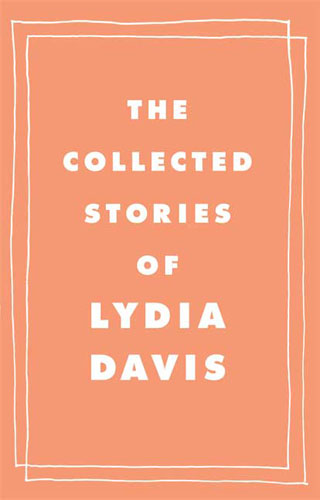
Win a Copy of The Collected Stories of Lydia Davis

UPDATE: The contest is closed–and in record time.

Want to win a copy of The Collected Stories of Lydia Davis? Of course you do. The book makes a hefty stocking stuffer, so you could even give it away if you wanted to, but we suggest you do the selfish thing and hold on to it. It’s excellent.

Picador has kindly agreed to give a copy to one lucky Biblioklept reader (you must have a U.S. address, though). Win this handsome Davis volume by being the first to correctly answer all three questions of our quiz. Post your answers in the comments section.

1. Lydia Davis was married to another famous writer back in the 1970s. Name that writer and his new novel.

2. One of Davis’s short story collections is titled Samuel Johnson Is Indignant. Why is Dr. Johnson indignant? (Hint: Read our review).

3. In a 2008 interview with The Believer, Davis commented that she tried to translate/update a famous 18th century Irish novelist’s work. Who was the writer?

Charles Burns Interviewed

Vodpod videos no longer available.

“Hostess” — Amy Hempel

“Hostess” by Amy Hempel–

She swallowed Gore Vidal. Then she swallowed Donald Trump. She took a blue capsule and a gold spansule–a B-complex and an E–and put them on the tablecloth a few inches apart. She pointed the one at the other. “Martha Stewart,” she said, “meet Oprah Winfrey.” She swallowed them both without water.

(From Micro Fiction, edited by Jerome Stern).

Henry Miller on Surrealism, Lewis Carroll, and Dada

Henry Miller, in a 1962 Paris Review interview, speaks about surrealism, dada, and his love for Lewis Carroll—

INTERVIEWER

In “An Open Letter to Surrealists Everywhere” you say, “I was writing surrealistically in America before I ever heard the word.” Now, what do you mean by surrealism?

MILLER

When I was living in Paris, we had an expression, a very American one, which in a way explains it better than anything else. We used to say, “Let’s take the lead.” That meant going off the deep end, diving into the unconscious, just obeying your instincts, following your impulses, of the heart, or the guts, or whatever you want to call it. But that’s my way of putting it, that isn’t really surrealist doctrine; that wouldn’t hold water, I’m afraid, with an André Breton. However, the French standpoint, the doctrinaire standpoint, didn’t mean too much to me. All I cared about was that I found in it another means of expression, an added one, a heightened one, but one to be used very judiciously. When the well-known surrealists employed this technique, they did it too deliberately, it seemed to me. It became unintelligible, it served no purpose. Once one loses all intelligibility, one is lost, I think.

INTERVIEWER

Is surrealism what you mean by the phrase “into the night life”?

MILLER

Yes, there it was primarily the dream. The surrealists make use of the dream, and of course that’s always a marvelous fecund aspect of experience. Consciously or unconsciously, all writers employ the dream, even when they’re not surrealists. The waking mind, you see, is the least serviceable in the arts. In the process of writing one is struggling to bring out what is unknown to himself. To put down merely what one is conscious of means nothing, really, gets one nowhere. Anybody can do that with a little practice, anybody can become that kind of writer.

INTERVIEWER

You have called Lewis Carroll a surrealist, and his name suggests the kind of jabberwocky which you use occasionally . . .

MILLER

Yes, yes, of course Lewis Carroll is a writer I love. I would give my right arm to have written his books, or to be able to come anywhere near doing what he did. When I finish my project, if I continue writing, I would love to write sheer nonsense.

INTERVIEWER

What about Dadaism? Did you ever get into that?

MILLER

Yes, Dadaism was even more important to me than surrealism. The Dadaist movement was something truly revolutionary. It was a deliberate conscious effort to turn the tables upside down, to show the absolute insanity of our present-day life, the worthlessness of all our values. There were wonderful men in the Dadaist movement, and they all had a sense of humor. It was something to make you laugh, but also to make you think.

Dinner with Henry Miller

Vodpod videos no longer available.

Via Ubuweb—

Dinner With Henry is a rare, 30-minute documentary about Henry Miller. It is exactly what the title implies: footage of Henry having dinner. With him at the table is the film crew, and actress/model Brenda Venus, to whom Henry was enamoured in the final years of life. Henry – at age 87 – spends the majority of his time speaking on a number of subjects, the most persistent of which is Blaise Cendrars. Occasionally, he complains about the food. That is all. It may not be of much interest to a general audience, but is a curious “slice of life” for any Miller fan who likes to imagine being at the table with him.

Jonathan Safran Foer Talks About His New Book, Tree of Codes

Jonathan Safran Foer’s new book, Tree of Codes, is a cut-up — or cut-out, rather — of Bruno Schulz’s The Street of Crocodiles. More here.

“To Bertholt Brecht” — William Meredith

“To Bertholt Brecht” by William Meredith— 

I’ve heard that you said, when a scene you had revised
Still didn’t suit a man you used to know,
“But I am not Kafka!” What artist hasn’t sized
Himself in the dwindling lacquer row
Of chinese dolls that, with no loss of face,
Can be out back inside one another now
And only a fool quarrel about his place.
There are such ranks; and yet I quarrel with
Those who have put a price on mere despair,
Ranking a man as he can fetch up death
And senselessness, and finding you famous so.
You called your foe by name: a naive faith.
It is a naive disillusion, everywhere
Fudging the good and bad, we must call foe.
The truth is hidden as cunningly from one
Time as another; what they change is the decoys,
And it takes a wily man to use the gun.
I think you would not be fooled by our bully-boys
Who say, “As Brecht said, I live in an age of blood.”
You might stop with an oath their shrill, untimely noise:
Evil is nothing until it touches good.

Silly CNN Report on Thomas Pynchon

Timothy Leary Just Wanted to Meet Thomas Pynchon