
Unidentified participant: Mr. Faulkner, you may have touched on this previously, but could you give some advice to young writers? What advice would you give to young writers?
William Faulkner: At one time I thought the most important thing was talent. I think now that—that the young man or the young woman must possess or teach himself, train himself, in infinite patience, which is to—to try and to try and to try until it comes right. He must train himself in ruthless intolerance. That is, to throw away anything that is false no matter how much he might love that page or that paragraph. The most important thing is insight, that is, to be—to curiosity—to—to wonder, to mull, and to—to—to muse why it is that man does what he does. And if you have that, then I don’t think the talent makes much difference, whether you’ve got that or not.
Unidentified participant: How would you suggest that he get this insight? Through experience?
William Faulkner: Yes, and then the greatest part of experience is in the books, to read. To read and to read and to read and to read. To watch people, to have—to never judge people. To watch people, what they do, with—with—without intolerance. Simply to—to learn why it is they did what they did.
Category: Literature
Duck Tales (Thomas Pynchon’s Mason & Dixon)
Back Inhabitants all up and down the Line soon begin taking the Frenchman’s Duck to their Bosoms, for being exactly what they wish to visit their lives at this Moment,— something possess’d of extra-natural Powers,— Invisibility, inexhaustible Strength, an upper Velocity Range that makes her the match, in Momentum, of much larger opponents,— Americans desiring generally, that ev’ry fight be fair. Soon Tales of Duck Exploits are ev’rywhere the Line may pass. The Duck routs a great army of Indians. The Duck levels a Mountain west of here. In a single afternoon the Duck, with her Beak, has plow’d ev’ry Field in the County, at the same time harrowing with her Tail. That Duck!
As to the Duck’s actual Presence, Opinions among the Party continue to vary. Axmen, for whom tales of disaster, stupidity, and blind luck figure repeatably as occasions for merriment, take to shouting at their Companions, “There she goes!” or, “Nearly fetch’d ye one!” whilst those more susceptible to the shifts of Breeze between the Worlds, notably at Twilight, claim to’ve seen the actual Duck, shimmering into Visibility, for a few moments, then out again.
“I might’ve tried to draw a bead onto it, . . . but it knew I was there. It came walking over and look’d me thump in the eye. I was down flat, we were at the same level, see. ‘Where am I?’ it wants to know. ‘Pennsylvania or Maryland, take your pick,’ says I. It had this kind of Expression onto its Face, and seem’d jumpy. I tried to calm it down. It gave that Hum, and grew vaporous, and disappear’d.”
Mason and Dixon attempt to ignore as much of this as they may, both assuming ’tis only another episode of group Folly, to which this Project seems particularly given, and that ’twill pass all too soon, to be replaced by another, and so on, till perhaps, one day, by something truly dangerous.
From Chapter 45 of Thoma Pynchon’s novel Mason & Dixon.
“Nobody’s Story” — Charles Dickens
“Nobody’s Story”
by
Charles Dickens
He lived on the bank of a mighty river, broad and deep, which was always silently rolling on to a vast undiscovered ocean. It had rolled on, ever since the world began. It had changed its course sometimes, and turned into new channels, leaving its old ways dry and barren; but it had ever been upon the flow, and ever was to flow until Time should be no more. Against its strong, unfathomable stream, nothing made head. No living creature, no flower, no leaf, no particle of animate or inanimate existence, ever strayed back from the undiscovered ocean. The tide of the river set resistlessly towards it; and the tide never stopped, any more than the earth stops in its circling round the sun.
He lived in a busy place, and he worked very hard to live. He had no hope of ever being rich enough to live a month without hard work, but he was quite content, GOD knows, to labour with a cheerful will. He was one of an immense family, all of whose sons and daughters gained their daily bread by daily work, prolonged from their rising up betimes until their lying down at night. Beyond this destiny he had no prospect, and he sought none.
There was over-much drumming, trumpeting, and speech-making, in the neighbourhood where he dwelt; but he had nothing to do with that. Such clash and uproar came from the Bigwig family, at the unaccountable proceedings of which race, he marvelled much. They set up the strangest statues, in iron, marble, bronze, and brass, before his door; and darkened his house with the legs and tails of uncouth images of horses. He wondered what it all meant, smiled in a rough good-humoured way he had, and kept at his hard work. Continue reading ““Nobody’s Story” — Charles Dickens”
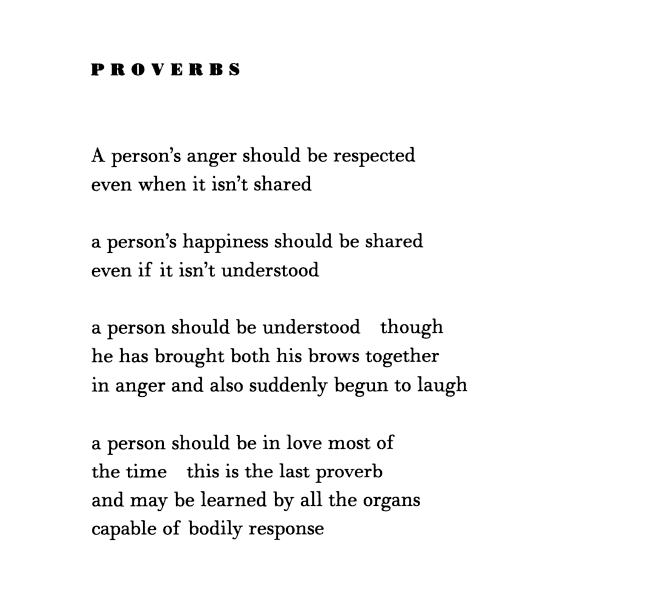
“Proverbs” — Grace Paley
“The Elements of Poetry” — George Santayana
“The Elements of Poetry”
by
George Santayana
If poetry in its higher reaches is more philosophical than history, because it presents the memorable types of men and things apart from unmeaning circumstances, so in its primary substance and texture poetry is more philosophical than prose because it is nearer to our immediate experience. Poetry breaks up the trite conceptions designated by current words into the sensuous qualities out of which those conceptions were originally put together. We name what we conceive and believe in, not what we see; things, not images; souls, not voices and silhouettes. This naming, with the whole education of the senses which it accompanies, subserves the uses of life; in order to thread our way through the labyrinth of objects which assault us, we must make a great selection in our sensuous experience; half of what we see and hear we must pass over as insignificant, while we piece out the other half with such an ideal complement as is necessary to turn it into a fixed and well-ordered conception of the world. This labor of perception and understanding, this spelling of the material meaning of experience, is enshrined in our workaday language and ideas; ideas which are literally poetic in the sense that they are “made” (for every conception in an adult mind is a fiction), but which are at the same time prosaic because they are made economically, by abstraction, and for use.
When the child of poetic genius, who has learned this intellectual and utilitarian language in the cradle, goes afield and gathers for himself the aspects of nature, he begins to encumber his mind with the many living impressions which the intellect rejected, and which the language of the intellect can hardly convey; he labors with his nameless burden of perception, and wastes himself in aimless impulses of emotion and reverie, until finally the method of some art offers a vent to his inspiration, or to such part of it as can survive the test of time and the discipline of expression.
The poet retains by nature the innocence of the eye, or recovers it easily; he disintegrates the fictions of common perception into their sensuous elements, gathers these together again into chance groups as the accidents of his environment or the affinities of his temperament may conjoin them; and this wealth of sensation and this freedom of fancy, which make an extraordinary ferment in his ignorant heart, presently bubble over into some kind of utterance.
The fullness and sensuousness of such effusions bring them nearer to our actual perceptions than common discourse could come; yet they may easily seem remote, overloaded, and obscure to those accustomed to think entirely in symbols, and never to be interrupted in the algebraic rapidity of their thinking by a moment’s pause and examination of heart, nor ever to plunge for a moment into that torrent of sensation and imagery over which the bridge of prosaic associations habitually carries us safe and dry to some conventional act. How slight that bridge commonly is, how much an affair of trestles and wire, we can hardly conceive until we have trained ourselves to an extreme sharpness of introspection. But psychologists have discovered, what laymen generally will confess, that we hurry by the procession of our mental images as we do by the traffic of the street, intent on business, gladly forgetting the noise and movement of the scene, and looking only for the corner we would turn or the door we would enter. Yet in our alertest moment the depths of the soul are still dreaming; the real world stands drawn in bare outline against a background of chaos and unrest. Our logical thoughts dominate experience only as the parallels and meridians make a checkerboard of the sea. They guide our voyage without controlling the waves, which toss forever in spite of our ability to ride over them to our chosen ends. Sanity is a madness put to good uses; waking life is a dream controlled.
Out of the neglected riches of this dream the poet fetches his wares. He dips into the chaos that underlies the rational shell of the world and brings up some superfluous image, some emotion dropped by the way, and reattaches it to the present object; he reinstates things unnecessary, he emphasizes things ignored, he paints in again into the landscape the tints which the intellect has allowed to fade from it. If he seems sometimes to obscure a fact, it is only because he is restoring an experience. The first element which the intellect rejects in forming its ideas of things is the emotion which accompanies the perception; and this emotion is the first thing the poet restores. He stops at the image, because he stops to enjoy. He wanders into the bypaths of association because the bypaths are delightful. The love of beauty which made him give measure and cadence to his words, the love of harmony which made him rhyme them, reappear in his imagination and make him select there also the material that is itself beautiful, or capable of assuming beautiful forms. The link that binds together the ideas, sometimes so wide apart, which his wit assimilates, is most often the link of emotion; they have in common some element of beauty or of horror.
What Machine Is It? (Thomas Pynchon’s Mason & Dixon)
“What Machine is it,” young Cherrycoke later bade himself goodnight, “that bears us along so relentlessly? We go rattling thro’ another Day,— another Year,— as thro’ an empty Town without a Name, in the Midnight . . . we have but Memories of some Pause at the Pleasure-Spas of our younger Day, the Maidens, the Cards, the Claret,— we seek to extend our stay, but now a silent Functionary in dark Livery indicates it is time to re-board the Coach, and resume the Journey. Long before the Destination, moreover, shall this Machine come abruptly to a Stop . . . gather’d dense with Fear, shall we open the Door to confer with the Driver, to discover that there is no Driver, . . . no Horses, . . . only the Machine, fading as we stand, and a Prairie of desperate Immensity. . . .”
The last lines of Ch. 35 of Thomas Pynchon’s novel Mason & Dixon seem to reiterate (what I take to be) the novel’s central question.
“The Christmas Tree and the Wedding,” a short story by Fyodor Dostoevsky
“The Christmas Tree and the Wedding”
by Fyodor Dostoevsky
The other day I saw a wedding… But no! I would rather tell you about a Christmas tree. The wedding was superb. I liked it immensely. But the other incident was still finer. I don’t know why it is that the sight of the wedding reminded me of the Christmas tree. This is the way it happened:
Exactly five years ago, on New Year’s Eve, I was invited to a children’s ball by a man high up in the business world, who had his connections, his circle of acquaintances, and his intrigues. So it seemed as though the children’s ball was merely a pretext for the parents to come together and discuss matters of interest to themselves, quite innocently and casually.
I was an outsider, and, as I had no special matters to air, I was able to spend the evening independently of the others. There was another gentleman present who like myself had just stumbled upon this affair of domestic bliss. He was the first to attract my attention. His appearance was not that of a man of birth or high family. He was tall, rather thin, very serious, and well dressed. Apparently he had no heart for the family festivities. The instant he went off into a corner by himself the smile disappeared from his face, and his thick dark brows knitted into a frown. He knew no one except the host and showed every sign of being bored to death, though bravely sustaining the role of thorough enjoyment to the end. Later I learned that he was a provincial, had come to the capital on some important, brain-racking business, had brought a letter of recommendation to our host, and our host had taken him under his protection, not at all con amore. It was merely out of politeness that he had invited him to the children’s ball.
They did not play cards with him, they did not offer him cigars. No one entered into conversation with him. Possibly they recognised the bird by its feathers from a distance. Thus, my gentleman, not knowing what to do with his hands, was compelled to spend the evening stroking his whiskers. His whiskers were really fine, but he stroked them so assiduously that one got the feeling that the whiskers had come into the world first and afterwards the man in order to stroke them. Continue reading ““The Christmas Tree and the Wedding,” a short story by Fyodor Dostoevsky”
A great disorderly Tangle of Lines vanishing into the Mnemonick Deep (Pynchon’s Mason & Dixon)
Facts are but the Play-things of lawyers,— Tops and Hoops, forever a-spin. . . . Alas, the Historian may indulge no such idle Rotating. History is not Chronology, for that is left to lawyers,— nor is it Remembrance, for Remembrance belongs to the People. History can as little pretend to the Veracity of the one, as claim the Power of the other,— her Practitioners, to survive, must soon learn the arts of the quidnunc, spy, and Taproom Wit,— that there may ever continue more than one life-line back into a Past we risk, each day, losing our forebears in forever,— not a Chain of single Links, for one broken Link could lose us All,— rather, a great disorderly Tangle of Lines, long and short, weak and strong, vanishing into the Mnemonick Deep, with only their Destination in common.
— The Revd Wicks Cherrycoke, Christ and History
From Thomas Pynchon’s novel Mason & Dixon.
William Faulkner explains the genesis of The Sound and the Fury
Unidentified participant: This is a question about writing in general. I think maybe you just answered it, but they say until Hawthorne came along that there were two ways to construct a story: either start with the characters and then a plot, or start with a plot and make up your characters, and they say that Hawthorne started with the idea and invented both. And I wonder, I know there’s no one formula to producing a story, but I just wonder where you start most often and what you feel is most important, what pattern you [have worked out] to use?
William Faulkner: Three methods you just stated, all will work but—but none—neither or none are more important than the others, and no one can say just what method the story demands. Apparently there’s something inside the man or the woman that must be—be told, must be written. It could be an anecdote. It could be a character. It could be an idea, but I don’t think you could say which system to—or which pattern to assume in order to—to create a story or a book.
Unidentified participant: You have no favorite pattern? It just depends on the individual—?
William Faulkner: That’s right, that’s right. It could be an anecdote. The Sound and the Fury came out of an anecdote, a picture of a—a little girl, the muddy seat of her drawers when she climbed the tree to look in a parlor window, and that’s—the book came from that.
Unidentified participant: Mr. Faulkner
William Faulkner: Sir.
Unidentified participant: In The Sound and the Fury, the first three sections of that book are narrated by one of the—of the four Compson children, and in view of the fact that Caddy figures so prominently, is there any particular reason why you didn’t have a section with—giving her views or impressions of what went on?
William Faulkner: That’s a good question. That—the explanation of that whole book is in that. It began with the—the picture of the—the little girl’s muddy drawers, climbing that tree to look in the parlor window with her brothers that didn’t have the courage to climb the tree waiting to see what she saw. and I tried first to tell it with one brother, and that wasn’t enough. That was Section One. I tried with another brother, and that wasn’t enough. That was Section Two. I tried the third brother, because Caddy was still to me too beautiful and too moving to—to reduce her to telling what was going on, that it would be more—more passionate to see her through somebody else’s eyes, I thought. And that failed, and I tried myself, the fourth section, to tell what happened, and I still failed. [audience laughter] So—
Unidentified participant: Mr. Faulkner, when you wrote this, did you have it thought out beforehand, the whole sequences, or did they sort of evolve as you wrote it?
William Faulkner: It evolved as I wrote it. It began with the picture, as I said, of—of the little girl climbing the tree to tell her brothers what was going on in the room where the grandmother’s funeral was taking place, and the rest grew from that.
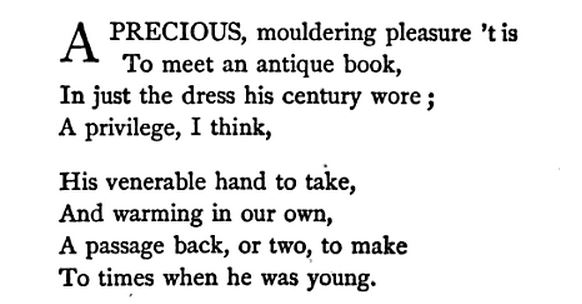
Precious (Emily Dickinson)
Inherent Vice (Thomas Pynchon’s Mason & Dixon)
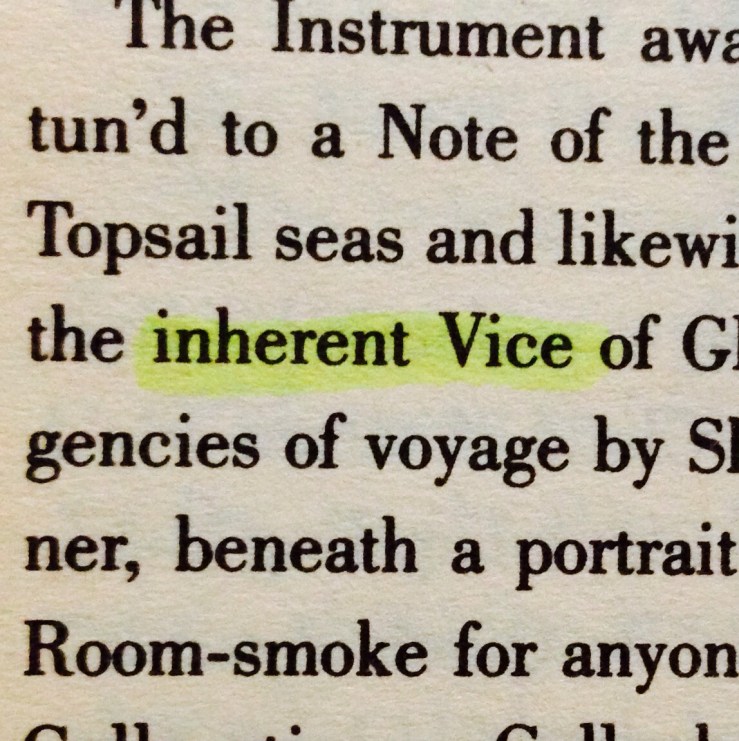
From page 272, chapter 27 of Thomas Pynchon’s novel Mason & Dixon. The phrase “against the day” appeared in chapter 13, on page 125. Perhaps I should be on the lookout for the phrase “bleeding edge.”
A clip from Paul Thomas Anderson’s film Inherent Vice
Thomas Pynchon’s Mason & Dixon (Second Riff: The Pygmies’ Discovery of Great Britain)
A. Okay. So I finished the first section of Mason & Dixon a few days ago. I’m now at the part where our titular heroes are smoking weed and eating snacks with George Washington. I can’t possibly handle all the material I’ve read so far—even in a riff (here’s the first riff for anyone inclined)—so instead I’ll annotate a few passages from Ch. 19, one of my favorite episodes so far.
B. Setting and context: 1762. “The George,” a pub in Gloucestershire (Mason’s home county). The patrons at the tavern are heatedly discussing the eleven days that went “missing” when the British moved from the Julian calendar to the Gregorian calendar.
One (satirical) source for this controversy comes from William Hogarth’s 1755 painting An Election Entertainment; in the detail below, you can read (barely) the slogan “Give us our Eleven Days” on the black banner under the man’s foot.

A bit more context, via History Today:
In 1750 England and her empire, including the American colonies, still adhered to the old Julian calendar, which was now eleven days ahead of the Gregorian calendar, introduced in 1582 by Pope Gregory XIII and in use in most of Europe.
Attempts in the sixteenth and seventeenth centuries to adopt the new calendar had broken on the rock of the Church of England, which denounced it as popish. The prime mover in changing the situation was George Parker, second Earl of Macclesfield, a keen astronomer and a Fellow of the Royal Society. He was assisted in his calculations by his friend James Bradley…
I emphasized Bradley—Mason’s mentor—and Macclesfield as they are minor characters in this episode.
Basically, the pub patrons demand that Mason explain what happened to the missing eleven days.
C. Okay—so this whole episode, this discussion of time and space clearly helps underline the big themes of Mason & Dixon: How to measure the intangible, the invisible—how to pin down the metaphysical to the physical—how to know and how to not know. (Hence all the paranoia). Continue reading “Thomas Pynchon’s Mason & Dixon (Second Riff: The Pygmies’ Discovery of Great Britain)”
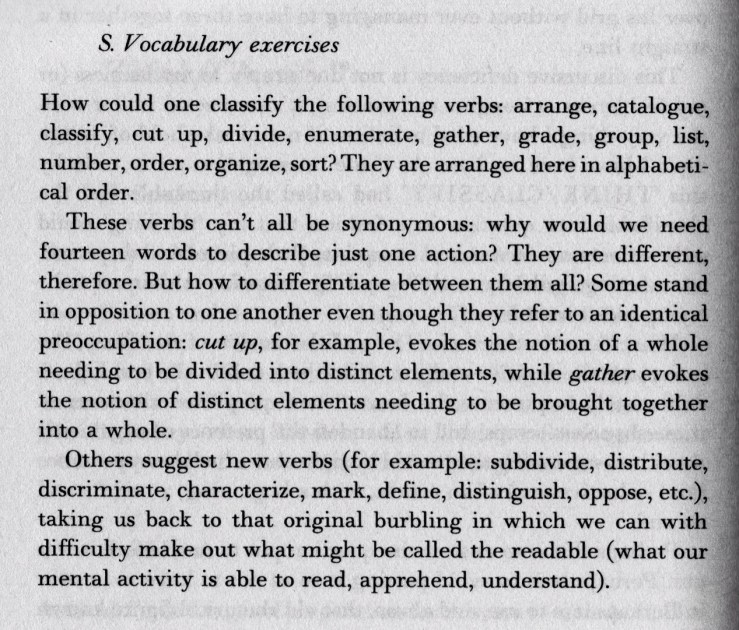
Vocabulary exercises (Georges Perec)
Read Willa Cather’s short story “The Sentimentality of William Tavener”
“The Sentimentality of William Tavener”
by
Willa Cather
It takes a strong woman to make any sort of success of living in the West, and Hester undoubtedly was that. When people spoke of William Tavener as the most prosperous farmer in McPherson County, they usually added that his wife was a “good manager.” She was an executive woman, quick of tongue and something of an imperatrix. The only reason her husband did not consult her about his business was that she did not wait to be consulted.
It would have been quite impossible for one man, within the limited sphere of human action, to follow all Hester’s advice, but in the end William usually acted upon some of her suggestions. When she incessantly denounced the “shiftlessness” of letting a new threshing machine stand unprotected in the open, he eventually built a shed for it. When she sniffed contemptuously at his notion of fencing a hog corral with sod walls, he made a spiritless beginning on the structure—merely to “show his temper,” as she put it—but in the end he went off quietly to town and bought enough barbed wire to complete the fence. When the first heavy rains came on, and the pigs rooted down the sod wall and made little paths all over it to facilitate their ascent, he heard his wife relate with relish the story of the little pig that built a mud house, to the minister at the dinner table, and William’s gravity never relaxed for an instant. Silence, indeed, was William’s refuge and his strength.
William set his boys a wholesome example to respect their mother. People who knew him very well suspected that he even admired her. He was a hard man towards his neighbors, and even towards his sons; grasping, determined and ambitious. Continue reading “Read Willa Cather’s short story “The Sentimentality of William Tavener””
Thomas Pynchon’s recipe for what is arguably the first British Pizza (Mason & Dixon)
“Lud wishes to know,” Whike relays at last, “Mr. Emerson’s Cousin’s Views, upon the Structure of the World.”
“A Spheroid, the last I heard of it, Sir.”
“Ahr Ahr ahr, ’ahr ahhrr!”
“ ’And I say, ’tis Flat,’” the Jesuit smoothly translates. “Why of course, Sir, flat as you like, flat as a Funnel-Cake, flat as a Pizza, for all that,— ”
“Apologies, Sir,—” Whike all Unctuosity, “the foreign Word again, was . . . ?”
“The apology is mine,— Pizza being a Delicacy of Cheese, Bread, and Fish ubiquitous in the region ’round Mount Vesuvius. . . . In my Distraction, I have reach’d for the Word as the over-wrought Child for its Doll.”
“You are from Italy, then, sir?” inquires Ma.
“In my Youth I pass’d some profitable months there, Madam.”
“Do you recall by chance how it is they cook this ‘Pizza’? My Lads and Lasses grow weary of the same Daily Gruel and Haggis, so a Mother is ever upon the Lurk for any new Receipt.”
“Why, of course. If there be a risen Loaf about . . . ?”
Mrs. Brain reaches ’neath the Bar and comes up with a Brown Batch-Loaf, rising since Morning, which she presents to “Cousin Ambrose,” who begins to punch it out flat upon the Counter-Top. Lud, fascinated, offers to assault the Dough himself, quickly slapping it into a very thin Disk of remarkable Circularity.
“Excellent, Sir,” Maire beams, “I don’t suppose anyone has a Tomato?”
“A what?”
“Saw one at Darlington Fair, once,” nods Mr.”“Brain.
“No good, in that case,— eaten by now.”
“The one I saw, they might not have wanted to eat . . . ?”
Dixon, rummaging in his Surveyor’s Kit, has come up with the Bottle of Ketjap, that he now takes with him ev’rywhere. “This do?”
“That was a Torpedo, Husband.”
“That Elecktrickal Fish? Oh . . . then this thing he’s making isn’t elecktrical?”
“Tho’ there ought to be Fish, such as those styl’d by the Neopolitans, Cicinielli. . . .”
“Will Anchovy do?” Mrs. Brain indicates a Cask of West Channel ’Chovies from Devon, pickl’d in Brine.
“Capital. And Cheese?”
“That would be what’s left of the Stilton, from the Ploughman’s Lunch.”
“Very promising indeed,” Maire wringing his Hands to conceal their trembling. “Well then, let us just . . .”
By the Time what is arguably the first British Pizza is ready to come out of the Baking-Oven beside the Hearth, the Road outside has gone quiet and the Moorland dark, several Rounds have come and pass’d, and Lud is beginning to show signs of Apprehension. “At least ’tis cloudy tonight, no Moonlight’ll be getting thro’,” his Mother whispers to Mr. Emerson.”
From Thomas Pynchon’s novel Mason & Dixon.
“The work is the thing. It don’t matter who wrote it” — William Faulkner
Unidentified participant: Sir, concerning individuality you were discussing a moment ago, you’ve often said—been quoted that you’re a literary man—I beg your pardon, you are not a literary man. By implication one might think that you’d prefer the author who is so to speak spontaneous and not always steady against one who’s read all the literature in his culture and [gives] a steady effort to produce, and works on his style. Is that correct […]?
William Faulkner: How do you mean prefer the author, to spend an evening with him or the work he does?
Unidentified participant: The work he does […]
William Faulkner: Now you—
Unidentified participant: […] clear up: do you mean by implication that you prefer the man who writes so to speak spontaneously or the man who studies his style, reads and learns techniques and works out something [totally] […]?
William Faulkner: I would say first that—the the author is not—is of no importance at all, it’s what he writes. It don’t matter who wrote it. If—and—to—if you mean prefer him as an individual, then I will take the former because the intellectual man and I wouldn’t have anything to talk about. But the man has—has very little to do with his work in my opinion. The work is the thing. It don’t matter who wrote it.
Unidentified participant: Well then let’s say it’s work, [which type of work do you prefer]?
William Faulkner: Well, I think that some people must be intellectual, must be interested, immersed in—in his craft, in literature, to write, to do the work. Other people must be immersed in something completely different. They must in a sense lead a Jekyll and Hyde existence to do the work. It’s the work that matters. It’s not how he did it.
 Biblioklept