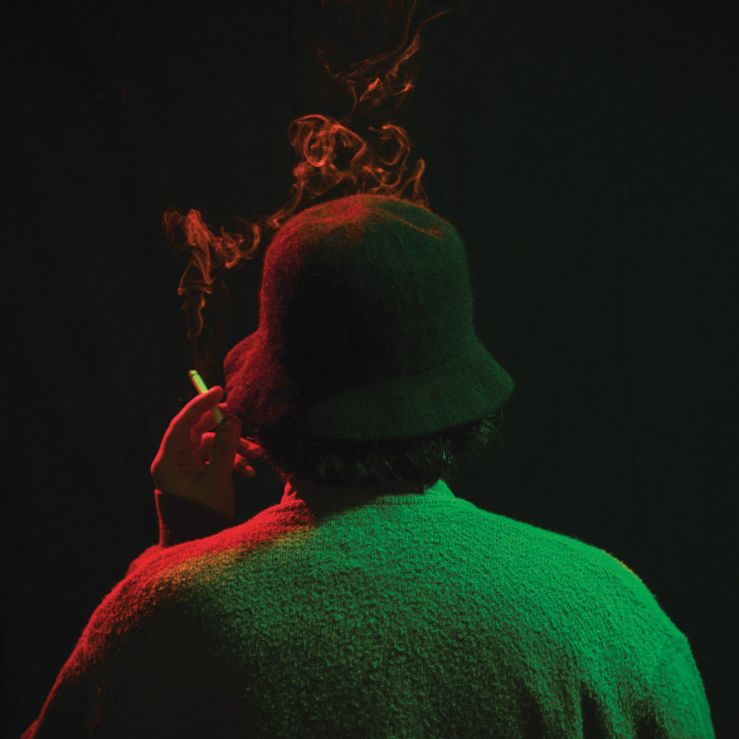
I was pretty happy when Jim O’Rourke’s new LP Simple Songs showed up in today’s mail. (I tried to take a photo of the record cover, which has this glossy-embossed-Jim-visual-echo-of-the-cover-to-Halfway-to-a-Threeway-thing going on, but it was too glossy, the cover, so here’s the Drag City packing tape that sealed the package):
I’ve already lauded Simple Songs here, based on listening to it dozens of times on NPR last week. Even though the streaming quality wasn’t so bad (and I played it over a proper stereo system), it simply isn’t as good as the full rich sound on the vinyl. (As I write this, I realize that I have a tendency, like many people, I’m thinking, to listen to too much new music digitally, over streaming services or as shitty compressed mp3s, or—even worse!—on YouTube. I think O’Rourke’s songwriting, musicianship, and production can withstand these new technologies, but I’ve also been a huge fan of his for, jeez, 20 years now, so I’m compelled to listen to his work much more closely than, say, New Band with mp3).
Anyway.
Simple Songs is beautiful: Rich, full, personal, and somehow expansive at only eight songs in 33 minutes. O’Rourke seems to have structured the album like a 1970s singer-songwriter record—the sequencing is perfect, with each side culminating in moments that synthesize O’Rourke’s cynicism with real pathos. Worth the long wait.
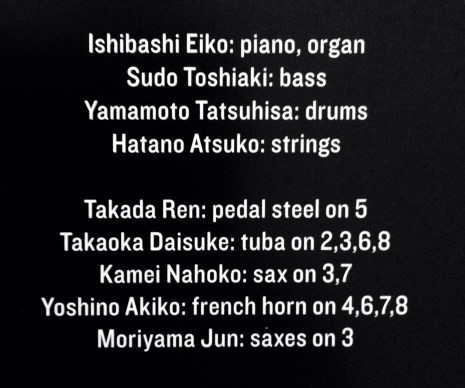
The LP contains a lyric sheet, as well as the album’s personnel:
I’m thinking that some of these guys are playing with O’Rourke in this concert from last year (I’m pretty confident that Yamamoto Tatsuhisa is on drums):
In the last minute of “Hotel Blue,” the fourth track on his new LP Simple Songs, Jim O’Rourke belts out his lines with an emotional directness we haven’t heard in his work before. He sings, and sings with a sincere presence and confidence perhaps previously absent from his fine work. The song builds from a few strums of acoustic guitar into a crescendo worthy of Harry Nilsson.
Like Nilsson (or Nilsson’s hero Randy Newman), O’Rourke’s work is saturated in a dark humor that’s perhaps easy to ignore because his music sounds so pretty. Simple Song’s first track “Friends with Benefits” reveals that welcoming-repulsing impetus in its opening lines: “Nice to see you once again / Been a long time, my friend / since you’ve crossed my mind at all.”
The initial moments of “Friends with Benefits” feel like an overture, unfurling in little episodes that recall O’Rourke’s 2009 suite The Visitor. The track eventually coalesces and climaxes in Terry Riley violin strokes, reverberating, decisive guitar lines, and stomping drums.
These musical elements continue throughout the album, which is often driven by piano riffs cribbed from all your favorite ’70s groups. Standout track “Half Life Crisis” bounces along in a Steely Dan strut, punctuated by Brian May guitar squiggles. Dissonant orchestral touches creep into the song’s final moments, recalling some of O’Rourke’s more “experimental” work—but also calling back to The Beatles.
Simple Songs feels like the culmination 0f some of O’Rourke’s projects over the past decade, and it made me revisit them. The Visitor sounds almost like a sketchbook for this record,and All Kinds of People, the record of Burt Bacharach songs O’Rourke recorded with various vocalists, feels in retrospect like a practice run at a personal pop record. Simple Songs builds on O’Rourke’s previous two “pop” records (Eureka and Insignificance), and even though it’s not named after a Nic Roeg film, it completes a trilogy of sorts. (But I hope this is more than a trilogy, to be clear).
The emotional intensity promised in “Hotel Blue” returns in the album’s closing tracks. “End of the Road” sees O’Rourke singing—not just talk-singing, but really singing—over McCartney piano and strings. “If you were at sea / They’d throw you overboard,” our misanthrope suggests. And in the final rousing track “All Your Love,” O’Rourke sings, “I’m so happy now / And I blame you,” before promising that “All your love / Will never change me.”
I’m not very good at writing about music, and really, writing is no substitute for listening. You can stream the album now at NPR—just do it over a real sound system or at least with some proper headphones. It sounds too good for your laptop’s tinny little noise holes.
Derek Pyle: Waywords and Meansigns is a collaborative music project recreating James Joyce’s Finnegans Wake. Seventeen different musicians from all around world have each taken a chapter of Finnegans Wake and set it to music, thereby creating an unabridged audio version of Finnegans Wake.
Finnegans Wake is an incredible book, but it’s notoriously difficult to read. One hope of the project is to create a version of the Wake that is accessible to newcomers — people can just listen to and enjoy the music. To maximize accessibility, we are distributing all the audio freely via our website. But the project does not only appeal to Wake newcomers — as we’ve seen so far, a lot of scholars and devoted readers are also finding Waywords and Meansigns an exciting way of interpreting and engaging with Joyce’s text.
I recently talked to Derek Pyle about his project Waywords and Meansigns, which adapts James Joyce’s novel Finnegans Wake into a new musical audiobook. Derek worked for years as half of Jubilation Press. Printing the poems of Lawrence Ferlinghetti, Thich Nhat Hanh, and William Stafford, Derek’s letterpress work can be found in the special collections of the New York Public Library, Brown University, and the Book Club of California. Derek co-founded Waywords and Meansigns in 2014 and became the project’s primary director in 2015. While living part-time in Western Massachusetts, Derek produces Waywords and Meansigns in eastern Canada.
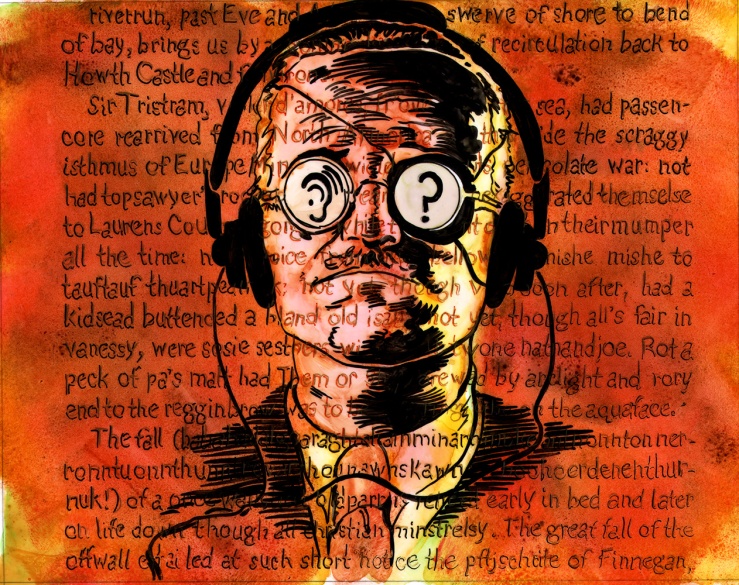
Image by Robert Berry
Biblioklept: What is Waywords and Meansigns?
Derek Pyle: Waywords and Meansigns is a collaborative music project recreating James Joyce’s Finnegans Wake. Seventeen different musicians from all around world have each taken a chapter of Finnegans Wake and set it to music, thereby creating an unabridged audio version of Finnegans Wake.
Finnegans Wake is an incredible book, but it’s notoriously difficult to read. One hope of the project is to create a version of the Wake that is accessible to newcomers — people can just listen to and enjoy the music. To maximize accessibility, we are distributing all the audio freely via our website. But the project does not only appeal to Wake newcomers — as we’ve seen so far, a lot of scholars and devoted readers are also finding Waywords and Meansigns an exciting way of interpreting and engaging with Joyce’s text.
Biblioklept: How did the project come about?
DP: In 2014 I organized a party to celebrate the 75th anniversary of the publication of Finnegans Wake. To celebrate we decided to listen to Patrick Healy’s audiobook recording of Finnegans Wake, which is 20-odd hours long. The party, as you can imagine, lasted all weekend — we actually listened to Johnny Cash’s unabridged reading of the New Testament that weekend too. There was very little sleep, and fair amount of absinthe.
A lot of people really rag on Healy’s recording, because it’s read at breakneck speed. I actually like it though — he creates a very visceral flood of experience, which is one way of reading, or interpreting, Finnegans Wake. But during the party I started wondering about other ways you could perform the text, and that’s when I came up with the idea of approaching musicians to create a new kind of audiobook.
As it turns out, a lot of people seemed to think my idea was a good one. We’ve had no shortage of musicians willing to contribute, including some really cool cats like Tim Carbone of Railroad Earth and bassist Mike Watt, who currently plays in Iggy Pop’s band The Stooges.
Biblioklept: Watt rules! I love the Minutemen and his solo stuff. He seems like a natural fit for this kind of project, as so much of his music is based around story telling. I imagine the musicians involved are composing the music themselves…are they also recording it themselves?
DP: Yeah, it’s very cool to have Watt on board. Turns out he’s a huge fan of Joyce — he recorded a track for Fire Records in 2008, for an album of various musicians turning the poems of Joyce’s Chamber Music into songs. Mary Lorson, of the bands Saint Low and Madder Rose, also played on that Fire Records album, and she’s collaborating with author Brian Hall for our project.
To answer your question, yes, all the musicians are recording their own chapters. Since we have contributors from all around the world — from Berlin to Amsterdam to British Columbia — it would be a logistical nightmare to figure out where and when to record everyone. Not to mention the cost of it. One of the really cool things, I think, about this project — for everyone, it’s a labor of love. No one is making a profit, off any of this. People are just doing it because they love Joyce, or they’re obsessed with Finnegans Wake, or it just seems like a fun challenge to think creatively in this unique way. Either way it’s a pursuit of passion. That’s why we will distribute all the audio freely. There’s this phrase in Finnegans Wake, “Here Comes Everybody!” We’re having fun with Finnegans Wake and everybody is invited to the party. Continue reading “Derek Pyle Discusses Waywords and Meansigns, an Unabridged Musical Adaptation of James Joyce’s Finnegans Wake”→


 Biblioklept