“Blind, loving, wrestling touch! sheath’d, hooded, sharp-tooth’d touch!” — Walt Whitman

Blind, loving, wrestling touch! sheath’d, hooded, sharp-tooth’d touch!
Did it make you ache so, leaving me?

Parting, track’d by arriving—perpetual payment of perpetual loan;
Rich, showering rain, and recompense richer afterward.

Sprouts take and accumulate—stand by the curb prolific and vital:
Landscapes, projected, masculine, full-sized and golden

Section 29 of Walt Whitman’s Song of Myself.

Ed Sanders and a Drunken Jack Kerouac on William F. Buckley’s Firing Line in 1968

Charles Bukowski Talks About Coping with Depression

Anne Sexton Reads “Wanting to Die”

Portrait of William Butler Yeats by His Father John Butler Yeats

“cruelty. don’t talk to me about cruelty” — Lucille Clifton

A poem by Lucille Clifton—

cruelty. don’t talk to me about cruelty
or what i am capable of.

when i wanted the roaches dead i wanted them dead
and i killed them. i took a broom to their country

and smashed and sliced without warning
without stopping and i smiled all the time i was doing it.

it was a holocaust of roaches, bodies,
parts of bodies, red all over the ground.

i didn’t ask their names.
they had no names worth knowing.

now i watch myself whenever i enter a room.
i never know what i might do.

“to sex brawl and dare” — A Poem from Surrealist Ghérasim Luca

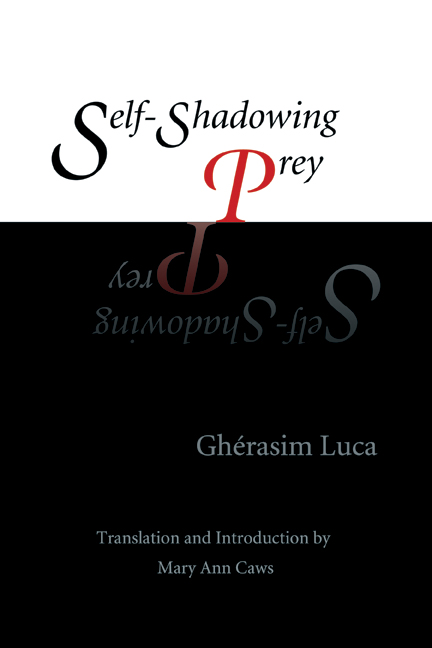
The good people at Contra Mundum Press are putting out the first English language translation of Romanian surrealist Ghérasim Luca’s Self-Shadowing Prey. Mary Ann Caws translates. Here’s the first poem in the book:

at the edge of a forest

whose trees are slender ideas

and each leaf a thought at bay

the vegetal reveals to us

the damned depths of an animal sect

or more precisely

an old insect anguish

waking up as man

the only way

the only basic weapon

to animate a mental state

that I hurry to write mantil

like a mantis

if only to mark

with a dry warning laugh

the devouring word

Entity and antithesis of the bush

a sort of wild and organic brush

grows in the head of that man

ravaged

by the heresy of parks and greenhouses

like the orgasm of a key

a lovely door

So the legendary passivity

the famous and ample passivity of plants

changes here to idle hate

to mad rage

to sex brawl and dare

luring by sap blood lava . . .

as rapid as the passage of woman

to beast

she empties us of a foul ancestral

wound

which in a spurt relieves us

of these fixed plaints

and these false death rattles plumbing us

our calm gestures of the interred

Now only terror

is still able to insert

in the tropism of body and of guilty

spirit

this prism as doubled echo

where brains and senses capture

the violent innocence

of a flora and a fauna

whose marriage is a long seizure

and a rape as slow as gold

in the implacable lead

And it’s around the mental equator

in the space delimited by the tropics

of a head

at the angle of the eye and what surrounds it

that the myth of a kind of utopian

jungle surges into the world

As virgin as the unknowable

or the other “face” of the moon

and never in the reach of a gun

or an axe

its prey is the snow

sand ball hip if not the trap

that the diffuse breath of a dream

lights up

For tangled

soldered to massive corkscrew keys

the vines

the branches stoves and rituals

fuse

around the forms placed

as if by miracle

at the crossroads of dryads

of druids and of man

So many points to aim at

all these yes and nos that

outside outside of time

of space and weight

select a sort of coupled oasis

and hamlet

to descend in these gods

from before the ages

the gods-place-beast-island-ash-fire

come forth as from the coupling of bird

and branch

and those exiled from the center

and from the shade of a golden foliage

will adore one day

between the walls of their somber cities

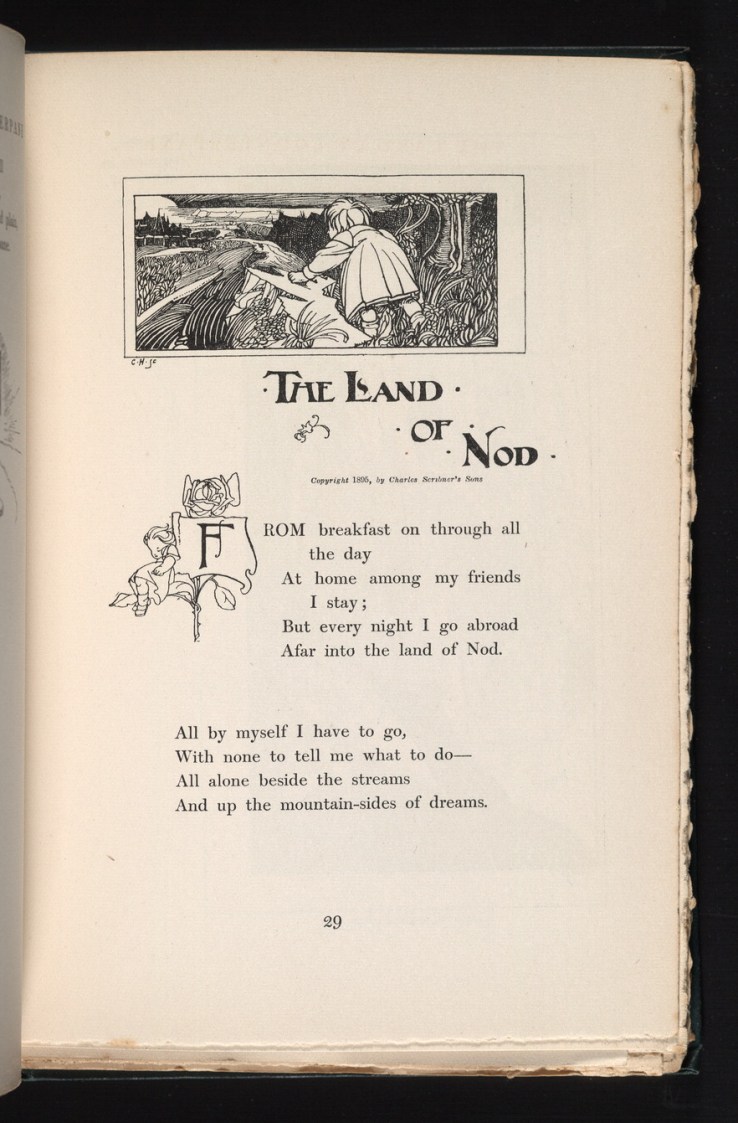
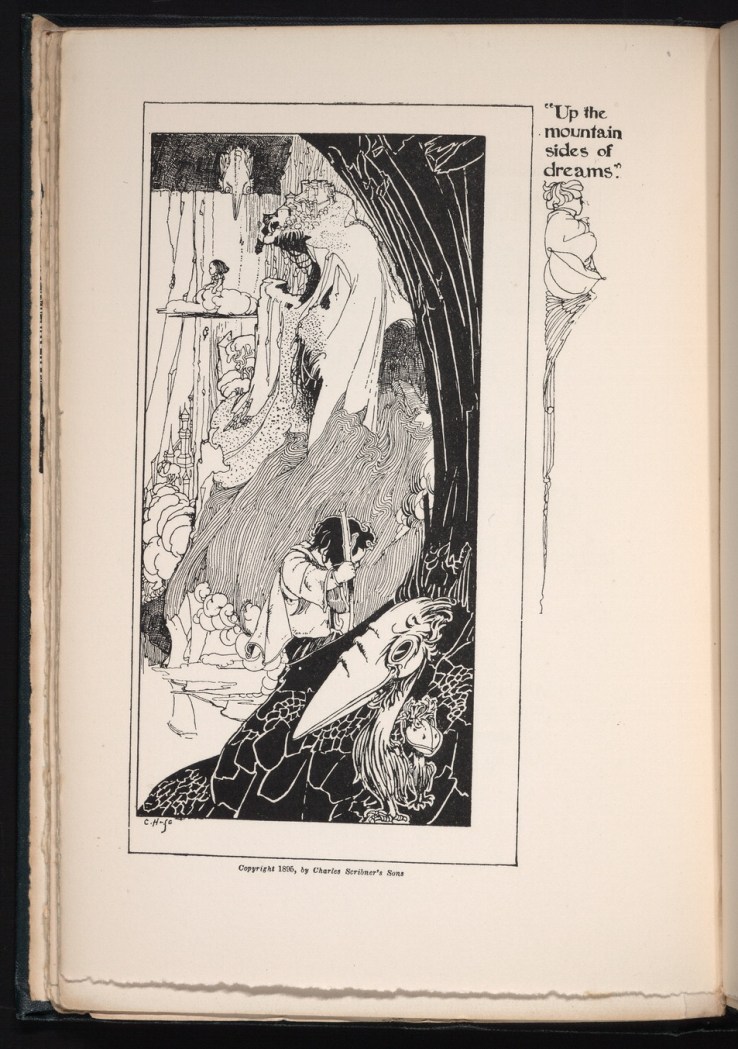
“The Land of Nod” — An Illustrated Poem by Robert Louis Stevens

(From A Child’s Garden of Verses by Robert Louis Stevenson; illustrated by Charles Robinson, 1895. Via the LOC’s rare books collection.)

Ezra Pound Shares Poetry Tips from Hardy, Yeats, Ford, and Bridges

Ezra Pound’s poetry tips; from The Paris Review interview:

INTERVIEWER

You once wrote that you had four useful hints from living literary predecessors, who were Thomas Hardy, William Butler Yeats, Ford Madox Ford, and Robert Bridges. What were these hints?

POUND

Bridges’s was the simplest. Bridges’s was a warning against homophones. Hardy’s was the degree to which he would concentrate on the subject matter, not on the manner. Ford’s in general was the freshness of language. And Yeats you say was the fourth? Well, Yeats by 1908 had written simple lyrics in which there were no departures from the natural order of words.

Handwritten Draft of Auden’s “Musée des Beaux Arts”

(Via the Library of Congress).

“A Wounded Deer—leaps highest— ” — Emily Dickinson

A poem by Emily Dickinson:

A Wounded Deer—leaps highest—
I’ve heard the Hunter tell—
‘Tis but the Ecstasy of death
And then the Brake is still!

The Smitten Rock that gushes!
The trampled Steel that springs!
A Cheek is always redder
Just where the Hectic stings!

Mirth is the Mail of Anguish
In which it Cautious Arm,
Lest anybody spy the blood
And “you’re hurt” exclaim!

Walt Whitman’s Cardboard Butterfly

(More/background/controversy)

“Walter, Leave Off” — D.H. Lawrence on Walt Whitman

From Lawrence’s chapter on Whitman in Studies in Classic American Literature (more):

POST-MORTEM effects?

But what of Walt Whitman?

The ‘good grey poet’.

Was he a ghost, with all his physicality?

The good grey poet.

Post-mortem effects. Ghosts.

A certain ghoulish insistency. A certain horrible pottage of human parts. A certain stridency and portentousness. A luridness about his beatitudes.

DEMOCRACY! THESE STATES! EIDOLONS! LOVERS, ENDLESS LOVERS!

ONE IDENTITY!

ONE IDENTITY!

I AM HE THAT ACHES WITH AMOROUS LOVE.

Do you believe me, when I say post-mortem effects ?

When the Pequod went down, she left many a rank and dirty steamboat still fussing in the seas. The Pequod sinks with all her souls, but their bodies rise again to man innumerable tramp steamers, and ocean-crossing liners. Corpses.

What we mean is that people may go on, keep on, and rush on, without souls. They have their ego and their will, that is enough to keep them going.

So that you see, the sinking of the Pequod was only a metaphysical tragedy after all. The world goes on just the same. The ship of the soul is sunk. But the machine-manipulating body works just the same: digests, chews gum, admires Botticelli and aches with amorous love.

I AM HE THAT ACHES WITH AMOROUS LOVE.

What do you make of that? I AM HE THAT ACHES. First generalization. First uncomfortable universalization. WITH AMOROUS LOVE! Oh, God! Better a bellyache. A bellyache is at least specific. But the ACHE OF AMOROUS LOVE!

Think of having that under your skin. All that!

I AM HE THAT ACHES WITH AMOROUS LOVE.

Walter, leave off. You are not HE. You are just a limited Walter. And your ache doesn’t include all Amorous Love, by any means. If you ache you only ache with a small bit of amorous love, and there’s so much more stays outside the cover of your ache, that you might be a bit milder about it.

I AM HE THAT ACHES WITH AMOROUS LOVE.

CHUFF! CHUFF! CHUFF!

CHU-CHU-CHU-CHU-CHUFF!

Reminds one of a steam-engine. A locomotive. They’re the only things that seem to me to ache with amorous love. All that steam inside them. Forty million foot-pounds pressure. The ache of AMOROUS LOVE. Steam-pressure. CHUFF!

An ordinary man aches with love for Belinda, or his Native Land, or the Ocean, or the Stars, or the Oversoul: if he feels that an ache is in the fashion.

It takes a steam-engine to ache with AMOROUS LOVE. All of it.

Walt was really too superhuman. The danger of the superman is that he is mechanical.

“Holy Thursday” — William Blake

Trapper’s Wedding — Walt Whitman

I saw the marriage of the trapper in the open air in the far west,
the bride was a red girl,
Her father and his friends sat near cross-legged and dumbly smoking,
they had moccasins to their feet and large thick blankets
hanging from their shoulders,
On a bank lounged the trapper, he was drest mostly in skins, his luxuriant
beard and curls protected his neck, he held his bride by the hand,
She had long eyelashes, her head was bare, her coarse straight locks
descended upon her voluptuous limbs and reach’d to her feet.

—Walt Whitman, Song of Myself, section 10.

“For the Dead” — Adrienne Rich

RIP Adrienne Rich. “For the Dead”:

I dreamed I called you on the telephone
to say: Be kinder to yourself
but you were sick and would not answer

The waste of my love goes on this way
trying to save you from yourself

I have always wondered about the left-over
energy, the way water goes rushing down a hill
long after the rains have stopped

or the fire you want to go to bed from
but cannot leave, burning-down but not burnt-down
the red coals more extreme, more curious
in their flashing and dying
than you wish they were
sitting long after midnight

William James on Walt Whitman: “He Is Aware Enough of Sin for a Swagger to Be Present in His Indifference Towards It”

William James on Walt Whitman; from The Varieties of Religious Experience (1902):

Walt Whitman owes his importance in literature to the systematic expulsion from his writings of all contractile elements. The only sentiments he allowed himself to express were of the expansive order; and he expressed these in the first person, not as your mere monstrously conceited individual might so express them, but vicariously for all men, so that a passionate and mystic ontological emotion suffuses his words, and ends by persuading the reader that men and women, life and death, and all things are divinely good Whitman is often spoken of as a “pagan.” The word nowadays means sometimes the mere natural animal man without a sense of sin; sometimes it means a Greek or Roman with his own peculiar religious consciousness. In neither of these senses does it fitly define this poet. He is more than your mere animal man who has not tasted of the tree of good and evil. He is aware enough of sin for a swagger to be present in his indifference towards it, a conscious pride in his freedom from flexions and contractions, which your genuine pagan in the first sense of the word would never show