Reflection (What Does Your Soul Look Like?), 1997 by Peter Doig (b. 1959)
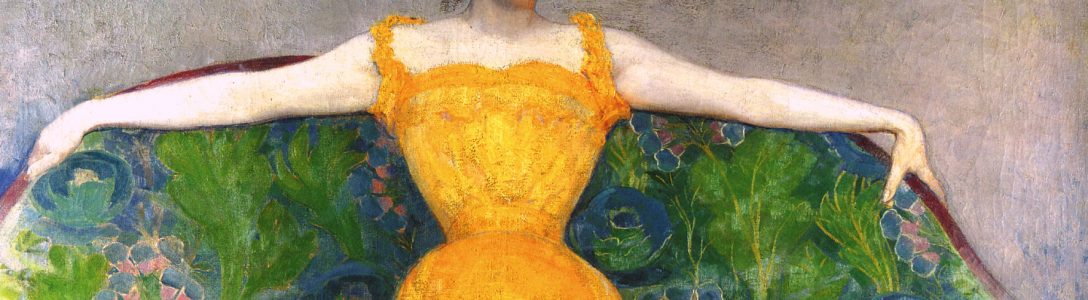
Reflection (What Does Your Soul Look Like?), 1997 by Peter Doig (b. 1959)

McClintic Sphere, an innovative jazz saxophonist, and Paolo Majistral, the Maltese “girl [who] lived proper nouns” are two minor characters in Thomas Pynchon’s first novel, V. I will get back to them in a second.
But—
A novel crammed with minor characters (hundreds of them, I’d guess) V. pulsates with intersections, drive-bys, concordances and discordance. Characters crisscross and quick-change in ways that both parody and honor the authorial sleight-of-hand in play in V.
Pynchon repeatedly challenges his readers’ credulity–while its intersections are never as neat and tidy as its titular vee angle might suggest, V. is still a confusion of happenstance that both confounds and sanctifies coincidence, even as it ironizes those winds of fate.
The mode is necessarily postmodern. Pynchon repeatedly evokes Modernist poets by name—Pound and Eliot, especially—but it’s the immediate postwar (post, war, world, two) that he’s most concerned with in V. The novel critiques Modernist critiques (through a double lens of a critique of colonialism).
The great concern here is for the divergent angle of the second half of the twentieth century. As such, much of V. is a loving parody of the Beat scene (much more loving than Gaddis’s sustained attack on art poseurs in The Recognitions). In V., Pynchon creates a non-chorus in The Whole Sick Crew, an outcast cast of losers and would-bes and pseudointellectuals.
The Whole Sick Crew lards V.’s enormous, hard-to-follow cast. Two members of the nebulous Crew are
McClintic Sphere, an innovative jazz saxophonist, and Paolo Majistral, the Maltese “girl [who] lived proper nouns.”
And so–
There’s a marvelous moment about two-thirds of the way through V. where McClintic and Paolo, erstwhile lovers (Paolo in the guise of “Ruby” — everyone here is a quick change artist)—where McClintic and Paolo transcend the quick-changing and irony and and sensory-cloggingness of the modern condition. They drive upstate, talk straight—the plot details don’t matter here, just read:
Maybe the only peace undisturbed that night was McClintic’s and Paola’s. The little Triumph forged along up the Hudson, their own wind was cool, taking away whatever of Nueva York had clogged ears, nostrils, mouths.
She talked to him straight and McClintic kept cool.
And then our man McClintic comes to something close to an epiphany, although epiphanies are always hedged, suspicious, constrained in Pynchon—but I think there’s something real here. Earlier in the novel, McClintic feels concern for the postwar “cool,” for the feeling that the world might flip or flop again, go from zero to binary in a weird heartbeat (that binary code theme pulsates through the rest of Pynchon’s work to date). Makes sense for machines, maybe, but people aren’t, or shouldn’t be, machines.
McClintic’s epiphany is a pragmatic resolution, and I take it to be Pynchon’s cautionary thesis:
…there came to McClintic something it was time he got around to seeing: that the only way clear of the cool/crazy flipflop was obviously slow, frustrating and hard work. Love with your mouth shut, help without breaking your ass or publicizing it: keep cool, but care. He might have known, if he’d used any common sense. It didn’t come as a revelation, only something he’d as soon not’ve admitted.
The epiphany is bitter, and Pynchon’s narrator refuses its epiphanic value (“It didn’t come as a revelation”), even as the narrative acknowledges its intrinsic power. A few lines later, McClintic addresses the Real Work to Be Done in the World:
Nobody is going to step down from Heaven and square away Roony and his woman, or Alabama, or South Africa or us and Russia. There’s no magic words. Not even I love you is magic enough. Can you see Eisenhower telling Malenkov or Khrushchev that? Ho-ho.”
“Keep cool but care,” he said. Somebody had run over a skunk a ways back. The smell had followed them for miles. “If my mother was alive I would have her make a sampler with that on it.”
The highway stinks, sticks skunky to fleeing motion, gummed up in the nostalgic emblems we’d imaginatively credit to our loving forebears. The grist, grit, and horror of the big postwar world will cling to the present. Nobody’s stepping down from heaven, or Heaven and there are no magic words—but there is a kind of love, a loving with your mouth shut, a kind of radical, earnest, transcendent love that Pynchon evokes, soils, and sanctifies here.
George Plimpton’s review of Thomas Pynchon’s debut novel V. was first published in The New York Times on April 21, 1963 (hey! 58 years ago to the day, coincidentally) under the title “Mata Hari with a Clockwork Eye, Alligators in the Sewer.”
The NYT republished the piece on 6 Oct. 1996, under the title “The Whole Sick Crew.” It ran next to a 1969 review of Philip Roth’s Portnoy’s Complaint—with a big picture of Roth. No Pynchon pic, natch.

Plimpton’s review below:
“Mata Hari with a Clockwork Eye, Alligators in the Sewer”
(A review of Thomas Pynchon’s novel V.)
by
George Plimpton
Since the war a category of the American novel has been developed by a number of writers: American picaresque one might call the archetype, and its more notable practitioners would include Saul Bellow with ”The Adventures of Augie March,” Jack Kerouac, ”On the Road,” Joseph Heller, ”Catch-22,” Clancy Sigal, ”Going Away,” and Harry Matthews, who last fall produced a generally overlooked though brilliant novel entitled ”Conversions.” The genus is distinguished by what the word ”picaresque” implies — the doings of a character or characters completely removed from socio-political attachments, thus on the loose, and, above all, uncommitted.
Such novels are invariably lengthy, heavily populated with eccentrics, deviates, grotesques with funny names (so they can be remembered), and are usually composed of a series of bizarre adventures or episodes in which the central character is involved, then removed and flung abruptly into another. Very often a Quest is incorporated, which keeps the central character on the move.
For the author, the form of the picaresque is convenient: he can string together the short stories he has at hand (publishers are reluctant to publish short-story collections, which would suggest the genre is perhaps a type of compensation). Moreover — the well-made, the realistic not being his concern — the author can afford to take chances, to be excessive, even prolix, knowing that in a work of great length stretches of doubtful value can be excused. The author can tell his favorite jokes, throw in a song, indulge in a fantasy or so, include his own verse, display an intimate knowledge of such disparate subjects as physics, astronomy, art, jazz, how a nose-job is done, the wildlife in the New York sewage system. These indeed are some of the topics which constitute a recent and remarkable example of the genre: a brilliant and turbulent first novel published this month by a young Cornell graduate, Thomas Pynchon. He calls his book ”V.”
” V.” has two main characters. One of them is Benny Profane — on the loose in New York City following a Navy hitch and a spell as a road-laborer. Born in 1932, Profane is Depression-formed, and his function in the novel is to perfect his state of ”schlemihlhood” — that is to say being the victim, buffeted by circumstance and not caring to do much about it — resigned to being behind the 8-ball. Indeed, in one poolroom fracas the 8-ball rolls up to Profane, prostrate on the floor, and stares him in the eye. His friends are called the Whole Sick Crew, a fine collection of disaffected about whom one observer says ”there is not one you can point to and say is well.” Typical of them is the itinerant artist Slab, who calls himself a catatonic expressionist. Beset by a curious block he can only paint cheese danishes — Cheese Danish No. 56 is his subject at one stage of the book.
Set in contrast to Profane is a young adventurer named Stencil. He is active as opposed to passive, obsessed by a self-imposed duty which he follows, somewhat joylessly — a Quest to discover the identity of V., a woman’s initial which occurs in the journals of his father, a British Foreign Office man, drowned in a waterspout off Malta. The search for V., a puzzle slowly fitted together by a series of brilliant episodic flashbacks, provides the unifying device of the novel — a framework encompassing a considerable panorama of history and character. V., turning up first as a young girl in Cairo at the start of the century, reappears under various names and guises, invariably at times of strife and riot, in Florence, Paris, Malta, South Africa. Finally one finds her disguised as a Manichaean priest, trapped under a beam in a World War II bombing raid on Malta and being literally disassembled by a crowd of children.
The identity of V., what her many guises are meant to suggest, will cause much speculation. What will be remembered, whether or not V. remains elusive, is Pynchon’s remarkable ability — which includes a vigorous and imaginative style, a robust humor, a tremendous reservoir of information (one suspects that he could churn out a passable almanac in a fortnight’s time) and, above all, a sense of how to use and balance these talents. True, in a plan as complicated and varied as a Hieronymus Bosch triptych, sections turn up which are dull — the author backing and filling, shuffling the pieces of his enormous puzzle to no effect — but these stretches are far fewer than one might expect.
Pynchon is in his early twenties; he writes in Mexico City — a recluse. It is hard to find out anything more about him. At least there is at hand a testament — this first novel ”V.” — which suggests that no matter what his circumstances, or where he’s doing it, there is at work a young writer of staggering promise.

The Blue Bird I, 2019 by Natalie Frank (b. 1980)
“The Blue Bird”
by
Madame d’Aulnoy
Translated from the French by
Andrew Lang
Once upon a time there lived a King who was immensely rich. He had broad lands, and sacks overflowing with gold and silver; but he did not care a bit for all his riches, because the Queen, his wife, was dead. He shut himself up in a little room and knocked his head against the walls for grief, until his courtiers were really afraid that he would hurt himself. So they hung feather-beds between the tapestry and the walls, and then he could go on knocking his head as long as it was any consolation to him without coming to much harm. All his subjects came to see him, and said whatever they thought would comfort him: some were grave, even gloomy with him; and some agreeable, even gay; but not one could make the least impression upon him. Indeed, he hardly seemed to hear what they said. At last came a lady who was wrapped in a black mantle, and seemed to be in the deepest grief. She wept and sobbed until even the King’s attention was attracted; and when she said that, far from coming to try and diminish his grief, she, who had just lost a good husband, was come to add her tears to his, since she knew what he must be feeling, the King redoubled his lamentations. Then he told the sorrowful lady long stories about the good qualities of his departed Queen, and she in her turn recounted all the virtues of her departed husband; and this passed the time so agreeably that the King quite forgot to thump his head against the feather-beds, and the lady did not need to wipe the tears from her great blue eyes as often as before. By degrees they came to talking about other things in which the King took an interest, and in a wonderfully short time the whole kingdom was astonished by the news that the King was married again to the sorrowful lady. Continue reading “The Blue Bird I — Natalie Frank”

The Pandemic, 2021 by Miles Cleveland Goodwin (b. 1980)
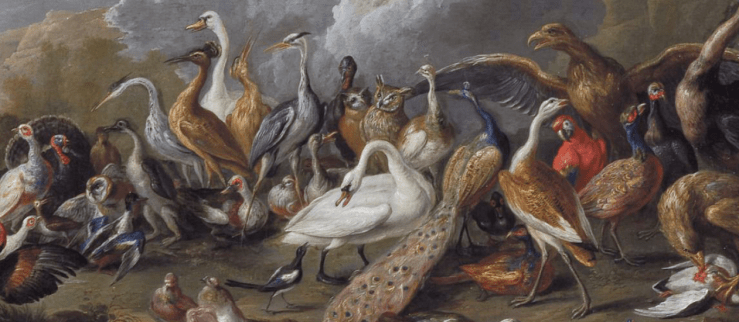
Allegory of Air (detail), 1661 by Jan van Kessel the Elder (1626-1679)
“little report of the day”
by
Jack Collum
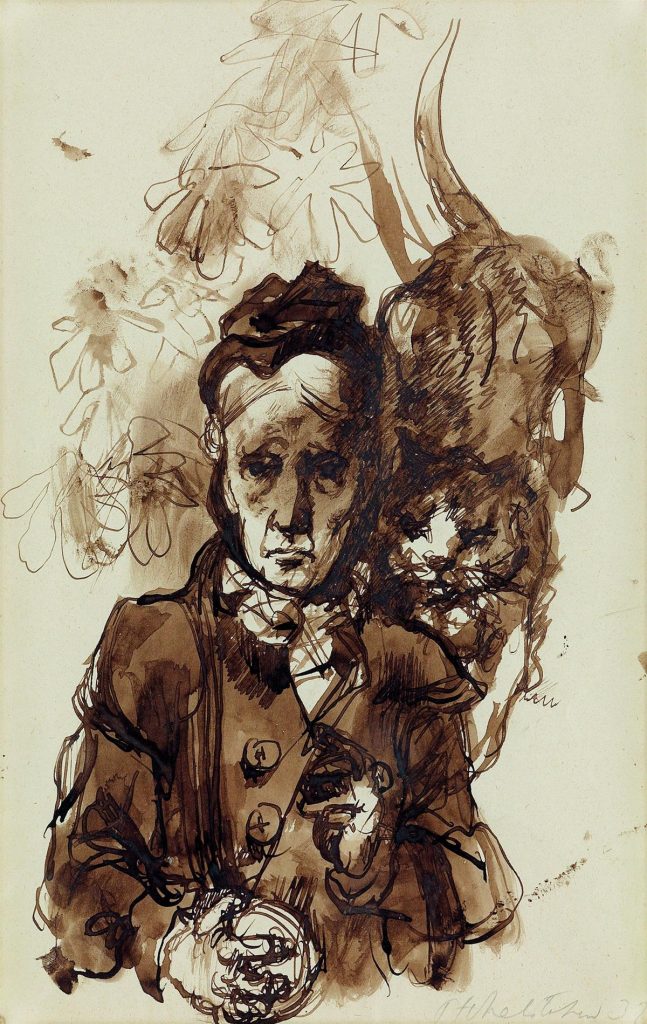
The Sorceress, 1932 by Pavel Tchelitchew (1898-1957)

Mario Levrero’s The Luminous Novel is forthcoming in English translation by Annie McDermott from the good folks at And Other Stories. It’s a big ole book! Here is And Other Stories’ blurb:
A writer attempts to complete the novel for which he has been awarded a big fat Guggenheim grant, though for a long time he succeeds mainly in procrastinating – getting an electrician to rewire his living room so he can reposition his computer, buying an armchair, or rather, two: ‘In one, you can’t possibly read: it’s uncomfortable and your back ends up crooked and sore. In the other, you can’t possibly relax: the hard backrest means you have to sit up straight and pay attention, which makes it ideal if you want to read.’
Insomniacs, romantics and anyone who’s ever written (or failed to write) will fall in love with this compelling masterpiece told by a true original, with all his infuriating faults, charming wit and intriguing musings.
I loved the last two And Other Stories editions I read, by the way. I highly recommend Norah Lange’s Notes from Childhood (translated by Nora Whittle) — I wrote about it here.
The other AOS book was Ann Quin’s 1969 avant garde novel Passages, which is unlike anything else I’ve ever read (although Joyce’s Ulysses, Jane Bowles’s Two Serious Ladies, Beckett, Derrida’s Glas, and Julia Kristeva come to mind). I reread it last weekend in an attempt to outline a review, which I hope to have up soon.
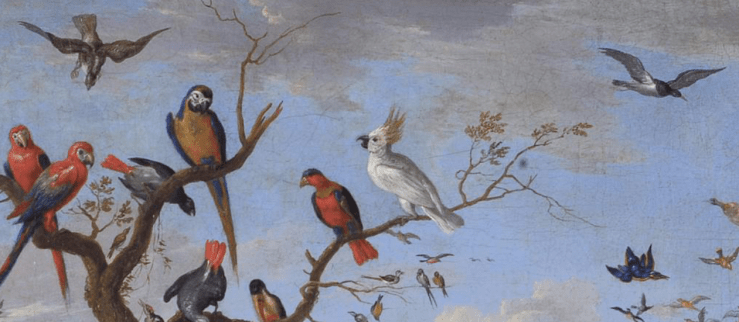
Allegory of Air (detail), 1661 by Jan van Kessel the Elder (1626-1679)

Chaos XLIX by Michael Palmer (b. 1942)
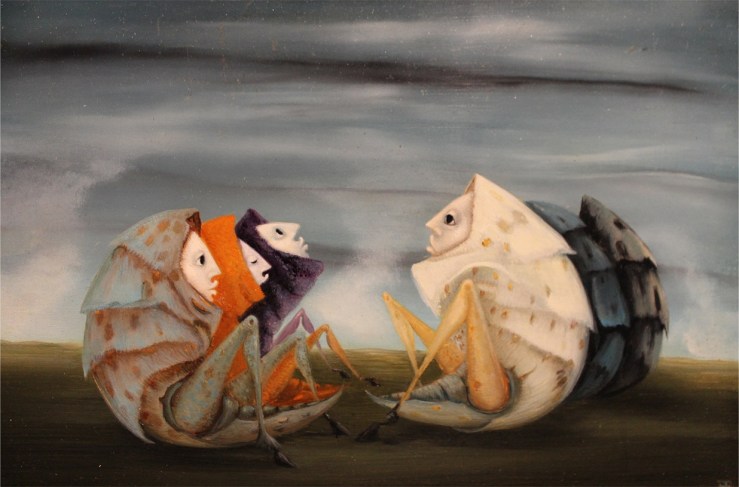
Wait, 1961 by Bridget Tichenor (1917-1990)
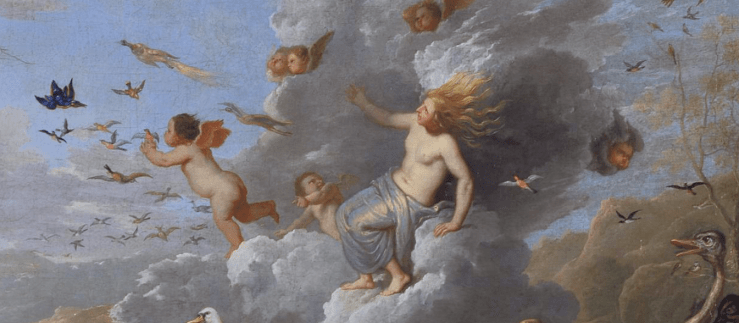
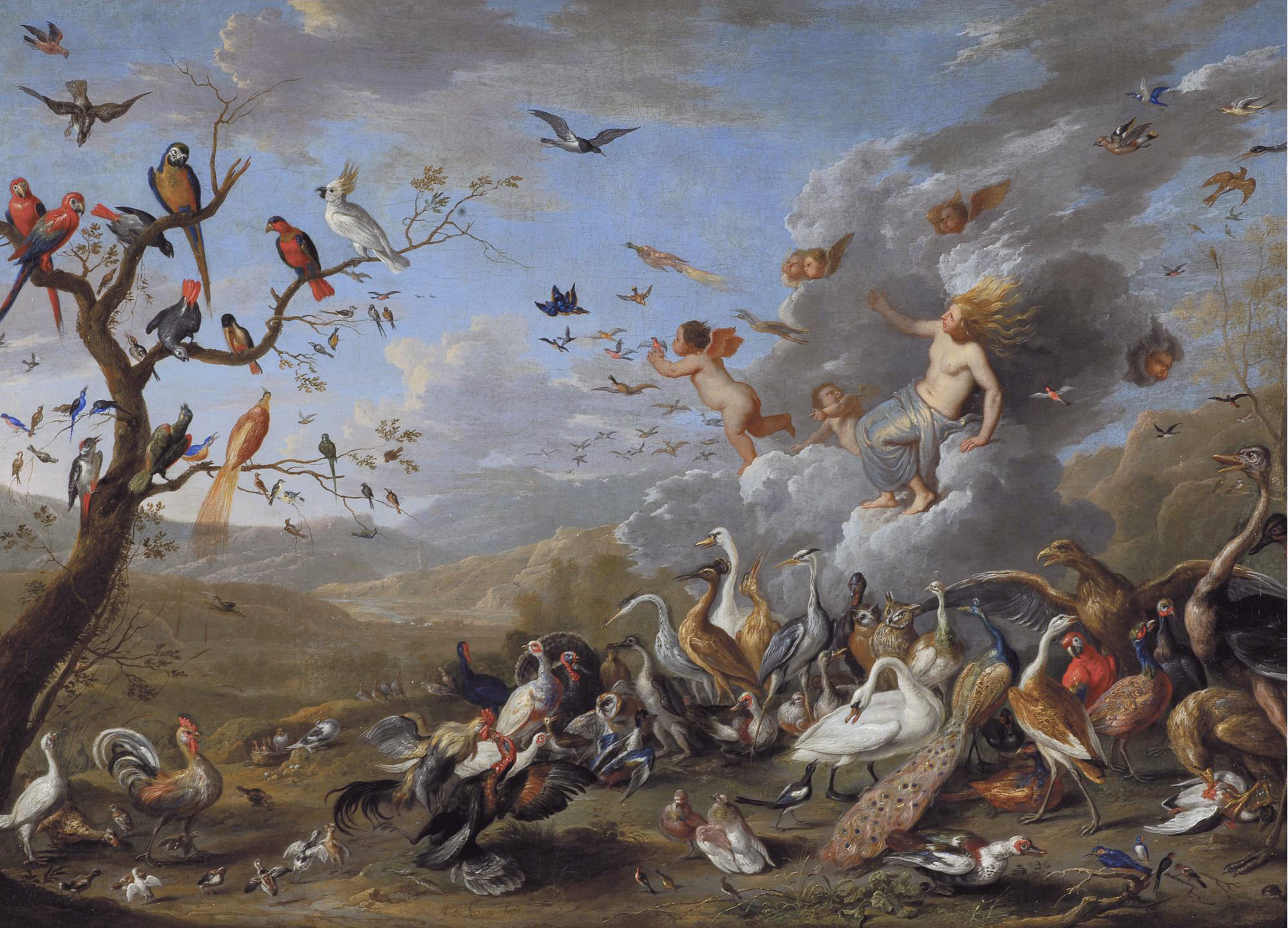
Allegory of Air (detail), 1661 by Jan van Kessel the Elder (1626-1679)

I came across this 1976 first edition paperback of Angela Carter’s collection Fireworks two weeks ago and couldn’t pass it up, even though all of Fireworks is collected in Burning Your Boats, which I already own. I love the hornyassed cover by Bob Foulke. I cannot find anything else by Foulke on the internet.
Here is the opening of “The Executioner’s Beautiful Daughter”:
Here, we are high in the uplands.
A baleful almost-music, that of the tuneless cadences of an untutored orchestra repercussing in an ecstatic agony of echoes against the sounding boards of the mountains, lured us into the village square where we discover them twanging, plucking and abusing with horsehair bows a wide variety of crude stringed instruments. Our feet crunch upon dryly whispering shifting sawdust freshly scattered over impacted surfaces of years of sawdust clotted, here and there, with blood shed so long ago it has, with age, acquired the colour and texture of rust . . . sad, ominous stains, a threat, a menace, memorials of pain.
There is no brightness in the air. Today the sun will not irradiate the heroes of the dark spectacle to which accident and disharmony combined to invite us. Here, where the air is choked all day with diffuse moisture tremulously, endlessly the point of becoming rain, light falls as if filtered through muslin so at all hours a crepuscular gloaming prevails; the sky looks as though it is about to weep and so, gloomily illuminated through unshed tears, the tableau vivant before us is suffused with the sepia tints of an old photograph and nothing within it moves. The intent immobility of the spectators, wholly absorbed as they are in the performance of their hieratic ritual, is scarcely that of living things and this tableau vivant might be better termed a nature morte for the mirthless carnival is a celebration of a death. Their eyes, the whites of which are yellowish, are all fixed, as if attached by taut, invisible strings upon a wooden block lacquered black with the spilt dews of a millennia of victims.
And now the rustic bandsmen suspend their unmclodious music. This death must be concluded in the most dramatic silence. The wild mountain-dwellers are gathered together to watch a public execution; that is the only entertainment the country offers.
Time, suspended like the rain, begins again in silence, slowly.

News or Something, 2017 by Pablo Martinez
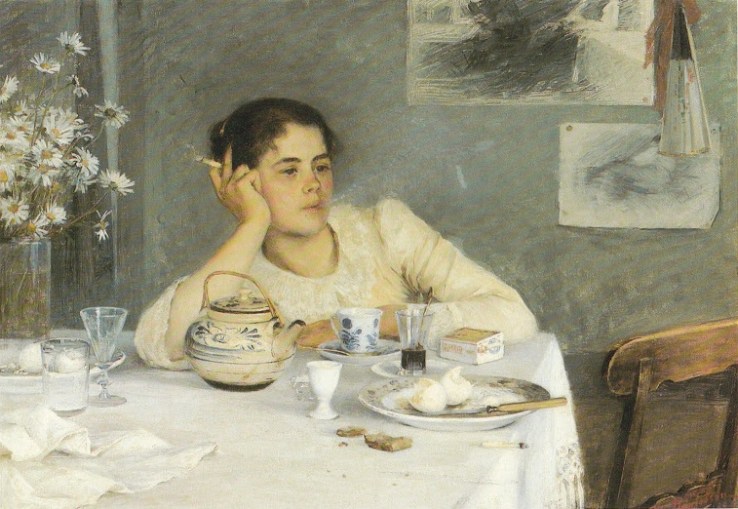
After Breakfast, 1890 by Elin Danielson-Gambogi (1861-1919)
“Seascape”
by
Elizabeth Bishop
This celestial seascape, with white herons got up as angels,
flying high as they want and as far as they want sidewise
in tiers and tiers of immaculate reflections;
the whole region, from the highest heron
down to the weightless mangrove island
with bright green leaves edged neatly with bird-droppings
like illumination in silver,
and down to the suggestively Gothic arches of the mangrove roots
and the beautiful pea-green back-pasture
where occasionally a fish jumps, like a wildflower
in an ornamental spray of spray;
this cartoon by Raphael for a tapestry for a Pope:
it does look like heaven.
But a skeletal lighthouse standing there
in black and white clerical dress,
who lives on his nerves, thinks he knows better.
He thinks that hell rages below his iron feet,
that that is why the shallow water is so warm,
and he knows that heaven is not like this.
Heaven is not like flying or swimming,
but has something to do with blackness and a strong glare
and when it gets dark he will remember something
strongly worded to say on the subject.
 Biblioklept