Woman in the Plural is a newly-translated collection of poems and plays by Vítězslav Nezval. The new translation is by Ka (the volume also features art by Karel Teige).
In the summer of 1935, Vítězslav Nezval, already one of the most celebrated Czech poets of his generation, embarked on a period of manic creativity that would result in three volumes of poetry written and published in a two-year span (1935-37), mirrored by three volumes of memoir-like poetic prose. These collections would not only reshape Czech poetry, blending approaches developed by the French Surrealists with national cultural sensibilities and political concerns, taken together they are among the highest achievements of the interwar avant-garde. Woman in the Plural (1936), the first volume in this loose trilogy, adopted “objective chance” as its modus operandi (whereas the third and final volume, The Absolute Gravedigger (1937), was guided by the paranoiac-critical method).
Appearing in English translation for the first time, Woman in the Plural displays Nezval’s prodigious talents in a variety of forms, styles, and genres as he spins images of the female form like a zoetrope to create novel and hallucinatory ways of conceiving woman’s mythical, divine, and creative power. It is an eclectic collection that blends profound free verse, at times reading like a cascade of automatic writing, with pages from Nezval’s dream journal, an exuberant set of Surrealist exercises, and a full-length play of chance encounters with “a woman like any other,” all the while addressing the social and political uncertainties of the 1930s. Led off by Karel Teige’s original collages from the first edition, Woman in the Plural is a vibrant and volatile tour de force from one of the greatest European artists of the 20th century.
Another chapter composed as playwright’s drama—mostly dialogue, and a few spare stage directions.
The dialogue is between Ahab and the carpenter. The poor old man has been charged with the task of converting Queequeg’s coffin into a life-buoy (you will recall The Pequod lost both the life-buoy and the sailor it was thrown to save in the previous chapter).
Ahab’s back-and-forth with the carpenter highlight’s the captain’s careen into deeper madness. He’s alarmed by the carpenter’s ironic task:
Then tell me; art thou not an arrant, all-grasping, intermeddling, monopolising, heathenish old scamp, to be one day making legs, and the next day coffins to clap them in, and yet again life-buoys out of those same coffins? Thou art as unprincipled as the gods, and as much of a jack-of-all-trades.”
It’s another metatextual moment in Moby-Dick, where Ahab plays a critic, pointing out perhaps that Melville’s ironic foreshadowing here is overdetermined stuff. But the dialogue leads Ahab inward to monologue, and he tries to play out the greater meaning of the symbol, beyond plot-bound gimmickry. The phenomenal experience of hearing the carpenter’s work sends him into a philosophical reverie:
Rat-tat! So man’s seconds tick! Oh! how immaterial are all materials! What things real are there, but imponderable thoughts? Here now’s the very dreaded symbol of grim death, by a mere hap, made the expressive sign of the help and hope of most endangered life. A life-buoy of a coffin! Does it go further? Can it be that in some spiritual sense the coffin is, after all, but an immortality-preserver! I’ll think of that.
In the end though the coffin is a life-preserver—it saves Ishmael, and, in a sense, is an immortality-preserver, as it becomes the mechanism that sustains Ishmael’s infinite witnessing.
III. Ch. 128, “The Pequod Meets The Rachel.”
This is possibly the saddest chapter in Moby-Dick.
The Pequod meets The Rachel, also of Nantucket. It’s the penultimate ship they will meet in their soon-to-be-over voyage (the ironically named Delight is their last exchange).
The captain of The Rachel is able to affirm Ahab’s monomaniacal hailing, and then pose his own rejoinder:
“Hast seen the White Whale?”
“Aye, yesterday. Have ye seen a whale-boat adrift?”
The Rachel’s captain boards The Pequod. It turns out that one of the whaling boats of The Rachel set out after Moby Dick, yet never returned. We then learn his motivation for the curt gam:
The story told, the stranger Captain immediately went on to reveal his object in boarding the Pequod. He desired that ship to unite with his own in the search; by sailing over the sea some four or five miles apart, on parallel lines, and so sweeping a double horizon, as it were.
Callous Stubb suggests that the captain is anxious to get the boat’s crew back because “some one in that missing boat wore off that Captain’s best coat; mayhap, his watch.” Stubb shows a tenderer heart though when the truth is revealed: “My boy, my own boy is among them,” pleads the captain,” begging Ahab to charter The Pequod for two days.
Stubb—who I’ve thought in this reread the villain of the novel for his bullying humor—redeems himself here: “His son!” cried Stubb, “oh, it’s his son he’s lost! I take back the coat and watch—what says Ahab? We must save that boy.”
What says Ahab?
But first—what says the captain—referred to repeatedly as “the stranger” in this chapter:
“I will not go,” said the stranger, “till you say aye to me. Do to me as you would have me do to you in the like case.
The Gospel’s injunction is straightforward. We must treat others—particularly strangers, those othered-others, “the least of these,” in the NIV translation—as we wish to be treated.
And so well,
What says Ahab?
“Avast,” cried Ahab—“touch not a rope-yarn”; then in a voice that prolongingly moulded every word—“Captain Gardiner, I will not do it. Even now I lose time. Good-bye, good-bye. God bless ye, man, and may I forgive myself, but I must go.
Ahab hopes he can forgive himself. But the end of Matthew Ch. 25 is pretty clear (KJV this time).: “Verily I say unto you, Inasmuch as ye did it not to one of the least of these, ye did it not to me. And these shall go away into everlasting punishment.”
IV. Ch. 129, “The Cabin.”
Another chapter composed as playwright’s drama—mostly dialogue, and a few spare stage directions—and, like Ch. 127, a chapter that ends in a crazed monologue.
The chapter starts with Ahab telling Pip way too late, “Lad, lad, I tell thee thou must not follow Ahab now. The hour is coming when Ahab would not scare thee from him, yet would not have thee by him.” Ahab tells Pip that Pip is the cure for his malady, but that his “malady becomes [his] most desired health.” It’s a strange moment between two cursed persons—Ahab recognizes here the injunction in the Gospel of Matthew that he’s failed to meet in the previous chapter (and hey, I even forgot to point out that the captain of The Rachel is not even a stranger to Ahab—our monomaniac calls the man by name!)—but where was I? I think it’s a weird tender moment. Ahab recognizes Pip as a kind of son, and tells him to stay safe in his cabin. But he also seems to know that the entire ship is headed toward some kind of Big Death.
Ahab departs; Pip fills the cabin — and the end of the “The Cabin” — with his crazed voice. He’s already the vacant post that Ishmael will evoke in the novel’s epilogue. So let him speak:
Here he this instant stood; I stand in his air,—but I’m alone. Now were even poor Pip here I could endure it, but he’s missing. Pip! Pip! Ding, dong, ding! Who’s seen Pip? He must be up here; let’s try the door. What? neither lock, nor bolt, nor bar; and yet there’s no opening it. It must be the spell; he told me to stay here: Aye, and told me this screwed chair was mine. Here, then, I’ll seat me, against the transom, in the ship’s full middle, all her keel and her three masts before me. Here, our old sailors say, in their black seventy-fours great admirals sometimes sit at table, and lord it over rows of captains and lieutenants. Ha! what’s this? epaulets! epaulets! the epaulets all come crowding! Pass round the decanters; glad to see ye; fill up, monsieurs! What an odd feeling, now, when a black boy’s host to white men with gold lace upon their coats!—Monsieurs, have ye seen one Pip?—a little negro lad, five feet high, hang-dog look, and cowardly! Jumped from a whale-boat once;—seen him? No! Well then, fill up again, captains, and let’s drink shame upon all cowards! I name no names. Shame upon them! Put one foot upon the table. Shame upon all cowards.—Hist! above there, I hear ivory—Oh, master! master! I am indeed down-hearted when you walk over me. But here I’ll stay, though this stern strikes rocks; and they bulge through; and oysters come to join me.
“The Needle” is another one of Melville’s satanic reversals in Moby-Dick. Lightning from the tempest that The Pequod endured over the past few chapters has caused all compasses aboard the ship to be perfectly reversed. Needles fly in the exact opposite directions. What might have been up, in a certain sense, points downward.
Again, Ahab is a bad reader—or a reader whose monomania overrides his ability to comprehend other perspectives, other views, other directions.
III. And yet Ahab is a bold reader, one who shapes nature to his own direction (or will in anywise perish doing so):
“Men,” said he, steadily turning upon the crew, as the mate handed him the things he had demanded, “my men, the thunder turned old Ahab’s needles; but out of this bit of steel Ahab can make one of his own, that will point as true as any.”
Ahab sets about to magnetize a needle with the “steel head of the lance,” and the crew watches on in wonder and mild horror. Ishmael (Melville) notes that, “with fascinated eyes they awaited whatever magic might follow” — and then tellingly: “But Starbuck looked away.”
Starbuck’s attempt to see no evil reverberates through the crew who gaze at the new compass needle in turns at the end of the scene:
One after another they peered in, for nothing but their own eyes could persuade such ignorance as theirs, and one after another they slunk away.
In his fiery eyes of scorn and triumph, you then saw Ahab in all his fatal pride.
Slink away; perish still.
Moby-Dick illustration by Barry Moser
IV. Ch. 125, “The Log and Line.”
A somewhat extended episode, the mechanics of which I’m in no mood to summarize here. Suffice to say that “the log and line” — basically, a way of calculating the ship’s speed — “had but very seldom been in use” lately on The Pequod’s voyage. Ahab has found other ways to measure and to read the phenomenal world. But, thinking he’s closing in on the White Whale, he commands the “golden-hued Tahitian and the grizzly Manxman” to the task of log and line.
V. The Manxman declares the line “rotten,” a prescient analysis that reads The Pequod’s impending doom.
A mark of that rottenness evinces in Pip’s emergence. The crazed cabin boy alights on the deck, a rotten line in a book of glowing rotten lines. He contests his own identity. He’s a vacant post, a drowned sailor:
“Pip? whom call ye Pip? Pip jumped from the whale-boat. Pip’s missing. Let’s see now if ye haven’t fished him up here, fisherman. It drags hard; I guess he’s holding on. Jerk him, Tahiti! Jerk him off; we haul in no cowards here. Ho! there’s his arm just breaking water. A hatchet! a hatchet! cut it off—we haul in no cowards here. Captain Ahab! sir, sir! here’s Pip, trying to get on board again.”
VI. (I will leave the line Jerk him off in this oh-so-phallic novel alone, apart from noting it here in these parentheses.)
VII. “Peace, thou crazy loon,” cries the Manxman, trying to shoo him from the quarter-deck, but Ahab admonishes the older sailor and enters into conversation with the insane cabin boy:
“The greater idiot ever scolds the lesser,” muttered Ahab, advancing. “Hands off from that holiness! Where sayest thou Pip was, boy?
“Astern there, sir, astern! Lo! lo!”
“And who art thou, boy? I see not my reflection in the vacant pupils of thy eyes. Oh God! that man should be a thing for immortal souls to sieve through! Who art thou, boy?”
“Bell-boy, sir; ship’s-crier; ding, dong, ding! Pip! Pip! Pip! One hundred pounds of clay reward for Pip; five feet high—looks cowardly—quickest known by that! Ding, dong, ding! Who’s seen Pip the coward?”
“There can be no hearts above the snow-line. Oh, ye frozen heavens! look down here. Ye did beget this luckless child, and have abandoned him, ye creative libertines. Here, boy; Ahab’s cabin shall be Pip’s home henceforth, while Ahab lives. Thou touchest my inmost centre, boy; thou art tied to me by cords woven of my heart-strings. Come, let’s down.”
Pip then, and not Fedallah, is Ahab’s true squire. Poor child.
Moby-Dick illustration by Barry Moser
VIII. Ch. 126, “The Life-Buoy.”
“[D]etermined by Ahab’s level log and line; the Pequod held on her path towards the Equator.” On their way there,
sailing by a cluster of rocky islets…the watch…was startled by a cry so plaintively wild and unearthly—like half-articulated wailings of the ghosts of all Herod’s murdered Innocents—that one and all, they started from their reveries…
The wailing there again calls to me. I’ve probably stated ad nauseum in these riffs that Moby-Dick is a whaling book about wailing.
IX. Ishmael continues his ironic critique of the viewpoints of “pagans” and “civilized” folk:
The Christian or civilized part of the crew said it was mermaids, and shuddered; but the pagan harpooneers remained unappalled.
The pagan harpooneers remain unappalled because they are not in the thrall of superstitious ignorance.
X. The wailing is not lost souls or mermaids, we learn, but rather the crying of
some young seals that had lost their dams, or some dams that had lost their cubs, [who] must have risen nigh the ship and kept company with her, crying and sobbing with their human sort of wail.
Their human sort ofwail—a wailing, a hailing, an interpellation that the sailors can read.
XI. After this wailing episode, we learn that a lookout posted at the top of The Pequod drowns. The crew spies him, “a falling phantom in the air,” and throw out the titular life-buoy to recover him.
Neither returns.
XII. The life-buoy must be resurrected in a new form, though. However, “no cask of sufficient lightness could be found.” Fortunately (ultimately, for Ishmael), “by certain strange signs and inuendoes Queequeg hinted a hint concerning his coffin”
“A life-buoy of a coffin!” cried Starbuck, starting.
“Rather queer, that, I should say,” said Stubb.
“It will make a good enough one,” said Flask, “the carpenter here can arrange it easily.”
And so the carpenter does, despite the queerness of this job—making a life preserver of a coffin.
Hence Moby-Dick formalizes its theme of LIFE | DEATH in an overdetermined symbol, an abstract concrete thing our living ghosting narrator will cling to after the drama’s done, after the sweep of disaster vortexes all.
Here, we—and by which we, I guess I mean Ishmael’s consciousness–or maybe I just mean we—enter Starbuck’s consciousness.
Our good Christian co-commander stands outside crazy Captain Ahab’s quarters, wondering whether to tell his commander that The Pequod has escaped a typhoon–or to kill the tyrant.
II. Ch. 123 delivers the longest (I mean, I’m pretty sure it’s the longest) monologue we get from Starbuck in the novel, as he ponders the morality of assassinating his captain, Ahab. It begins:
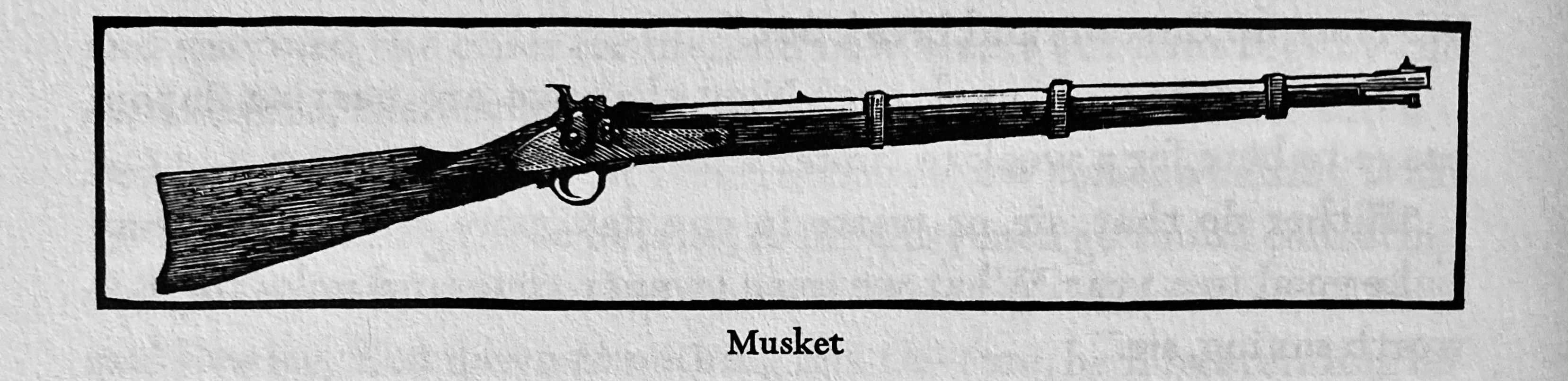
“He would have shot me once,” he murmured, “yes, there’s the very musket that he pointed at me;—that one with the studded stock; let me touch it—lift it. Strange, that I, who have handled so many deadly lances, strange, that I should shake so now. Loaded? I must see. Aye, aye; and powder in the pan;—that’s not good. Best spill it?—wait. I’ll cure myself of this. I’ll hold the musket boldly while I think.
Starbuck’s monologue is riddled with the kind of dashes and question marks we might more readily identify with Poe’s bipolars or Dickinson’s Riddles. Madness infects, and Starbuck is touched.
III. “Has he not dashed his heavenly quadrant?” Starbuck dashingly muses, prefiguring, perhaps, Emily Dickinson’s lines, “Done with the Compass – / Done with the Chart!”
Wild nights indeed!
IV. Starbuck’s wild night again shifts into Poe territory. He’s got a touch of craze to his soul, but he’s still the Christian moral (a)center of Melville’s satanic novel. Here, he weighs the metaphysical against the physical:
But shall this crazed old man be tamely suffered to drag a whole ship’s company down to doom with him?—Yes, it would make him the wilful murderer of thirty men and more, if this ship come to any deadly harm; and come to deadly harm, my soul swears this ship will, if Ahab have his way. If, then, he were this instant—put aside, that crime would not be his. Ha! is he muttering in his sleep? Yes, just there,—in there, he’s sleeping. Sleeping? aye, but still alive, and soon awake again.
V. Starbuck understands that Ahab will wholly infect the crew of The Pequod, dooming them in his disease:
Not reasoning; not remonstrance; not entreaty wilt thou hearken to; all this thou scornest. Flat obedience to thy own flat commands, this is all thou breathest. Aye, and say’st the men have vow’d thy vow; say’st all of us are Ahabs.
VI. In the end though—well, in the end, Starbuck chickens out, as we knew he would. “Great God, where art Thou? Shall I? shall I?” he implores, but God does not answer in any language Starbuck is prepared to read. Instead, Ahab answers (and God through him?) — “Stern all! Oh Moby Dick, I clutch thy heart at last!” — another prefiguration of the demise of the crew Starbuck would save if he were made of sterner stuff.
VII. The episode ends with Starbuck retreating, telling Stubb to wake Ahab.
II. Ch. 120, “The Deck Towards the End of the First Night Watch.”
A very short chapter with a mediumish-length title
After the title, we have a stage direction: Ahab standing by the helm. Starbuck approaching him.
The rest is a brief exchange between Captain and First Mate, in which Starbuck is overwhelmed (again) by Ahab’s tyrannical force.
III. Ch. 121, “Midnight.—The Forecastle Bulwarks.”
We go from Ahab and Starbuck to “Stubb and Flask mounted on them [the forecastle bulwarks], and passing additional lashings over the anchors there hanging.”
After this stage direction, again—dialogue. I might summarize their brief conversation, which we audit unimpeded by authorial intrusions—but I’d rather point out the complete retreat of Ishmael. He is again a ghostly voyeur, here there and everywhere in the text, an open ear, unobtrusive, the ship’s silent spirit.
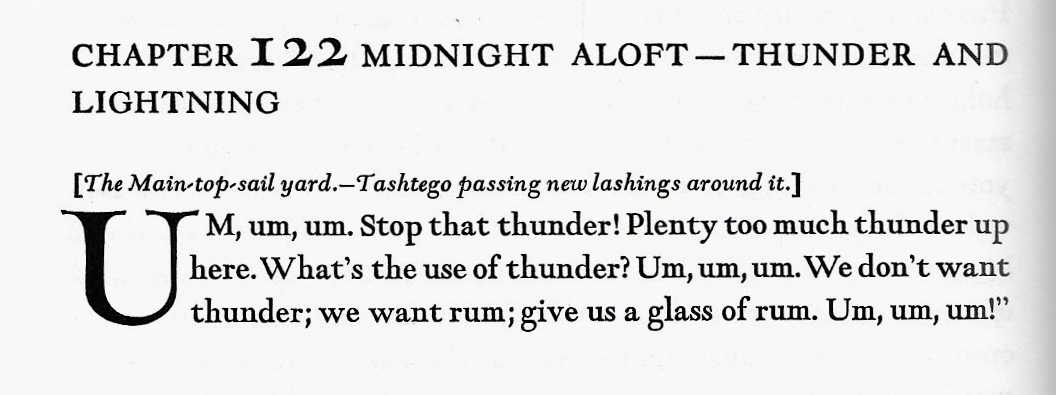
IV. Ch. 122, “Midnight Aloft.—Thunder and Lightning.”
Great little poem, this chapter. Look, here it is. Read it aloud, make it rhyme:
I. In this riff, Chapters 118 and 119 of Moby-Dick.
II. Ahab has already gone mad before The Pequod sets sail on this particular voyage, but Ch. 118, “The Quadrant,” feels like a tipping point where his madness spills a bit too outside of himself. Starbuck has already expressed his mortification for their revenge mission, but it’s not until the end of “The Quadrant” that he seems to fully comprehend the depth of Ahab’s madness:
“I have sat before the dense coal fire and watched it all aglow, full of its tormented flaming life; and I have seen it wane at last, down, down, to dumbest dust. Old man of oceans! of all this fiery life of thine, what will at length remain but one little heap of ashes!”
What prompts this strange, deathly, foreboding analogy? A monomaniacal monologue from Ahab, of course.
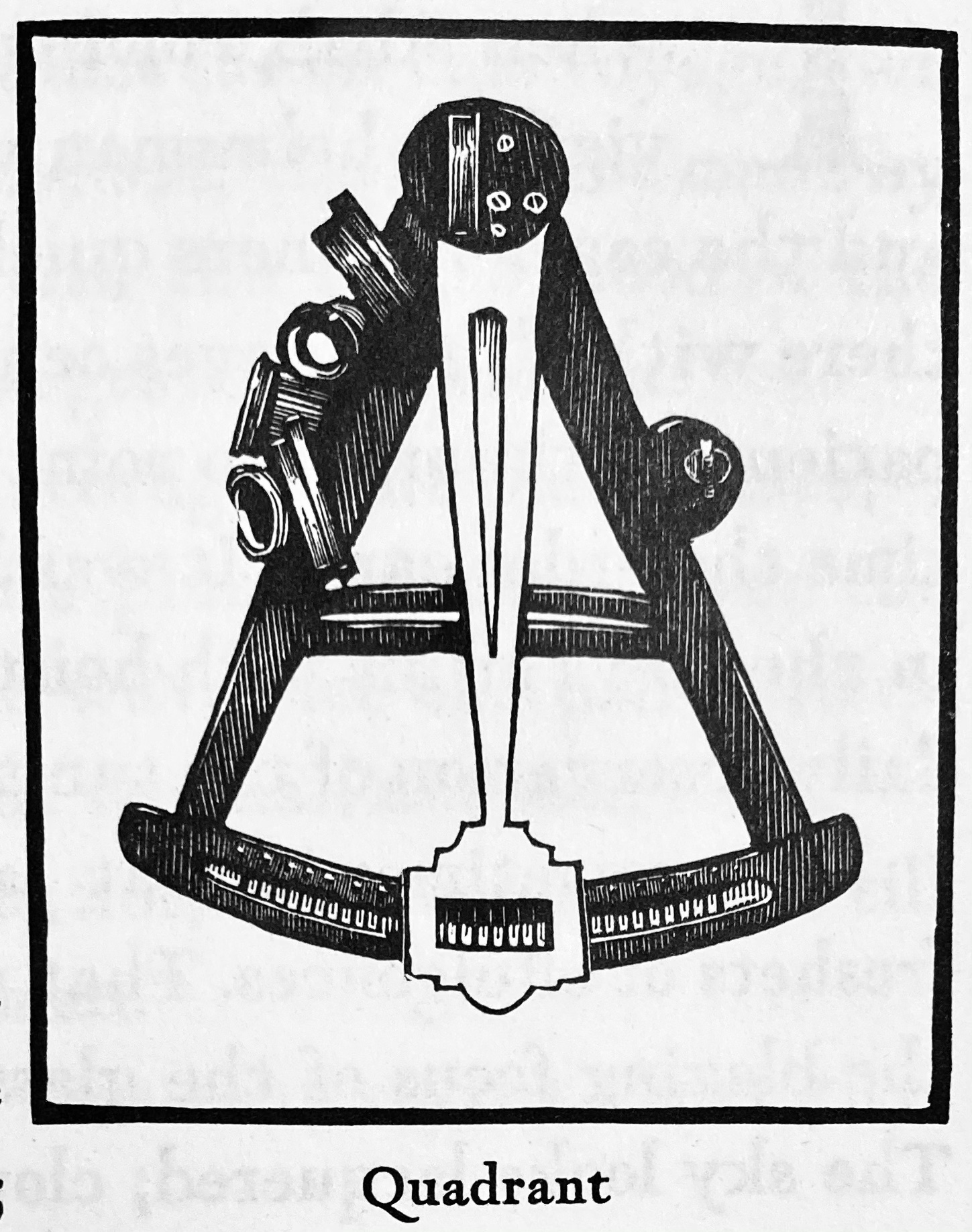
III. Starbuck—and physical foil to Starbuck’s metaphysical moralizing, Stubb—witness Ahab castigate his quadrant in a fury, trampling upon it “with his live and dead feet” alike.
Ahab’s anger comes down again to the limitations of reading, of knowing through the signs and symbols of the world. Gazing at “its numerous cabalistical contrivances,” he censures the device as a “Foolish toy! babies’ plaything of haughty Admirals, and Commodores, and Captains.”
For Ahab, this navigation tool does not measure up: “what after all canst thou do, but tell the poor, pitiful point, where thou thyself happenest to be on this wide planet, and the hand that holds thee: no! not one jot more!” He curses the “vain toy,” which can attest where he is, but cannot find him the object of his murderous desire, Moby Dick.
Moby-Dick illustration by Barry Moser
IV. Ch. 119, “The Candles.”
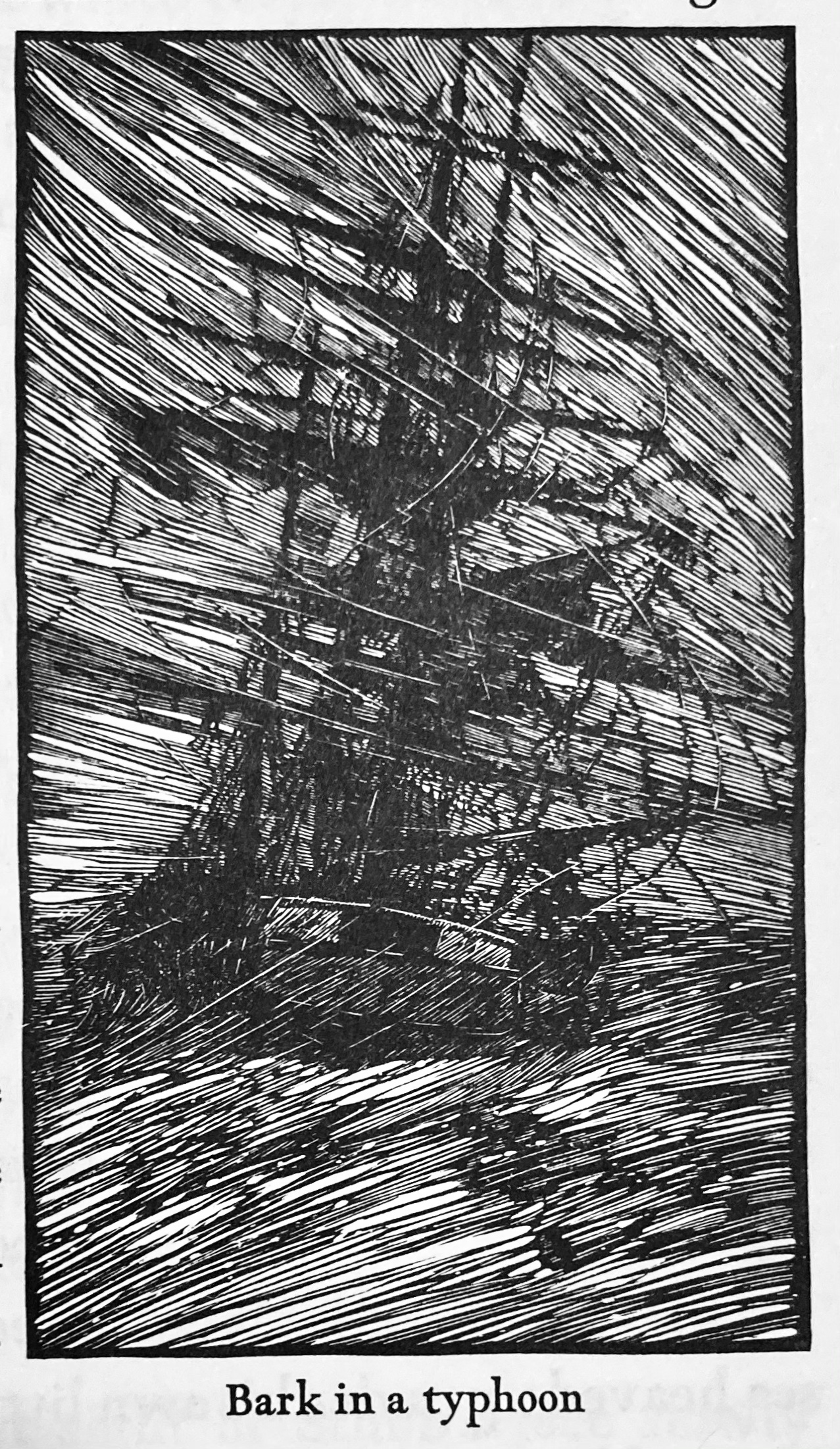
The titular candles here are the three masts of The Pequod, which, struck by lightning during a typhoon, catch on fire. Hence, Ahab’s ship doubles Ahab’s body, which has been afflicted with its own lightning scar.
The scene is bombastic, and Ahab attends it in a kind of prayer-like reverie. He delivers another monologue that indirectly echoes Starbuck’s undelivered admonition that Ahab might end “a heap of ashes”:
“Oh! thou clear spirit of clear fire, whom on these seas I as Persian once did worship, till in the sacramental act so burned by thee, that to this hour I bear the scar; I now know thee, thou clear spirit, and I now know that thy right worship is defiance. … In the midst of the personified impersonal, a personality stands here…Oh, thou clear spirit, of thy fire thou madest me, and like a true child of fire, I breathe it back to thee.”
Here, Melville—or is it Ishmael?—delivers stage directions:
[Sudden, repeated flashes of lightning; the nine flames leap lengthwise to thrice their previous height; Ahab, with the rest, closes his eyes, his right hand pressed hard upon them.]
V. Ahab at this point is full-on crazy. He directly addresses the lightning and fire, in which he finds a kind of power unconstrained by maps and charts, a force that no quadrant might locate. He vows to read the lightning, to find meaning by groping in blindness, a thing of ashes:
“I own thy speechless, placeless power; said I not so? Nor was it wrung from me; nor do I now drop these links. Thou canst blind; but I can then grope. Thou canst consume; but I can then be ashes. Take the homage of these poor eyes, and shutter-hands. I would not take it. The lightning flashes through my skull; mine eye-balls ache and ache; my whole beaten brain seems as beheaded, and rolling on some stunning ground.
Ahab continues to read the lightning with his eyes closed. He claims that he is darkness, the dark that affords the light its position through opposition, and goes so far as to claim the lightning as his father:
Oh, oh! Yet blindfold, yet will I talk to thee. Light though thou be, thou leapest out of darkness; but I am darkness leaping out of light, leaping out of thee! The javelins cease; open eyes; see, or not? There burn the flames! Oh, thou magnanimous! now I do glory in my genealogy. But thou art but my fiery father; my sweet mother, I know not.
But mother? Sweet mother, I know not: “Oh, cruel! what hast thou done with her?”
Again—Moby-Dick is a novel of orphans wailing.
And fathers? Well, they’re out there, in the natural phenomena, I guess—symbols are all Ahab needs to father him.
VI. Ahab’s series of satanic inversions continues. He envies the lightning’s “unbegotten…unbegun” singularity. He also evokes in his anti-prayer the “unsuffusing thing beyond thee, thou clear spirit, to whom all thy eternity is but time.” Ahab tries to read god through this “clear spirit”: “Through thee, thy flaming self, my scorched eyes do dimly see it” — but dimly here does so much work. Ahab is a failed transcendentalist.
VII. He reads in the fire another orphan, another outcast figuration of himself (and Ishmael, and the others who crew The Pequod):
Oh, thou foundling fire, thou hermit immemorial, thou too hast thy incommunicable riddle, thy unparticipated grief. Here again with haughty agony, I read my sire. Leap! leap up, and lick the sky! I leap with thee; I burn with thee; would fain be welded with thee; defyingly I worship thee!”
Ahab now dominates not just The Pequod, but the voice of the novel itself. He reads the lightning, worships the fire, and finds not solace but the confirmation of his vengeance in its clarifying spirit.
I. I “finished” rereading Moby-Dick a few minutes before I started composing this riff.
I feel sad and a little deflated. Deflated here is maybe the wrong word. This is a novel of expansion and contraction, the physical and the metaphysical, the abstract exploding into the concrete. But the novel’s conclusion seems like an undoing to all of its elation—all of Ishmael’s evocation of brotherly-love, of the milk of human kindness, of finding transcendence through a reading of nature. (Maybe Ahab is a bad reader—maybe this is the point of Moby-Dick—that vengeance and pride lead to madness and death.)
II. It’s also possible that I feel deflated and sad because the last riff I wrote about Moby-Dick was on Ch. 112—a short minor chapter that I could’ve squared away in a sentence or two. Something like, Melville here parodies temperance-movement literature while at the same time anchoring the blacksmith’s backstory in an earnest core of fellow feeling and human sympathy—something like that. Only I didn’t; I wrote more fucking words on Ch. 112 than Melville wrote in Ch. 112.
III. Which is all a long way of saying that there’s something addictive about Melville’s rhetoric in Moby-Dick. It’s bombastic and purple and chews scenery; it twists metaphors and pokes at unresolved allegories; its a great big challenge of voices that repeatedly threatens to overwhelm the consciousness that seeks to apprehend it. Maybe comprehend it instead then. Maybe just go with its flow instead.
IV. (Blogging about Moby-Dick as I’ve reread it is an attempt to apprehend it, thus my feelings of deflated depression at the end.)
V. But let us move on; excuse my preamble.
VI. Ch. 113, “The Forge.”
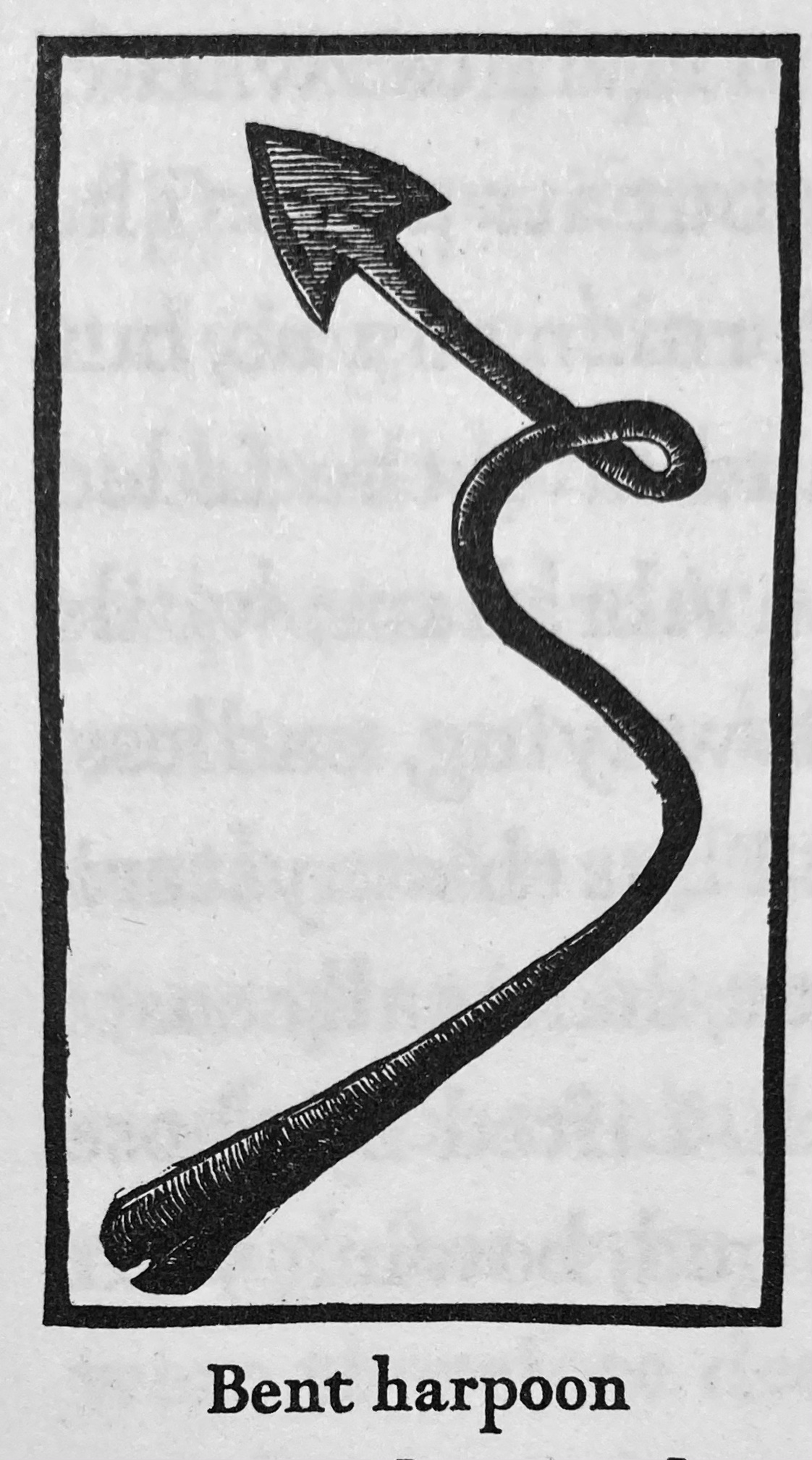
We’ve met the blacksmith Perth and attended to his tale with sympathy. Anon. Let us to Ahab, who commands the poor fellow to smith him a new harpoon, “Fashioned at last into an arrowy shape.” Perth tells Ahab to bring a water cask by to temper the harpoon, but the mad captain insists instead on a satanic blood baptism:
“No, no—no water for that; I want it of the true death-temper. Ahoy, there! Tashtego, Queequeg, Daggoo! What say ye, pagans! Will ye give me as much blood as will cover this barb?” holding it high up. A cluster of dark nods replied, Yes. Three punctures were made in the heathen flesh, and the White Whale’s barbs were then tempered.
“Ego non baptizo te in nomine patris, sed in nomine diaboli!” deliriously howled Ahab, as the malignant iron scorchingly devoured the baptismal blood.
VII. Ch. 114, “The Glider.”
The Pequod glides upon the pacific Pacific. Ahab finds peace and torment in the pacified peace:
Oh, grassy glades! oh, ever vernal endless landscapes in the soul; in ye,—though long parched by the dead drought of the earthy life,—in ye, men yet may roll, like young horses in new morning clover; and for some few fleeting moments, feel the cool dew of the life immortal on them. Would to God these blessed calms would last. But the mingled, mingling threads of life are woven by warp and woof: calms crossed by storms, a storm for every calm. There is no steady unretracing progress in this life; we do not advance through fixed gradations, and at the last one pause:—through infancy’s unconscious spell, boyhood’s thoughtless faith, adolescence’ doubt (the common doom), then scepticism, then disbelief, resting at last in manhood’s pondering repose of If. But once gone through, we trace the round again; and are infants, boys, and men, and Ifs eternally. Where lies the final harbor, whence we unmoor no more? In what rapt ether sails the world, of which the weariest will never weary? Where is the foundling’s father hidden? Our souls are like those orphans whose unwedded mothers die in bearing them: the secret of our paternity lies in their grave, and we must there to learn it.
I mean like holy fuck, Ahab’s inner monologue here is like—I mean like I have no simile to work from here for that like. I guess you could attack it as purpleprosed Shakespeare aping, or a college sophomore who’s fastened himself to a volume of Nietzsche—but it’s not.
(I’ll move on for my own sanity.)
VIII. Ch. 115, “The Pequod meets the Bachelor.”
The Pequod meets The Bachelor in this chapter, the 115th chapter of Moby-Dick.
The Bachelor is a horny, celebratory ship, filled to its proverbial gills with sperm. “‘Come aboard, come aboard!’ cried the gay Bachelor’s commander, lifting a glass and a bottle in the air,” notes Ishmael, as the crew of The Pequod fails to come to the gay Bachelor’s commander.
Ahab’s rejoinder to joy:
“Thou art too damned jolly. Sail on.”
Let us sail on.
IX. Ch. 116, “The Dying Whale.”
The “next day after encountering the gay Bachelor, whales were seen and four were slain; and one of them by Ahab.”
Ahab is metaphysically-moved by the moment of the slaying:
Then hail, for ever hail, O sea, in whose eternal tossings the wild fowl finds his only rest. Born of earth, yet suckled by the sea; though hill and valley mothered me, ye billows are my foster-brothers!”
Hail, hail, whale, wail.
X. Ch. 117, “The Whale Watch.”
Another short chapter. Fedallah, Ahab’s erstwhile lieutenant and prognosticator prognosticates that “ere thou couldst die on this voyage, two hearses must verily be seen by thee on the sea; the first not made by mortal hands; and the visible wood of the last one must be grown in America.”
And, more foreshadowing–
Take another pledge, old man,” said the Parsee, as his eyes lighted up like fire-flies in the gloom—“Hemp only can kill thee.”
“The gallows, ye mean.—I am immortal then, on land and on sea,” cried Ahab, with a laugh of derision;—“Immortal on land and on sea!”
Again—Ahab is a bad reader. He cannot read through any lens but his monomaniacal monocle of revenge. He misreads Fedallah and trips over his own ego, even as the umbilical threads of his own fate wrap around him, shrouding him in the garments of his watery tomb.
I. In this riff, Ch. 112 of Moby-Dick, “The Blacksmith.”
II. “The Blacksmith” chapter is neither especially long nor short, and a reader could skip over it without missing any of the “plot” of Moby-Dick (while also misunderstanding the “plot” of Moby-Dick).
And yet,
And yet reading the chapter again, I was struck by its terrible pathos (and ultimate irony). Ishmael’s tale is not just about whaling, but wailing. Poor Perth’s silent wailing is included here. Ishmael bears witness to the man’s disaster.
III. Ch. 112 focuses its camera on “Perth, the begrimed, blistered old blacksmith” of The Pequod, who, after working on Ahab’s leg, has “not removed his portable forge” from the ship’s deck. Thus, he is “now almost incessantly invoked by the headsmen, and harpooneers, and bowsmen to do some little job for them.”
Surrounded by a demanding “eager circle, all waiting to be served,” Perth is nevertheless “a patient hammer wielded by a patient arm.” Ishmael notes that, “No murmur, no impatience, no petulance did come from him,” and although he praises the old man’s fortitude, he nevertheless notes that Perth is “Most miserable!”
IV. Ishmael notes “A peculiar walk in this old man, a certain slight but painful appearing yawing in his gait.” Perth’s limp links him to Ahab, but the blacksmith is more forthcoming with his backstory. The crew of The Pequod persists in questioning him, “and so it came to pass that every one now knew the shameful story of his wretched fate.”
V. We learn that “one bitter winter’s midnight, on the road running between two country towns, the blacksmith half-stupidly felt the deadly numbness stealing over him, and sought refuge in a leaning, dilapidated barn.” In this halfway nonplace, his feet frozen, the blacksmith “at last came out the four acts of the gladness” and ushers in “the one long, and as yet uncatastrophied fifth act of the grief of his life’s drama.”
He falls into what “sorrow’s technicals called ruin,” despit his decades as “an artisan of famed excellence” with “a youthful, daughter-like, loving wife, and three blithe, ruddy children.”
Well so what happens, already, Ishmael?
Well so and anyway, “one night, under cover of darkness, and further concealed in a most cunning disguisement, a desperate burglar slid into his happy home, and robbed them all of everything.”
A burglar?! Tell more, Ish?
“And darker yet to tell, the blacksmith himself did ignorantly conduct this burglar into his family’s heart.”
Gasp!
“It was the Bottle Conjuror! Upon the opening of that fatal cork, forth flew the fiend, and shrivelled up his home.”
Egad!
VI. “The Blacksmith” begins to tiptoe along a strange line of earnestness and irony.
VII. On one hand, Melville’s bombastic language and the blacksmith’s preposterous story seems to skewer nineteenth-century temperance tracts. Are we to believe Perth when he tells us that he became an alcoholic one night because his feet were cold? Further, his (hyperbolic, in Ishmael’s relation) story is riddled with other gaps as it approaches its maudlin conclusion:
Why tell the whole? The blows of the basement hammer every day grew more and more between; and each blow every day grew fainter than the last; the wife sat frozen at the window, with tearless eyes, glitteringly gazing into the weeping faces of her children; the bellows fell; the forge choked up with cinders; the house was sold; the mother dived down into the long church-yard grass; her children twice followed her thither; and the houseless, familyless old man staggered off a vagabond in crape; his every woe unreverenced; his grey head a scorn to flaxen curls!
Just how is it that Perth’s young (“daughter-like”!) wife and young children die? Nevermind, Ish. After all, Why tell the whole? (This in a novel that tells more than the whole, and then tells it again a different way.)
The blacksmith’s tale, in Melville’s telling, seems to me an ironic puncturing of sentimentality and overt moralism, a subtle satire on the temperance movement’s blinded scope.
But the blacksmith’s tale in Ishmael’s telling—
VIII. In Ishmael’s telling, there is something of earnest sympathy in the blacksmith’s tale. Consider Ishmael’s subtle identification with Perth in the chapter’s penultimate paragraph:
Death seems the only desirable sequel for a career like this; but Death is only a launching into the region of the strange Untried; it is but the first salutation to the possibilities of the immense Remote, the Wild, the Watery, the Unshored; therefore, to the death-longing eyes of such men, who still have left in them some interior compunctions against suicide, does the all-contributed and all-receptive ocean alluringly spread forth his whole plain of unimaginable, taking terrors, and wonderful, new-life adventures; and from the hearts of infinite Pacifics, the thousand mermaids sing to them—“Come hither, broken-hearted; here is another life without the guilt of intermediate death; here are wonders supernatural, without dying for them. Come hither! bury thyself in a life which, to your now equally abhorred and abhorring, landed world, is more oblivious than death. Come hither! put up thy gravestone, too, within the churchyard, and come hither, till we marry thee!”
Ishmael, like Perth, has taken to the sea to avoid death, to avoid suicide—remember, whaling is Ish’s “substitute for pistol and ball.” He romanticizes the call to adventure by figuring it in the voices of a “thousand mermaids” singing, yet nevertheless understands the death-urge that underwrites this drive to the sea.
The chapter concludes with Ishmael telling us that,
Hearkening to these voices, East and West, by early sunrise, and by fall of eve, the blacksmith’s soul responded, Aye, I come! And so Perth went a-whaling.
Again, Moby-Dick is a novel about whaling–and wailing.




 Biblioklept