
Planes, Rockets, and the Spaces in Between, 2018 by Amy Sherald (b. 1973)
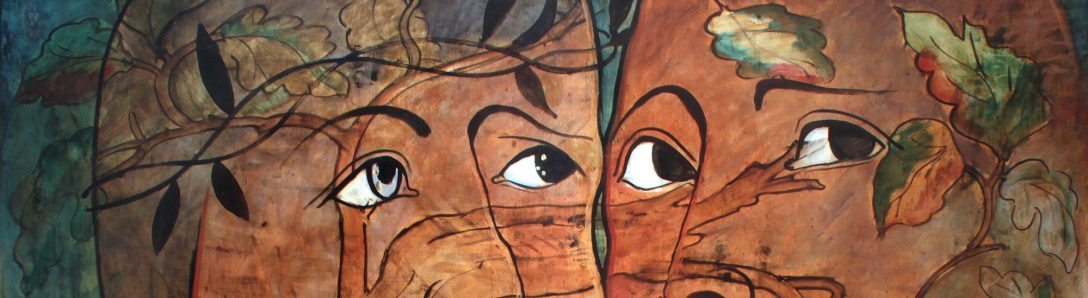
Planes, Rockets, and the Spaces in Between, 2018 by Amy Sherald (b. 1973)

Judith and Holofernes, 2012 by Kehinde Wiley (b. 1977)
PREVIOUSLY:
Introductions + stories 1956-1959
“The Subliminal Man,” Black Friday, and Consumerism
IN THIS RIFF:
“A Host of Furious Fancies” (1980)
“News from the Sun” (1981)
“Memories of the Space Age” (1982)
“Myths of the Near Future” (1982)
“Report on an Unidentified Space Station” (1982)
“The Object of the Attack” (1984)
“Answers to a Questionnaire” (1985)
“The Man Who Walked on the Moon” (1985)
“The Secret History of World War 3” (1988)
“Love in a Colder Climate” (1989)
“The Enormous Space” (1989)
“The Largest Theme Park in the World” (1989)
“War Fever” (1989)
“News from the Sun” (1981) / “Myths of the Near Future” (1982) / “Memories of the Space Age” (1982)
Let me first confess how happy I am to be finished with this enormously enormous book (okay, not physically enormous on my Kindle, but still…). Let me also confess to dread at having to finish out these riffs (no, no one is forcing me, but still…). At this point, I feel like I could write my own Ballard story—a crazed astronaut here, a drained swimming pool there, a femme fatale, some psychotropic drugs, armchair psychology, a swamp, some birds (perhaps), a plane or two, time obsession, sex obsession, space obsession. Obsession obsession Anyway. Ballard arguably peaks in the early 1980s; everything after reads like a day-glow Keith Haringesque pop-approximation of his grittier seventies stuff—or (worse) scolding wrapped up in little morality plays.
But, like I said (wrote), Ballard is in his prime in the early 1980s, and “News,” “Myths,” and “Memories” are some of his finest stories (file these triplets in my quasi-fictional-but-c’mon-we-can-make-this-happen collection The Essential Short Stories of J.G. Ballard)—they are also some of his most Ballardian, riffing on space-travel-as-cosmic-taboo, paranoid parables obsessed with time. A particularly Ballardian paragraph (from “Memories”):
He had almost ceased to breathe. Here, at the centre of the space grounds, he could feel time rapidly engorging itself. The infinite pasts and future of the forest had fused together. A long–tailed parakeet paused among the branches over his head, an electric emblem of itself more magnificent than a peacock. A jewelled snake hung from a bough, gathering to it all the embroidered skins it had once shed.
(Parenthetical aside: “Myths” and “Memories” are both set in Florida. Ballard’s depiction of Florida feels thoroughly inauthentic (I’m Floridian), but that inauthenticity also feels thoroughly appropriate).
“A Host of Furious Fancies” (1980)
Ballard constructs this little tale around a psychoanalytic reading of Cinderella:
The entire fairy tale of Cinderella was being enacted, perhaps unconsciously, by this deranged heiress. If she herself was Cinderella, Dr Valentina Gabor was the fairy godmother, and her magic wand the hypodermic syringe she waved about so spectacularly. The role of the pumpkin was played by the ‘sacred mushroom’, the hallucinogenic fungus from which psilocybin was extracted. Under its influence even an ancient laundry van would seem like a golden coach. And as for the ‘ball’, this of course was the whole psychedelic trip.
But who then was Prince Charming? As I arrived at the great mansion at the end of its drive it occurred to me that I might be unwittingly casting myself in the role, fulfilling a fantasy demanded by this unhappy girl. . . .
For all my resistance to that pseudo–science, it occurred to me that once again a psychoanalytic explanation made complete sense of these bizarre events and the fable of Cinderella that underpinned them. I walked up the staircase past the dismembered clock. Despite the fear–crazed assault on them, the erect hands still stood upright on the midnight hour – that time when the ball ended, when the courtships and frivolities of the party were over and the serious business of a real sexual relationship began. Fearful of that male erection, Cinderella always fled at midnight.
Etc.
Ballard’s Freudian riff would be more interesting as an essay.
(The story also showcases some of his typical chauvinism: The psychiatrist is described as the “woman psychiatrist” — just as earlier a dentist is referred to as a “lady dentist,” etc. Straight through to the end of the collection. In the 1990s).
“Report on an Unidentified Space Station” (1982) / “The Enormous Space” (1989)
“Report” and “Space” both read like takes on Sigizmund Krzhizhanovsky’s Soviet-era short story “Quadraturin” — both concern space, that corollary to time, and, just as Ballard repeatedly posits time as a matter of perspective, he treats space—area—the same way here. “Report” is a bit more satisfying than “Space,” which feels like a retread of so many of Ballard’s revenge stories—only with, uh, some comical cannibalism.
“Attack” and “Questionnaire” are maybe the same story—only “Questionnaire” is essentially perfect, whereas “Attack” feels like a clumsy, heavy first draft (but only because “Questionnaire” exists—do you see what I mean by this?)
Both stories showcase Ballard’s syntheses of religion (messianic; apocalyptic) and assassination (political; media-saturated). While “Attack” employs a discursive-but-still-linear approach to the theme, “Answers to a Questionnaire” gives us a discontinuous but more engaging riff in the form of (uh) exactly what its title promises. First fifth:
1) Yes.
2) Male (?)
3) do Terminal 3, London Airport, Heathrow.
4) Twenty–seven.
5) Unknown.
6) Dr Barnardo’s Primary, Kingston–upon–Thames; HM Borstal, Send, Surrey; Brunel University Computer Sciences Department.
7) Floor cleaner, Mecca Amusement Arcades, Leicester Square.
8) If I can avoid it.
9) Systems Analyst, Sperry–Univac, 1979–83.
10) Manchester Crown Court, 1984.
11) Credit card and computer fraud.
12) Guilty.
13) Two years, HM Prison, Parkhurst.
14) Stockhausen, de Kooning, Jack Kerouac.
15) Whenever possible.
16) Twice a day.
17) NSU, Herpes, gonorrhoea.
18) Husbands.
19) My greatest ambition is to turn into a TV programme.
20) I first saw the deceased on 17 February 1986, in the chapel at London Airport. He was praying in the front pew.
Essential, natch.
“The Man Who Walked on the Moon” (1985)
I should’ve wedged this passable but ultimately forgettable little tale in elsewhere. J.G. Ballard’s faux memoir of a faux astronaut. Pass.
“The Secret History of World War 3” (1988)
“The Secret History of World War 3” is Ballard’s “I told you so” sequel to one of his best stories (frankly a much better story), 1968’s “Why I Want to Fuck Ronald Reagan.” In his unofficial sequel, Ballard imagines (the horror!) of a third Reagan term (post-Bush 1), in which the country is obsessed with the President’s (lack of) health:
…the nation’s TV screens became a scoreboard registering every detail of the President’s physical and mental functions. His brave, if tremulous, heartbeat drew its trace along the lower edge of the screen, while above it newscasters expanded on his daily physical routines, on the twenty–eight feet he had walked in the rose garden, the calorie count of his modest lunches, the results of his latest brain–scan, read–outs of his kidney, liver and lung function. In addition, there was a daunting sequence of personality and IQ tests, all designed to reassure the American public that the man at the helm of the free world was more than equal to the daunting tasks that faced him across the Oval Office desk.
The story concerns a man who—alone, always alone, despite his wife, I mean this is Ballard here, hero’s alone (and right, justified) in his paraonoia—a man who is the only person to remember the brief outbreak of WW3, wedged, as it is, among updates of Ronnie and Nancy’s bowel movements. The story is farcical but juvenile, and if it seems surprisingly sophomoric, it’s worth noting that “TSHofWW3” echoes not just “Fuck Ronald Reagan,” but also one of Ballard’s earliest efforts, “Escapement” (1956), where a man sits on his couch in disbelief as his wife (stand-in for the whole world) fails to perceive what he perceives.
“Love in a Colder Climate” (1989) / “The Largest Theme Park in the World” (1989) /“War Fever” (1989)
A trio of late period lectures blazoned in the day glow approximations that anyone who live in the late eighties will not-so-fondly recall. Ballard evokes the neon apocalyptic impulses of the day, reworking his familiar themes—reproduction, civilization, war (etc.). Our baroque surrealist’s strokes are broader, not as sharp, more magnified—more Haring than Delvaux. Michel Houellebecq will pick up JGB’s torch here (with arguably better results) a decade and a half later.
On the horizon:
A handful of stories of the nineties: Or: Ballard returns to the same well with diminishing returns.
[Ed. note: Biblioklept originally ran a series of posts on The Complete Short Stories of J.G. Ballard between October 2013 and March 2014.]

To Reason with Heathen at Harvest, 2017 by Lynette Yiadom-Boakye (b. 1977)
PREVIOUSLY:
Introductions + stories 1956-1959
“The Subliminal Man,” Black Friday, and Consumerism
IN THIS RIFF:
“The Greatest Television Show on Earth” (1972)
“My Dream of Flying to Wake Island” (1974)
“The Air Disaster'” (1975)
“Low–Flying Aircraft” (1975)
“The Life and Death of God” (1976)
“Notes Towards a Mental Breakdown” (1976)
“The 60 Minute Zoom” (1976)
“The Smile” (1976)
“The Ultimate City” (1976)
“The Dead Time” (1977)
“The Index” (1977)
“The Intensive Care Unit” (1977)
“Theatre of War” (1977)
“Having a Wonderful Time” (1978)
“One Afternoon at Utah Beach” (1978)
“Zodiac 2000” (1978)
“Motel Architecture” (1978)
“Notes Towards a Mental Breakdown” (1976) / “The Index” (1977)
By the end of the sixties, Ballard had found a style and rhetoric to match his weird futurism. His output of stories slowed down considerably in the ’70s, as he found financial comfort and some measure of fame as a writer. If 1969’s collection The Atrocity Exhibition didn’t cement Ballard as a voice at the forefront of avant-garde fiction, then Crash (1973) surely did. Ballard published four novels in the seventies, and as usual, the stories he composed around the same time often feel like sketches or dress rehearsals for bigger ideas.
The two strongest stories here—or maybe, I should just admit, the stories I like best—are “Notes Towards a Mental Breakdown” and “The Index.” Ballard’s repetitions can often be draining, especially if you read all these stories back to back, but “Notes” and “Index” feel vital, necessary—essential. Yes, of course they belong in that ideal collection I’ve been imagining, The Essential Short Stories of J.G. Ballard. Both stories condense Ballard’s obsessions into short, strange, experiments.
“Notes Towards a Mental Breakdown” reads as a playful but sinister parody of what a fictionalized autobiography of Ballard might look like. The story consists of a single sentence: “A discharged Broadmoor patient compiles ‘Notes Towards a Mental Breakdown,’ recalling his wife’s murder, his trial and exoneration.” Each subsequent paragraph is a numbered footnote, which complicates and disrupts the levels of fictionality and reality that we might expect to inhere in the plot. With its missing mental patients, psycholinguistics, dead, adulterous wife, surrealism, airplanes, etc., “Notes” encapsulates so many of Ballard’s stories to date, yet makes the reader encounter them with fresh perspective. Sample paragraph:
A vital role seems to have been played during these last days by the series of paintings by Max Ernst entitled Garden Airplane Traps, pictures of low walls, like the brick–courses of an uncompleted maze, across which long wings have crashed, from whose joints visceral growths are blossoming. In the last entry of his diary, the day before his wife’s death, 27 March 1975, Loughlin wrote with deceptive calm: ‘Ernst said it all in his comment on these paintings, the model for everything I’ve tried to do… “Voracious gardens in turn devoured by a vegetation which springs from the debris of trapped airplanes… Everything is astonishing, beart–breaking and possible… with my eyes I see the nymph Echo…” Shortly before writing out these lines he had returned to his Hendon apartment to find that his wife had set off for Gatwick Airport with Dr Douglas, intending to catch the 3.15 p.m. flight to Geneva the following day. After calling Richard Northrop, Loughlin drove straight to Elstree Flying Club.

“The Index” tells the story of HRH—
Physician and philosopher, man of action and patron of the arts, sometime claimant to the English throne and founder of a new religion, Henry Rhodes Hamilton was evidently the intimate of the greatest men and women of our age. After World War II he founded a new movement of spiritual regeneration, but private scandal and public concern at his growing megalomania, culminating in his proclamation of himself as a new divinity, seem to have led to his downfall.
After a very short introductory note (which I yanked the above from), “The Index” takes the form of “the index to the unpublished and perhaps suppressed autobiography of a man who may well have been one of the most remarkable figures of the twentieth century.” Ballard crams an analysis of the entire 20th century into the index, with bizarre humor and grand results. Forced to read between the lines, HRH (his royal highness) seems to be present at every single meaningful event of the last century, whether he’s advising Churchill:
Churchill, Winston, conversations with HRH, 221; at Chequers with HRH, 235; spinal tap performed by HRH, 247; at Yalta with HRH, 298, ‘iron curtain’ speech, Fulton, Missouri, suggested by HRH, 312; attacks HRH in Commons debate, 367
Ghandi:
Ghandi, Mahatma, visited in prison by HRH, 251; discussesBhagavadgita with HRH, 253; has dhoti washed by HRH, 254; denounces HRH, 256
–or Hitler:
Hitler, Adolf, invites HRH to Berchtesgaden, 166; divulges Russia invasion plans, 172; impresses HRH, 179; disappoints HRH, 181
I have to share this entry too:
Hemingway, Ernest, first African safari with HRH, 234; at Battle of the Ebro with HRH, 244; introduces HRH to James Joyce, 256; portrays HRH in The Old Man and the Sea, 453
Ballard is at his best when he makes the reader work the hardest (think of “The Beach Murders,” “The Drowned Giant,” or “Why I Want to Fuck Ronald Reagan”), and “The Index” and “Notes” are no exception.
“The Greatest Television Show on Earth” (1972) / “The Life and Death of God” (1976)
“The Greatest Television Show on Earth” and “The Life and Death of God” are both composed in a detached, slightly ironic, and highly-omniscient tone that Ballard rarely employs. Most of the time he uses a free indirect style that floats near the harried, paranoid consciousness of one of his (always male) protagonist, constraining the viewpoint to that character. There’s also the occasional first-person voice. It’s worth noting that Ballard’s omniscient voice, usually reserved for wry fables, is one of his strongest (see also: “The Drowned Giant”). This pair of stories—and I do take them as a pair—are thought experiments that ultimately focus on metaphysics, a subject that is somewhat rare in the Ballardverse.
“The Greatest Television Show on Earth” imagines a future (2001!) in which time travel has been perfected and history itself becomes the history channel as billions become addicted to television broadcasts of historical battles. Over time, however, the producers begin to interfere. They try to make history flashier, more violent (sexier?). The story ends with a metaphysical gesture that might be read ironically, although I find it hard to see the conclusion (which I won’t spoil here) as anything other than Ballard’s moralistic reactionary streak alight.
“The Life and Death of God” takes a cue from Voltaire’s quip that if God did not exist it would be necessary to invent him. In this fable/thought experiment, scientists prove beyond doubt (keyword: doubt) that God is real. Ballard imagines a world relieved of radical doubt—a world without faith:
Within two months of the confirmation of the worldwide rumour of God’s existence came the first indications of government concern over the consequences. Industry and agriculture were already affected, though far less than commerce, politics and advertising. Everywhere the results of this new sense of morality, of the virtues of truth and charity, were becoming clear. A legion of overseers, time–keepers and inspectors found themselves no longer needed. Longestablished advertising agencies became bankrupt. Accepting the public demand for total honesty, and fearful of that supreme client up in the sky, the majority of television commercials now ended with an exhortation not to buy their products.
And then things get worse. “The Life and Death” again shows Ballard’s reactionary, elitist stripe, his lack of faith in the so-called common person to make meaning and organize a life without an anchoring center—illusory or otherwise.
“The Air Disaster'” (1975) / “Low–Flying Aircraft” (1975) /”The 60 Minute Zoom” (1976) / “The Smile” (1976) / “The Intensive Care Unit” (1977) / “Theatre of War” (1977) / “Having a Wonderful Time” (1978) / “One Afternoon at Utah Beach” (1978) /”Motel Architecture” (1978)
In the order they are listed above, with apologies:
Ballard does cargo cult / Ballard explores child-mutation-as-harbinger-of-new-evolutionary-jump / Ballard does Rear Window (the story anticipates Blue Velvet) / Ballard writes about emotional transference and a sex doll / Ballard mashes up his TV obsessions with his displacement obsessions with his Oedipal obsessions / Ballard imagines a contemporary Civil War in Britain, with American aggressors; there’s a gimmick end here that actually works wonderfully / Ballard’s permanent vacation riff / Ballard writes yet another cheating-wife-leads-to-husband’s-attempt-at-revenge, this time with a Nazi motif / Ballard repeats “Intensive Care Unit,” but mixes it up with voyeurism and a kick of Psycho. (The story anticipates what DeLillo will do a decade later).
Sorry to lump all these together. I probably shouldn’t handle the whole decade of stories at once, but I’m almost finished with this enormous, very long book (dear lord I am ready to be finished) and lumping I shall do. Of this set, “The Intensive Care Unit” and “Theatre of War” are the best, and the most mediocre of the bunch (“Low-Flying Aircraft” and “One Afternoon at Utah Beach”) are better than the mediocre stories of the sixties.
“Zodiac 2000” (1978)
Ballard’s most deconstructive, postmodern stories begin with an author’s note, an apologia of sorts, and while I often think these are unnecessary, I’ve also used them to help summarize the stories. So too with “Zodiac 2000”:
An updating, however modest, of the signs of the zodiac seems long overdue. The houses of our psychological sky are no longer tenanted by rams, goats and crabs but by helicopters, cruise missiles and intra–uterine coils, and by all the spectres of the psychiatric ward. A few correspondences are obvious – the clones and the hypodermic syringe conveniently take the place of the twins and the archer. But there remains the problem of all those farmyard animals so important to the Chaldeans. Perhaps our true counterparts of these workaday creatures are the machines which guard and shape our lives in so many ways – above all, the taurean computer, seeding its limitless possibilities. As for the ram, that tireless guardian of the domestic flock, his counterpart in our own homes seems to be the Polaroid camera, shepherding our smallest memories and emotions, our most tender sexual acts. Here, anyway, is an s–f zodiac, which I assume the next real one will be…
If “Zodiac 2000” doesn’t quite work as well as Ballard’s other list-driven/fractured stories, it’s probably because he attempts to screw a plot-driven thriller onto his weird frame. It’s almost as if he has a left-over story that wasn’t quite good enough to sell, and says, hey, I’ve got this idea for a structure, let me mash it all together. In Ballard’s best stuff, frame and content are inseparable; “Zodiac 2000″ is not Ballard’s best” — but it’s still more interesting than his most mediocre.
“The Ultimate City” (1976)
Speaking of mediocre: “The Ultimate City” is a very long short story, a novella really, that I invite anyone reading The Complete Short Stories of J.G. Ballard to feel totally okay about skipping. You’ve read this story before, under several different titles, by this point, or maybe you’ll read it later. It’s another thought experiment dressed up as an essay dressed up as an adventure story. At its best there are some good ideas here infused with a heavy dose of environmentalism. At its worst though, “The Ultimate City” is didactic, ponderous, meandering, overstuffed, and redolent of hoary tropes (there’s even a Magical Negro).
“The Dead Time” (1977)
1977’s “The Dead Time” is, unless I’m mistaken, Ballard’s first attempt to write directly (if still indirectly) about his experiences as a captive ex-patriot in WWII. Ballard, as is well-known, was interred in a prison camp in Shanghai by the Japanese forces, and this traumatic ordeal undoubtedly underwrites so much of his violent, alienated fiction. If we take Ballard’s childhood internment and the subsequent abject horrors he faced to be the cornerstone of the Ballardverse he would later create, then we must also, significantly, recognize that almost all of Ballard’s fiction up to “The Dead Time” is a displacement and revision of those terrors (which Ballard handled most directly in his mainstream breakthrough, 1984’s Empire of the Sun).
“The Dead Time” focuses on a hero who, released from his Shanghai prison in the final days of WWII, wonders hungry and dissociated through a corpse-and-trash-strewn apocalyptic landscape. He’s charged with the bizarre duty of transporting and then burying a truckload of dead bodies. Little else happens. The tale is, without a doubt, Ballard’s most real, and probably most terrifying story to date:
I tried to pick up another of the corpses, but again my hands froze, and again I felt the same presentiment, an enclosing wall that enveloped us like the wire fence around our camp. I watched the flies swarm across my hands and over the faces of the bodies between my feet, relieved now that I would never again be forced to distinguish between us. I hurled the tarpaulin into the canal, so that the air could play over their faces as we sped along. When the engine of the truck had cooled I refilled the radiator with water from the canal, and set off towards the west.
The narrator’s abject trial continues, and we see in the corpses in his charge the grotesque bits and fragments that have fueled the two previous decades of Ballard’s writing:
Under the cover of darkness – for I would not have dared to commit this act by daylight – I returned to the truck and began to remove the bodies one by one, throwing them down on to the road. Clouds of flies festered around me, as if trying to warn me of the insanity of what I was doing. Exhausted, I pulled the bodies down like damp sacks, ruthlessly avoiding the faces of the nuns and the children, the young amputee and the elderly woman.
As we reach the end of the narrative, our hero remarks,
From this time onwards, during the confused days of my journey to my parents’ camp, I was completely identified with my companions. I no longer attempted to escape them.
It’s difficult not to read here some reconciliation here, as if Ballard is finally ready to write through his formative traumas without the intermediary tropes of science fiction or radical paranoia. What we get here is wonderfully, viscerally real. Fantastic stuff, and clearly part of my ideal Essential collection.
On the horizon:
Ballard writes the same story three times in a row! We get one of his best stories, “Answers to a Questionnaire”! And I finish! Yay!
[Ed. note: Biblioklept originally ran a series of posts on The Complete Short Stories of J.G. Ballard between October 2013 and March 2014.]
“If My Enemy Is a Clown, a Natural Born Clown”
by
Ishmael Reed
i tore down my thoughts
roped in my nightmares
remembered a thousand curses
made blasphemous vows to demons
choked on the blood of hosts
ate my hat
threw fits in the street
got up bitchy each day
told off the mailman
lost many friends
left parties in a huff
dry fucked a dozen juke boxes
made anarchist speeches in brad
the falcon’s 55 (but was never
thrown out)
drank 10 martinis a minute
until 1 day the book was finished
my unspeakable terror between the
covers, on you i said to the
enemies of the souls
well lorca, pushkin i tried
but in this place they assassinate
you with pussy or pats on
the back, lemon chiffon between
the cheeks or 2 weeks on a mile
long beach.
i have been the only negro
on the plane 10 times this year
and its only the 2nd month
i am removing my blindfold and
leaving the dock. the judge
giggles constantly and the prosecutor
invited me to dinner
no forwarding address please
i called it pin the tail on the devil
they called it avant garde
they just can’t be serious
these big turkeys
PREVIOUSLY:
Introductions + stories 1956-1959
“The Subliminal Man,” Black Friday, and Consumerism
IN THIS RIFF:
“Cry Hope, Cry Fury!” (1967)
“The Recognition” (1967)
“The Cloud–Sculptors of Coral D” (1967)
“Why I Want to Fuck Ronald Reagan” (1968)
“The Dead Astronaut” (1968)
“The Comsat Angels” (1968)
“The Killing Ground” (1969)
“A Place and a Time to Die” (1969)
“Say Goodbye to the Wind” (1970)
“Cry Hope, Cry Fury!” (1967) / “The Cloud-Sculptors of Coral D” (1967) / “Say Goodbye to the Wind” (1970)
Ballard’s Vermilion Sands stories, collected and published together (under the title Vermilion Sands in 1971), are generally my least favorite selections in The Complete Short Stories of J.G. Ballard. The stories, composed over a decade, share a unified tone and a consistent (first-person) point of view to match their unified setting, and that setting is interesting enough—Ballardian enough—but each story is essentially just a delivery mechanism for a Cool Idea that Ballard has about art.
In “Cry Hope, Cry Fury!”, Ballard’s Cool Idea is a light-responsive painting technique:
Like all paintings produced at Vermilion Sands at that time, it would not actually need the exercise of the painter’s hand. Once the pigments had been selected, the photosensitive paint would produce an image of whatever still life or landscape it was exposed to. Although a lengthy process, requiring an exposure of at least four or five days, it had the immense advantage that there was no need for the subject’s continuous presence. Given a few hours each day, the photosensitive pigments would anneal themselves into the contours of a likeness.
This discontinuity was responsible for the entire charm and magic of these paintings. Instead of a mere photographic replica, the movements of the sitter produced a series of multiple projections, perhaps with the analytic forms of cubism, or, less severely, a pleasant impressionistic blurring.
The idea is interesting in and of itself, calling back to the central conceit of another VS story, “Studio 5, The Stars.” In that tale, poetry is the automated product of programmed machines. The concept of programmed art is fascinating, and clearly Ballard’s fiction tracks a predictive curve, but like most Vermilion Sands stories, “Cry Hope, Cry Fury!” is clumsily executed pulp fiction. “The Cloud-Sculptors of Coral D” is no different (the Cool Idea is cloud-sculpting, which allows Ballard to riff on one of his central motifs, airplanes). “Say Goodbye to the Wind” features living, responsive clothing. It also features another stereotypical Ballardian (pseudo)ingénue (the man really had a difficult time coming up with complex female characters). However, with its notes on “the teenage cult” and its obsession with plastic surgery, the story points to the more compelling territory Ballard was exploring.
“The Recognition” (1967)
A doomed circus, another (pseudo)ingénue, another dwarf, another morality fable, another stab at magical realism—far less successful than “The Drowned Giant” though.
“Why I Want to Fuck Ronald Reagan” (1968)
This is one you might as well just read: I mean, an attempt to describe it here will fail. But I’ll fail anyway.
“Reagan” was first published when the former actor and then-Governor of California was positioned as a write-in candidate for the ’68 election—the Gipper was the conservative alternative to Nixon. Written in the style of an academic psychology paper, the piece isn’t so much satire as something else entirely. I’m not sure exactly what that “something else” is, but it’s probably best signaled in Ballard’s own prose:
Sexual fantasies in connection with Ronald Reagan. The genitalia of the Presidential contender exercised a continuing fascination. A series of imaginary genitalia were constructed using (a) the mouth–parts of Jacqueline Kennedy, (b) a Cadillac rear–exhaust vent, (c) the assembly kit prepuce of President Johnson, (d) a child–victim of sexual assault. In 89 per cent of cases, the constructed genitalia generated a high incidence of self–induced orgasm. Tests indicate the masturbatory nature of the Presidential contender’s posture. Dolls consisting of plastic models of Reagan’s alternate genitalia were found to have a disturbing effect on deprived children.
According to a number of sources, including Ballard himself, the story was disseminated at the 1980 Republican National Convention in Detroit. VICE reports:
. . . a number of still-unknown former Situationists got hold of letterhead stamped with the seal of the Republican National Committee, upon which they printed Ballard’s Reagan text, replaced his offending title with the innocuous, “Official Republican 1980 Presidential Survey,” and managed to distribute copies to delegates on the convention floor in Detroit, one of the most audacious acts of political theater in our time.
“Reagan” is one of only three sections of The Atrocity Exhibition collected in The Complete Stories. It also clearly belongs in The Essential Short Stories of J.G. Ballard, an ideal collection that does not yet exist.
“The Dead Astronaut”
Betrayal, unfaithful wives, the fall-out of the space race against the backdrop of the Cold War, paranoia, radiation, etc.
“The Comsat Angels”
Ballard’s best stories, like “The Index,” “Why I Want to Fuck Ronald Reagan,” “The Beach Murders,” or “Answers to a Questionnaire” all succeed because their form is indivisible from their content—the idea that Ballard delivers is inseparable from the method of delivery. Most of Ballard’s stories are beholden to genre conventions though, and while Ballard’s treatment of these conventions are often excellent (and sometimes not-so-excellent), against the backdrop of his best stuff, the conventional exercises are always a little disappointing, or at least frustrating. Often clunky and heavy-handed, his stories for sci-fi mags are often the worst offenders.
However, when Ballard works through the conventions of detective fiction, he usually has stronger results. Edgar Allan Poe is surely Ballard’s foremost literary ancestor, a comparison that finds illustration in “The Comsat Angels,” a detective piece with a nimble streak of sci-fi running through it for flavor. Cloning, conspiracy, and paranoia done right. Great stuff.
“The Killing Ground” (1969) / “A Place and a Time to Die” (1969)
These stories are basically thought exercises where Ballard takes on the Vietnam War and its simultaneous culture war. “The Killing Ground” foregrounds the Vietnam War, but still displaces it, extrapolating a future where “Thirty years after the original conflict in south–east Asia, the globe was now a huge insurrectionary torch, a world Vietnam,” with Imperial America dominating the globe with its war machine. (Thank goodness nothing like that really happened!). “A Place and a Time to Die” is more oblique, a tale of fear of invading otherness. “A Place and a Time to Die” could resonate just as strongly today in contemporary America, with its exurbs and gated communities and Stand Your Ground laws.
On the horizon:
Some of Ballard’s best, including “The Index” and another (oblique) Vietnam story, “Theatre of War.” I’ll also riff on Ballard’s pseudo-but-not-so-pseudo-autobiographical story, “Notes Toward a Mental Breakdown.”
[Ed. note: Biblioklept originally ran a series of posts on The Complete Short Stories of J.G. Ballard between October 2013 and March 2014.]
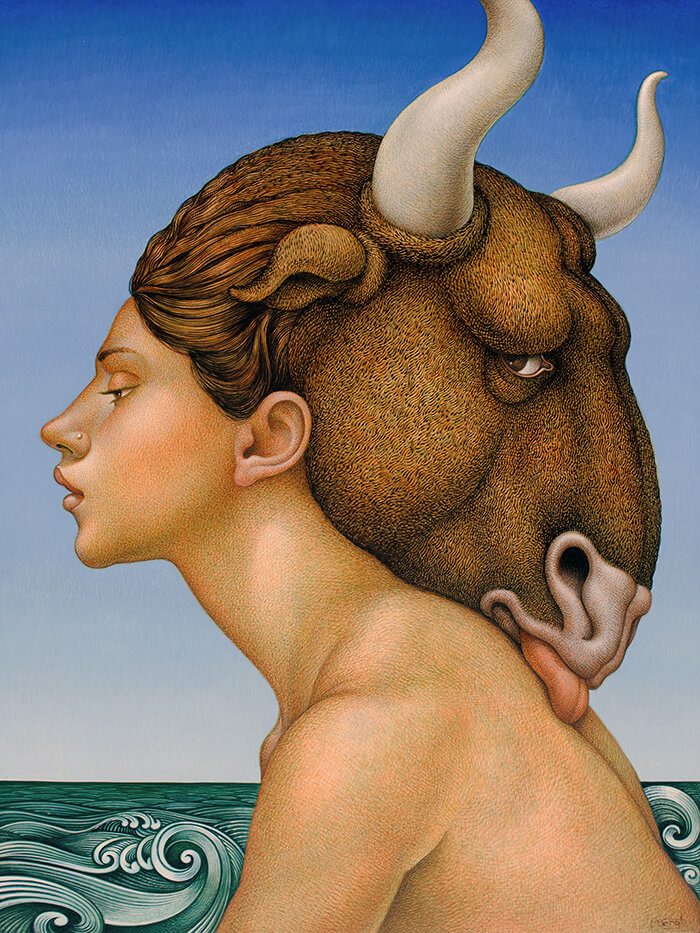
Janus, 2017 by Michael Bergt (b. 1956)

Representation Véritable, 2015 by Walton Ford (b. 1960)
PREVIOUSLY:
Introductions + stories 1956-1959
“The Subliminal Man,” Black Friday, and Consumerism
IN THIS RIFF:
“The Beach Murders'”(1966)
“The Day of Forever” (1966)
“The Impossible Man” (1966)
“Storm–Bird, Storm–Dreamer” (1966)
“Tomorrow is a Million Years” (1966)
“The Assassination of John Fitzgerald Kennedy Considered as a Downhill Motor Race” (1966)
“The Beach Murders” (1966)
Up until the mid-sixties, Ballard wasn’t able to find a rhetoric to match his ideas. Perhaps this makes sense if we consider that Ballard’s fiction has always been more interested in art, music, film, and biology than literature itself. He still relied on the tropes of magazine pulp fiction and hard-boiled detective stories to frame his tales, and while even the weakest of these tales was better than an episode of The Twilight Zone, they still occupied the same territory. Although Ballard’s earliest stories are distinctly Ballardian–obsessed with time, saturated in surrealism and psychology, shot through with a Cold War era paranoia and its attendant nihilism—it’s not until 1964, in the fragmentary “The Terminal Beach,” and the wry fabulism of “The Drowned Giant,” that Ballard finally merges form and content.
With “The Beach Murders,” Ballard manages to overstuff all of his tropes into a strange burlesque game. Paranoid, breast-obsessed, violent and funny, “The Beach Murders” comprises 26 sections, one for each letter in the English alphabet. And like the alphabet, Ballard’s story can be combined in any number of possibilities. In his introduction to the story, the narrator hints at a solution to the puzzle, before pointing out that any “final answer” will forever remain unclear:
Readers hoping to solve the mystery of the Beach Murders – involving a Romanoff Princess, a CIA agent, two of his Russian counterparts and an American limbo dancer – may care to approach it in the form of the card game with which Quimby, the absconding State Department cipher chief, amused himself in his hideaway on the Costa Blanca. The principal clues have therefore been alphabetized. The correct key might well be a familiar phrase, e. g. PLAYMATE OF THE MONTH, or meaningless, e. g. qwertyuiop… etc. Obviously any number of solutions is possible, and a final answer to the mystery, like the motives and character of Quimby himself, lies forever hidden.
“The Beach Murders” reads like a postmodern update of one of Edgar Allan Poe’s detective stories. Its gestures recall the fragmentation of his hero William Burroughs, as well as the techniques of his American contemporary Donald Barthelme–not to mention the emerging wave of continental deconstruction. It’s also very, very fun. Part of my ideal collection, The Essential Short Stories of J.G. Ballard.
“The Day of Forever” (1966)
It’s tempting to give in to biographical criticism when considering the subtle but significant shift in Ballard’s work after the shocking death of his wife Helen in 1964. While themes of loss, sleeplessness, and despair reverberate through many (if not most) of his early stories, they become sharper, more defined after 1964.
“The Day of Forever” is not exactly a great story, especially if you do what I’m doing—that is, read all of his stories chronologically. The story, about a world that has ceased to rotate, feels like a series of sketches that Ballard is using for something bigger (or has left out of something bigger). Taken in the context of his wife’s death, however, the story seems richer, sadder, more personal in its evocations of dreamlessness and loss.
When the story’s protagonist Halliday raids an abandoned gallery for its surrealist images, it’s hard not to intuit Ballard’s own desire to recover the unrecoverable:
In the students’ gallery hung the fading reproductions of a dozen schools of painting, for the most part images of worlds without meaning. However, grouped together in a small alcove Halliday found the surrealists Delvaux, Chirico and Ernst. These strange landscapes, inspired by dreams that his own could no longer echo, filled Halliday with a profound sense of nostalgia. One above all, Delvaux’s The Echo’, which depicted a naked Junoesque woman walking among immaculate ruins under a midnight sky, reminded him of his own recurrent fantasy. The infinite longing contained in the picture, the synthetic time created by the receding images of the woman, belonged to the landscape of his unseen night.

“The Impossible Man” (1966)
The theme of recovery surfaces again in “The Impossible Man,” where a young man named Conrad (insert observation here that so many of Ballard’s protagonist’s are nakedly named for writers) is given the chance to walk again after a terrible accident—he’ll receive the limbs of a man who died causing the accident. With its fetishizing of scars, auto accidents, and surgery, “The Impossible Man” points directly toward Ballard’s weirdest works, The Atrocity Exhibition and Crash.
“Storm–Bird, Storm–Dreamer” (1966)
“Storm-Bird, Storm-Dreamer” evokes a rich, Gothic world, a swampland where humans battle mutant birds. Here, a strange woman in mourning awaits the return of her lost child (there’s that theme again!) through some avian agency. There are skiffs and pergolas and feathers and shotguns. There is a dwarf. Dark and romantic, the tale’s themes—and the delivery of those themes—recall Ballard’s earlier forays into magical realism, “The Drowned Giant” and 1962’s “The Garden of Time.”
“Tomorrow is a Million Years” (1966)
Ballard’s narrator in “Tomorrow is a Million Years” directly invokes Robinson Crusoe and Moby-Dick and alludes to the myth of the Flying Dutchman. Allusion is a fundamental trope of literature—indeed, most literature seems to take literature as its own subject—but Ballard’s allusions, beyond his character names (he christens a character in 1967’s “Cry Hope, Cry Fury!” Melville) tend to skew toward art and music. The allusions to doomed voyages and shipwreck are appropriate here, and Ballard synthesizes them into a tale of madness and hallucination. And, at the risk of spoiling the tale’s shocking ending, I’ll suggest again that Ballard is writing through/to/around/beneath the death of his wife.
“The Assassination of John Fitzgerald Kennedy Considered as a Downhill Motor Race” (1966)
Ballard begins “Assassination” with an author’s note:
The assassination of President Kennedy on November 22nd, 1963, raised many questions, not all of which were answered by the Report of the Warren Commission. It is suggested that a less conventional view of the events of that grim day may provide a more satisfactory explanation. In particular Alfred Jarry’s “The Crucifixion Considered as an Uphill Bicycle Race” gives us a useful lead.
Author of the infamous proto-surrealist play Ubu Roi, Alfred Jarry’s pataphysical conceits undoubtedly influenced and engaged Ballard, offering him new ways of writing beyond the constraints of his earlier pulp fiction. Published almost 60 years after Jarry’s death, “Assassination” is just as shocking as the text it’s modeled on, suggesting that the disruptive powers of language that Ballard was beginning to experiment with retain vitality outside of history. It’s worth sharing the opening paragraphs of “Assassination”:
Oswald was the starter.
From his window above the track he opened the race by firing the starting gun. It is believed that the first shot was not properly heard by all the drivers. In the following confusion Oswald fired the gun two more times, but the race was already under way.
Kennedy got off to a bad start.
There was a governor in his car and its speed remained constant at about fifteen miles an hour. However, shortly afterwards, when the governor had been put out of action, the car accelerated rapidly, and continued at high speed along the remainder of the course.
The visiting teams. As befitting the inauguration of the first production car race through the streets of Dallas, both the President and the Vice–President participated. The Vice–President, Johnson, took up his position behind Kennedy on the starting line. The concealed rivalry between the two men was of keen interest to the crowd. Most of them supported the home driver, Johnson.
If “Kennedy got off to a bad start” doesn’t crack you up then it’s likely this story isn’t for you. Ballard’s humor often rests entirely on a kind of moral irony in his earlier stories (you know, like something from the Twilight Zone series), but “Assassination” shows a wry constraint, a trust in the reader that probably originated in Ballard’s growing comfort in his own powers. (Later stories like “The Greatest Television Show on Earth” and “The Life and Death of God” advance Ballard’s control of dark humor).
“The Assassination of John Fitzgerald Kennedy Considered as a Downhill Motor Race” was published in The Atrocity Exhibition; for whatever reason, The Complete Short Stories only includes two other stories from that collection (“Why I Want to Fuck Ronald Reagan” and “The Secret History of World War 3,” which wasn’t actually part of the original AE pressing). So maybe Complete is not so complete.
Should go without saying: Essential.
On the horizon:
I’m actually almost finished with the book (my Kindle tells me I’m at 72%). I should probably slow down and try to take more notes for these riffs—or just write faster and looser. But the reading becomes far more compelling at this point, as Ballard transcends the limitations of sci-fi pulp and begins to contend with his surrealist forbears. Next time: “Why I Want to Fuck Ronald Reagan”! Another Vermilion Sands story—this one not so bad! Ballard takes on Vietnam! Etc.
[Ed. note: Biblioklept originally ran a series of posts on The Complete Short Stories of J.G. Ballard between October 2013 and March 2014.]

Bird and Mastadon, c. 1940s by György Kepes (1906–2001)
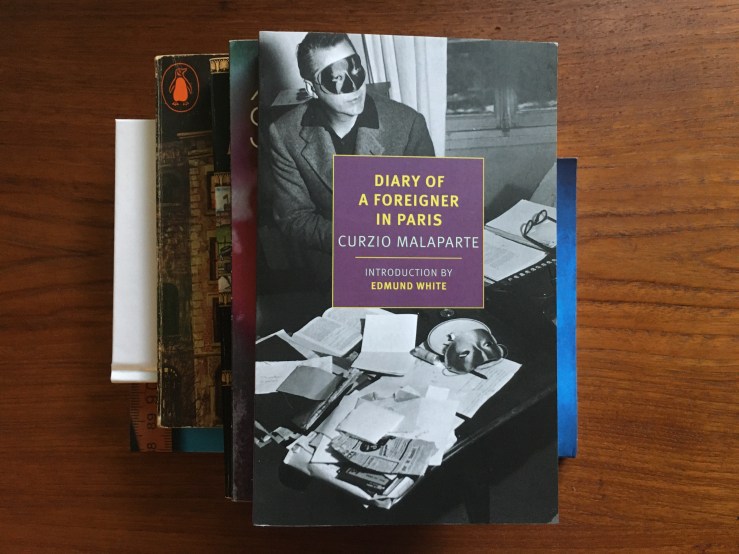
Curzio Malaparte’s Diary of a Foreigner in Paris is new from NYRB in translation from Stephen Tilley. NYRB’s blurb:
In 1947 Curzio Malaparte returned to Paris for the first time in fourteen years. In between, he had been condemned by Mussolini to five years in exile and, on release, repeatedly imprisoned. In his intervals of freedom, he had been dispatched as a journalist to the Eastern Front, and though many of his reports from the bloodlands of Poland and Ukraine were censored, his experiences there became the basis for his unclassifiable postwar masterpiece and international bestseller, Kaputt. Now, returning to the one country that had always treated him well, the one country he had always loved, he was something of a star, albeit one that shines with a dusky and disturbing light.
The journal he kept while in Paris records a range of meetings with remarkable people—Jean Cocteau and a dourly unwelcoming Albert Camus among them—and is full of Malaparte’s characteristically barbed reflections on the temper of the time. It is a perfect model of ambiguous reserve as well as humorous self-exposure. There is, for example, Malaparte’s curious custom of sitting out at night and barking along with the neighborhood dogs—dogs, after all, were his only friends when in exile. The French find it puzzling, to say the least; when it comes to Switzerland, it is grounds for prosecution!

Mercury Sent to Admonish Aeneas, by Joseph Mallord William Turner (1775–1851)

PREVIOUSLY:
Introductions + stories 1956-1959
“The Subliminal Man,” Black Friday, and Consumerism
IN THIS RIFF:
“The Reptile Enclosure” (1963)
“A Question of Re-Entry” (1963)
“The Time Tombs” (1963)
“Now Wakes the Sea” (1963)
“The Venus Hunters” (1963)
“End-Game” (1963)
“Minus One” (1963)
“The Sudden Afternoon” (1963)
“The Screen Game” (1963)
“Time of Passage” (1964)
“Prisoner of the Coral Deep” (1964)
“The Lost Leonardo” (1964)
“The Terminal Beach” (1964)
“The Illuminated Man” (1964)
“The Delta at Sunset” (1964)
“The Drowned Giant” (1964)
“The Gioconda of the Twilight Noon” (1964)
“The Volcano Dances” (1964)
“The Reptile Enclosure” (1963) / “A Question of Re-Entry” (1963) / “The Time Tombs” (1963) / “Now Wakes the Sea” (1963) / “The Venus Hunters” (1963) / “Minus One” (1963) / “Prisoner of the Coral Deep” (1964) / “The Illuminated Man” (1964) / “The Delta at Sunset” (1964) / “The Gioconda of the Twilight Noon” /”The Volcano Dances” (1964)
There are 98 stories in The Complete Short Stories of J.G. Ballard. That’s a lot of stories. Maybe too many. Too many for me to write about in full, anyway. I’ve lumped these stories together because they are somewhat unremarkable: Ballard does his Ballardian thing way better elsewhere. Several of these stories feel like sketches (or leftovers) from Ballard’s early novels like The Drowned World, The Burning World, and The Crystal World. Themes of time, memory, art, and nature abound here, usually glommed on to simple adventure narratives or sci-fi pulp treadthroughs. Jungles, watches, crystals, structures, beaches. Misanthropy, paranoia, nagging wives, misunderstood heroes. Man apart from nature, but beholden to nature. Etc. The worst moments of these stories—and we can find these moments all through early Ballard, to be fair—suffer from a bad case of White Man’s Burden doubled up with a shot of misogyny. I’ve written it before in these posts, but the most disappointing aspect of early Ballard is our would-be futurist’s inability to transcend the patriarchal ideology of the post-war era. So now let’s move to the good stuff.
“End-Game” (1963)
I first read “End-Game” when I was sixteen or seventeen, and it’s always stuck with me. It’s the story of a former “party member” who’s been imprisoned under nebulous circumstances—only his prison isn’t that bad—a nice little villa, comfortable, with books and a chess set. He even has a housekeeper. Unfortunately, the housekeeper is also his executioner, and the date and method of the execution is forever withheld from him:
This ironic inversion of the classical Kafkaesque situation, by which, instead of admitting his guilt to a non–existent crime, he was forced to connive in a farce maintaining his innocence of offences he knew full well he had committed, was preserved in his present situation at the execution villa.
The psychological basis was more obscure but in some way far more threatening, the executioner beckoning his victim towards him with a beguiling smile, reassuring him that all was forgiven. Here he played upon, not those unconscious feelings of anxiety and guilt, but that innate conviction of individual survival, that obsessive preoccupation with personal immortality which is merely a disguised form of the universal fear of the image of one’s own death. It was this assurance that all was well, and the absence of any charges of guilt or responsibility, which had made so orderly the queues into the gas chambers.
Ballard directly invokes Kafka, whose tale “Before the Law” comes to mind here (not to mention The Trial and The Castle); “End-Game” also feels like Ballard’s take on 1984. It’s a great little tale, and I think it helps to prove that Ballard is at his best when he sticks to a confined, limited cast and setting. Much of the force of “End-Game” comes from Ballard pitting his prisoner/protagonist against the protagonist’s mental conception of his guard/executioner. Part of my ideal collection, The Essential Short Stories of J.G. Ballard.
“The Sudden Afternoon” (1963) / “Time of Passage” (1964)
In “The Sudden Afternoon” and “Time of Passage,” Ballard explores how time and place—context, I suppose—constitute identity. The former story is a tale of metempsychosis with a troubling take on Indian spirituality, wherein a doctor—an Indian, of course—transplants his psyche and his wife’s psyche into the bodies of another couple (his wife is dying of a terminal disease). Ballard’s own wife died a year after the story was first published (I’m reminded of Poe here, whose wife Virginia died after the publication of “The Raven”). “The Sudden Afternoon” isn’t very good, but structurally we see Ballard beginning to employ something approaching the cut-ups/fragments he’ll move to in the next decade.
“Time of Passage” is essentially a rewrite of F. Scott Fitzgerald’s “The Curious Case of Benjamin Button.” It’s also basically a rewrite of Ballard’s own 1961 tale “Mr. F Is Mr. F” — only this time, Ballard dispenses with abject-horror-for-maternal-body in lieu of a fable-like exploration of what a life in reverse might actually look like. A lovely story. Stick it in The Essentials.
“The Screen Game” (1963)
Another Vermilion Sands story. More insanity. Another femme fatale. An attempt at the story of Orpheus, perhaps. I would have lumped it in with the stories in point 1, but I wanted to clarify: The Vermilion Sands stories are the worst.
“The Lost Leonardo” (1964)
This is an excellent little detective tale with mystical-magic undertones. I’m a sucker for any story of art theft, too. We all know Dan Brown ripped off Umberto Eco, but maybe Eco ripped off Ballard? Who cares. Lovely stuff. Ballard is excellent at the detective story; Poe is one of his clearest predecessors, but like Poe, he’s more famous for other stuff. Too bad. Let’s call it Essential.
“The Terminal Beach” (1964)
1964’s “The Terminal Beach” is such a big break through for Ballard in terms of formal elements and structuring that it probably deserves its own post, but I’ll jab at it here anyway. Up until now, Ballard’s stories have been notable almost entirely for their ideas—his prose has improved some, but ultimately, the pulp fiction he’s writing for magazine publication constrains him to a pedestrian rhetoric that simply can’t match how far out his concepts are. With “The Terminal Beach,” Ballard finally approaches a narrative structure—fractured, polyglossic, shifting through interiors to exteriors, breaking through different forms—that can match the themes of his tale. The story–clearly an Essential—points to the finest of Ballard’s future work. You can read it here in two parts, but here’s a taste that I think stands alone as a microfiction:
The Fly
(A small fly, which Traven presumes has followed him into the fissure, now buzzes about the corpse’s face. Guiltily, Traven leans forward to kill it, then reflects that perhaps this minuscule sentry has been the corpse’s faithful companion, in return fed on the rich liqueurs and distillations of its pores. Carefully, to avoid injuring the fly, he encourages it to alight on his wrist.)
DR YASUDA: Thank you, Traven. In my position, you understand
TRAVEN: Of course, Doctor. I’m sorry I tried to kill it – these ingrained habits, you know, they’re not easy to shrug off. Your sister’s children in Osaka in ’44, the exigencies of war, I hate to plead them. Most known motives are so despicable, one searches the unknown in the hope that YASUDA: Please, Traven, do not be embarrassed. The fly is lucky to retain its identity for so long. ‘That son you mourn, not to mention my own two nieces and nephew, did they not die each day? Every parent in the world grieves for the lost sons and daughters of their earlier childhoods.
TRAVEN: You’re very tolerant, Doctor. I wouldn’t dare – YASUDA: Not at all, Traven. I make no apologies for you. Each of us is little more than the meagre residue of the infinite unrealized possibilities of our lives. But your son, and my nephew, are fixed in our minds forever, their identities as certain as the stars.
TRAVEN: (not entirely convinced) That may be so, Doctor, but it leads to a dangerous conclusion in the case of this island. For instance, the blocks – YASUDA: They are precisely what I refer to, Traven. Here among the blocks you at last find an image of yourself free of the hazards of time and space. This islandis an ontological Garden of Eden, why seek to expel yourself into a world of quantal flux?
TRAVEN: Excuse me (The fly has flown back to the corpse’s face and sits in one of the dried-up orbits, giving the good doctor an expression of quizzical beadiness. Reaching forward, Traven entices it on to his palm. He examines it carefully) Well, yes, these bunkers may be ontological objects, but whether this is the ontological fly is doubtful. It’s true that on this island it’s the only fly, which is the next best thing
YASUDA: You can’t accept the plurality of the universe – ask yourself why, Traven. Why should this obsess you? It seems to me that you are hunting for the white leviathan, zero. The beach is a dangerous zone. Avoid it. Have a proper humility, pursue a philosophy of acceptance.
TRAVEN: Then may I ask why you came here, Doctor?
YASUDA: To feed this fly. ‘What greater love – ?’
TRAVEN: (Still puzzling) It doesn’t really solve my problem. The blocks, you see
YASUDA: Very well, if you must have it that way
TRAVEN: But, Doctor
YASUDA: (Peremptorily) Kill that fly!
TRAVEN: That’s not an end, or a beginning.
(Hopelessly, he kills the fly. Exhausted, he falls asleep beside the corpse.)
“The Drowned Giant” (1964)
Another Essential, this puzzling fable readily recalls Gabriel García Márquez’s story “A Very Old Man with Enormous Wings.” Ballard rarely handles archetypes so directly as he does here. Even if the story’s theme seems almost too-plain—we lose the miracle, we cast down the old gods, we deny the sublime, etc.—its construction and telling are wonderfully achieved.
The lower jaw, typically, found its way to the museum of natural history. The remainder of the skull has disappeared, but is probably still lurking in the waste grounds or private gardens of the city – quite recently, while sailing down the river, I noticed two ribs of the giant forming a decorative arch in a waterside garden, possibly confused with the jaw–bones of a whale. A large square of tanned and tattooed skin, the size of an indian blanket, forms a backcloth to the dolls and masks in a novelty shop near the amusement park, and I have no doubt that elsewhere in the city, in the hotels or golf clubs, the mummified nose or ears of the giant hang from the wall above a fireplace. As for the immense pizzle, this ends its days in the freak museum of a circus which travels up and down the north–west. This monumental apparatus, stunning in its proportions and sometime potency, occupies a complete booth to itself. The irony is that it is wrongly identified as that of a whale, and indeed most people, even those who first saw him cast up on the shore after the storm, now remember the giant, if at all, as a large sea beast.
On the horizon:
Ballard plays with fragmentation again in “The Beach Murders” and “The Assassination of John Fitzgerald Kennedy Considered as a Downhill Motor Race” — and we finally get to his stories of the late sixties.
[Ed. note: Biblioklept originally ran a series of posts on The Complete Short Stories of J.G. Ballard between October 2013 and March 2014.]

Venus and Adonis, 1981 by Stephen McKenna (1939–2017)

A Boy Reading, c. 1795 by Ramsay Richard Reinagle (1775–1862)
 Biblioklept