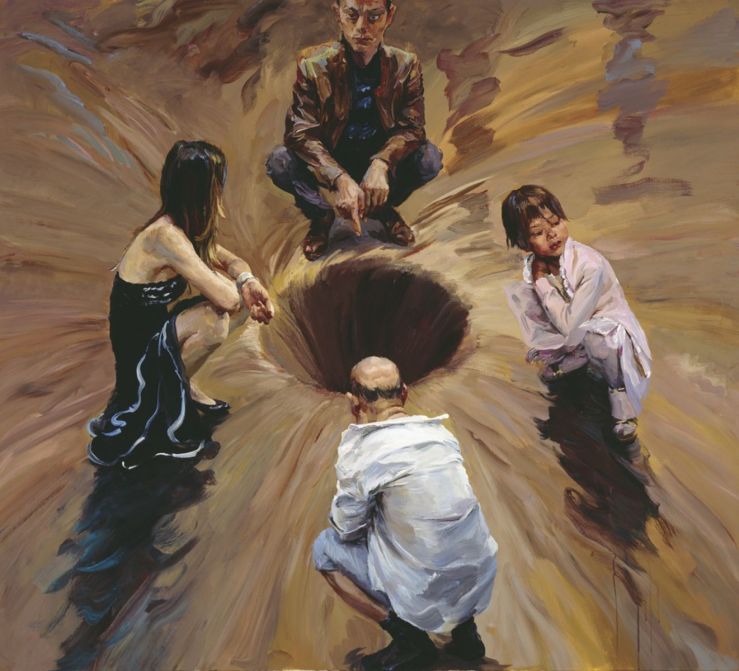
Resolution — Yu Hong

facf2650004b57ebcbf59641d90ed922

Resolution, 2015 by Yu Hong (b. 1966)

A Short History of Modern Painting –Mark Tansey

1vf9zt_4qaut_2340x1316

A Short History of Modern Painting, 1982 by Mark Tansey (b. 1949)

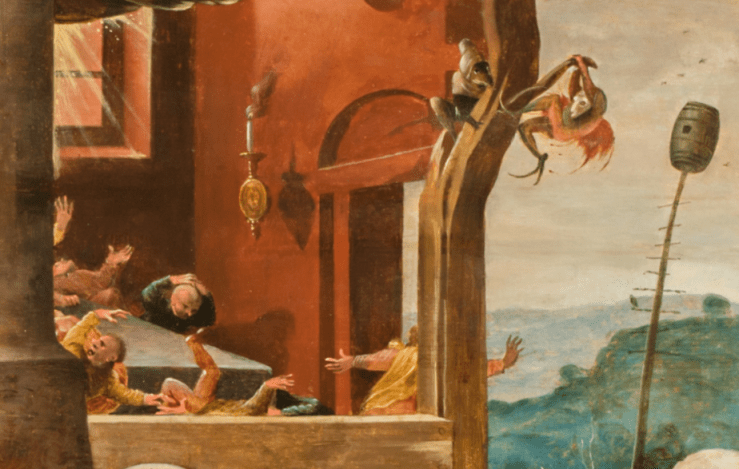
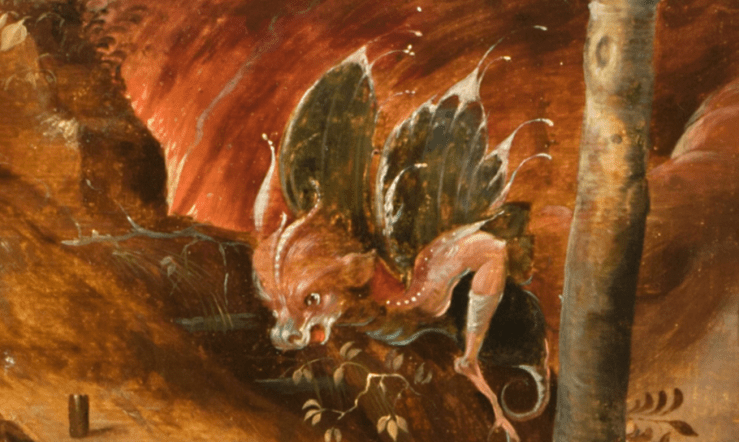
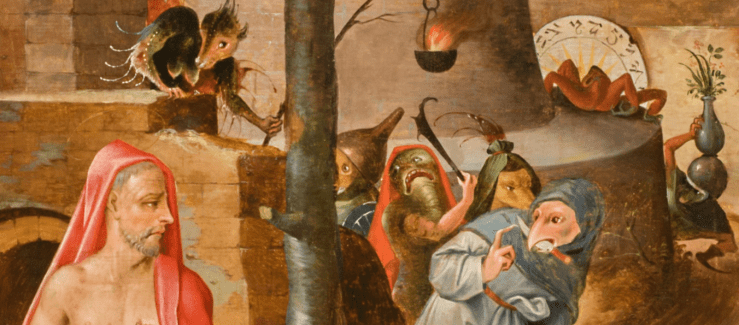
The Mocking of Job — Jan Mandyn

the_mocking_of_job_28jan_mandijn29

Screenshot 2020-06-17 at 11.50.11 AMScreenshot 2020-06-17 at 11.49.53 AMScreenshot 2020-06-17 at 11.47.54 AMScreenshot 2020-06-17 at 11.47.25 AMScreenshot 2020-06-17 at 11.47.02 AMScreenshot 2020-06-17 at 11.46.44 AMScreenshot 2020-06-17 at 11.46.27 AMScreenshot 2020-06-17 at 11.46.01 AMScreenshot 2020-06-17 at 11.45.40 AMScreenshot 2020-06-17 at 11.48.12 AM

“Suffer me that I may speak; and after that I have spoken, mock on” (Job 21: 3, KJV)

The Mocking of Job, c. 1550 by Jan Mandyn (attributed; c. 1500-1559)

“The Painting after Lunch” — Clarence Major

“The Painting after Lunch”

by

Clarence Major


It wasn’t working. Didn’t look back. Needed something else. So
I went out. After lunch I saw it in a different light, like a thing
emerging from behind a fever bush, something reaching the
senses with the smell of seaweed boiling, and as visible as yellow
snowdrops on black earth. Tasted it too, on the tongue Jamaica
pepper. To the touch, a velvet flower. Dragging and scumming, I
gave myself to it stroke after stroke. It kept coming in bits and fits,
fragments and snags. I even heard it singing but in the wrong key
like a deranged bird in wild cherries, having the time of its life.

Catalogue these books (A passage from Joyce’s Uylsses)

What final visual impression was communicated to him by the mirror?

The optical reflection of several inverted volumes improperly arranged and not in the order of their common letters with scintillating titles on the two bookshelves opposite.

Catalogue these books.

Thom’s Dublin Post Office Directory, 1886.

Denis Florence M’Carthy’s Poetical Works (copper beechleaf bookmark at p. 5).

Shakespeare’s Works (dark crimson morocco, goldtooled).

The Useful Ready Reckoner (brown cloth).

The Secret History of the Court of Charles II (red cloth, tooled binding).

The Child’s Guide (blue cloth).

The Beauties of Killarney (wrappers).

When We Were Boys by William O’Brien M. P. (green cloth, slightly faded, envelope bookmark at p. 217).

Thoughts from Spinoza (maroon leather).

The Story of the Heavens by Sir Robert Ball (blue cloth).

Ellis’s Three Trips to Madagascar (brown cloth, title obliterated).

The Stark-Munro Letters by A. Conan Doyle, property of the City of Dublin Public Library, 106 Capel street, lent 21 May (Whitsun Eve) 1904, due 4 June 1904, 13 days overdue (black cloth binding, bearing white letternumber ticket).

Voyages in China by “Viator” (recovered with brown paper, red ink title).

Philosophy of the Talmud (sewn pamphlet).

Lockhart’s Life of Napoleon (cover wanting, marginal annotations, minimising victories, aggrandising defeats of the protagonist).

Soll und Haben by Gustav Freytag (black boards, Gothic characters, cigarette coupon bookmark at p. 24).

Hozier’s History of the Russo-Turkish War (brown cloth, 2 volumes, with gummed label, Garrison Library, Governor’s Parade, Gibraltar, on verso of cover).

Laurence Bloomfield in Ireland by William Allingham (second edition, green cloth, gilt trefoil design, previous owner’s name on recto of flyleaf erased).

A Handbook of Astronomy (cover, brown leather, detached, 5 plates, antique letterpress long primer, author’s footnotes nonpareil, marginal clues brevier, captions small pica).

The Hidden Life of Christ (black boards).

In the Track of the Sun (yellow cloth, titlepage missing, recurrent title intestation).

Physical Strength and How to Obtain It by Eugen Sandow (red cloth).

Short but yet Plain Elements of Geometry written in French by F. Ignat. Pardies and rendered into Engliſh by John Harris D. D. London, printed for R. Knaplock at the Biſhop’s Head, MDCCXI, with dedicatory epiſtle to his worthy friend Charles Cox, eſquire, Member of Parliament for the burgh of Southwark and having ink calligraphed statement on the flyleaf certifying that the book was the property of Michael Gallagher, dated this 10th day of May 1822 and requeſting the perſon who should find it, if the book should be loſt or go aſtray, to reſtore it to Michael Gallagher, carpenter, Dufery Gate, Enniſcorthy, county Wicklow, the fineſt place in the world.

From James Joyce’s Ulysses.

St. Lucy — Domenico Beccafumi

saint_lucy_by_domenico_di_pace_beccafumi

St. Lucy, 1521 by Domenico Beccafumi (1486-1551)

Books acquired, 8 June 2020 and 13 June 2020

img_5670

My birthday was last Sunday. My favorite bookstore is closed on Sundays, so as a treat to myself I browsed it Monday afternoon. I was looking for specific titles by Nalo Hopkinson and Kit Reed (no luck), as well as another Muriel Spark. I picked up Spark’s third novel, Momento Mori and read it this week. It’s a good book, but nowhere near the sharp excellence of Loitering with Intent. I also found a first edition paperback of William H. Gass’s first novel, Omensetter’s Luck. I should’ve left it for some kid to find—I have a Meridian first edition of Omensetter’s already—but I couldn’t. I hate the collector in me.

img_5658

I also picked up Charles Wright’s novel The Messenger, despite already having an omnibus that collects all three of Wright’s novels. Couldn’t help it; the mass-market cover was too good (although James Baldwin’s name doesn’t have to be quite that big, does it?).

Early in the week I got an email containing my daughter’s summer reading directions–Paul Coelho’s The Alchemist and Howard Zinn’s A Young People’s History of the United States. I treated myself to another Muriel Spark–an especially short one, about a nunnery—The Abbess of Crewe. 

img_5668

On the Map — William Coldstream

On the Map 1937 by Sir William Coldstream 1908-1987

On the Map, 1937 by William Coldstream (1908-1987)

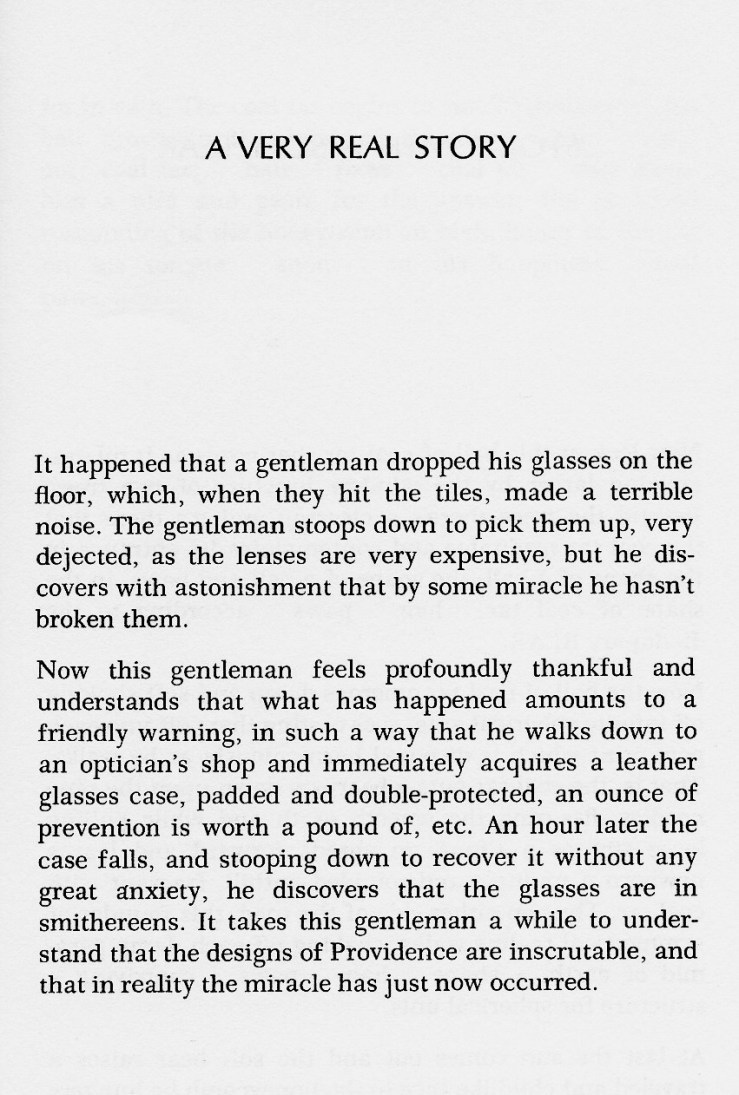
“A Very Real Story” — Julio Cortázar

2020-03-06_151902_4

(English translation by Paul Blackburn.)

The Man with the Cubist Head — Julio Larraz 

the-man-with-the-cubist-head2018oil-on-canvas62x70in.hi-res.

The Man with the Cubist Head, 1987 by Julio Larraz (b. 1944)

Blog about some recent reading

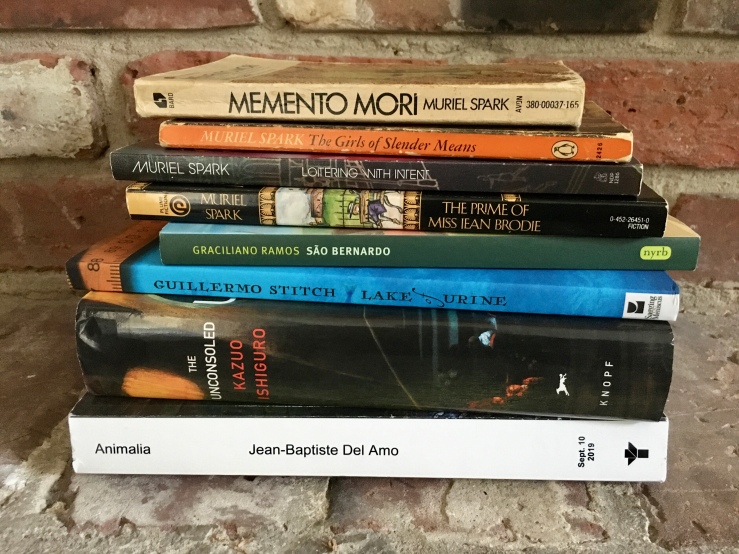
img_5662

From bottom to top:

I finally started Jean-Baptiste Del Amo’s Animalia last week. I took the book with me to a place we rented near Black Mountain, North Carolina for a week. I purposefully took only Animalia, leaving behind two books I was in the middle of—Muriel Spark’s Loitering with Intent and Guillermo Stitch’s Lake of Urine. I used the adverb purposefully in the previous sentence, although I’m not sure what my purpose was. I think I just wanted an associative break from the past few months. I read geographically, even in my own home. I read the first section of Animalia, often overwhelmed by its abject lifeforce. The novel begins in rural southwest France at the end of the nineteenth century, focusing on a family farm. The preceding sentence is a bad description: Animalia is, so far anyway, a visceral, naturalistic, and very precise rendering of humans as animals. I don’t think I’ve ever been as intrigued as to how a novel was translated, either. In Frank Wynne’s English translation, Del Amo’s prose carries notes and tones evocative of Faulkner or Cormac McCarthy. Del Amo employs precise Latinate words, using, for example, genetrix, instead of mother, as in this paragraph:

The genetrix, a lean, cold woman, with a ruddy neck and hands that are ever busy, affords the child scant attention. She is content merely to instruct her, to pass on the skills for those chores that are the preserve of their sex, and the child quickly learns to emulate her in her tasks, to mimic her gestures and her bearing. At five years old, she holds herself stiff and staid as a farmer’s wife, feet planted firmly on the ground, clenched fists resting on her narrow hips. She beats the laundry, churns the butter and draws water from the well or the spring without expecting affection or gratitude in return. Before Éléonore was born, the father twice impregnated the genetrix, but her menses are light, irregular, and continued to flow during the months when, in hindsight, she realizes that she was pregnant, though her belly had barely begun to swell. Although scrawny, she had a pot-belly as a child, her organs strained and bloated from parasitic infections contracted through playing in dirt and dungheaps, or eating infected meat, a condition her mother vainly attempted to treat with decoctions of garlic.

The paragraph, from early in Animalia, conveys the prose’s abject flavor. Read the rest of the excerpt at Granta.

Kazuo Ishiguro’s The Unconsoled is over 500 pages but somehow does not read like a massive novel, partly, I suppose, because the novel quickly teaches you how to read the novel. The key for me came about 100 pages in, when the narrator goes to a showing of 2001: A Space Odyssey starring Clint Eastwood and Yul Brynner. There’s an earlier reference to a “bleeper” that stuck out too, but it’s at the precise moment of this alternate 2001 that The Unconsoled’s just-slightly-different universe clicked for me. Following in the tradition of Kafka’s The CastleThe Unconsoled reads like a dream-fever set of looping deferrals. Our narrator, Ryder, is (apparently) a famous pianist who arrives at an unnamed town, where he is to…do…something?…to help restore the town’s artistic and aesthetic pride. (One way we know that The Unconsoled takes place in an alternate reality is that people care deeply about art, music, and literature.) However, Ryder keeps getting sidetracked, entangled in promises and misunderstanding, some dark, some comic, all just a bit frustrating. There’s a great video game someone could make out of The Unconsoled—a video game consisting of only side quests perhaps. Once the reader gives in to The Unconsoled’s looping rhythms, there’s an almost hypnotic pleasure to the book. Its themes of family disappointment, artistic struggle, and futility layer like musical motifs, ultimately suggesting that the events of the novel could take place entirely in Ryder’s consciousness, where he orchestrates all the parts himself. Under the whole thing though is a very conventional plot though—think a Kafka fanfic version of Waiting for Guffman. I loved it.

I will be posting a proper review of Guillermo Stitch’s Lake of Urine some time this month, so I won’t remark at length on it. I’m a little under halfway through (had to restart after returning from the mountains), and it seems to me that the plot is impossible to describe. Or maybe it’s really simple: A rural couple, Norabole and Bernard, escape from their small town and move to the big city (“Big City”). Norabole very quickly becomes the CEO of a huge company, with an eye toward creating “the world’s first Gothic conglomerate” (she plans to get an exorcist on the board, as well as having the company partake in an annual seance). Meanwhile, Bernard struggles to find employment and whips up seven course meals for his Noarbole. He also has apparently contracted (contracted?!) xenoglossiaLake of Urine is energetic and very funny and so so weird. Stitch seems to be doing whatever he wants on the page and I dig it.

I really enjoyed Graciliano Ramos’s novel São Bernardo (new translation by Padma Viswanathan), mostly for the narrator’s voice (which reminded me very much of Al Swearengen of Deadwood). Through somewhat nefarious means, Paulo Honorio takes over the run-down estate he used to toil on, restores it to a fruitful enterprise, screws over his neighbors, and exploits everyone around him. He decries at one point that “this rough life…gave me a rough soul,” which he uses as part confession and part excuse for his failure to evolve to the level his younger, sweeter wife would like him to. São Bernardo is often funny, but has a mordant, even tragic streak near its end. Ultimately, it’s Honorio’s voice and viewpoint that engages the reader. He paints a clear and damning portrait of himself and shows it to the reader—but also shows the reader that he cannot see himself. Good stuff.

Four by Muriel Spark. I’d never read her until May, and I’ve just been gobbling these up. I started with The Prime of Miss Jean Brodie, which is fantastic, and then read The Girls of Slender Means, which I liked even more than Prime. Slender Means unself-consciously employs some postmodern techniques to paint a vibrant picture of what the End of the War might feel like. The novel unexpectedly ends in a negative religious epiphany. (And the whole thing coincides with the bombings of Hiroshima and Nagasaki.) I then read Loitering with Intent, which is my favorite so far—just sharp as hell, and chock full of patterns and loops that I want to go back to again. I definitely will reread that one. I’m near the end of Memento Mori, a novel that concerns aging, memory, loss, and coming to terms with death. I was surprised to learn that this was Spark’s third novel, and that she would’ve been around 41—my age—when it was published. Most of the characters are over seventy, and Spark seems to inhabit their consciousness with a level of acuity that surprises me. Memento Mori is sharp and witty, but, barring some last minute shift, it’s not been my favorite Spark—but it’s still very good, and I want to read more. Any suggestions?

John Jacob-Jingle-Heimer-Schmidt — John Jacobsmeyer 

111679

John Jacob-Jingle-Heimer-Schmidt, 2011 by John Jacobsmeyer (b. 1964)

The Essential Short Stories of J.G. Ballard

jgb_complete_ss4003111

I. “Manhole 69” (1957)

II. “Chronopolis” (1960)

III.  “The Voices of Time” (1960)

IV. “The Overloaded Man” (1961)

V. “Billennium” (1961)

VI. “Thirteen to Centaurus” (1962)

VII. “The Subliminal Man” (1963)

VIII. “End-Game” (1963)

IX. “Time of Passage” (1964)

X. “The Lost Leonardo” (1964)

XI. “The Terminal Beach” (1964)

XII. “The Drowned Giant” (1964)

XIII. “The Beach Murders” (1966)

XIV.  “The Assassination of John Fitzgerald Kennedy Considered as a Downhill Motor Race” (1966)

XV. “Why I Want to Fuck Ronald Reagan” (1968)

XVI. “Notes Towards a Mental Breakdown” (1976)

XVII. “The Index” (1977)

XVIII. “The Dead Time” (1977)

XIX. “News from the Sun” (1981)

XX. “Myths of the Near Future” (1982)

XXI. “Memories of the Space Age” (1982)

XXII. “Answers to a Questionnaire” (1985)

XXIII. “A Guide to Virtual Death” (1992)

At 1200 pages and just under 100 stories, The Complete Short Stories is frankly too complete—but I read them all anyway. The list above is my suggestion for a volume I’d call The Essential Short Stories of J.G. Ballard. Each selection on the list is linked to a riff I wrote; in several cases, links to the full text of the story can be found at the riff.

[Ed. note: Biblioklept originally ran a series of posts on The Complete Short Stories of J.G. Ballard between October 2013 and March 2014.]

A Shepard for First Days — Jean-Pierre Roy

jean-pierre-roy-05

A Shepard for First Days, 2017 by Jean-Pierre Roy (b. 1974)

Selections from One-Star Amazon Reviews of Ralph Ellison’s Invisible Man

[Editorial note: The following citations come from one-star Amazon reviews of Ralph Ellison’s novel Invisible Man (which is great, by the way)I’ve preserved the reviewers’ own styles of punctuation and spelling. More one-star Amazon reviews.]


The Invisible man and his wife, the invisible woman, had their second child. Just like their first child, the second one isn’t much to look at.

If ever there was a book that should be banned, I think this might be one

 child fight club, drinking whiskey in whorehouses and incest 

snatch the rosy infants from wombs of expectant mothers

Someone has to stand up to this kind of gross stuff! 

all manner of utterly confusing events take stage

he is killing me with his “beautiful” prose

Mom I don’t think I should be reading this

paragraphs ( Yes, paragraphs!)

I am not cultured enough

Oprah might like it doh.

convoluted language

the longest sentences 

I do not understand.

spit on her nipples

to much symbolism

I am not a prude

urge to ramble

pornographic

Noble goals

Okay

rated X

My son

My child

My teenager

my grandson

BAD BAD BOOK.

glaringly obvious

impossibly surreal

NEVER read this book

We discarded the book

the lead character is naive 

this book will destroy life itself

I am compelled to rip it, burn it

Terrible reading. I had to turn it off.

 a long winded speech about nothing

this book needs relegated to the 1950’s

the ending, which envolves a coal mine

Really pretty sick stuff here. Good luck.

 my 17 year old daughter for AP English

on my son’s required reading list for school

my son to read for his high school honors English class

required reading for my son’s high school English class

A very dark read that shows how nothing’s changed in 50 years

Toni Morrison tends to do the same thing in some of her novels.

If you are expecting something along the lines of H.G. Wells’ classic, you will be sorely disappointed.

although I saw that Saul Bellow had praised it, I found the promise of Invisible Man intriguing nonetheless

This movie was NOT worth 19.99 nothing special, different or unique. Should have just watched Sleeping With The Enemy” over again. Wasted 19.99.

The Complete Short Stories of J.G. Ballard (Eleventh Riff: The Nineties)

jgb_complete_ss4003111

PREVIOUSLY:

Introductions + stories 1956-1959

Stories of 1960

Stories of 1961

Stories of 1962

“The Subliminal Man,” Black Friday, and Consumerism

Stories of 1963-1964

Stories of 1966

Closing out the sixties

The seventies

The eighties

IN THIS RIFF:

“Dream Cargoes” (1990)

“A Guide to Virtual Death” (1992)

“The Message from Mars” (1992)

“Report from an Obscure Planet” (1992)

“The Secret Autobiography of J G B” (1981/2009)

“The Dying Fall” (1996)

“Dream Cargoes” (1990)

By the 1990s Ballard had written essentially the same stories over and over—with diminishing returns. Some of the weakness in the later entries in the Complete Short Stories can be attributed to Ballard’s prescience. The world caught up to him at some point, blunting his satire into something goofier, more cartoonish, but also sharpening the reactionary streak that always glowed under the surface of his writing. At his peak, Ballard used his stories to provoke readers into looking at their culture in a new way, and the best of those stories still retain a futurist power. However, many of the late period stories blazon their moral outrage in a wearisome didactic streak.

1990’s “Dream Cargoes” is paint-by-numbers Ballard: Themes of time, sleep, mutation, ecological disaster, birds, etc. The plot anticipates one of Ballard’s weaker novels, Rushing to Paradise (1994), a day-glo nightmare about misguided attempts to steward the forces of nature. And like Rushing to Paradise, the prose here is weak—Ballard relies on the stock phrases that litter his earliest stories.

“The Message from Mars” (1992) / “Report from an Obscure Planet” (1992) / “A Guide to Virtual Death” (1992)

“The Message from Mars” anticipates public disinterest in astronomy (and science in general), the end of NASA’s space shuttle program, and China’s emerging dominance as a world power with space flight capability. So there you go. (It also posits the horror of a President Quayle!). Ballard sends a group of astronauts on a Mars mission, refuses to share their findings with us, and then leaves them, once they land, in their space shuttle, where they live on for decades, silent, incommunicado, alienated from humanity in their self-imposed exile. Ballard’s cynicism is balanced by his refusal to overstate any kind of moral here—the story succeeds in its evocation of mystery.

“Report from an Obscure Planet” is another riff on millennial anxieties, written in the perspective of a “we” condemning the human race for its shortsighted, disastrous treatment of the planet. Ballard doesn’t seem to keen on the future wonders promised by computers:

Driven by the need for a more lifelike replica of the scenes of carnage that most entertained them, the people of this unhappy world had invented an advanced and apparently interiorised version of their television screens, a virtual replica of reality in which they could act out their most deviant fantasies. These three–dimensional simulations were generated by their computers, and had reached a stage of development in the last years of the millennium in which the imitation of reality was more convincing than the original. It may even have become the new reality to the extent that their cities and highways, their fellow citizens and, ultimately, themselves seemed mere illusions by comparison with the electronically generated amusement park where they preferred to play. Here they could assume any identity, create and fulfill any desire, and explore the most deviant dreams.  

While “Report from an Obscure Planet” uses a didactic narrator and a heavy hand to telegraph its message, its companion piece “A Guide to Virtual Death” is far more fun, wicked, and shockingly accurate (if wildly hyperbolic). Sure, yes, okay—another list from Ballard, and okay, yes, sure—I tend to be keen on his lists (“The Index,” “The Assassination of John Fitzgerald Kennedy Considered as a Downhill Motor Race”)—but they also tend to be his strongest pieces. As usual with his list-stories, Ballard feels obligated to begin with a note:

For reasons amply documented elsewhere, intelligent life on earth became extinct in the closing hours of the 20th Century. Among the clues left to us, the following schedule of a day’s television programmes transmitted to an unnamed city in the northern hemisphere on December 23, 1999, offers its own intriguing insight into the origins of the disaster.

6.00 am Porno–Disco. Wake yourself up with his–and–her hard–core sex images played to a disco beat.

7.00 Weather Report. Today’s expected micro–climates in the city’s hotel atriums, shopping malls and office complexes. Hilton International promises an afternoon snow–shower as a Christmas appetiser.

7.15 News Round–up. What our news–makers have planned for you. Maybe a small war, a synthetic earthquake or a famine–zone! charity tie–in.

7.45 Breakfast Time. Gourmet meals to watch as you eat your diet cellulose.

Brief but Essential. Go ahead and read the whole thing.

“The Dying Fall” (1996) / “The Secret Autobiography of J G B” (1981/2009)

The American edition of Complete Stories is more complete than the British volume, including two extra stories. “The Dying Fall” (read it here if you like) is an unfortunate last entry, a weak note in a grand tome. It’s not bad; it’s simply not good, yet another revenge tale with a bad wife, etc. It feels like a frame for Ballard to riff on architecture and psychoanalysis.

“The Secret Autobiography of J G B” is much stronger (you can read it here), although it was also composed at his peak and republished (“rediscovered”) after his death. The final lines would have made a fitting end for the entire collection:

When the summer was followed by a mild autumn, B had established a pleasant and comfortable existence for himself. He had abundant stocks of tinned food, fuel, and water with which to survive the winter. The river was nearby, clear and free of all pollution, and petrol was easy to obtain, in unlimited quantities, from the filling stations and parked cars. At the local police station, he assembled a small armory of pistols and carbines, to deal with any unexpected menace that might appear.

But his only visitors were the birds, and he scattered handfuls of rice and seeds on his lawn and on those of his former neighbors. Already he had begun to forget them, and Shepperton soon became an extraordinary aviary, filled with birds of every species.

Thus the year ended peacefully, and B was ready to begin his true work.

On the horizon:

I am done! Sort of. One more post—I’ll revisit these riffs and select the tales that I would include in a collection I would call The Essential Short Stories of J.G. Ballard.

[Ed. note: Biblioklept originally ran a series of posts on The Complete Short Stories of J.G. Ballard between October 2013 and March 2014.]
Planes, Rockets, and the Spaces in Between — Amy Sherald

Planes, Rockets, and the Spaces in Between, 2018 by Amy Sherald (b. 1973)