Blog about some recent reading

img_4404

Bottom and then top:

I’ve been enjoying reading the imperative surreal poems in Jiří Kolář’s’s A User’s Manual (translated by Ryan Scott). I’ve been reading them slowly, one or two every other day.

I got Anna Kavan’s Machines in the Head a few weeks ago and have read the first few stories. These are unsettling little parables. The work Kafkaesque is much overused, but it applies here: Kavan’s stories are cryptic, often pulsing with vague menace and surreal flourishes, much like her masterpiece Ice.

Middle: Anne Boyer’s The Undying will likely end up one of the best books published in 2019 that I actually read in 2019 (I don’t read a lot of contemporary fiction, but I’ve read more this year than in the past few years). An aphoristic memoir-essay, The Undying is a discursive dive into Boyer’s diagnosis of, treatment of, and recovery from breast cancer. It’s an angry, smart book, with little bursts of mean humor, and it rips apart the ways that neoliberal late capitalism have made health care inhuman and inhumane.

I also really dug Carl Shuker’s slim novel A Mistake. Set in Wellington, New Zealand, A Mistake is the story of Elizabeth Taylor, the only female surgeon at her hospital. Like The Undying, Shuker’s novel is in some ways a critique of neoliberalism’s attempt to quantify every aspect of medical care. The novel is set against “the minister’s mistake,” a plan to publicize each surgeon’s results. And at the beginning of the novel, well, there’s a mistake, one which Elizabeth is involved with. Although the blurb describes A Mistake as a “procedural thriller,” I found it closer to a character study of an outsider who finds herself increasingly alienated by her peers and friends alike. Shuker conveys his hero edging into paranoia and depression in sharp, precise prose which occasionally recalls Don DeLillo.

I absolutely love love love Paul Beatty’s novel The Sellout so far. I recall its being hyped quite a bit a few years ago, after it won the Man Booker Prize (I think it was the first US book to do so), and hype often puts me off, but a short story I read a few months ago by Beatty at Granta made me seek out The Sellout. Beatty’s playful prose and zany plotting readily recalls the work of Thomas Pynchon and Ishmael Reed. The story focuses on a farmer who grows watermelons and weed in the strange farm town of Dickens, which is ensconced in urban Los Angeles. Dickens is erased, but the narrator seeks to bring it back. He somehow ends up keeping a slave, a former Little Rascals star named Hominy. I’m doing a bad job describing the plot. The book is energetic and very, very funny, and Beatty’s satirical take on race in America is scathing.

I’d love to get proper reviews of these books out over the winter break, but for now, I’ll simply say they’re all Good Stuff.

“To a Chameleon” — Marianne Moore

chameleon

Red Rabbit — Jean-Michel Basquiat

2018_nyr_15968_0033b_000jean-michel_basquiat_red_rabbit

Red Rabbit, 1982 by Jean-Michel Basquiat (1960-1988)

Knowing has two poles (William H. Gass)

Knowing has two poles, and they are always poles apart: carnal knowing, the laying on of hands, the hanging of the fact by head or heels, the measurement of mass and motion, the calibration of brutal blows, the counting of supplies; and spiritual knowing, invisibly felt by the inside self, who is but a fought-over field of distraction, a stage where we recite the monotonous monologue that is our life, a knowing governed by internal tides, by intimations, motives, resolutions, by temptations, secrecy, shame, and pride.

From “The Art of Self” by William H. Gass.

The Kiss — Danica Lundy

thekissScreenshot 2019-12-03 at 6.56.58 PMScreenshot 2019-12-03 at 6.56.40 PMScreenshot 2019-12-03 at 6.56.18 PM

The Kiss, 2019 by Danica Lundy (b. 1991)

Consume — Linsey Levendall

ll1

Consume, 2019 by Linsey Levendall

Posted in Art

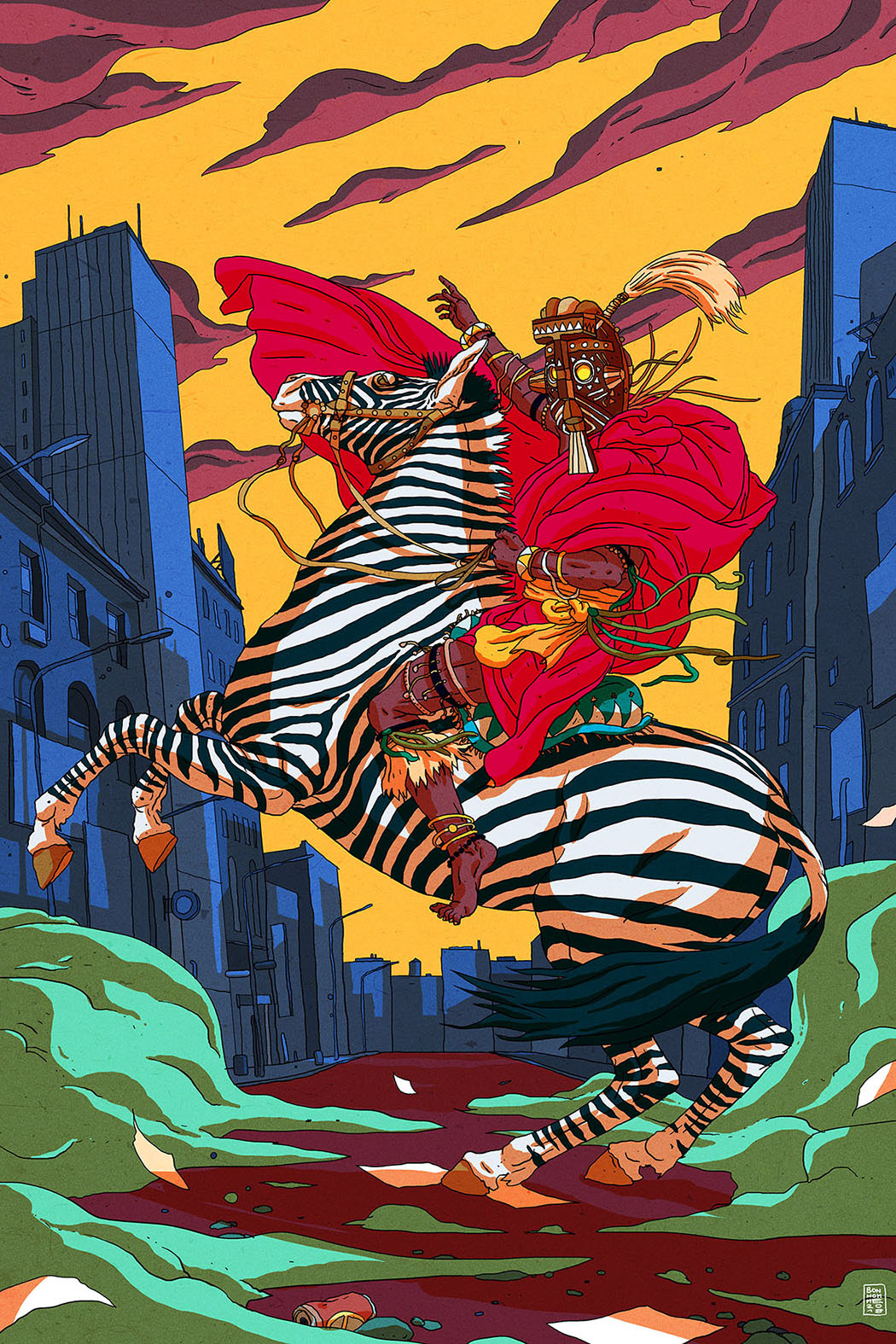
Freedom — Olivier Bonhomme

38640872306441.5be2f0ebdd680

Freedom, 2018 by Olivier Bonhomme (b. 1986)

Posted in Art

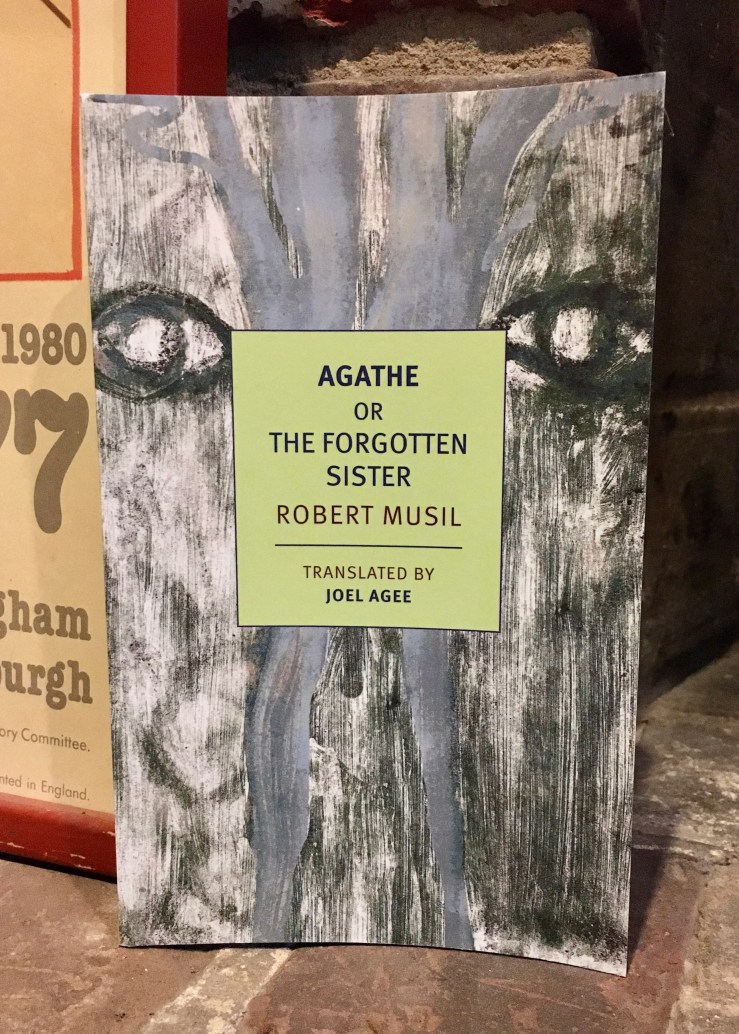
Robert Musil’s Agathe, or The Forgotten Sister (Book acquired like probably the last week of November 2019)

img_4474

In his introduction to Robert Musil’s Agathe, or The Forgotten Sister, NYRB editor Edwin Frank writes that,

Essay, in this quintessentially essayistic novel, is the mode for depicting a mind so active that it nearly constitutes a character independent of the man whose mind it is. That man is a thirty-two-year-old Austrian mathematician known to the reader only by his first name, Ulrich, who, disillusioned in his quest for intellectual glory after reading a newspaper about a racehorse of genius, decides to take a year-long ‘vacation from life,’ which he conceives of as an experiment in pure philosophic contemplation — ‘living essayistically,’ he calls it — in the hope of perhaps, by that pathless route, discovering an occupation better suited to his abilities. If he does not find it within a year, he will put an end to his life, because, to his fanatically logical and consequent mind, an unjustified life is not worth living.

I’ll confess I’ve never read Musil, despite two lukewarm milquetoast attempts, but I liked Frank’s introduction. Seems like I need to read The Man without Qualities before this. Here’s the NYRB blurb:

Agathe is the sister of Ulrich, the restless and elusive “man without qualities” at the center of Robert Musil’s great, unfinished novel of the same name. For years Agathe and Ulrich have ignored each other, but when brother and sister find themselves reunited over the bier of their dead father, they are electrified. Each is the other’s spitting image, and Agathe, who has just separated from her husband, is even more defiant and inquiring than Ulrich. Beginning with a series of increasingly intense “holy conversations,” the two gradually enlarge the boundaries of sexuality, sensuality, identity, and understanding in pursuit of a new, true form of being that they are seeking to discover.

Robert Musil’s The Man Without Qualities is perhaps the most profoundly exploratory and unsettling masterpiece of twentieth-century fiction. Agathe; or, The Forgotten Sister reveals with new clarity a particular dimension of this multidimensional book—the dimension that meant the most to Musil himself and that inspired some of his most searching writing. The outstanding translator Joel Agee captures the acuity, audacity, and unsettling poetry of a book that is meant to be nothing short of life-changing.

Agathe’s English translation is by Joel Agee.

St. Francis and the Birds — Stanley Spencer

St Francis and the Birds 1935 by Sir Stanley Spencer 1891-1959

St. Francis and the Birds, 1935 by Stanley Spencer (1891–1959)

What did Nathaniel Hawthorne see near the lake on the first day of December, 1850?

December 1st.–I saw a dandelion in bloom near the lake.

Nathaniel Hawthorne’s journal entry for December 1st, 1850. From Passages from the American Note-Books.

The Eyes in the Grillwork — Wilfredo Lam

willam

The Eyes in the Grillwork, 1942 by Wilfredo Lam (1902-1982)

Unclothe Hercules — Xiao Guo Hui

xiao-guo-hui-_cutts_2015_03_27_32640-717x1024Unclothe Hercules, 2015 by Xiao Guo Hui (b. 1969)
Gluttony — James Ensor

default

Gluttony, 1904 — James Ensor (1860-1949)

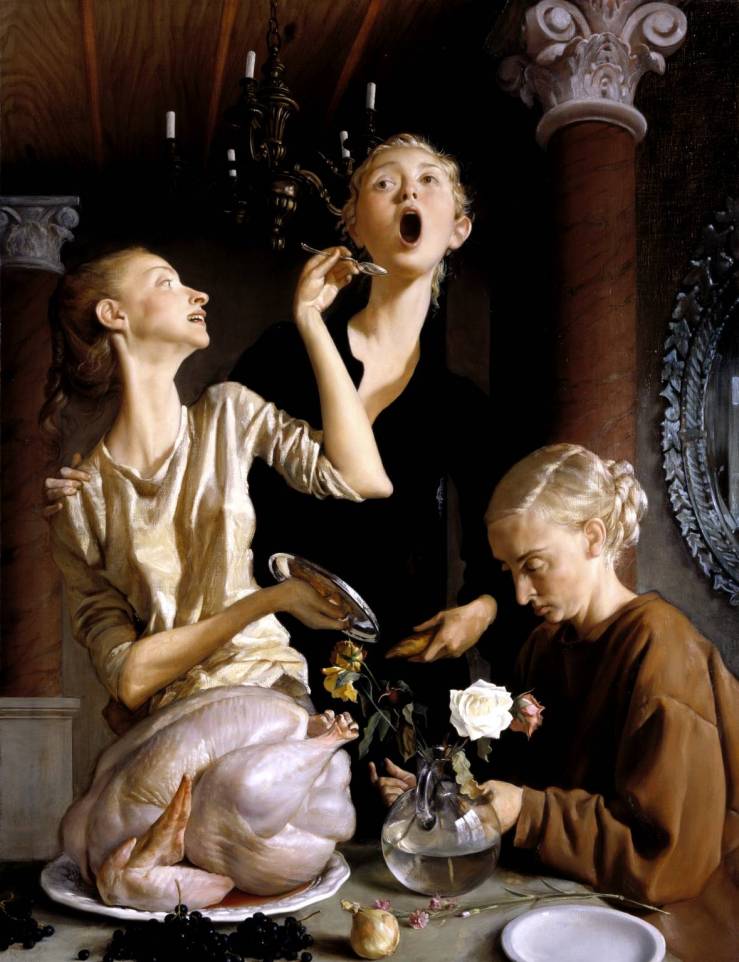
Thanksgiving — John Currin

Thanksgiving 2003 by John Currin born 1962

Thanksgiving, 2003 by John Currin (b. 1962)

(Not Quite) All the Food in Thomas Pynchon’s Books

I was looking for something else when I found a fun article from six years ago in Bon Appétit. The article, by Nicole Villeneuve, is called “All the Food in Thomas Pynchon’s Books (and What It Means, Sorta),” and it riffs on most of the food in Pynchon’s oeuvre.

Here’s the section on “The Inedible,” which includes notes on two of my favorite scenes from Gravity’s Rainbow—–

The Inedible

“A lot of people who think they’re cooks but are clinically deluded,” says a mess hall manager in Vineland. Pynchon includes a lot of their misguided creations in his books, relishing the gross and inedible—the places where “even [the] Jell-O salads have scum on them.”

Maybe the most memorable example is the “English Candy Drill,” in which a parade of disgusting sweets are sampled, unwillingly, by Tyrone Slothrop, the protagonist (sorta) in Gravity’s Rainbow: rhubarb creams, cherry-quinine petit fours, eucalyptus-flavored fondant, and pepsin-flavored nougat, licorice drops with a “dribbling liquid center, which tastes like mayonnaise and orange peels” and “a hard sour gooseberry shell into a wet spurting unpleasantness of, he hopes it’s tapioca, little glutinous chunks of something all saturated with powdered cloves.”

Gravity’s Rainbow includes another scene that’s hard to stomach: As a culinary prank, Bodine and Roger hold a dinner party with an intentionally revolting menu: “snot soup,” “sum soufflé,” “vomit vichyssoise” and “wart waffles.” Needless to say, “A general loss of appetite reigns, not to mention overt nausea.”

It’s a fun article, like I said, but there are a few things missing. It notes Against the Day’s cult of mayonnaise but leaves out all the ketchup (ketjap) stuff in Mason & Dixon, as well as Mason & Dixon’s important core distinction between Grape People and Grain People:

“If this is as bad as it gets, why I can abide thah’. As long as the Spirits don’t run out.”

“Nor the Wine.”

“Wine.” Dixon is now the one squinting. Mason wonders what he’s done this time. ” ‘Grape or Grain, but ne’er the Twain,’ as me Great- Uncle George observ’d to me more than once,— ‘Vine with Corn, beware the Morn.’ Of the two sorts of drinking Folk this implies, than’ is, Grape People and Grain People, You will now inform rne of Your membership in the Brotherhood of the, eeh, Grape…? and that You seldom, if ever, touch Ale or Spirits, am I correct?”

“Happily so, I should imagine, as, given a finite Supply, there’d be more for each of us, it’s like Jack Sprat, isn’t it.”

“Oh, I’ll drink Wine if I must…?— and now we’re enter’d upon the Topick,— ”

“— and as we are in Portsmouth, after all,— there cannot lie too distant some Room where each of us may consult what former Vegetation pleases him?”

Dixon looks outside at the ebbing wintry sunlight. “Nor too early, I guess…?”

“We’re sailing to the Indies,— Heaven knows what’s available on Board, or out there. It may be our last chance for civiliz’d Drink.”

“Sooner we start, the better, in thah’ case…?”

Again, a fun article—but what other food bits are missing? (We can leave the coprophagia and urolagnia in Gravity’s Rainbow out, though.)

Culte de la mayonnaise (Thomas Pynchon)

THE NEXT TIME he saw Pléiade Lafrisée was at a café-restaurant off the Place d’Armes. It would not occur to him until much later to wonder if she had arranged the encounter. She was in pale violet peau de soie, and a hat so beguiling that Kit was only momentarily surprised to find himself with an erection. It was still early in the study of these matters, only a few brave pioneers like the Baron von Krafft-Ebing had dared peep into the strange and weirdly twilit country of hat-fetishism—not that Kit noticed stuff like that ordinarily, but it happened actually to be a gray toque of draped velvet, trimmed with antique guipure, and a tall ostrich plume dyed the same shade of violet as her dress. . . .

“This? One finds them in every other midinette’s haunt, literally for sous.”

“Oh. I must’ve been staring. What happened to you the other night?”

“Come. You can buy me a Lambic.”

The place was like a museum of mayonnaise. This being just at the height of the culte de la mayonnaise then sweeping Belgium, oversize exhibits of the ovoöleaginous emulsion were to be encountered at every hand. Heaps of Mayonnaise Grenache, surrounded by plates of smoked turkey and tongue, glowed redly as if from within, while with less, if any, reference to actual food it might have been there to modify, mountains of Chantilly mayonnaise, swept upward in gravity-impervious peaks insubstantial as cloud, along with towering masses of green mayonnaise, basins of boiled mayonnaise, mayonnaise baked into soufflés, not to mention a number of not entirely successful mayonnaises, under some obscure attainder, or on occasion passing as something else, dominated every corner.

“How much do you know of La Mayonnaise?” she inquired.

He shrugged. “Maybe up to the part that goes ‘Aux armes, citoyens’—”

But she was frowning, earnest as he had seldom seen her. “La Mayonnaise,” Pléiade explained, “has its origins in the moral squalor of the court of Louis XV—here in Belgium the affinity should not be too surprising. The courts of Leopold and Louis are not that different except in time, and what is time? Both monumentally deluded men, maintaining their power through oppression of the innocent. One might usefully compare Cleo de Mérode and the marquise de Pompadour. Neuropathists would recognize in both kings a desire to construct a self-consistent world to live inside, which allows them to continue the great damage they are inflicting on the world the rest of us must live in.

“The sauce was invented as a new sensation for jaded palates at court by the duc de Richelieu, at first known as mahonnaise after Mahon, the chief port of Minorca, the scene of the due’s dubious ‘victory’ in 1756 over the illfated Admiral Byng. Basically Louis’s drug dealer and pimp, Richelieu, known for opium recipes to fit all occasions, is also credited with the introduction into France of the cantharides, or Spanish fly.” She gazed pointedly at Kit’s trousers. “What might this aphrodisiac have in common with the mayonnaise? That the beetles must be gathered and killed by exposing them to vinegar fumes suggests an emphasis on living or recently living creatures—the egg yolk perhaps regarded as a conscious entity—cooks will speak of whipping, beating, binding, penetration, submission, surrender. There is an undoubtedly Sadean aspect to the mayonnaise. No getting past that.”

Kit was a little confused by now. “It always struck me as kind of, I don’t know . . . bland?”

“Until you look within. Mustard, for example, mustard and cantharides, n’estce pas? Both arousing the blood. Blistering the skin. Mustard is the widelyknown key to resurrecting a failed mayonnaise, as is the cantharides to reviving broken desire.”

“You’ve been thinking about mayonnaise a lot, mademoiselle.”

“Meet me tonight,” a sudden fierce whisper, “out at the Mayonnaise Works, and you shall perhaps understand things it is given only to a few to know. There will be a carriage waiting.” She pressed his hand and was gone in a mist of vetiver, abruptly as the other evening.

A passage from Thomas Pynchon’s novel Against the Day; I don’t think you need any context to appreciate this passage.


Machines in the Head: Selected Stories of Anna Kavan (Book acquired, 18 Nov. 2019)

img_4405

I’m really excited about this one. Anna Kavan’s novel Ice is one of the best books I read this year (I blogged about it here and here and here. T Machines in the Head: Selected Short Stories of Anna Kavan is out early next year from NYRB. Their blurb:

Anna Kavan is one of the great originals of twentieth-century fiction, comparable to Leonora Carrington and Jean Rhys, a writer whose stories explored and plumbed the depths of her long addiction to heroin. This anthology of Kavan’s stories draws together a selection of her best writing from across her long career. Stories from across her collections show the range of her style: oblique and elegiac tales of breakdown and asylum incarceration from Asylum Piece (1940), moving evocations of wartime from I Am Lazarus (1945), fantastic and surrealist pieces from A Bright Green Field (1958), and stories of addiction from Julia and the Bazooka. Her late sci-fi stories will appeal to fans of her last novel, Ice. “Five Days to Countdown,” first published in Encounter (1968) and later collected in My Soul in China, is preoccupied with Cold War concerns and the sartorial aesthetics of the 1960s, and, published here for the first time, “Starting a Career” is a futuristic spy thriller, whose protagonist sets out to become the world’s greatest enigma.

Kavan was determined to experiment throughout her writing career, and this collection is moving, funny, bizarre, poignant, often unsettling, but always distinctive and often unique. And even though better known as a writer than an artist, Kavan painted throughout her life.