Mass-market Monday | Vance Randolph’s Pissing in the Snow & Other Ozark Folktales

Pissing in the Snow & Other Ozark Folktales, collected and transcribed by Vance Randolph with annotations by Frank A. Hoffmann. Avon Bard (1977). No cover artist credited. 239 pages. A tale from the collection:

“Have You Ever Been Diddled?”

Told by J. L. Russell, Harrison, Ark., April, 1950. He heard this one near Berryville, Ark., in the 1890’s.

One time there was a town girl and a country girl got to talking about the boys they had went with. The town girl told what kind of a car her boyfriends used to drive, and how much money their folks has got. But the country girl didn’t take no interest in things like that, and she says the fellows are always trying to get into her pants.

So finally the town girl says, “Have you ever been diddled?” The country girl giggled, and she says yes, a little bit.

“How much?” says the town girl. “Oh, about like that,” says the country girl, and she held up her finger to show an inch, or maybe an inch and a half.

The town girl just laughed, and pretty soon the country girl says, “Have you ever been diddled?” The town girl says of course she has, lots of times. “How much?” says the country girl. “Oh, about like that,” says the town girl, and she marked off about eight inches, or maybe nine.

The country girl just set there goggle-eyed, and she drawed a deep breath. “My God,” says the country girl, “that ain’t diddling! Why, you’ve been fucked!”

[J1805.5]

Eight notes on Stephen Dixon’s novel Interstate

1,  It upset me deeply, reading Stephen Dixon’s 1995 novel Interstate. It fucked me up a little bit, and then a little bit more, addicted to reading it as I was over two weeks in a new year.

2,  What is it about, Stephen Dixon’s 1995 novel Interstate? I mean, you probably won’t like it, but that wasn’t the stupid rhetorical question that led this point. (And also but maybe like, you will like it.) Interstate was a finalist for the 1995 National Book Award. It didn’t win. The NBA’s website’s one-sentence summary fucks up: “In the author’s first novel since Frog, a Finalist for the National Book Award, a father mentally replays, in eight variations, the shooting of his daughters on an interstate highway.”

3,  There is (or is it are?) one too many esses in the NBA’s summary of Stephen Dixon’s 1995 novel Interstate—there are two daughters, plural, but only one is shot, and shot tragically, awfully, fatally—and really, as its variations play out, it’s not entirely clear if anyone was shot, if anyone was even on the highway, if anyone was even real. Are all the so-called events of the novel simply (there’s no simply about it) in the narrator’s imagination? “…but there I go again, the world’s easiest and most desirable copy out, the dream,” muses the narrator at one point. Not even a dream though, it’s all just words.

4,  It’s all “just” words, and if someone told me they read and hated Stephen Dixon’s 1995 novel Interstate, I’d shrug and ask if they made it all the way through all the words and still hated it. If someone told me that they made it all the way through Interstate and found it to be a strange and unappealing writing experiment, I’d mildly agree with them, and then tell them that I loved that particular flavor and if they didn’t like that particular flavor, well, cool.

5,  If someone read all the words in Stephen Dixon’s 1995 novel Interstate and concluded that it seemed like an ambitious and highly-achieved creative writing exercise — writing experiment, rather — I’d likely initially agree and then hedge a bit before mumbling something like, I don’t think it was an exercise or experiment on the author Stephen Dixon’s part. It might make for experimental reading, but I think he absolutely knew what he was doing; this wasn’t practice or exercise — it was the real thing.

6, I have, thus far, done a lousy job, not even really a job, of describing the force of language in Stephen Dixon’s 1995 novel Interstate. Normally I’d crib a few choice passages—and to be clear, Interstate s fat and juicy with choice passages—but we are talking about long, twisty, tangled passages, sentences that go on for pages, sentences that find the predicate verb sundered for a few paragraphs from its eventual object, sentences that move us through thought, how divergent thought can be how, how imprecise, indirect, yet still sharp and often painful. An easy, lazy comparison would be to liken Dixon’s paragraphs to Thomas Bernhard’s (although Dixon denied the influence, much like William Gaddis did in his final novel)—there’s a different flavor here but our guys are working in a similar mode. (Think too of László Krasznahorkai or Gabriel García Márquez or Faulkner or Mauro Javier Cárdenas or any number of practitioners of the long paragraph). John Domini, in his contemporary review in the Portland Oregonian (reprinted in his excellent collection The Sea-God’s Herb) does a better job of describing Dixon’s style than I can do:

Characters talk themselves through backwaters of memory (sometimes creating comic relief) or sail into dreamy what-ifs, all in order to put off some looming and drear inevitability. In conversation, one may mention an important insight that he or she has to share, then spiral away through a half-dozen distractions before revealing what matters. The format feels like a natural fit to the shuttered claustrophobia of worry and loss. So do the jam-packed paragraphs, sometimes running several pages without a break. Better still, these blocks of talky phrasing flicker with light, even (every now and again) with happier possibilities.”

(Maybe I just wanted to quote that lovely phrase of Domini’s, “blocks of talky phrasing flicker with light.”)

7,  “Better still, these blocks of talky phrasing flicker with light, even (every now and again) with happier possibilities,” Domini wrote of Stephen Dixon’s 1995 novel Interstate. The last of Dixon’s eight Interstates is an unexpected gift — a happy ending, or, rather a banal ending, a plain ending, an ending without tragedy or comedy or epic heroism. An ending where everyone gets to bed in time to fit in a little light reading before shuteye. It sounds hokey when I write it out, but there’s nothing trite about the conclusion. The reader purchases this moment of catharsis from all the terror (and horrifying comedy, which I’ve neglected in this riff and will continue to neglect) — the reader purchases the cathartic conclusion from the preceding horror.

8,  I wonder how I might have reacted to Stephen Dixon’s 1995 novel Interstate if I had read it, say, when it was first published, back when I was a junior in high school. Or how would I have reacted to it ten years after that, not yet a parent? (And writing these thoughts out now, I realize that, more than anything by Bernhard or Krasznahorkai or Faulkner or the other Dixon I’ve read, Interstate most reminds me of (at least at this moment that I write) of Frank Capra’s 1946 film It’s a Wonderful Life. I’ve watched It’s a Wonderful Life once a year for the past four decades, finding it strangely different every few years — first baffling and even a bit scary, then boring, then exasperating, infuriating even, then schmaltzy, sentimental, ludicrous, and then magical, endearing, heartbreaking, perfect–I’ve veered off course, where was I?) I wonder how being a parent has colored my psychic engagement with the novel Interstate? I was not so much manipulated by the tragedy of losing a child through violent, chaotic, meaningless death but rather the more banal tragedy the novel repeatedly engages — losing a child through half-neglect, through half-listening, through selfishness, through an inability to focus on now — not really so much losing a child but losing out on connections, memories, time you’ll never get back. It fucked me up, Interstate, and I don’t think I’d like to go down its road again — but I loved it. Very highly recommended.

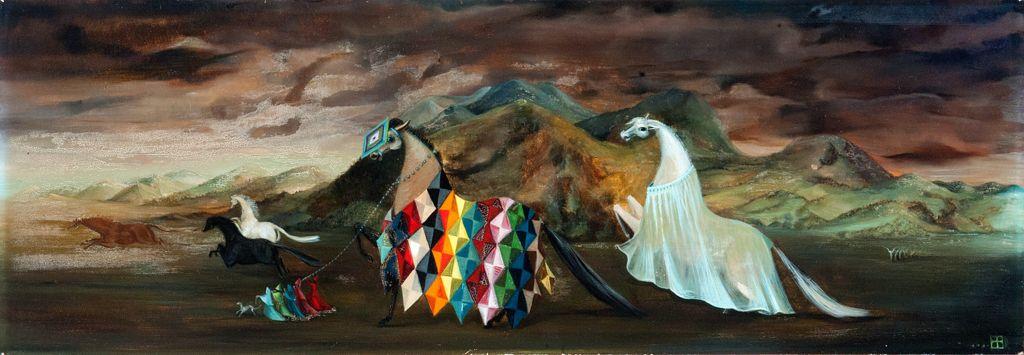
Simpatía — Remedios Varo 

Simpatía (La rabia del gato) (Sympathy, the Cat’s Rage), 1955 by Remedios Varo (1908-1963)

He saw the three caravels | A sentence from Gabriel García Márquez’s The Autumn of the Patriarch

On another distant December when the house was inaugurated, he had seen from that terrace the line of the hallucinated isles of the Antilles which someone pointed out to him in the showcase of the sea, he had seen the perfumed volcano of Martinique, over there general, he had seen the tuberculosis hospital, the gigantic black man with a lace blouse selling bouquets of gardenias to governors’ wives on the church steps, he had seen the infernal market of Paramaribo, there general, the crabs that came out of the sea and up through the toilets, climbing up onto the tables of ice cream parlors, the diamonds embedded in the teeth of black grandmothers who sold heads of Indians and ginger roots sitting on their safe buttocks under the drenching rain, he had see the solid gold cows on Tanaguarena beach general, the blind visionary of La Guayra who charged two reals to scare off the blandishments of death with a one-string violin, he had seen Trinidad’s burning August, automobiles going the wrong way, the green Hindus who shat in the middle of the street in front of their shops with genuine silkworm shirts and mandarins carved from the whole tusk of an elephant, he had seen Haiti’s nightmare, its blue dogs, the oxcart that collected the dead off the streets at dawn, he had seen the rebirth of Dutch tulips in the gasoline drums of Curacao, the windmill houses with roofs built for snow, the mysterious ocean liner that passed through the center of the city among the hotel kitchens, he had seen the stone enclosure of Cartagena de Indias, its bay closed off by a chain, the light lingering on the balconies, the filthy horses of the hacks who still yawned for the viceroys’ fodder, its smell of shit general sir, how marvelous, tell me, isn’t the world large, and it was, really, and not just large but insidious, because if he went up to the house on the reefs in December it was not to pass the time with those refugees whom he detested as much as his own image in the mirror of misfortune but to be there at the moment of miracles when the December light came out, mother—true and he could see once more the whole universe of the Antilles from Barbados to Veracruz, and then he would forget who had the double-three piece and go to the overlook to contemplate the line of islands as lunatic as sleeping crocodiles in the cistern of the sea, and contemplating the islands he evoked again and relived that historic October Friday when he left his room at dawn and discovered that everybody in the presidential palace was wearing a red biretta, that the new concubines were sweeping the parlors and changing the water in the cages wearing red birettas, that the milkers in the stables, the sentries in their boxes, the cripples on the stairs and the lepers in the rose beds were going about with the red birettas of a carnival Sunday, so he began to look into what had happened to the world while he was sleeping for the people in his house and the inhabitants of the city to be going around wearing red birettas and dragging a string of jingle bells everywhere, and finally he found someone to tell him the truth general sir, that some strangers had arrived who gabbled in funny old talk because they made the word for sea feminine and not masculine, they called macaws poll parrots, canoes rafts, harpoons javelins, and when they saw us going out to greet them and swim around their ships they climbed up onto the yardarms and shouted to each other look there how well-formed, of beauteous body and fine face, and thick-haired and almost like horsehair silk, and when they saw that we were painted so as not to get sunburned they got all excited like wet little parrots and shouted look there how they daub themselves gray, and they are the hue of canary birds, not white nor yet black, and what there be of them, and we didn’t understand why the hell they were making so much fun of us general sir since we were just as normal as the day our mothers bore us and on the other hand they were decked out like the jack of clubs in all that heat, which they made feminine the way Dutch smugglers do, and they wore their hair like women even though they were all men and they shouted that they didn’t understand us in Christian tongue when they were the ones who couldn’t understand what we were shouting, and then they came toward us in their canoes which they called rafts, as we said before, and they were amazed that our harpoons had a shad bone for a tip which they called a fishy tooth, and we traded everything we had for these red birettas and these strings of glass beads that we hung around our necks to please them, and also for these brass bells that can’t be worth more than a penny and for chamber pots and eyeglasses and other goods from Flanders, of the cheapest sort general sir, and since we saw that they were good people and men of good will we went on leading them to the beach without their realizing it, but the trouble was that among the I’ll swap you this for that and that for the other a wild motherfucking trade grew up and after a while everybody was swapping his parrots, his tobacco, his wads of chocolate, his iguana eggs, everything God ever created, because they took and gave everything willingly, and they even wanted to trade a velvet doublet for one of us to show off in Europeland, just imagine general, what a wild affair, but he was so confused that he could not decide whether that lunatic business came within the incumbency of his government, so he went back to his bedroom, opened the window that looked out onto the sea so that perhaps he might discover some new light to shed on the mix-up they had told him about, and he saw the usual battleship that the marines had left behind at the dock, and beyond the battleship, anchored in the shadowy sea, he saw the three caravels.


From Gabriel García Márquez’s The Autumn of the Patriarch in translation by Gregory Rabassa.

Mass-market Monday | Gabriel García Márquez’s The Autumn of the Patriarch

The Autumn of the Patriarch, Gabriel García Márquez. Translation by Gregory Rabassa. Avon Bard (1977). No cover artist credited. 251 pages.
I started in on The Autumn of the Patriarch this afternoon, soaking into its initial pages, which seemed to me at first a grand revision of Faulkner’s “A Rose for Emily,” and then coasted on the sentences through its first section. Here are the first nine sentences:

Over the weekend the vultures got into the presidential palace by pecking through the screens on the balcony windows and the flapping of their wings stirred up the stagnant time inside, and at dawn on Monday the city awoke out of its lethargy of centuries with the warm, soft breeze of a great man dead and rotting grandeur. Only then did we dare go in without attacking the crumbling walls of reinforced stone, as the more resolute had wished, and without using oxbows to knock the main door off its hinges, as others had proposed, because all that was needed was for someone to give a push and the great armored doors that had resisted the lombards of William Dampier during the building’s heroic days gave way. It was like entering the atmosphere of another age, because the air was thinner in the rubble pits of the vast lair of power, and the silence was more ancient, and things were hard to see in the decrepit light. All across the first courtyard, where the paving stones had given way to the underground thrust of weeds, we saw the disorder of the post of the guard who had fled, the weapons abandoned in their racks, the big, long rough-planked tables with plates containing the leftovers of the Sunday lunch that had been interrupted by panic, in shadows we saw the annex where government house had been, colored fungi and pale irises among the unresolved briefs whose normal course had been slower than the pace of the dryest of lives, in the center of the courtyard we saw the baptismal font where more than five generations had been christened with martial sacraments, in the rear we saw the ancient viceregal stable which had been transformed into a coach house, and among the camellias and butterflies we saw the berlin from stirring days, the wagon from the time of the plague, the coach from the year of the comet, the hearse from progress in order, the sleep-walking limousine of the first century of peace, all in good shape under the dusty cobwebs and all painted with the colors of the flag. In the next courtyard, behind an iron grille, were the lunar-dust-covered rosebushes under which the lepers had slept during the great days of the house, and they had proliferated to such a degree in their abandonment that there was scarcely an odorless chink in that atmosphere of roses which mingled with the stench that came to us from the rear of the garden and the stink of the henhouse and the smell of dung and urine ferment of cows and soldiers from the colonial basilica that had been converted into a milking barn. Opening a way through the asphyxiating growth we saw the arches of the gallery with potted carnations and sprigs of astromelias and pansies where the concubines’ quarters had been, and from the variety of domestic leftovers and the quantity of sewing machines we thought it possible that more than a thousand women had lived there with their crews of seven-month runts, we saw the battlefield disorder of the kitchens, clothes rotting in the sun by the wash basins, the open slit trench shared by concubines and soldiers, and in back we saw the Babylonian willows that had been carried alive from Asia Minor in great seagoing hothouses, with their own soil, their sap, and their drizzle, and behind the willows we saw government house, immense and sad, where the vultures were still entering through the chipped blinds. We did not have to knock down the door, as we had thought, for the main door seemed to open by itself with just the push of a voice, so we went up to the main floor along a bare stone stairway where the opera-house carpeting had been torn by the hoofs of the cows, and from the first vestibule on down to the private bedrooms we saw the ruined offices and protocol salons through which the brazen cows wandered, eating the velvet curtains and nibbling at the trim on the chairs, we saw heroic portraits of saints and soldiers thrown to the floor among broken furniture and fresh cow flops, we saw a dining room that had been eaten up by the cows, the music room profaned by the cows’ breakage, the domino tables destroyed and the felt on the billiard tables cropped by the cows, abandoned in a corner we saw the wind machine, the one which counterfeited any phenomenon from the four points of the compass so that the people in the house could bear up under their nostalgia for the sea that had gone away, we saw birdcages hanging everywhere, still covered with the sleeping cloths put on some night the week before, and through the numerous windows we saw the broad and sleeping animal that was the city, still innocent of the historic Monday that was beginning to come to life, and beyond the city, up to the horizon, we saw the dead craters of harsh moon ash on the endless plain where the sea had been. In that forbidden corner which only a few people of privilege had ever come to know, we smelled the vultures’ carnage for the first time, we caught their age-old asthma, their premonitory instinct, and guiding ourselves by the putrefaction of their wing flaps in the reception room we found the wormy shells of the cows, their female animal hindquarters repeated many times in the full-length mirrors, and then we pushed open a side door that connected with an office hidden in the wall, and there we saw him, in his denim uniform without insignia, boots, the gold spur on his left heel, older than all old men and all old animals on land or sea, and he was stretched out on the floor, face down, his right arm bent under his head as a pillow, as he had slept night after night every night of his ever so long life of a solitary despot. Only when we turned him over to look at his face did we realize that it was impossible to recognize him, even though his face had not been pecked away by vultures, because none of us had ever seen him, and even though his profile was on both sides of all coins, on postage stamps, on condom labels, on trusses and scapulars, and even though his engraved picture with the flag across his chest and the dragon of the fatherland was displayed at all times in all places, we knew that they were copies of copies of portraits that had already been considered unfaithful during the time of the comet, when our own parents knew who he was because they had heard tell from theirs, as they had from theirs before them, and from childhood on we grew accustomed to believe that he was alive in the house of power because someone had seen him light the Chinese lanterns at some festival, someone had told about seeing his sad eyes, his pale lips, his pensive hand waving through the liturgical decorations of the presidential coach, because one Sunday many years ago they had brought him the blind man on the street who for five cents would recite the verses of the forgotten poet Ruben Dario and he had come away happy with the nice wad they had paid him for a recital that had been only for him, even though he had not seen him, of course, not because he was blind, but because no mortal had ever seen him since the days of the black vomit and yet we knew that he was there, we knew it because the world went on, life went on, the mail was delivered, the municipal band played its retreat of silly waltzes on Saturday under the dusty palm trees and the dim street lights of the main square, and other old musicians took the places of the dead musicians in the band.

“Legend” — Dorothea Tanning

“Legend”

by

Dorothea Tanning

From Surrealist Women: An International Anthology (ed. Penelope Rosemont). “Legend” first appeared in Max Ernst’s At Eye Level and Paramyths, the catalog of the “Max Ernst: 30 Years of His Work” exhibition in Beverly Hills in 1949.


A young sinner grew weary of Olympus. He went to the head of the stairs where the three graces sat knitting sweaters for their earthly sons. (Winter was at hand.) Each of them smiled secretly at the young sinner, each believing she was the only one whom he had provided with pleasant memories. But they wouldn’t let him pass.

“It’s a cruel place,” said one. “How will you nourish yourself?”

“On destinies,” he answered promptly. “Take the laughter of seven maidens, stir in several of the moonbeams that fall across their beds. Add the head of a procession, a few umbrella ribs and a tale of hilarious crime. Season it madly and serve on collection plates.”

“But,” said another, barring the way, “Where will you go?”

“To picnics,” said he, making a perfect triple pirouette.

The third grace laid her knitting in her lap where it formed a pretty, medium-sized figleaf. She turned her eyes up to him and said softly, “What will you do?”

She looked so charming that for a moment the young sinner hesitated. Perhaps he wouldn’t go after all. But he recovered himself and said:

“Please be advised that I will vaccinate the world with a desire for violent and perpetual astonishment. Disguised in my own presence, I will conduct a horde through the five aqueducts of knowledge, after which their guardians will ask the authorities for replacements. I will provoke prodigies. When I have built the torpid town, certain words will fall into disuse: eminent prominent peerless noble honorable lordly stately august princely majestic sacred and sublime. I will make rhapsodies from grains of sleep. I’ll wrap up a manmaking hat and drop it in the mailbox. I’ll hold a revolver up to nature. When professional critics lose themselves in the swamp I’ll arrange a delegation of chimeras with their own language and their own secrets. As for the night, I will discover all its phases. And I will fall in love.”

The three graces had been looking rather sleepy; but at the last words they opened their mouths in horror, then picked up their knitting and fled.

With his glittering blue eyes the young sinner sent lightning strokes after them—a parting gift. Then he ran down the steps, two at a time.

Nonjoke | From Stephen Dixon’s Interstate

A passage from Stephen Dixon’s novel Interstate


So you go with the doctor to the room Julie’s in and the doctor says, right outside it—door closed, no little window in it, legs so weak while you walked that the doctor had to hold your arm, you said “I think I’m going to fall, grab me,” and he did, while you walked you thought “It’s like an execution I’m going to, mine, hanging, shooting, injection, gas; fear, weakness, feeling you want to heave,” sign on the door saying “Do Not Enter, Medical Staff Only, Permission Required”—“She’s in there on the bed. It’s not really a bed, we call it something else, but for our purposes we’ll call it that.” “What do you call it normally, meaning the technical calling—the word, you know?” and he says “‘Bed’ will do.” “But I’d like to know, if you don’t mind. I’m not sure why, peculiar reasons probably, but just, could you?” “An examination table, that’s all it is, but now it’s made up to look like a bed—sheets, a pillow.” “For under her head.” “Under her head, yes.” “You’re giving me a lot of your time, I’m sorry.” “It’s okay, what I do.” “I’ve been thinking of her head, only before, I think, on a pillow when she was alive. Everybody’s sure she’s dead?” He nods. “Then I’ll see her in there. I mean, I would, of course, if she were alive, but I’m saying for now.” You put your hand on the door. It has no knob or bar, only needs a push. Which side of the room will the bed be? The left, you guess. But it’s a table, so may be in the middle. “Yell for me, ‘Dr. Wilkie,’ if all of a sudden you need assistance. Or if you want, I’ll come in with you.” “You’ve seen her?” “Uh-huh.” “No, I want to see her alone.” “I can go in and leave when you want. Or with a flick of your finger, if you can’t speak, or point to the door.” “Nah, I want it to be now just me and her. ‘Me and she’ sounds better but it’s ‘me and her, me and her.’ Meaning, they go together, correctly, though in that case it could be ‘she and I’ for all I know. Why do I bring these things up? Delaying.” “No matter what, I won’t budge from here unless there’s an emergency I’m absolutely needed for. Chances of that are minimal, and I’ve asked another doctor to fill in for me. But you never know.” “You never know,” you say. “And I suppose I should go in now, get it over with. Somehow I imagine her in the middle of the room on that table-bed, head on the left side of it, so, perpendicular to us,” and you show with your hands in a T what you mean. “I believe that’s the way it is.” “So there. And all my life, you know, I’ve been getting things over with—no window in the room, probably.” “None.” “Lots of lights, some side tables with instruments and things on them, and so on. In fact, there’s a standard joke, a running one, rather, around my household—no, it’s no time for lines or jokes. This isn’t one, what I was about to say, but might sound like it. I haven’t told you it yet?” “If you mean now or before, not that I know of.” “I think I’ve told everyone else in the world. I have so few things to say. Of interest. Though it always had a serious degree to it. Side. It borders. Straddles.” “Go on, tell me if it’ll help relax and prepare you for going inside. Remember, here and now, anything you do or say is okay.” “Right, better I feel that way, relaxed, prepared, so I don’t crash first thing on seeing her, my dear kid, truly the dearest little girl-child-kid there ever was,” and you start crying and you cry and say “Everybody says ‘ever was,’ I bet, everybody, in a situation like this, and I should stop all this kind of talk. Just saying it, of course I know what it’ll do, so I have to wonder if I didn’t say it just to go to pieces and delay some more my going in. There,” patting yourself under the eyes, tears, “these goddamn these. Stop, stop, stop,” slapping your cheeks. “But my nonjoke. Nonintended for one, the something I was going to say and will probably say it that I said might sound like a joke, and other times it could be. Now it’s just a fact. An insight into me. So I’m telling it as an illustration of my always wanting to get things over with—trips, books, days, work, housecleaning, even sex sometimes. Cooking, quick, quick, quick. A joke to everyone I know, I can tell you, as if work to get rid of to clear yourself for the real or more important work, stuff that’s killing you for you to do and which turns out to be the same thing, get rid of it, clear yourself for something else, and so on. So say it. Or do it. My hand’s on the door again but I’m not pushing it even a quarter-inch. I can’t seem to get in there. Whyever why? The example’s this. That I want on my tombstone for it to read—Rather, that I want my epitaph to say on my tombstone, chiseled in—Rather, for ‘tombstone’ sounds so Western western—in other words, fake—that I want my head-or footstone—my gravestone epitaph to say, you know, under my name, birth and death dates—anywhere on the stone—‘So, I got it over with.’ Just that. You see the point; message is clear, isn’t it? It’s not funny now. Of course, nothing is, goes without saying, and long way I told the story, end of it was dead before I got there,” dropping your head, crying again, hand off the door. “This is too hard. Impossible. Why does it have to be? Her, I mean. I know, old question, but couldn’t this all somehow be a wake-up dream? All that’s done-before crap too, everybody must say it in a situation like this, and especially to you, true?” “But any other time your epitaph line would be humorous. I understand that. You got it over with—you’re a man who likes getting things over with, and the big thing, the biggest, life, you’re saying in this fictitious epitaph, you did.” “Maybe it was ‘Well, I finally got it over with’ what I told my wife and friends countless—endless amounts—countless times. Or no ‘well,’ but a ‘finally.’ So just ‘I finally’—and no ‘so’ either, so just i finally got it over with.’ I think that’s it. It is. Anyway, what’s the damn difference? One of those. And I should get it over with, finally. I know I have to see her, I want to.” “You’re right when you imply I know how difficult it is,” he says. “I’ve been through this with plenty of other people.” “Other fathers? But ones who adore their kids? Love them, adore them, worship them; if there was one word for those three, then that?” “Fathers, mothers, husbands, children for their sisters or brothers—everyone close.” “Okay. You close your eyes, you hold your breath, you push open the door and walk in. That’s all you have to do, just those.” You do them, push the door shut behind you without turning around, let your breath out and smell; nothing unusual, something medicinal; and open your eyes.

Saint Valentine — Jean Hugo

saint-valentin-1930.jpg


Saint Valentine, 1930 by Jean Hugo (1894-1984)

Alice Walker reading from Zora Neale Hurston’s Mules and Men

American Flamingo (Detail) — John James Audubon

American Flamingo (detail), 1838 by John James Audubon (1785-1851)

Un Ballo in Maschera — George Tooker

Un Ballo in Maschera (A Masked Ball), 1983 by George Tooker (1920-2011)

Mass-market Monday | Harlan Ellison’s The Glass Teat and The Other Glass Teat

The Glass Teat, Harlan Ellison. Ace Books (1983 reprint). Cover art by Barclay Shaw. 319 pages.

The Other Glass Teat, Harlan Ellison. Ace Books (1983). Cover art by Barclay Shaw. 397 pages.

Part of an ostensible review of the sitcom Happy Days; from Ellison’s column published on 3 July 1970 and reprinted in The Other Glass Teat:

One begins to realize that our national middle-class hunger to return to two decades of Depression, world war, Prohibition, Racism Unadmitted, Covert Fascination with Sex, Deadly Innocence, Isolationism, Provincialism, and Deprivation Remembered as Good Old Days has become a cultural sickness.

The past has always been a rich source for fun and profit. Nostalgia is a good thing. It keeps us from forgetting our roots. Readers of this column know I trip down Memory Lane myself frequently. But it is clearly evident that when an entire nation refuses to accept the responsibilities of its own future, when it seeks release in a morbid fascination with its past, and when it elevates the dusty dead days of the past to a pinnacle position of Olympian grandeur … we are in serious trouble.

“Football,” a very short story by Richard Brautigan

“Football”

by

Richard Brautigan


The confidence that he got by being selected all-state in football lasted him all of his life. He was killed in an automobile accident when he was twenty-two. He was buried on a rainy afternoon.

Halfway through the burial service the minister forgot what he was talking about. Everybody stood there at the grave waiting for him to remember.

Then he remembered.

“This young man,” he said. “Played football.”

Self Portrait — Dirck Helmbreker

Self Portrait, 1650 by Dirck Helmbreker (1633-1696)

Castigo francés — Francisco Goya

Castigo francés (French punishment), Notebook G.48 (c. 1824-1828) by Francisco Goya (1746-1828)

Blog about some recent reading

What an interesting few weeks it’s been! Here’s (some of) what I’ve been reading so far this year:

I’m in the middle of Stephen Dixon’s novel Interstate. It is a devastating, ugly, addictive, beautiful novel; I have no idea if it is “good” or not but I love it. I can’t really think of a single person I know (in real life) I could recommend it to. We played cards with some friends and one of them asked about what I was reading, and I said a novel called Interstate by this guy Stephen Dixon, and she asked of course What’s it about? and I said something, Well, this guy’s driving on the interstate with his daughters and two guys in a van pull up along side him and start shooting at them, killing his younger daughter–this happens in like, the first few paragraphs–and then we see how this event destroys his life–but then Dixon repeats the initial scenario like seven more times with different (but all really tragic so far) outcomes–and it’s written in this addictive vocal style that might be really off-putting to many readers, and it also makes really fascinating use of the coordinating conjunction for, which may just be a verbal tic –and it’s also really funny at times? I am not trying to sell this novel to anyone but I love it.

My reading experience of Briana Loewinsohn’s graphic novel Raised by Ghosts was kinda sorta the opposite of Dixon’s Interstate in that after I finished it I immediately pressed it on my wife and then my kids and then texted some of my oldest friends about it (oldest in the previous clause should be understood to modify the friendship, not the actual friend’s years–although we’re all getting older). We’re all getting older, all the time, and Raised by Ghosts provoked an aged nostalgia in me. I’m about half a year older than Loewinsohn and so much of her semi-autobiographical novel resonated with me. She gets everything right about what it was like to be a little bit of a weirdo at school in the nineties. There’s this wonderful passage on how important it was to get a handwritten note from a friend; there’s a page that’s nothing but a notebook page filled with band names; there’s a marvelous scene where our hero loses her shit watching You’re a Good Man, Charlie Brown. I should have a proper review this week or next, but great stuff. (The whole family loved it, by the way.)

I’ve been reading a collection of Dino Buzzati short stories translated by Lawrence Venuti; my technique is to read one of the shorter stories when I feel a bit of dread or anxiety from, like, reading something else. (The collection is called The Bewitched Bourgeois by the way.) I’ve enjoyed reading them, and have especially enjoyed allowing myself to read them at random instead of following the collection’s chronological trajectory. Very Kafka, very Borges, but also very original.

Not in the picture above, but I’ve also been working my way through a digital copy of Vladimir Sorokin’s short story collection Dispatches from the District Committee, in translation by Max Lawton (and illustrated by Gregory Klassen). Great gross stuff.

I picked up a collection of Jane Bowles’ sketches, letters, and other ephemera a few weeks ago–I love her stuff, but really it was that these were contained in the somewhat-rare Black Sparrow Press edition Feminine Wiles. I’m pretty sure all of the stuff here is collected in My Sister’s Hand in Mine, but I’ve enjoyed dipping into this one more. It’s slim, not bulky, but that bulky boy’s around her (My Sister’s) if I need him.

My uncle sent me a copy of Werner Herzog’s 2022 memoir Every Man for Himself and God Against All for Christmas (in translation by Michael Hofmann). I devoured the first few chapters and then a colleague hipped me to the fact that there’s an audiobook of Herzog reading his memoir (available on Spotify and other platforms) — so on my commute I’ve been listening to him read his own memoir, which is just amazing. Like fucking amazing. Hearing him say phrases like “the escapades of Christopher Robin, Winnie-the-Pooh, Piglet, and Eeyore” or that “chipmunks…have something consoling about them” is surreal. There are like fifty insane things that happen in every chapter, and if Dwight Garner of the failing New York Times attested that he didn’t “believe a word” of the memoir, I take the opposite tack. Everything is true, everything is permitted.

Finally, I can’t really say I’ve been “reading” Remedios Varo: El hilo invisible by Jose Antonio Gil and Magnolia Rivera. My grasp of Spanish cannot graspingly grasp too much of the Spanish (although my iPhone’s picture-text-translate thing works fine when I’m really curious), but the book is a lovely visual catalog of not just one of my favorite artist’s works (including many pieces I haven’t seen before), but also documents her visual influences. I picked it up at the Museo de Arte Moderno in Mexico City back in January, still floating on the high of seeing many of Varo’s lovely paintings there that afternoon.

Mass-market Monday | William Gibson’s Neuromancer

Neuromancer, William Gibson. Ace Books (1984 imprint; 29th printing). No cover designer or artist credited. 271 pages.

ISFDB gives the cover artist as Rick Berry.

I borrowed and never returned Neuromancer from one of my best friends. We were best friends in middle school, but I stole this book like senior year of high school or maybe the year after. 1997ish, when the world seemed fairly settled.

According to a blog I wrote in 2006 (JFC), I lost my friend’s copy to one of my students, who took it and never returned it. Did I buy this 29th printing to replace the copy that I’d sorta-kinda-stolen years ago? I can’t recall. I vaguely recall doing so, but it’s also possible I’ve fabricated the past, creating memories like a man wielding large shears and bolts of felt might create strange stupid felt shapes.

Tilford, I’m sorry. You probably can’t have your book back, but you can have this one. Just let me know.

I would love to bottle the feeling of reading those first three Gibson novels and to sip from that bottle, but that’s nostalgia, and fuck nostalgia.