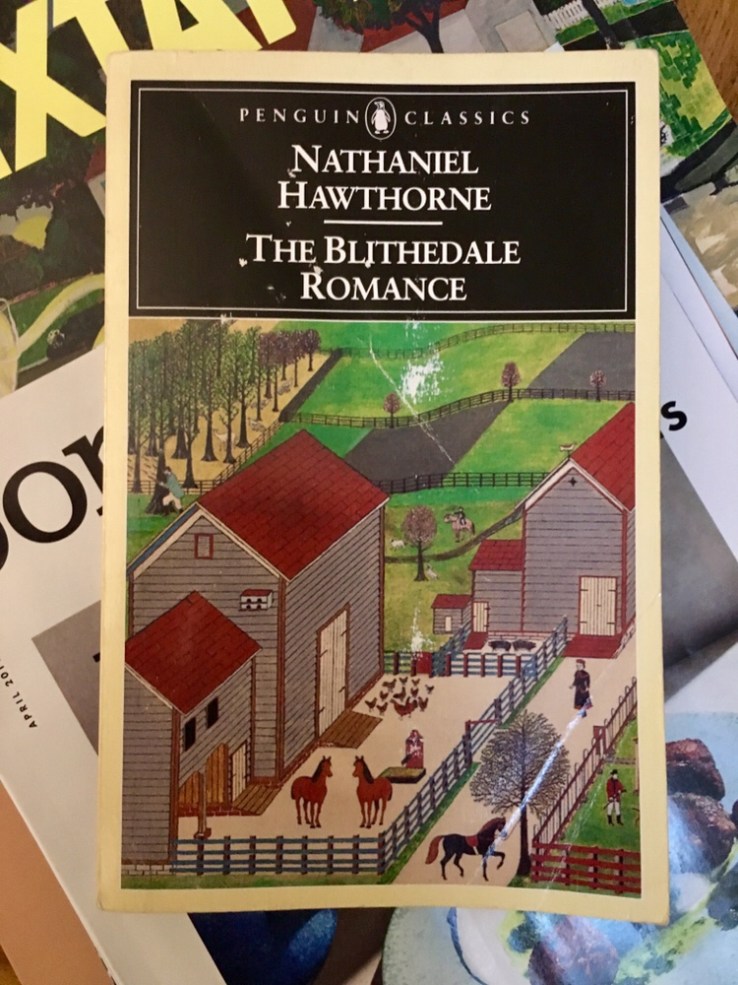

Iris Murdoch’s The Bell (Book acquired, 23 Feb. 2018)

img_9112

I picked up Iris Murdoch’s novel The Bell the other day. I’d put it on my 2018 Good Intentions Reading List, but somehow failed to find it at the big used bookstore I frequent. I found six copies there on Friday, all in different editions—it turns out there was another shelf of Murdoch, but higher up and to the right of where I was looking. Anyway.

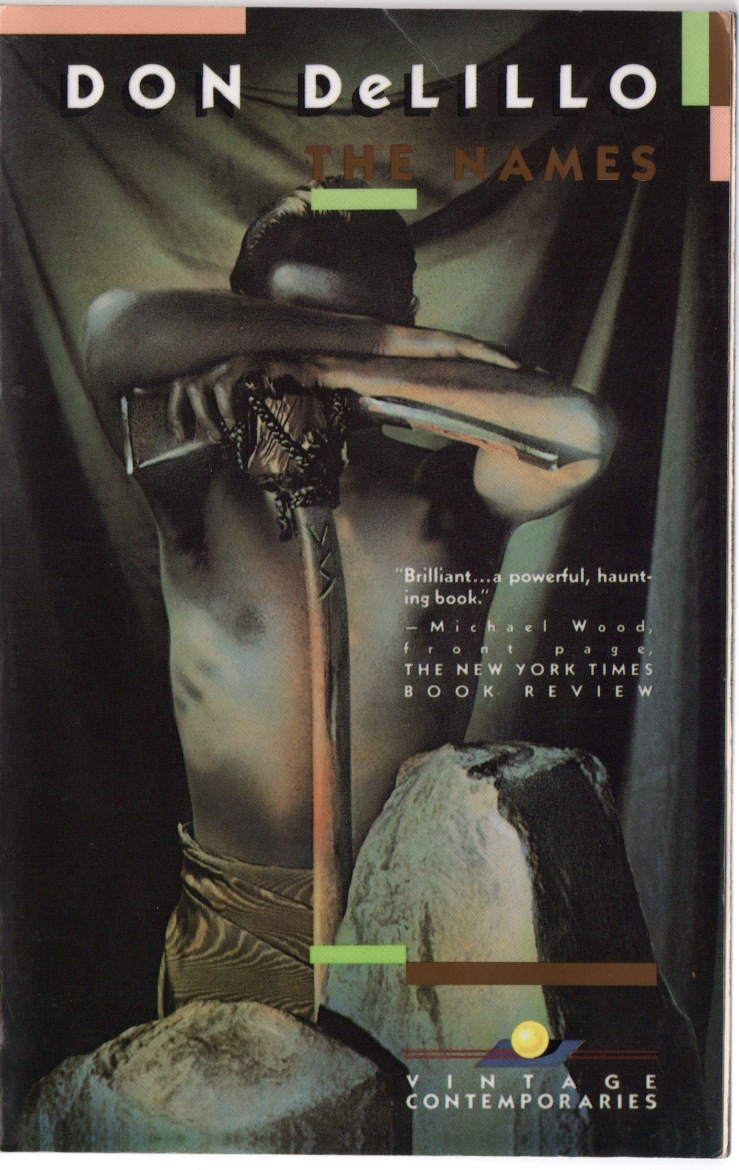
How is my progress on that 2018 list, you ask? Not great. I stalled out on William Gass’s The Tunnel after about 60 pages. I usually have fun reading Gass and I wasn’t having fun; in fact, I started approaching the book as a chore, which is not what I want to be doing with my spare time. I got sidetracked with Stanisław Witkiewicz’s Narcotics (not on The List—I hope to have a review up this week), and then picked up Don DeLillo’s The Names (on The List) instead of The Tunnel. I sank into the DeLillo, which feels a bit like a smart beach read after tangling with The Tunnel’s difficult defensive barriers. I plan to dip into The Bell next, and then approach the bigger books on The List—MiddlemarchWar & Peace, uh, The Tunnel—this summer when my teaching load is a lot lighter.


Hunger, Madness, Crime — Antoine Wiertz

antoine_wiertz_-_faim2c_folie_et_crime

Hunger, Madness, Crime, 1851 by Antoine Wiertz (1806 – 1865)

Some pleasures overflow the conditions attending them (Don DeLillo)

He had bitten into a peach and was smelling the pit-streaked flesh. I think I smiled, recognizing my own mannerism. These peaches were a baffling delight, certain ones, producing the kind of sense pleasure that’s so unexpectedly deep it seems to need another context. Ordinary things aren’t supposed to be this gratifying. Nothing about the exterior of the peach tells you it will be so lush, moist and aromatic, juices running along your gums, or so subtly colored inside, a pink-veined golden bloom. I tried to discuss this with the faces across the table.

“But I think pleasure is not easy to repeat,” Eliades said. “Tomorrow you will eat a peach from the same basket and be disappointed. Then you will wonder if you were mistaken. A peach, a cigarette. I enjoy one cigarette out of a thousand. Still I keep smoking. I think pleasure is in the moment more than in the thing. I keep smoking to find this moment. Maybe I will die trying.”

Possibly it was his appearance that gave these remarks the importance of a world view. His wild beard covered most of his face. It started just below the eyes. He seemed to be bleeding this coarse black hair. His shoulders curved forward as he spoke and he rocked slightly at the front edge of the chair. He wore a tan suit and pastel tie, an outfit at odds with the large fierce head, the rough surface he carried.

I tried to pursue the notion that some pleasures overflow the conditions attending them. Maybe I was a little drunk.

From Don DeLillo’s novel The Names.

adriaen_coorte_-_three_peaches_on_a_stone_ledge_with_a_painted_lady_butterfly

Three Peaches on a Stone Ledge with a Painted Lady Butterfly, 1695 by Adriaen Coorte (ca. 1665–1707)

Black Pegasus — Tomohiro Takagi

016_Tomohiro-Takagi_Black-Pegasus

Black Pegasus, 2010 by Tomohiro Takagi (b. 1972)

The Open Door — James McNeill Whistler

the-open-door

The Open Door, c. 1901 by James McNeill Whistler (1834-1903)

Exorcism — Natalie Frank

w33

Exorcism, 2012 by Natalie Frank (b. 1980)

“They may, because I would not cloy your ear– ” — John Berryman

Capture

Cursed Forest — Kilian Eng

tumblr_oveiuu5e8b1qbluruo1_1280

Cursed Forest by Kilian Eng (b. 1982)

“To the Garden of the World” — Walt Whitman

img_9017

From the Heritage Press edition of Walt Whitman’s Leaves of Grass, illustrated by Rockwell Kent, 1936.

That Which I Should Have Done I Did Not Do (The Door) — Ivan Albright

69579-050-a27a5236
That Which I Should Have Done I Did Not Do (The Door), 1931/41 by Ivan Albright (1897-1983)

Understanding Leda — Heidi Taillefer

heidi-taillefer-understanding-leda

Understanding Leda, 2014 by Heidi Taillefer

Undiscovered Genius — Jean-Michel Basquiat

photo

Undiscovered Genius, 1983 by Jean-Michel Basquiat (1960-1988)

Tourism is the march of stupidity (Don DeLillo)

My life was full of routine surprises. One day I was watching runners from Marathon dodge taxis near the Athens Hilton, the next I was turning a corner in Istanbul to see a gypsy leading a bear on a leash. I began to think of myself as a perennial tourist. There was something agreeable about this. To be a tourist is to escape accountability. Errors and failings don’t cling to you the way they do back home. You’re able to drift across continents and languages, suspending the operation of sound thought. Tourism is the march of stupidity. You’re expected to be stupid. The entire mechanism of the host country is geared to travelers acting stupidly. You walk around dazed, squinting into fold-out maps. You don’t know how to talk to people, how to get anywhere, what the money means, what time it is, what to eat or how to eat it. Being stupid is the pattern, the level and the norm. You can exist on this level for weeks and months without reprimand or dire consequence. Together with thousands, you are granted immunities and broad freedoms. You are an army of fools, wearing bright polyesters, riding camels, taking pictures of each other, haggard, dysenteric, thirsty. There is nothing to think about but the next shapeless event.

From Don DeLillo’s novel The Names.


Parson Weems’ Fable — Grant Wood

parson-weemss-fable-amon-carter-museum-of-american-2

Parson Weems’ Fable, 1939 by Grant Wood (1891–1942)

Sic transit sin (George Herriman’s Krazy Kat)

img_9053

“The 27 Depravities” — Don DeLillo

Every day made her more certain of my various failings. I compiled a mental list, which I often recited aloud to her, asking how accurate it was in reflecting her grievances. This was my chief weapon of the period. She hated the feeling that someone knew her mind.

1.      Self-satisfied.

2.      Uncommitted.

3.      Willing to settle.

4.      Willing to sit and stare, conserving yourself for some end-of-life event, like God’s face or the squaring of the circle.

5.      You like to advertise yourself as refreshingly sane and healthy in a world of driven neurotics. You make a major production of being undriven.

6.      You pretend.

7.      You pretend not to understand other people’s motives.

8.      You pretend to be even-tempered. You feel it gives you a moral and intellectual advantage. You are always looking for an advantage.

9.      You don’t see anything beyond your own modest contentment. We all live on the ocean swell of your well-being. Everything else is trivial and distracting, or monumental and distracting, and only an unsporting wife or child would lodge a protest against your teensy weensy happiness.

10.   You think being a husband and father is a form of Hitlerism and you shrink from it. Authority makes you uneasy, doesn’t it? You draw back from anything that resembles an official capacity.

11.   You don’t allow yourself the full pleasure of things.

12.   You keep studying your son for clues to your own nature.

13.   You admire your wife too much and talk about it too much. Admiration is your public stance, a form of self-protection if I read it correctly.

14.   Gratified by your own feelings of jealousy.

15.   Politically neuter.

16.   Eager to believe the worst.

17.   You will defer to others, you will be acutely sensitive to the feelings of strangers, but you will contrive to misunderstand your family. We make you wonder if you are the outsider in this group.

18.   You have trouble sleeping, an attempt to gain my sympathy.

19.   You sneeze in books.

20.   You have an eye for your friends’ wives. Your wife’s friends. Somewhat speculative, somewhat detached.

21.   You go to extremes to keep your small mean feelings hidden. Only in arguments do they appear. Completing your revenge. Hiding it even from yourself at times. Not willing to be seen taking your small mean everyday revenge on me, which, granted, I have sometimes abundantly earned. Pretending your revenge is a misinterpretation on my part, a misunderstanding, some kind of accident.

22.   You contain your love. You feel it but don’t like to show it. When you do show it, it is the result of some long drawn-out decision making process, isn’t it, you bastard.

23.   Nurser of small hurts.

24.   Whiskey sipper.

25.   Underachiever.

26.   Reluctant adulterer.

27.   American.

We came to refer to these as the 27 Depravities, like some reckoning of hollow-cheeked church theologians. Since then I’ve sometimes had to remind myself it was my list, not hers.

From Don DeLillo’s novel The Names.

img_2722

Illustration for Frankenstein — Bernie Wrightson

27698926799_ffde169509_o