Eddie Campbell’s canon of great graphic novels, 1977-2001

Eddie Campbell’s book Alec: How to Be an Artist (Eddie Campbell Comics, 2001) covers the “rise and fall of the graphic” over the course of a few decades. Alec combines memoir with art history and art criticism, all told through scratchy inks and spidery lettering (and plenty of pastiche–Campbell literally pastes the work of other comic artists of the last century throughout the book, along with “serious” artwork  ). While Campbell’s autobiographical stand-in “Alec MacGarry” is obviously central to the story, other figures loom here, including Bill Sienkiewicz (“Billy the Sink”), Art Spiegelman, Stephen Bissette, Dave Sim, Eastman and Laird—and especially Campbell’s From Hell partner, Alan Moore.

How to Be an Artist offers a fascinating and personal look at the time before (and immediately after) comic books reached a tipping point into (gasp!) serious artistic respectability. Witty, warm, and occasionally cruel, Campbell’s book explores the intersection of commerce and art in a very particular place and a very particular time.

The book was especially revelatory for me, I suppose: I transitioned from super hero comics to, like comix in the early nineties, a transition helped by works championed in How to Be an Artist, like Neil Gaiman and Dave McKean’s Sandman books and Dave Sim’s Cerebus. Indeed, the backpages of Cerebus in the late eighties and early nineties operated like a long messy ranty meditation on the theme of “How to be an (independent, successful, self-publishing) artist”—and it was also in the backpages of an issue of Cerebus that I first saw Campbell’s work (the prologue of From Hell was published in Cerebus #124).

How to Be an Artist’s final chapter sees Campbell offer up a canon of “graphic novels” from 1977 to 2001 (I’ve typed out the full list at the bottom of this post). Campbell (or, properly, Campbell’s persona Alec) begins the chapter by dwelling on the problematic term “graphic novel”:
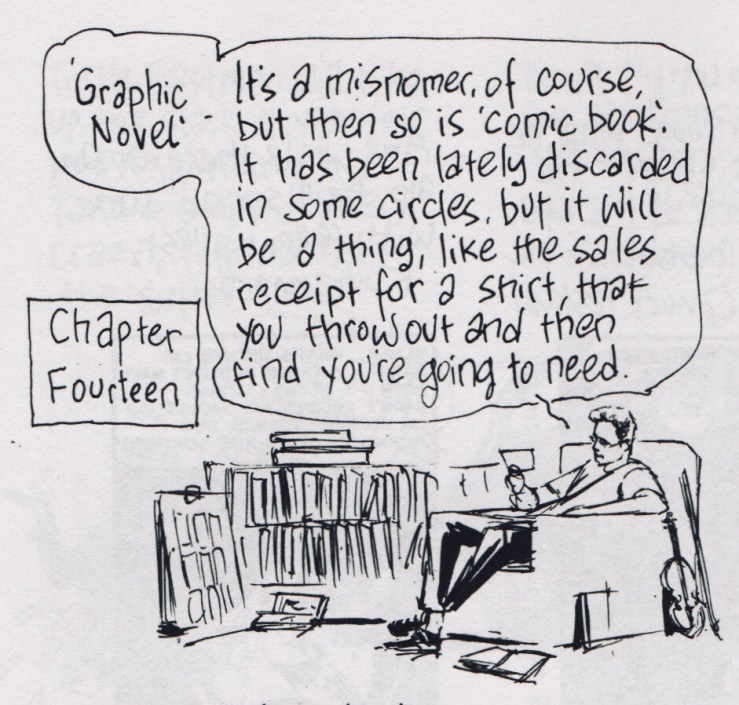
img_8424

After resolving to use the term, despite whatever problems might be attached to it, Campbell goes on to point out that, after the success of works like Watchmen and Maus, a glut of so-called “graphic novels” flooded the market place. He then goes about naming the best, those works that represent a “worthwhile phase in the human cultural continuum”:
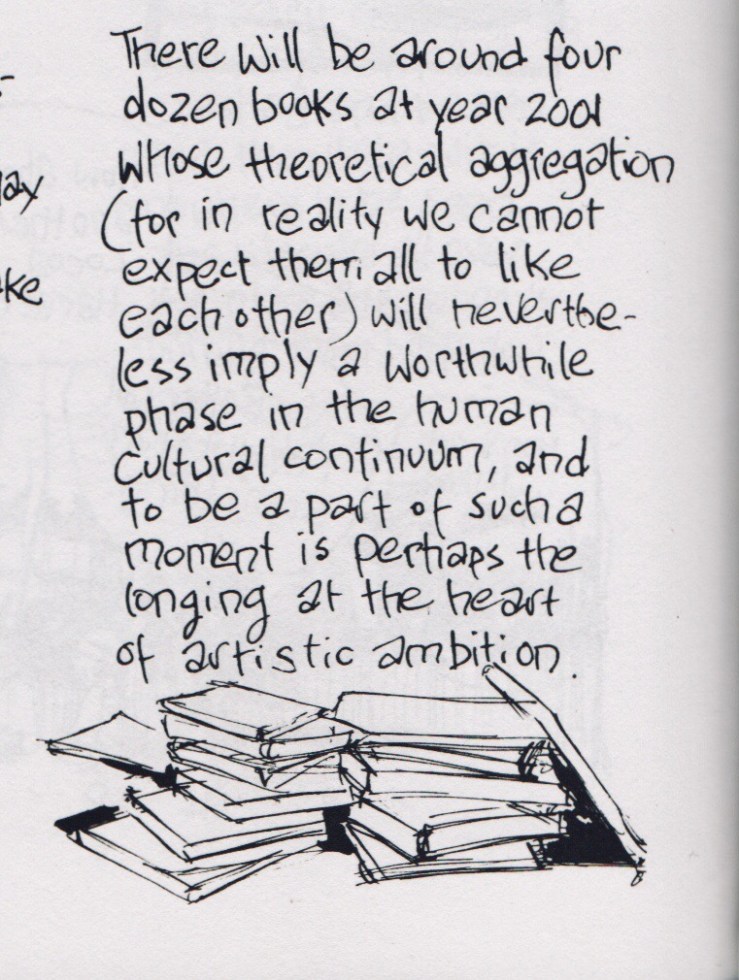
img_8424-1

The list is organized semi-chronologically; Campbell groups works in a series together, as with Will Eisner’s Dropsie Ave books. Here’s the first page of the canon, to give you an idea of its form and layout (note that the list, like the entire book, is written in the future tense):
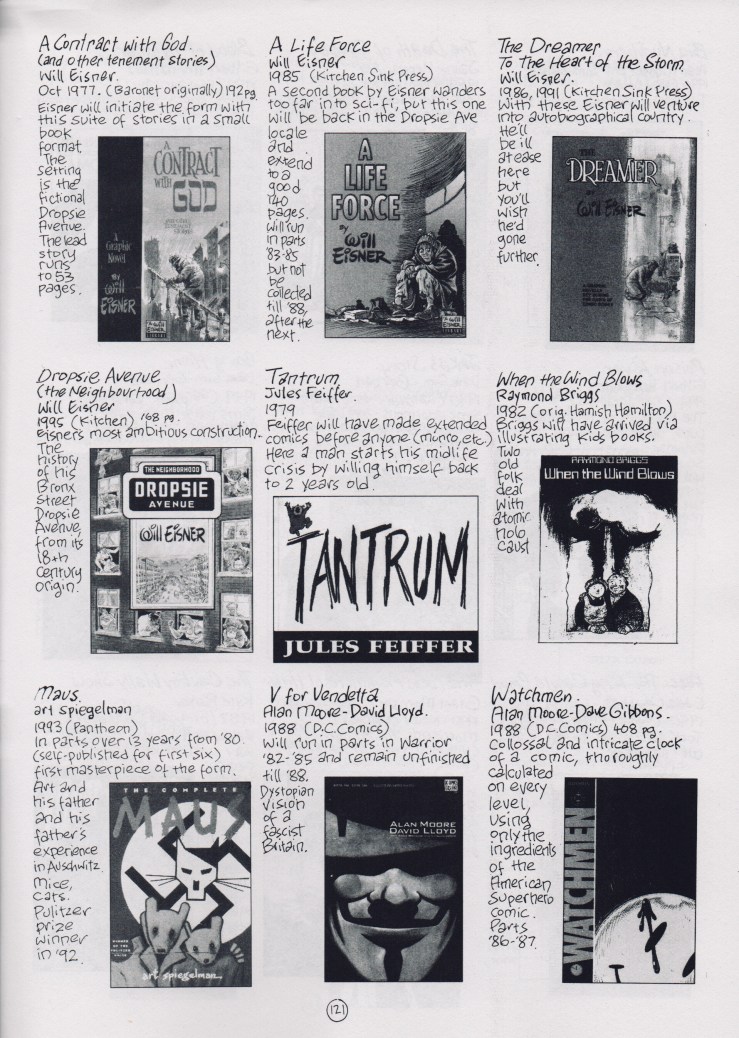
img_8425

I’ve never read When the Wind Blows.

I’ve also never read, to my shame, the unfinished project Big Numbers (by Alan Moore and Bill Sienkiewicz). Campbell details the drama surrounding why the project was never finished in How to Be an Artist. I’ll have to track it down.
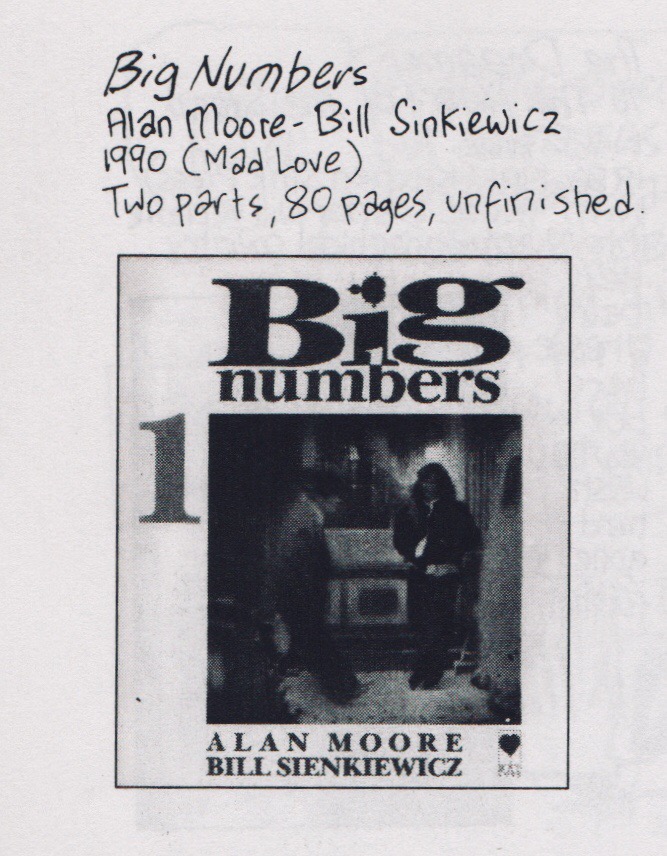
img_8427-2

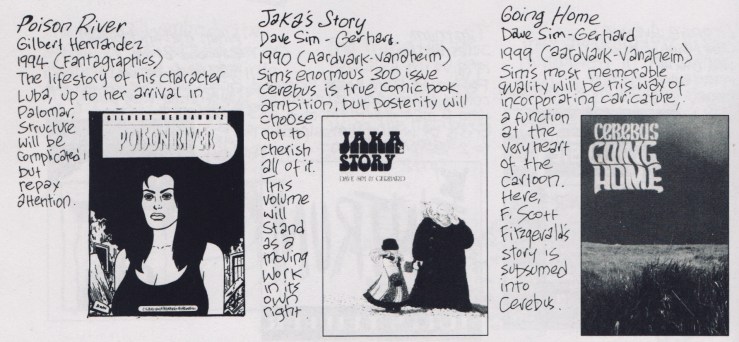
Campbell includes a trio of Love & Rockets novels. Poison River is the first one I read. I was a junior in high school; I checked it out from the public library. Somehow my mother saw it, flicked through it, and was mortified.
img_8427-1

Campbell seems to split the difference on Dave Sim’s Cerebus, including critical favorite Jaka’s Story along with the later novel Going Home (which sees Sim trying to reign in the project and steer it toward a conclusion). (Nobody asked me but I would’ve included Church & State and Church & State II).
img_8430

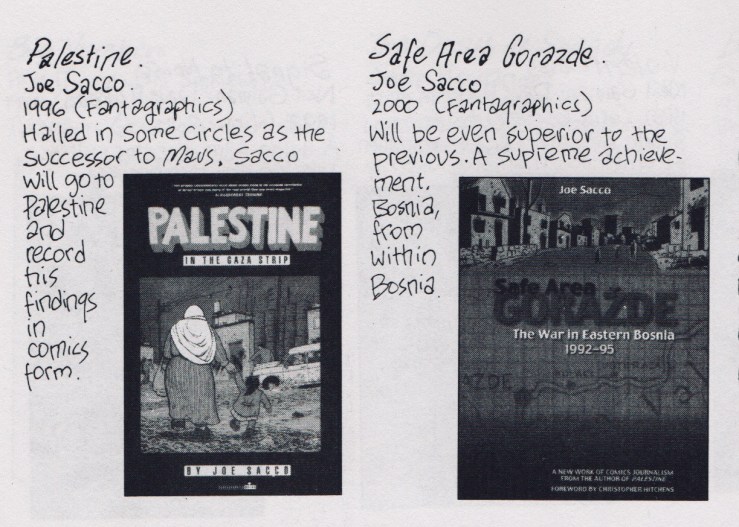
Joe Sacco’s comix-journalism is excellent, and Campbell includes both Palestine and Safe Area Gorazde. These “graphic novels” (they aren’t really graphic novels, except that they are) expanded what was possible not just in comics, but also in journalism.
img_8430-1

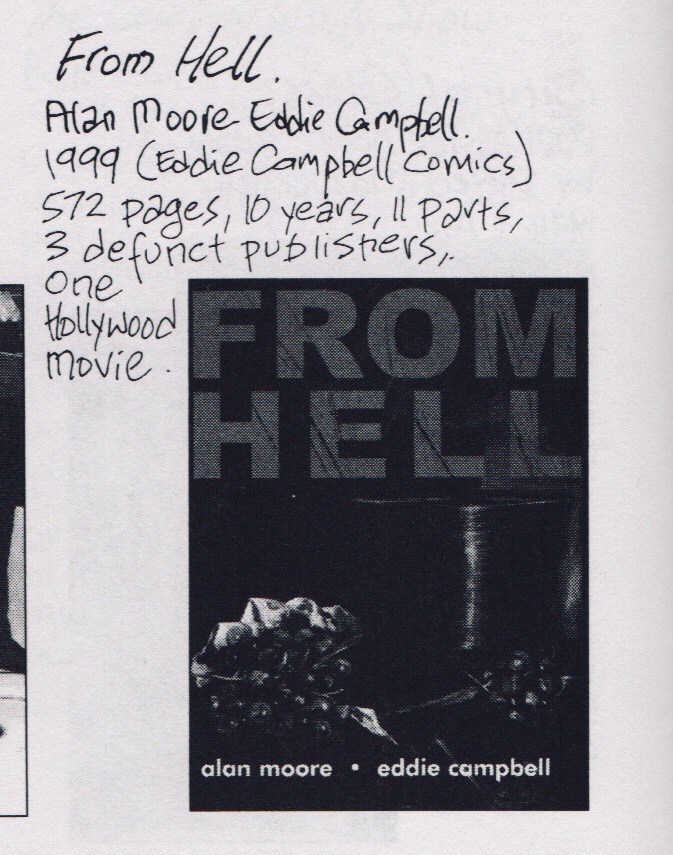
From Hell isn’t the only one of his own works that Campbell includes on his list—he also includes another Alec novel, The King of Canute Crowd. I love the gesture—an artist fully assured of the qualities in his best work. For the record, if pressed to name “the best graphic novel” I would probably immediately say, “Oh, it’s From Hell of course” (and then hem and haw and hedge, bringing up Chris Ware’s Building Stories, the first half of Sim’s Cerebus project, David Mazzucchelli’s Asterios PolypLove & Rockets, etc.).

img_8431

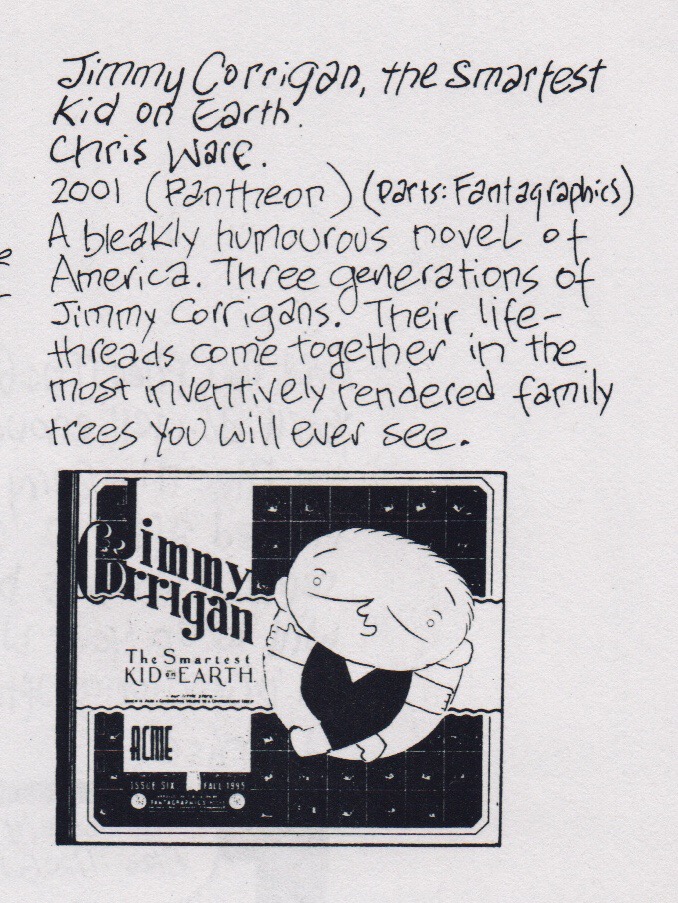
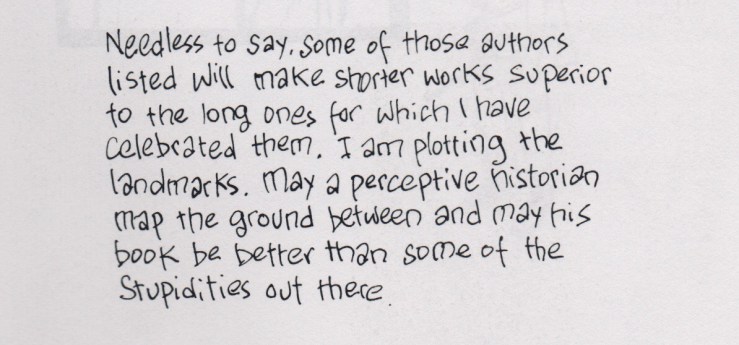
Chris Ware’s Jimmy Corrigan shows up on the list, of course. I’m sure Building Stories would be on here too—along with dozens of others—if the list were updated. Indeed, Campbell’s canon (my term, not his), ends with this disclaimer:
img_8431-1


Here’s the full list:


A Contract with God, Will Eisner, 1977

A Life Force, Will Eisner, 1985

The Dreamer, Will Eisner, 1986/1991

Dropsie Avenue, Will Eisner, 1995

Tantrum, Jules Feiffer, 1979

When the Wind Blows, Raymond Briggs, 1982

Maus, Art Spiegleman, 1991

V for Vendetta, Alan Moore and David Lloyd, 1988

Watchmen, Alan Moore and Dave Gibbons, 1988

Big Numbers, Alan Moore and Bill Sienkiewicz, 1990

The Death of Speedy, Jaime Hernandez, 1989

Blood of Palomar, Gilbert Hernandez, 1989

Poison River, Gilbert Hernandez, 1994

Jaka’s Story, Dave Sim and Gerhard, 1990

Going Home, Dave Sim and Gerhard, 1999

Alec: The King Canute Crowd, 1990

The New Adventures of Hitler, Grant Morrison and Steve Yeowell, 1990

The Cowboy Wally Show, Kyle Baker, 1987

Why I Hate Saturn, Kyle Baker, 1990

Violent Cases, Neil Gaiman and Dave McKean, 1987

Signal to Noise, Neil Gaiman and Dave McKean, 1992

Mr. Punch, Neil Gaiman and Dave McKean, 1995

Casanova’s Last Stand, Hunt Emerson, 1993

Tale of One Bad Rat, Bryan Talbot, 1995

City of Glass, Paul Auster/David Mazzucchelli, 1994

The Playboy/I Never Liked You, Chester Brown, 1991/1994

Stuck Rubber Baby, Howard Cruse, 1995

Palestine, Joe Sacco, 1996

Safe Area Gorazde, Joe Sacco, 2000

Ghost World, Daniel Clowes, 1997/2000

It’s a Good Life If You Don’t Weaken, Seth, 1997

Ethel and Ernest, Raymond Briggs, 1998

Gemma Bovery, Posy Simmonds, 1999

Cages, Dave McKean, 1998

Uncle Sam, Steve Darnall and Alex Ross, 1998

From Hell, Alan Moore and Eddie Campbell, 1999

Hicksville, Dylan Horrocks, 1998

The Jew of New York, Ben Katchor, 1998

Jimmy Corrigan, the Smartest Kid on Earth, Chris Ware, 2001

Goodbye, Chunky Rice, Craig Thompson, 1999

Dear Julia, Brian Biggs, 2000

Berlin, Jason Lutes, 2001
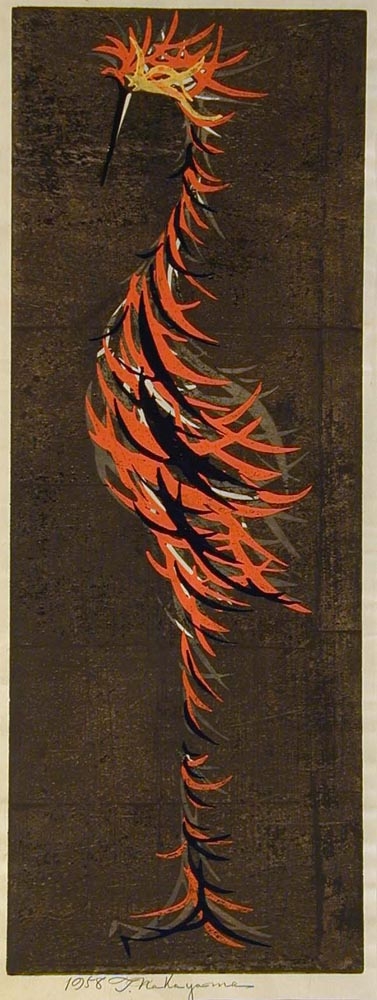


Incarnation — Tadashi Nakayama

incarnation-moku-1958

Incarnation, 1958 by Tadashi Nakayama (1927-2014)

I ♡ a millionaire

Unexpected Answer — Rene Magritte

4939817

Unexpected Answer, 1933 by Rene Magritte (1898-1967)

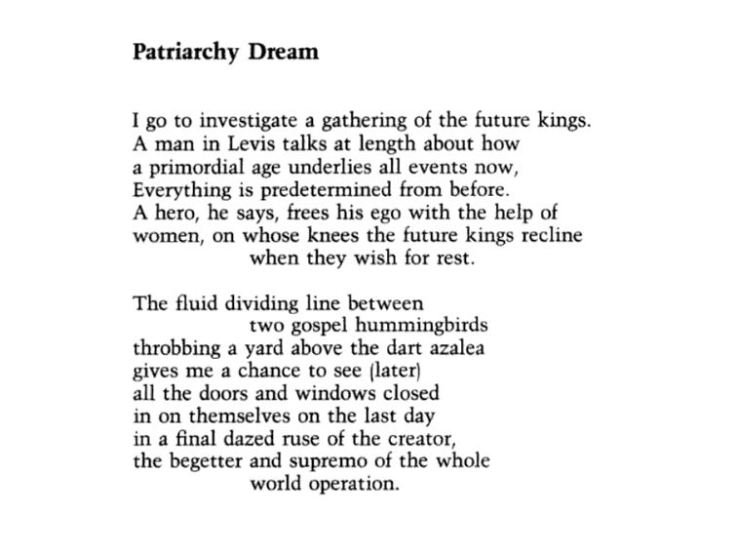
“Patriarchy Dream” — Tom Clark

patriarchy dream

List with No Name #60

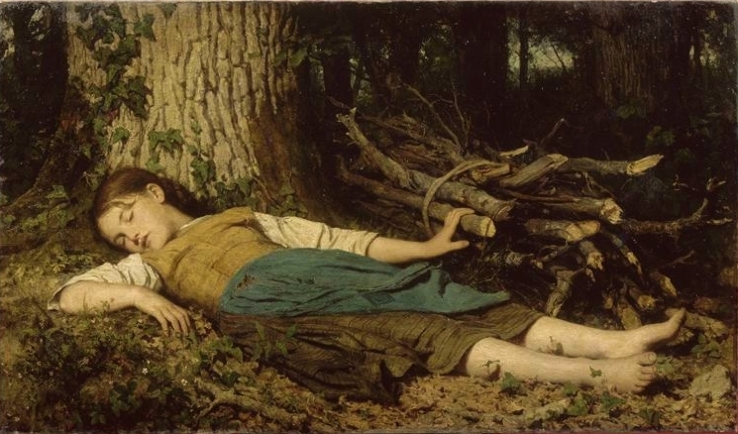
dans-les-bois-1865

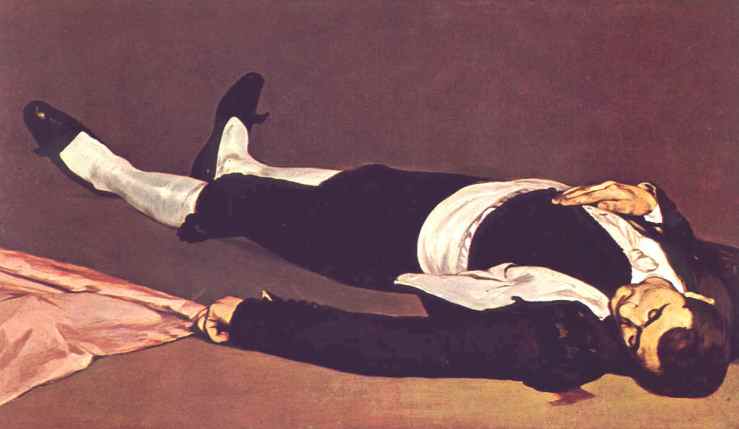
the-dead-toreador-1865(1)

reclining-nude-2002

reclining-female-nude-1501halfhd

sleep

henri-regnault-dead-on-the-field-of-battle-1870-1hd

reclining-nude-1917-1

the-artist-s-mother-sleeping-1911

30205493802_a738db2db9_b

young-woman-reclining-in-spanish-costume-1863halfhd

sleeping-child

tumblr_ohas4lzjj11sxx9qco1_1280

sleep-1908

naked-portrait-1

reclining-nude

reclining-female-nude-1907

6630260724164207126

reclining-model

Lucian Freud 1922-2011 http:/www.tuttartpitturasculturapoesiamusica.com;

sleeping-cupid-16081

laid-down-woman-sleeping-1899halfhd

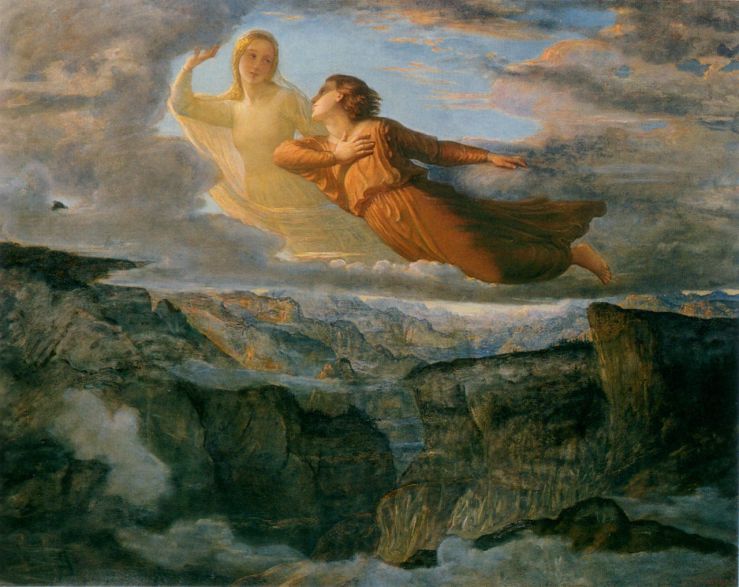
The Ideal — Louis Janmot

1280px-louis_janmot_-_poc3a8me_de_l27c3a2me_17_-_le28099idc3a9al

Poème de l’âme 17: L’Idéal Louis Janmot (Poem of the Soul 17: The Ideal) by Louis Janmot (1814-1892)

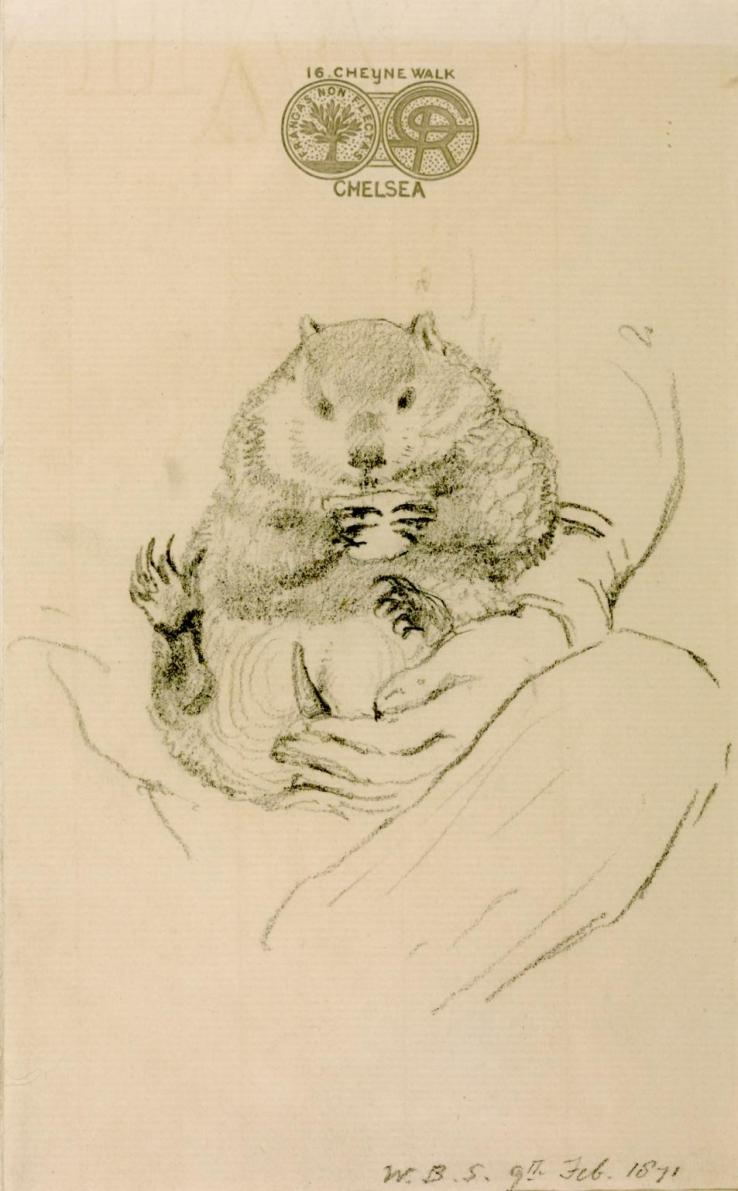
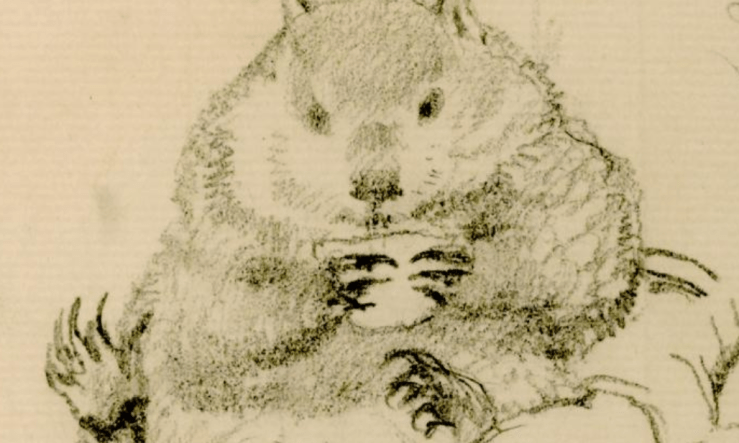
Rossetti’s Wombat Seated in his Master’s Lap — William Bell Scott

Rossetti's Wombat Seated in his Master's Lap 1871 by William Bell Scott 1811-1890

Screenshot 2017-11-08 at 8.38.19 PM

Rossetti’s Wombat Seated in his Master’s Lap 1871 by William Bell Scott (1811-1890)

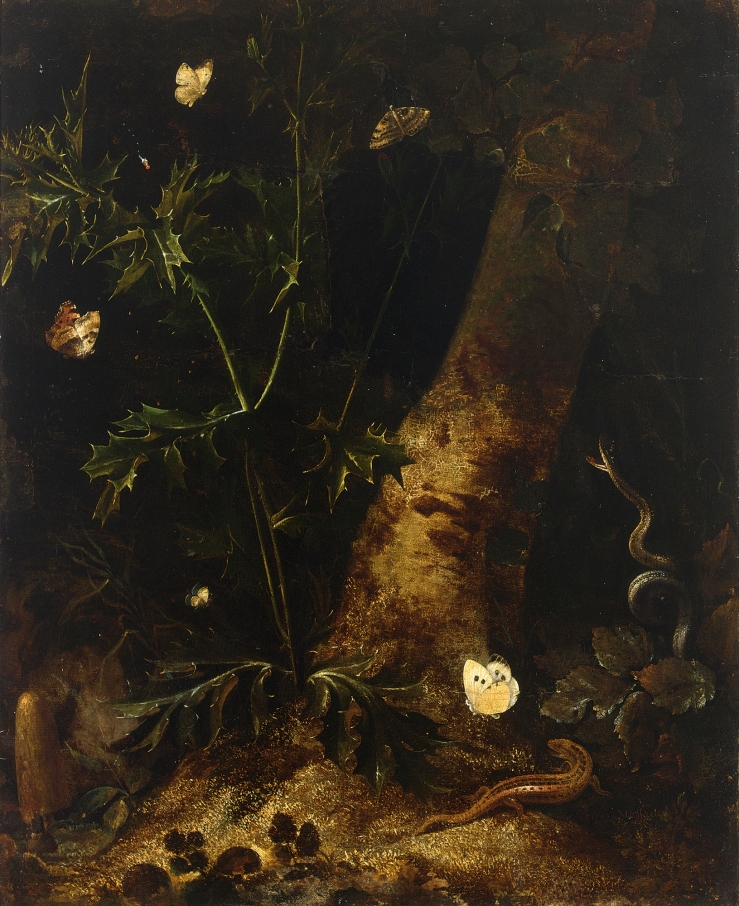
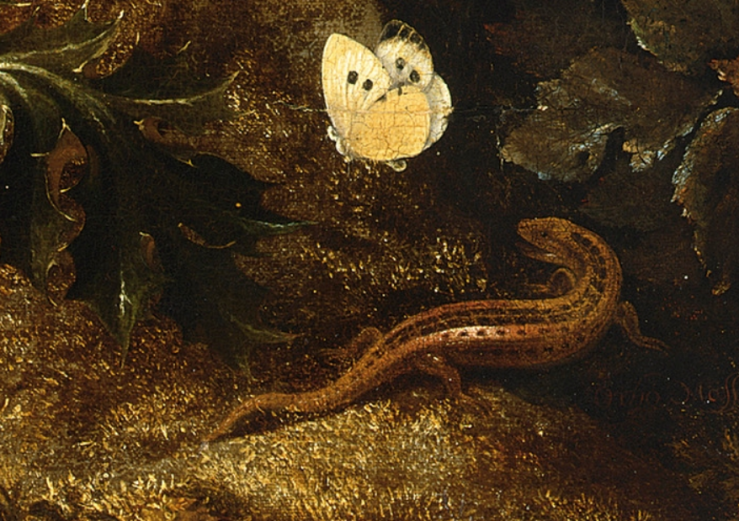
Forest Floor Still Life with a Salamander, Snake and Various Butterflies around a Thistle — Otto Marseus van Schrieck

a-forest-floor-still-life-with-a-salamander-snake-and-various-butterflies-around-a-thistleScreenshot 2017-11-08 at 2.13.28 PM

 Forest Floor Still Life with a Salamander, Snake and Various Butterflies around a Thistle, by Otto Marseus van Schrieck (1613-1678)

Expect no more love and tenderness from Mother Nature | Nathaniel Hawthorne’s journal entry for November 8th, 1842

November 8th.–I am sorry that our journal has fallen so into neglect; but I see no chance of amendment. All my scribbling propensities will be far more than gratified in writing nonsense for the press; so that any gratuitous labor of the pen becomes peculiarly distasteful. Since the last date, we have paid a visit of nine days to Boston and Salem, whence we returned a week ago yesterday. Thus we lost above a week of delicious autumnal weather, which should have been spent in the woods or upon the river. Ever since our return, however, until to-day, there has been a succession of genuine Indian-summer days, with gentle winds, or none at all, and a misty atmosphere, which idealizes all nature, and a mild, beneficent sunshine, inviting one to lie down in a nook and forget all earthly care. To-day the sky is dark and lowering, and occasionally lets fall a few sullen tears. I suppose we must bid farewell to Indian summer now, and expect no more love and tenderness from Mother Nature till next spring be well advanced. She has already made herself as unlovely in outward aspect as can well be. We took a walk to Sleepy Hollow yesterday, and beheld scarcely a green thing, except the everlasting verdure of the family of pines, which, indeed, are trees to thank God for at this season. A range of young birches had retained a pretty liberal coloring of yellow or tawny leaves, which became very cheerful in the sunshine. There were one or two oak-trees whose foliage still retained a deep, dusky red, which looked rich and warm; but most of the oaks had reached the last stage of autumnal decay,–the dusky brown hue. Millions of their leaves strew the woods and rustle underneath the foot; but enough remain upon the boughs to make a melancholy harping when the wind sweeps over them. We found some fringed gentians in the meadow, most of them blighted and withered; but a few were quite perfect. The other day, since our return from Salem, I found a violet; yet it was so cold that day, that a large pool of water, under the shadow of some trees, had remained frozen from morning till afternoon. The ice was so thick as not to be broken by some sticks and small stones which I threw upon it. But ice and snow too will soon be no extraordinary matters with us.

During the last week we have had three stoves put up, and henceforth no light of a cheerful fire will gladden us at eventide. Stoves are detestable in every respect, except that they keep us perfectly comfortable.

Nathaniel Hawthorne’s journal entry for November 8th, 1842. From Passages from the American Note-Books.

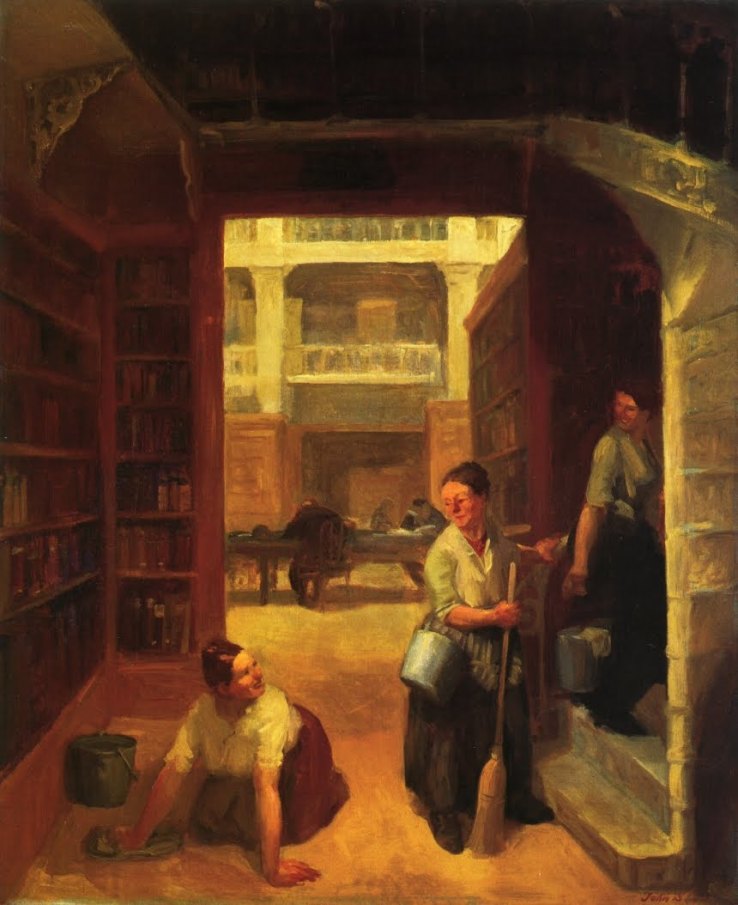
Scrubwoman, Astor Library — John French Sloan

scrubwoman2bastor2blibrary

Scrubwoman, Astor Library, 1911 by John French Sloan

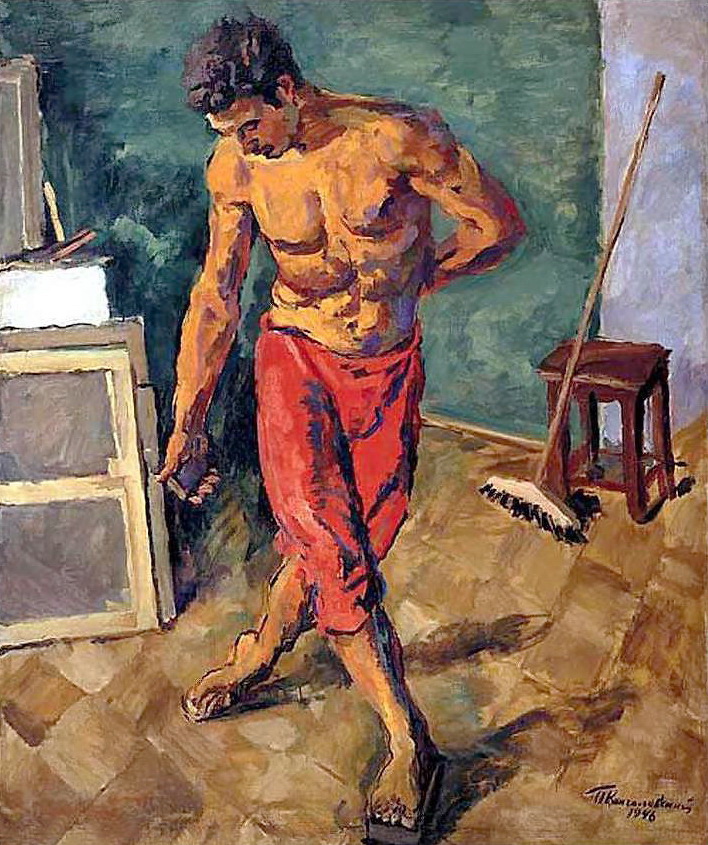
Floor Polisher — Pyotr Konchalovsky

floor-polisher-1946

Floor Polisher, 1946 by Pyotr Konchalovsky (1876–1956)

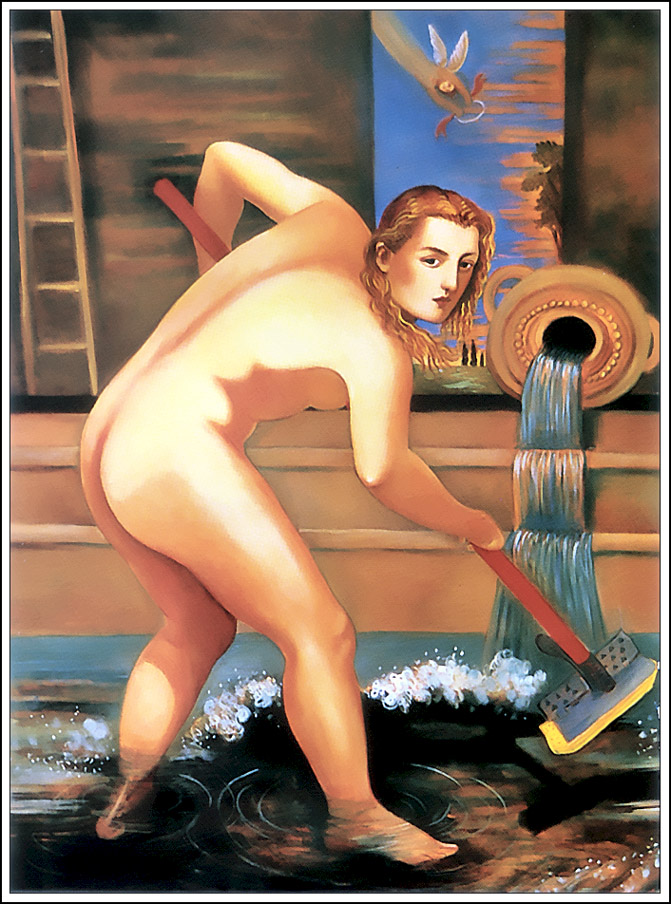
Eternal Mopping — Edith Vonnegut

DG-029-EdithVonnegut-EternalMopping_je

Eternal Mopping by Edith Vonnegut (b. 1949)

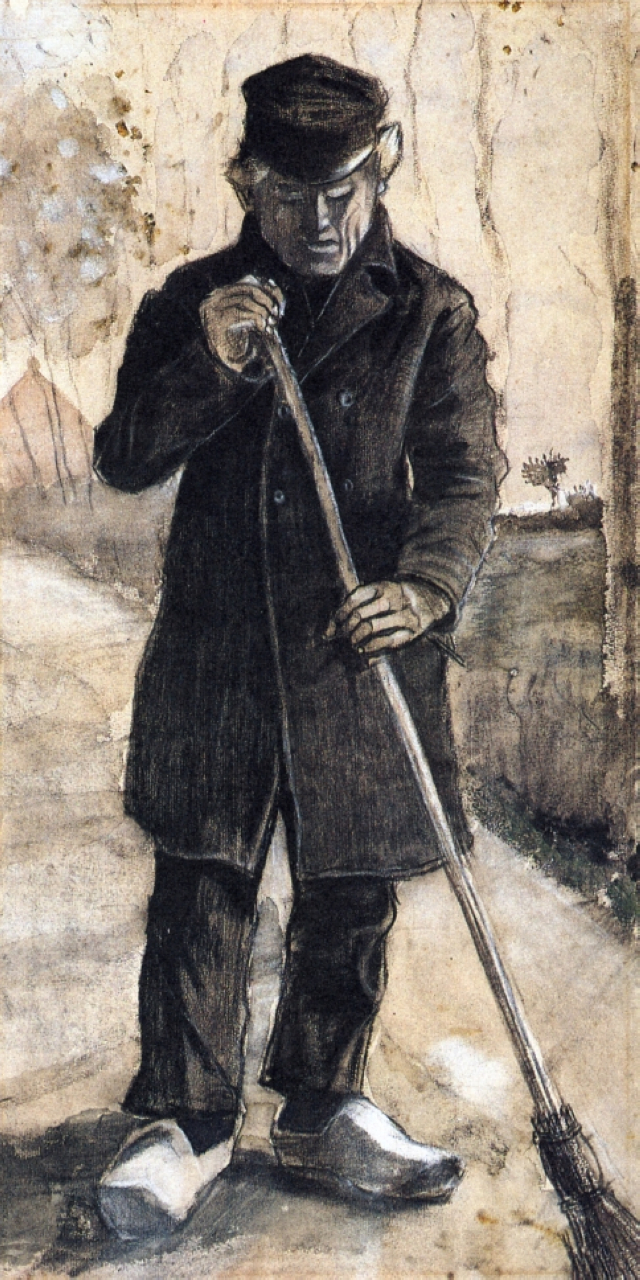
A Man with a Broom — Vincent van Gogh

a-man-with-a-broom-18811

A Man with a Broom, 1881 by Vincent van Gogh (1843-1890)

New Broom — Tim Mara

New Broom 1987 by Tim Mara 1948-1997

New Broom, 1987 by Tim Mara (1948–1997)

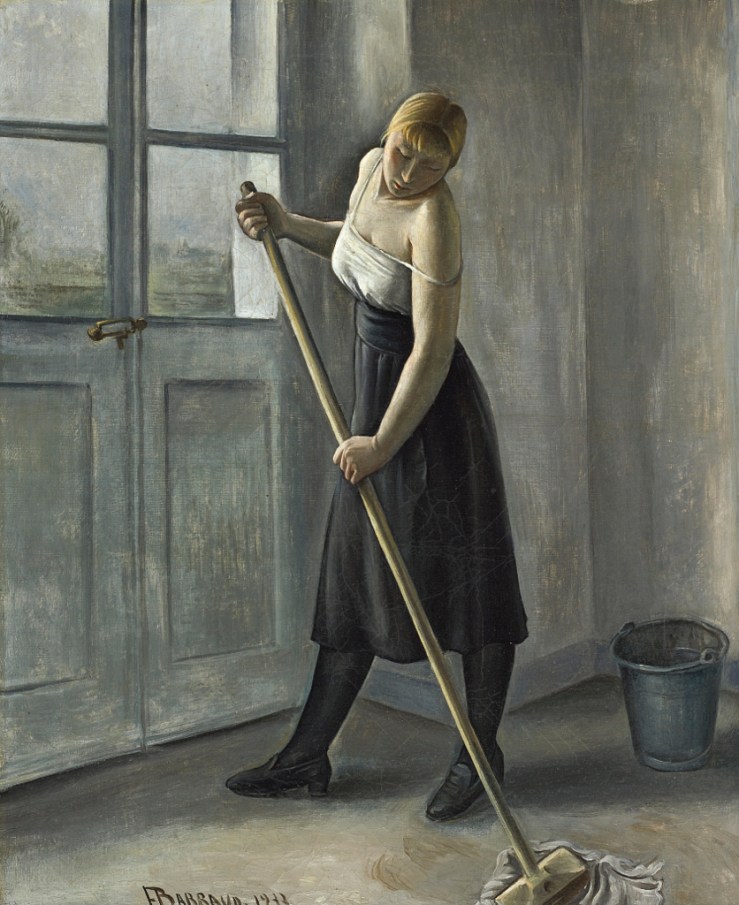
Girl Cleaning — François Barraud

6e2394512497b94a3d06d68e221c2a94

Girl Cleaning, 1933 by François Barraud (1899–1934)

“Slang in America,” an essay by Walt Whitman

“Slang in America”

by

Walt Whitman


View’d freely, the English language is the accretion and growth of every dialect, race, and range of time, and is both the free and compacted composition of all. From this point of view, it stands for Language in the largest sense, and is really the greatest of studies. It involves so much; is indeed a sort of universal absorber, combiner, and conqueror. The scope of its etymologies is the scope not only of man and civilization, but the history of Nature in all departments, and of the organic Universe, brought up to date; for all are comprehended in words, and their backgrounds. This is when words become vitaliz’d, and stand for things, as they unerringly and soon come to do, in the mind that enters on their study with fitting spirit, grasp, and appreciation.

Slang, profoundly consider’d, is the lawless germinal element, below all words and sentences, and behind all poetry, and proves a certain perennial rankness and protestantism in speech. As the United States inherit by far their most precious possession—the language they talk and write—from the Old World, under and out of its feudal institutes, I will allow myself to borrow a simile even of those forms farthest removed from American Democracy. Considering Language then as some mighty potentate, into the majestic audience-hall of the monarch ever enters a personage like one of Shakspere’s clowns, and takes position there, and plays a part even in the stateliest ceremonies. Such is Slang, or indirection, an attempt of common humanity to escape from bald literalism, and express itself illimitably, which in highest walks produces poets and poems, and doubtless in pre-historic times gave the start to, and perfected, the whole immense tangle of the old mythologies. For, curious as it may appear, it is strictly the same impulse-source, the same thing. Slang, too, is the wholesome fermentation or eructation of those processes eternally active in language, by which froth and specks are thrown up, mostly to pass away; though occasionally to settle and permanently crystallize.

To make it plainer, it is certain that many of the oldest and solidest words we use, were originally generated from the daring and license of slang. In the processes of word-formation, myriads die, but here and there the attempt attracts superior meanings, becomes valuable and indispensable, and lives forever. Thus the term right means literally only straight. Wrong primarily meant twisted, distorted. Integrity meant oneness. Spirit meant breath, or flame. A supercilious person was one who rais’d his eyebrows. To insult was to leap against. If you influenced a man, you but flow’d into him. The Hebrew word which is translated prophesy meant to bubble up and pour forth as a fountain. The enthusiast bubbles up with the Spirit of God within him, and it pours forth from him like a fountain. The word prophecy is misunderstood. Many suppose that it is limited to mere prediction; that is but the lesser portion of prophecy. The greater work is to reveal God. Every true religious enthusiast is a prophet. Continue reading ““Slang in America,” an essay by Walt Whitman”