Louis Takes Flight — F. Scott Hess

hess027

The Green Comet — Michael Hutter

tumblr_ncctksbuz21rlaql2o1_1280

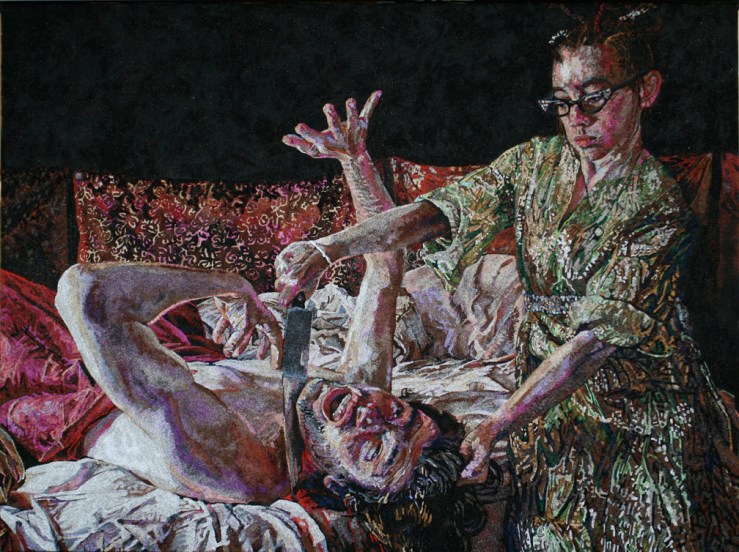
Judith and Holofernes — Jamie Vasta

giuditta

The Temptation of St. Anthony (detail) — Marten de Vos

Screenshot 2016-06-01 at 12.04.21 PM

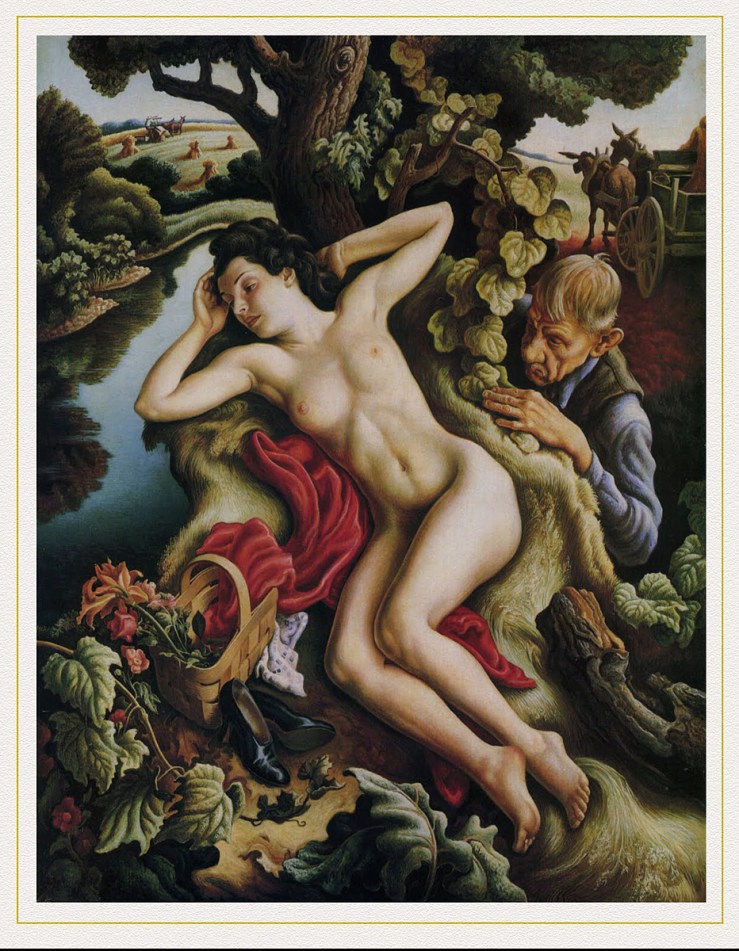
Persephone — Thomas Hart Benton

01_thomas_hart_benton_persephone_1939_100

The Temptation of St. Anthony (detail) — Marten de Vos

Screenshot 2016-06-01 at 12.00.37 PM

“Suicide’s Note” — Langston Hughes

Screenshot 2016-06-02 at 3

The Judgment of Paris — Dario Ortiz

darc3ado_ortiz_-_el_juicio_de_paris_o_paris_y_las_prepago

The Temptation of St. Anthony (detail) — Marten de Vos

Screenshot 2016-05-31 at 9.00.26 PM

Men will the laws of nature (From Stanley Elkin’s novel The Franchiser)

They drove up to the Broadmoor, a pink Monaco castle at the foot of the Rockies, and he showed her the hotel in a proprietary way, taking her through the nifty Regency public rooms with their beautiful sofas, the striped, silken upholstery like tasteful flags. He showed her huge tiaras of chandelier, soft plush carpets. “Yes,” she said, “carpets were our first floors, our first highways.”

“I didn’t know that.”

“We call the rug in the hall a ‘runner.’ It’s where the runners or messengers waited in the days of kings and emperors.”

“I never made the connection.”

“It’s an insight. Chandeliers must have come in with the development of lens astronomy at the beginning of the seventeenth century. I should think it was an attempt to mimic rather than parody the order of the heavens, to bring the solar system indoors.”

“Really?”

“Well, where, to simple people, would the universe seem to go during the daylight hours, Ben?”

“But chandeliers give light.”

“Not during the daytime. The chandelier is a complex invention—a sculpture of the invisible stars by day, a pragmatic mechanism by night. But a much less daring device finally than carpeting.”

“Why, Patty?”

“Because carpeting—think of Oriental rugs—was always primarily ornamental and decorative. It was a deliberate expression of what ground—our first flooring, remember, and incidentally we have to regard tile, too, as a type of carpeting—ought to be in a perfect world. Order, symmetry, design. And since rugs came in before lens telescopy, how could they know? Oh, carpeting’s much more daring. A leap of will.”

“Of will?”

“Men will the laws of nature.”

From Stanley Elkin’s 1976 novel The Franchiser.


Book Acquired 6.1.16

IMAG0163


Publisher (Repeater Books) sent me this intriguing first novel, The Aesthetics of Degradation, from translator Adrian Nathan West (Franz Werfel, Josef Winkler) the other day. Working on a review of Han Kang’s Human Acts right now (which is good, uh, really good), which will be up here soon (I hope!), but looking forward to this one from Mr. West. From the back:


Pornography keeps getting more extreme. Manufacturers, defenders and consumers of porn rely on a mix of wilful [sic] ignorance and bad faith to avoid serious discussion. When we do talk about violence against women in the porn world, the debate all too often becomes technical, complicated by legalities and outrage.

[…]

Collapsing distinctions between novel, memoir, and essay, this book will not make for light reading. But at its core is an extraordinarily brave and honest concern for the women and men who have been hurt in the name of sexual gratification.

There’s a blurb by Edmund White that I won’t reproduce. Is that important? I don’t know. Trying to be thorough.

The Miraculous Draft of Fishes — Konrad Witz

800px-konrad_witz_-_fischzug_petri

“Pain has an element of blank” — Emily Dickinson

Screenshot 2016-05-31 at 8.55.21 PM

The Temptation of St. Anthony (detail) — Marten de Vos

Screenshot 2016-05-31 at 4.16.09 PM

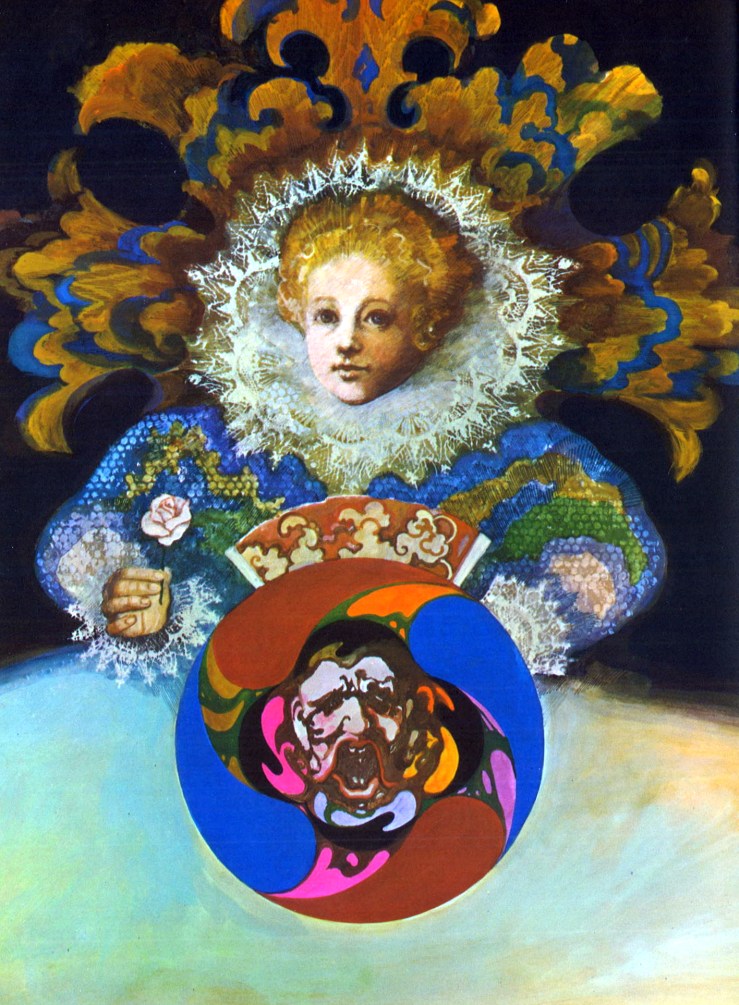
Illustration for Oscar Wilde’s “The Birthday of the Infanta” — James Hill

Birthday Infanta

James Hill’s illustration for “The Birthday of the Infanta” by Oscar Wilde. From The Short Stories of Oscar Wilde, Heritage Press, 1968.


“The Birthday of the Infanta”

by

Oscar Wilde


It was the birthday of the Infanta.  She was just twelve years of age, and the sun was shining brightly in the gardens of the palace.

Although she was a real Princess and the Infanta of Spain, she had only one birthday every year, just like the children of quite poor people, so it was naturally a matter of great importance to the whole country that she should have a really fine day for the occasion.  And a really fine day it certainly was.  The tall striped tulips stood straight up upon their stalks, like long rows of soldiers, and looked defiantly across the grass at the roses, and said: ‘We are quite as splendid as you are now.’  The purple butterflies fluttered about with gold dust on their wings, visiting each flower in turn; the little lizards crept out of the crevices of the wall, and lay basking in the white glare; and the pomegranates split and cracked with the heat, and showed their bleeding red hearts.  Even the pale yellow lemons, that hung in such profusion from the mouldering trellis and along the dim arcades, seemed to have caught a richer colour from the wonderful sunlight, and the magnolia trees opened their great globe-like blossoms of folded ivory, and filled the air with a sweet heavy perfume.

The little Princess herself walked up and down the terrace with her companions, and played at hide and seek round the stone vases and the old moss-grown statues.  On ordinary days she was only allowed to play with children of her own rank, so she had always to play alone, but her birthday was an exception, and the King had given orders that she was to invite any of her young friends whom she liked to come and amuse themselves with her.  There was a stately grace about these slim Spanish children as they glided about, the boys with their large-plumed hats and short fluttering cloaks, the girls holding up the trains of their long brocaded gowns, and shielding the sun from their eyes with huge fans of black and silver.  But the Infanta was the most graceful of all, and the most tastefully attired, after the somewhat cumbrous fashion of the day.  Her robe was of grey satin, the skirt and the wide puffed sleeves heavily embroidered with silver, and the stiff corset studded with rows of fine pearls.  Two tiny slippers with big pink rosettes peeped out beneath her dress as she walked.  Pink and pearl was her great gauze fan, and in her hair, which like an aureole of faded gold stood out stiffly round her pale little face, she had a beautiful white rose.

Continue reading “Illustration for Oscar Wilde’s “The Birthday of the Infanta” — James Hill”

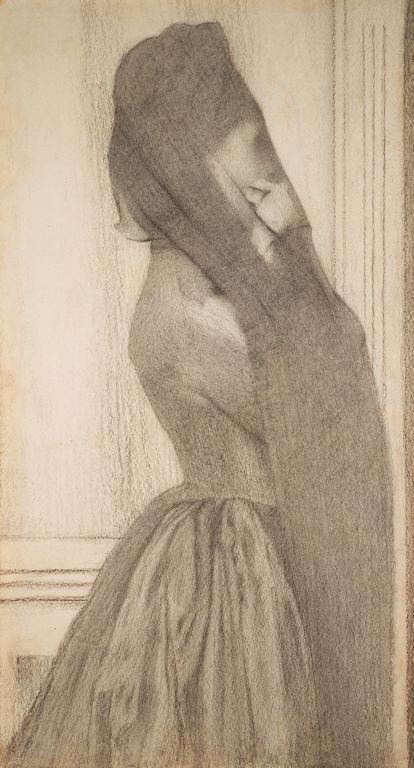
The Veil — Fernand Khnopff

the-veil-1887