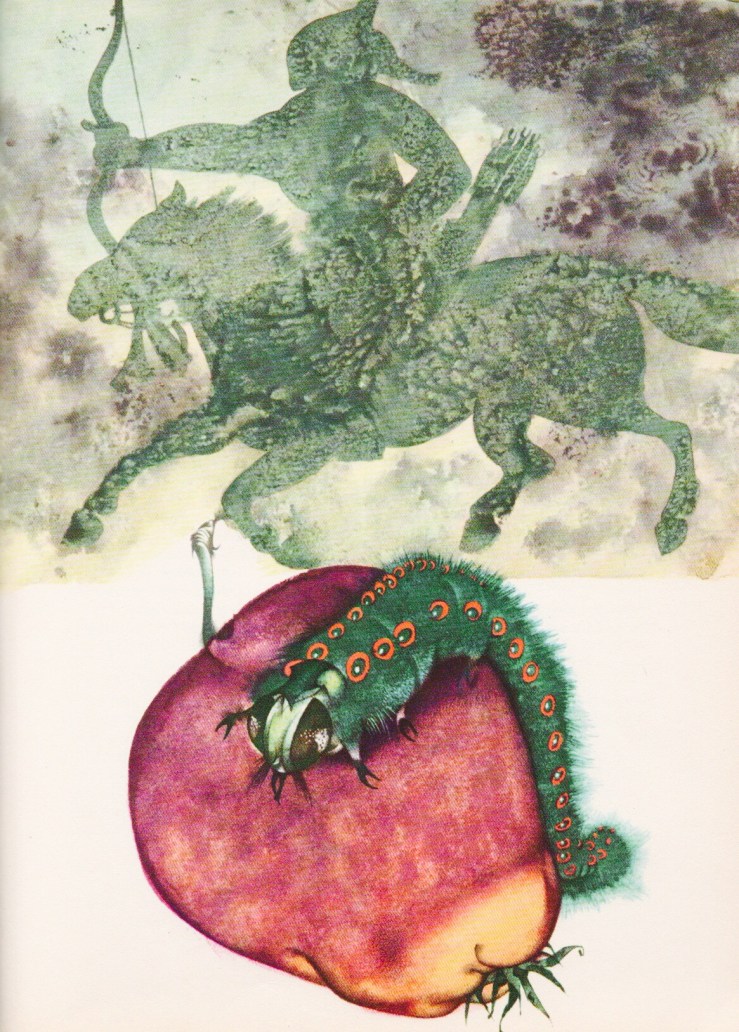
Vanitas Newtoniana — Agostino Arrivabene

resize (3)

Perseus Rescuing Andromeda (detail) — Piero di Cosimo

perseus11

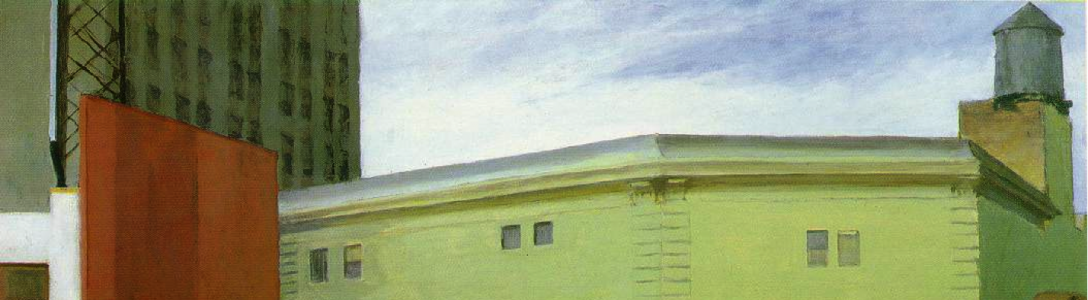
“The Difficulty of Crossing a Field,” a very short tale by Ambrose Bierce

“The Difficulty of Crossing a Field”

by

Ambrose Bierce

from Present at a Hanging and Other Ghost Stories


One morning in July, 1854, a planter named Williamson, living six miles from Selma, Alabama, was sitting with his wife and a child on the veranda of his dwelling.  Immediately in front of the house was a lawn, perhaps fifty yards in extent between the house and public road, or, as it was called, the “pike.”  Beyond this road lay a close-cropped pasture of some ten acres, level and without a tree, rock, or any natural or artificial object on its surface.  At the time there was not even a domestic animal in the field.  In another field, beyond the pasture, a dozen slaves were at work under an overseer.

Throwing away the stump of a cigar, the planter rose, saying: “I forgot to tell Andrew about those horses.”  Andrew was the overseer.

Williamson strolled leisurely down the gravel walk, plucking a flower as he went, passed across the road and into the pasture, pausing a moment as he closed the gate leading into it, to greet a passing neighbor, Armour Wren, who lived on an adjoining plantation.  Mr. Wren was in an open carriage with his son James, a lad of thirteen.  When he had driven some two hundred yards from the point of meeting, Mr. Wren said to his son: “I forgot to tell Mr. Williamson about those horses.”

Mr. Wren had sold to Mr. Williamson some horses, which were to have been sent for that day, but for some reason not now remembered it would be inconvenient to deliver them until the morrow.  The coachman was directed to drive back, and as the vehicle turned Williamson was seen by all three, walking leisurely across the pasture.  At that moment one of the coach horses stumbled and came near falling.  It had no more than fairly recovered itself when James Wren cried: “Why, father, what has become of Mr. Williamson?”

It is not the purpose of this narrative to answer that question.

Mr. Wren’s strange account of the matter, given under oath in the course of legal proceedings relating to the Williamson estate, here follows:

“My son’s exclamation caused me to look toward the spot where I had seen the deceased [sic] an instant before, but he was not there, nor was he anywhere visible.  I cannot say that at the moment I was greatly startled, or realized the gravity of the occurrence, though I thought it singular.  My son, however, was greatly astonished and kept repeating his question in different forms until we arrived at the gate.  My black boy Sam was similarly affected, even in a greater degree, but I reckon more by my son’s manner than by anything he had himself observed.  [This sentence in the testimony was stricken out.]  As we got out of the carriage at the gate of the field, and while Sam was hanging [sic] the team to the fence, Mrs. Williamson, with her child in her arms and followed by several servants, came running down the walk in great excitement, crying: ‘He is gone, he is gone!  O God! what an awful thing!’ and many other such exclamations, which I do not distinctly recollect.  I got from them the impression that they related to something more – than the mere disappearance of her husband, even if that had occurred before her eyes.  Her manner was wild, but not more so, I think, than was natural under the circumstances.  I have no reason to think she had at that time lost her mind.  I have never since seen nor heard of Mr. Williamson.”

This testimony, as might have been expected, was corroborated in almost every particular by the only other eye-witness (if that is a proper term) – the lad James.  Mrs. Williamson had lost her reason and the servants were, of course, not competent to testify.  The boy James Wren had declared at first that he saw the disappearance, but there is nothing of this in his testimony given in court.  None of the field hands working in the field to which Williamson was going had seen him at all, and the most rigorous search of the entire plantation and adjoining country failed to supply a clew.  The most monstrous and grotesque fictions, originating with the blacks, were current in that part of the State for many years, and probably are to this day; but what has been here related is all that is certainly known of the matter.  The courts decided that Williamson was dead, and his estate was distributed according to law.

The Howl — Jean Veber

19234680404_c33052824a_c

The Bride — Theodor von Holst

The Bride 1842 by Theodor von Holst 1810-1844

Ash Wednesday — Carl Spitzweg

ash-wednesday-1860

“Shrove Tuesday,” a tale by Anton Chekhov

“Shrove Tuesday”

by

Anton Chekhov

English translation by

Constance Garnett

from ‘The Cook’s Wedding’ and Other Stories


“PAVEL VASSILITCH!” cries Pelageya Ivanovna, waking her husband. “Pavel Vassilitch! You might go and help Styopa with his lessons, he is sitting crying over his book. He can’t understand something again!”

Pavel Vassilitch gets up, makes the sign of the cross over his mouth as he yawns, and says softly: “In a minute, my love!”

The cat who has been asleep beside him gets up too, straightens out its tail, arches its spine, and half-shuts its eyes. There is stillness. . . . Mice can be heard scurrying behind the wall-paper. Putting on his boots and his dressing-gown, Pavel Vassilitch, crumpled and frowning from sleepiness, comes out of his bedroom into the dining-room; on his entrance another cat, engaged in sniffing a marinade of fish in the window, jumps down to the floor, and hides behind the cupboard.

“Who asked you to sniff that!” he says angrily, covering the fish with a sheet of newspaper. “You are a pig to do that, not a cat. . . .”

From the dining-room there is a door leading into the nursery. There, at a table covered with stains and deep scratches, sits Styopa, a high-school boy in the second class, with a peevish expression of face and tear-stained eyes. With his knees raised almost to his chin, and his hands clasped round them, he is swaying to and fro like a Chinese idol and looking crossly at a sum book. Continue reading ““Shrove Tuesday,” a tale by Anton Chekhov”

Perseus Rescuing Andromeda (detail) — Piero di Cosimo

perseus5

The Fat Kitchen — Pieter Bruegel the Elder

the-fat-kitchen-1563

Pancake Tuesday — Pavel Filonov

pancake-tuesday-maslenitsa-1914

Film poster for Malick’s The Thin Red Line — Tomer Hanuka

trl

Inherent Vice (William Gaddis’s J R)

img_1471

From page 571 of my Penguin edition of William Gaddis’s novel J R. The phrase appears as part of the character Jack Gibbs’s work in progress, Agapē AgapeThe phrase is not especially uncommon, I suppose, in art history, and I (obliquely) remark it in this post for my own amusement.

Two Women on a Sofa — Walter Sickert

two-women-on-a-sofa-1904

Read “Loka,” a short story by Kate Chopin

“Loka”

by

Kate Chopin

from Bayou Folk (1894)


She was a half-breed Indian girl, with hardly a rag to her back. To the ladies of the Band of United Endeavor who questioned her, she said her name was Loka, and she did not know where she belonged, unless it was on Bayou Choctaw.

She had appeared one day at the side door of Frobissaint’s “oyster saloon” in Natchitoches, asking for food. Frobissaint, a practical philanthropist, engaged her on the spot as tumbler-washer.

She was not successful at that; she broke too many tumblers. But, as Frobissaint charged her with the broken glasses, he did not mind, until she began to break them over the heads of his customers. Then he seized her by the wrist and dragged her before the Band of United Endeavor, then in session around the corner. This was considerate on Frobissaint’s part, for he could have dragged her just as well to the police station.

Loka was not beautiful, as she stood in her red calico rags before the scrutinizing band. Her coarse, black, unkempt hair framed a broad, swarthy face without a redeeming feature, except eyes that were not bad; slow in their movements, but frank eyes enough. She was big—boned and clumsy.

She did not know how old she was. The minister’s wife reckoned she might be sixteen. The judge’s wife thought that it made no difference. The doctor’s wife suggested that the girl have a bath and change before she be handled, even in discussion. The motion was not seconded. Loka’s ultimate disposal was an urgent and difficult consideration.

Some one mentioned a reformatory. Every one else objected.

Madame Laballière, the planter’s wife, knew a respectable family of ‘Cadians living some miles below, who, she thought, would give the girl a home, with benefit to all concerned. The ‘Cadian woman was a deserving one, with a large family of small children, who had all her own work to do. The husband cropped in a modest way. Loka would not only be taught to work at the Padues’, but would receive a good moral training beside.

That settled it. Every one agreed with the planter’s wife that it was a chance in a thousand;-and Loka was sent to sit on the steps outside, while the band proceeded to the business next in order.

Loka was afraid of treading upon the little Padues when she first got amongst them,—there were so many of them,—and her feet were like leaden weights, encased in the strong brogans with which the band had equipped her.

Madame Padue, a small, black-eyed, aggressive woman, questioned her in a sharp, direct fashion peculiar to herself.

“How come you don’t talk French, you?” Loka shrugged her shoulders.

“I kin talk English good ‘s anybody; an’ lit’ bit Choctaw, too,” she offered, apologetically.

Ma foi, you kin fo’git yo’ Choctaw. Soona the betta for me. Now if you wil-lin’, an’ ent too lazy an’ sassy, we ‘ll git ‘long somehow. Vrai sauvage ça,” she muttered under her breath, as she turned to initiate Loka into some of her new duties.

She herself was a worker. A good deal more fussy one than her easy-going husband and children thought necessary or agreeable. Loka’s slow ways and heavy motions aggravated her. It was in vain Monsieur Padue expostulated:—

“She’s on’y a chile, rememba, Tontine.”

“She’s vrai sauvage, that’s w’at. It’s got to be work out of her,” was Tontine’s only reply to such remonstrance.

The girl was indeed so deliberate about her tasks that she had to be urged constantly to accomplish the amount of labor that Tontine required of her. Moreover, she carried to her work a stolid indifference that was exasperating. Whether at the wash-tub, scrubbing the floors, weeding the garden, or learning her lessons and catechism with the children on Sundays, it was the same.

It was only when intrusted with the care of little Bibine, the baby, that Loka crept somewhat out of her apathy. She grew very fond of him. No wonder; such a baby as he was! So good, so fat, and complaisant! He had such, a way of clasping Loka’s broad face between his pudgy fists and savagely biting her chin with his hard, toothless gums! Such a way of bouncing in her arms as if he were mounted upon springs! At his antics the girl would laugh a wholesome, ringing laugh that was good to hear. Continue reading “Read “Loka,” a short story by Kate Chopin”

Laughter is probably doomed to disappear.

img_1468

Frontispiece to Mahendra Singh’s forthcoming novel American Candide; the illustration (as well as all the illustrations in the novel) is by Singh. Just enjoying the hell out of it so far.

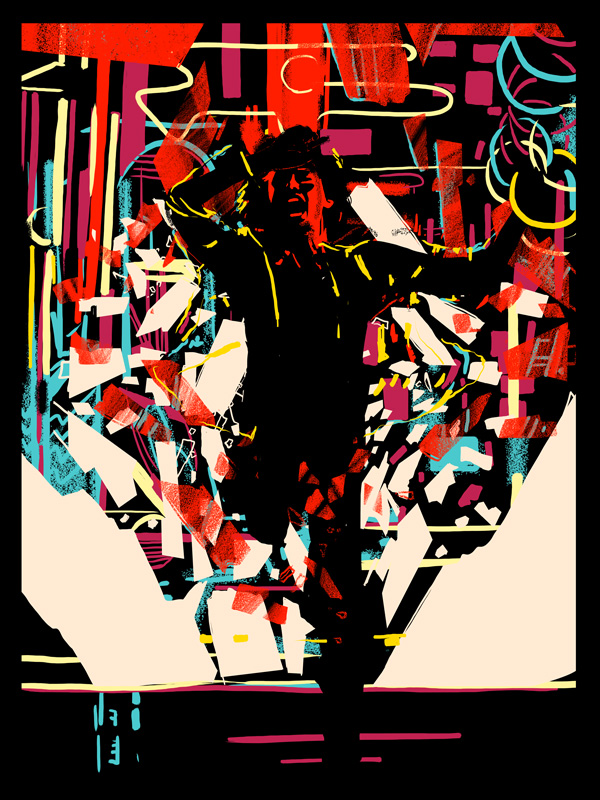
David Bowie — Kilian Eng

tumblr_o0t1y94ry51qbluruo1_1280

Three Books

img_1464

Angels by Denis Johnson. 1989 Vintage Contemporaries trade paperback. Cover design by Lorraine Louie. Cover illustration by Chris Moore.

img_1463

Fiskadoro by Denis Johnson. 1986 Vintage Contemporaries trade paperback. Cover design by Lorraine Louie. Cover illustration by Rick Lovell.

img_1465

The Stars at Noon by Denis Johnson. 1988 Vintage Contemporaries trade paperback. Cover design by Lorraine Louie. Cover illustration by Rick Lovell.