Young Fig Posing for Leonardo da Vinci — Felix Labisse

Autumn Haystacks — Jean-Francois Millet

The Fall of the Rebel Angels (Detail) — Pieter Bruegel the Elder

Screenshot 2015-10-17 at 5.14.39 PM

The polar ice kept melting and the sea kept rising (Ursula K. Le Guin)

He rode the Vancouver subway back into Portland. The trains were already jam-packed; he stood out of reach of strap or stanchion, supported solely by the equalizing pressure of bodies on all sides, occasionally lifted right off his feet and floating as the force of crowding (c) exceeded the force of gravity (g). A man next to him holding a newspaper had never been able to lower his arms, but stood with his face muffled in the sports section. The headline, “BIG A-l STRIKE NEAR AFGHAN BORDER,” and the subhead, “Threat of Afghan Intervention,” stared Orr eye to I for six stops. The newspaper holder fought his way off and was replaced by a couple of tomatoes on a green plastic plate, beneath which was an old lady in a green plastic coat, who stood on Orr’s left foot for three more stops.He struggled off at the East Broadway stop, and shoved along for four blocks through the ever-thickening off-work crowd to Willamette East Tower, a great, showy, shoddy shaft of concrete and glass competing with vegetable obstinacy for light and air with the jungle of similar buildings all around it. Very little light and air got down to street level; what there was was warm and full of fine rain. Rain was an old Portland tradition, but the warmth—70° F on the second of March—was modern, a result of air pollution. Urban and industrial effluvia had not been controlled soon enough to reverse the cumulative trends already at work in the mid-twentieth century; it would take several centuries for the CO2 to clear out of the air, if it ever did. New York was going to be one of the larger casualties of the Greenhouse Effect, as the polar ice kept melting and the sea kept rising; indeed all Boswash was imperiled. There were some compensations. San Francisco Bay was already on the rise, and would end up covering all the hundreds of square miles of landfill and garbage dumped into it since 1848. As for Portland, with eighty miles and the Coast Range between it and the sea, it was not threatened by rising water: only by falling water.

It had always rained in western Oregon, but now it rained ceaselessly, steadily, tepidly. It was like living in a downpour of warm soup, forever.

The New Cities—Umatilla, John Day, French Glen—were east of the Cascades, in what had been desert thirty years before. It was fiercely hot there still in summer, but it rained only 45 inches a year, compared with Portland’s 114 inches. Intensive farming was possible: the desert blossomed. French Glen now had a population of 7 million. Portland, with only 3 million and no growth potential, had been left far behind in the March of Progress. That was nothing new for Portland. And what difference did it make? Undernourishment, overcrowding, and pervading foulness of the environment were the norm. There was more scurvy, typhus, and hepatitis in the Old Cities, more gang violence, crime, and murder in the New Cities. The rats ran one and the Mafia ran the other. George Orr stayed in Portland because he had always lived there and because he had no reason to believe that life anywhere else would be better, or different.

From Ursula K. Le Guin’s 1971 novel The Lathe of Heaven.

Three Blurbs

image image image

Three Books

image

The Crack-Up by F. Scott Fitzgerald; edited by Edmund Wilson. A 1956 New Directions mass market paperback. No designer credited. The Crack-Up collects autobiographical pieces by Fitzgerald, along with letters and essays by some of Fitzgerald’s contemporaries and near-contemporaries—but the highlight is the inclusion of Fitzgerald’s note-books. (I shamelessly plundered them on this blog for years). Its cover is black and white and gray.image

An Armful of Warm Girl by W.M. Spackman. 1981 trade paperback edition by Van Vactor & Goodheart. Cover design by Leslie Evans. A perfect little novella, with a perfect opening page. Its cover is black and white and gray.
image

Flee by Evan Dara. 2013 trade paperback edition by Aurora. Design by Todd Michael Bushman. Blogged about it here and here. Its cover is black and white and gray.

Judas Iscariot — Sascha Schneider

tumblr_meosa95R3I1qlh1qpo1_1280

The Fall of the Rebel Angels (Detail) — Pieter Bruegel the Elder

Screenshot 2015-10-17 at 5.11.52 PM

What will the creature made all of seadrift do on the dry sand of daylight; what will the mind do, each morning, waking? (Ursula K. Le Guin)

Current-borne, wave-flung, tugged hugely by the whole might of ocean, the jellyfish drifts in the tidal abyss. The light shines through it, and the dark enters it. Borne, flung, tugged from anywhere to anywhere, for in the deep sea there is no compass but nearer and farther, higher and lower, the jellyfish hangs and sways; pulses move slight and quick within it, as the vast diurnal pulses beat in the moon-driven sea. Hanging, swaying, pulsing, the most vulnerable and insubstantial creature, it has for its defense the violence and power of the whole ocean, to which it has entrusted its being, its going, and its will.

But here rise the stubborn continents. The shelves of gravel and the cliffs of rock break from water baldly into air, that dry, terrible outerspace of radiance and instability, where there is no support for life. And now, now the currents mislead and the waves betray, breaking their endless circle, to leap up in loud foam against rock and air, breaking…

What will the creature made all of seadrift do on the dry sand of daylight; what will the mind do, each morning, waking?

The first three paragraphs of Ursula K. Le Guin’s 1971 novel The Lathe of Heaven.

Wally with a Red Blouse — Egon Schiele

wally with a red blouse

The Morning — Caspar David Friedrich

The Night — Max Beckmann

“All art constantly aspires towards the condition of music”

Invention of a Dream — Richard Oelze

Nathaniel Hawthorne’s journal entry from October 16th, 1837

October 16th.–Spent the whole afternoon in a ramble to the sea-shore, near Phillips’s Beach. A beautiful, warm, sunny afternoon, the very pleasantest day, probably, that there has been in the whole course of the year. People at work, harvesting, without their coats. Cocks, with their squad of hens, in the grass-fields, hunting grasshoppers, chasing them eagerly with outspread wings, appearing to take much interest in the sport, apart from the profit. Other hens picking up the ears of Indian corn. Grasshoppers, flies, and flying insects of all sorts are more abundant in these warm autumnal days than I have seen them at any other time. Yellow butterflies flutter about in the sunshine, singly, by pairs, or more, and are wafted on the gentle gales. The crickets begin to sing early in the afternoon, and sometimes a locust may be heard. In some warm spots, a pleasant buzz of many insects.

Crossed the fields near Brookhouse’s villa, and came upon a long beach,–at least a mile long, I should think,–terminated by craggy rocks at either end, and backed by a high broken bank, the grassy summit of which, year by year, is continually breaking away,and precipitated to the bottom. At the foot of the bank, in some parts, is a vast number of pebbles and paving-stones, rolled up thither by the sea long ago. The beach is of a brown sand, with hardly any pebbles intermixed upon it. When the tide is part way down, there is a margin of several yards from the water’s edge, along the whole mile length of the beach, which glistens like a mirror, and reflects objects, and shines bright in the sunshine, the sand being wet to that distance from the water. Above this margin the sand is not wet, and grows less and less damp the farther towards the bank you keep. In some places your footstep is perfectly implanted, showing the whole shape, and the square toe, and every nail in the heel of your boot. Elsewhere, the impression is imperfect, and even when you stamp, you cannot imprint the whole. As you tread, a dry spot flashes around your step, and grows moist as you lift your foot again. Pleasant to pass along this extensive walk, watching the surf-wave;–how sometimes it seems to make a feint of breaking, but dies away ineffectually, merely kissing the strand; then, after many such abortive efforts, it gathers itself, and forms a high wall, and rolls onward, heightening and heightening without foam at the summit of the green line, and at last throws itself fiercely on the beach, with a loud roar, the spray flying above. As you walk along, you are preceded by a flock of twenty or thirty beach birds, which are seeking, I suppose, for food on the margin of the surf, yet seem to be merely sporting, chasing the sea as it retires, and running up before the impending wave. Sometimes they let it bear them off their feet, and float lightly on its breaking summit; sometimes they flutter and seem to reston the feathery spray. They are little birds with gray backs and snow-white breasts; their images may be seen in the wet sand almost or quite as distinctly as the reality. Their legs are long. As you draw near, they take a flight of a score of yards or more, and then recommence their dalliance with the surf-wave. You may behold their multitudinous little tracks all along your way. Before you reach the end of the beach, you become quite attached to these little sea-birds, and take much interest in their occupations. After passing in one direction, it is pleasant then to retrace your footsteps. Your tracks being all traceable, you may recall the whole mood and occupation of your mind during your first passage. Here you turned somewhat aside to pick up a shell that you saw nearer the water’s edge. Here you examined a long sea-weed, and trailed its length after you for a considerable distance. Here the effect of the wide sea struck you suddenly. Here you fronted the ocean, looking at a sail, distant in the sunny blue. Here you looked at some plant on the bank. Here some vagary of mind seems to have bewildered you; for your tracks go round and round, and interchange each other without visible reason. Here you picked up pebbles and skipped them upon the water. Here you wrote names and drew faces with a razor sea-shell in the sand.

After leaving the beach, clambered over crags, all shattered and tossed about everyhow; in some parts curiously worn and hollowed out, almost into caverns. The rock, shagged with sea-weed,–in some places, a thick carpet of seaweed laid over the pebbles, into which your foot would sink. Deep tanks among these rocks, which the sea replenishes at high tide, and thenleaves the bottom all covered with various sorts of sea-plants, as if it were some sea-monster’s private garden. I saw a crab in one of them; five-fingers too. From the edge of the rocks, you may look off into deep, deep water, even at low tide. Among the rocks, I found a great bird, whether a wild-goose, a loon, or an albatross, I scarcely know. It was in such a position that I almost fancied it might be asleep, and therefore drew near softly, lest it should take flight; but it was dead, and stirred not when I touched it. Sometimes a dead fish was cast up. A ledge of rocks, with a beacon upon it, looking like a monument erected to those who have perished by shipwreck. The smoked, extempore fire-place, where a party cooked their fish. About midway on the beach, a fresh-water brooklet flows towards the sea. Where it leaves the land, it is quite a rippling little current; but, in flowing across the sand, it grows shallower and more shallow, and at last is quite lost, and dies in the effort to carry its little tribute to the main.

Nathaniel Hawthorne’s journal entry from October 16th, 1837. From Passages from the American Note-Books.
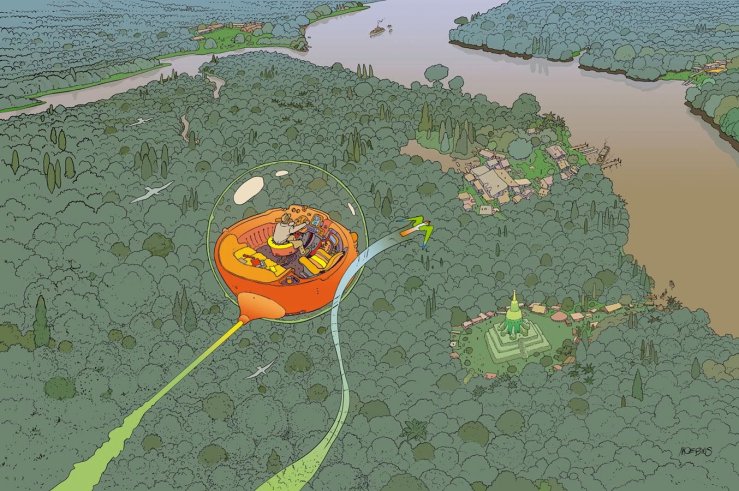
Voyage d’Hermès — Moebius

Moebius-VoyageHermes-4

Cursed Wolf Thy Fury inward on Thyself Prey and Consume Thee — Gustave Doré