Obsession — Roberto Bernardi

painting_09_m

Just when I thought I couldn’t stand it another minute longer, Friday came.

ebFrom “Crusoe in England” by Elizabeth Bishop.


“You and he were buddies, weren’t you?”

William Faulkner reads his short story “Shingles for the Lord”

Pap got up a good hour before daylight and caught the mule and rid down to Killegrews’ to borrow the froe and maul. He ought to been back with it in forty minutes. But the sun had rose and I had done milked and fed and was eating my breakfast when he got back, with the mule not only in a lather but right on the edge of the thumps too.

“Fox hunting,” he said. “Fox hunting. A seventy-year-old man, with both feet and one knee, too, already in the grave, squatting all night on a hill and calling himself listening to a fox race that he couldn’t even hear unless they had come up onto the same log he was setting on and bayed into his ear trumpet. Give me my breakfast,” he told maw. “Whitfield is standing there right this minute, straddle of that board tree with his watch in his hand.”
And he was. We rid on past the church, and there was not only Solon Quick’s school-bus truck but Reverend Whitfield’s old mare too. We tied the mule to a sapling and hung our dinner bucket on a limb, and with pap toting Killegrew’s froe and maul and the wedges and me toting our ax, we went on to the board tree where Solon and Homer Bookwright, with their froes and mauls and axes and wedges, was setting on two upended cuts, and Whitfield was standing jest like pap said, in his boiled shirt and his black hat and pants and necktie, holding his watch in his hand. It was gold and in the morning sunlight it looked big as a full-growed squash.
“You’re late,” he said.
So pap told him again about how Old Man Killegrew had been off fox hunting all night, and nobody at home to lend him the froe but Mrs. Killegrew and the cook. And naturally, the cook wasn’t going to lend none of Killegrew’s tools out, and Mrs. Killegrew was worser than deaf than even Killegrew. If you was to run in and tell her the house was afire, she would jest keep on rocking and say she thought so, too,[audience laughter] unless she began to holler back to the cook to turn the dogs loose before you could even open your mouth.

You can listen to Faulkner read his story “Shingles for the Lord” at Mary Washington College. (There’s a full transcript too).

Pure Reason — René Magritte

Mormons Visit a Country Carpenter — Christen Dalsgaard

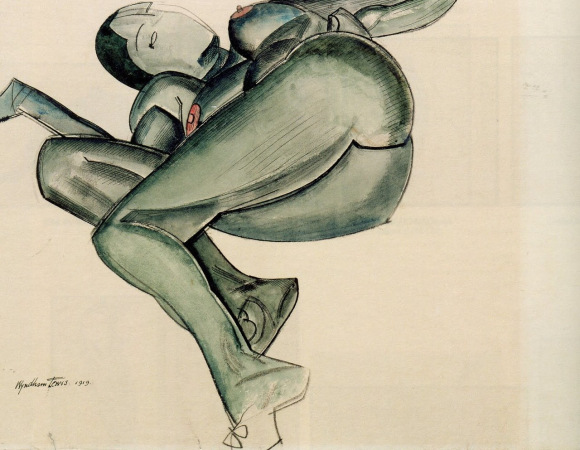
Nude 1 — Wyndham Lewis

nude-1-by-wyndham-lewis

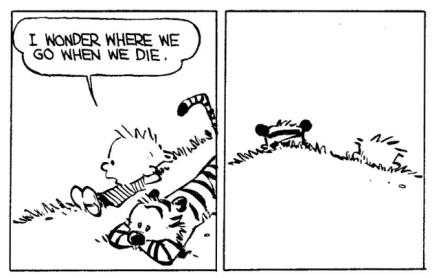
Questions (Calvin and Hobbes)

IMG_0133.PNG

IMG_0131.PNG


IMG_0138.PNG

IMG_0136.PNG


IMG_0139.PNG

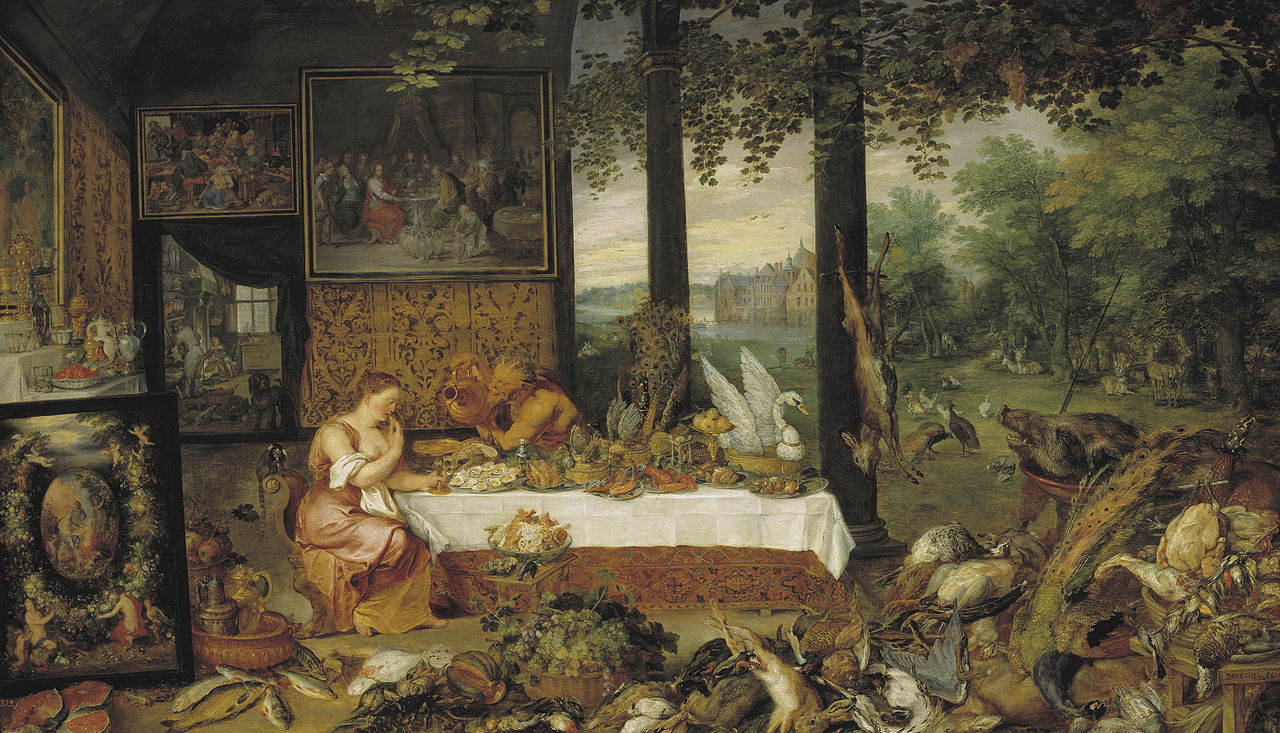
Allegory of Taste — Jan Bruegel the Elder & Peter Paul Rubens

Jan_Brueghel_I_&_Peter_Paul_Rubens_-_Taste_(Museo_del_Prado)

André Holland Reads from David Foster Wallace’s The Pale King

André Holland (of The Knick, which I dug) reads from David Foster Wallace’s The Pale King. (Via Matt Bucher).

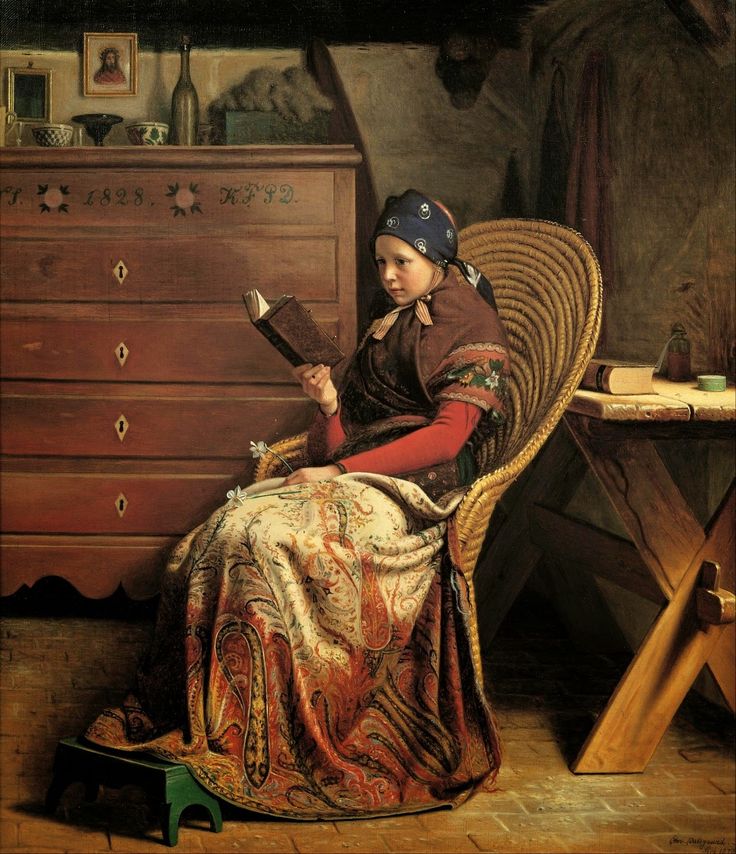
A Young Girl from Salling Reading — Christen Dalsgaard

Woman at a Dressing Table — Gustave Caillebotte

“A long, long sleep, a famous sleep” — Emily Dickinson

Capture

The Cat With Hands — Robert Morgan

Bukowski Wearing a Bukowski T-Shirt

039a65931ea1c4037be6416c832ebdf9

In a Pine Wood — Christen Dalsgaard

Dalsgaard

List with No Name #48

  1. The desire to manufacture and maintain happiness leads our culture, our society, our whatever to repeatedly perform contrived aesthetic scenarios.
  2. Happiness being, perhaps, a modern, or at least modernish, invention.
  3. Modernish affect.
  4. And happiness, we maybe telling ourselves, the goal, the telos, the whatever, of religion, politics, culture.
  5. Like many Americans, I have absolutely no idea what will make me happy.
  6. I know that happiness is not stable.
  7. One of Blake’s chimney sweepers remarks that because he is happy and dances and sings they (God/priest/king) are absolved from the belief that they’ve done him injury.
  8. Religion, or the practice and observance of religion, is the maintenance, repetition, and performance of contrived aesthetic scenarios.
  9. Months ago at a baptism I witnessed a man sway.
  10. The swayer swayed rhythmically: his eyes closed, his brow wrinkled, his mouth downturned in the pretense of ecstasy—he swayed to the guitar-strumming of an Episcopalian priest, who plucked and sang a song I’d never heard.
  11. The assembled witnesses mumbling through words of which they weren’t sure.
  12. (Or mute, glaring, like my brother, my father, myself).
  13. Later the priest reserved damning words for this world.
  14. (I’ve committed no details of the sermon to memory, but we may file the whole damn deal under “Platonic shadows of some other promised Real-to-Come“).
  15. And yet the backdrop of the whole affair—did I mention this baptism was outside?—this backdrop was the mighty north-flowing St Johns River, a beautiful spring day, hot, goddamn was it hot-–this backdrop was beautiful, ecstatically beautiful, the deep dark blue choppy river, so broad, coursed in the background, dotted with white sails—trees: announce them: cypress, sweetbay, oak—they swayed—or their branches swayed, their green leaves tickled in the occasional too-brief wind—the sky blazed azure, that’s the word we have, streaked with violent clouds (they were not fluffy)—birds flew—can I remember them, the birds? Let’s license my memory: let’s say white ibises beat past the spectacle, that black vultures hovered not too close. Let’s imagine limpkins and red-shouldered hawks, like the proud avian who lives in the oak across the street from me. Ospreys. Hell, throw in a bald eagle.
  16. The world, this world, which is to say this particular aesthetic arrangement had the potential to authorize happiness—and yet the man in black yapped on about its utter falsenessthis world, this beautiful beautiful world.
  17. Emily Dickinson claimed to keep the Sabbath at home, by which I think she meant her back yard. Sounds nice there—the sermon is never long, and instead of getting to Heaven at last – you’re going, all along.
  18. (I had to preserve and repeat and maintain the aesthetics of Ms. Dickinson’s dash).
  19. I went and stood in the shade and tried to feel happy.
  20. But the man, the swaying man—his performance of ecstasy—all this, mixed with the sermon to spoil the happiness, which I probably enjoyed just as much—the which there referring to the feeling of feeling spoiled happiness, or rather the feeling of potential happiness spoiled.
  21. That the feeling of the feeling was as pure as it might be, mediated by Nature and its enemy Religion.
  22. And finding the man’s swaying performance so thoroughly unconvincing, having witnessed ecstasy my own damn self, at least once or even twice in thirty-five years.
  23. And maybe even experiencing ecstasy, its edges, its agony.
  24. (Ms. Dickinson reported that she liked a look of agony. Its truth).
  25. That ecstasy, or awe, or reverence, or pick your own synonym, because, hey, language is weak as usual, as always, as always-shall-be—language can’t pin down transcendence to a signifying utterance—where was I, am I?—that ecstasy might be pantomimed in the service of a service, of a system, of a religion—this is the shadow of happiness, the shadow of the ideal of happiness: the problem. The problem.
  26. I was never close enough to hear the infant’s cries, coos, wails, burbles, sounds, which she must have uttered—maybe she slept through the ordeal—but any sounds she made must have been the purest utterances at the occasion, the repetitions of Nature, still outside of the culture in which we had gathered to inscribe her.
  27. I wrote all this for me, not for you, not for anyone else—but let me end with the cloying sentimental jeering pretense that I wrote it for the baptized baby, a supporting character in this narrative, whose life I hope is mostly happy.