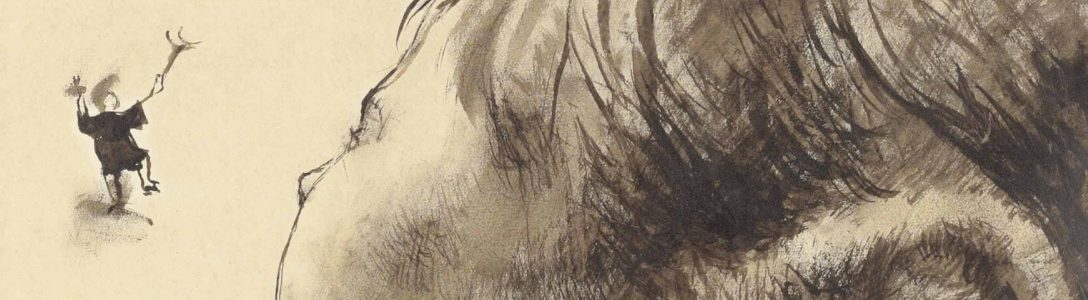
A Sufi Sage (After Melancholia) — Farrukh Beg

“I Am in Danger—Sir—” — Adrienne Rich

“I Am in Danger—Sir—” by Adrienne Rich

“Half-cracked” to Higginson, living,
afterward famous in garbled versions,
your hoard of dazzling scraps a battlefield,
now your old snood

mothballed at Harvard
and you in your variorum monument
equivocal to the end—
who are you?

you, woman, masculine
in single-mindedness,
for whom the word was more
than a symptom—

a condition of being.
Till the air buzzing with spoiled language
sang in your ears
of Perjury

and in your half-cracked way you chose
silence for entertainment,
chose to have it out at last
on your own premises.

The Dark Figure — Federico Castellón

Baptism in Kansas — John Steuart Curry

Lily and the Sparrows — Philip Evergood

“Company” — Les Murray

Capture

Marty Hart Watches the Star Wars Holiday Special

I Never Stopped Loving You — Chris Ware

“The Executor” — Muriel Spark

“The Executor”

by

Muriel Spark

When my uncle died all the literary manuscripts went to a university foundation, except one. The correspondence went too, and the whole of his library. They came (a white-haired man and a young girl) and surveyed his study. Everything, they said, would be desirable and it would make a good price if I let the whole room go – his chair, his desk, the carpet, even his ashtrays. I agreed to this. I left everything in the drawers of the desk just as it was when my uncle died, including the bottle of Librium and a rusty razor blade.

My uncle died this way: he was sitting on the bank of the river, playing a fish. As the afternoon faded a man passed by, and then a young couple who made pottery passed him. As they said later, he was sitting peacefully awaiting the catch and of course they didn’t disturb him. As night fell the colonel and his wife passed by; they were on their way home from their daily walk. They knew it was too late for my uncle to be simply sitting there, so they went to look. He had been dead, the doctor pronounced, from two to two and a half hours. The fish was still struggling with the bait. It was a mild heart attack. Everything my uncle did was mild, so different from everything he wrote. Yet perhaps not so different. He was supposed to be “far out”, so one didn’t know what went on out there. Besides, he had not long returned from a trip to London. They say, still waters run deep. Continue reading ““The Executor” — Muriel Spark”

Sybil — Edward Burne-Jones

Octopus and Fish — Ito Jakuchu

The Fox and Mr. Anderson

Sad Postcard in a Sad Book (Gass/Pancake)

20140311-143226.jpg

A book, you would think, is not a pocket, a purse, or a wastebasket, but people dispose of their sniffle-filled Kleenex between unexposed pages, their toothpicks, too, dirty where they’ve gripped them while cleaning their teeth—such in-decency—matchbooks with things written on the underside of the flap, usually numbers, of telephones, I suppose; or they leave paper clips and big flat mother-of-pearl buttons—imagine—curls of hair and all sorts of receipts as well as other slips of paper they’ve used to mark the spot where they stopped; and they file correspondence between leaves as if a book were a slide drawer—do they do that to their own books?—or they tuck snapshots, postcards, unused stamps, into them, now and then a pressed bloom—they stain, I’ve seen leaf shadows—one- to five- to ten-dollar bills, you’d never guess, yes, rubber bands, a shoelace, candy and gum wrappers—even their chewed gum that I have to pry out with a putty knife—people—people—I dee-clare—and newspaper clippings, often the author’s reviews, that are among the worst intruders because in time they’ll sulfur the pages where they’ve been compressed the way people who fall asleep on the grass of a summer morning leave their prints for the use of sorcerers like me to make our magic.

–From William H. Gass’s novel  Middle C.

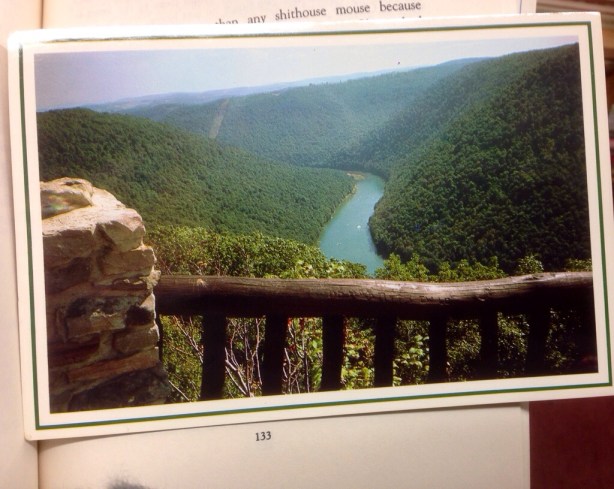
I leave stuff in books all the time. In fact, I almost always leave something (a movie stub, a photo, a note, a picture my son or daughter drew, something) in each book I finished.  (I even wrote about it a bit last year). So I guess Miss Moss, the old librarian in Gass’s Middle C, would be royally pissed with my habits. I read this passage a day or two after a visit to my favorite used bookstore, where, looking for books by Grace Paley, I came across an uncracked copy of Breece D’J. Pancake’s super sad super terrific collected stories. I own the book, but in a different edition (fox on the cover), so I grabbed it out. Lo and behold, a postcard!–and of a scene straight out of Pancake’s own semi-beloved West Virginia, no less! The note, a token of friendship, accompanied an inscription in the book itself—is there anything sadder than an inscribed book abandoned to a used bookstore?

I left the book, postcard in it, easily resisting the initial temptation to slide it into one of the Paley volumes. Destined for another reader.

20140311-143234.jpg

Artificial Mondrian — Hiroshi Kawano

Alain Resnais on the Script for Last Year at Marienbad

Should have been (T.S. Eliot)

Capture
