Calvin and Hobbes Take on Marcel Duchamp

calvin

Reading — Jose Ferraz de Almeida Jr

reading

I had no idea Luis Buñuel directed the 1954 film adaptation of Robinson Crusoe

…the weird thing is that I actually saw this as a kid. A few years later I saw Belle du jour (thanks to my uncle!) and then of course Un chien andalou and L’age d’or in college…

The Good Samaritan — Rodolphe Bresdin

bresdin_samaritan_26_w

William T. Vollmann, Profiled at Newsweek, Suggests “We’re a culture of prostitutes”

Newsweek has published a profile/interview of William T. Vollmann by Alexander Nazaryan. It’s a vivid, engaging read. The first two paragraphs of the profile:

If William T. Vollmann ever wins the Nobel Prize in Literature – as many speculate he will – he knows exactly what he will do with the $1.1 million pot the Swedes attach to the award. “It will be fun to give some to prostitutes,” he says, sitting on his futon, chuckling, a half-empty bottle of pretty good bourbon between us.

He is neither flippant nor drunk, though more booze awaits us out there in the temperate Sacramento twilight. Vollmann became famous for fiction that treated the sex worker as muse – especially the street stalker of those days in the Tenderloin of San Francisco when AIDS was just coming to haunt the national psyche and the yuppie invasion was a nightmare not yet hatched. His so-called prostitution trilogy – Whores for GloriaButterfly Stories, and The Royal Family – is overflowing with life and empathy, nothing like the backcountry machismo of Raymond Carver or fruitless experimentation of Donald Barthelme, both oh-so-popular with young writers when Vollmann first came on the scene after graduating from Cornell in 1981. He approached the prostitute like an anthropologist, yet did so without condescension, writing in Whores for Gloria, “The unpleasantnesses of her profession are largely caused by the criminal ambiance in which the prostitute must conduct it.”

Read the rest of it.

Frank O´Hara — Alice Neel

“Home Run” — Steven Millhauser

You can read along here…

“Ubazakura” –Lafcadio Hearn

“Ubazakura” –Lafcadio Hearn

Three hundred years ago, in the village called Asamimura, in the district called Onsengori, in the province of Iyo, there lived a good man named Tokubei. This Tokubei was the richest person in the district, and the muraosa, or headman, of the village. In most matters he was fortunate; but he reached the age of forty without knowing the happiness of becoming a father. Therefore he and his wife, in the affliction of their childlessness, addressed many prayers to the divinity Fudo Myo O, who had a famous temple, called Saihoji, in Asamimura.

At last their prayers were heard: the wife of Tokubei gave birth to a daughter. The child was very pretty; and she received the name of Tsuyu. As the mother’s milk was deficient, a milk-nurse, called O-Sode, was hired for the little one.


O-Tsuyu grew up to be a very beautiful girl; but at the age of fifteen she fell sick, and the doctors thought that she was going to die. In that time the nurse O-Sode, who loved O-Tsuyu with a real mother’s love, went to the temple Saihoji, and fervently prayed to Fudo-Sama on behalf of the girl. Every day, for twenty-one days, she went to the temple and prayed; and at the end of that time, O-Tsuyu suddenly and completely recovered.

Then there was great rejoicing in the house of Tokubei; and he gave a feast to all his friends in celebration of the happy event. But on the night of the feast the nurse O-Sode was suddenly taken ill; and on the following morning, the doctor, who had been summoned to attend her, announced that she was dying.

Then the family, in great sorrow, gathered about her bed, to bid her farewell. But she said to them:—

“It is time that I should tell you something which you do not know. My prayer has been heard. I besought Fudo-Sama that I might be permitted to die in the place of O-Tsuyu; and this great favor has been granted me. Therefore you must not grieve about my death… But I have one request to make. I promised Fudo-Sama that I would have a cherry-tree planted in the garden of Saihoji, for a thank-offering and a commemoration. Now I shall not be able myself to plant the tree there: so I must beg that you will fulfill that vow for me… Good-bye, dear friends; and remember that I was happy to die for O-Tsuyu’s sake.”


After the funeral of O-Sode, a young cherry-tree,—the finest that could be found,—was planted in the garden of Saihoji by the parents of O-Tsuyu. The tree grew and flourished; and on the sixteenth day of the second month of the following year,—the anniversary of O-Sode’s death,—it blossomed in a wonderful way. So it continued to blossom for two hundred and fifty-four years,—always upon the sixteenth day of the second month;—and its flowers, pink and white, were like the nipples of a woman’s breasts, bedewed with milk. And the people called it Ubazakura, the Cherry-tree of the Milk-Nurse.

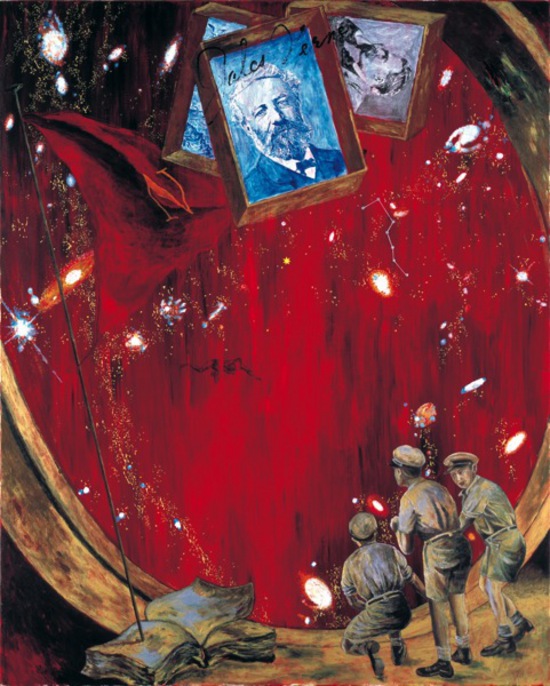
Jules Verne’s Ocean — Tadanori Yokoo

yokoo_tadanori_02-thumb-550xauto-319

Closed (After Hopper’s Nighthawks) — Andy Leipzig

andrewleipzig_324234234_large

“Rites of Melancholy” — W.G. Sebald

This realization of the impossibility of salvation matches the unrelated condition of melancholy which, in developing its own rituals, promises some relief but not release from suffering and the “feral deseases” so often mentioned in Robert Burton’s Anatomy of Melancholy. Among these rituals, in the narrator’s case, are the nocturnal reading of telephone directories and timetables, the unfolding of maps, and the making of plans for imaginary journeys to the most distant of lands, countries that might well lie beyond the sea shown in the background of Dürer’s Melencolia. Like Robert Burton, who was familiar with melancholy all his life, the narrator is a man “who delights in cosmography … but has never travelled except by map and card.” And the summer bed with room enough for seven sleepers where he meditates on stories such as that of the Black Death, with all its paths and coincidences, is of the same century as Burton’s compendium, an era of anxiety when the fear was first uttered “that the great mutations of the world are acted, or time may be too short for our designes.” The narrator’s digressive excursions from the starting point of this realization open up the view—again, a reminiscence from Hamlet—of a world lying far below melancholy, a “dead globe crawling with parasites” whose power of attraction is spent and forfeit. The icy sense of distance as the narrator turns away from all earthly life represents a vanishing point in the dialectic of melancholy. However, the other dimension of the Saturnian circumstances responsible for melancholy does point, as Benjamin has said and in the context of the heavy, dry nature of that planet, to the type of man predestined to hard and fruitless agricultural labor. It is probably no coincidence that the narrator’s only utilitarian occupation seems to be growing herbs. He sends these herbs, dried and in carefully adjusted mixtures, to various delicatessens in Milan and Amsterdam as well as to Germany, to Hamburg and Hannover. Perhaps they bear the words “Rosemary, that’s for remembrance” written in Ophelia’s hand.

From W.G. Sebald’s essay “Constructs of Mourning,” collected in Campo Santo.


Dance of the Dead — Karl Hofer

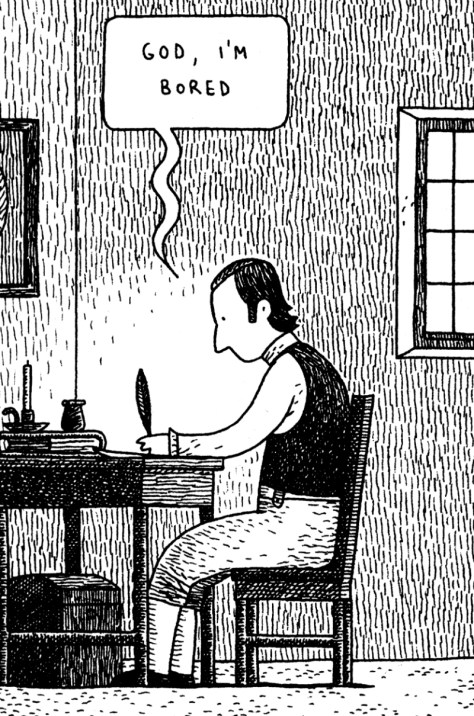
Bored (Tom Gauld)

bored

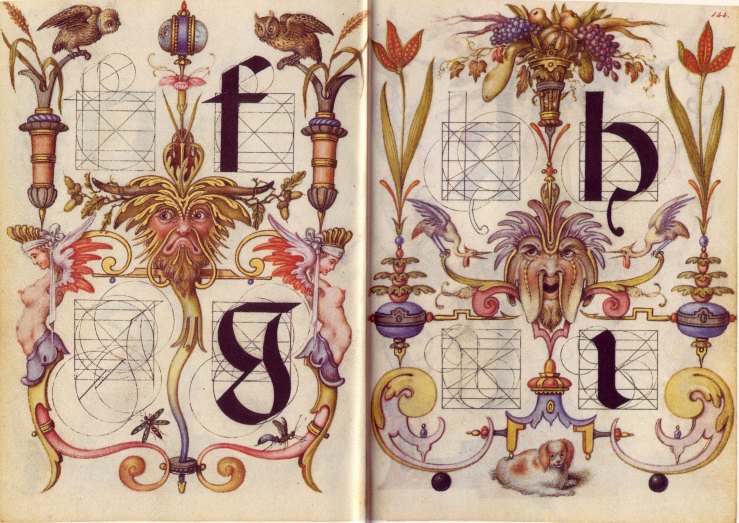
From Mira Calligraphiæ Monumenta — Joris Hoefnagel

hoefnagel2(Via/about/more).

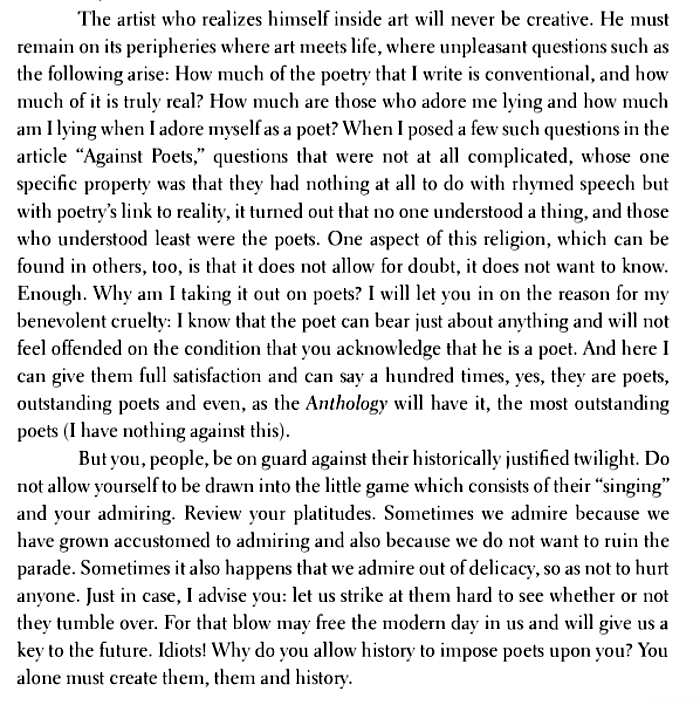
“The artist who realizes himself inside art will never be creative” (Witold Gombrowicz)

wg

Portrait of a Young Man with Book – Agnolo Bronzino

Wave — Moebius

wave