The Artist’s Granddaughter at the Table — Max Liebermann

Expectation — Richard Oelze

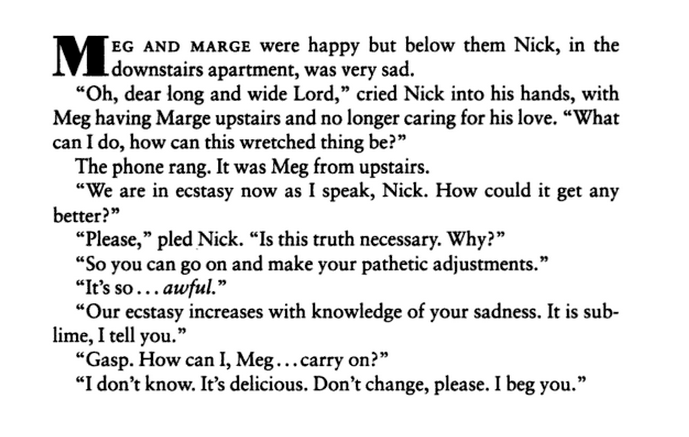
“Dear Awful Diary” — Barry Hannah

dadbh

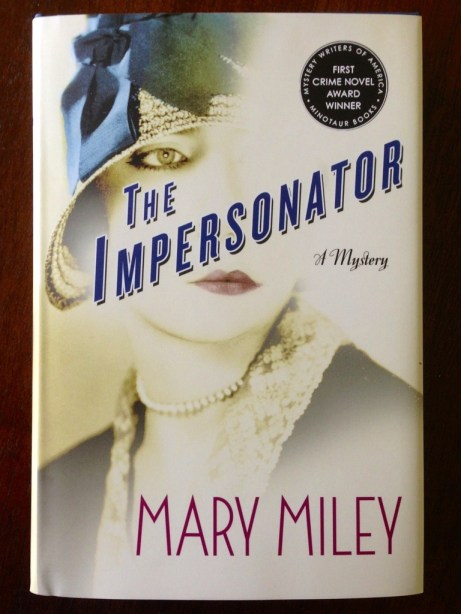
The Impersonator (Book Acquired, 8.26.2013)

20130830-074003.jpg

The Impersonator, a mystery by Mary Miley. Publisher Macmillan/Minotaur’s blurb:

In 1917, Jessie Carr, fourteen years old and sole heiress to her family’s vast fortune, disappeared without a trace. Now, years later, her uncle Oliver Beckett thinks he’s found her: a young actress in a vaudeville playhouse is a dead ringer for his missing niece. But when Oliver confronts the girl, he learns he’s wrong. Orphaned young, Leah’s been acting since she was a toddler.

Oliver, never one to miss an opportunity, makes a proposition—with his coaching, Leah can impersonate Jessie, claim the fortune, and split it with him. The role of a lifetime, he says. A one-way ticket to Sing Sing, she hears. But when she’s let go from her job, Oliver’s offer looks a lot more appealing. Leah agrees to the con, but secretly promises herself to try and find out what happened to the real Jessie. There’s only one problem: Leah’s act won’t fool the one person who knows the truth about Jessie’s disappearance.

Set against a Prohibition-era backdrop of speakeasies and vaudeville houses, Mary Miley’s Minotaur Books/Mystery Writers of America First Crime Novel Competition winner The Impersonator will delight readers with its elaborate mystery and lively prose.

Walt Kelly’s NO!

WaltKelly_NO-1_cover_100

Read all of Walt Kelly’s NO! at Whirled of Kelly.

“Perhaps the universe is suspended on the tooth of some monster” (Thoughts from Anton Chekhov’s Note-Books)

* * * * *

A scholar, without talent, a blockhead, worked for twenty-four years and produced nothing good, gave the world only scholars as untalented and as narrow-minded as himself. At night he secretly bound books—that was his true vocation: in that he was an artist and felt the joy of it. There came to him a bookbinder, who loved learning and studied secretly at night.

* * * * *

But perhaps the universe is suspended on the tooth of some monster.

* * * * *

Keep to the right, you of the yellow eye!

* * * * *

Do you want to eat? No, on the contrary.

* * * * *

A pregnant woman with short arms and a long neck, like a kangaroo.

* * * * *

How pleasant it is to respect people! When I see books, I am not concerned with how the authors loved or played cards; I see only their marvelous works.

* * * * *

To demand that the woman one loves should be pure is egotistical: to look for that in a woman which I have not got myself is not love, but worship, since one ought to love one’s equals.

* * * * *

The so-called pure childlike joy of life is animal joy.

* * * * *

—From Anton Chekhov’s Note-Books.

Portrait of Y.E. Kustodieva — Boris Kustodiev

Last Year at Marienbad — Alain Resnais (Full Film)

Sharks — Utagawa Kuniyoshi

The Mystery at the Middle of Ordinary Life — Don DeLillo

The Mystery at the Middle of Ordinary Life, a one-act play by Don DeLillo

A MAN and a WOMAN in a room.

WOMAN: I was thinking how strange it is.

MAN: What?

WOMAN: That people are able to live together. Days and nights and years. Five years go by. How do they do it? Ten, eleven, twelve years. Two people making one life. Sharing ten thousand meals. Talking to each other face to face, open face, like hot sandwiches. All the words that fill the house. What do people say over a lifetime? Trapped in each other’s syntax. The same voice. The droning tonal repetition. I’ll tell you something.

MAN: You’ll tell me something.

WOMAN: There’s a mystery here. The people behind the walls of the brown house next door. What do they say and how do they survive it? All that idle dialogue. The nasality. The banality. I was thinking how strange it is. How do they do it, night after night, all those nights, those words, those few who do it and survive?

MAN: They make love. They make salads.

WOMAN: But sooner or later they have to speak. This is what shatters the world. I mean isn’t it gradually shattering to sit and listen to the same person all the time, without reason or rhyme. Words that trail away. The pauses. The clauses. How many thousands of times can you look at the same drained face and watch the mouth begin to open? Everything’s been fine up to now. It is when they open their mouths. It is when they speak.

[Pause.]

MAN: I’m still not over this cold of mine.

WOMAN: Take those things you take.

MAN: The tablets.

WOMAN: The caplets.

[Pause.]

MAN: Long day.

WOMAN: Long day.

MAN: A good night’s sleep.

WOMAN: Long slow day.

[Lights slowly down.]

CURTAIN

On the Beach — Felix Vallotton

Workers – David Burliuk

“The Unknown Citizen” — W.H. Auden

“The Unknown Citizen” by W.H. Auden—

(To JS/07 M 378
This Marble Monument
Is Erected by the State)

He was found by the Bureau of Statistics to be
One against whom there was no official complaint,
And all the reports on his conduct agree
That, in the modern sense of an old-fashioned word, he was a
saint,
For in everything he did he served the Greater Community.
Except for the War till the day he retired
He worked in a factory and never got fired,
But satisfied his employers, Fudge Motors Inc.
Yet he wasn’t a scab or odd in his views,
For his Union reports that he paid his dues,
(Our report on his Union shows it was sound)
And our Social Psychology workers found
That he was popular with his mates and liked a drink.
The Press are convinced that he bought a paper every day
And that his reactions to advertisements were normal in every way.
Policies taken out in his name prove that he was fully insured,
And his Health-card shows he was once in a hospital but left it cured.
Both Producers Research and High-Grade Living declare
He was fully sensible to the advantages of the Instalment Plan
And had everything necessary to the Modern Man,
A phonograph, a radio, a car and a frigidaire.
Our researchers into Public Opinion are content
That he held the proper opinions for the time of year;
When there was peace, he was for peace: when there was war, he went.
He was married and added five children to the population,
Which our Eugenist says was the right number for a parent of his
generation.
And our teachers report that he never interfered with their
education.
Was he free? Was he happy? The question is absurd:
Had anything been wrong, we should certainly have heard.


The Hammock — James Tissot

From Luigi Serafini’s Codex Seraphinianus

From Luigi Serafini’s surreal cryptoencyclopedia, Codex Seraphinianus. (More/about).


List of Possible Descriptors for Thomas Pynchon’s Novel Against the Day

  1. Study of light and non-light
  2. Byzantine mosaic
  3. Codex of visible and invisible
  4. Musical comedy
  5. Daffy
  6. Anarchist golf
  7. Photograph—the posing of, the taking of, the development of, the product of, the negative of, the future of, the past of, the continuous present of, the potential of…
  8. Revenge story
  9. Spy game
  10. Study of physical and metaphysical
  11. Likely too long for most readers
  12. Advent of modernity
  13. Kaleidoscopic
  14. Alternate history of labor unions
  15. Math discussion
  16. Alternate reality exercises
  17. Invisible portraits, invisible landscapes
  18. Epic romance
  19. Flight log
  20. Hat fetishes
  21. Overstuffed
  22. Hallucinogenic
  23. Endless digression
  24. Maps and legends
  25. Underappreciated
  26. Flaneur’s game
  27. International intrigue
  28. Love story
  29. Lust story
  30. Series of ever-changing vectors
  31. Polyglossic carnival
  32. Sprawling
  33. Doppelgangers and the women who love them
  34. Vaudeville routine
  35. Infinite jest
  36. Over the sky, under the desert, into the center of the earth
  37. Boys’ adventure story
  38. Girls’ adventure story
  39. Post-Victorian sci-fi
  40. Acronyms!
  41. Zingers
  42. Mayonnaise history
  43. Magic trick
  44. Exiles
  45. Time travel calisthenics
  46. Art history
  47. Stamp collection
  48. Lumpy
  49. Like a surreal version of the game of Risk
  50. Genre mash-up
  51. Dream factory
  52. Gilded Age fallout
  53. Unwieldy
  54. Sentimental
  55. Ironic
  56. Holy Grail quest
  57. Whatever word is the most intense and accurate opposite of sparse
  58. Robber barons and the men who hate them
  59. Ever bilocating plot lines unfolding and retangling in the direction of increasing entropy
  60. Pulp fiction
  61. Invisible ink
  62. Flip side of a tapestry, its ragged threads exposed
  63. Salad of utopian visions
  64. Confusing
  65. Vision through Iceland spar
  66. Critique of capitalism
  67. Disappearing act
  68. Polyphonic spree
  69. Moving pictures
  70. Deconstruction of family values
  71. Drunken cavalcade of dick jokes
  72. Rage against the machine
  73. Time travelogue
  74. All-you-can-think
  75. Anti-war tract
  76. Explosions!
  77. Seance
  78. Shaggy ______________
  79. Critique of oligarchy
  80. Jazz improvisation
  81. Polyamory-positive
  82. Coffee-positive
  83. Meta-something-or-other
  84. Cricket with no scorekeeper
  85. 1,085 pages in hardback
  86. Often fuzzy, bilocated, discursive—full of flashforwards and flashbacks and side flashes
  87. Sexy sex sex
  88. Funhouse maze with smoke and mirrors
  89. High adventure
  90. Dictionary of mysticism
  91. Scathing analysis of Manifest Destiny
  92. Simultaneously heavy and light, profound and sophomoric
  93. “What It Means to Be an American”
  94. Goofy
  95. Drug manual
  96. Positive visions of the possibilities for human coexistence
  97. Index of wonderfully bad puns
  98. Perpetual motion machine
  99. Spiralling and unspiralling riffage
  100. A zillion dime novels turned on their ears and spines and just spinning
  101. Flight toward grace

Paradise City (Book Acquired, 8.26.2013)

20130830-073951.jpg

The name of this writer is Archer Mayor, which is like two professions and is too good to be made up. Paradise City is “A Joe Gunther Novel,” and I assume it somehow involves Axl Rose. Har har. Actually it’s set in Vermont. Publisher’s blurb:

Joe Gunther and his team at the Vermont Bureau of Investigation are alerted to a string of unrelated burglaries across Vermont. Someone, in addition to flatscreens, computers, and stereos, has also been stealing antiques and jewelry.

Meanwhile, in Boston, an elderly woman surprises some thieves in her Beacon Hill home and is viciously murdered. The Boston police find that not only is the loot similar to what’s being stolen in Vermont, but it may have the same destination. Word is out that someone powerful is purchasing these particular kinds of items in the “Paradise City” of Northampton, Mass.

Gunther, the Boston Police, and the vengeful granddaughter of the murdered old lady convene on Northampton, eager to get to the bottom of the mystery and find the “responsible parties”—although each is motivated to mete out some very different penalties.