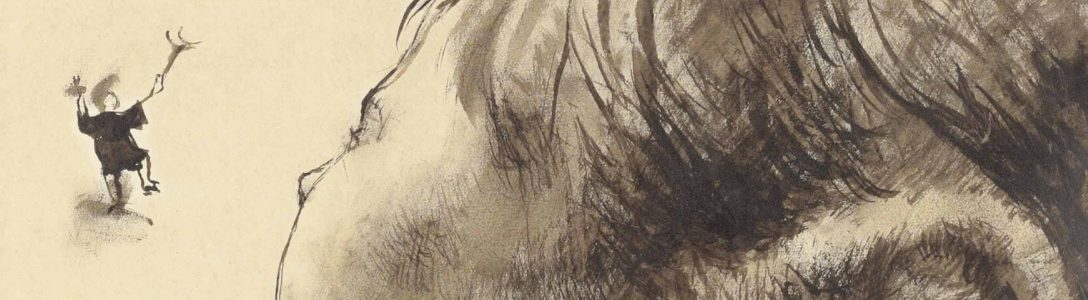
August in the City — Edward Hopper

hopper

List with No Name #35

  1. Achebe
  2. Bolaño
  3. Carter
  4. DeLillo
  5. Ellison
  6. Fitzgerald
  7. Gaddis
  8. Houellebecq
  9. Ishiguro
  10. James
  11. Kertész
  12. Lispector
  13. McCarthy
  14. Nabokov
  15. O’Connor
  16. Pullman
  17. Quincey, de
  18. Rousseau
  19. Shakespeare
  20. Tolkien
  21. Uris
  22. Vollmann
  23. Wallace
  24. X, Malcolm
  25. Yates
  26. Zweig

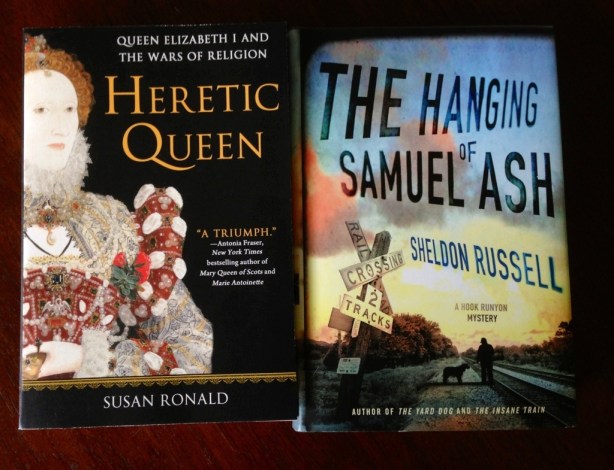
Heretic/Hanging (Books Acquired, Sometime Last Week)

20130806-162835.jpg

I was out of town when these showed up last week.

First, Susan Ronald’s Heretic Queen: Publisher St. Martin’s Griffin’s blurb:

Acclaimed biographer Susan Ronald delivers a stunning account of Elizabeth I that focuses on her role in the Wars on Religion—the battle between Protestantism and Catholicisim that tore apart Europe in the 16th Century

Elizabeth’s 1558 coronation procession was met with an extravagant outpouring of love. Only twenty-five years old, the young queen saw herself as their Protestant savior, aiming to provide the nation with new hope, prosperity, and independence from the foreign influence that had plagued her sister Mary’s reign. Given the scars of the Reformation, Elizabeth would need all of the powers of diplomacy and tact she could summon.

Extravagant, witty, and hot-tempered, Elizabeth was the ultimate tyrant. Yet at the outset, in religious matters, she was unfathomably tolerant for her day. “There is only one Christ, Jesus, one faith,” Elizabeth once proclaimed. “All else is a dispute over trifles.” Heretic Queen is the highly personal, untold story of how Queen Elizabeth I secured the future of England as a world power. Susan Ronald paints the queen as a complex character whose apparent indecision was really a political tool that she wielded with great aplomb.

And: The Hanging of Samuel Ash by Sheldon Russell, from Minotaur. Publishers Weekly blurb:

A compelling lead compensates only in part for the relatively weak plot of Russell’s fourth mystery featuring one-armed Santa Fe railroad bull Hook Runyon (after 2012’s Dead Man’s Tunnel), set during WWII against a backdrop of labor unrest. When Runyon checks out a nonworking signal on a remote stretch of track, he discovers a man’s corpse hanging from the signal’s cantilever. The only clue to the dead man’s identity is a Bronze Star inscribed with the name Samuel Ash. Not wanting the war hero to be buried in a pauper’s grave, Runyon takes custody of the body and embarks on a quest to find Ash’s relatives and the truth about his death. A dose of humor lightens the gloom—pickpockets steal Runyon’s wallet and badge while he’s hunting pickpockets—but the mystery itself never picks up much steam. Fans will hope for a return to form next time.


“Waitin’ Around to Die” — Townes van Zandt

“Translations are always disgusting / But they brought me a lot of money” (Thomas Bernhard)

tb

From Thomas Bernhard’s play Der Weltverbesserer (The World-Fixer). The translation here is by Gitta Honegger and appears as an illustrating example in her fantastic essay “Language Speaks. Anglo-Bernhard: Thomas Bernhard in Translation,” collected in A Companion to the Works of Thomas Bernhard (ed. Matthias Konzett). At the time of Companion’s first publication, Der Weltverbesserer had yet to be released in an English edition; Ariadne released one in 2005.


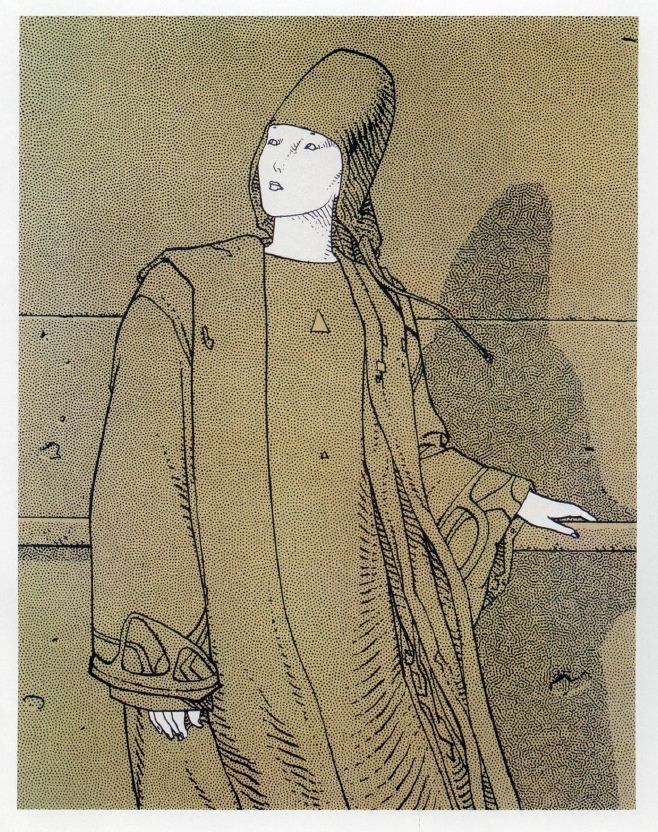
Helen — Moebius

helen

“Von Kempelen and His Discovery ” — Edgar Allan Poe

“Von Kempelen and His Discovery ” by Edgar Allan Poe

AFTER THE very minute and elaborate paper by Arago, to say nothing of the summary in ‘Silliman’s Journal,’ with the detailed statement just published by Lieutenant Maury, it will not be supposed, of course, that in offering a few hurried remarks in reference to Von Kempelen’s discovery, I have any design to look at the subject in a scientific point of view. My object is simply, in the first place, to say a few words of Von Kempelen himself (with whom, some years ago, I had the honor of a slight personal acquaintance), since every thing which concerns him must necessarily, at this moment, be of interest; and, in the second place, to look in a general way, and speculatively, at the results of the discovery.

It may be as well, however, to premise the cursory observations which I have to offer, by denying, very decidedly, what seems to be a general impression (gleaned, as usual in a case of this kind, from the newspapers), viz.: that this discovery, astounding as it unquestionably is, is unanticipated.

By reference to the ‘Diary of Sir Humphrey Davy’ (Cottle and Munroe, London, pp. 150), it will be seen at pp. 53 and 82, that this illustrious chemist had not only conceived the idea now in question, but had actually made no inconsiderable progress, experimentally, in the very identical analysis now so triumphantly brought to an issue by Von Kempelen, who although he makes not the slightest allusion to it, is, without doubt (I say it unhesitatingly, and can prove it, if required), indebted to the ‘Diary’ for at least the first hint of his own undertaking.

The paragraph from the ‘Courier and Enquirer,’ which is now going the rounds of the press, and which purports to claim the invention for a Mr. Kissam, of Brunswick, Maine, appears to me, I confess, a little apocryphal, for several reasons; although there is nothing either impossible or very improbable in the statement made. I need not go into details. My opinion of the paragraph is founded principally upon its manner. It does not look true. Persons who are narrating facts, are seldom so particular as Mr. Kissam seems to be, about day and date and precise location. Besides, if Mr. Kissam actually did come upon the discovery he says he did, at the period designated—nearly eight years ago—how happens it that he took no steps, on the instant, to reap the immense benefits which the merest bumpkin must have known would have resulted to him individually, if not to the world at large, from the discovery? It seems to me quite incredible that any man of common understanding could have discovered what Mr. Kissam says he did, and yet have subsequently acted so like a baby—so like an owl—as Mr. Kissam admits that he did. By-the-way, who is Mr. Kissam? and is not the whole paragraph in the ‘Courier and Enquirer’ a fabrication got up to ‘make a talk’? It must be confessed that it has an amazingly moon-hoaxy-air. Very little dependence is to be placed upon it, in my humble opinion; and if I were not well aware, from experience, how very easily men of science are mystified, on points out of their usual range of inquiry, I should be profoundly astonished at finding so eminent a chemist as Professor Draper, discussing Mr. Kissam’s (or is it Mr. Quizzem’s?) pretensions to the discovery, in so serious a tone. Continue reading ““Von Kempelen and His Discovery ” — Edgar Allan Poe”

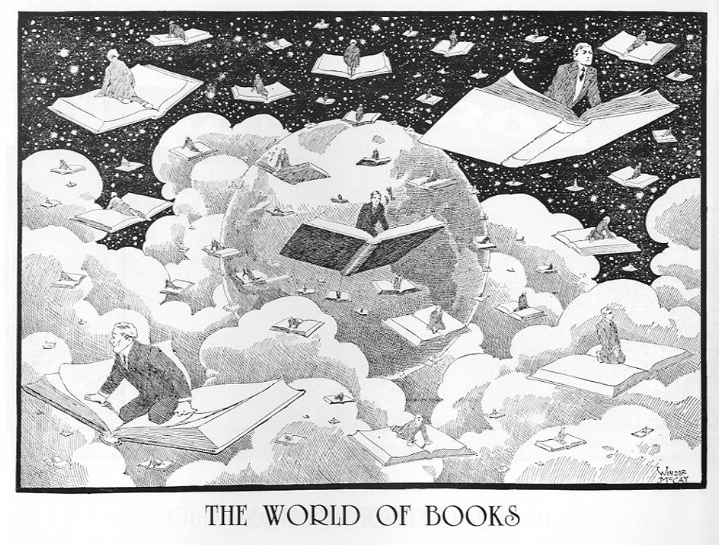
World of Books — Winsor McCay

McCayWorldOfBooksBaja

“The Double” — Jorge Luis Borges

“The Double” by Jorge Luis Borges (From Book of Imaginary Beings)

Suggested or stimulated by reflections in mirrors and in water and by twins, the idea of the Double is common to many countries. It is likely that sentences such as A friend is another self by Pythagoras or the Platonic Know thyself were inspired by it. In Germany this Double is called Doppelgänger, which means ’double walker’. In Scotland there is the fetch, which comes to fetch a man to bring him to his death; there is also the Scottish word wraith for an apparition thought to be seen by a person in his exact image just before death. To meet oneself is, therefore, ominous. The tragic ballad ‘Ticonderoga’ by Robert Louis Stevenson tells of a legend on this theme. There is also the strange picture by Rossetti (‘How They Met Themselves’) in which two lovers come upon themselves in the dusky gloom of a wood. We may also cite examples from Hawthorne (‘Howe’s Masquerade’), Dostoyevsky, Alfred de Musset, James (‘The Jolly Corner’), Kleist, Chesterton (‘The Mirror of Madmen’), and Hearn (Some Chinese Ghosts).

The ancient Egyptians believed that the Double, the ka, was a man’s exact counterpart, having his same walk and his same dress. Not only men, but gods and beasts, stones and trees, chairs and knives had their ka, which was invisible except to certain priests who could see the Doubles of the gods and were granted by them a knowledge of things past and things to come.

To the Jews the appearance of one’s Double was not an omen of imminent death. On the contrary, it was proof of having attained prophetic powers. This is how it is explained by Gershom Scholem. A legend recorded in the Talmud tells the story of a man who, in search of God, met himself.

In the story ‘William Wilson’ by Poe, the Double is the hero’s conscience. He kills it and dies. In a similar way, Dorian Gray in Wilde’s novel stabs his portrait and meets his death. In Yeats’s poems the Double is our other side, our opposite, the one who complements us, the one we are not nor will ever become.

Plutarch writes that the Greeks gave the name other self to a king’s ambassador.


From A Week of Kindness — Max Ernst

“Reindeer discovered again their ancient powers of flight,” and other Tunguska effects (Pynchon’s Against the Day)

FOR A WHILE after the Event, crazed Raskol’niki ran around in the woods, flagellating themselves and occasional onlookers who got too close, raving about Tchernobyl, the destroying star known as Wormwood in the book of Revelation. Reindeer discovered again their ancient powers of flight, which had lapsed over the centuries since humans began invading the North. Some were stimulated by the accompanying radiation into an epidermal luminescence at the red end of the spectrum, particularly around the nasal area. Mosquitoes lost their taste for blood, acquiring one instead for vodka, and were observed congregating in large swarms at local taverns. Clocks and watches ran backward. Although it was summer, there were brief snowfalls in the devastated taiga, and heat in general tended to flow unpredictably for a while. Siberian wolves walked into churches in the middle of services, quoted passages from the Scriptures in fluent Old Slavonic, and walked peaceably out again. They were reported to be especially fond of Matthew 7:15, “Beware of false prophets, which come to you in sheep’s clothing, but inwardly they are ravening wolves.” Aspects of the landscape of Tierra del Fuego, directly opposite the Stony Tunguska on the globe, began to show up in Siberia—sea ernes, gulls, terns, and petrels landing in the branches of fir trees, swooping to grab fish out of the streams, taking a bite, screaming with distaste, and throwing them back. Granite cliffs rose sheer and unexpected out of the forest. Oceangoing ships unmanned by visible crews, attempting to navigate the shallow rivers and creeks, ran aground. Entire villages came to the conclusion that they were not where they ought to be, and without much advance planning simply packed up what they had, left behind what they couldn’t carry, and headed off together into the brush, where presently they set up villages no one else could see. Or not very clearly.

And from everywhere in the taiga, all up and down the basins of the Yenisei, came reports of a figure walking through the aftermath, not exactly an angel but moving like one, deliberately, unhurried, a consoler. Accounts differed as to whether the outsize figure was man or woman, but all reported having to look steeply upward when trying to make out its face, and a deep feeling of fearless calm once it had passed.

Some thought it might be some transfigured version of the shaman Magyakan, whose whereabouts had been puzzling folks along the Stony T. No one had seen him since the Event, his izba was empty, and the magical force that had kept it from sinking, like everyone else’s dwelling in Siberia, into the summer-thawed earth, had abated, so that the cabin now tilted at a thirty-degree angle, like a ship at sea about to slide beneath the waves.

None of the strange effects lasted long, and as the Event receded in memory, arguments arose as to whether this or that had even happened at all. Soon the forest was back to normal, green underbrush beginning to appear among the dead-white trunks, the animals fallen speechless again, tree-shadows again pointing in their accustomed directions, and Kit and Prance continued to make their way through it with no idea what this meant for their mission out here.

—Another citation from Thomas Pynchon’s Against the Day.

List with No Name #34

  1. Atwood
  2. Borges
  3. Calvino
  4. Dickinson
  5. Emerson
  6. Faulkner
  7. Gombrowicz
  8. Hawthorne
  9. Ibsen
  10. Joyce
  11. Kafka
  12. Lish
  13. Melville
  14. Nin
  15. O’Brien
  16. Poe
  17. Queneau
  18. Roth
  19. Sebald
  20. Twain
  21. Updike
  22. Vonnegut
  23. Walser
  24. Xenophon
  25. Yeats
  26. Zola

Marilyn — Allan D’Arcangelo

Vasiliy Luzhsky on Vacation in London’s Hyde Park — Boris Kustodiev

The Stone Operation (The Cure of Folly) — Hieronymus Bosch

“Your whole history in America has been one long religious war, secret crusades, disguised under false names” (Pynchon’s Against the Day)

“Not quite how it sorts out. Differences among the world religions are in fact rather trivial when compared to the common enemy, the ancient and abiding darkness which all hate, fear, and struggle against without cease”— he made a broad gesture to indicate the limitless taiga all around them— “Shamanism. There isn’t a primitive people anywhere on Earth that can’t be found practicing some form of it. Every state religion, including your own, considers it irrational and pernicious, and has taken steps to eradicate it.”

“What? there’s no ‘state religion’ in the U.S.A., pardner, we’ve got freedom of worship, it’s guaranteed in the Constitution—keeps church and state separate, just so’s we don’t turn into something like England and keep marching off into the brush with bagpipes and Gatling guns, looking for more infidels to wipe out. Nothing personal o’ course.”

“The Cherokee,” replied Prance, “the Apache, the massacre of the Sioux Ghost Dancers at Wounded Knee, every native Red Indian you’ve found, you people have either tried to convert to Christianity or you’ve simply killed.”

“I suggest it was about the fear of medicine men and strange practices, dancing and drug-taking, that allow humans to be in touch with the powerful gods hiding in the landscape, with no need of any official church to mediate it for them. The only drug you’ve ever been comfortable with is alcohol, so you went in and poisoned the tribes with that. Your whole history in America has been one long religious war, secret crusades, disguised under false names. You tried to exterminate African shamanism by kidnapping half the continent into slavery, giving them Christian names, and shoving your peculiar versions of the Bible down their throats, and look what happened.”

“The Civil War? That was economics. Politics.”

“That was the gods you tried to destroy, waiting their hour, taking their revenge. You people really just believe everything you’re taught, don’t you?”

Another passage from Thomas Pynchon’s enormous novel Against the Day. Context unimportant to content here.