Woman Reading — Henri Matisse

Made-up Flowers from Boris Vian’s Novel Heartsnatcher

In the order they appear:

Amizaltzes

Powaroses

Marienbud

Yellowplush

Dreamrape

Fenellacas

Ninastangas

Astrakhan

Marazardins

Seacrocus

Bruinzozos

Bazabobos

Petaleaves

Translated from the French by Stanley Chapman

Painters Painting, a 1973 Documentary Featuring Andy Warhol, Jasper Johns, Willem de Kooning, and More

“An Immortal” — Robert Walser

walser

Susan Sontag’s Notebooks, 1964-1980 (Book Acquired, 7.09.2013)

20130717-120722.jpg

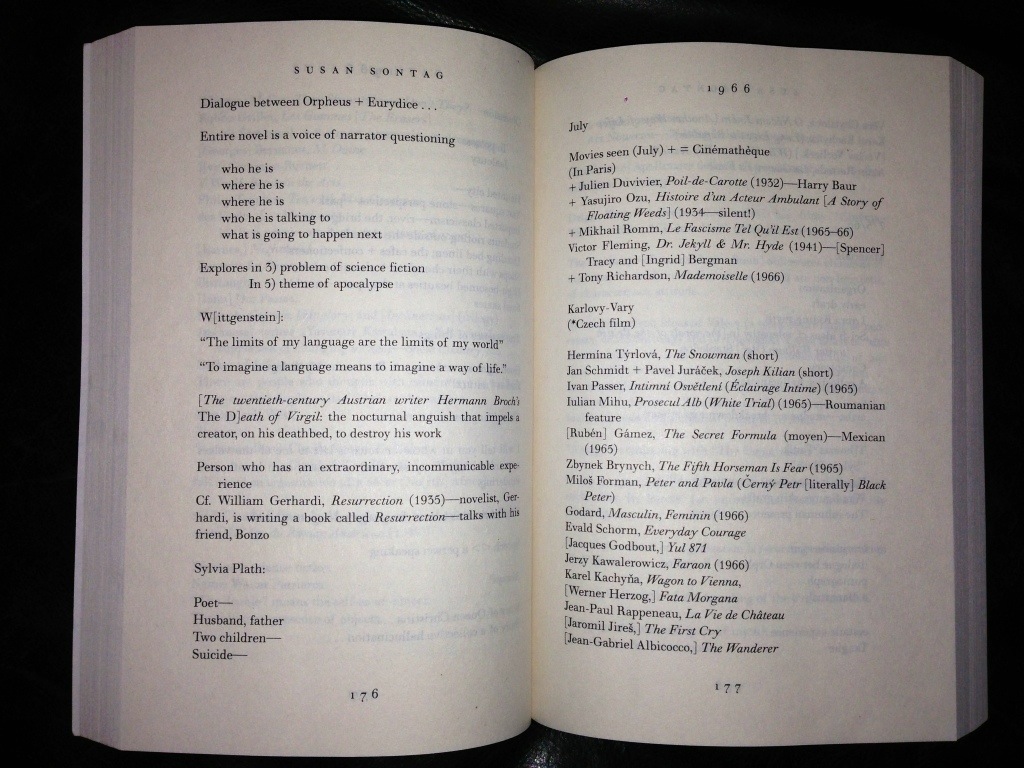
I’ve been—I don’t know—strolling through Susan Sontag’s journals and notebooks this past week. Collected as As Consciousness Is Harnessed to Flesh and new from Picador, this volume picks up where Reborn left off. I’ll be doing a full write up some time this month—really more about writer notebooks (I love Hawthorne’s in particular). Until then—a sample spread from the summer of ’66:

20130717-120729.jpg

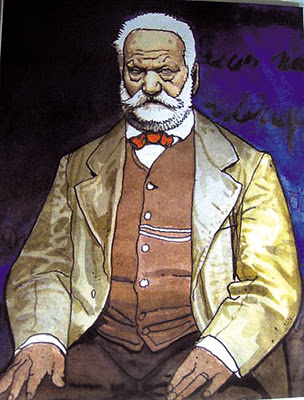
Portrait of Victor Hugo — Moebius

23993e0e301661297cd7e1d072471f1c

“Scandal” — Willa Cather

“Scandal” by Willa Cather

Kitty Ayrshire had a cold, a persistent inflammation of the vocal cords which defied the throat specialist. Week after week her name was posted at the Opera, and week after week it was canceled, and the name of one of her rivals was substituted. For nearly two months she had been deprived of everything she liked, even of the people she liked, and had been shut up until she had come to hate the glass windows between her and the world, and the wintry stretch of the Park they looked out upon. She was losing a great deal of money, and, what was worse, she was losing life; days of which she wanted to make the utmost were slipping by, and nights which were to have crowned the days, nights of incalculable possibilities, were being stolen from her by women for whom she had no great affection. At first she had been courageous, but the strain of prolonged uncertainty was telling on her, and her nervous condition did not improve her larynx. Every morning Miles Creedon looked down her throat, only to put her off with evasions, to pronounce improvement that apparently never got her anywhere, to say that tomorrow he might be able to promise something definite.

Her illness, of course, gave rise to rumours—rumours that she had lost her voice, that at some time last summer she must have lost her discretion. Kitty herself was frightened by the way in which this cold hung on. She had had many sharp illnesses in her life, but always, before this, she had rallied quickly. Was she beginning to lose her resiliency? Was she, by any cursed chance, facing a bleak time when she would have to cherish herself? She protested, as she wandered about her sunny, many-windowed rooms on the tenth floor, that if she was going to have to live frugally, she wouldn’t live at all. She wouldn’t live on any terms but the very generous ones she had always known. She wasn’t going to hoard her vitality. It must be there when she wanted it, be ready for any strain she chose to put upon it, let her play fast and loose with it; and then, if necessary, she would be ill for a while and pay the piper. But be systematically prudent and parsimonious she would not. Continue reading ““Scandal” — Willa Cather”

Mufti Reading in His Prayer Stool — Jean-Leon Gerome

Explication/Confusion of Pacific Rim in Ten Images

Delacroix
Goya
Voltron
Voltron
Dürer
Blake
original-godzilla
Godzilla
Matejko
Burne-Jones
Adams
Adams
Corinth

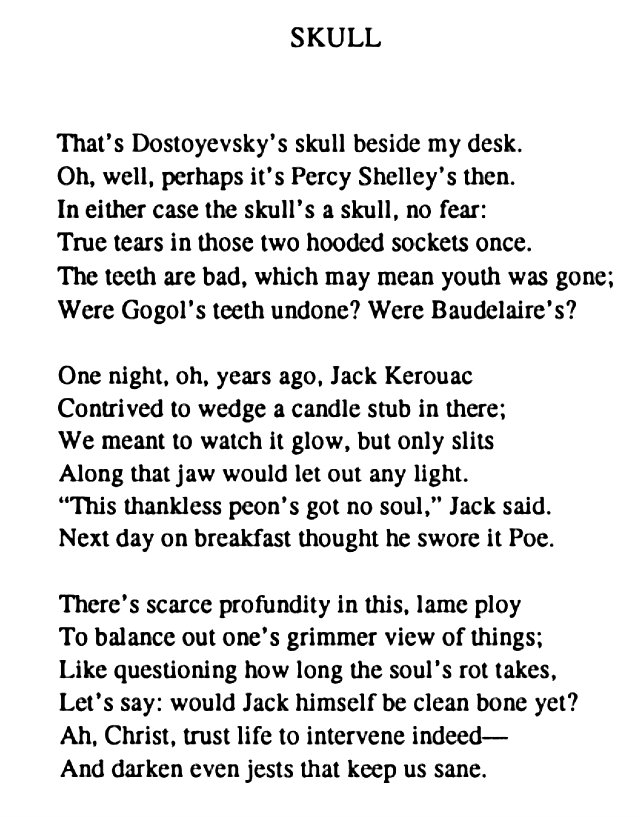
“Skull” — David Markson

skull

(Via).

Hindering the Artist is a Crime, It is Murdering Life in the Bud — Egon Schiele

“I’ve always been a monster guy” — Guillermo del Toro on Godzilla

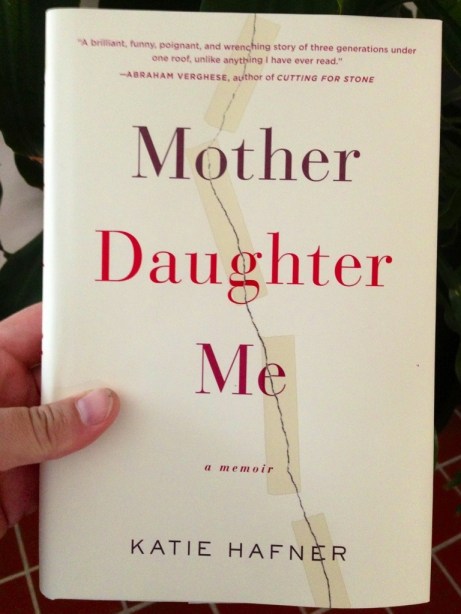
Mother Daughter Me (Book Acquired, 7.08.2013)

20130709-141434.jpg

Mother Daughter Me is Katie Hafner’s memoir, new in hardback from Random House. Their blurb:

The complex, deeply binding relationship between mothers and daughters is brought vividly to life in Katie Hafner’s remarkable memoir, an exploration of the year she and her mother, Helen, spent working through, and triumphing over, a lifetime of unresolved emotions.

Dreaming of a “year in Provence” with her mother, Katie urges Helen to move to San Francisco to live with her and Zoë, Katie’s teenage daughter. Katie and Zoë had become a mother-daughter team, strong enough, Katie thought, to absorb the arrival of a seventy-seven-year-old woman set in her ways.

Filled with fairy-tale hope that she and her mother would become friends, and that Helen would grow close to her exceptional granddaughter, Katie embarked on an experiment in intergenerational living that she would soon discover was filled with land mines: memories of her parents’ painful divorce, of her mother’s drinking, of dislocating moves back and forth across the country,  and of Katie’s own widowhood and bumpy recovery. Helen, for her part, was also holding difficult issues at bay.

How these three women from such different generations learn to navigate their challenging, turbulent, and ultimately healing journey together makes for riveting reading. By turns heartbreaking and funny—and always insightful—Katie Hafner’s brave and loving book answers questions about the universal truths of family that are central to the lives of so many.

Bell Jar Malady — Ruby Osorio

“Elegy with Surrealist Proverbs as Refrain” — Dana Gioia

“Elegy with Surrealist Proverbs as Refrain” by Dana Gioia—

“Poetry must lead somewhere,” declared Breton.
He carried a rose inside his coat each day
to give a beautiful stranger—“Better to die of love
than love without regret.” And those who loved him
soon learned regret. “The simplest surreal act
is running through the street with a revolver
firing at random.” Old and famous, he seemed démodé.
There is always a skeleton on the buffet.

Wounded Apollinaire wore a small steel plate
inserted in his skull. “I so loved art,” he smiled,
“I joined the artillery.” His friends were asked to wait
while his widow laid a crucifix across his chest.
Picasso hated death. The funeral left him so distressed
he painted a self-portrait. “It’s always other people,”
remarked Duchamp, “who do the dying.”
I came. I sat down. I went away.

Dali dreamed of Hitler as a white-skinned girl—
impossibly pale, luminous and lifeless as the moon.
Wealthy Roussel taught his poodle to smoke a pipe.
“When I write, I am surrounded by radiance.
My glory is like a great bomb waiting to explode.”
When his valet refused to slash his wrists,
the bankrupt writer took an overdose of pills.
There is always a skeleton on the buffet.

Breton considered suicide the truest art,
though life seemed hardly worth the trouble to discard.
The German colonels strolled the Île de la Cité—
some to the Louvre, some to the Place Pigalle.
“The loneliness of poets has been erased,” cried Éluard,
in praise of Stalin. “Burn all the books,” said dying Hugo Ball.
There is always a skeleton on the buffet.
I came. I sat down. I went away.

Young Girl Reading — Henri Martin

Portrait of H.P. Lovecraft — Mike Mignola

mignola

(Via).