Portrait of Johannes Wtenbogaert — Rembrandt

Maya Deren’s Surreal Short Film, Ritual in Transfigured Time

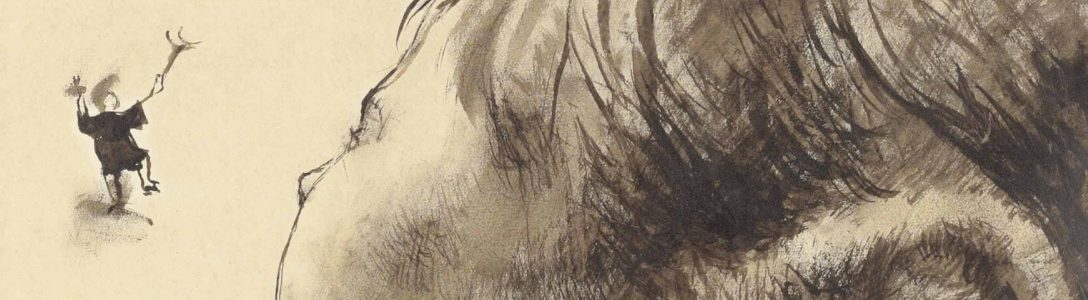
Untitled (Pangolin) — Madeline von Foerster

Pangolin_sm

(Via/more).

Ten Ideas from Nathaniel Hawthorne’s Note-Books

  1. A tree, tall and venerable, to be said by tradition to have been the staff of some famous man, who happened to thrust it into the ground, where it took root.
  2. A fellow without money, having a hundred and seventy miles to go, fastened a chain and padlock to his legs, and lay down to sleep in a field. He was apprehended, and carried gratis to a jail in the town whither he desired to go.
  3. An old volume in a large library,–every one to be afraid to unclasp and open it, because it was said to be a book of magic.
  4. A ghost seen by moonlight; when the moon was out, it would shine and melt through the airy substance of the ghost, as through a cloud.
  5. A scold and a blockhead,–brimstone and wood,–a good match.
  6. To make one’s own reflection in a mirror the subject of a story.
  7. In a dream to wander to some place where may be heard the complaints of all the miserable on earth.
  8. Some common quality or circumstance that should bring together people the most unlike in all other respects, and make a brotherhood and sisterhood of them,–the rich and the proud finding themselves in the same category with the mean and the despised.
  9. A person to consider himself as the prime mover of certain remarkable events, but to discover that his actions have not contributed in the least thereto. Another person to be the cause, without suspecting it.
  10. A person or family long desires some particular good. At last it comes in such profusion as to be the great pest of their lives.

—Notations from Nathaniel Hawthorne’s American Note-Books. (See also: Twenty ideas from Nathaniel Hawthorne’s Note-Books)

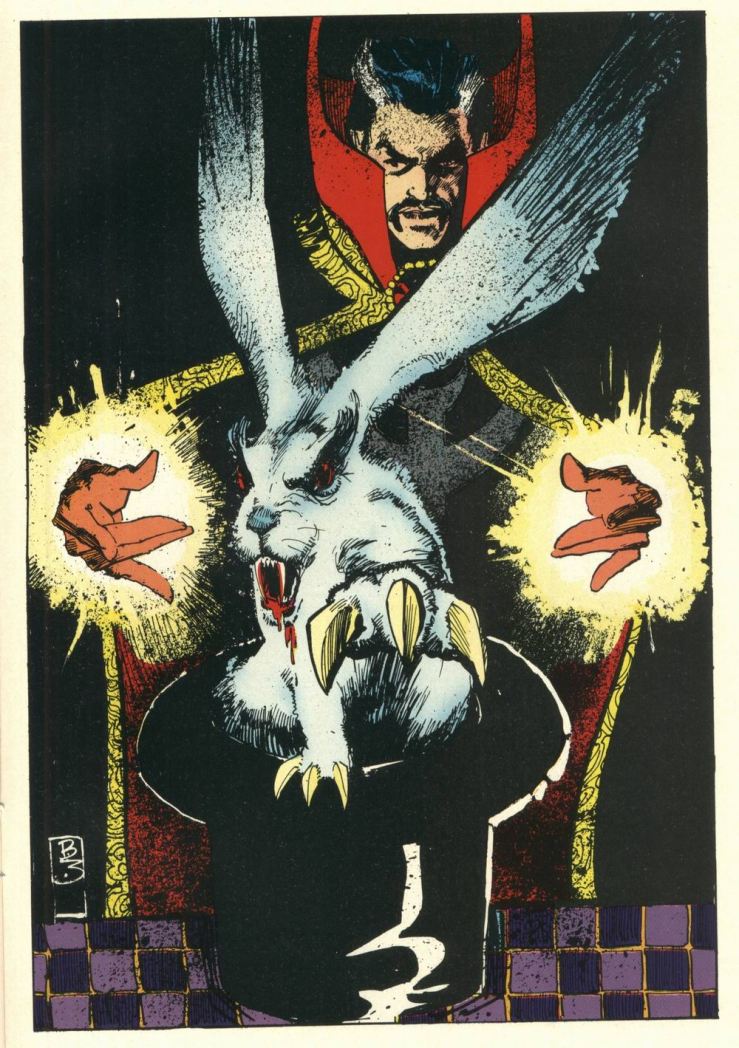
Dr. Strange — Bill Sienkiewicz

tumblr_mlsd1dwEtG1rcp7bmo1_1280

(Via).

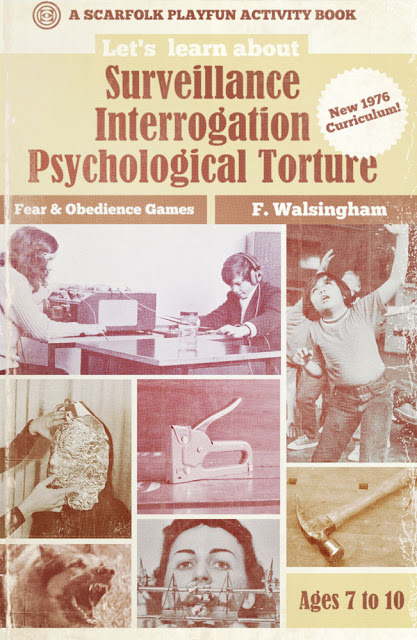
Let’s Learn About Surveillance, Interrogation, and Psychological Torture

surveillancewww-scarfolk-blogspot-com

Getting psyched about our family summer vacation to Scarfolk!

“The End of the World” — G.K. Chesterton

“The End of the World” by G.K. Chesterton

For some time I had been wandering in quiet streets in the curious town of Besançon, which stands like a sort of peninsula in a horse-shoe of river. You may learn from the guide books that it was the birthplace of Victor Hugo, and that it is a military station with many forts, near the French frontier. But you will not learn from guide books that the very tiles on the roofs seem to be of some quainter and more delicate colour than the tiles of all the other towns of the world; that the tiles look like the little clouds of some strange sunset, or like the lustrous scales of some strange fish. They will not tell you that in this town the eye cannot rest on anything without finding it in some way attractive and even elvish, a carved face at a street corner, a gleam of green fields through a stunted arch, or some unexpected colour for the enamel of a spire or dome.

…..Evening was coming on and in the light of it all these colours so simple and yet so subtle seemed more and more to fit together and make a fairy tale. I sat down for a little outside a café with a row of little toy trees in front of it, and presently the driver of a fly (as we should call it) came to the same place. He was one of those very large and dark Frenchmen, a type not common but yet typical of France; the Rabelaisian Frenchman, huge, swarthy, purple-faced, a walking wine-barrel; he was a sort of Southern Falstaff, if one can imagine Falstaff anything but English. And, indeed, there was a vital difference, typical of two nations. For while Falstaff would have been shaking with hilarity like a huge jelly, full of the broad farce of the London streets, this Frenchman was rather solemn and dignified than otherwise—as if pleasure were a kind of pagan religion. After some talk which was full of the admirable civility and equality of French civilisation, he suggested without either eagerness or embarrassment that he should take me in his fly for an hour’s ride in the hills beyond the town. And though it was growing late I consented; for there was one long white road under an archway and round a hill that dragged me like a long white cord. We drove through the strong, squat gateway that was made by Romans, and I remember the coincidence like a sort of omen that as we passed out of the city I heard simultaneously the three sounds which are the trinity of France. They make what some poet calls “a tangled trinity,” and I am not going to disentangle it. Whatever those three things mean, how or why they co-exist; whether they can be reconciled or perhaps are reconciled already; the three sounds I heard then by an accident all at once make up the French mystery. For the brass band in the Casino gardens behind me was playing with a sort of passionate levity some ramping tune from a Parisian comic opera, and while this was going on I heard also the bugles on the hills above, that told of terrible loyalties and men always arming in the gate of France; and I heard also, fainter than these sounds and through them all, the Angelus. Continue reading ““The End of the World” — G.K. Chesterton”

Minerva — Rembrandt

Old Money

Capture

(More Gatsby comics by Kate Beaton at her site Hark, a vagrant).

Hawthorne Anecdote

I was sent for to the police court the other morning, in the case of an American sailor accused of robbing a shipmate at sea. A large room, with a great coal-fire burning on one side, and above it the portrait of Mr. Rushton, deceased, a magistrate of many years’ continuance. A long table, with chairs, and a witness-box. One of the borough magistrates, a merchant of the city, sat at the head of the table, with paper and pen and ink before him; but the real judge was the clerk of the court, whose professional knowledge and experience governed all the proceedings. In the short time while I was waiting, two cases were tried, in the first of which the prisoner was discharged. The second case was of a woman,—a thin, sallow, hard-looking, careworn, rather young woman,—for stealing a pair of slippers out of a shop: The trial occupied five minutes or less, and she was sentenced to twenty-one days’ imprisonment,—whereupon, without speaking, she looked up wildly first into one policeman’s face, then into another’s, at the same time wringing her hands with no theatric gesture, but because her torment took this outward shape,—and was led away. The Yankee sailor was then brought up,—an intelligent, but ruffian-like fellow,—and as the case was out of the jurisdiction of the English magistrates, and as it was not worth while to get him sent over to America for trial, he was forthwith discharged. He stole a comforter.

If mankind were all intellect, they would be continually changing, so that one age would be entirely unlike another. The great conservative is the heart, which remains the same in all ages; so that commonplaces of a thousand years’ standing are as effective as ever.

–From the January 6th, 1854 entry of Nathaniel Hawthorne’s English note-books.

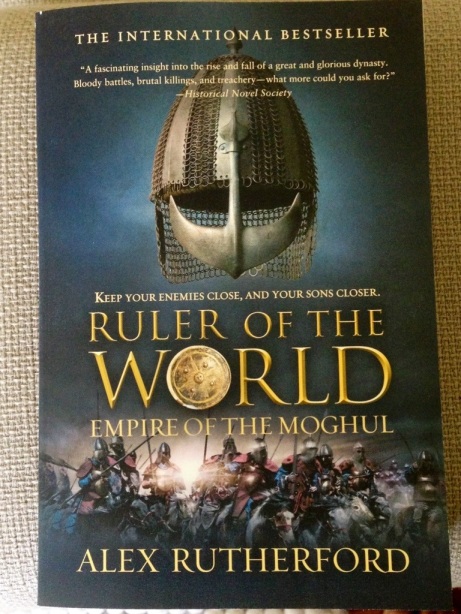
Ruler of the World (Book Acquired, 5.06.2013)

20130506-191048.jpg

Ruler of the World by Alex Rutherford. Pub’s copy:

Alex Rutherford’s internationally bestselling series continues with Ruler of the World, the story of the third great Moghul Emperor, Akbar, leader of a triumphant dynasty which contained the seeds of its own destruction.

Akbar, ruler of a sixth of the world’s people, colossally rich and utterly ruthless, was a contemporary of Elizabeth I, but infinitely more powerful. He extended his empire over much of Asia, skillfully commanding tens of thousands of men, elephants and innovative technology, yet despite the unimaginable bloodshed which resulted his rule was based on universal religious tolerance.

However, Akbar’s homelife was more complicated. He defied family, nobles and mullahs to marry a beautiful Rajput princess, whose people he had conquered; but she hated Akbar and turned Salim, his eldest son, against him. What’s more, as any Moghul prince could inherit his father’s crown and become Emperor, his sons were brought up to be intensely competitive and suspicious of each other: to see each other as rivals for the greatest prize of all. And, as Salim grew to manhood, the relationship between father and son became tainted by rebellion and competition to be the greatest Moghul of them all.


Pray for These Little Ones (Perforce They Live Together) — Ivan Albright

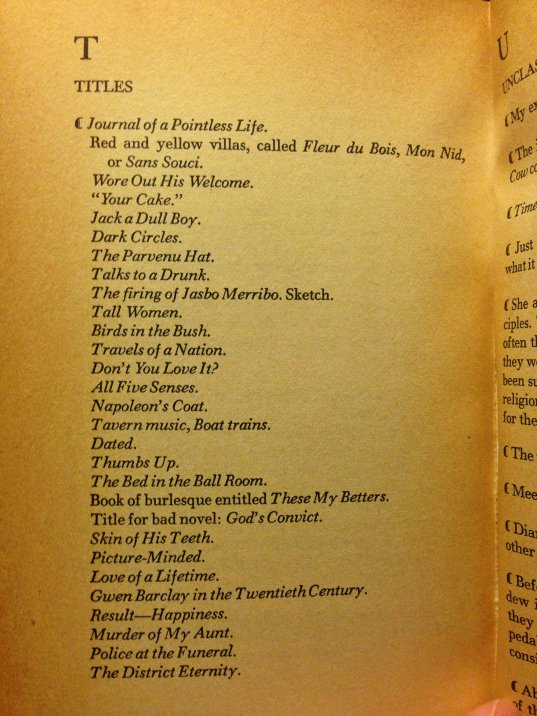
Journal of a Pointless Life, and Other Titles from F. Scott Fitzgerald’s Notebooks

IMG_5729

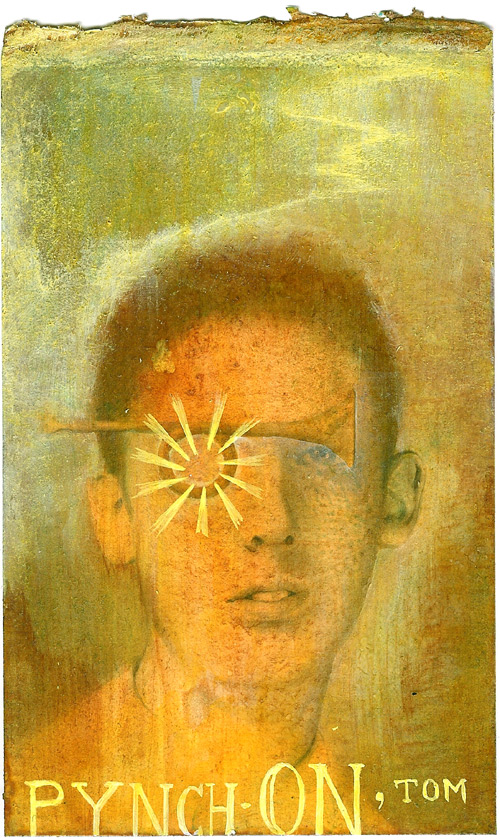
Thomas Pynchon Portrait — James Jean

James Jean does Thomas Pynchon. (Via Hey Oscar Wilde!).

“An Ideal Family” — Katherine Mansfield

“An Ideal Family” by Katherine Mansfield

That evening for the first time in his life, as he pressed through the swing door and descended the three broad steps to the pavement, old Mr. Neave felt he was too old for the spring. Spring—warm, eager, restless—was there, waiting for him in the golden light, ready in front of everybody to run up, to blow in his white beard, to drag sweetly on his arm. And he couldn’t meet her, no; he couldn’t square up once more and stride off, jaunty as a young man. He was tired and, although the late sun was still shining, curiously cold, with a numbed feeling all over. Quite suddenly he hadn’t the energy, he hadn’t the heart to stand this gaiety and bright movement any longer; it confused him. He wanted to stand still, to wave it away with his stick, to say, “Be off with you!” Suddenly it was a terrible effort to greet as usual—tipping his wide-awake with his stick—all the people whom he knew, the friends, acquaintances, shopkeepers, postmen, drivers. But the gay glance that went with the gesture, the kindly twinkle that seemed to say, “I’m a match and more for any of you”—that old Mr. Neave could not manage at all. He stumped along, lifting his knees high as if he were walking through air that had somehow grown heavy and solid like water. And the homeward-looking crowd hurried by, the trams clanked, the light carts clattered, the big swinging cabs bowled along with that reckless, defiant indifference that one knows only in dreams…

It had been a day like other days at the office. Nothing special had happened. Harold hadn’t come back from lunch until close on four. Where had he been? What had he been up to? He wasn’t going to let his father know. Old Mr. Neave had happened to be in the vestibule, saying good-bye to a caller, when Harold sauntered in, perfectly turned out as usual, cool, suave, smiling that peculiar little half-smile that women found so fascinating.

Ah, Harold was too handsome, too handsome by far; that had been the trouble all along. No man had a right to such eyes, such lashes, and such lips; it was uncanny. As for his mother, his sisters, and the servants, it was not too much to say they made a young god of him; they worshipped Harold, they forgave him everything; and he had needed some forgiving ever since the time when he was thirteen and he had stolen his mother’s purse, taken the money, and hidden the purse in the cook’s bedroom. Old Mr. Neave struck sharply with his stick upon the pavement edge. But it wasn’t only his family who spoiled Harold, he reflected, it was everybody; he had only to look and to smile, and down they went before him. So perhaps it wasn’t to be wondered at that he expected the office to carry on the tradition. H’m, h’m! But it couldn’t be done. No business—not even a successful, established, big paying concern—could be played with. A man had either to put his whole heart and soul into it, or it went all to pieces before his eyes… Continue reading ““An Ideal Family” — Katherine Mansfield”

The Rich Man from the Parable — Rembrandt

Entr’acte — René Clair (Score by Erik Satie)