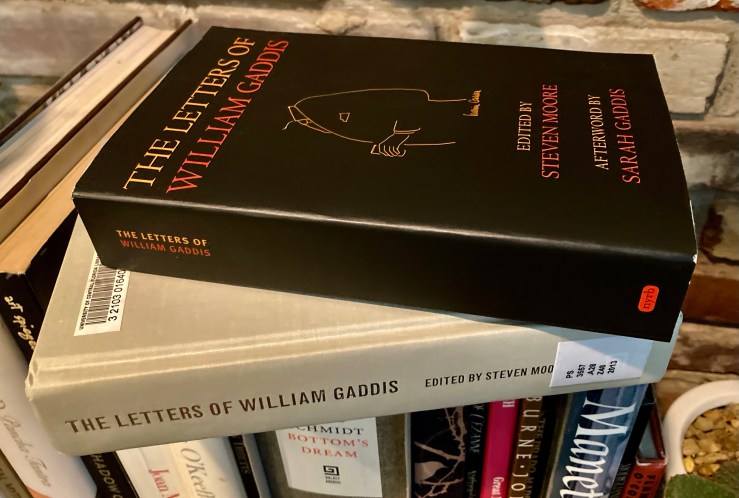
Ten years ago, Dalkey Archive published The Letters of William Gaddis. Edited and introduced by Steven Moore, Letters functions as an ersatz autobiography or a one-sided epistolary autobiographical novel. As a public-facing author, Gaddis was hardly a Pynchon or Salinger, but, in a 1986 Paris Review interview, he did stick by the hero of his first novel The Recognitions, contending,
What’s any artist but the dregs of his work[?]: I gave that line to Wyatt thirty-odd years ago and as far as I’m concerned it’s still valid,
Wyatt, and Gaddis, wanted to know “what people want from the man they didn’t get from his work.” The Letters offers some answers—close to 700 pages of them in the new NYRB edition of the book that includes “over two dozen new letters and photographs.”
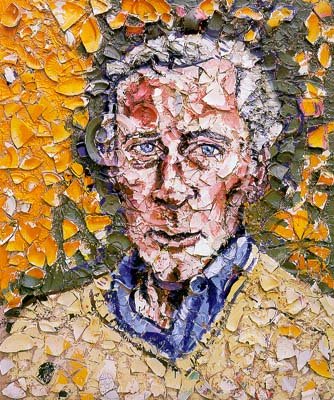
Portrait of William Gaddis, Julian Schnabel, 1987
I first read The Letters of William Gaddis slowly between 2014 and 2019 as an e-book (both legit and samizdat). Moore organized the collection around Gaddis’s five books, and I found myself often distracted, opening up the the volumes to find parallels between life and art (or moments where WG outright stole from reality). I’d never actually held the Dalkey edition, but I wanted to get a comparison, so I asked my librarian to engage in some hot library on library action, and I now have the University of Central Florida’s copy in my possession. The hardback volume is missing the jacket, which featured Julian Schnabel’s 1987 portrait of Gaddis on the cover.
The new NYRB edition, perhaps more appropriately, features Gaddis’s self-portrait as cover art. The black, gold, and red, as well as the extra-large dimensions (by NYRB standards) match the NYRB versions of The Recognitions and J.R. It’s longer and a bit smaller than the hardback Dalkey, but the print is about the same size.
I’ve decided to cover the book at my own pace; I’ve reread the first two sections, “Growing Up,” and “The Recognitions,” which covers 1930-1955. I remembered pretty much all of it, and my judgments remain the same: Gaddis is an unrepentant mama’s boy, his sweet ma Edith is the early hero of the book, quick to send money and books. Angry Young Man Gaddis is more Otto than Wyatt, but he can sling sentences with the best of them—and that’s the joy of The Letters: the writing is really, really good.
Like I said though, I’ll cover the volume at my own pace. I’ve got notes prepped for the first two sections, and I aim to get those blogs out sooner than later. In the meantime, here’s the publisher’s blurb, almost certainly Moore’s writing, updated just a tad from the Dalkey:
Now recognized as one of the giants of postwar American fiction, William Gaddis shunned the spotlight during his life, which makes this collection of his letters a revelation. Beginning in 1930 when Gaddis was at boarding school and ending in September 1998, a few months before his death, these letters function as a kind of autobiography, and also reveal the extent to which he drew upon events in his life for his fiction. Here we see him forging his first novel, The Recognitions (1955), while living in Mexico, fighting in a revolution in Costa Rica, and working in Spain, France, and North Africa. Over the next twenty years he struggles to find time to write the National Book Award–winning J R (1975) amid the complications of work and family; deals with divorce and disillusionment before reviving his career with Carpenter’s Gothic (1985); then teaches himself enough about the law to produce A Frolic of His Own(1994). Resuming his lifelong obsession with mechanization and the arts, he finishes a last novel, Agapē Agape (published in 2002), as he lies dying.
This newly revised edition includes clarifying notes by Gaddis scholar Steven Moore, as well as an afterword by the author’s daughter, Sarah Gaddis.
This expedition to see Céline was organized in 1958 by Allen Ginsberg who had got his address from someone. It is in Meudon, across the river from Paris proper. We finally found a bus that let us off in a shower of French transit directions: “Tout droit, Messieurs …” Walked for half a mile in this rundown suburban neighborhood, shabby villas with flaking stucco—it looked sort of like the outskirts of Los Angeles—and suddenly there’s this great cacophony of barking dogs. Big dogs, you could tell by the bark. “This must be it,” Allen said. Here’s Céline shouting at the dogs, and then he stepped into the driveway and motioned to us to come in. He seemed glad to see us and clearly we were expected. We sat down at a table in a paved courtyard behind a two-story building and his wife, who taught dancing—she had a dancing studio—brought coffee.
Céline looked exactly as you would expect him to look. He had on a dark suit, scarves and shawls wrapped around him, and the dogs, confined in a fenced-in area behind the villa, could be heard from time to time barking and howling. Allen asked if they ever killed anyone and Céline said, “Nooo. I just keep them for the noise.” Allen gave him some books, Howl and some poems by Gregory Corso and my book Junky. Céline glanced at the books without interest and laid them sort of definitively aside. Clearly he had no intention of wasting his time. He was sitting out there in Meudon. Céline thinks of himself as the greatest French writer, and no one’s paying any attention to him. So, you know, there’s somebody who wanted to come and see him. He had no conception of who we were.
Allen asked him what he thought of Beckett, Genet, Sartre, Simone de Beauvoir, Henri Michaux, just everybody he could think of. He waved this thin, blue-veined hand in dismissal: “Every year there is a new fish in the literary pond.
“It is nothing. It is nothing. It is nothing,” he said about all of them.
“Are you a good doctor?” Allen asked.
And he said: “Well … I am reasonable.”
Was he on good terms with the neighbors? Of course not.
“I take my dogs to the village because of the Jeeews. The postmaster destroys my letters. The druggist won’t fill my prescriptions.…” The barking dogs punctuated his words.
We walked right into a Céline novel. And he’s telling us what shits the Danes were. Then a story about being shipped out during the war: the ship was torpedoed and the passengers are hysterical so Céline lines them all up and gives each of them a big shot of morphine, and they all got sick and vomited all over the boat.
He waved goodbye from the driveway and the dogs were raging and jumping against the fence.
From With William Burroughs, by Victor Bockris. The speaker is, of course, Burroughs, prompted by a question from Bockris. It’s from the chapter entitled “Dinner with Nicolas Roeg, Lou Reed, Bockris-Wylie, and Gerard Malanga: New York 1978.” Roeg and Reed come off as total pricks.
Detail from The Age of Alexander, 1959 by Cy Twombly
“The best and most skilled of parasites live, reproduce, and die, without their hosts ever really knowing, or at least being able to do anything about it,” declares A.V. Marraccini, early in her new book We the Parasites. “I’m not even a good parasite because painters or novelists can see me seeing them, drawing off their vital fluid, forming new and odd things in my dark-lobed ovarians, and then shoving them out, hastily and fitfully, into the world of papers and reviews.”
We the Parasites belongs in part to that “world of papers and reviews,” that world of criticism, but it also exists on the other side of any genre margin we might wish to impose. A.V. Marraccini’s book is generative, creative, fruitful, a hybrid that points to something beyond the lyric essay. It is stuffed with art and poetry and life; it is erudite and frequently fun; it is moody and sometimes melodramatic, but tonally consistent.
Marraccini’s central metaphor is that critics are parasites. This metaphor gives Marraccini space in which to wander: through history, through art. Through her own history and her present consciousness. She concocts a discursive ekphrasis that zigs and zags from the commensalism of figs and wasps to the paintings of Cy Twombly to John Updike’s novel 1963 The Centaur.
These nimble discursions are one of the primary joys in reading We the Parasites. Marraccini will offer a nice chunk of an H.D. poem before grafting an entire section of Cy Twombly’s Wikipedia page into her text. The particular section Marraccini excises details the so-called Phaedrus incident, in which “Cambodian-French artist Rindy Sam [was arrested] after she kissed one panel of Twombly’s triptych Phaedrus. The panel, an all-white canvas, was smudged by Sam’s red lipstick and she was tried in a court in Avignon for ‘voluntary degradation of a work of art.’ …The prosecution described the act as a ‘sort of cannibalism, or parasitism…'” Marraccini goes on to describe Twombly’s Phaedrus as “a sort of cannibalism or parasitism on Theocritus.”
Apart from Marraccini herself, Cy Twombly strikes me as the major figure of We the Parasites. This statement is arguable, as others loom–Alexander the Great, Rainer Maria Rilke, the pseudonymous “Chiron,” one-time mentor to Marraccini who insists she read Updike’s novel The Centaur. But it’s Twombly whom Marraccini most frequently and successfully trains her ekphrastic powers on. Her multivalent reading of Twombly’s 1959 painting The Age of Alexander consumes the end of the book, and no wonder, for she attests that she sees the painting in her sleep, finding in its grafts a symbolic aesthetic language that approaches her own obsessions of parasitism:
Am I “over interpreting” this painting? Probably. It certainly meant nothing about wounds and fish louses to Cy Twombly. Were I writing an historical or academic argument I would have to care then, about the boundary conditions for believability, for perceived intent, and for context. Whatever this is, I’ve now called them off. I can say anything, which is nothing so much as dangerously overwhelming. I do this all the time to the whole world; see it as a layering of partially readable signs and portents, like some unlucky augur forever staring into the guts of sheep, the flightpath of certain birds. This often calls for melodrama, especially when the drama of the world as it really is doesn’t result in any kind of expected catharsis, Aristotelian or otherwise. I map myself onto whatever interpretation I’ve divined for that day, that hour, and then map myself back into the world again in another looping cycle.
Detail from The Age of Alexander, 1959 by Cy Twombly
While she never states it directly, Marraccini’s appreciation for Twombly’s paintings seems to come as an aesthetic reaction to their hybridity, their apparent incompleteness, their textual overdetermination. Many of Twombly’s paintings seem like studies, unfinished things that the viewer must complete with their own gaze. (Perhaps such thoughts or feelings went through Rindy Sam’s mind right before she kissed Phaedrus.) In a section of We the Parasites that has nothing to do with Twombly, she writes
Sometimes the study is better than the finished thing as it is here, suffused with longing. The provisionality of the study leaves room for it to be free. Right now, like time and the future, language is also provisional, so provisional and free that it feels like you might fall of something huge and intractable every time you write a sentence. There is danger here, with passion, the same frisson always but configured anew. No one is touching anyone’s strange body.
“No one is touching anyone’s strange body.” This is not some tortured metaphor, no. We the Parasites is a stealth plague memoir. 2020 and Covid-19 hang over the book, inverting its would-be-flânerie into flânerie for silent nights, cybernights, flânerie for necessary introversion. We stroll (or jog, or even run) along with Marraccini (a “3 a.m. cryptid”) and her private thoughts, late at night in dead quiet London. She scavenges with some foxes. She names the foxes. She thinks about Twombly; she thinks about an old love; she thinks about “Chiron.”
But We the People is not a straightforward Covid-19 memoir (it is not a straightforward anything)—its memoir intentions are largely aesthetic, often dwelling on Marraccini’s feelings of being an outsider in the Oxbridge world she now inhabits:
I’m a thief; a thousand hundred generations of starving Sicilian farmers indenturing their backs to some steep, rocky crag, a thousand hundred shtetl girls married off young. I’m from a hot, flat suburb of a third-rate city near a swam and the sea, I’m nothing from nowhere to you. I’ve seen the seen the asphalt burble in the heat before a thunderstorm in the summer. Do you think that there are barbarians? That I am one? Well, barbar then.
(Oh, you’re also from Florida? I thought after reading these sentences.)
But I don’t think that Marraccini really would accept the mantle of barbarian. There’s a defensive hedging in some of We the Parasite’s erudition; there are times our author need not try so hard. The prose flows finer (or coarser, as necessary) when the hedges give way: “We always go back to Homer, or I do, the I who wants to be the authoritative we,” Marraccini admits. The next sentence highlights the anxiety inherent in the pretense of critical authority: “I have also always been late to Homer, that same belatedness that creeps up everywhere again.” The anxiety here echoes an early sentiment, one I believe plainly felt by anyone who has ever dared to write about art:
All the battles royale are decided…How do you look at the plain, the beach, the walls of the city, the oak trees and the cauldrons on the tripods over small fires—how do you look at it all and live with the fact that you are always after? Always, somehow, about to break into tenderness and despair?
And yet an abiding love and appreciation and a desire to communicate that love and appreciation overcomes this despair. Like any writer sensitive enough to attend to all the before that they have come after, Marraccini understands the risk and guts it takes to write. The critic may be a parasite, but the critic does not seek to remove art from the world—the critic seeks to enliven the art, to expand its lifeforce:
If I am greedy for, say, a novel, or Bruegel’s Fall of Icarus, or the piano sonatas of the Younger of the Scarlattis, I don’t take it from the world. Or I do, a version of it, and put it in my Simoneidean memory house which is perhaps also a private brothel. But the Bruegel is still there, the Scarlatti, the novel, to seduce other people, other critics. Parasites want their hosts to live so they can spread.
But We the Parasites isn’t exactly a work of sustained criticism, nor is it a lyric essay, nor a memoir. It grafts elements of those genres, in the spirit of works by authors like W.G. Sebald, S.D. Chrostowska, Claudine Rankine, Ben Lerner, and Maggie Nelson. I’ve tried to give enough of a sample of the prose and scope of Marraccini’s book here to let potential readers determine whether or not this is their cup of figs and wasps. I admired much in We the People, and even admired it when it irritated me. I look forward to seeing what Marraccini will do next. Recommended.
As in that grey exurban wasteland in Gatsby
When the white sky darkens over the city
Of ashes, far from the once happy valley,
This daze spreads across the blank faces
Of the inhabitants, suddenly deprived
Of the kingdom’s original promised gift.
Did I say kingdom when I meant place
Of worship? Original when I meant
Damaged in handling? Promised when
I meant stolen? Gift when I meant
Trick? Inhabitants when I meant slaves?
Slaves when I meant clowns
Who have wandered into test sites? Test
Sites when I meant contagious hospitals?
Contagious hospitals when I meant clouds
Of laughing gas? Laughing gas
When I meant tears? No, it’s true,
No one should be writing poetry
In times like these, Dear Reader,
I don’t have to tell you of all people why.
It’s as apparent as an attempted
Punch in the eye that actually
Catches only empty air—which is
The inside of your head, where
The green ritual sanction
Of the poem has been cancelled.
There was once a society of scoundrels, or rather not scoundrels per se, just ordinary, average people. They always stuck together. When one of them had perpetrated some rascally act, or rather, nothing really rascally, just averagely bad, he would confess it to the others, and they investigated it, condemned it, imposed penalties, forgave him, etc. This wasn’t corrupt — the interests of the individual and the society were kept in balance and the confessor received the punishment he asked for. So they always stuck together, and even after their death they didn’t abandon their society, but ascended to heaven in a troop. It was a sight of childlike innocence to see them flying. But since everything at heaven’s gate is broken up into its component parts, they plunged down like so many rocks.
In a long, delirious monologue driven by bile and cocaine, a prostitute named Anúncia recounts the story of her life, remembering and sometimes inhabiting the men and women who left the deepest scars on her psyche—her absent father, her mentally disturbed mother, the son she never wanted, the parade of lovers like the poet and the philosopher—all the while drawing grand conclusions about the nature of sex, life, and death from her own experiences. In a world ravaged by pollution and unceasing war, the narrator’s acid tongue condemns anyone who believes that filth and depravity have more to do with copulation than the misery inflicted by exploitation and inequality.
In acidic, relentless, and sometimes dream-like prose, Barbieri conjures a figure at once singularly human and divine, an androgynous, eternal being made of viscera and utterance. The Whore, more than anything, is an interrogation of interiority, and the ways in which the emotional and spiritual interior is not only inseparable from one’s physical form, but, in fact, strengthened by acknowledgement of the body.
For just about cocktail time (I use it only as a figure of speech, to indicate the hour, for no one thought of such an amenity) we arrived in New Orleans. There the fun started. And it was so consistently folly that I cannot take it from day to day. Enough to say that we slept in the car for a few nights (I have not thought it necessary to mention that it was raining—rain such as Malay gets once in a generation), being low enough on funds to consider selling the car and sailing across the Gulf (until we were told that sailboats bring around 1500$), and other similarly unfelicitous notions. We spent one night in a great house belonging to friends of Bill’s family, who apparently had not been posted on his standing (though one look at either of us should have told them that we were not exactly eligible bachelors). The living room was so big that a grand piano was passed quite unnoticed in one corner; there were, as a matter of fact, two kitchens, abreast of one another for no reason that my modest eating interests could resolve, and a dining room which should have been roped off and ogled at. By this time we had become rather legendary mendicants, with a good part of the city crossing the street when we approached. Fortunately New Orleans has a French Quarter. I was pulling at what was becoming a rather eager mustache and waiting for the time-honoured greeting: “Hello, friend/ Where are you from?”, this being the first step to any southern or western jail on a vagrancy charge, when we were introduced to a young man by a girl who had not the sense to see the desperation in our characters, and pictured us fondly as Bohem . . . This southern gentleman (for he is, or rather was before he became involved with us) found something in us which prompted him to offer an apartment which was kicking around in his hands. And therewith another resolve: sell the automobile, live for a little time in New Orleans, perhaps even work, and then go to Mexico in somewhat less sportive fashion than a Cord car. Oh, the gladsome effect of plans and resolution. We moved out of the car, into the apartment, had the lights and gas turned on, bargained with a passerby to sell the Cord for 300$, I wrote you a letter giving my address and settled state of mind, clothes were taken to be laundered and cleaned, and we drank a quiet glass of absinthe in what was once Jean Lafitte’s blacksmithshop and went ‘home’. As was well to be expected, dawn broke the following morning and so did everything else. The real-estate company appeared with legal forms which practically made us candidates for the penitentiary for our brief tenancy. The man who had made arrangements to buy the car had talked with some evil companion who convinced him that nothing could ruin him so quickly as a Cord (which is something I cannot quite deny flatly at the moment), and once more we were free to blow our brains out in the streets. But even New Orleans has laws against that, so what could we do but take miserable pennies to Lafitte’s and invest them, this time in defeatingly tiny glasses of beer?
The proprietor of Lafitte’s is a man whose name has passed me without ever leaving a mark. He is quiet, pleasant, 42, and believes that everyone should have a quiet little pub of his own, at least fifty yards from his. I approached him modestly simply to ask if he had any sporting friends who thought life had come to such a pass that they would enjoy sporting about the Quarter in a long low and very moderately priced automobile. From there we went on to the intellectual world, bogged through its vagaries for a little while, and after I had proved my metal by reciting a few lines from T S Eliot, he encouraged us with tasteful portions of absinthe and loaned me 10$.
From a letter William Gaddis wrote to his mother Edith Gaddis. The letter is dated 9 March 1947. It is collected in The Letters of William Gaddis.
The judge smiled. Men are born for games. Nothing else. Every child knows that play is nobler than work. He knows too that the worth or merit of a game is not inherent in the game itself but rather in the value of that which is put at hazard. Games of chance require a wager to have meaning at all. Games of sport involve the skill and strength of the opponents and the humiliation of defeat and the pride of victory are in themselves sufficient stake because they inhere in the worth of the principals and define them. But trial of chance or trial of worth all games aspire to the condition of war for here that which is wagered swallows up game, player, all.
Suppose two men at cards with nothing to wager save their lives. Who has not heard such a tale? A turn of the card. The whole universe for such a player has labored clanking to this moment which will tell if he is to die at that man’s hand or that man at his. What more certain validation of a man’s worth could there be? This enhancement of the game to its ultimate state admits no argument concerning the notion of fate. The selection of one man over another is a preference absolute and irrevocable and it is a dull man indeed who could reckon so profound a decision without agency or significance either one. In such games as have for their stake the annihilation of the defeated the decisions are quite clear. This man holding this particular arrangement of cards in his hand is thereby removed from existence. This is the nature of war, whose stake is at once the game and the authority and the justification. Seen so, war is the truest form of divination. It is the testing of one’s will and the will of another within that larger will which because it binds them is therefore forced to select. War is the ultimate game because war is at last a forcing of the unity of existence. War is god. Brown studied the judge.
You’re crazy Holden. Crazy at last.
The judge smiled.
From Chapter XVII of Cormac McCarthy’s novel Blood Meridian.
The “article” consists of a ten-question questionnaire Esquire fiction editor Rust Hills sent to around fifty American writers.
What’s the greatest price you’ve paid in your career?
MAX APPLE: Over a career it’s more like a mortgage. You pay it out day by day and keep hoping that the rate will go down and some day you’ll renegotiate from strength.
VANCE BOURJAILY: $722,250—which is the difference between what my first nine books earned and the million dollars I’d have had by then if I’d made movies (if I’d had the ability).
HAROLD BRODKEY: The pain of clear thought.
HARRY CREWS: My liver.
J. P. DONLEAVY: Leaving everyone convinced I was a ruthless bastard.
STANLEY ELKIN: You’re sitting on an airplane, say, or talking to someone at a party, and the guy in the next seat or the person at the party says “And what do you do for a living, sir?” and you gotta say ‘I’m a writer,” and he says “Have you written anything I might have heard of?” This is the price I have paid for my career.
RICHARD FORD: Writers don’t have “careers.” Advertising executives do. The highest price I’ve paid is twenty-five dollars for a pizza Carver and I bought once in Port Angeles, Washington, in 1983.
BRUCE JAY FRIEDMAN: Little, if any, time on the playing field.
WILLIAM H. GASS: Ordinary life. We can’t find competent help to do our living for us. Another way of putting it: being an ordinary person in an ordinary world doing an ordinary job. What a waste of life that is.
BARRY HANNAH: Lack of peace of mind, lack of money.
KEN KESEY: Fame—it has made me the observed instead of the observer. Bad for a writer.
JAMES ALAN McPHERSON: I have been known to give up family, friends, and money in order to maintain my sense of personal integrity. I think it is this trait of character, whether or not based on “right” and “wrong,” that is at the basis of my work as a writer and as a teacher.
LEONARD MICHAELS: Marriage.
TONI MORRISON: Good company: that of my children and of friends. Much too little of both.
JOYCE CAROL OATES: ? (Perhaps I haven’t paid it yet.)
TIM O’BRIEN: My health, my golf game, fun.
PADGETT POWELL: You mean all the agony and wheel-racked whimpering before one can utter the good words? Or the booze and fractured homelife and fly-off-the-handle meannesses to the gentle folk around you? Or the loss of self-confidence. All that? Naa. I’ve gone scot-free.
REYNOLDS PRICE: I’ve been paid—thirty years of steady reward.
RICHARD PRICE: Too Much + Too Soon = Arrested Development.
TOM ROBBINS: I ’ve never thought of it as a career. A “careen” is more like it. And it would have been cheap at any price.
JOHN SAYLES: Writing is so much easier than the other jobs I’ve had. I can’t imagine any of it as “paying a price.”
BOB SHACOCHIS: The sacrifice of the artist is a romantic illusion. The possibility of forfeiture and loss is, if anything, democratic. Any person who makes a commitment to the pursuit of something meaningful is at risk.
JOHN EDGAR WIDEMAN: Circa $5.75 for an Absolut on the rocks at the Hotel Dorset, New York City.










 Biblioklept