Watch The Little Island, Richard Williams’s Animated Treatise on Truth, Beauty, and Good

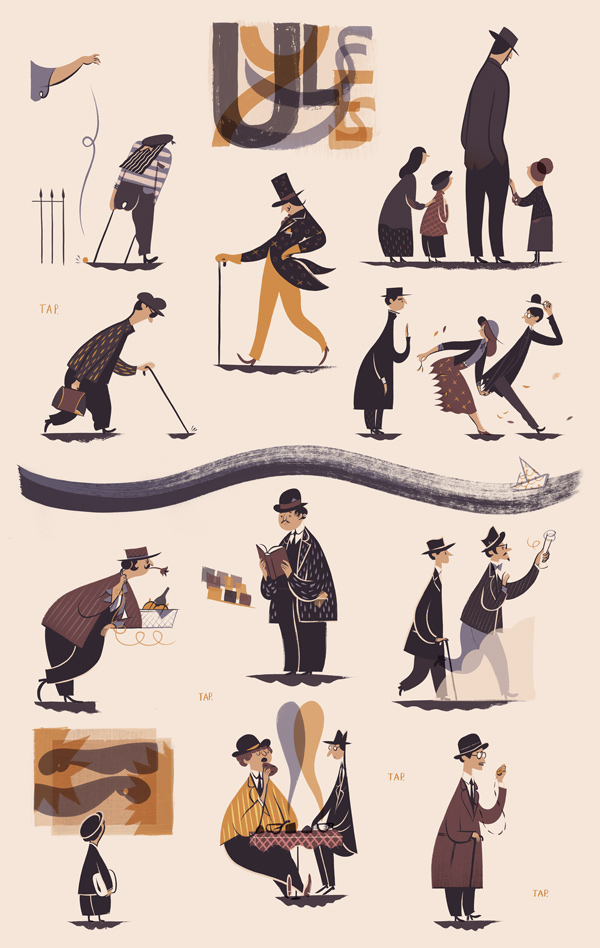
Ulysses — Roman Muradov

ulysses

(Roman Muradov’s wonderful illustration to the Wandering Rocks episode of Joyce’s Ulysses; lots more great stuff at Roman’s site and blog).

“Flaubert me no Flauberts, Bovary me no Bovarys” — Thomas Wolfe Writes to F. Scott Fitzgerald

Dear Scott:

I don’t know where you are living and I’ll be damned if I’ll believe anyone lives in a place called “The Garden of Allah,” which was what the address on your envelope said. I am sending this on to the old address we both know so well.

The unexpected loquaciousness of your letter struck me all of a heap. I was surprised to hear from you but I don’t know that I can truthfully say I was delighted. Your bouquet arrived smelling sweetly of roses but cunningly concealing several large-sized brick-bats. Not that I resented them. My resenter got pretty tough years ago; like everybody else I have at times been accused of “resenting criti[ci]sm” and although I have never been one of those boys who break out in a hearty and delighted laugh when someone tells them everything they write is lousy and agree enthusiastically, I think I have taken as many plain and fancy varieties as any American citizen of my age now living. I have not always smiled and murmured pleasantly “How true,” but I have listened to it all, tried to profit from it where and when I could and perhaps been helped by it a little. Certainly I don’t think I have been pig-headed about it. I have not been arrogantly contemptuous of it either, because one of my besetting sins, whether you know it or not, is a lack of confidence in what I do.

So I’m not sore at you or sore about anything you said in your letter. And if there is any truth in what you say— any truth for me—you can depend upon it I shall probably get it out. It just seems to me that there is not much in what you say. You speak of your “case” against me, and frankly I don’t believe you have much case. You say you write these things because you admire me so much and because you think my talent unmatchable in this or any other country and because you are ever my friend. Well Scott I should not only be proud and happy to think that all these things are true but my respect and admiration for your own talent and intelligence are such that I should try earnestly to live up to them and to deserve them and to pay the most serious and respectful attention to anything you say about my work.

I have tried to do so. I have read your letter several times and I’ve got to admit it doesn’t seem to mean much. I don’t know what you are driving at or understand what you expect or hope me to do about it. Now this may be pig-headed but it isn’t sore. I may be wrong but all I can get out of it is that you think I’d be a good writer if I were an altogether different writer from the writer that I am.

This may be true but I don’t see what I’m going to do about it. And I don’t think you can show me and I don’t see what Flaubert and Zola have to do with it, or what I have to do with them. I wonder if you really think they have anything to do with it, or if this is just something you heard in college or read in a book somewhere. This either—or kind of criticism seems to me to be so meaningless. It looks so knowing and imposing but there is nothing in it. Why does it follow that if a man writes a book that is not like Madame Bovary it is inevitably like Zola. I may be dumb but I can’t see this. You say that Madame Bovary becomes eternal while Zola already rocks with age. Well this may be true—but if it is true isn’t it true because Madame Bovary may be a great book and those that Zola wrote may not be great ones? Wouldn’t it also be true to say that Don Quixote or Pickwick or Tristram Shandy “become eternal” while already Mr. Galsworthy “rocks with age.” I think it is true to say this and it doesn’t leave much of your argument, does it? For your argument is based simply upon one way, upon one method instead of another. And have you ever noticed how often it turns out that what a man is really doing is simply rationalizing his own way of doing something, the way he has to do it, the way given him by his talent and his nature, into the only inevitable and right way of doing everything—a sort of classic and eternal art form handed down by Apollo from Olympus without which and beyond which there is nothing. Now you have your way of doing something and I have mine, there are a lot of ways, but you are honestly mistaken in thinking that there is a “way.” I suppose I would agree with you in what you say about “the novel of selected incident” so far as it means anything. I say so far as it means anything because every novel, of course, is a novel of selected incident. There are no novels of unselected incident. You couldn’t write about the inside of a telephone booth without selecting. You could fill a novel of a thousand pages with a description of a single room and yet your incidents would be selected. And I have mentioned Don Quixote and Pickwick and The Brothers Karamazov and Tristram Shandy to you in contrast to The Silver Spoon or The White Monkey as examples of books that have become “immortal” and that boil and pour. Just remember that although Madame Bovary in your opinion may be a great book, Tristram Shandy is indubitably a great book, and that it is great for quite different reasons. It is great because it boils and pours—for the unselected quality of its selection. You say that the great writer like Flaubert has consciously left out the stuff that Bill or Joe will come along presently and put in. Well, don’t forget, Scott, that a great writer is not only a leaver-outer but also a putter-inner, and that Shakespeare and Cervantes and Dostoevsky were great putter-inners—greater putter-inners, in fact, than taker-outers and will be remembered for what they put in—remembered, I venture to say, as long as Monsieur Flaubert will be remembered for what he left out.

As to the rest of it in your letter about cultivating an alter ego, becoming a more conscious artist, my pleasantness or grief, exuberance or cynicism, and how nothing stands out in relief because everything is keyed at the same emotional pitch—this stuff is worthy of the great minds that review books nowadays—the Fadimans and De Votos—but not of you. For you are an artist and the artist has the only true critical intelligence. You have had to work and sweat blood yourself and you know what it is like to try to write a living word or create a living thing. So don’t talk this foolish stuff to me about exuberance or being a conscious artist or not bringing things into emotional relief, or any of the rest of it. Let the Fadimans and De Votos do that kind of talking but not Scott Fitzgerald. You’ve got too much sense and you know too much. The little fellows who don’t know may picture a man as a great “exuberant” six-foot-six clodhopper straight out of nature who bites off half a plug of apple tobacco, tilts the corn liquor jug and lets half of it gurgle down his throat, wipes off his mouth with the back of one hairy paw, jumps three feet in the air and clacks his heels together four times before he hits the floor again and yells “Whoopee, boys I’m a rootin, tootin, shootin son of a gun from Buncombe County—out of my way now, here I come!”—and then wads up three-hundred thousand words or so, hurls it back at a blank page, puts covers on it and says “Here’s my book!” Now Scott, the boys who write book reviews in New York may think it’s done that way; but the man who wrote Tender Is the Night knows better. You know you never did it that way, you know I never did, you know) no one else who ever wrote a line worth reading ever did. So don’t give me any of your guff, young fellow. And don’t think I’m sore. But I get tired of guff—I’ll take it from a fool or from a book reviewer but I won’t take it from a friend who knows a lot better. I want to be a better artist. I want to be a more selective artist. I want to be a more restrained artist. I want to use such talent as I have, control such forces as I may own, direct such energy as I may use more cleanly, more surely and to better purpose. But Flaubert me no Flauberts, Bovary me no Bovarys. Zola me no Zolas. And exuberance me no exuberances. Leave this stuff for those who huckster in it and give me, I pray you, the benefits of your fine intelligence and your high creative faculties, all of which I so genuinely and profoundly admire. I am going into the woods for another two or three years. I am going to try to do the best, the most important piece of work I have ever done. I am going to have to do it alone. I am going to lose what little bit of reputation I may have gained, to have to hear and know and endure in silence again all of the doubt, the disparagement and ridicule, the post-mortems that they are so eager to read over you even before you are dead. I know what it means and so do you. We have both been through it before. We know it is the plain damn simple truth. Well, I’ve been through it once and I believe I can get through it again. I think I know a little more now than I did before, I certainly know what to expect and I’m going to try not to let it get me down. That is the reason why this time I shall look for intelligent understanding among some of my friends. I’m not ashamed to say that I shall need it. You say in your letter that you are ever my friend. I assure you that it is very good to hear this. Go for me with the gloves off if you think I need it. But don’t De Voto me. If you do I’ll call your bluff.

I’m down here for the summer living in a cabin in the country and I am enjoying it. Also I’m working. I don’t know how long you are going to be in Hollywood or whether you have a job out there but I hope I shall see you before long and that all is going well with you. I still think as I always thought that Tender Is the Night had in it the best work you have ever done. And I believe you will surpass it in the future. Anyway, I send you my best wishes as always for health and work and success. Let me hear from you sometime. The address is Oteen, North Carolina, just a few miles from Asheville, Ham Basso, as you know, is not far away at Pisgah Forest and he is coming over to see me soon and perhaps we shall make a trip together to see Sherwood Anderson. And now this is all for the present—unselective, you see, as usual. Good bye Scott and good luck.

Ever yours,
Tom Wolfe

(July 26, 1937; republished in New Directions’ edition of The Crack Up).

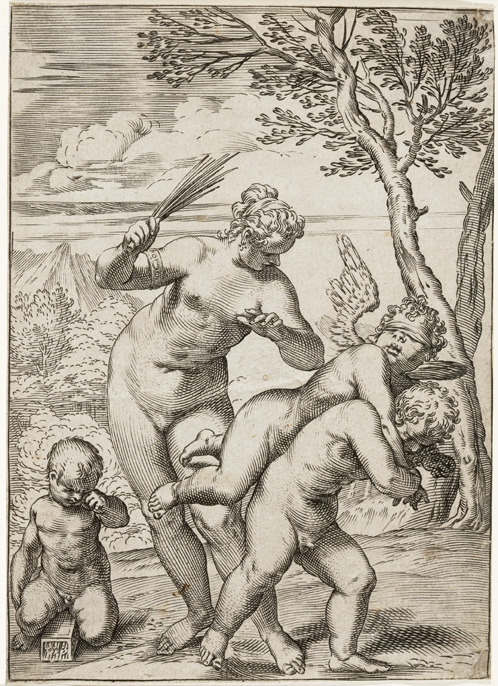
Venus Punishing Profane Love — Agostino Carracci

venus-punishing-profane-love-1595

“The Incredible and Sad Tale of Innocent Eréndira and Her Heartless Grandmother” — Gabriel García Márquez”

“The Incredible and Sad Tale of Innocent Eréndira and Her Heartless Grandmother” by Gabriel García Márquez

Erendira was bathing her grandmother when the wind of her misfortune began to blow. The enormous mansion of moon like concrete lost in the solitude of the desert trembled down to its foundations with the first attack. But Erendira and her grandmother were used to the risks of the wild nature there, and in the bathroom decorated with a series of peacocks and childish mosaics of Roman baths they scarcely paid any attention to the caliber of the wind.

The grandmother, naked and huge in the marble tub, looked like a handsome white whale. The granddaughter had just turned fourteen and was languid, soft-boned, and too meek for her age. With a parsimony that had something like sacred rigor about it, she was bathing her grandmother with water in which purifying herbs and aromatic leaves had been boiled, the latter clinging to the succulent back, the flowing metal-colored hair, and the powerful shoulders which were so mercilessly tattooed as to put sailors to shame.

“Last night I dreamt I was expecting a letter,” the grandmother said.

Erendira, who never spoke except when it was unavoidable, asked:

“What day was it in the dream?”

“Thursday.”

“Then it was a letter with bad news,” Erendira said, “but it will never arrive.”

When she had finished bathing her grandmother, she took her to her bedroom. The grandmother was so fat that she could only walk by leaning on her granddaughter’s shoulder or on a staff that looked like a bishop’s crosier, but even during her most difficult efforts the power of an antiquated grandeur was evident. In the bedroom, which had been furnished with an excessive and somewhat demented taste, like the whole house, Erendira needed two more hours to get her grandmother ready. She untangled her hair strand by strand, perfumed and combed it, put an equatorially flowered dress on her, put talcum powder on her face, bright red lipstick on her mouth, rouge on her cheeks, musk on her eyelids, and mother-of-pearl polish on her nails, and when she had her decked out like a larger than life-size doll, she led her to an artificial garden with suffocating flowers that were like the ones on the dress, seated her in a large chair that had the foundation and the pedigree of a throne, and left her listening to elusive records on a phonograph that had a speaker like a megaphone. Continue reading ““The Incredible and Sad Tale of Innocent Eréndira and Her Heartless Grandmother” — Gabriel García Márquez””

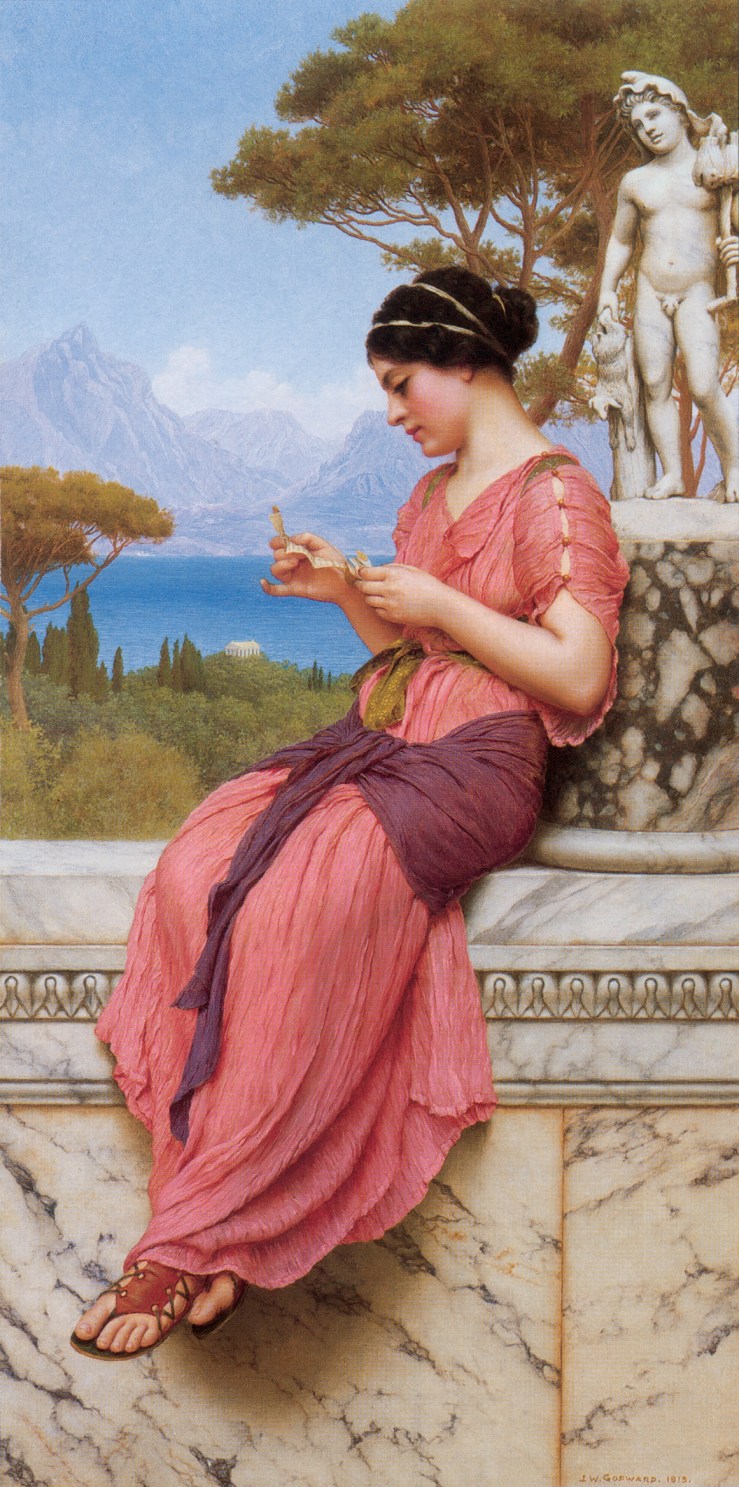
The Love Letter — John William Godward

the-love-letter-1913

List with No Name #15

  1. Joseph Cornell’s boxes.
  2. Much of J.G. Ballard, especially the stuff in the ’70s and ’80s.
  3. The Residents.
  4. The films of the Brothers Quay.
  5. Charles Burns’s stuff.
  6. Wm. Burroughs, or the idea of Wm. Burroughs.
  7. Joseph Beuys and his goddamn fat and felt.

Watch Peter Greenaway’s Meredith Monk Documentary

Charles Darwin — James Tissot

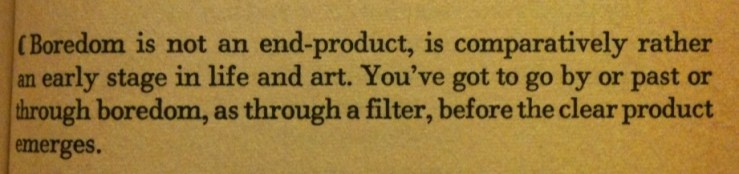
Boredom // F. Scott Fitzgerald

20130211-213526.jpg

Marvin Digs — Ralph Bakshi (Short Film)

T.S. Eliot Writes to F.Scott Fitzgerald

FABER AND GWYER LTD. Publishers 24 Russell Square, London, W.C.1. 31st December, 1925
F. Scott Fitzgerald, Esqre., % Charles Scribners & Sons, New York City.

Dear Mr. Scott Fitzgerald,
The Great Gatsby with your charming and overpowering inscription arrived the very morning that I was leaving in some haste for a sea voyage advised by my doctor. I therefore left it behind and only read it on my return a few days ago. I have, however, now read it three times. I am not in the least influenced by your remark about myself when I say that it has interested and excited me more than any new novel I have seen, either English or American, for a number of years.

When I have time I should like to write to you more fully and tell you exactly why it seems to me such a remarkable book. In fact it seems to me to be the first step that American fiction has taken since Henry James….

By the way, if you ever have any short stories which you think would be suitable for the Criterion I wish you would let me see them.

With many thanks, I am,
Yours very truly, T. S. Eliot

P.S. By a coincidence Gilbert Seldes in his New York Chronicle in the Criterion for January 14th has chosen your book for particular mention.


Portrait of James Joyce — Djuna Barnes

“Mrs. Bullfrog” — Nathaniel Hawthorne

“Mrs. Bullfrog” by Nathaniel Hawthorne

It makes me melancholy to see how like fools some very sensible people act in the matter of choosing wives. They perplex their judgments by a most undue attention to little niceties of personal appearance, habits, disposition, and other trifles which concern nobody but the lady herself. An unhappy gentleman, resolving to wed nothing short of perfection, keeps his heart and hand till both get so old and withered that no tolerable woman will accept them. Now this is the very height of absurdity. A kind Providence has so skilfully adapted sex to sex and the mass of individuals to each other, that, with certain obvious exceptions, any male and female may be moderately happy in the married state. The true rule is to ascertain that the match is fundamentally a good one, and then to take it for granted that all minor objections, should there be such, will vanish, if you let them alone. Only put yourself beyond hazard as to the real basis of matrimonial bliss, and it is scarcely to be imagined what miracles, in the way of recognizing smaller incongruities, connubial love will effect.

For my own part I freely confess that, in my bachelorship, I was precisely such an over-curious simpleton as I now advise the reader not to be. My early habits had gifted me with a feminine sensibility and too exquisite refinement. I was the accomplished graduate of a dry goods store, where, by dint of ministering to the whims of fine ladies, and suiting silken hose to delicate limbs, and handling satins, ribbons, chintzes calicoes, tapes, gauze, and cambric needles, I grew up a very ladylike sort of a gentleman. It is not assuming too much to affirm that the ladies themselves were hardly so ladylike as Thomas Bullfrog. So painfully acute was my sense of female imperfection, and such varied excellence did I require in the woman whom I could love, that there was an awful risk of my getting no wife at all, or of being driven to perpetrate matrimony with my own image in the looking-glass. Besides the fundamental principle already hinted at, I demanded the fresh bloom of youth, pearly teeth, glossy ringlets, and the whole list of lovely items, with the utmost delicacy of habits and sentiments, a silken texture of mind, and, above all, a virgin heart. In a word, if a young angel just from paradise, yet dressed in earthly fashion, had come and offered me her hand, it is by no means certain that I should have taken it. There was every chance of my becoming a most miserable old bachelor, when, by the best luck in the world, I made a journey into another state, and was smitten by, and smote again, and wooed, won, and married, the present Mrs. Bullfrog, all in the space of a fortnight. Owing to these extempore measures, I not only gave my bride credit for certain perfections which have not as yet come to light, but also overlooked a few trifling defects, which, however, glimmered on my perception long before the close of the honeymoon. Yet, as there was no mistake about the fundamental principle aforesaid, I soon learned, as will be seen, to estimate Mrs. Bullfrog’s deficiencies and superfluities at exactly their proper value.

The same morning that Mrs. Bullfrog and I came together as a unit, we took two seats in the stage-coach and began our journey towards my place of business. There being no other passengers, we were as much alone and as free to give vent to our raptures as if I had hired a hack for the matrimonial jaunt. My bride looked charmingly in a green silk calash and riding habit of pelisse cloth; and whenever her red lips parted with a smile, each tooth appeared like an inestimable pearl. Such was my passionate warmth that—we had rattled out of the village, gentle reader, and were lonely as Adam and Eve in paradise—I plead guilty to no less freedom than a kiss. The gentle eye of Mrs. Bullfrog scarcely rebuked me for the profanation. Emboldened by her indulgence, I threw back the calash from her polished brow, and suffered my fingers, white and delicate as her own, to stray among those dark and glossy curls which realized my daydreams of rich hair. Continue reading ““Mrs. Bullfrog” — Nathaniel Hawthorne”

The Love Letter — Eugene de Blaas

the-love-letter-1

The Sin of Harold Diddlebock — Preston Sturges (Full Film)

An Extract from an Extract from Flann O’Brien’s At Swim-Two-Birds

Title of Book referred to: The Athenian Oracle, being an Entire COLLECTION of all the Valuable QUESTIONS and ANSWERS in the old Athenian Mercuries intermixed with many CASES in Divinity, Hiftory, Philofophy, Mathematicks, Love, Poetry, never before publifhed.

Extract from Book referred to:

1. Whether it be poffible for a woman fo carnally to know a Man in her fleep as to conceive, for I am fure that this and no way other was I got with Child.

2. Whether it be lawful to ufe Means to put a ftop to this growing mifchief, and kill it in the Embryo; this being the only way to avert the Thunderclap of my Father’s Indignation.

To the firft Question, Madam, we are very pofitive, that you are luckily miftaken, for the thing is abfolutely impoffible if you know nothing of it; indeed, we had an account of a Widow that made fuch a pretence, and fhe might have better credit than a maid, who can have no plea but dead drunk, or in fome fwooning fit, and our Phyficians will hardly allow a poffibility of the thing then. So that you may fet your heart at reft, and think no more of the matter, unlefs for your diverfion.

As for the fecond Queftion, fuch practices are murder, and thofe that are fo unhappy as to come under fuch Circumftances if they ufe the forementioned means, will certainly one day find the remedy worfe than the Difeafe. There are wifer methods to be taken in fuch Cafes, as a fmall journey and a Confident. And afterwards, fuch a pious and good life as may redreff fuch an heavy miffortune.

Questions, a Selection of Further: Almond, why fo bitter being taken in the mouth, and yet the Oyl fo very fweet? Apprentice, reduced to want, how may he relieve himself? Blood, is the eating of it lawful? Baptifm, adminiftered by a Mid-wife or Lay Hand, is it lawful? Devil, why called Lucifer; and elfewhere the Prince of Darknefs? Eftate, gotten by felling lewd Books, can it profper? Eyes, what Method muft I take with ’em when weak? Horfe, with a round fundament, why does he emit a fquare Excrement? Happinefs, what is it? Lady, difturbed in her Bed, your thoughts of it? Light, is it a Body? Myftae or Cabalifts, what d’ye think of them? Marriage, is not the End of it, in a great Meafure, loft nowadays? Poem, by Mr. Tate? Virginity, is it a Vertue? Wind, what is it? Wife, is it lawful for a Man to beat her? Wife, if an ill one, may I pray that God wou’d take her to himfelf?

Conclusion of the foregoing.

From Flann O’Brien’s novel At Swim-Two-Birds.