“Bed-Books and Night-Lights” — H.M. Tomlinson

“Bed-Books and Night-Lights” — H.M. Tomlinson

The rain flashed across the midnight window with a myriad feet. There was a groan in outer darkness, the voice of all nameless dreads. The nervous candle-flame shuddered by my bedside. The groaning rose to a shriek, and the little flame jumped in a panic, and nearly left its white column. Out of the corners of the room swarmed the released shadows. Black specters danced in ecstasy over my bed. I love fresh air, but I cannot allow it to slay the shining and delicate body of my little friend the candle-flame, the comrade who ventures with me into the solitudes beyond midnight. I shut the window.

They talk of the candle-power of an electric bulb. What do they mean? It cannot have the faintest glimmer of the real power of my candle. It would be as right to express, in the same inverted and foolish comparison, the worth of “those delicate sisters, the Pleiades.” That pinch of star dust, the Pleiades, exquisitely remote in deepest night, in the profound where light all but fails, has not the power of a sulphur match; yet, still apprehensive to the mind though tremulous on the limit of vision, and sometimes even vanishing, it brings into distinction those distant and difficult hints—hidden far behind all our verified thoughts—which we rarely properly view. I should like to know of any great arc-lamp which could do that. So the star-like candle for me. No other light follows so intimately an author’s most ghostly suggestion. We sit, the candle and I, in the midst of the shades we are conquering, and sometimes look up from the lucent page to contemplate the dark hosts of the enemy with a smile before they overwhelm us; as they will, of course. Like me, the candle is mortal; it will burn out.

As the bed-book itself should be a sort of night-light, to assist its illumination, coarse lamps are useless. They would douse the book. The light for such a book must accord with it. It must be, like the book, a limited, personal, mellow, and companionable glow; the solitary taper beside the only worshiper in a sanctuary. That is why nothing can compare with the intimacy of candle-light for a bed-book. It is a living heart, bright and warm in central night, burning for us alone, holding the gaunt and towering shadows at bay. There the monstrous specters stand in our midnight room, the advance guard of the darkness of the world, held off by our valiant little glim, but ready to flood instantly and founder us in original gloom.

The wind moans without; ancient evils are at large and wandering in torment. The rain shrieks across the window. For a moment, for just a moment, the sentinel candle is shaken, and burns blue with terror. The shadows leap out instantly. The little flame recovers, and merely looks at its foe the darkness, and back to its own place goes the old enemy of light and man. The candle for me, tiny, mortal, warm, and brave, a golden lily on a silver stem!

“Almost any book does for a bed-book,” a woman once said to me. I nearly replied in a hurry that almost any woman would do for a wife; but that is not the way to bring people to conviction of sin. Her idea was that the bed-book is soporific, and for that reason she even advocated the reading of political speeches. That would be a dissolute act. Certainly you would go to sleep; but in what a frame of mind! You would enter into sleep with your eyes shut. It would be like dying, not only unshriven, but in the act of guilt. Continue reading ““Bed-Books and Night-Lights” — H.M. Tomlinson”
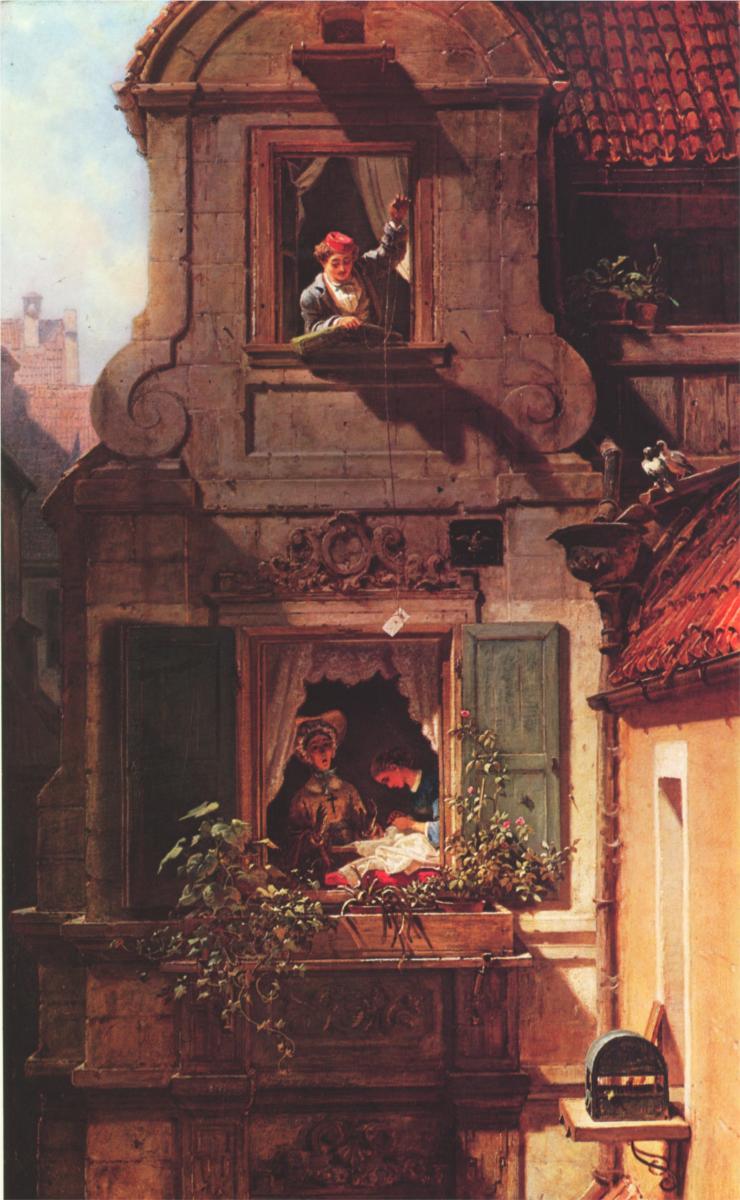
Intercepted Love Letter — Carl Spitzweg

the-intercepted-love-letter.jpg!HD

Alfred Hitchcock’s The 39 Steps (Full Film)

List with No Name #16

  1. Heaven’s Gate
  2. John Carter from Mars
  3. My Blueberry Nights
  4. The Box
  5. Dune
  6. Master and Commander: The Far Side of the World
  7. The Adventures of Baron Munchausen 
  8. Popeye
  9. Krull
  10. Nothing But Trouble
  11. Showgirls

A Brief Review of David Malouf’s Essay The Happy Life (Book Acquired, Some Time in December 2012)

20130107-201922.jpg

When David Malouf’s little hardback essay The Happy Life showed up late last year to Biblioklept World Headquarters, I’ll admit to grimacing a bit. I judge books by their covers, their appearance, their size, and frankly Malouf’s little book, with its smallish dimensions and hokey subtitle seemed to scream “self-help/gift book.” And oh the emoticon!

But before I do these “Books Acquired” I always take the time to sample the prose a bit. Here’s what happened with Malouf: I kept reading. Malouf snagged me into doing a thought experiment on the first page (“Think of a medieval farmer as he struggled to keep body and soul together”), an exercise that quickly led to citations from Solzhenitsyn, Montaigne, and Sir Henry Wotton—before posing the book’s central questions:

The question that arises is not so much ‘How should we live if we want to be happy?’ but how is it, when the chief sources of human unhappiness, of misery and wretchedness, have largely been removed from our lives—large-scale social injustice, famine, plague and other diseases, the near-certainty of an early death—that happiness still eludes so many of us? What have we succumbed to or failed to do that might have helped us? What is it in us, or in the world we have created, that continues to hold us back?

First World Problems! Seriously though, Malouf seems aware of the simple answer to these questions—it’s impossible and likely dangerous to be happy all the time; what he really seems concerned about are the paradigms and ideologies and systems—government, media, corpocracy, pick your poison—that create impositions of happiness as a kind of ideal. As such, Malouf returns again and again to Jefferson’s “life, liberty, and the pursuit of happiness,” along with Solzhenitsyn’s One Day in the Life of Ivan Denisovich. He ends his long essay with a discussion of Solzhenisyn’s Shukov, “an unlikely example of the happy man.” And through this storytelling, we can find a moment of stabilizing happiness too:

Fiction, with its preference for what is small and might elsewhere seem irrelevant; its facility for smuggling us into another skin and allowing us to live a new life there; its painstaking devotion to what without it might go unnoticed and unseen; its respect for contingency, and the unlikely and odd; its willingness to expose itself to moments of low, almost animal being and make them nobly illuminating, can deliver truths we might not otherwise stumble on.

Shukhov is not happy because he has solved the problem of ‘how to live’ —the live he lives is too provisional, too makeshift for that. Or because, as the classical schools would have put it, he has achieved quite self-containment, self-sufficiency. Quite the opposite.

What he achieves, briefly, intermittently, is moments of self-fulfillment, something different and more accessible, more democratic we might call it, than self-containment. But he achieves it only at moments.

He is happynow—who can know what tomorrow or the day after will do to him? He is happy within limits—and this may be a clue to what makes happiness possible for him, or for any of us.

There’s nothing really radical about this thesis—that we can claim agency to our own happiness by choosing to measure it in small units—but the way that Malouf reaches it is pleasurable to follow and intellectually engaging. I hope that some suckers judge this book by its cover, pick it up in the hopes of buying a map to contentment, and then stick around for Malouf’s journey through literature, philosophy, art, and history. Good stuff.

The Happy Life is new in hardback from Pantheon.


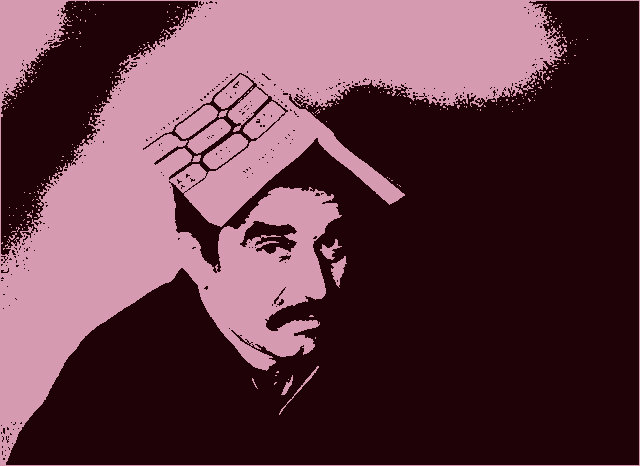
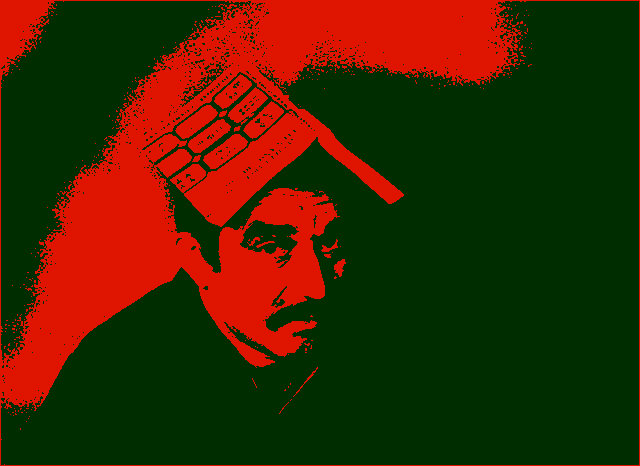
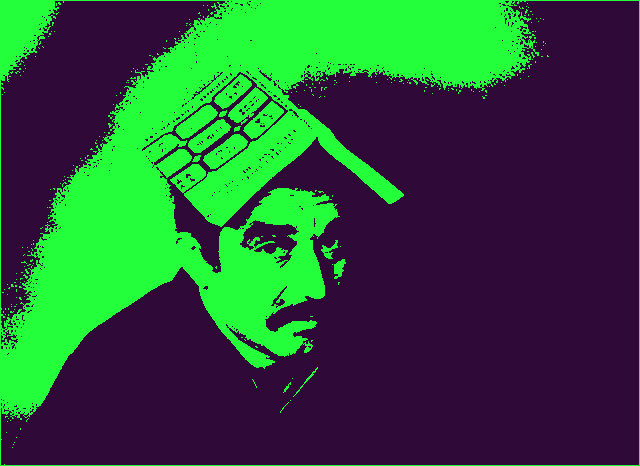
Seven Versions of Gabriel García Márquez Wearing a Book as a Hat

1 2 3 47 5 6

Caravaggio Documentary (The Power of Art)

Infidelity, A Screenplay by F. Scott Fitgerald

Infidelity, a screenplay by F. Scott Fitzgerald

[About / via]

The Waldorf Roof after the theatre on a gala night: A well-dressed crowd, two bands, a floor show.

Camera picks up two men in tailcoats at a table near the door. One of them is trim and elderly. The other has wild, rumpled hair. They have dropped in for a quick drink and their top hats sit on the table before them. Both hold opera glasses to their eyes, through which they rather unsteadily observe the crowd.

Camera shoots between them at the crowd.

GREY HAIR: Table beside the bass drum.

RUMPLED HAIR (moving his opera glasses): I’ve got it.

GREY HAIR: What do you say?

RUMPLED HAIR: Let me concentrate.

A blurred dose shot of a table across the room seen through a frame shaped like this [sign] OO to suggest open glasses. The blur dears to show two young people leaning ecstatically over: the table toward each other.

The observers’table.

RUMPLED HAIR: I say, engaged.

GREY HAIR: Sure. Now the couple on their right.

Camera, acting as opera glasses, pans to a dull couple of thirty, utterly bored, staring for amusement anywhere bur at each other. Accidently, their eyes meet with a glazed expression and, as if startled, hastily seek other focuses.

GREY HAIR’S VOICE: Married.

RUMPLED HAIR’S VOICE: That’s too easy.

Camera, as opera-glasses, pans gain to the right, picking up a devoted couple of thirty-five, happy; at ease with each other, interested in what’s outside because they are seeing it together.

RUMPLED HAIR’S VOICE: Married?

GREY HAIR’S VOICE: Yes. (Pause.) Lucky devils.

Camera, as opera glasses, pans left, picking up another couple. The girl is talking earnestly, passionately to the man. The man is listening, his mouth moving uneasily. Once his eyes wander quickly from side to side, then back to her. Her eyes have swayed slightly with his.

GREY HAIR’S VOICE: Cheating.

The observers’table: Both men lower their opera-glasses, laughing. Continue reading “Infidelity, A Screenplay by F. Scott Fitgerald”

The Love Letter — Alfred Stevens

the-love-letter stevens

“Our souls are like those orphans whose unwedded mothers die in bearing them” (Moby-Dick)

Oh, grassy glades! oh, ever vernal endless landscapes in the soul; in ye,—though long parched by the dead drought of the earthy life,—in ye, men yet may roll, like young horses in new morning clover; and for some few fleeting moments, feel the cool dew of the life immortal on them. Would to God these blessed calms would last. But the mingled, mingling threads of life are woven by warp and woof: calms crossed by storms, a storm for every calm. There is no steady unretracing progress in this life; we do not advance through fixed gradations, and at the last one pause:—through infancy’s unconscious spell, boyhood’s thoughtless faith, adolescence’ doubt (the common doom), then scepticism, then disbelief, resting at last in manhood’s pondering repose of If. But once gone through, we trace the round again; and are infants, boys, and men, and Ifs eternally. Where lies the final harbor, whence we unmoor no more? In what rapt ether sails the world, of which the weariest will never weary? Where is the foundling’s father hidden? Our souls are like those orphans whose unwedded mothers die in bearing them: the secret of our paternity lies in their grave, and we must there to learn it.

From “The Glider,” Chapter 114 of Melville’s Moby-Dick.

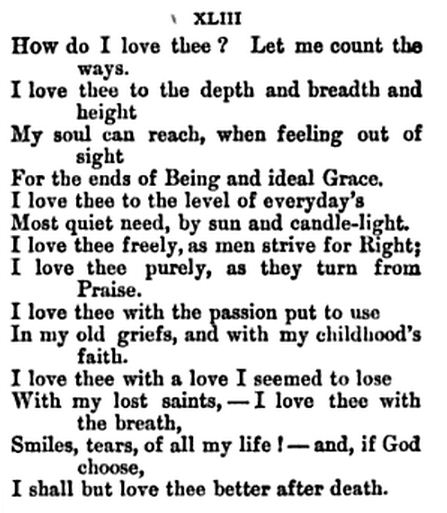
“How Do I Love Thee?” — Elizabeth Barrett Browning

Capture

Zora Neale Hurston’s Love Spells

Conjure up some last-minute romance. In the appendix to her collection of Florida folktales, Mules and Men, author Zora Neale Hurston offers up a host of Hoodoo, including the following love spells:

TO MAKE A MAN COME HOME

Take nine deep red or pink candles. Write his name three times on each candle. Wash the candles with Van-Van. Put the name three times on paper and place under the candles, and call the name of the party three times as the candle is placed at the hours of seven, nine or eleven.

TO MAKE PEOPLE LOVE YOU

Take nine lumps of starch, nine of sugar, nine teaspoons of steel dust. Wet it all with Jockey Club cologne. Take nine pieces of ribbon, blue, red or yellow. Take a dessertspoonful and put it on a piece of ribbon and tie it in a bag. As each fold is gathered together call his name. As you wrap it with yellow thread call his name till you finish. Make nine bags and place them under a rug, behind an armoire, under a step or over a door. They will love you and give you everything they can get. Distance makes no difference. Your mind is talking to his mind and nothing beats that.

TO BREAK UP A LOVE AFFAIR

Take nine needles, break each needle in three pieces. Write each person’s name three times on paper. Write one name backwards and one forwards and lay the broken needles on the paper. Take five black candles, four red and three green.

Tie a string across the door from it, suspend a large candle upside down, It will hang low on the door; bum one each day for one hour. If you burn your first in the daytime, keep on in the day; if at night, continue at night. A tin plate with paper and needles in it must be placed to catch wax in.

When the ninth day is finished, go out into the street and get some white or black dog dung. A dog only drops his dung in the street when he is running and barking, and whoever you curse will run and bark likewise. Put it in a bag with the paper and carry it to running water, and one of the parties will leave town.


Heart

20130120-102144.jpg

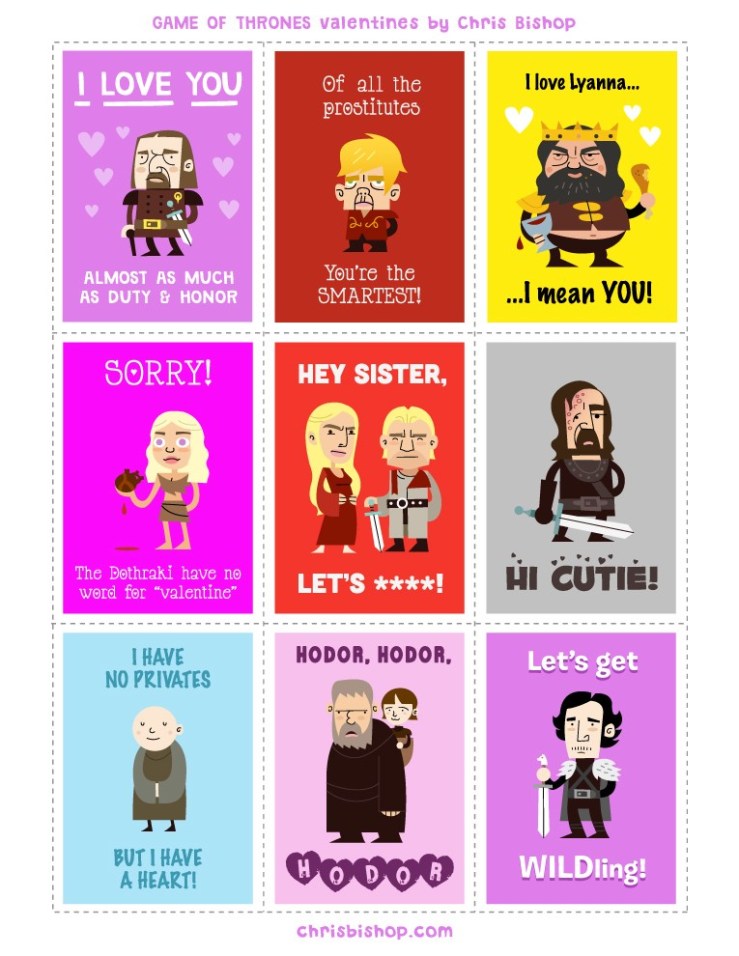
Game of Thrones Valentines — Chris Bishop

gotvalentine12(You saw these last year, but they are still good. By Chris Bishop).

“How Sir Launcelot departed to seek the Queen Guenever, and how he found her at Almesbury” — Sir Thomas Malory

“How Sir Launcelot departed to seek the Queen Guenever, and how he found her at Almesbury” by Sir Thomas Malory

Then came Sir Bors de Ganis, and said: My lord Sir Launcelot, what think ye for to do, now to ride in this realm? wit ye well ye shall find few friends. Be as be may, said Sir Launcelot, keep you still here, for I will forth on my journey, and no man nor child shall go with me. So it was no boot to strive, but he departed and rode westerly, and there he sought a seven or eight days; and at the last he came to a nunnery, and then was Queen Guenever ware of Sir Launcelot as he walked in the cloister. And when she saw him there she swooned thrice, that all the ladies and gentlewomen had work enough to hold the queen up. So when she might speak, she called ladies and gentlewomen to her, and said: Ye marvel, fair ladies, why I make this fare. Truly, she said, it is for the sight of yonder knight that yonder standeth; wherefore I pray you all call him to me.

When Sir Launcelot was brought to her, then she said to all the ladies: Through this man and me hath all this war been wrought, and the death of the most noblest knights of the world; for through our love that we have loved together is my most noble lord slain. Therefore, Sir Launcelot, wit thou well I am set in such a plight to get my soul-heal; and yet I trust through God’s grace that after my death to have a sight of the blessed face of Christ, and at domesday to sit on his right side, for as sinful as ever I was are saints in heaven. Therefore, Sir Launcelot, I require thee and beseech thee heartily, for all the love that ever was betwixt us, that thou never see me more in the visage; and I command thee, on God’s behalf, that thou forsake my company, and to thy kingdom thou turn again, and keep well thy realm from war and wrack; for as well as I have loved thee, mine heart will not serve me to see thee, for through thee and me is the flower of kings and knights destroyed; therefore, Sir Launcelot, go to thy realm, and there take thee a wife, and live with her with joy and bliss; and I pray thee heartily, pray for me to our Lord that I may amend my misliving. Now, sweet madam, said Sir Launcelot, would ye that I should now return again unto my country, and there to wed a lady? Nay, madam, wit you well that shall I never do, for I shall never be so false to you of that I have promised; but the same destiny that ye have taken you to, I will take me unto, for to please Jesu, and ever for you I cast me specially to pray. If thou wilt do so, said the queen, hold thy promise, but I may never believe but that thou wilt turn to the world again. Well, madam, said he, ye say as pleaseth you, yet wist you me never false of my promise, and God defend but I should forsake the world as ye have done. For in the quest of the Sangreal I had forsaken the vanities of the world had not your lord been. And if I had done so at that time, with my heart, will, and thought, I had passed all the knights that were in the Sangreal except Sir Galahad, my son. And therefore, lady, sithen ye have taken you to perfection, I must needs take me to perfection, of right. For I take record of God, in you I have had mine earthly joy; and if I had found you now so disposed, I had cast me to have had you into mine own realm.

Love Letters — Stanley Spencer

love-letters-1950

“I want it of the true death-temper” (Moby-Dick)

“Look ye, blacksmith, these are the gathered nail-stubbs of the steel shoes of racing horses.”

“Horse-shoe stubbs, sir? Why, Captain Ahab, thou hast here, then, the best and stubbornest stuff we blacksmiths ever work.”

“I know it, old man; these stubbs will weld together like glue from the melted bones of murderers. Quick! forge me the harpoon. And forge me first, twelve rods for its shank; then wind, and twist, and hammer these twelve together like the yarns and strands of a tow-line. Quick! I’ll blow the fire.”

When at last the twelve rods were made, Ahab tried them, one by one, by spiralling them, with his own hand, round a long, heavy iron bolt. “A flaw!” rejecting the last one. “Work that over again, Perth.”

This done, Perth was about to begin welding the twelve into one, when Ahab stayed his hand, and said he would weld his own iron. As, then, with regular, gasping hems, he hammered on the anvil, Perth passing to him the glowing rods, one after the other, and the hard pressed forge shooting up its intense straight flame, the Parsee passed silently, and bowing over his head towards the fire, seemed invoking some curse or some blessing on the toil. But, as Ahab looked up, he slid aside.

“What’s that bunch of lucifers dodging about there for?” muttered Stubb, looking on from the forecastle. “That Parsee smells fire like a fusee; and smells of it himself, like a hot musket’s powder-pan.”

At last the shank, in one complete rod, received its final heat; and as Perth, to temper it, plunged it all hissing into the cask of water near by, the scalding steam shot up into Ahab’s bent face.

“Would’st thou brand me, Perth?” wincing for a moment with the pain; “have I been but forging my own branding-iron, then?”

“Pray God, not that; yet I fear something, Captain Ahab. Is not this harpoon for the White Whale?”

“For the white fiend! But now for the barbs; thou must make them thyself, man. Here are my razors—the best of steel; here, and make the barbs sharp as the needle-sleet of the Icy Sea.”

For a moment, the old blacksmith eyed the razors as though he would fain not use them.

“Take them, man, I have no need for them; for I now neither shave, sup, nor pray till—but here—to work!”

Fashioned at last into an arrowy shape, and welded by Perth to the shank, the steel soon pointed the end of the iron; and as the blacksmith was about giving the barbs their final heat, prior to tempering them, he cried to Ahab to place the water-cask near.

“No, no—no water for that; I want it of the true death-temper. Ahoy, there! Tashtego, Queequeg, Daggoo! What say ye, pagans! Will ye give me as much blood as will cover this barb?” holding it high up. A cluster of dark nods replied, Yes. Three punctures were made in the heathen flesh, and the White Whale’s barbs were then tempered.

“Ego non baptizo te in nomine patris, sed in nomine diaboli!” deliriously howled Ahab, as the malignant iron scorchingly devoured the baptismal blood.

Now, mustering the spare poles from below, and selecting one of hickory, with the bark still investing it, Ahab fitted the end to the socket of the iron. A coil of new tow-line was then unwound, and some fathoms of it taken to the windlass, and stretched to a great tension. Pressing his foot upon it, till the rope hummed like a harp-string, then eagerly bending over it, and seeing no strandings, Ahab exclaimed, “Good! and now for the seizings.”

At one extremity the rope was unstranded, and the separate spread yarns were all braided and woven round the socket of the harpoon; the pole was then driven hard up into the socket; from the lower end the rope was traced half-way along the pole’s length, and firmly secured so, with intertwistings of twine. This done, pole, iron, and rope—like the Three Fates—remained inseparable, and Ahab moodily stalked away with the weapon; the sound of his ivory leg, and the sound of the hickory pole, both hollowly ringing along every plank. But ere he entered his cabin, light, unnatural, half-bantering, yet most piteous sound was heard. Oh, Pip! thy wretched laugh, thy idle but unresting eye; all thy strange mummeries not unmeaningly blended with the black tragedy of the melancholy ship, and mocked it!

From “The Forge,” Chapter 113 of Melville’s Moby-Dick.