George Washington’s Rules of Civility

(Non-manuscript, more legible version).

“Silence–A Fable” — Edgar Allan Poe

“Silence–A Fable” by Edgar Allan Poe

ALCMAN. The mountain pinnacles slumber; valleys, crags and
     caves are silent.

“LISTEN to me,” said the Demon as he placed his hand upon my head. “The region of which I speak is a dreary region in Libya, by the borders of the river Zaire. And there is no quiet there, nor silence.

“The waters of the river have a saffron and sickly hue; and they flow not onwards to the sea, but palpitate forever and forever beneath the red eye of the sun with a tumultuous and convulsive motion. For many miles on either side of the river’s oozy bed is a pale desert of gigantic water-lilies. They sigh one unto the other in that solitude, and stretch towards the heaven their long and ghastly necks, and nod to and fro their everlasting heads. And there is an indistinct murmur which cometh out from among them like the rushing of subterrene water. And they sigh one unto the other.

“But there is a boundary to their realm—the boundary of the dark, horrible, lofty forest. There, like the waves about the Hebrides, the low underwood is agitated continually. But there is no wind throughout the heaven. And the tall primeval trees rock eternally hither and thither with a crashing and mighty sound. And from their high summits, one by one, drop everlasting dews. And at the roots strange poisonous flowers lie writhing in perturbed slumber. And overhead, with a rustling and loud noise, the gray clouds rush westwardly forever, until they roll, a cataract, over the fiery wall of the horizon. But there is no wind throughout the heaven. And by the shores of the river Zaire there is neither quiet nor silence.

“It was night, and the rain fell; and falling, it was rain, but, having fallen, it was blood. And I stood in the morass among the tall and the rain fell upon my head—and the lilies sighed one unto the other in the solemnity of their desolation.

“And, all at once, the moon arose through the thin ghastly mist, and was crimson in color. And mine eyes fell upon a huge gray rock which stood by the shore of the river, and was lighted by the light of the moon. And the rock was gray, and ghastly, and tall,—and the rock was gray. Upon its front were characters engraven in the stone; and I walked through the morass of water-lilies, until I came close unto the shore, that I might read the characters upon the stone. But I could not decypher them. And I was going back into the morass, when the moon shone with a fuller red, and I turned and looked again upon the rock, and upon the characters;—and the characters were DESOLATION.

“And I looked upwards, and there stood a man upon the summit of the rock; and I hid myself among the water-lilies that I might discover the actions of the man. And the man was tall and stately in form, and was wrapped up from his shoulders to his feet in the toga of old Rome. And the outlines of his figure were indistinct—but his features were the features of a deity; for the mantle of the night, and of the mist, and of the moon, and of the dew, had left uncovered the features of his face. And his brow was lofty with thought, and his eye wild with care; and, in the few furrows upon his cheek I read the fables of sorrow, and weariness, and disgust with mankind, and a longing after solitude.

“And the man sat upon the rock, and leaned his head upon his hand, and looked out upon the desolation. He looked down into the low unquiet shrubbery, and up into the tall primeval trees, and up higher at the rustling heaven, and into the crimson moon. And I lay close within shelter of the lilies, and observed the actions of the man. And the man trembled in the solitude;—but the night waned, and he sat upon the rock.

“And the man turned his attention from the heaven, and looked out upon the dreary river Zaire, and upon the yellow ghastly waters, and upon the pale legions of the water-lilies. And the man listened to the sighs of the water-lilies, and to the murmur that came up from among them. And I lay close within my covert and observed the actions of the man. And the man trembled in the solitude;—but the night waned and he sat upon the rock.

“Then I went down into the recesses of the morass, and waded afar in among the wilderness of the lilies, and called unto the hippopotami which dwelt among the fens in the recesses of the morass. And the hippopotami heard my call, and came, with the behemoth, unto the foot of the rock, and roared loudly and fearfully beneath the moon. And I lay close within my covert and observed the actions of the man. And the man trembled in the solitude;—but the night waned and he sat upon the rock.

“Then I cursed the elements with the curse of tumult; and a frightful tempest gathered in the heaven where, before, there had been no wind. And the heaven became livid with the violence of the tempest—and the rain beat upon the head of the man—and the floods of the river came down—and the river was tormented into foam—and the water-lilies shrieked within their beds—and the forest crumbled before the wind—and the thunder rolled—and the lightning fell—and the rock rocked to its foundation. And I lay close within my covert and observed the actions of the man. And the man trembled in the solitude;—but the night waned and he sat upon the rock.

“Then I grew angry and cursed, with the curse of silence, the river, and the lilies, and the wind, and the forest, and the heaven, and the thunder, and the sighs of the water-lilies. And they became accursed, and were still. And the moon ceased to totter up its pathway to heaven—and the thunder died away—and the lightning did not flash—and the clouds hung motionless—and the waters sunk to their level and remained—and the trees ceased to rock—and the water-lilies sighed no more—and the murmur was heard no longer from among them, nor any shadow of sound throughout the vast illimitable desert. And I looked upon the characters of the rock, and they were changed;—and the characters were SILENCE.

“And mine eyes fell upon the countenance of the man, and his countenance was wan with terror. And, hurriedly, he raised his head from his hand, and stood forth upon the rock and listened. But there was no voice throughout the vast illimitable desert, and the characters upon the rock were SILENCE. And the man shuddered, and turned his face away, and fled afar off, in haste, so that I beheld him no more.”

Now there are fine tales in the volumes of the Magi—in the iron-bound, melancholy volumes of the Magi. Therein, I say, are glorious histories of the Heaven, and of the Earth, and of the mighty sea—and of the Genii that over-ruled the sea, and the earth, and the lofty heaven. There was much lore too in the sayings which were said by the Sybils; and holy, holy things were heard of old by the dim leaves that trembled around Dodona—but, as Allah liveth, that fable which the Demon told me as he sat by my side in the shadow of the tomb, I hold to be the most wonderful of all! And as the Demon made an end of his story, he fell back within the cavity of the tomb and laughed. And I could not laugh with the Demon, and he cursed me because I could not laugh. And the lynx which dwelleth forever in the tomb, came out therefrom, and lay down at the feet of the Demon, and looked at him steadily in the face.


Louise Loved to Climb to the Summit on One of the Barren Hills Flanking the River, and Stand There While the Wind Blew — N.C. Wyeth

louise-loved-to-climb-to-the-summit-on-one-of-the-barren-hills-flanking-the-river-and-stand

Dr. Jekyll and Mr. Hyde (1920 Silent Film Starring John Barrymore)

Kô & Kô — Maria Helena Vieira da Silva

k-k-1933

Posted in Art

The Goodbye Place — Richard Kelly (Short Film)

Seven-Inch Sundays #1 // Archers of Loaf — “Harnessed in Slums”

20130216-150618.jpg

Before mp3s, we used to buy these things called seven-inches, small disks of vinyl, usually played at 45rpm, usually offering an a-side with the band or singer’s single, and backed with (b/w) a b-side offering a song (or songs!) that probably wouldn’t be on the album. A lot of times, 7″s would consist of songs that wouldn’t be on any album. Or that would be it for the band—just the one 7″. I bought many, many of these little disks between 1992 and 1999, and I still have three boxes full of them gathering dust in a utility room.

Anyway, new feature: I’ll pull out one each Sunday, listen to it, photograph it, share some thoughts on it, etc.

For this week, I pulled out the closest box and then pulled out the first 7″ in the stack: Archers of Loaf’s 1995 single for “Harnessed in Slums,” b/w “Telepathic Traffic.”

20130216-150634.jpg

“Harnessed in Slums” is the second track from the band’s second album, 1996’s album Vee Vee.

Vee Vee came out shortly after the 1995 EP Vs. the Greatest of All Time, which I think might be the Archers’ best work—or at least, that’s how I remember it. Anyway, I loved this early arc of the band’s career, which kicked off with Icky Mettle, a basically perfect glob of nineties indie rock.

I haven’t listened to Archers of Loaf in years. I lost interest in what the band was doing by the late nineties, and like many of the albums I listened to thousands of times in my teens, I find their music too intertwined in intense memories and feelings to listen to again. I have a hard time extricating the psychic detritus of my youth from certain albums.

20130216-150656.jpg

The crunchy warbled opening  of “Harnessed in Slums” brought back a strange rush of the past. I remembered seeing the band—on a school night!—in support of Icky Mettle. My friend Wayne brought a paper headband to the show and guitarist Eric Johnson wore it through most of the set. They gave us the set list (on a paper plate) and autographed stuff. I wonder if they thought it was weird that we wanted their autographs—think it’s weird now. (By the time I was 17 I had almost no interest in talking to anyone in a band, let alone getting an autograph).

“Harnessed in Slums” is a perfect Archers track, poppy, proggy, fake-sloppy, a punk anthem channeled through the crunchy trademark sound of the 1990s NC Triangle. Weirder and darker than Superchunk, tighter and more metallic than Pavement, Archers of Loaf hit a not-too-sweet spot somewhere between prog virtuosity and DIY punk aesthetic. The lyrics are bizarre, maybe meaningless, a shout-along that could have come from a Burroughs cut up (“I want waste / We want waste / They want waste / Slaves want waste”; “Strip the color from the meat of my eye”).

20130216-150643.jpg

The b-side is “Telepathic Traffic,” a jam that swells with acoustic guitars and snaky, snarly guitar lines—there’s almost something crime noir about the song. It’s sinister anyway. Eric Bachmann’s opening barks are almost comical, as if he’s imitating some British post-punk hero, before clustering into a pogoing chorus. “Telepathic Traffic” bears a few too many conventions that can become tiresome over an album—the track slows and speeds up unnecessarily when it should plow straight ahead (or perhaps just get faster).

Listening to these tracks again doesn’t make me want to pull out Icky Mettle as much as it makes me want to check out Erich Bachmann’s latest stuff. Has he mellowed out? Added more/different instrumentation? Complicated or simplified his sound? I remember being perplexed by his 1995 solo album Barry Black, which I recall having chamber arrangements. Maybe I should check it out.

Early Sunday Morning — Edward Hopper

early-sunday-morning

André Brink’s Philida (Book Acquired, Some Time in January 2013).

20130213-170550.jpg

André Brink’s Philida is new in handsome trade paperback from Vintage. Love the cover on this one, and the story seems intriguing. From the Man Booker Prize site (the book was longlisted last year):

The year is 1832 and the Cape is rife with rumours about the liberation of the slaves. Philida made a pact for freedom with Francois Brink, the son of her master, but he has reneged on his promise to set her free. Deciding to take matters into her own hands, Philida risks her life by setting off on foot for distant Stellenbosch, in a journey that begins with the small act of saying no.

And from The Guardian’s favorable review:

In order to underline the multiplicity of experiences, Philida hops from one narrator to another, interspersed with third-person, quasi-historical material; each chapter begins with what is to follow in précis (“In which Philida and Ouma Petronella travel to the Caab where they encounter a woman who farms with slaves”), gesturing towards the conventions of both the picaresque novel and the folk-tales that [one of the characters] relates. Unsurprisingly, given the strength of her story, Philida’s voice dominates. If she can occasionally feel like a mouthpiece for a rather overworked metaphor (“What happen to me will always be what others want to happen. I am a piece of knitting that is knitted by somebody else.”), she can also be brilliantly irreverent and almost ribald. “That’s what the old goat make us listen to every night at prayers,” she reflects on Cornelis’s fondness for Bible stories of a sexual nature. “And almost every time it is a woman who get it in her sticky parts.”

“T.S. Eliot” — Ezra Pound

“T.S. Eliot” by Ezra Pound (from Instigations)

Il n’y a de livres que ceux où un écrivain s’est raconté lui-même en racontant les mœurs de ses contemporains—leurs rêves, leurs vanités, leurs amours, et leurs folies.— Remy de Gourmont.

De Gourmont uses this sentence in writing of the incontestable superiority of “Madame Bovary,” “L’Éducation Sentimentale” and “Bouvard et Pécuchet” to “Salammbô” and “La Tentation de St. Antoine.” A casual thought convinces one that it is true for all prose. Is it true also for poetry? One may give latitude to the interpretation of rêves; the gross public would have the poet write little else, but De Gourmont keeps a proportion. The vision should have its place in due setting if we are to believe its reality.

The few poems which Mr. Eliot has given us maintain this proportion, as they maintain other proportions of art. After much contemporary work that is merely factitious, much that is good in intention but impotently unfinished and incomplete; much whose flaws are due to sheer ignorance which a year’s study or thought might have remedied, it is a comfort to come upon complete art, naïve despite its intellectual subtlety, lacking all pretense.

It is quite safe to compare Mr. Eliot’s work with anything written in French, English or American since the death of Jules Laforgue. The reader will find nothing better, and he will be extremely fortunate if he finds much half as good.

The necessity, or at least the advisability of comparing English or American work with French work is not readily granted by the usual English or American writer. If you suggest it, the Englishman answers that he has not thought about it—he does not see why he should bother himself about what goes on south of the channel; the American replies by stating that you are “no longer American.” This is the bitterest jibe in his vocabulary. The net result is that it is extremely difficult to read one’s contemporaries. After a time one tires of “promise.” Continue reading ““T.S. Eliot” — Ezra Pound”

Manikin — Paul Cadmus

Paul Cadmus - Tutt'Art@ - (8)

Hairy Harry, Mad Peter and Tiny Amon — Agostino Carracci

hairy-harry-mad-peter-and-tiny-amon-1600

Gerhard Richter Painting (Documentary Film)

John Dos Passos Writes to F. Scott Fitzgerald

Why Scott—you poor miserable bastard, it was damn handsome of you to write me. Had just heard about your shoulder and was on the edge of writing when I got your letter. Must be damned painful and annoying. Let us know how you are. Katy sends love and condolences. We often talk about you and wish we could get to see you.

I’ve been wanting to see you, naturally, to argue about your Esquire articles [The Crack-Up]—Christ, man, how do you find time in the middle of the general conflagration to worry about all that stuff? If you don’t want to do stuff on your own, why not get a reporting job somewhere. After all not many people write as well as you do. Here you’ve gone and spent forty years in perfecting an elegant and complicated piece of machinery (tool I was going to say) and the next forty years is the time to use it—or as long as the murderous forces of history will let you. God damn it, I feel frightful myself—I have that false Etruscan feeling of sitting on my tail at home while etcetera etcetera is on the march to Rome —but I have two things laid out I want to finish up and I’m trying to take a course in American history and most of the time the course of world events seems so frightful that I feel absolutely paralysed—and the feeling that I’ve got to hurry to get stuff out before the big boys close down on us. We’re living in one of the damnedest tragic moments in history—if you want to go to pieces I think it’s absolutely O. K. but I think you ought to write a first rate novel about it (and you probably will) instead of spilling it in little pieces for Arnold Gingrich—and anyway, in pieces or not, I wish I could get an hour’s talk with you now and then, Scott, and damn sorry about the shoulder. Forgive the locker room peptalk.

Yrs, Dos.

(1936; republished in New Directions’ edition of The Crack-Up).

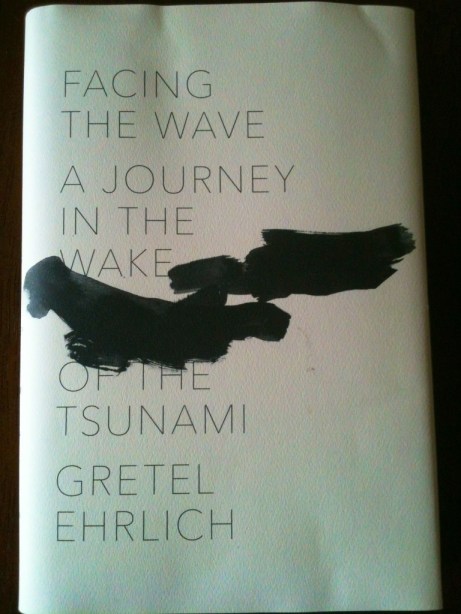
Gretel Ehrlich’s Facing the Wave (Book Acquired, Some Time Earlier This Month)

20130213-170614.jpg

Got into this a bit the other day. Last year, a reader sent me a copy of Ehrlich’s The Future of Ice, which was nice, but I could never really get into it. Anyway, like the cover on this one. Blurb from publisher Pantheon (you can also read an excerpt here):

From one of the preeminent and most admired observers of the natural world, a heartrending and inspirational portrait of Japan after the 2011 tsunami, when survivors found their world utterly transformed by loss, grief, destruction, and the urgent need to reconstruct their homes, their towns, and their lives.

A passionate student of Japanese poetry, theater, and art for much of her life, Gretel Ehrlich felt compelled to return to the earthquake-and-tsunami-devastated Tohoku coast to bear witness, listen to survivors, and experience their terror and exhilaration in villages and towns where all shelter and hope seemed lost. In an eloquent narrative that blends strong reportage, poetic observation, and deeply felt reflection, she takes us into the upside-down world of northeastern Japan, where nothing is certain and where the boundaries between living and dying have been erased by water.

The stories of rice farmers, monks, and wanderers; of fishermen who drove their boats up the steep wall of the wave; and of an eighty-four-year-old geisha who survived the tsunami to hand down a song that only she still remembered are both harrowing and inspirational. Facing death, facing life, and coming to terms with impermanence are equally compelling in a landscape of surreal desolation, as the ghostly specter of Fukushima Daiichi, the nuclear power complex, spews radiation into the ocean and air. Facing the Wave is a testament to the buoyancy, spirit, humor, and strong-mindedness of those who must find their way in a suddenly shattered world.

Sinbad the Sailor — Ub Iwerks

Orchidaceae — Ernst Haeckel

Haeckel_Orchidae