Anthems in New Tongues I Hear Saluting Me (Whitman/Dali)


Salvador Dali Museum.
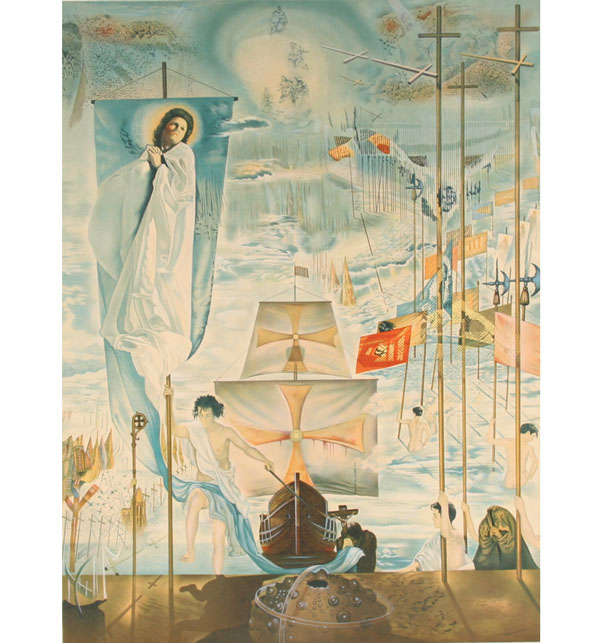
Salvador Dalí, The Discovery of America by Christopher Columbus

“Prayer of Columbus” by Walt Whitman

A batter’d, wreck’d old man,
Thrown on this savage shore, far, far from home,
Pent by the sea and dark rebellious brows, twelve dreary months,
Sore, stiff with many toils, sicken’d and nigh to death,
I take my way along the island’s edge,
Venting a heavy heart.
I am too full of woe!
Haply I may not live another day;
I cannot rest O God, I cannot eat or drink or sleep,
Till I put forth myself, my prayer, once more to Thee,
Breathe, bathe myself once more in Thee, commune with Thee,
Report myself once more to Thee.
Thou knowest my years entire, my life,
My long and crowded life of active work, not adoration merely;
Thou knowest the prayers and vigils of my youth,
Thou knowest my manhood’s solemn and visionary meditations,
Thou knowest how before I commenced I devoted all to come to Thee,
Thou knowest I have in age ratified all those vows and strictly kept them,
Thou knowest I have not once lost nor faith nor ecstasy in Thee,
In shackles, prison’d, in disgrace, repining not,
Accepting all from Thee, as duly come from Thee.
All my emprises have been fill’d with Thee,
My speculations, plans, begun and carried on in thoughts of Thee,
Sailing the deep or journeying the land for Thee;
Intentions, purports, aspirations mine, leaving results to Thee.
O I am sure they really came from Thee,
The urge, the ardor, the unconquerable will,

The potent, felt, interior command, stronger than words,

A message from the Heavens whispering to me even in sleep,
These sped me on.
By me and these the work so far accomplish’d,
By me earth’s elder cloy’d and stifled lands uncloy’d, unloos’d,
By me the hemispheres rounded and tied, the unknown to the known.
The end I know not, it is all in Thee,
Or small or great I know not–haply what broad fields, what lands,
Haply the brutish measureless human undergrowth I know,
Transplanted there may rise to stature, knowledge worthy Thee,
Haply the swords I know may there indeed be turn’d to reaping-tools,
Haply the lifeless cross I know, Europe’s dead cross, may bud and
blossom there.
One effort more, my altar this bleak sand;
That Thou O God my life hast lighted,
With ray of light, steady, ineffable, vouchsafed of Thee,
Light rare untellable, lighting the very light,
Beyond all signs, descriptions, languages;
For that O God, be it my latest word, here on my knees,
Old, poor, and paralyzed, I thank Thee.
My terminus near,
The clouds already closing in upon me,
The voyage balk’d, the course disputed, lost,
I yield my ships to Thee.
My hands, my limbs grow nerveless,
My brain feels rack’d, bewilder’d,
Let the old timbers part, I will not part,
I will cling fast to Thee, O God, though the waves buffet me,
Thee, Thee at least I know.
Is it the prophet’s thought I speak, or am I raving?
What do I know of life? what of myself?
I know not even my own work past or present,
Dim ever-shifting guesses of it spread before me,
Of newer better worlds, their mighty parturition,
Mocking, perplexing me.
And these things I see suddenly, what mean they?
As if some miracle, some hand divine unseal’d my eyes,
Shadowy vast shapes smile through the air and sky,
And on the distant waves sail countless ships,
And anthems in new tongues I hear saluting me.

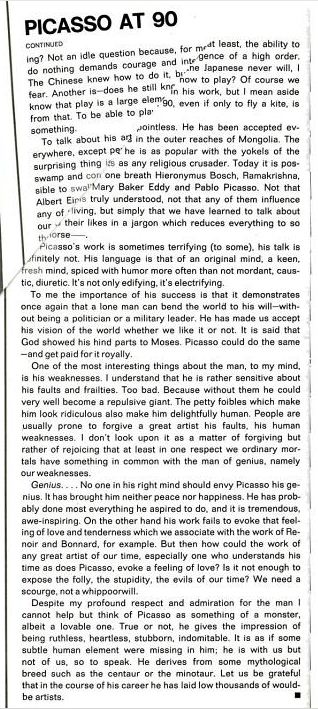
 

“Picasso at 90” — Henry Miller (1971 LIFE Magazine Profile)

“Picasso at 90” is an October, 1971 profile on the artist by Henry Miller, presented here via Google Books. In a felicitous cubist twist, the second page of the article (featuring the full portrait of Picasso and, on its back, the column of text) seems to have been cut (or ripped) and then repaired.

St. Gregory the Great — Francisco Goya

An Evening with Edgar Allan Poe — Vincent Price Recites Four Poe Classics

Alexander Alexeieff Illustrates Poe’s Story “The Fall of the House of Usher”

(More/via/about).

Read Edgar Allan Poe’s Story “A Descent into the Maelström”


“A Descent into the Maelström” by Edgar Allan Poe—

The ways of God in Nature, as in Providence, are not as our ways; nor are the models that we frame any way commensurate to the vastness, profundity, and unsearchableness of His works, which have a depth in them greater than the well of Democritus.
Joseph Glanville.

WE had now reached the summit of the loftiest crag. For some minutes the old man seemed too much exhausted to speak.

“Not long ago,” said he at length, “and I could have guided you on this route as well as the youngest of my sons; but, about three years past, there happened to me an event such as never happened before to mortal man –or at least such as no man ever survived to tell of –and the six hours of deadly terror which I then endured have broken me up body and soul. You suppose me a very old man –but I am not. It took less than a single day to change these hairs from a jetty black to white, to weaken my limbs, and to unstring my nerves, so that I tremble at the least exertion, and am frightened at a shadow. Do you know I can scarcely look over this little cliff without getting giddy?”

The “little cliff,” upon whose edge he had so carelessly thrown himself down to rest that the weightier portion of his body hung over it, while he was only kept from falling by the tenure of his elbow on its extreme and slippery edge –this “little cliff” arose, a sheer unobstructed precipice of black shining rock, some fifteen or sixteen hundred feet from the world of crags beneath us. Nothing would have tempted me to within half a dozen yards of its brink. In truth so deeply was I excited by the perilous position of my companion, that I fell at full length upon the ground, clung to the shrubs around me, and dared not even glance upward at the sky –while I struggled in vain to divest myself of the idea that the very foundations of the mountain were in danger from the fury of the winds. It was long before I could reason myself into sufficient courage to sit up and look out into the distance.

“You must get over these fancies,” said the guide, “for I have brought you here that you might have the best possible view of the scene of that event I mentioned –and to tell you the whole story with the spot just under your eye.”

“We are now,” he continued, in that particularizing manner which distinguished him –“we are now close upon the Norwegian coast –in the sixty-eighth degree of latitude –in the great province of Nordland –and in the dreary district of Lofoden. The mountain upon whose top we sit is Helseggen, the Cloudy. Now raise yourself up a little higher –hold on to the grass if you feel giddy –so –and look out beyond the belt of vapor beneath us, into the sea.” Continue reading “Read Edgar Allan Poe’s Story “A Descent into the Maelström””

The Fall of the House of Usher — Edgar Allan Poe’s Tale Comes to Life in a Creepy Stop-Motion Film by Jan Svankmajer

Book Shelves #41, 10.07.2012


20121001-205929.jpg

Book shelves series #41, forty-first Sunday of 2012

Lots of lovely books and mags with pictures.

Several years worth of subscription to The Believer, with an unsorted stack setting up front:

20121001-200254.jpg

I suppose I could write a whole post about The Believer, which I think is an excellent mag but no longer subscribe to, but instead, here’s a cover from Charles Burns:

20121001-200318.jpg

Charles Burns also shows up in this section, which includes stuff by R. Crumb, Daniel Clowes, Art Spiegelman, and more:

20121001-200329.jpg

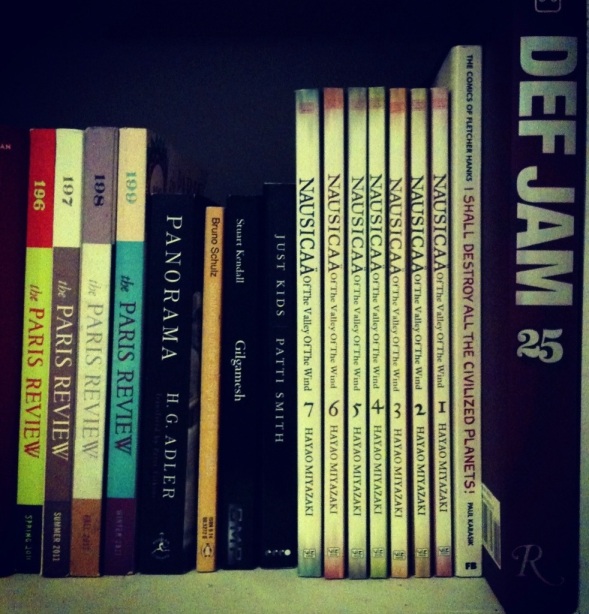
The wife got me a subscription to The Paris Review last year; then, some unsorted books, and then the Nausicaä collection (also courtesy the wife):

20121001-200342.jpg

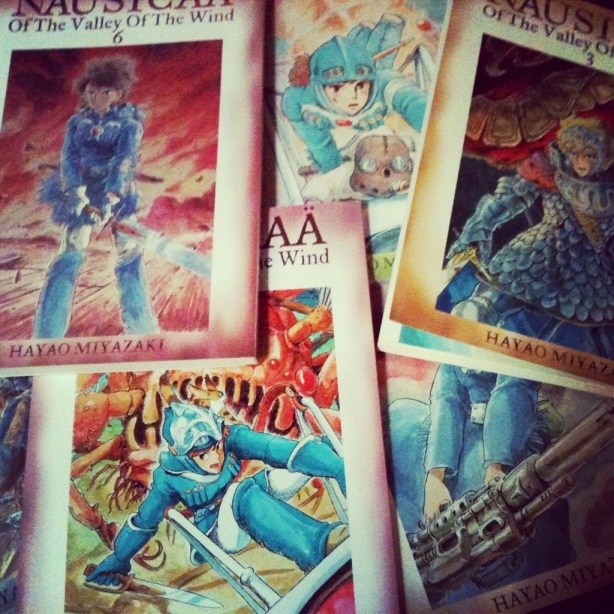
Nausicaä spread out on my couch. (My son and I ended up looking through them for an hour):

20121001-200353.jpg


Portrait of Edgar Allan Poe — Felix Vallotton

Railway — Edouard Manet

Lunch Break with a Knight — Norman Rockwell

Songs from the Second Floor (Roy Andersson, Full Film)

“Life in the jungle” (Kafka)

(From Kafka’s Diaries).

Breakfast — Diego Velazquez

The Cup of Tea — Andre Derain

Birdwalk Empire

Ingmar Bergman’s Persona (Full Film)