The Most Beautiful Machine by Hanns-Martin Wagner. Based on an idea by mathematician Claude E. Shannon. The trunk is closed, an observer presses the ON button, and a prosthetic arm pops out, presses the OFF button, and the trunk closes again. Lovely. More/see it in action.
I’d been wanting to read a biography of Goya for some time now. For a few years now, his art has come occupy a strange space in the back of my subconscious mind—all the pain and violence and horror of it. Maybe it’s all the Roberto Bolaño I’ve been reading. I’m convinced that if you want to understand Bolaño it helps to have Goya as a visual referent. Also, I cut up an oversized Italian collection of color prints from Goya to hang in my office, so they’re always kinda in my visual field.
Anyway, last week I went by my favorite local used bookstore to pick up a copy of W.G. Sebald’s After Nature that they’d kindly ordered for me and went through the biographies as well to find something on Goya. There were at least half a dozen, but the recently deceased Robert Hughes’s was the most beautiful and most recent, and its opening captivated me: In the first chapter, Hughes describes how a near-fatal car crash in 1999 unlocked the Goya study that he’d been wanting to write for years. The scene unfolds as a bizarre prolonged fever dream, a horrifying narrative informed by Goya’s asylums and bullfights, with the strange layer of modern airport slathered on top.
I’ve read the first 150 pages since then. Hughes’s writing is crisp and the text is rich; Hughes builds a slow case, arguing against Goya’s reputation as a radical but also highlighting the artist’s powers of pathos (not to mention his skill, both raw and refined). Hughes had me hooked with the following paragraph, which could also stand in as a simple description of a decsonstructionist theory of identity:
Goya was in some ways the greatest of all delineators of madness, because he was unrivaled in his ability to locate it among the common presences of human life, to see it as a natural par t of man’s (and woman’s) condition, not as an intrusion of the divine or the demonic from above or below. Madness does not come from outside into a stable and virtuous normality. That, Goya knew in his excruciating sanity, was nonsense. There is no perfect stability of the human condition, only approximations of it, sometimes fragile because created by culture. Part of his creed, indeed the very core of his nature as an artist, was Terence’s “Nihil humanum a me alienum puto,” “I think nothing human alien to me.” This was part of Goya’s immense humanity, a range of sympathy, almost literally, “co-suffering,” rivaling that of Dickens or Tolstoy.
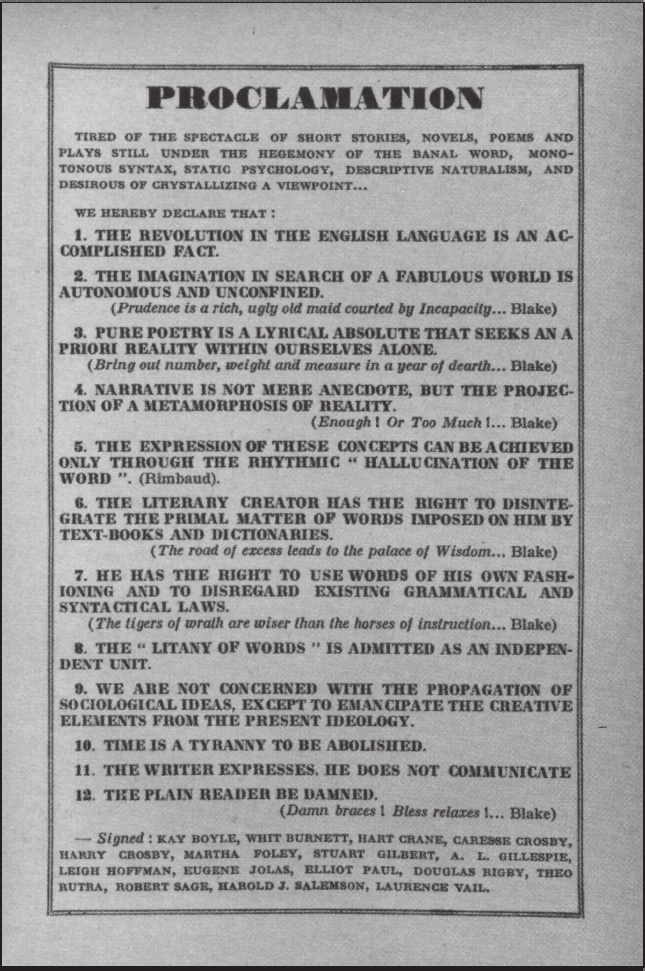
I’ve been digging Stephen Eric Bronner’s tight synthesis of modernism, Modernism at the Barricades, which traces the historical rise of expressionism, futurism, surrealism and more against the political, social, and historical backdrop of the emerging 20th century. Bronner’s book is a sharp but concise primer of sorts, using examples like the correspondence between Schoenberg and Kandinsky and the paintings of Emil Nolde to illuminate the big concepts and cultural aims of different modernist movements. Photographs, prints, and posters (like the proclamation below) help to illustrate Bronner’s chapters as well.
The Revolution of the World Proclamation — Eugene Jolas (1929)
Bronner’s book would make a handy starting point to any student beginning a study of modernism. It doesn’t try to exhaustively account for each and every modernist, but neither does it forsake specificity in favor of a broad overview. Best of all, Bronner is clear and concise, an attribute which unfortunately is all too rare in academic writing. There’s a lucid sensibility that seems to govern the book, which we can see from its earliest chapter. Here Bronner delineates modernism’s cultural project and at the same time points out some of modernism’s own shortsightedness:
Modernism would call into question every aspect of modern life, from the architecture through which our apartments are designed, to the furniture in which we sit, to the comic books our children read, to the films we watch and the museums we visit, to the experience of time and individual possibility that mark our lives. Modernists may have believed that they were contesting modernity, but their efforts and their hopes were shaped by it. Their activities legitimated what they intended to oppose. Their critique, in short, presupposed its object. Modernists believed that they were contesting tradition in the name of the new and the constraints of everyday life in the name of multiplied experience and individual freedom. These artists were essentially anarchists imbued with what Georg Lukács termed “romantic anti-capitalism.”
They opposed the “system” without understanding how it worked or what radical political transformation required and implied. Oddly, they never understood how deeply they were enmeshed in what they opposed. Modernists envisioned an apocalypse that had no place for institutions or agents generated within modernity. Theirs was less a concern with class consciousness than an opposition to the alienating and reifying constraints of modernity. Unfettered freedom of expression and a transformation in the experience of everyday life were the modernists’ goals. Even when seduced by totalitarian movements, whether of the left or the right, most of them despised what Czeslaw Milosz called the“captive mind.” Not all the problems that they uncovered—sexual repression and generational conflicts, among others—required utopian solutions. But their utopian inclinations were transparent from the beginning. Modernists believed that the new would not come from within modernity, but would appear as an external event or force for which, culturally, the vanguard would act as a catalyst.
Good stuff. Modernism at the Barricades is new in hardback from Columbia University Press.






 Biblioklept