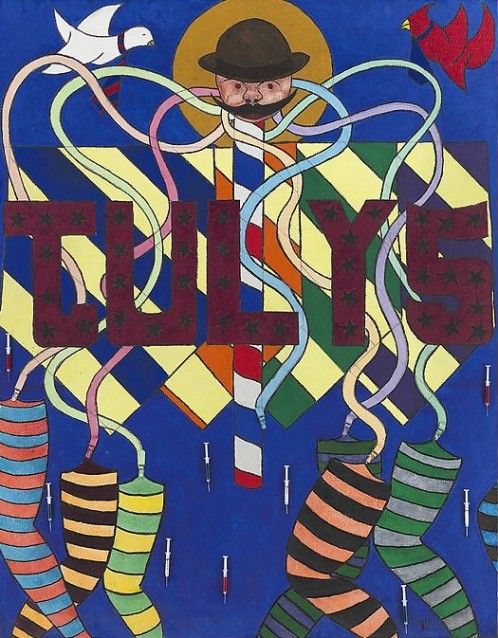
Yes Sisyphus, known as the craftiest of men | From Roberto Bolaño’s 2666

Then, incomprehensibly, he began to make faces that in some way linked him to the wife of the writer from Mainz, to such a degree that Bubis thought they must be brother and sister and only thus could one fully understand the presence of the writer and his wife at the meal. It was also possible, thought Bubis, that they were lovers, because it was common knowledge that lovers often began to resemble each other, usually in their smiles, their opinions, their points of view, in short, the superficial trappings that all human beings are obliged to bear until their deaths, like the rock of Sisyphus, yes Sisyphus, known as the craftiest of men, son of Aeolus and Enarete, founder of the city of Ephyra, which is the old name for Corinth, a city that the good Sisyphus turned into the staging ground of his happy misdeeds, because with his characteristic nimbleness of body and intellectual inclination to see every turn of fate as a chess problem or a detective story to unravel, and his instinct for laughter and jokes and jests and cracks and quips and gags and pranks and punch lines and spoofs and stories and gibes and taunts and send-ups and satires, he turned to theft, in other words parting all passersby from their belongings, even going so far as to steal from his neighbor Autolycus, also a thief, perhaps with the remote hope that one who steals from a thief is granted one hundred years of forgiveness, and at the same time smitten by his neighbor’s daughter, Anticlea, because Anticlea was very beautiful, a treat, but the girl had an official suitor, she was promised to Laertes, of subsequent fame, which didn’t daunt Sisyphus, who could count on the complicity of the girl’s father, the thief Autolycus, whose admiration for Sisyphus had sprung up like the regard of an objective and honorable artist for another artist of superior gifts, so that even though it could be said that as a man of honor he remained true to his promise to Laertes, he didn’t look unkindly upon the romantic attentions Sisyphus lavished on his daughter or treat them as disrespect or mockery of his future son-in-law, and in the end his daughter married Laertes, or so it’s said, but only after surrendering to Sisyphus one or two or five or seven times, possibly ten or fifteen times, always with the collusion of Autolycus, who wanted his neighbor to plant the seed of a grandchild as clever as Sisyphus, and on one of these occasions Anticlea was left with child and nine months later, now the wife of Laertes, her son would be born, the son of Sisyphus, called Odysseus or Ulysses, who in fact turned out to be just as clever as his father, though Sisyphus never gave him a thought and continued to live his life, a life of excesses and parties and pleasure, during which he married Merope, the dimmest star in the Pleiades precisely because she married a mortal, a miserable mortal, a miserable thief, a miserable gangster in thrall to his excesses, blinded by his excesses, among which not least was the seduction of Tyro, the daughter of Sisyphus’s brother Salmoneus, whom Sisyphus pursued not because he was interested in Tyro, not because Tyro was particularly sexy, but because Sisyphus hated his own brother and wanted to cause him pain, and for this deed, after his death, he was condemned in hell to push a stone to the top of a hill only to watch it roll down to the bottom and then push it back up to the top of the hill and watch it roll again to the bottom, and so on eternally, a bitter punishment out of all proportion to his crimes or sins, the vengeance of Zeus, it’s said, because on a certain occasion Zeus passed through Corinth with a nymph he had kidnapped, and Sisyphus, who was smarter than a whip, seized his chance, and when Asopus, the girl’s father, came by in desperate search of his daughter, Sisyphus offered to give him the name of his daughter’s kidnapper, but only if Asopus made a fountain spring up in the city of Corinth, which shows that Sisyphus wasn’t a bad citizen or perhaps he was thirsty, to which Asopus agreed and the fountain of crystalline waters sprang up and Sisyphus betrayed Zeus, who, in a blind rage, sent him ipso facto to Thanatos, or death, but Sisyphus was too much for Thanatos, and in a masterstroke perfectly in keeping with his craftiness and sense of humor he captured Thanatos and threw him in chains, a feat within reach of very few, truly very few, and for a long time he kept Thanatos in chains and during all that time not a single human being died on the face of the earth, a golden age in which men, though still men, lived free of the anxiety of death, in other words, free of the anxiety of time, because now they had more than enough time, which is perhaps what distinguishes a democracy, spare time, surplus time, time to read and time to think, until Zeus had to intervene personally and Thanatos was freed and then Sisyphus died.

But the faces Junge was making didn’t have anything to do with Sisyphus, thought Bubis.

From “The Part About Archimboldi,” 2666, by Roberto Bolaño in translation by Natasha Wimmer.
Posted in Art

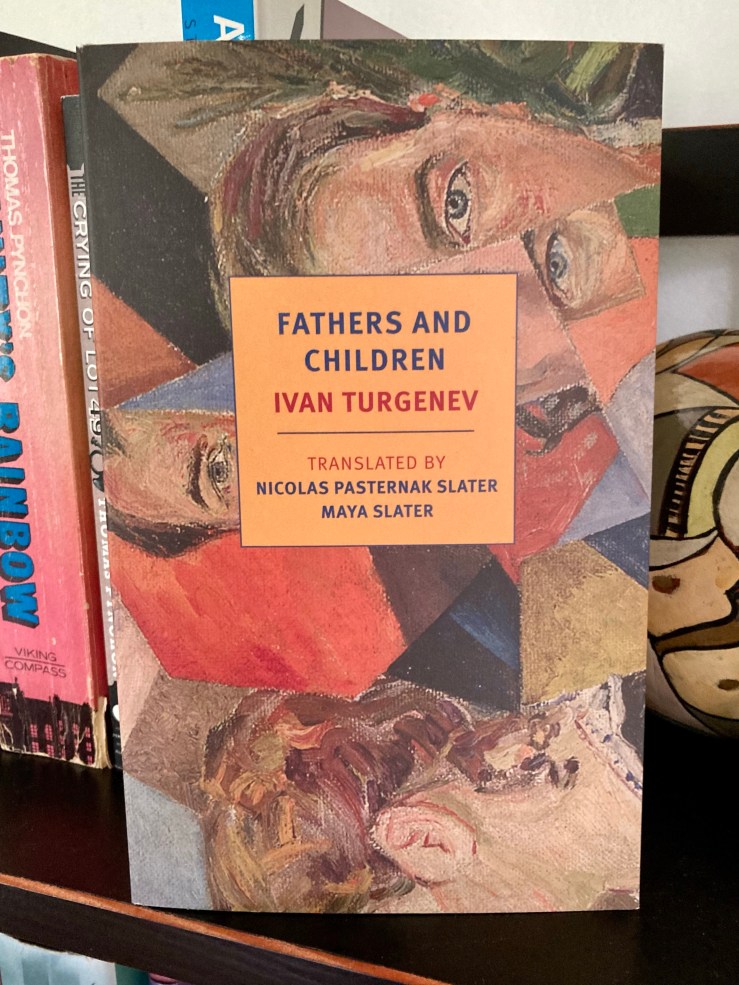
Ivan Turgenev’s Fathers and Children (Book acquired, 6 July 2022)

NYRB is publishing Ivan Turgenev’s novel Fathers and Children next month, in English translation by Nicolas Pasternak Slater and Maya Slater. NYRB’s blurb:

Ivan Turgenev’s Fathers and Children is a masterpiece not only of the nineteenth century but of the whole of Russian literature, a book full to bursting with life. It is a novel about the relationships between the young and the old; about love, families, politics, religion; about strong beliefs and heated disagreements, illness and death. It is about the clash between liberals and conservatives, revolutionaries and reactionaries. At the time of its publication in 1862, the book aroused indignation in its critics who felt betrayed by Turgenev’s refusal to let his novel serve a single ideology; it also received a spirited defense by those who saw in his diffuse sympathies a greater service to art and to humanity. Fathers and Children is not a practical manifesto but a lasting work of art and a timely book for our present age, newly and ably translated by Nicolas Pasternak Slater and Maya Slater.

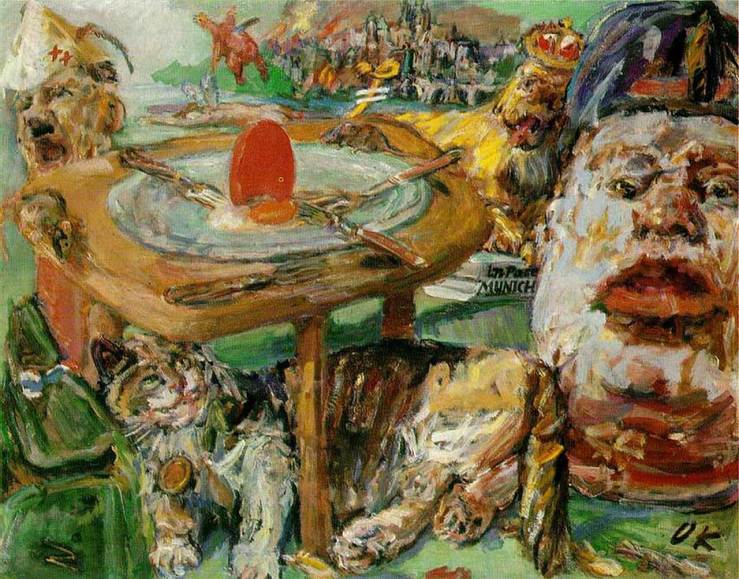
The Red Egg — Oskar Kokoschka

The Red Egg, 1941 by Oskar Kokoschka (1886-1980)

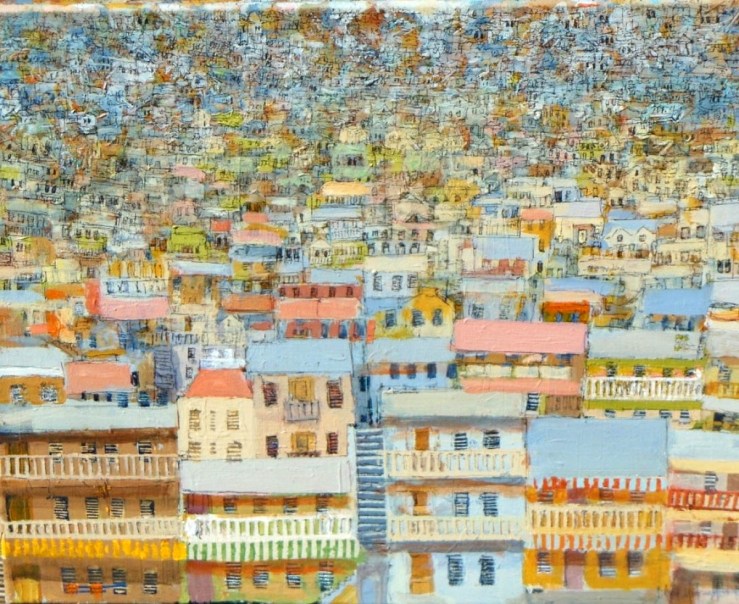
Chaos XXLIII — Michael Palmer

My poor father. I was a writer, I was a writer, but my indolent, voracious brain gnawed at my own entrails | From Roberto Bolaño’s 2666

“My poor father. I was a writer, I was a writer, but my indolent, voracious brain gnawed at
my own entrails. Vulture of my Prometheus self or Prometheus of my vulture self, one day I understood that I might go so far as to publish excellent articles in magazines and newspapers, and even books that weren’t unworthy of the paper on which they were printed. But I also understood that I would never manage to create anything like a masterpiece. You may say that literature doesn’t consist solely of masterpieces, but rather is populated by so-called minor works. I believed that, too. Literature is a vast forest and the masterpieces are the lakes, the towering trees or strange trees, the lovely, eloquent flowers, the hidden caves, but a forest is also made up of ordinary trees, patches of grass, puddles, clinging vines, mushrooms, and little wild-flowers. I was wrong. There’s actually no such thing as a minor work. I mean: the author of the minor work isn’t Mr. X or Mr. Y. Mr. X and Mr. Y do exist, there’s no question about that, and they struggle and toil and publish in newspapers and magazines and sometimes they even come out with a book that isn’t unworthy of the paper it’s printed on, but those books or articles, if you pay close attention, are not written by them.

“Every minor work has a secret author and every secret author is, by definition, a writer of
masterpieces. Who writes the minor work? A minor writer, or so it appears. The poor man’s
wife can testify to that, she’s seen him sitting at the table, bent over the blank pages, restless
in his chair, his pen racing over the paper. The evidence would seem to be incontrovertible.
But what she’s seen is only the outside. The shell of literature. A semblance,” said the old
man to Archimboldi and Archimboldi thought of Ansky. “The person who really writes the
minor work is a secret writer who accepts only the dictates of a masterpiece.

“Our good craftsman writes. He’s absorbed in what takes shape well or badly on the page.
His wife, though he doesn’t know it, is watching him. It really is he who’s writing. But if his wife had X-ray vision she would see that instead of being present at an exercise of literary creation, she’s witnessing a session of hypnosis. There’s nothing inside the man who sits there writing. Nothing of himself, I mean. How much better off the poor man would be if he devoted himself to reading. Reading is pleasure and happiness to be alive or sadness to be alive and above all it’s knowledge and questions. Writing, meanwhile, is almost always empty. There’s nothing in the guts of the man who sits there writing. Nothing, I mean to say, that his wife, at a given moment, might recognize. He writes like someone taking dictation. His novel or book of poems, decent, adequate, arises not from an exercise of style or will, as the poor unfortunate believes, but as the result of an exercise of concealment. There must be many books, many lovely pines, to shield from hungry eyes the book that really matters, the wretched cave of our misfortune, the magic flower of winter!

“Excuse the metaphors. Sometimes, in my excitement, I wax romantic. But listen. Every
work that isn’t a masterpiece is, in a sense, a part of a vast camouflage. You’ve been a soldier, I imagine, and you know what I mean. Every book that isn’t a masterpiece is cannon fodder, a slogging foot soldier, a piece to be sacrificed, since in multiple ways it mimics the
design of the masterpiece. When I came to this realization, I gave up writing. Still, my mind
didn’t stop working. In fact, it worked better when I wasn’t writing. I asked myself: why does a masterpiece need to be hidden? what strange forces wreath it in secrecy and mystery?

“By now I knew it was pointless to write. Or that it was worth it only if one was prepared to
write a masterpiece. Most writers are deluded or playing. Perhaps delusion and play are the
same thing, two sides of the same coin. The truth is we never stop being children, terrible children covered in sores and knotty veins and tumors and age spots, but ultimately children, in other words we never stop clinging to life because we are life. One might also say: we’re theater, we’re music. By the same token, few are the writers who give up. We play at believing ourselves immortal. We delude ourselves in the appraisal of our own works and in our perpetual misappraisal of the works of others. See you at the Nobel, writers say, as one might say: see you in hell.

From Roberto Bolaño’s 2666, in Natasha Wimmer’s translation.

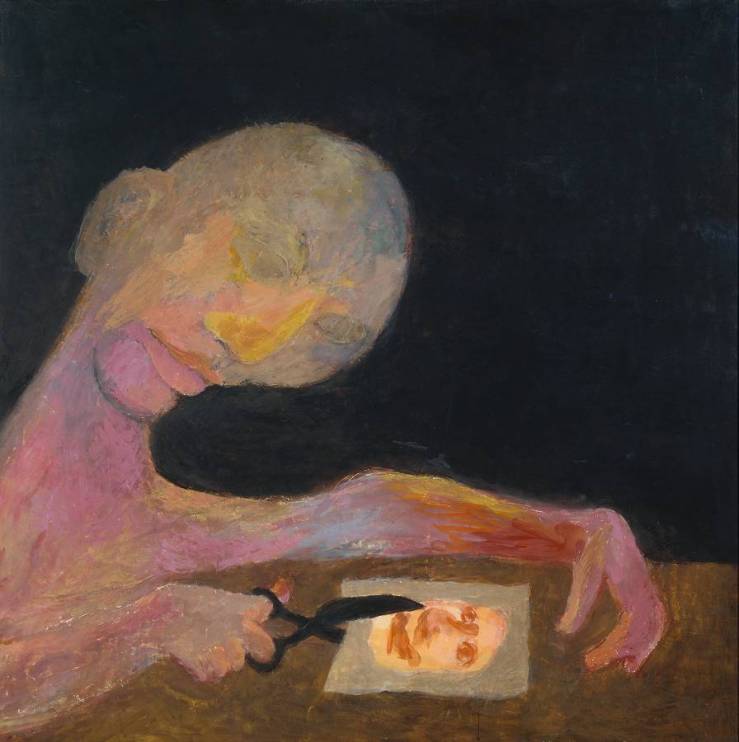
Person Cutting an Image — Ken Kiff

Person Cutting an Image, 1965-71 by Ken Kiff (1935-2001)

The novel, so unanimously acclaimed, was called Twilight | From Roberto Bolaño’s 2666

The following excerpt of Roberto Bolaño’s 2666 (in Natasha Wimmer’s translation) is more or less self-contained, or at least as self-contained as anything in that labyrinth. It’s the summary of a character named Ansky’s novel; Hans Reiter (aka Archimboldi) is reading Ansky’s diaries while hiding during the war–

The novel, so unanimously acclaimed, was called Twilight and its plot was very simple: a boy of fourteen abandons his family to join the ranks of the revolution. Soon he’s engaged in combat against Wrangel’s troops. In the midst of battle he’s injured and his comrades leave him for dead. But before the vultures come to feed on the bodies, a spaceship drops onto the battlefield and takes him away, along with some of the other mortally wounded soldiers. Then the spaceship enters the stratosphere and goes into orbit around Earth. All of the men’s wounds are rapidly healed. Then a very thin, very tall creature, more like a strand of seaweed than a human being, asks them a series of questions like: how were the stars created? where does the universe end? where does it begin? Of course, no one knows the answers. One man says God created the stars and the universe begins and ends wherever God wants. He’s tossed out into space. The others sleep. When the boy awakes he finds himself in a shabby room, with a shabby bed and a shabby wardrobe where his shabby clothes hang. When he goes to the window he gazes out in awe at the urban landscape of New York. But the boy finds only misfortune in the great city. He meets a jazz musician who tells him about chickens that talk and probably think.

“The worst of it,” the musician says to him, “is that the governments of the planet know it and that’s why so many people raise chickens.”

The boy objects that the chickens are raised to be eaten. The musician says that’s what the chickens want. And he finishes by saying:

“Fucking masochistic chickens, they have our leaders by the balls.”

He also meets a girl who works as a hypnotist at a burlesque club, and he falls in love. The girl is ten years older than the boy, or in other words twenty-four, and although she has a number of lovers, including the boy, she doesn’t want to fall in love with anyone because she believes that love will use up her powers as a hypnotist. One day the girl disappears and the boy, after searching for her in vain, decides to hire a Mexican detective who was a soldier under Pancho Villa. The detective has a strange theory: he believes in the existence of numerous Earths in parallel universes. Earths that can be reached through hypnosis. The boy thinks the detective is swindling him and decides to accompany him in his investigations. One night they come upon a Russian beggar shouting in an alley. The beggar shouts in Russian and only the boy can understand him. The beggar says: I fought with Wrangel, show some respect, please, I fought in Crimea and I was evacuated from Sevastopol in an English ship. Then the boy asks whether the beggar was at the battle where he fell badly wounded. The beggar looks at him and says yes. I was too, says the boy. Impossible, replies the beggar, that was twenty years ago and you weren’t even born yet.

Then the boy and the Mexican detective set off west in search of the hypnotist. They find her in Kansas City. The boy asks her to hypnotize him and send him back to the battlefield where he should have died, or accept his love and stop fleeing. The hypnotist answers that neither is possible. The Mexican detective shows an interest in the art of hypnosis. As the detective begins to tell the hypnotist a story, the boy leaves the roadside bar and goes walking under the night sky. After a while he stops crying.

He walks for hours. When he’s in the middle of nowhere he sees a figure by the side of the road. It’s the seaweedlike extraterrestrial. They greet each other. They talk. Often, their conversation is unintelligible. The subjects they address are varied: foreign languages, national monuments, the last days of Karl Marx, worker solidarity, the time of the change measured in Earth years and stellar years, the discovery of America as a stage setting, an unfathomable void—as painted by Dore—of masks. Then the boy follows the extraterrestrial away from the road and they walk through a wheat field, cross a stream, climb a hill, cross another field, until they reach a smoldering pasture.

In the next chapter, the boy is no longer a boy but a young man of twenty-five working at a Moscow newspaper where he has become the star reporter. The young man receives the assignment to interview a Communist leader somewhere in China. The trip, he is warned, is extremely difficult, and once he reaches Peking, the situation may be dangerous, since there are lots of people who don’t want any statement by the Chinese leader to get out. Despite these warnings, the young man accepts the job. When, after much hardship, he finally gains access to the cellar where the Chinese leader is hidden, the young man decides that not only will he interview him, he’ll also help him escape the country. The Chinese leader’s face, in the light of a candle, bears a notable resemblance to that of the Mexican detective and former soldier under Pancho Villa. The Chinese leader and the young Russian, meanwhile, come down with the same illness, brought on by the pestilence of the cellar. They shake with fever, they sweat, they talk, they rave, the Chinese leader says he sees dragons flying low over the streets of Peking, the young man says he sees a battle, perhaps just a skirmish, and he shouts hurrah and urges his comrades onward. Then both lie motionless as the dead for a long time, and suffer in silence until the day set for their flight.

Each with a temperature of 102 degrees, the two men cross Peking and escape. Horses and provisions await them in the countryside. The Chinese leader has never ridden before. The young man teaches him how. During the trip they cross a forest and then some enormous mountains. The blazing of the stars in the sky seems supernatural. The Chinese leader asks himself: how were the stars created? where does the universe end? where does it begin? The young man hears him and vaguely recalls a wound in his side whose scar still aches, darkness, a trip. He also remembers the eyes of a hypnotist, although the woman’s features remain hidden, mutable. If I close my eyes, thinks the young man, I’ll see her again. But he doesn’t close them. They make their way across a vast snow-covered plain. The horses sink in the snow. The Chinese leader sings. How were the stars created? Who are we in the middle of the boundless universe? What trace of us will remain?

Suddenly the Chinese leader falls off his horse. The young Russian examines him. The Chinese leader is like a burning doll. The young Russian touches the Chinese leader’s forehead and then his own forehead and understands that the fever is devouring them both. With no little effort he ties the Chinese leader to his mount and sets off again. The silence of the snow-covered plain is absolute. The night and the passage of stars across the vault of the sky show no signs of ever ending. In the distance an enormous black shadow seems to superimpose itself on the darkness. It’s a mountain range. In the young Russian’s mind the certainty takes shape that in the coming hours he will die on that snow-covered plain or as he crosses the mountains. A voice inside begs him to close his eyes, because if he closes them he’ll see the eyes and then the beloved face of the hypnotist. It tells him that if he closes his eyes he’ll see the streets of New York again, he’ll walk again toward the hypnotist’s house, where she sits waiting for him on a chair in the dark. But the Russian doesn’t close his eyes. He rides on.

Fifty similes, really more than fifty similes, from Roberto Bolaño’s novel 2666

  1. She looks like a nun, thought Quincy, or like she belongs to a dangerous cult.
  2. the movie in the dream was like a negative of the real movie
  3. clouds that looked like cathedrals or maybe just little toy churches abandoned in a labyrinthine marble quarry one hundred times bigger than the Grand Canyon
  4. like the work of a lunatic
  5. like a miniature Russian Orthodox church
  6. what it was most like was an enchanted island
  7. like the lilies that bloom and die in a single day
  8. a dream that breaks away from another dream like one drop of water breaking away from a bigger drop of water
  9. a metaphor is like a life jacket
  10. there are life jackets that float and others that sink to the bottom like lead
  11. I went through books like they were barbecue.
  12. friendly words that sounded like obscenities to my ear and that, thinking about it now, might actually have been obscene
  13. Reading is like thinking, like praying, like talking to a friend, like expressing your ideas, like listening to other people’s ideas, like listening to music (oh yes), like looking at the view, like taking a walk on the beach.
  14. gestured and bobbed like a rapper
  15. Hollows in the ground, like World War I bomb craters
  16. Fate headed down the stairs, taking them in threes as if he were dashing for the street, like a boy heading out for a free afternoon with his friends.
  17. smiling a catlike smile
  18. everyone, I mean everyone, is like the ancient Christians in the Roman circus
  19. Sunsets in the desert seem like they’ll never end, until suddenly, before you know it, they’re done. It’s like someone just turned out the lights
  20. She had a hoarse, nasal voice and she didn’t talk like a New York secretary but like a
    country person who has just come from the cemetery.
  21. like butterflies summoned by his prayers
  22. something like happiness
  23. stood to attention like a soldier
  24. the story grows like a snowball until the sun comes out and the whole damn ball melts and everybody forgets about it and goes back to work
  25. The fucking killings are like a strike, amigo, a brutal fucking strike.
  26. “It’s like a dream,” said Guadalupe Roncal. “It looks like something alive.”
  27. it looks like a woman who’s been hacked to pieces. Who’s been hacked to pieces but is still alive. And the prisoners are living inside this woman.”
  28. two Mexican reporters who stared at him like dying men
  29. the knowledge slipped like water through his fingers
  30. she smiled like a goddess
  31. This place is like hell
  32. A black sky like the bottom of the sea.
  33. like fucking a man who isn’t exactly a man
  34. like becoming a little girl again
  35. like being fucked by a rock. A mountain.
  36. it’s like you’re fucking a mountain but you’re fucking inside a cave
  37. In other words it’s like being fucked by a mountain in a cave inside the mountain itself
  38. Well, it feels like being fucked by the air. That’s exactly how it feels.
  39. So fucking a policeman is like being fucked by a mountain and fucking a narco is like being fucked by the air.
  40. like a tour guide with an eye for local color
  41. he treated her like his slave
  42. like a joke
  43. like the title of a David Lynch film
  44. narrow room like a monk’s cell
  45. the shadows dispersed by the flashes of car lights like comet tails in the dark
  46. It’s odd that someone would hang a book out like a shirt
  47. like a huge hearse
  48. She looked like an athlete from the 1940s.
  49. All of this is like somebody else’s dream
  50. the highway was like a river

These similes are from “The Part About Fate,” the third part of 2666, a novel by Roberto Bolaño, in English translation by Natasha Wimmer.
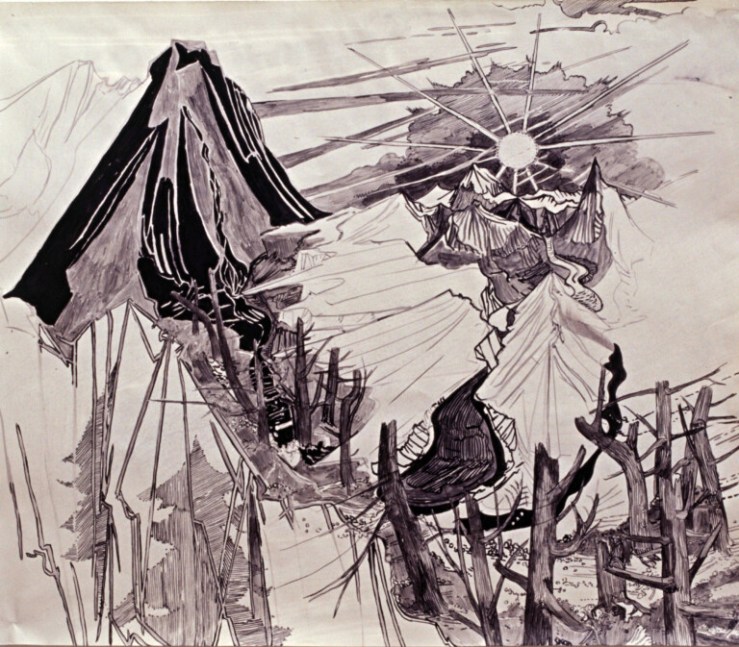
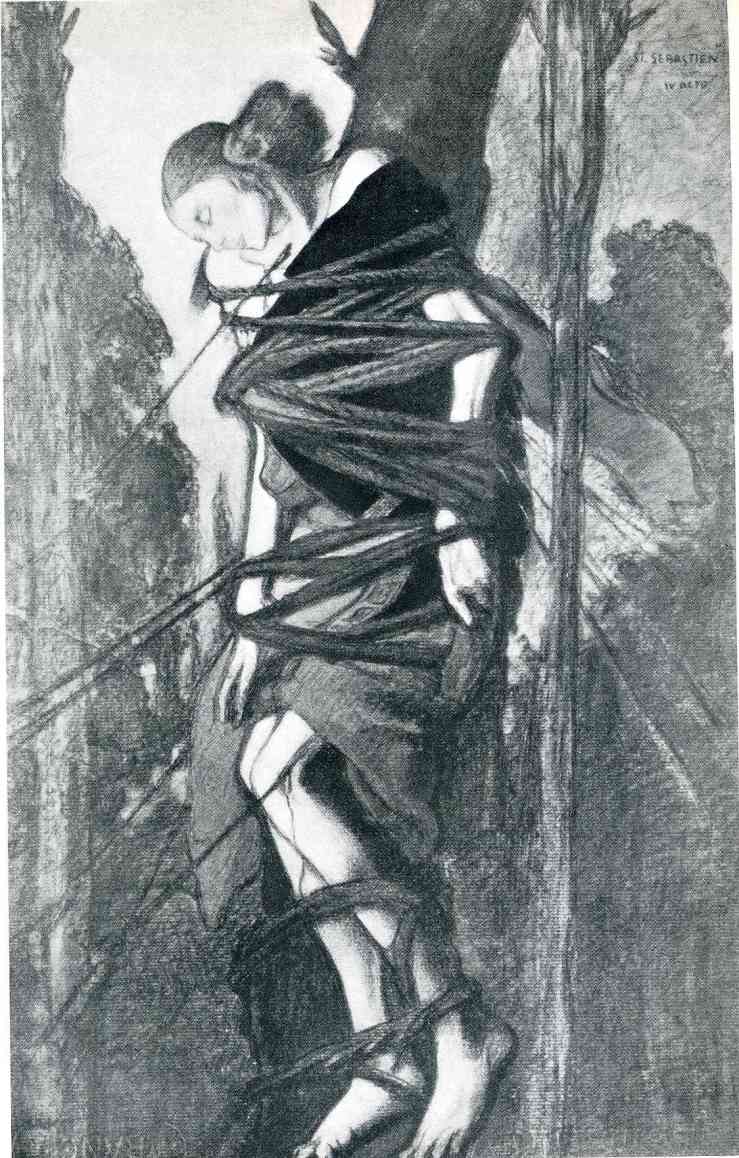
St. Sebastian — Leon Bakst

St. Sebastian by Leon Bakst (1866-1924)

Submission — Jesse Mockrin

Submission, 2021 by Jesse Mockrin (b. 1981)

A metaphor is like a life jacket | From Roberto Bolaño’s 2666

Really, when you talk about stars you’re speaking figuratively. That’s metaphor. Call someone a movie star. You’ve used a metaphor. Say: the sky is full of stars. More metaphors. If somebody takes a hard right to the chin and goes down, you say he’s seeing stars. Another metaphor. Metaphors are our way of losing ourselves in semblances or treading water in a sea of seeming. In that sense a metaphor is like a life jacket. And remember, there are life jackets that float and others that sink to the bottom like lead. Best not to forget it. But really, there’s just one star and that star isn’t semblance, it isn’t metaphor, it doesn’t come from any dream or any nightmare. We have it right outside. It’s the sun. The sun, I am sorry to say, is our only star. When I was young I saw a science fiction movie. A rocket ship drifts off course and heads toward the sun. First, the astronauts start to get headaches. Then they’re all dripping sweat and they take off their spacesuits and even so they can’t stop sweating and before long they’re dehydrated. The sun’s gravity keeps pulling them ceaselessly in. The sun begins to melt the hull of the ship. Sitting in his seat, the viewer can’t help feeling hot, too hot to bear. Now I’ve forgotten how it ends. At the last minute they get saved, I seem to recall, and they correct the course of that rocket ship and turn it around toward the earth, and the huge sun is left behind, a frenzied star in the reaches of space.

From “The Part About Fate,” the third part of 2666, a novel by Roberto Bolaño, in English translation by Natasha Wimmer.
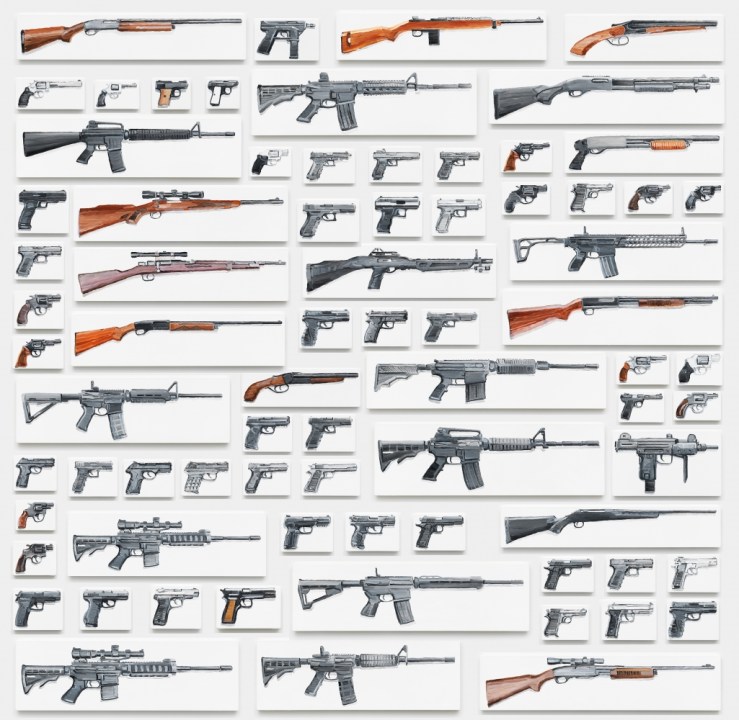
Death by Gun — Cynthia Daignault

Death by Gun (Or April 14, 1865; November 22, 1963; November 24, 1963; February 21, 1965; August 1, 1966; April 4, 1968; June 3, 1968; June 5, 1968; November 27, 1978; December 8, 1980; September 25, 1982; July 18, 1984; August 20, 1986; October 16, 1991; April 8, 1994; March 30, 1995; September 7, 1996; March 9, 1997; April 20, 1999; July 29, 1999; February 20, 2005; November 6, 2006; April 16, 2007; April 3, 2009; November 5, 2009,m; February 26, 2012; July 20, 2012; August 9, 2014; November 22, 2014; June 17, 2015; July 23, 2015; October 1, 2015; June 12, 2016; July 6, 2016; October 1, 2017; December 14, 2012; December 2, 2015; November 5, 2017; February 14, 2018), 2018 by Cynthia Daignault (b. 1978)

July 5th — William N. Copley

July 5th, 1982 by William N. Copley (1919-1996)

Melting — Susanne Kühn

Melting, 2000 by Susanne Kühn (b. 1969)

47 or so similes from Roberto Bolaño’s novel 2666

These similes are from “The Part About Amalfitano,” the second part of 2666, a novel by Roberto Bolaño, in English translation by Natasha Wimmer.

  1. It’s like a fetus
  2. he held the letter in his two hands like a life raft of reeds and grasses
  3. a doglike fervor
  4. a Turkish carpet like the threadbare carpet from the Thousand and One Nights, a battered carpet that sometimes functioned as a mirror, reflecting all of us from below
  5. standing there like a tiny and infinitely patient Amazon
  6. like pilgrims
  7. like mendicants or child prophets
  8. like someone who’s burned himself
  9. like sucking a small to medium dick
  10. like shooting a Zen arrow with a Zen bow into a Zen pavilion
  11. The lunatic, who was sitting down again, took it in the chest and dropped like a little bird.
  12. those days were like a prolonged parachute landing after a long space flight
  13. back and forth like a sleepwalker
  14. marched from the west like a ragtag army whose only strength was its numbers
  15. dropped down from the Pyrenees like the ghosts of dead beasts
  16. the floor waxer like a cross between a mastiff and a pig sitting next to a plant
  17. like a trick photograph that isn’t a trick, floating, floating pensively in the skies of Paris, weary
  18. like a memory rising up from glacial seas
  19. The University of Santa Teresa was like a cemetery that suddenly begins to think, in vain.
  20. It also was like an empty dance club.
  21. like a feudal lord riding out on horseback to survey his lands
  22. like provincial intellectuals
  23. like deeply self-sufficient men
  24. like a zombie
  25. like a medieval squire
  26. like a medieval princess
  27. Her hand was like a blind woman’s hand.
  28. like a cloud cemetery
  29. like a thick chili whose last simmer was fading in the west
  30. the coffinlike shadow
  31. purple like the skin of an Indian woman beaten to death
  32. laughing in a whisper, like a fly
  33. like an endoscopy, but painless
  34. slept like a baby
  35. I feel like a nightingale, he thought happily.
  36. like a lover whose embrace maddened the horse as well as the rider, both of them dying of fright or ending up at the bottom of a ravine, or the colocolo, or the chonchones, or the candelillas, or so many other little creatures, lost souls, incubi and succubi, lesser demons that roamed between the Cordillera de la Costa and the Andes
  37. very tan, like a singer or a Puerto Rican playboy
  38. A confident, mocking smile, like the smile of a cocksure sniper.
  39. like a joke
  40. something like laughter but also something like sorrow
  41. like the Greek state
  42. like an arrowhead
  43. burst out from a corner like someone playing a bad joke or about to attack him
  44. the slight shadow, like a hastily dug pit that gives off an alarming stench
  45. Something like the smoke signals
  46. military men behaved like writers, and writers, so as not to be outdone,
    behaved like military men, and politicians (of every stripe) behaved like writers and like military men, and diplomats behaved like cretinous cherubim, and doctors and lawyers behaved like thieves
  47. You’re like me and I’m like you. We aren’t happy.

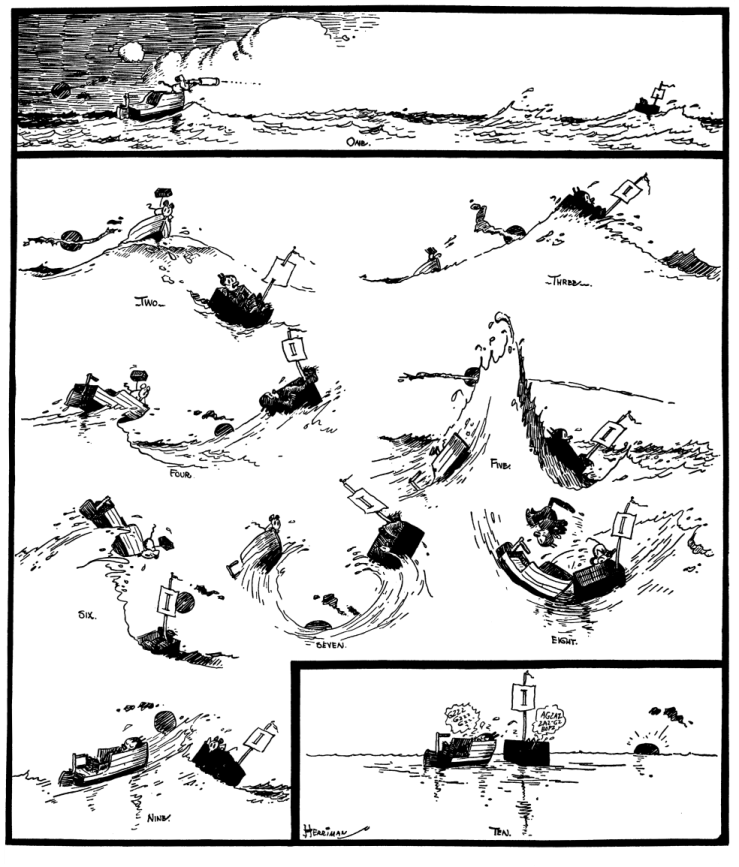
Encounter at sea (George Herriman’s Krazy Kat)

E.E. Cummings’ The Enormous Room ( Book acquired, mid-June 2022)

E.E. Cummings’ autobiographical novel The Enormous Room is forthcoming in a new edition from NYRB in July. Their blurb:

In 1917, after the entry of America into World War I, E. E. Cummings, a recent graduate of Harvard College, volunteered to serve on an ambulance corps in France. He arrived in Paris with a new friend, William Slater Brown, and they set about living it up in the big city before heading off to their assignment. Once in the field, they wrote irreverent letters about their experiences, which attracted the attention of the censors and ultimately led to their arrest. They were held for months in a military detention camp, sharing a single large room with a host of fellow detainees. It is this experience that Cummings relates in lightly fictionalized form in The Enormous Room, a book in which a tale of woe becomes an occasion of exuberant mischief. A free-spirited novel that displays the same formal swagger as his poems, a stinging denunciation of the stupidity of military authority, and a precursor to later books like Catch-22 and MASH, Cummings’s novel is an audacious, uninhibited, lyrical, and lasting contribution to American literature.