Crucifixion — Antonello da Messina

Easter in Shakespeare

From Thomas Firminger Thiselton-Dyer’s indispensable volume Folk-lore in Shakespeare:

Easter. According to a popular superstition, it is considered unlucky to omit wearing new clothes on Easter Day, to which Shakespeare no doubt alludes in “Romeo and Juliet” (iii. 1), when he makes Mercutio ask Benvolio whether he did “not fall out with a tailor for wearing his new doublet before Easter.” In East Yorkshire, on Easter Eve, young folks go to the nearest market-town to buy some new article of dress or personal adornment to wear for the first time on Easter Day, as otherwise they believe that birds—notably rooks or “crakes”—will spoil their clothes. In “Poor Robin’s Almanac” we are told: “At Easter let your clothes be new, Or else be sure you will it rue.” Some think that the custom of “clacking” at Easter—which is not quite obsolete in some counties—is incidentally alluded to in “Measure for Measure” (iii. 2) by Lucio: “his use was, to put a ducat in her clack-dish.” [649] The clack or clap dish was a wooden dish with a movable cover, formerly carried by beggars, which they clacked and clattered to show that it was empty. In this they received the alms. Lepers and other paupers deemed infectious originally used it, that the sound might give warning not to approach too near, and alms be given without touching the person. A popular name for Easter Monday was Black Monday, so called, says Stow, because “in the 34th of Edward III. (1360), the 14th of April, and the morrow after Easter Day, King Edward, with his host, lay before the city of Paris; which day was full dark of mist and hail, and so bitter cold, that many men died on their horses’ backs with the cold. Wherefore unto this day it hath been call’d the Blacke Monday.” Thus, in the “Merchant of Venice” (ii. 5), Launcelot says, “it was not for nothing that my nose fell a-bleeding on Black Monday last at six o’clock i’ the morning.”

Rabbits — David Lynch

Read “Scholars of Sodom,” an Excerpt from Roberto Bolaño’s New Book The Secret of Evil

It’s 1972 and I can see V.S. Naipaul strolling through the streets of Buenos Aires. Well, sometimes he’s strolling, but sometimes, when he’s on his way to meetings or keeping appointments, his gait is quick and his eyes take in only what he needs to see in order to reach his destination with a minimum of bother, whether it’s a private dwelling or, more often, a restaurant or a café, since many of those who’ve agreed to meet him have chosen a public place, as if they were intimidated by this peculiar Englishman, or as if they’d been disconcerted by the author of Miguel Street and A House for Mr. Biswas when they met him in the flesh and had thought: Well, I didn’t think it would be like this, or: This isn’t the man I’d imagined, or: Nobody told me.

So there he is, Naipaul, and it seems that all he can notice are outward movements, but in fact he’s noticing inward movements too, although he interprets them in his own way, sometimes arbitrarily, and he’s moving through Buenos Aires in the year 1972 and writing as he moves or perhaps only wanting to write as his legs move through that strange city, and he’s still young, forty years old, but he already has a considerable body of work behind him, a body of work that doesn’t weigh him down or prevent him from moving briskly through Buenos Aires when he has an appointment to keep—the weight of the work, that’s something to which we shall have to return, the weight and the pride that he takes in his work, the weight and the responsibility, which don’t prevent his legs from moving nimbly or his hand from rising to hail a taxi, as he acts in character, like the man he is, a man who keeps his appointments punctually—but he is weighed down by the work when he goes strolling through Buenos Aires without appointments to exercise his British punctuality, without any pressing obligations, just walking along those strange avenues and streets, through that city in the southern hemisphere, so like the cities of the northern hemisphere, and yet nothing like them at all, a hole, a void that someone has suddenly inflated, a show that is strictly for local consumption; that’s when he feels the weight of the work, and it’s tiring to carry that weight as he walks, it exhausts him, it’s irritating and shameful.

Read the rest of the essay at NRYBFrom The Secret of Evil by Roberto Bolaño, translated by Chris Andrews, new from New Directions this month.

“I shall tell you a story about four little rabbits whose names were Flopsy, Mopsy, Cottontail and Peter” — Beatrix Potter Letter

‘Eastwood, Dunfield. Sept 4th ’93
My dear Noel, I don’t know what to write to you, so I shall tell you a story about four little rabbits whose names were – Flopsy, Mopsy, Cottontail and Peter. They lived with their mother in a sand bank under the root of a big fir tree.’

(Via/more).

“Holy Thursday” — William Blake

Studies of Embryos — Leonardo da Vinci

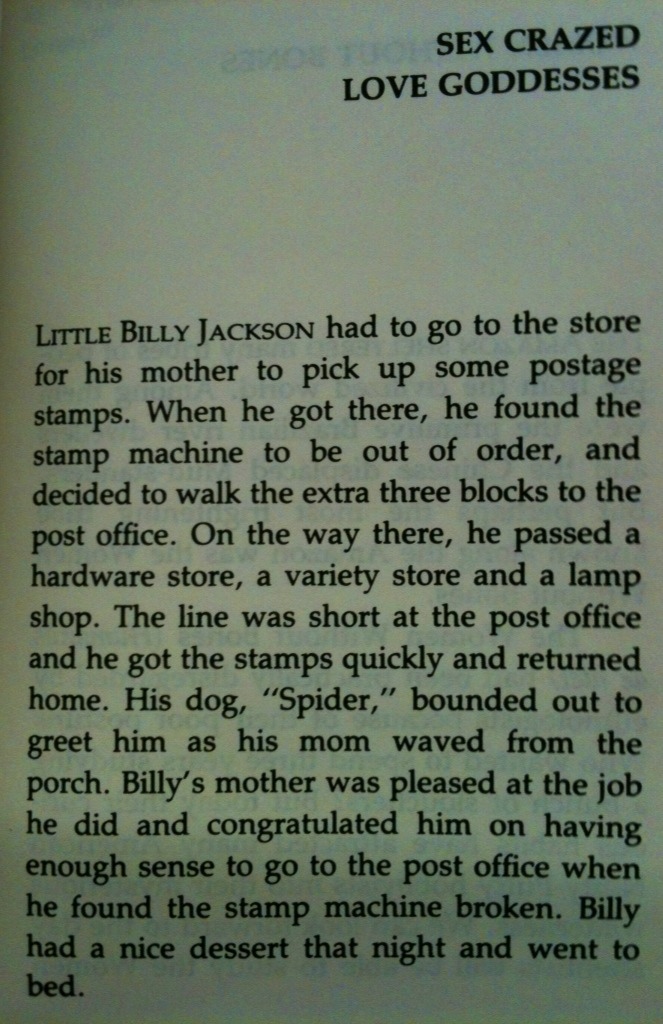
“Sex Crazed Love Goddesses” — Steve Martin

20120404-185250.jpg

(From Cruel Shoes).

The Opening of the Fifth Seal — El Greco

Books Acquired, 3.19.2012 — Or, Here’s What’s New From Picador

20120403-153037.jpg

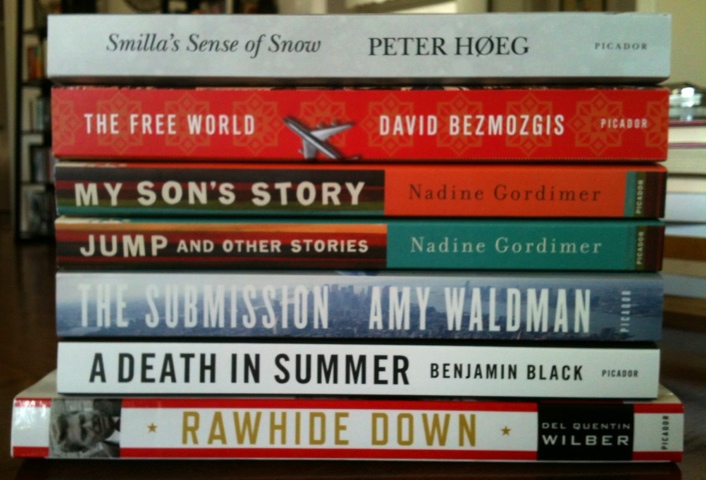
New and newish titles from the good people at Picador. A few highlights:

20120403-153044.jpg

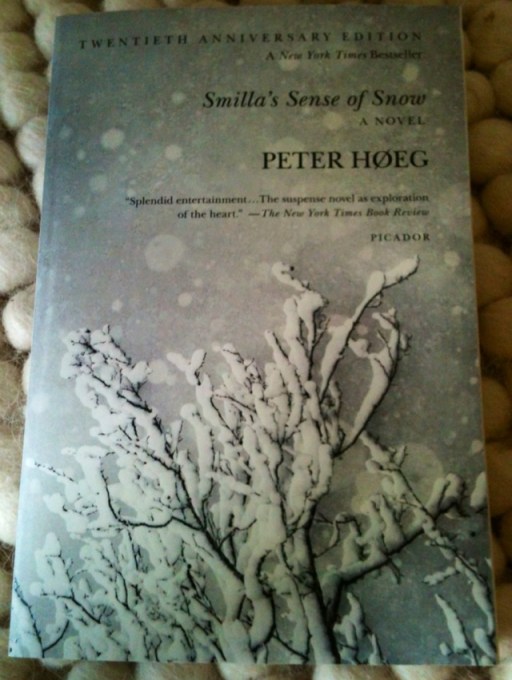
I read Peter Hoeg’s bestseller Smilla’s Sense of Snow over a decade ago; I recall reading it in a day or two, maybe as part of a long bus ride somewhere, and enjoying caustic Smilla’s murder investigation. It’s 20 years old now and getting the rerelease treatment. From Robert Nathan’s original 1993 review at The New York Times:

TRY this for an offer you could easily refuse. How would you like to be locked in a room for a couple of days with an irritable, depressed malcontent who also happens to be imperiously smart, bored and more than a little spoiled? Say no, and you will miss not only a splendid entertainment but also an odd and seductive meditation on the human condition. With “Smilla’s Sense of Snow,” his American debut following two previous books, the Danish novelist Peter Hoeg finds his own uncommon vein in narrative territory worked by writers as varied as Martin Cruz Smith and Graham Greene — the suspense novel as exploration of the heart. Mr. Hoeg’s heroine, Smilla Jaspersen, is the daughter of an Eskimo mother who was a nomadic native of Greenland and a wealthy Danish anesthesiologist father, parentage that endows her with the resilience of the frozen north and urban civilization’s existential malaise. One day just before Christmas, Smilla arrives at her Copenhagen apartment building to find a neighbor boy, 6-year-old Isaiah Christiansen, sprawled face down in the snow, dead after a fall from the roof of a nearby warehouse.

20120403-153052.jpg

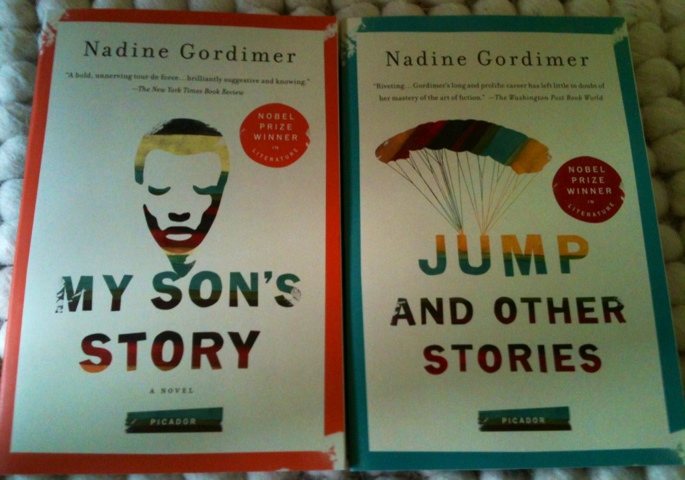
Love love love the covers for these pair by Nadine Gordimer—nice design work. I haven’t read Gordimer’s stuff — she’s a South African writer who won the Nobel in 1991 — so Jump and Other Stories seems like a good starting place. Here’s James Wood on Gordimer:

Gordimer’s talent is poetic and intellectual…Her best writing, sensuous, but aerated with deep intelligence, moving shrewdly between the serene claims of the poetic and the frantic compulsions of the political, makes her the lyrical analyst of an entire country

20120403-153103.jpg

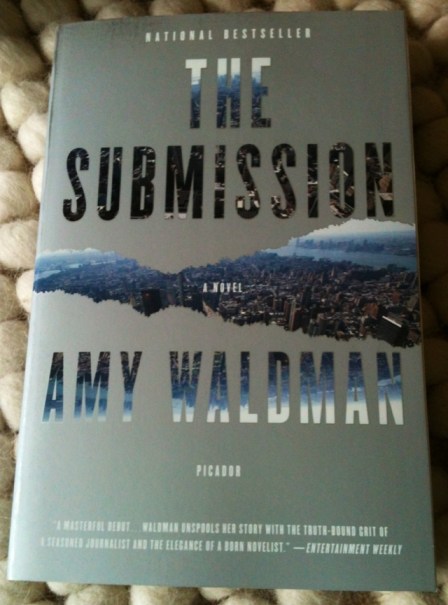
Amy Waldman’s The Submission is a 9/11 novel. Here’s Michiko Kakutani gushing in The New York Times:

A decade after 9/11, Amy Waldman’s nervy and absorbing new novel, “The Submission,” tackles the aftermath of such a terrorist attack head-on. The result reads as if the author had embraced Tom Wolfe’s famous call for a new social realism — for fiction writers to use their reporting skills to depict “this wild, bizarre, unpredictable, Hog-stomping baroque country of ours” — and in doing so, has come up with a story that has more verisimilitude, more political resonance and way more heart than Mr. Wolfe’s own 1987 best seller, “The Bonfire of the Vanities.”

20120403-153120.jpg

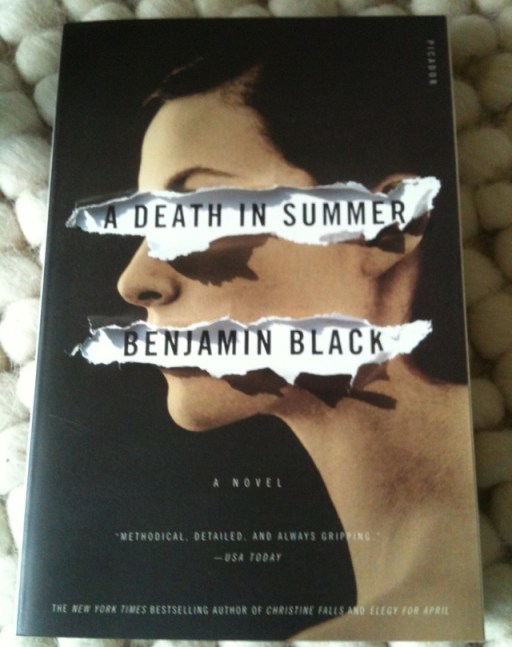
A Death in the Summer is new in trade paperback. It’s another in the Quirke crime series from Benjamin Black — pen name of writer John Banville. Jacket copy:

On a sweltering summer afternoon, newspaper tycoon Richard Jewell—known to his many enemies as Diamond Dick—is discovered with his head blown off by a shotgun blast. But is it suicide or murder? For help with the investigation, Detective Inspector Hackett calls in his old friend Quirke, who has unusual access to Dublin’s elite.

Jewell’s coolly elegant French wife, Françoise, seems less than shocked by her husband’s death. But Dannie, Jewell’s high-strung sister, is devastated, and Quirke is surprised to learn that in her grief she has turned to an unexpected friend: David Sinclair, Quirke’s ambitious assistant in the pathology lab at the Hospital of the Holy Family. Further, Sinclair has been seeing Quirke’s fractious daughter Phoebe, and an unlikely romance is blossoming between the two. As a record heat wave envelops the city and the secret deals underpinning Diamond Dick’s empire begin to be revealed, Quirke and Hackett find themselves caught up in a dark web of intrigue and violence that threatens to end in disaster.

Tightly plotted and gorgeously written, A Death in Summer proves to the brilliant but sometimes reckless Quirke that in a city where old money and the right bloodlines rule, he is by no means safe from mortal danger.

20120403-153135.jpg

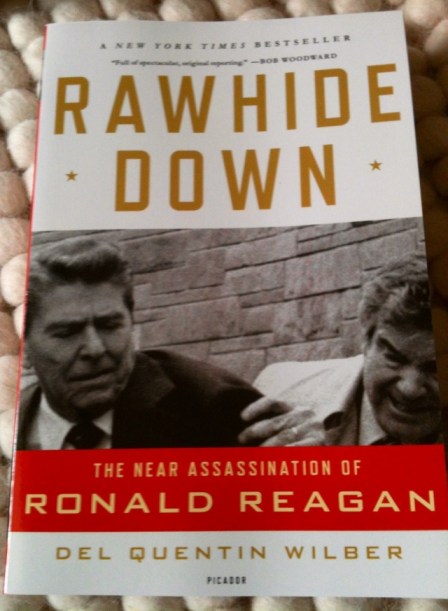
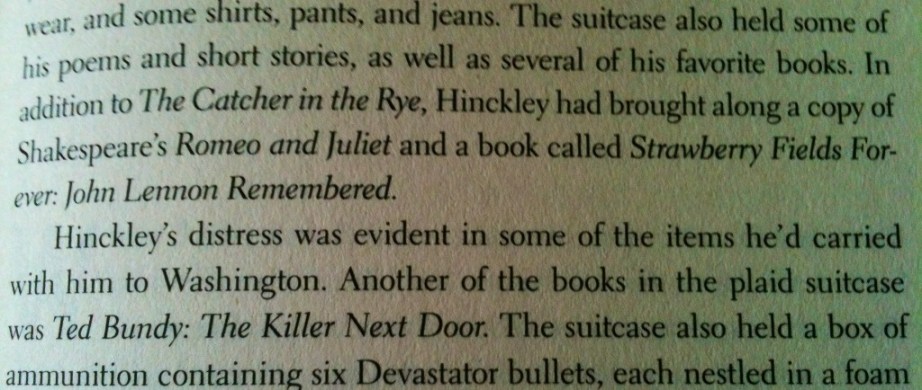
Del Quentin Wilber’s Rawhide Down: The Near Assassination of Ronald Reagan demanded more of my attention than I thought it would. It’s tightly paced book, telegraphed in sharp language—but most of all, the story of John Hinckley is just too bizarre. Here’s a sample of the would

20120403-153153.jpg

And if that’s not weird enough for you, check out Hinckley’s fantasy life:

20120403-153208.jpg

The Lamp — Roman Polanski

Trapper’s Wedding — Walt Whitman

I saw the marriage of the trapper in the open air in the far west,
the bride was a red girl,
Her father and his friends sat near cross-legged and dumbly smoking,
they had moccasins to their feet and large thick blankets
hanging from their shoulders,
On a bank lounged the trapper, he was drest mostly in skins, his luxuriant
beard and curls protected his neck, he held his bride by the hand,
She had long eyelashes, her head was bare, her coarse straight locks
descended upon her voluptuous limbs and reach’d to her feet.

—Walt Whitman, Song of Myself, section 10.

21 Citations on Pablo Picasso — David Markson

Pablo Picasso, Les Demoiselles d'Avignon, oil on canvas, 1907 (MoMA)

Painting is not done to decorate apartments –PICASSO

People speak of naturalism in opposition to modern painting.
Where and when has anyone ever seen a natural work of art?
Asked Picasso.

Depressed at the apparent lack of interest in one of his early still lifes, Matisse visited his dealer to retrieve it, only to learn that it had been purchased after all.
By Picasso.

The interrelationship of Picasso and Braque during Cubism:
Like being roped together on a mountain, Braque said.

The oddity that Velazquez and Picasso, surely two of the three greatest Spanish-born painters, each used his mother’s name rather than his father’s.

Among the many paintings in her Paris flat, Gertrude Stein had two exceptional Picassos.
If there were a fire, and I could save only one picture, it would be those two. Unquote.

The Bateau-Lavoir, the legendary former Montmartre piano factory broken up into artists’ studios, where Picasso contrived any number of his early masterpieces — while living with no running water and only one communal toilet.

The so-called anarchist artist who in 1988 smeared a large X in his own blood on a wall in the Museum of Modern Art — and in the process splattered an adjacent Picasso.

Picasso. Cézanne. Matisse. Braque. Bonnard. Renoir.
All of whom painted portraits of Ambroise Vollard.

Cartier-Bresson. Brassaï. Man Ray. Lee Miller. Robert Doisneau. Robert Capa. David Douglas Duncan. Cecil Beaton.
All of whom photographed Picasso.

Picasso’s play, Desire Caught by the Tail — which could be performed for the first time only privately, because of the Nazi occupation of Paris.
But avec Camus, Sartre, Michel Leiris, Raymond Queneau, Dora Maar, Pierre Reverdy, Simone de Beauvoir.

There is no such thing as abstract art, said Picasso.
You always have to start somewhere or other.

Gertrude Stein once delighted Picasso by reporting that a collector had been dumbfounded, years afterward, to hear that Picasso had given her her portrait as a gift, rather than asking payment.
Not understanding that that early in Picasso’s career, the difference had been next to negligible.

You never paint the Parthenon; you never paint a Louis XV armchair. You make pictures out of some little house in the Midi, a packet of tobacco, or an old chair.
Said Picasso.

Future generations will regard Bob Dylan with the awe reserved for Blake, Whitman, Picasso and the like.
Said an otherwise seemingly rational writer named Jonathan Lethem.

Picasso, avec laughter, after being asked if he had used models for Les Demoiselles d’Avignon:
Where would I have found them?

Picasso’s admiration for Charlie Chaplin.
Diego Rivera’s.
Stalin’s.

Kees van Dongen’s admission that there were occasions during his own early Montmartre years when he was forced to filch milk and/or bread from neighborhood doorsteps — with an accomplice named Picasso.

Picasso, in Paris during the Nazi occupation and learning that someone had accused him of having Jewish blood:
I wish I had.

A rejection of all that civilization has done.
Said the London Times of a first Post-Impressionist exhibition, in 1910 — which included Cézanne, van Gogh, Gauguin, Matisse, Picasso, others.

My old paintings no longer interest me. I’m much more curious about those I haven’t done yet.
Said Picasso, at seventy-nine.

From David Markson’s The Last Novel

Ray Harryhausen Discusses His Collection of John Martin Engravings

Birdseed Anecdote — F. Scott Fitzgerald

Once there was a whole lot of bird seed around the room because an author had adopted a chicken. It was impossible to explain to anyone just why he had adopted the chicken but still more impossible to know why he had bought the bird seed for the chicken. The chicken was later broiled and the bird seed thrown out, but the question of whether the man was an author or a lunatic was still unsolved in the minds of the hotel servants who had to deal with the situation. The hotel servants didn’t understand it. They didn’t understand how months later the author could write a story about it but they all bought the magazine.

—F. Scott Fitzgerald, The Notebooks

Charlie Chaplin’s Eating Machine (Modern Times)

Excursion into Philosophy — Edward Hopper