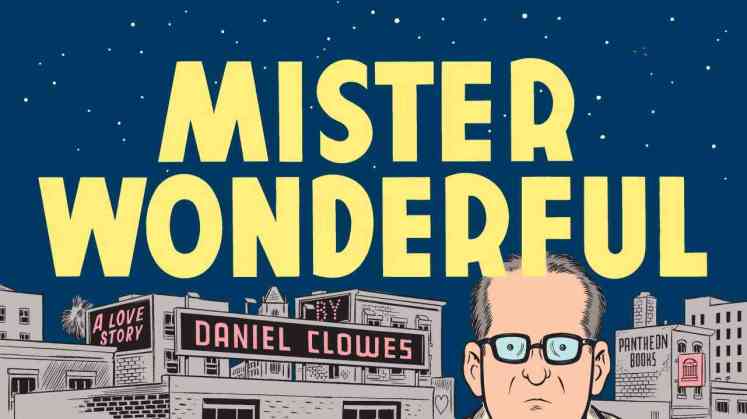
Mister Wonderful — Daniel Clowes

There’s an unexpected sweetness to Mister Wonderful, the latest work from Daniel Clowes (new in hardback from Pantheon). Sure, we’re still deep in Clowes territory here, with misanthropic protagonist Marshall offering up acerbic observations on wealthy yuppies, phony poseurs, and jerks on cell phones—all shot through a lens of self-loathing—but Mister Wonderful (subtitled A Love Story) is optimistic, a study in possibility that never tips over the sheer cliff of despair on the other side of romanticism. With its sense of balance, both emotional and narrative, Mister Wonderful is in some way the “good twin” to last year’s Wilson, a work that pointed to the illusory nature of growth and the futility of human connection.

Where Wilson measured the life of its eponymous protagonist over decades (and in extreme hyperbole) as he sought to regain contact with his estranged family, Mister Wonderful  covers just a few hours in the life of Marshall, a sad man set up on a blind date with nutty Natalie, a woman he immediately pegs as way out of his league. Marshall quickly romanticizes the possibility of a life with Natalie, struggling to keep his composure throughout their coffee and dinner date.
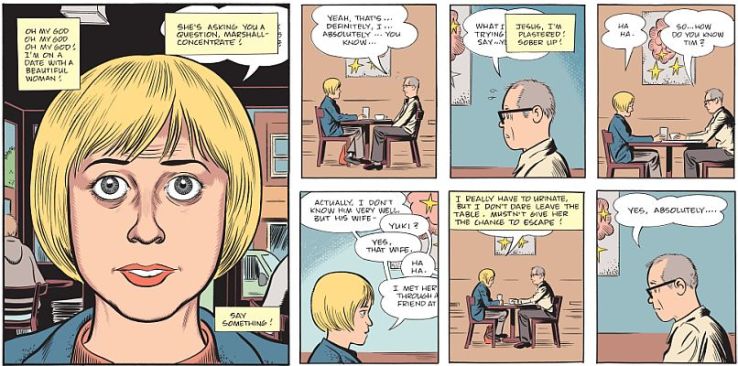
Natalie curtails the date to go to a party with old friends, but a surprise (violent) encounter allows Marshall a sliver of heroism—and a chance for more time with Natalie. They head to the party together, only to run into Natalie’s ex-boyfriend, giving Clowes plenty of oomph for a strong third act.

There’s a cinematic scope to Mister Wonderful. The book is 11″ x 6″, and Clowes makes excellent use of his Sunday’s comic page dimensions, exhibiting a level of detail and precision that imbue in Mister Wonderful an air of realism (one that contrasts the cartoony elements of evil twin Wilson). Clowes’s artistic powers are refined, balanced, and agile; he displays a command of color and shape that help define the strange emotional contours of Mister Wonderful, a book about second chances and those rare moments our interior lives might sync unexpectedly with the concrete possibilities life affords us.

Mister Wonderful is funny and balanced, but it’s not for everyone, including some longtime Clowes fans who might quibble with the book’s apparent slightness. Mister Wonderful clocks in at 80 pages, and while some readers may feel shortchanged, perhaps they are overlooking the scope of the work. Clowes is at the height of his powers here, deftly controlling a spare story about  midlife tumult. There’s maturity and depth in this graphic novella. “Novella” isn’t the right term—Mister Wonderful is closer to a long short story, expertly told. Clowes still exhibits some of the sharp, mean edges that marked his earlier work, but the points are more finely honed, more subtle and precise. Some of the erratic weirdness we find in Clowes’s early stuff isn’t on display here, but this is more on account of Clowes’s stronger command of his medium’s formal elements. The bizarre, cynical spirit remains, however. Thankfully, Clowes makes no attempt to redeem his weirdos, nor does he push them into an unearned, false conclusion. Instead, Mr. Wonderful presents their problems and hang-ups and shortcomings as very real, even as it suggests a tint of unironic optimism. Recommended.
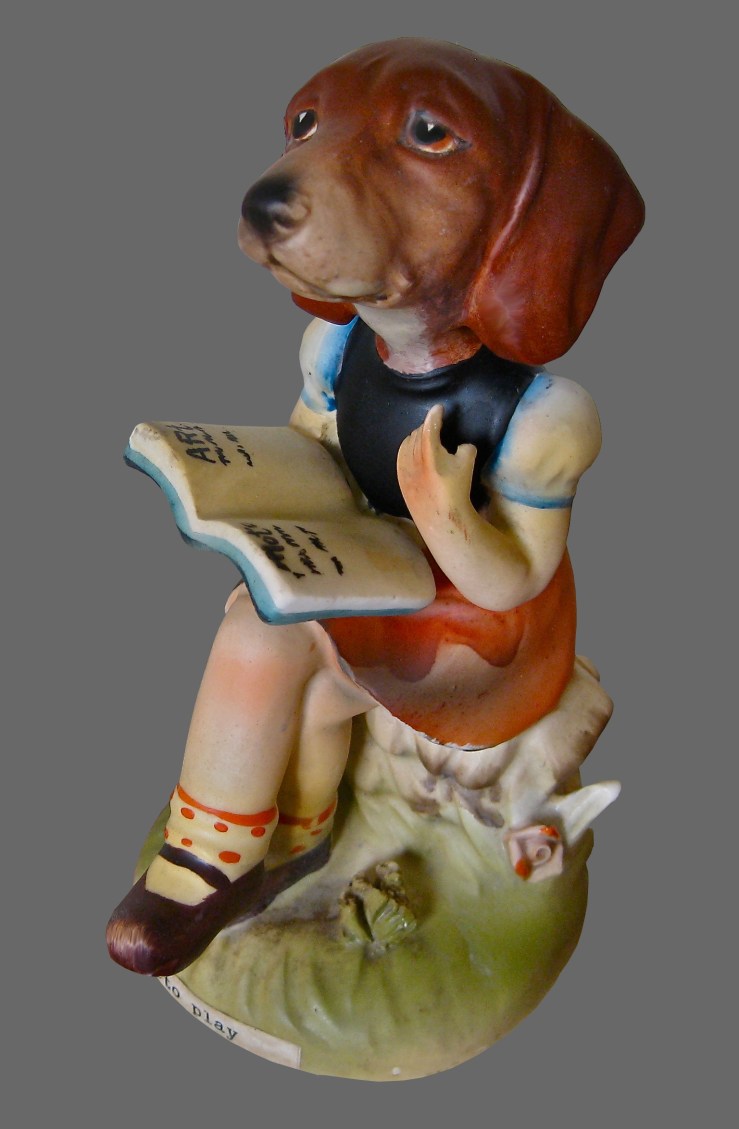
Dachshund Marveling at Joan Didion’s Mastery of the One-Word Sentence — Click Mort

(More and more).

“What Would Socrates Say?” — Woody Allen Attempts Syllogistic Logic

The Triple Hecate — William Blake

“The Mice” — Lydia Davis

“The Mice” a very short story by Lydia Davis (read our review of The Collected Stories of Lydia Davis)—

Mice live in our walls but do not trouble our kitchen. We are pleased but cannot understand why they do not come into our kitchen where we have traps set, as they come into the kitchens of our neighbors. Although we are pleased, we are also upset, because the mice behave as though there were something wrong with our kitchen. What makes this even more puzzling is that our house is much less tidy than the houses of our neighbors. There is more food lying about in our kitchen, more crumbs on the counters and filthy scraps of onion kicked against the base of the cabinets. In fact, there is so much loose food in the kitchen I can only think the mice themselves are defeated by it. In a tidy kitchen, it is a challenge for them to find enough food night after night to survive until spring. They patiently hunt and nibble hour after hour until they are satisfied. In our kitchen, however, they are faced with something so out of proportion to their experience that they cannot deal with it. They might venture out a few steps, but soon the overwhelming sights and smells drive them back into their holes, uncomfortable and embarrassed at not being able to scavenge as they should.

Willem de Kooning on Painting Women

“Mr. Brain” — Russell Edson

“Mr. Brain,” something by Russell Edson

 Mr Brain was a hermit dwarf who liked to eat shellfish off the moon. He liked to go into a tree then because there is a little height to see a little further, which may reveal now the stone, a pebble–it is a twig, it is nothing under the moon that you can make sure of.

So Mr Brain opened his mouth to let a moonbeam into his head.

Why to be alone, and you invite the stars to tea. A cup of tea drinks a luminous guest.

In the winter could you sit quietly by the window, in the evening when you could have vinegar and pretend it to be wine, because you would do well to eat doughnuts and pretend you drink wine as you sit quietly by the window. You may kick your leg back and forth. You may have a tendency to not want to look there too long and turn to find darkness in the room because it had become nighttime.

Why to be alone. You are pretty are you not/you are as pretty as you are not, or does that make sense.

You are not pretty, that is how you can be alone. And then you are pretty like fungus and alga, you are no one without some one, in theory alone.

Be good enough to go to bed so you can not think too much longer.

Marilyn Reads Whitman

(Via. See also and also).

“A Strange Kind of Slavery” — David Foster Wallace on Individuality, Corporatism, and Civic Responsibility

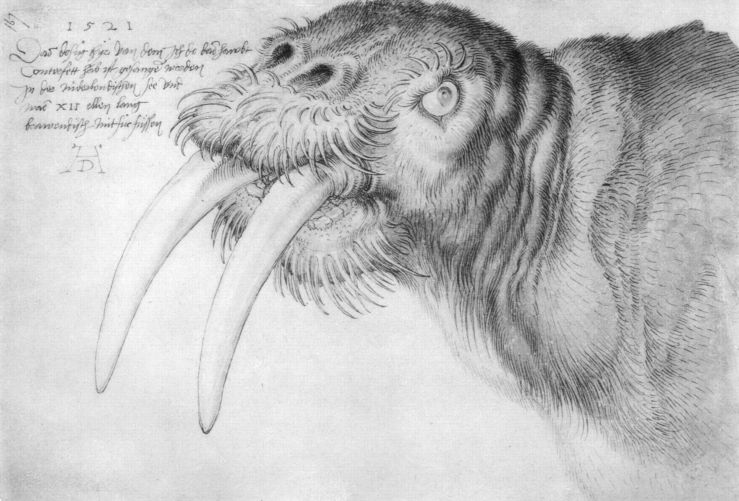
Head of a Walrus — Albrecht Dürer

“Quickly Aging Here” — A Poem by Denis Johnson

“Quickly Aging Here,” a poem by Denis Johnson—

1


nothing to drink in
the refrigerator but juice from
the pickles come back
long dead, or thin
catsup. i feel i am old


now, though surely i
am young enough? i feel that i have had
winters, too many heaped cold


and dry as reptiles into my slack skin.
i am not the kind to win
and win.
no i am not that kind, i can hear


my wife yelling, “goddamnit, quit
running over,” talking to
the stove, yelling, “i
mean it, just stop,” and i am old and
2


i wonder about everything: birds
clamber south, your car
kaputs in a blazing, dusty
nowhere, things happen, and constantly you


wish for your slight home, for
your wife’s rusted
voice slamming around the kitchen. so few


of us wonder why
we crowded, as strange,
monstrous bodies, blindly into one
another till the bed


choked, and our range
of impossible maneuvers was gone,
but isn’t it because by dissolving like so
much dust into the sheets we are crowding


south, into the kitchen, into
nowhere?

Robert Rauschenberg Tells the Story Behind Erased de Kooning

“There’s That Rainy Day” — Wes Montgomery

Erased de Kooning Drawing — Robert Rauschenberg

Frank Miller, Fascist Mouthpiece, Is a Cranky Old Hack

A few years ago on this blog, I re-evaluated some of Frank Miller’s work, set against his fervent, blind support of the Bush wars. Today, I read a vitriolic rant by Miller, posted at his blog, where he offers the following clumsy thesis—

The “Occupy” movement, whether displaying itself on Wall Street or in the streets of Oakland (which has, with unspeakable cowardice, embraced it) is anything but an exercise of our blessed First Amendment. “Occupy” is nothing but a pack of louts, thieves, and rapists, an unruly mob, fed by Woodstock-era nostalgia and putrid false righteousness. These clowns can do nothing but harm America.

Miller offers no evidence about how or why the OWS protesters will “harm America,” nor does he support his claim that the protests are “anything but an exercise of our blessed First Amendment.” Honestly, I can’t even tell if Miller is being sarcastic when he writes “blessed” to describe the First Amendment, which clearly states that the citizens of this country have a right to assemble. Most Americans support the OWS movement, or at least the spirit of the movement, even if they do not agree with all of the tactics or, um, fashion sense and personal hygiene habits of the group. But Miller, furious reactionary that he is, does not bother once to consider a single idea put forth by OWS. He cannot see past the personal attire and fashion sense of some of the protesters, writing that the movement is nothing “more than an ugly fashion statement by a bunch of iPhone, iPad wielding spoiled brats who should stop getting in the way of working people and find jobs for themselves.” Those kids with their iPhones!

In a baffling move of obscure non-logic, Miller then connects OWS to his “enemies,” those nefarious (if nebulous) forces “al-Qaeda and Islamicism.” The piece ends with this disingenuous call to action—

In the name of decency, go home to your parents, you losers. Go back to your mommas’ basements and play with your Lords Of Warcraft. Or better yet, enlist for the real thing. Maybe our military could whip some of you into shape.

Miller of course never served in any branch of the armed forces. He also has never heard of/chooses to ignore clear evidence that veterans are part of this movement, including Scott Olsen, who was badly injured by police in Oakland.

Since Frank is so frank, let’s all be frank: Frank Miller is a tedious, ill-informed, rage-choked hack who hasn’t produced a great work in over two decades.

Even worse, he’s a fascist.

Miller’s early work in the 1980s repeatedly pointed toward the essential conflict of individual versus society; his heroes and anti-heroes constantly found themselves squaring off against corrupt totalitarian systems that sought to silence dissent and curtail civil liberties. As Miller’s career fumbled along, he increasingly endorsed the underlying fascistic elements present in his vigilante heroes, a fascism wed to an image of the hero as a man whose uncompromising ideals—and uncomplicated misunderstandings of a complex world—inevitably lead to brutal violence. See, for example, Miller’s most recent effort, Holy Terror, an extremely poorly received piece of anti-Muslim propaganda, reviled by comic book audiences not entirely because of its ideological content, but also because of its poor execution. (For a detailed and insightful take-down of Miller’s pulp trash, read Spencer Ackerman’s review in Wired).

Miller is a reactionary crank, a regressive thinker who is terrorized by the idea that the America “he knows” is no longer the homogeneous ideal that it once was. Of course, America was never an idealized homogeneous space, but that doesn’t matter. That’s what fantasy is for. And Miller is a professional fantasist. His derangement evinces not just in his reactionary vitriol toward the OWS protesters, but also in his apparent fear of the technology that these “iPhone, iPad wielding spoiled brats” use to disseminate their message.

Take note that never once in his screed does Miller attempt to paraphrase, analyze, refute, address, or otherwise actually engage that message. Presumably he can’t; he can’t hear it. Like one of the flat characters in his comics, perhaps Miller’s own interior monologue edges out all other voices, reinforcing his own paranoid delusions that “others” are lurking in the shadows, ready to take away the precious freedoms and ideals that only he can understand and value.

One is tempted to point out that Ezra Pound, G.B. Shaw, and Virginia Woolf, among other modernists, supported fascism, that Heidegger was a member of the Nazi party, and yet these artists and thinkers maintain a canonical place to this day in their respective fields. Will history be so kind to Miller? This is an earnest question. Certainly The Dark Knight Returns is a singular work in the superhero comics genre. But works like Holy Terror will do little to preserve the reputation of the man behind the Robocop sequels and The Spirit movie. Great art will survive the straining force of history, but I do not think that Miller is a great artist. He’s just a loud, angry cartoonist with ugly, unfounded, illogical opinions—and I think that that is what history will show.

Book Acquired, 11.14.2011

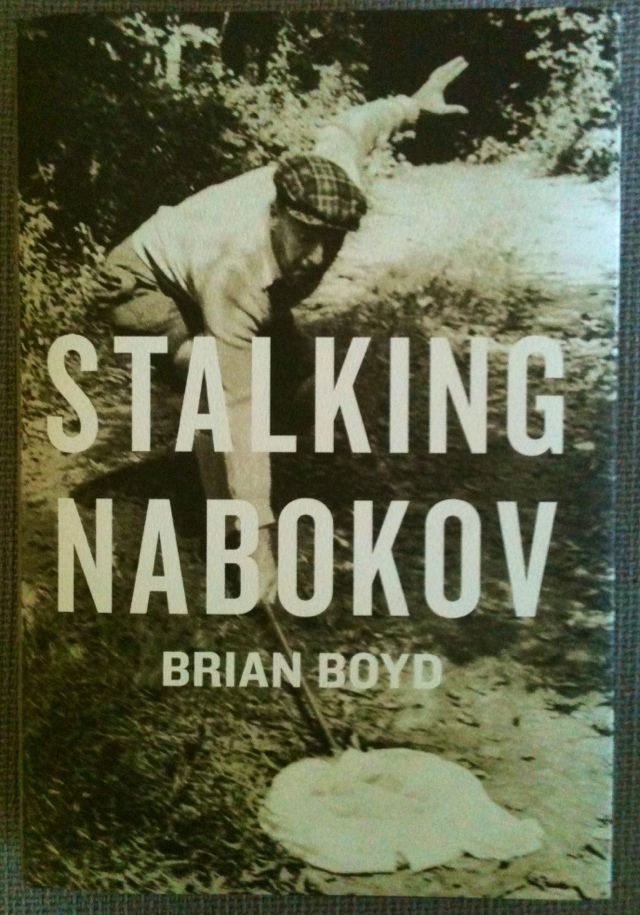
20111112-164308.jpg

Stalking Nabokov by Brian Boyd. Publisher Columbia UP’s description—

At the age of twenty-one, Brian Boyd wrote a thesis on Vladimir Nabokov that the famous author called “brilliant.” After gaining exclusive access to the writer’s archives, he wrote a two-part, award-winning biography, Vladimir Nabokov: The Russian Years (1990) and Vladimir Nabokov: The American Years (1991). This collection features essays written by Boyd since completing the biography, incorporating material he gleaned from his research as well as new discoveries and formulations.

Boyd confronts Nabokov’s life, career, and legacy; his art, science, and thought; his subtle humor and puzzle-like storytelling; his complex psychological portraits; and his inheritance from, reworking of, and affinities with Shakespeare, Pushkin, Tolstoy, and Machado de Assis. Boyd offers new ways of reading Nabokov’s best English-language works: LolitaPale FireAda, and the unparalleled autobiography, Speak, Memory, and he discloses otherwise unknown information about the author’s world. Sharing his personal reflections, Boyd recounts the adventures, hardships, and revelations of researching Nabokov’s biography and his unusual finds in the archives, including materials still awaiting publication. The first to focus on Nabokov’s metaphysics, Boyd cautions against their being used as the key to unlock all of the author’s secrets, showing instead the many other rooms in Nabokov’s castle of fiction that need exploring, such as his humor, narrative invention, and psychological insight into characters and readers alike. Appreciating Nabokov as novelist, memoirist, poet, translator, scientist, and individual, Boyd helps us understand more than ever the author’s multifaceted genius.

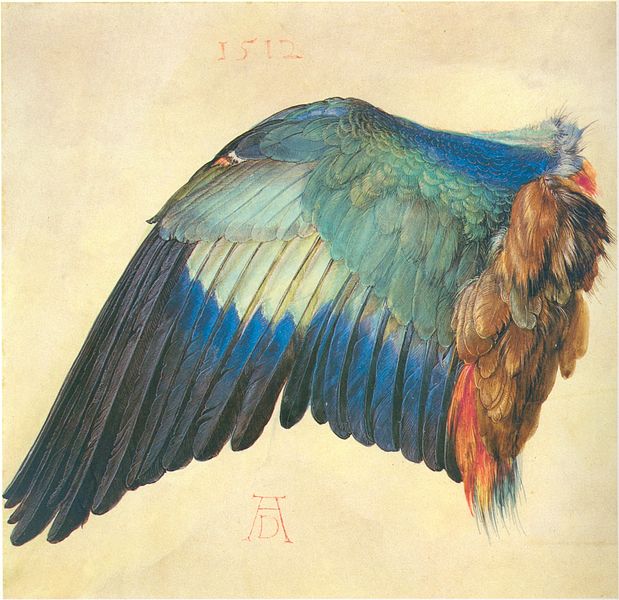
Wing of a Blue Roller — Albrecht Dürer