Frank Herbert Talks About Dune (Video)

Hunter S. Thompson Talks About Trying to Get The Rum Diary Published

Books Removed from Stack, 10.07.2011

20111006-144432.jpg

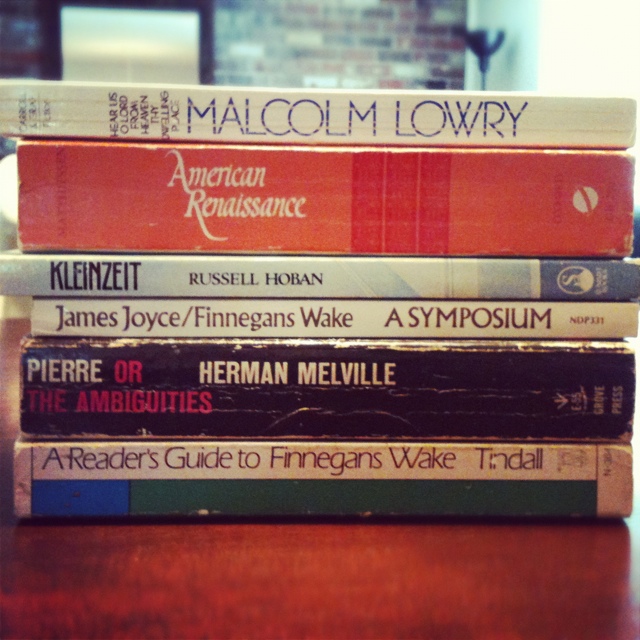
Summer wanes into fall; time to clean out the stack of books in my nightstand. Most volumes were permitted to stay, but I’m going to go ahead and find shelf space for these fellows.

The Lowry book, Hear Us O Lord from Heaven Thy Dwelling Place collects short stories and other writings. It’s a muddled, unfinished affair, and I muddled through not very much of it, leaving it unfinished.

F.O. Matthiessen’s American Renaissance: Art and Expression in the Age of Emerson and Whitman is full of insight and keen writing, but its voluminous scope and long essays kept making me wonder why I wasn’t just reading Hawthorne and Melville themselves. No knock on lit crit, but it seems wiser to spend reading time on the originals.

Speaking of Melville—I gave his incest novel Pierre another (third?) serious shot this summer, influenced by the Matthiessen, I guess. No go. Got distracted. It’s long.

I did finish Kleinzeit by Russell Hoban, a baffling schizophrenic novel that has thwarted every attempt of mine to review it. Here’s a review: it’s a strange, funny novel, a cult novel without a big enough cult.

I read several of the essays in A Symposium (ones by Beckett and William Carlos Williams), as well as the letters it includes (attacking Finnegans Wake) and Sylvia Beach’s reluctant intro. An interesting book but sometimes dry. Its inclusion, along with Tindall’s A Reader’s Guide to Finnegans Wake remind me of the brave week I spent trying to get a handle on Joyce’s language vortex. For whatever reason, I left the Wake in the stack. A dare? A dare.

1937 Orson Welles Screen Test (No, He Did Not Get the Part)

Book Acquired, 10.06.2011

20111006-144405.jpg

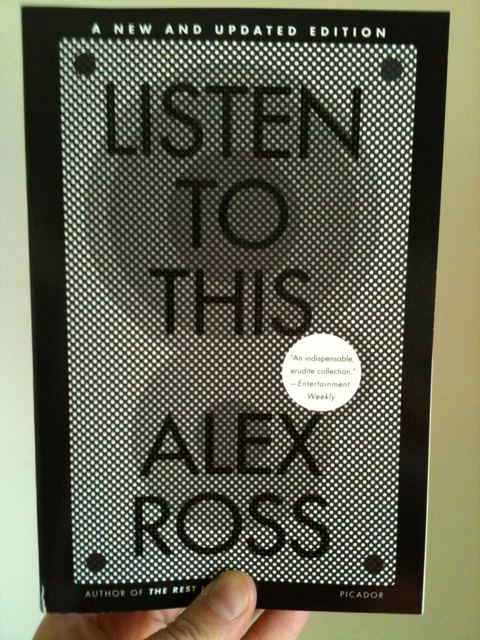
Listen to This by Alex Ross. Publisher Picador’s description—

Listen to This—which collects Alex Ross’s finest writing for The New Yorker since 1994—is the rare book that moves across the entire landscape of music, from classical to rock and back again.  In this series of lively, erudite essays, Ross tells of his own late-blooming discovery of pop, and of how contemporary sounds relate to centuries of musical tradition.  He vividly sketches canonical composers such as Schubert, Verdi, and Brahms; gives us in-depth interviews with modern pop masters such as Björk and Radiohead; and, in a previously unpublished essay, he brilliantly retells hundreds of years of music history—from Renaissance dances to Led Zeppelin—through a few iconic bass lines of celebration and lament. Witty, passionate, and brimming with insight, Listen to This shows how music expresses the full complexity of the human condition.

Portrait of Freud — Salvador Dali

Swedish Poet Tomas Tranströmer Wins the Nobel Prize in Literature

From the Nobel committee–

The Nobel Prize in Literature for 2011 is awarded to the Swedish poet Tomas Tranströmer “because, through his condensed, translucent images, he gives us fresh access to reality”.

Here’s Tranströmer’s “After a Death,” translated by Robert Bly—

Once there was a shock
that left behind a long, shimmering comet tail.
It keeps us inside. It makes the TV pictures snowy.
It settles in cold drops on the telephone wires.

One can still go slowly on skis in the winter sun
through brush where a few leaves hang on.
They resemble pages torn from old telephone directories.
Names swallowed by the cold.

It is still beautiful to hear the heart beat
but often the shadow seems more real than the body.
The samurai looks insignificant
beside his armor of black dragon scales.

“Steinbeck Is Sincere” — William T. Vollmann on East of Eden

William Vollmann writes about John Steinbeck’s East of Eden (excerpted from Imperial via Expelled from Eden)—

The book of his which I admire the most is East of Eden. For a decade now the character of Kate, whom some critics find unconvincing has haunted my head; she’s horrific, she’s pathetic, she’s steady and successful and lonely; she is perfectly what she is. The retelling of the Cain and Abel story is brilliant, the landscape descriptions lovely and lush, the plotting as careful and convincing as the best of George Eliot. And of course there’s a message, a flaw, personified by a Chinese servant who tells us, sometimes at great length, what to think. But Lee has never annoyed me. He speechifies intelligently, at times wittily, and sometimes compassionately. Do I care that nobody I’ve ever met talks like that? He is sincere because Steinbeck is sincere. And this is what I love about Steinbeck most of all, his sincerity.

Agnostic Symbol — Salvador Dali

“The Best Reader Is One Who Is Most Open to Human Possibility” — Don DeLillo

From a 1982  NYT profile of Don DeLillo. DeLillo talks Pynchon, Gaddis, and reader responsibility.

THE writer to whom Mr. DeLillo has most often been likened and for whom he has great respect is Thomas Pynchon. ”Somebody quoted Norman Mailer as saying that he wasn’t a better writer because his contemporaries weren’t better,” he says. ”I don’t know whether he really said that or not, but the point I want to make is that no one in Pynchon’s generation can make that statement. If we’re not as good as we should be it’s not because there isn’t a standard. And I think Pynchon, more than any other writer, has set the standard. He’s raised the stakes.”

Mr. DeLillo also praises William Gaddis for extending the possibilities of the novel by taking huge risks and making great demands on his readers. Yet many readers complain about the abstruseness of much contemporary writing.

”A lot of characters,” Mr. DeLillo says, ”have become pure act. The whole point in certain kinds of modern writing is that characters simply do what they do. There isn’t a great deal of thought or sentiment or literary history tied up in the actions of characters. Randomness is always hard to absorb.”

Mr. DeLillo believes that it is vital that readers make the effort. ”The best reader,” he says, ”is one who is most open to human possibility, to understanding the great range of plausibility in human actions. It’s not true that modern life is too fantastic to be written about successfully. It’s that the most successful work is so demanding.” It is, he adds, as though our better writers ”feel that the novel’s vitality requires risks not only by them but by readers as well. Maybe it’s not writers alone who keep the novel alive but a more serious kind of reader.”

I’m Here — Spike Jonze

(A Very Beautiful) Book Acquired, 9.27.2011

20111004-142338.jpg

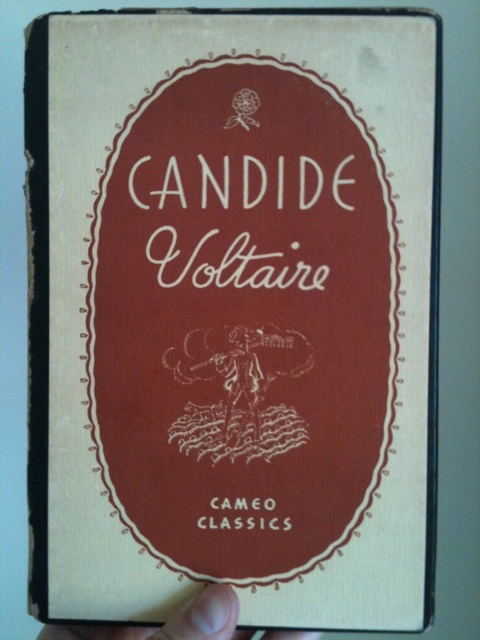
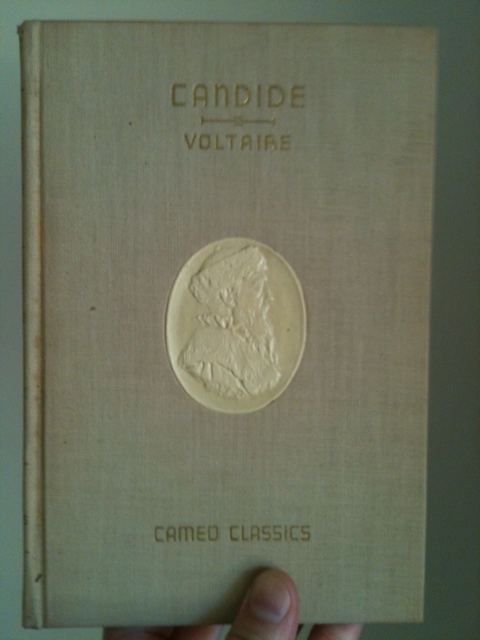
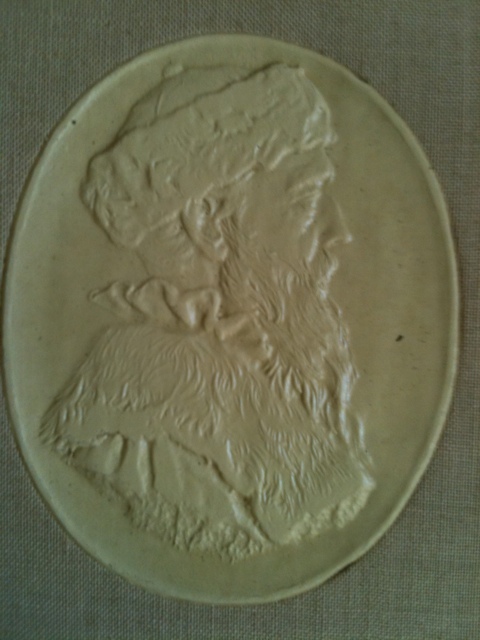
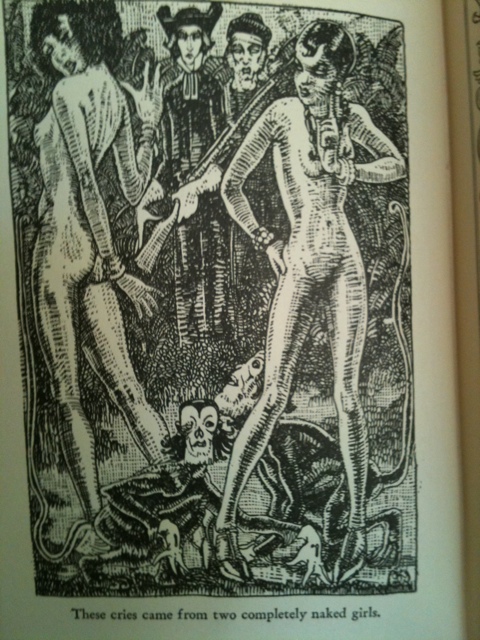
What a wonderful present: a 1930 Grosset & Dunlap edition Candide (read our review of Candide). Received it last week, but I’ve been to busy to photograph it. Has a nice slipcase (above), and the cover sports a tactile cameo of Gutenberg in profile—

20111004-142346.jpg

20111004-142354.jpg

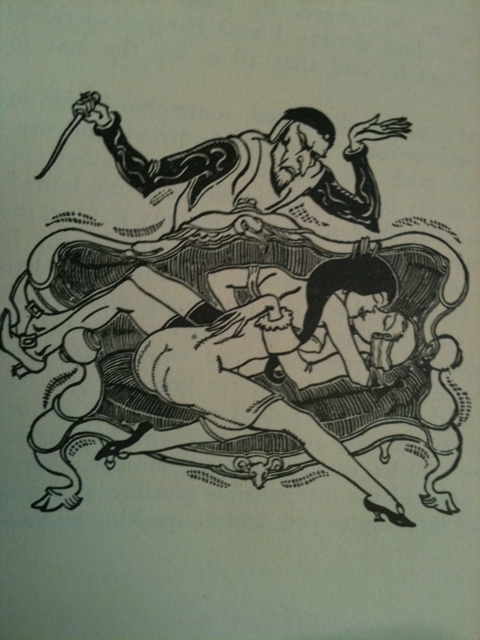
Illustrations are by Mahlon Blaine, and inevitably involve sex and/or violence—like this one below—

20111004-143419.jpg

There a number of handsome full page illustrations as well. Just lovely.

20111004-143428.jpg

Nobel Lit Odds, 10.04.2011

Via The New Yorker’s Book Bench blog, current odds (and yeah, we know, they change) from Ladbrokes for the 2011 Nobel Prize in Literature (the oddsmaker’s name is Magnus Puke, by the by).

Adonis (Syria): 4/1
Tomas Tranströmer (Sweden): 7/1
Haruki Murakami (Japan): 8/1
Bob Dylan (U.S.): 10/1
Assia Djebar (Algeria): 12/1
Peter Nadas (Hungary): 12/1
Ko Un (South Korea): 14/1
Les Murray (Australia): 16/1
Thomas Pynchon (U.S.): 20/1
Philip Roth (U.S.): 20/1
Nuruddin Farah (Somalia): 20/1

While it’s easy to dismiss literary competitions as trifling or even crass, they do much—particularly high profile ones like the Nobel or the Pulitzer—to augment the readership of these authors, cement the winner’s canonical place, and expose the winner to a larger audience. They also help writers get paid better, which is a good thing.

The odds don’t really mean that much of course—this time last year, Cormac McCarthy was the favorite with an 8:1 lead.

“We Are the Origin of Evil” — Carl Jung on Death, Nihilism, and Humanity

“Religion Would Thus Be the Universal Obsessional Neurosis of Humanity” — Sigmund Freud

From Freud’s The Future of an Illusion, which should be required reading for any thinking person—

We know that a human child cannot successfully complete its development to the civilized stage without passing through a phase of neurosis sometimes of greater and sometimes of less distinctness. This is because so many instinctual demands which will later be unserviceable cannot be suppressed by the rational operation of the child‘s intellect but have to be tamed by acts of repression, behind which, as a rule, lies the motive of anxiety. Most of these infantile neuroses are overcome spontaneously in the cause of growing up, and this is especially true of the obsessional neuroses of childhood. The remainder can be cleared up later still by psycho-analytic treatment. In just the same way, one might assume, humanity as a whole, in its development through the ages, fell into states analogous to the neuroses,‘ and for the same reasons – namely because in the times of its ignorance and intellectual weakness the instinctual renuncia­tions indispensable for man‘s communal existence had only been achieved by it by means of purely affective forces. The precipitates of these processes resembling repression which took place in prehistoric times still remained attached to civilization for long periods. Religion would thus be the universal obsessional neurosis of humanity; like the obsessional neurosis of children, it arose out of the Oedipus complex, out of the relation to the father. If this view is right, it is to be supposed that a turning-away from religion is bound to occur with the fatal inevitability of a process of growth, and that we find our­selves at this very juncture in the middle of that phase of development.