Terrence Malick’s beautiful, moving new film The Tree of Life explores humanity’s need to find metaphysical, spiritual, or psychological solace in a physical, natural, phenomenal world whose God remains silent, if not absent. The film begins by quoting the Book of Job: “Where were you when I laid the earth’s foundation . . . while the morning stars sang together and all the sons of God shouted for joy?” The line is God’s rejoinder to Job’s despair, a non-answer that recalls God’s response to Moses in Exodus when Moses asks his name and he replies: “I am that I am.” God is tautological; there is no analogy, no metaphoricity for God. Similarly, as in Job, it is not for us to understand God’s creation; rather, we are part of its mystery, and part of that mystery is to find meaning against a Darwinian backdrop. Malick’s project in The Tree of Life is to find meaning—but not explanation—through the beauty, grace, and the glory of nature, even as the film acknowledges the violence, injustice, and inconstancy of the natural world, a world that will never directly answer existential questioning.
The film begins with the O’Briens learning that one of their three sons has died. He is only nineteen years old, and the grief of his early death overwhelms his parents; it also casts an ever-present existential gloom over his brother Jack, who will become the ersatz protagonist of the film. Jack (portrayed as an adult by Sean Penn) is an architect in a big city. On a day that seems particularly freighted with significance—perhaps his brother’s birthday or deathday—he is unable to communicate with his wife or colleagues. Through Malick’s trademark interior-monologue whispers, Jack questions God again and again, trying to find meaning in his brother’s death.
In what may or may not be a daydream of Jack’s, the film then undertakes representing the creation of the universe, the expansion of galaxies, the formation of our own planet, and the subsequent life that evolves there. The segment is breathtaking, overwhelming, and worth the price of admission alone. In one shot, a giant dinosaur lies beached; the camera pans to reveal his side bloodied and bitten. The film then cuts to a shot of hammerhead sharks swarming in the deep. This Darwinian depiction is echoed and then contrasted in another shot, as one dinosaur finds another, of a different species, dying on a riverbed. The first dinosaur places his foot over the second’s neck, but then chooses not to kill the dying dinosaur, who struggles for life. There are perhaps two attitudes here toward life, one which is essentially a Nietzschean will-to-power, and the other Jesusian, an impulse born of empathy, identification, and ultimately radical love.
These contrasting ideals are embodied in Mr. and Mrs. O’Brien, and showcased in the next segment of the film, which is likely part of Jack’s memory, or maybe more accurately the idea of Jack’s memory. In a rushing flow of images and music, Malick captures the deep beauty, excitement, and confusion of early life. The episode might find a literary analogy in the early chapters of Joyce’s A Portrait of the Artist as a Young Man, which also attempts to show what early consciousness might be like. Malick’s syntax is typically Malickian, yet it fits its subject better here than it did in The New World or The Thin Red Line. The life of the young family is overwhelming in its natural beauty; however, the context of one of the boy’s impending death begins to throw shadows over the beauty. Thus we have the central apparent philosophical problem of the phenomenal world—what does it mean to die? This question in turn entails another—what does it mean to live?
For Mr. O’Brien, life is a Darwinian contest: “You can’t be too good,” he admonishes his boys. He keeps an ever-present stern hand around the back of Jack’s neck. The gesture is deeply ambiguous: it is at once a loving father’s guiding hand and at the same time a choking, killing noose. Mr. O’Brien dreams of becoming a big man, a successful man, a wealthy man. He is strict with the children, and instructs them toward a philosophy of self-reliance that is more Nietzsche than Thoreau. In contrast, Mrs. O’Brien takes a loving, playful, relaxed approach to her children (and life in general). She evokes something of a nature spirit, an earth mother able to recognize the beauty and glory in each transient moment. Where Mr. O’Brien grieves the could-have-been and pines for the will-be, Mrs. O’Brien finds meaning in the evanescent inconstancy of life.
These contrasting views come to a head as Jack approaches puberty. The film slides into an understated Oedipal drama. After a friend of the boys drowns, Jack wonders why he should be good if God isn’t. The Oedipal drama is thus capitulated not just at Jack’s parents, but at Jack’s internalization of a God-figure, which he dallies with rejecting, or at least defying. He becomes cruel at times to his brothers. He assaults an animal. He breaks windows. He sneaks into a neighbor’s house and (implicitly) masturbates over a piece of lingerie, after which shame and anger drives him to flee. In a painful, short scene, he acknowledges that he’s changed, that he can no longer talk to his mother. Jack pines for his lost innocence (“Why can’t I be like them again?” he asks God, presumably referring to his younger brothers), realizing that his isolation and loneliness is part of a larger existential dilemma.
Malick here complicates the earlier innocent joy of his film, acknowledging and dramatizing the deeply ambiguous, confusing, and painful realities of growing up. At the same time, The Tree of Life does not exactly grow dark during these scenes: Malick works to show the beauty of the natural world, of each moment in life, even as those moments are profoundly complicated by morality and personal perspective. Malick’s portrayal of the O’Brien family’s life in Waco, Texas in the late ’50s is rich, detailed, and intricately nuanced. It is real, and much of the credit must be given to the naturalistic performances of the boys (which elide all surfaces of “performance” as such), as well as outstanding turns by Jessica Chastain as Mrs. O’Brien and Brad Pitt as Mr. O’Brien. The real star of the film though might be the cinematographer, Emmanuel Lubezki, who deserves great praise for bringing vibrant life to Malick’s vision.
I have already over-summarized here, when what I really mean to say is: Go see The Tree of Life. Go see it in a theater. It’s beautiful. I will summarize no further, and only add that the film concludes with a metaphysical vision that testifies memory’s ability to give meaning to both life and death. The Tree of Life ultimately suggests that we should love our lives, love our families, and do our best to love existence despite life’s difficulty and inconstancy, despite an apparently indifferent God who will never respond directly to our questions. The filmdoes not attempt then to deflect the grief or explain it away or even to understand it, but rather to show us that suffering is part of grace and glory, and that there could be no grace and glory without suffering. Like Frank Capra’s masterpiece It’s a Wonderful Life, which it strongly recalls, The Tree of Life is able to deliver such an apparently simple—and potentially facile—message in a way that genuinely communicates the underlying complexity of such a message. Our lot in life is always Job’s lot; we are always on the path to or from grief—and yet this grief is deserved and appropriate precisely because life is glorious in the first place. Very highly recommended.
Literature has a unique power to echo not just from the past into the future, but also backwards through time—later works can somehow cast shadows on earlier ones, and later details of a writer’s biography sometimes seep into fiction that the writer produced earlier. Take for example Edgar Allan Poe. He published his long poem “The Raven,” about a man mourning his lost love, two years before the death of his wife, yet the autobiographical detail nevertheless freights the work with deeper emotional weight. Poe was a hero to Roberto Bolaño (“The honest truth is that with Edgar Allan Poe we would all have more than enough good material to read”), whose own early death seems to haunt the writing that came before it. In turn, the late opus 2666 seems to cast a huge shadow over the rest of Bolaño’s fiction, which of course preceded it. I’ve argued before that 2666 is the labyrinthine culmination of the Bolañoverse, a mirror-world of dread and paranoia and violence and literary criticism and strange beauty. The Third Reich, one of Bolaño’s earliest novels, now in its second part of a four-part serialization from The Paris Review, continues to show Bolaño gesturing toward the beast that would become 2666.
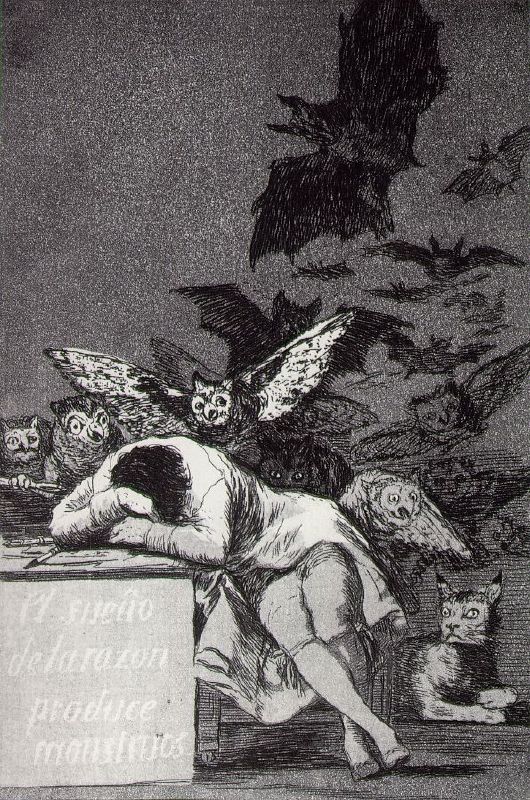
The Sleep of Reason Produces Monsters -- Goya (1797)
If 2666 impossibly haunts The Third Reich from the future, then paranoid Poe haunts it from the past. Last time we checked in, Udo Berger and his beautiful girlfriend Ingeborg had made tentative friends with another German couple while spending the summer at a seaside resort in Spain. Through this pair, they meet up with two nefarious locals, the Wolf and the Lamb; Udo also begins obsessing over a man named El Quemado, a burn victim who rents paddle boats to tourists. For Udo, the holiday is meant to be a working vacation—he’s a wargame enthusiast, and he plans to write a defining strategy for a new game called “The Third Reich” (implicitly, he plays the Nazi’s side). In the meantime, he’s also taken with the hotel’s owner, Frau Else, a German transplant who mysteriously disappears to take care of an ill husband who no one seems to see.
The first part of The Third Reich (published in the Spring ’11 issue) set the stage for dread, mystery, and extreme paranoia—all while on a sunny seaside holiday. The set-up recalls the seemingly innocuous first section of 2666, “The Part About the Critics,” where four European literature professors spend a vacation of sorts in sunny Mexico while ostensibly searching for a mysterious author. The Third Reich showcases the same sinister tension, describing—but never explaining—the stress between differing cultures, the radical alterity of “being on holiday,” of “vacating,” of being in a different place for a different purpose than what is usual, normal.
The second part of The Third Reich (in the new Summer ’11 issue) increases the dread and paranoia, all with a strange, mordant humor. The novel’s conceit is that the writing is Udo’s holiday’s journal; as such, he controls not only perspective and tone, but what details we learn—or don’t learn. It’s what Udo leaves out that becomes increasingly distressing and fascinating. Indeed, at a crucial point in the novel, Udo fails to explain to us why he remains in Spain after his holiday should be over, even as Ingeborg returns to Germany. There is an ostensible explanation—Charly has disappeared and Udo perhaps wants an answer to the mystery (I will withhold further details for fear of spoiling the plot). It seems more likely that Udo remains to work out his strategy for “The Third Reich”; he finds an unlikely gaming partner in El Quemado. Indeed, the wargame begins to define Udo’s perspective at all times—
When I saw from the balcony that the bathers were beating a mass retreat toward the hotels and campgrounds, I went down to the beach. It’s a sad time of day, and the bathers are sad: tired, sated with sun, they turn their gazes toward the line of buildings like soldier s already sure of defeat; with tired steps they cross the beach and the Paseo Maritimo, prudent but with a hint of scorn, of arrogance in the face of remote danger, their peculiar way of turning down side streets where they immediately seek out the shade leading them directly—they’re a tributue—toward the void.
German nihilism on holiday! Still, Udo finds perverse joy in his gaming sessions with El Quemado; in these episodes, his tone escalates to a manic pitch, reminiscent of some of Poe’s crazies (the narrator of “The Tell-Tale Heart” comes to mind in particular), as well as the mounting insanity of Oscar Amalfitano in 2666. And, just as in the early parts of 2666, The Third Reich begins to buzz with rumors of rape. Udo hints at these rumors, but is unwilling to explore them. Also mysterious is the identity of Frau Else’s husband, a pointedly Gothic conceit, of course, that nonetheless may be the beating heart of horror at the center of the story. He haunts Udo’s sleep—
I dreamed that someone was knocking at the door. It was nighttime and when I opened the door I saw someone slipping down the hall. I followed. Unexpectedly we came to a huge dark room filled with the outlines of heavy old furniture. The smell of mildew and dampness was strong. On a bed a shadowy figure was twisting and turning. At first I thought it was an animal. Then I recognized Frau Else’s husband. At last!
I’ve done my best to omit some of the sharp twists in this section of The Third Reich for fear of spoiling the book, but I will add that Part II ends with something of a subtle cliffhanger (as I write the term “subtle cliffhanger” I realize that it is pure oxymoron; mea culpa). In any case, I’m enjoying the serialization very much and look forward to reading Part III.
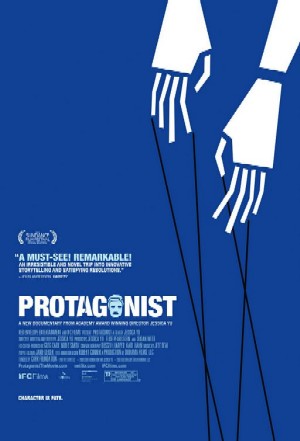
Jessica Yu’s 2007 documentary Protagonist chronicles the lives of four men to reveal how absolute certainty is a form of psychological blindness that can entail devastating consequences. In a spare, Errol Morriseque approach, Yu sticks mostly to upper-body shots of the men, who tell their stories directly to the camera, beginning with childhood and extending into their formative traumas and the consequent fallout of these traumas. Yu uses film or video of the men from outside sources at times (news reports, surveillance video, home video, cable access shows, etc.), but the major conceit for dramatizing or reenacting the men’s stories comes from her use of wooden puppets. These wooden puppets are dressed in ancient Greek theater garb, including two-faced masks; the puppet segments are set in a miniature Greek theater. In addition to the puppets who play act parts of the interviewee’s stories, there is a Greek chorus which introduces each chapter of the film by reciting lines from Greek tragedies that correlate directly to the men’s lives. While these lives never directly intersect, Yu deftly crafts her film to show how each person, as the protagonist of his own life, must course a trajectory against the curse/blessing of family, history, and social conditioning. While the men share certain phenomena in their pasts—abusive parents, strict religious upbringings, early childhood traumas—it’s their search for ultimate, authoritative certainty that most unites them. Each man quests for identity, and along the way is challenged, experiences epiphany, dreams of apotheosis, and achieves eventual catharsis. The search for certitude eventually blinds each man; as the film concludes, each subject recounts how absolute certainty—the absence of doubt—is precisely what leads to unthinking, inhumane actions. The film ends with one interviewee paraphrasing Socrates’ famous dictum: I only know that I know nothing.
I’ve omitted so far exactly what specific details make these men’s lives so hideous, so odious, so fascinating, so redemptive—so worth watching. Namely: What did these four dudes actually, like, do in their lives that is worth 90 minutes of your time? I was lucky enough not to know such details going in to the film, and I think that there couldn’t be a better way to see it. Each man tells his life story, beginning in youth; the stories become increasingly shocking as they progress. With this in mind, I strongly recommend you see Protagonist and skip the rest of the review, which contains SPOILERS.
From Edith Hamilton’s essay “William Faulkner: Sorcerer or Slave,” collected in The Ever Present Past—
Mr. Faulkner’s novels are about ugly people in an ugly land. There is no beauty anywhere. Whether he deliberately excludes it or does not perceive it, no one can say; but at least he says himself that a blossoming pear tree in the moonlight looks like hair streaming up from the head of a drowned woman, each hair distinct in the water from the others. He describes the scent of a blooming shrub, still wet with dew, as sickening. To walk through the woodlands in summer in “a gloom dimmer than the gray desolation of November” is to feel “malicious little eyes” watching (birds? squirrels?) while under foot the oozing earth crawls with snakes.
But the land is worse, far worse, than all of these unpleasant features put together. It ruins the people it nourishes. A dark curse lies on it. It was “already tainted before any white man owned it . . . from that old world’s corrupt and worthless twilight as though in the sailfulls of the old world’s tainted wind which drove the ships.” Columbus’, presumably. The initial curse, connected with the dispossession of the Indians, appears to be—Mr. Faulkner is not quite clear about it—inherited by the North as well as the South, but its full effect is shown concentrated in the South. “Don’t you see?” young Ike McCaslin cries in “The Bear.” “Don’t you see? This whole land, the whole South, is cursed, and all of us who derive from it, whom it ever suckled, lie under the curse.”
The people, thus doomed, are like the land that dooms them. It is part of the fate that molds them. “Our rivers, our land: opaque, slow, violent, shaping and creating the life of man in its implacable and brooking image.” At this point Poe comes irresistibly to mind. “The dank tarn of Auber—the misty mid region of Weir—the ghoul-haunted woodlands of Weir.” It is the point in the realm of romance where extremes meet, Poe’s lovely and lost Ulalume and Mr. Faulkner’s curse-ridden men
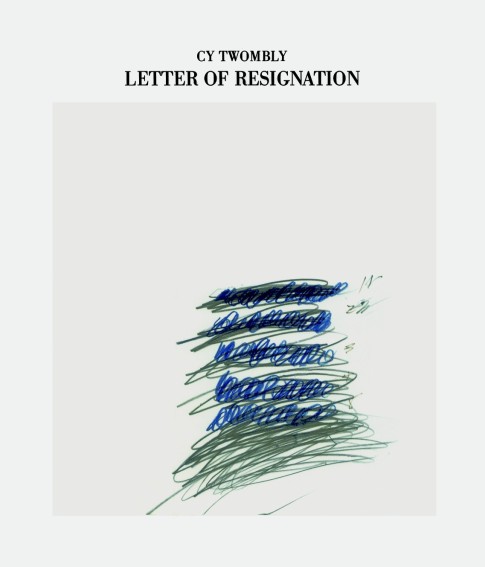
Thanks to Biblioklept reader Jescie for sending in this 2009 piece from Eye Level, which recounts film director John Waters narrating Cy Twombly’s collection Letter of Resignation. From the write-up—-
Baltimore-native Waters, best known for his films Hairspray and Pink Flamingos, spoke, if not performed, at the McEvoy Auditorium, as the inaugural speaker in the second annual American Pictures Distinguished Lecture Series. For one hour on Saturday afternoon, Waters shared his interpretation of Cy Twombly’s Letter of Resignation. From the word go, Waters had the SRO audience captivated as he “narrated” the thirty-eight separate drawings that make up this work. At times, Waters had us in stitches, relating slightly off-color stories, and using words not found in museum labels. Often in strong language, he created a persona, or voice for the letter writer: a disgruntled worker who is drafting (and re-drafting) his letter of resignation. By the thirty-eighth draft, he’s just about there. . . .
Waters, who keeps the Letters of Resignation catalogue by his bed, says that Twombly created “such confident work it makes people mad.” To detractors not fond of the work, Waters offered this retort, “This kind of contemporary art hates you too, and you deserve it.”
“Ode to the Only Girl,” a poem by John Edward Williams—
I’ve seen you many times in many places–
Theater, bus, train, or on the street;
Smiling in spring rain, in winter sleet,
Eyes of any hue in myriad faces;
Midnight black, all shades of brown your hair,
Long, short, bronze or honey-fair.
Instantly have I loved, have never spoken;
Slowly a truck passed, a light changed,
A door closed–all seemingly pre-arranged–
Then you were gone forever, the spell was broken.
Ubiquitios only one, we’ve met before
A hundred times, and we’ll meet again
As many more; in hills or forest glen,
On crowded street or lonely, peaceful shore;
Somewhere, someday–but how will we ever know
True love, how wil we ever know?





 Thanks to Biblioklept reader Jescie for sending in

 Biblioklept