Hypothetical Sentiments, Bodacious Birthdays, and Friendly Links

If this was the type of blog where I wrote about my personal life, the type of blog where I bared my naked soul to the keen scrutiny of all the world (wide web), the type of blog where I tried to express the ineffable internal in so many 0s and 1s–; if this were that type of blog, I might start this post with a litany of clichés and truisms about how the birth of my daughter Zoe this Sunday, 3 June, was easily the bestest, most significant thing to ever happen to me; how the birth of my daughter made me the happiest man in the etc., how beautiful and alert and cute and adorable etc., life-changing and dramatic, etc.; I might even post a sugary photo of her like this one–

–to justify all these wild claims.

But of course, this is all hypothetical; this is not a blog about how happy I am with our new addition, or how great my wife is at being a mother, or how lovely our little Zoe is–this is a blog about books and pop culture. So maybe I should link Zoe’s birthday, 3 June, with some famous people also born on that day: these include beat poet Allen Ginsberg, exiled dancer Josephine Baker, and game show host/CIA assassin (?) Chuck Barris. Zoe wasn’t the only person to have a birthday in the Biblioklept clan this week–I switched a digit just yesterday. Famous people who were also born on 7 June include libertine painter Paul Gaugin, American poet Gwendolyn Brooks, professional drunk Dean Martin, and Florida writer Harry Crews, whose novel a Feast of Snakes, out-Bukowskis Bukowski. But by far the coolest person to be born on 7 June (sorry Mr. Martin) is Prince (I’m not going to wiki-link to Prince. If you want to know about Prince, go buy Purple Rain, or Sign ‘O’ the Times, or 1999, or Diamonds and Pearls. Also, if you know-not the glory of Prince, hang your sorry head in shame (philistine)). On my birthday, I always wonder: “What is Prince doing for his birthday? Is he having a great time? I bet he’s doing some really awesome stuff!” It makes me happy. What can I say.

I guess some of my friends knew that I’d be tuckered out from the week’s excitement, so they sent me plenty of cool links, kind of doing my blog-job for me. Check it out:

–Watch the first episode of The Flight of the Conchords when you have a spare half hour. If you don’t find this hilarious, there is probably something wrong with your soul (thanks to Damon for the link)

–Treat yourself to an awesome mix tape, courtesy of Speck. My favorite track: “The Return” by Antares (those who don’t love spaced-out psychedelic prog jamz need not apply)

–Listen to this BBC Radio 4 story on Roger Linn, inventor of the drum machine

–Watch this presentation on Photosynth. Absolutely amazing (thanks to Mike for the links)

–Watch this preview of the upcoming Persepolis movie; then check out my review of the book (thanks to Nick for the link)
Knocked Up, Rakish Behavior, More Bibliomania, and a Brief Hiatus

So today we (id est, Mrs. Biblioklept and myself) saw Knocked Up, which is pretty much the best pregnancy movie I’ve ever seen (yes, better than 9 Months, Parenthood and Father of the Bride 2 put together, and at least equal to Rosemary’s Baby, which I’m not really sure even counts). Judd Apatow (we mentioned our love of Mr. Apatow’s work in a previous post) assembled a host of familiar faces from his regular crew (including his wife and daughters) to make a funny and honest (although certainly hyperbolic) movie about love, relationships, having kids, growing older, and all that crap. Highly recommended. For a more detailed review, check out this Slate article (warning: this is a typical Slate article, i.e. the author starts by saying they basically like what they’re about to discuss before hemming and hawing over every little detail in an effort to pick it apart. Still, on the whole, the article’s pretty good).

Now, writing about movies and card games and TV shows is all well and good, but once upon a time this was a blog about books (sort of), and perhaps some of you feel that I’ve gotten particularly lazy in my reading. This is actually far from the case; in fact, all I’ve been doing lately is reading. Only the reading I’ve been doing has been for a grad class revolving around the figure of the libertine. Summer school. Yay. Not that the class has been boring per se, just not really something that’s translated into anything I’ve felt the urge to write about. The poems and biographical of John Wilmot, Earl of Rochester have been of great interest–this guy was downright naughty. Also a relatively recent play about Rochester called The Libertine was particularly good (much better than the movie version starring Johnny Depp that came out a year or two ago). The current reading for the class, however, Samuel Richardson’s Clarissa, is more than I can bear. We are reading the abridged version, which is about 550 pages, paperback. The unabridged version is a large-sized small-print trade paperback topping 1600 pages. I have no idea what the editor cut out (neither do I care). The last time I read a book like this was in high school–Thomas Hardy’s Tess of the d’Urbervilles. Both novels are painfully long accounts of a young lady’s trying circumstances. In both novels nothing really happens, and anything interesting that does happen is so coded that you have to read between the lines to figure it out (“Huh? Did Tess get raped? Huh?” also, “Huh? Did Clarissa get raped? Huh?”). Maybe I’m just a lazy reader.

But being a lazy reader hasn’t stopped me from buying more books. My bibliomania persists unchecked, fueled by bargain blowout prices on last year’s hardback remainders and promises of free shipping from Amazon. A quick run down of what I bought this week, complete with odds that I’ll actually finish the book.

Sanctuary, William Faulkner

Intruder in the Dust, William Faulkner

The Portable Faulkner, ed. Malcolm Cowley

Fiction, Film, and Faulkner: The Art of Adaptation, Gene Phillips

Yes, I am taking a Faulkner class this summer. With the exception of the Phillips text, all materials were procured at my favorite local bookstore via store credit. Some of the books I used to get credit were not exactly mine. The Biblioklept strikes again! Likelihood that I’ll finish all of these: 99.9%. I’m a good student. I don’t cut any corners when it comes to class reading.

The Children’s Hospital, Chris Adrian

I’ve been wanting to read this all year; rave reviews all around. Likelihood that I’ll finish it: 50/50 might be generous. It’s pretty long (600 pages) and hardback (I have a very poor track record with hardback). I’ll give it a serious attempt in the two week window between the end of summer school and the fall semester. We’ll see.

U.S.!, Chris Bachelder

Another book I’ve heard only great things about. The Left (big-L) keeps reviving muckraker Upton Sinclair (you know, dude who wrote The Jungle) from the dead to help “the cause”; he is repeatedly assassinated. Likelihood that I’ll finish it: 99%–I started yesterday and am close to half finished. It’s very, very good, and I’ll try to review it later. It’s actually been a terrible distraction from Clarissa. Plus, according to the back of the book, Bachelder got his MFA from my alma mater, the University of Florida. So there.

Against the Day, Thomas Pynchon

I loved loved loved V. The Crying of Lot 49 was decent enough. Vineland was good enough, I suppose, albeit kind of silly. I’ve put down Gravity’s Rainbow more times than I can count. The first 100 pages of Mason & Dixon bored me to tears. Why did I buy this again? Oh, right, it was on sale. Likelihood that I’ll finish this: This book is hardcover and over a 1000 pages. Let’s just be honest–I will never finish this book. Maybe I’ll give it to a friend as a burdensome gift, a sort of annoying challenge.

__________________________________________________________________________________

I realize that this post has been overlong and probably looks like a weak attempt to compensate for not having written in some time (which it certainly is); however, it will have to suffice, gentle reader, for an indeterminate amount of time. Mrs. Biblioklept will be going into the exquisite labors of childbirth any minute now (really), so I’m not sure when I’ll have the leisure to post again. Until then.

The Biblioklept Salute to Eleven Great TV Shows, Not One of Them with Us Today–Part II

Our salute continues! (Part I here)

4. Freaks and Geeks (1999-2000, NBC)

Judd Apatow is a freaking genius. Freaks and Geeks is the only TV show I can think of to portray teenagers with any sense of realism. Set in a suburb outside of Detroit in the very early 80s, this show followed the awkward trials of Lindsay Weir, former mathlete turned “freak,” and her brother Sam, destined “geek.” Apatow handled the series with a remarkable blend of pathos and humor, but the best thing about the tone of the series was the complete lack of either schmaltzy sentimentality or undue glamor that plagues every show about teens. There are no rose-colored glasses here, no simple answers, and the endings are more often than not ambiguous–but that ambiguity is somehow more satisfying than a traditional happy ending.

5. Undeclared (2001-2002, FOX)

After Freaks and Geeks was canceled after one short season, Apatow gave TV another shot, switching to a new network and a new format. He brought along some of the actors from Freaks and Geeks, including Seth Rogan, who became a writer/producer on the show (Seth went on to co-star in Apatow’s blockbuster The 40 Year Old Virgin, and is the unlikely leading man in Apatow’s summer offering Knocked Up, which looks really, really funny). Set at the non-existent University of North Eastern California in the early oughties, Undeclared was based around a group of college freshmen trying to navigate their way through the tribulations of a new school full of new people. The show focused on Steven, a nerdy kid with the potential to reinvent himself in his new environs. He manages to hook up with fellow dormer Lizzie, despite her older boyfriend (Lizzie’s psycho-obsessive older boyfriend, played by Freaks and Geeks star Jason Segel, provides for one of the show’s funniest plots). Steven’s quest for cool is of course impeded by his father (played by folkie Loudon Wainwright III) who, after a nasty divorce, has embarked on his own quest for cool (midlife crisis style)).

Loudon Wainwright III plays “The Morgue.”

Before we leave our contemplation of Judd Apatow, I highly recommend everyone read this 2001 exchange of emails between Apatow and That 70s Show Creator Mark Brazill, published originally in Harper’s. Brazill accuses Apatow of plagiarism, hilarity ensues.

_________________________________________________________________________________

Later this week in the salute–is David Cross a dick? What do you do when the series that filled the Buffy-sized void in your pop culture heart is canceled? And does Nickelodeon really suck now, or have we just gotten older?

The Biblioklept Salute to Eleven Great TV Shows, Not One of Them with Us Today–Part I

We here at the Biblioklept are not above watching TV–in fact, TV is one of our favorite distractions from getting our assigned reading done. What follows is an incomplete list of some of our favorite TV shows that are no longer on air. Some were canceled too early, others probably benefited from getting off the air when they did. All were fantastic.

In no particular order:

1. Buffy the Vampire Slayer (1997-2001, the Warner Brothers network (“the WB”); 2001-2003, UPN)
My dad and brother turned me on to this show. Their initial attraction had to do with Sarah Michelle Gellar’s provocative attire. For my taste, Buffy (the show) had just the right balance of pop culture savvy and teen-drama kitsch. The show got particularly good when the Scoobies (Buffy’s crew’s nickname for themselves) went to college. Speaking of college, academia in the early oughties responded to the show with a field of cultural studies sometimes referred to as “Buffy studies.” So there.

A few scenes from “Once More, with Feeling” (in this episode, the Scoobies are put under a spell where they communicate by singing Broadway musical style).

Buffy creator/mastermind Joss Whedon directed the “Business School” episode of The Office a few months ago, which was very funny. The Office is really funny, but NBC should wrap it up next year before it starts to totally suck. While I’m voicing unsupported opinions, let me also go ahead and aver that the US version of The Office is superior to the British one (no knock on Gervais).

2. TV Funhouse (2000-2001, Comedy Central)

When will TV Funhouse get a DVD release? It amazes me that all the seasons of Air Wolf got collected on DVD, but this manic treasure remains uncollected. But I digress before I begin.

Robert Smigel’s Saturday Night Live shorts are funny in their own right, but the eight episodes he made of TV Funhouse are literally breathtakingly funny. I had a small but debilitating stroke due to a lack of oxygen resulting from laughing so much at the Anipal’s mischievous antics. The show featured plenty of cartoon shorts, like the ones you can still see on SNL, and those were pretty funny, but the best bits of TVF involved the adventures of the Anipals, a gang made of puppets and real animals. The best episode was a two-parter where the Anipals went to Atlantic City, where they met Robert Goulet and Triumph the Insult Comic Dog. Hilarity ensues. Not for children.

Check out “Fetal Scooby-Doo” (because I couldn’t find the Anipals).

3. Wonder Showzen ( MTV 2005-2006)

“Chinese Girl Baby Atlantis”

Again, not for children. Wonder Showzen kind of upped the ante for what you could do with kids on TV. This show features some of the darkest, nastiest satire on consumer culture I can think of. The final episode of the first season is almost an art prank. Entitled “Patience,” it truly, truly tests the audience patience, occurring in three acts: the first slowed down to incomprehensible goo, the second at a normal pace, and the third sped up.

Or better yet,watch a whole episode–check out “Cooperation” from the second season, (yes that is John Oates, Devendra Banhart, Rick Springfield, and Corin Tucker singing “War Doesn’t Solve Anything”)

_______________________________________________________

Later this week: Part II, in which we look at some of Judd Apatow’s beautiful flops and speculate that it was probably a good thing Arrested Development was canceled after three short seasons.

Apples to Apples

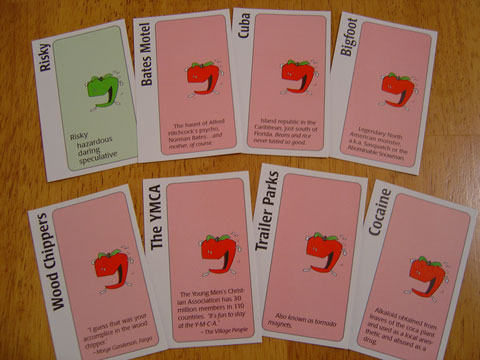
Apples to Apples is the best game I’ve played in years. It’s pretty basic: each player gets seven NOUN cards. The nouns cover a range of people, places, and things–everything from Frank Sinatra to Skiing to Wall Street to Bananas. Each round, a new player plays the judge. The judge sets out an ADJECTIVE card–something like Classy or Wise or Extravagant or Basic or Feminine, etc. Then, each player has to throw out (face down) the NOUN card that they think best fits the adjective in play. Each time the judge picks your card as the winner, you set it aside as a point. The player with the most points wins (duh).

apples-example-small.jpg

This game stimulates plenty of conversation; you can play it with friends for hours without noticing how much time has passed by. It also goes great when paired with beer or wine (but watch out that no one you’re playing with gets upset and knocks the wine bottle over and curses everyone, which may happen in some cases). Highly recommended.

Millionaire’s Maakies

Cartoon Network’s Adult Swim lineup is pretty much hit or miss. Despite great shows like Home Movies and Moral Orel, they still produce garbage like Aqua Teen Hunger Force (their worst crime of course is their culpability in getting Family Guy back on the air). Luckily, this “throw something up and see if it sticks” approach to TV programming allows for all sorts of weird visual shenanigans to take place on your TV screen that usually wouldn’t air on basic cable. In a fit of insomnia a few nights ago I caught some of Tony Millionaire’s series of shorts, Maakies. Odd/possibly disturbing/very funny. Enjoy (or not, you mirthless maggot!)

The Weird Wild World of Wonder Woman

What’s the deal with Wonder Woman? (images via Superdickery, who provide their own snarky comments).

277_4_219.jpg

A little five-on-one action. Luckily, that nasty voyeur Elongated Man is there to film the whole thing.

bindme.jpg

Good clean Amazon fun.

277_4_068.jpg

Look out for the giant phallus–uh–torpedo!

277_4_2051.jpg

A Freudian’s field day.

277_4_158.jpg

(Evil) mustache rides, 10 cents.

Old Joy

old-joy-poster.jpg

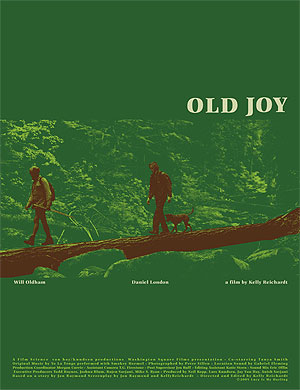
There’s a scene in Adaptation (dir. Spike Jonze, 2002), where “real life” screenwriter Charlie Kaufman (played by Nick Cage) delivers a railing lament that he can’t create the film he wants to–a film like “real life,” a film where people don’t face huge crises, where people don’t change, where nothing much happens. Adaptation unravels into a farce on Hollywood as Charlie’s twin brother Donald takes over the movie, clumsily forcing sex, drugs, and violence into a story frame that wasn’t meant to bear such themes. Perhaps last year’s Old Joy is the movie Charlie Kaufman would have wanted to make, if he could have.

I picked up Old Joy for two simple reasons: 1) the AV Club seemed to love it and 2) Will Oldham is one of the two leads (digression: a few years ago my wife and I saw Oldham perform on the tour supporting the Superwolf record. Oldham was drunk and somewhat lascivious, prompting my wife to announce that he would “never be allowed in our house.” That cracks me up to this day for some reason).

I didn’t expect to like Old Joy nearly as much as I did. The story is very simple: two aging hipsters go on a weekend camping trip in the Oregon Cascades in search of an isolated hot spring. They get a little lost the first night, camp near the road, and get back on track the next day, finding the springs without incident. Then they go home. No crises, no conflict, no life-changing events, right? Well, not necessarily. This movie is subtle. Crisis and conflict are never stated or overt, but there is definitely tension between these two old friends.

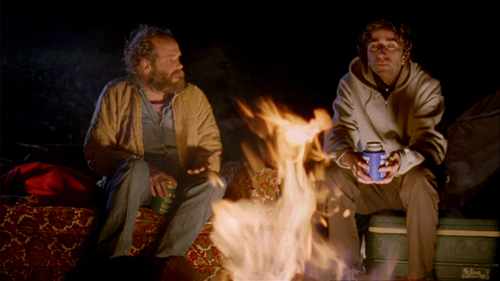
Aspects of Mark (Daniel London) and Kurt (Will Oldham) remind me of both myself and just about all of my friends. Mark’s wife is very pregnant; faced with imminent fatherhood, he is more conventionally “responsible” than Kurt, who apparently doesn’t have a permanent job or residence. Kurt gets the pair lost the first day of the trip, and while Mark pores over a map looking for some directions, Kurt carelessly rolls and smokes a joint. The tension between the two is largely implicit, and the only time the movie’s crisis–are these two still friends?–rears its head is over a campfire scene, when, after many several beers, Kurt breaks down and admits that there’s “something” between the two of them, and that their relationship has somehow changed. Mark swears that everything is fine and the issue is more or less dropped, at least in dialog. However, that conversation lingers wistfully over the rest of the film and perhaps remains unresolved.

oldjoypic.jpg

But dialog is not what this film is about. The real star of this film is director Kelly Reichardt’s lush footage of the verdant forests and streams of the Cascade Mountains. Paired with the more mundane shots of the countryside-as-seen-from-a-moving-car, these “nature shots” standout in their dreamy beauty. Reichardt’s pacing is lovely; he allows the camera to rest on still moments of tranquility, producing a soothing tone and mood that contrasts uneasily with the unspoken tensions between Mark and Kurt. Reichardt allows the forest’s own soundtrack of running water and singing birds to do much of the talking in this film, using Yo La Tengo’s beautiful soundtrack sparingly but to great effect. And at just 76 minutes, the film is a perfect length–the shots are profound at times, but never ponderous.

The overall experience of Old Joy is a mix of ineffable loss and stunning but calming beauty, perhaps best expressed in a line from Kurt. “Sorrow is just worn out joy,” he tells Mark, relating a dream he recently had. And it’s that kind of paradox that informs the film–that merging of beauty and loss and beginnings and endings. In the end, we don’t get answers, and if the characters change, those changes are understated and incremental. In Charlie Kaufman’s terms, this is a film about “real life,” and no doubt many viewers will see aspects of themselves haunting the screen.

Friday Funnies

16.gif

“The great epochs of our life come when we gain the courage to rechristen our evil as what is best in us.”

The other night, at our last birthing class, our fearless instructor pulled out the old overhead projector (she had previously come out strongly and scornfully against power point presentations), and began showing us various cartoons detailing the ups and downs of life with a new baby.

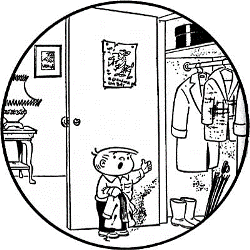
I knew that it was coming. I was clinching my jaw in preparation for it. But nothing could have readied me for just how loud the class laughed in appreciation for a Family Circus comic. I love comics of all kind, so the insipid lifeless crap-o-rama that is Family Circus is particularly offensive to me, especially when it’s somehow deemed to be true or, even worse, truly funny. Then again, the people in my birthing class are the same crew that suggested a few weeks ago that eating the placenta was distinctly un-American, so it seems about par for course that they would appreciate FC.

Fortunately, there’s an antidote to Bil Keane’s witless garbage. Check out The Nietzsche Family Circus, which pairs a random FC image to a random Nietzsche quote. If not always hilarious, the results are often instructive, and always constitute legitimate satire. Good stuff.

166.gif

“He who cannot give anything away cannot feel anything either.


Follow Through

Feist on Leno, 5.8.07.

Feist on Leno

feist.jpg

For those of you who can stay up past eleven, lovely-voiced Leslie Feist is scheduled to perform tonight (5.8.07) on The Tonight Show with Jay Leno. For the rest of us, I’m sure Youtube will provide. If you’re not sure that you’re interested, check out the video for “1 2 3 4” here (WARNING! In all likelihood this song will get stuck in your head for the next few days).

The New Feminism

Yay! Girl power!

Read this hilarious article from The Onion, “Women Now Empowered By Everything A Woman Ever Does.” It neatly sums up all of my feelings on the current national/pop cultural understanding of what feminism is in America today.

Every time a discussion of feminism comes up in any of my graduate courses, I always manage to come off like a caveman jerk as I try to explain how I think that the term “feminism”–much like “punk”–has been completely co-opted by mainstream patriarchal commercial culture, and thus etiolated of life, its original power sucked dry. There is of course an easy solution for this, which involves a re-appraisal of feminist objectives and a general re-education of young girls and boys (okay, easy in theory, not in practice). The concern  in academia with gender studies over the past two decades has done a remarkable job of re-framing the problematics of identity, sexuality, culture, etc. beyond just “women’s issues,” but the trickle-down of second-wave feminism seems to be, well, diluted at best and completely misunderstood at worst . And as recent attacks on Roe v Wade show, these aren’t battles that were neatly finished thirty years ago–there is still much at stake today. Get empowered, yo.

math.jpg

G is for…

G is for Gandalf the Gray (later, Gandalf the White), the archetypal wizard of Tolkien’s Middle Earth. Geeks who need to know can find an exhaustive biography of the fictional mage here (or perhaps you are a true geek who is already well versed in the lore of the Istari); however, it’s not Tolkien’s overly-detailed-to-the-point-of-insanity backgrounding that I love so much about Gandalf. It’s that Gandalf, like the hobbits of Lord of the Rings, is a complex and not-so-obvious hero. Despite his appearance as a frail old man, Gandalf is a actually a total bad-ass swordsman and magician. He’s also the mastermind behind all of the action, but it also seems evident that he’s not really sure what he’s doing at times. Repeatedly throughout LOTR, his faith in the silly little hobbits is questioned by kings and warriors and elves who don’t get why the wizard would put the fate of the world into the hands of child-sized halflings who don’t even wear shoes.

Gandalf was brought to life earlier this decade in an obscure series of low-budget film versions of LOTR; savvy readers may be able to find DVD versions of these movies from their favorite online boutiques that cater to such eccentric tastes. For the record, I thought Ian McKellen, who starred in these indie gems, was perfect as Gandalf. To learn more about Gandalf the Gay, check out this short essay from McKellen.

G is also for the Glass children, the protagonists of many of reclusive author J.D. Salinger’s short stories and novellas. The seven Glass children (Glass being the last name: the children are not made out of glass, dummy) all were recurring contestants on a radio-quiz show called It’s a Wise Child, a program which earned them both mild fame and some money. The eldest of the Glass children is Seymore, is central to many of Salinger’s stories, but my absolute favorite is “A Perfect Day for Bananafish.” It’s hard to properly describe the emotional impact of the story without spoiling the ending, but “Bananafish” contains themes that are relevant today and will probably always relevant: the psychological damage of warfare, the inability of humans to adequately express their thoughts and desires, the breakdown of the modern family. Everyone should read it–do yourself a favor and go pick up a copy of Nine Stories. You can get one mailed to your house for under five bucks. No excuses.

Leviathan–Jens Harder

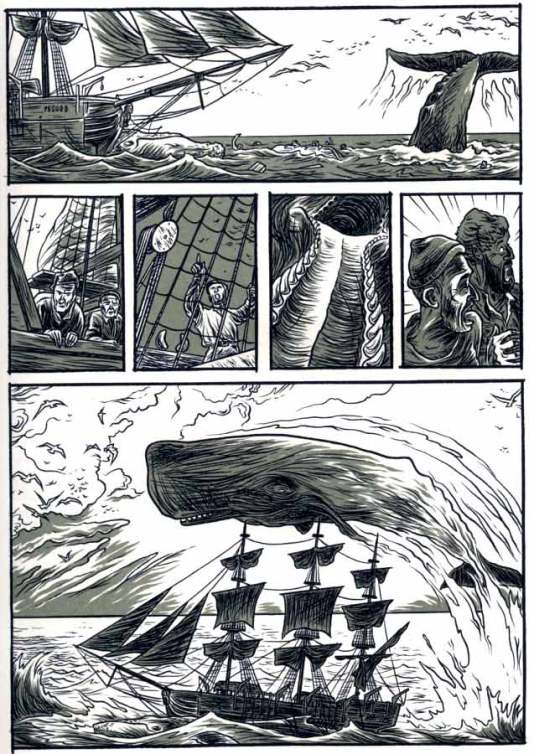
Jens Harder’s Leviathan is a graphic novel in the truest sense. Harder uses scratchy but fluid images to tell the story of a mystical whale who battles a giant squid, saves Noah’s ark, attacks the Pequod, wreaks havoc on a cruise ship, and eventually battles an armada of anachronisms. The only text Harder employs in Leviathan are excerpts and quotes from a variety of sources including the Bible and a host of philosophers; the bulk of quotes come from Melville’s Moby-Dick. Just as that novel begins with an “Etymology” followed by a section called “Extracts,” Harder begins with a section called “Leviathanology,” a collection of quotes about leviathans from the likes of Hobbes, Milton, and the book of Job. These quotes inform the story of Leviathan, connecting the whale to a sublime and unknowable mystery that Harder will explore. Harder’s surreal images often invert notions of “proper” space and time, giving the whale an awesome significance, but also positing the beast as something that denies signification. By eschewing the traditional forms of graphic storytelling, which rely on speech bubbles and clear-cut panel transitions, Harder is able to capture something that is essentially too large to capture. This book works. Highly recommended.

leviathan.jpg

More Soup

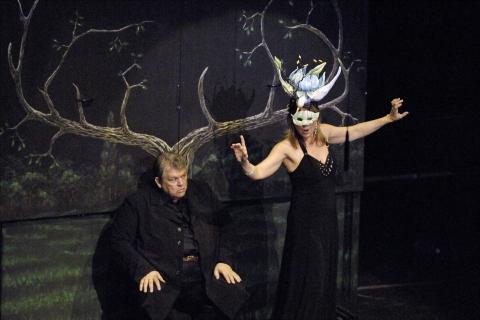
F is for Falstaff, Shakespeare’s knavish knight. Part rascally gnoff, part philosopher, this fat rascal appears in three of the bard’s plays. In Henry IV parts 1 and 2 he advises young Prince Hal (the future king) on matters of honor and drinking. In the comedy The Merry Wives of Windsor, Falstaff tries to cuckold some country farmers and steal their cash; the scalawag’s plans go awry and he ends up wearing the horns. Falstaff is one of Shakespeare’s most verbose characters–only Hamlet has more lines. And despite his fun-loving and roguish nature, Falstaff, like Hamlet, also provides several meditations on human nature, death, and the seeming futility of the individual’s ability to change social order.

falstaff605.jpg

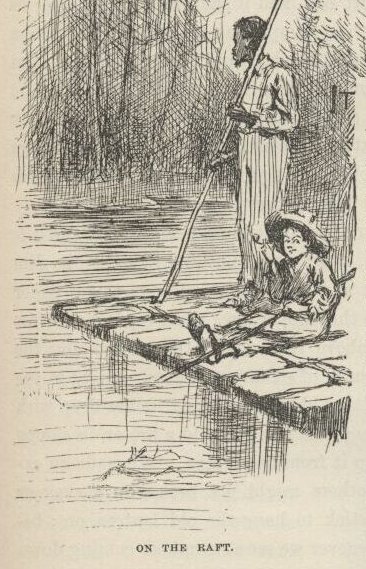
F is also for Finn, Huckleberry. Like Falstaff, Huck Finn is something of a rogue, albeit he is just a child. As the white trash double to middle class Tom Sawyer, Huck is one of Twain’s keenest tools for social satire. Huck escapes the Widow Douglas’s aspirations to give him a moral education, in turn helping her slave Jim make his own escape via the Mississippi River. While navigating the river, Huck must also navigate the perplexing and paradoxical moral codes of the strange South. Despite the happy ending of The Adventures of Huckleberry Finn, the novel remains controversial over a hundred years after its publication, still appearing frequently on lists of challenged books.

huck-and-jim-on-raft.jpg

End of the Century–The Heartbreaking Story of the Ramones

If you love the Ramones, you really shouldn’t watch the 2003 documentary film End of the Century–it will only break your heart.

logo_ramones1.jpg

I love the Ramones; I’ve loved the Ramones since I was a kid. I was lucky enough to see them in concert about twelve years ago (even then we were hip to the fact that the Ramones without Dee Dee–the C.J. version of Ramones–was not really the real Ramones). My favorite memory of the show was Joey saying that the venue of the show was built on top of a pet cemetery. Then they played “Pet Cemetery.” Genius.

So well and anyway. End of the Century. This is an excellent music documentary, a standout in a genre which is generally hit or miss. Unlike weaker films that rely on narrators or musicians influenced by the subject*, End of the Century is composed entirely of interviews (both archival and original to the film) with the Ramones themselves (Dee Dee, Tommy, Joey, Johnny, Marky, Richie (Richie wears a conservative suit in his interview, and mostly complains about not getting a taste of “that T-shirt money”) and C.J. (C.J. comes across as naive, energetic, and wholly endearing, making me feel kind of bad about my previous opinions of him). In addition to the Ramones’ first-hand accounts, there are plenty of interviews with managers and friends and family and roadies and so on–eyewitnesses who candidly relate the good, the bad, and the ugly in excruciating detail (there is plenty of ugly). Raw live footage dating back to the early 70s brings to life the sheer volume and bizarre intensity of a Ramones show.

So why so heartbreaking? Well, here’s the deal. We know that the John and Paul didn’t like each other. We know that Mick and Keith bicker. We know that bands have “creative differences” and egos get bruised and so and so on. But with the Ramones, well, I guess I always thought of them, as well, cartoons of themselves. But End of the Century makes it very clear that these guys were very, very serious about themselves and what they did. They were in no way cultivating an image: the Ramones really were what you thought they were. And they hated each other. Like, years-of-not-talking-to-each-other hatred, right up until their retirement. They were bitter–they really wanted to be successful. Now, I always thought of the Ramones as legendary, as huge, as the original punk band. But they wanted to be huge, huge like the Beach Boys or the Beatles. Hits on the radio huge (a quick aside: the accounts of working with Phil Spector on the 1980 album End of the Century, in the hopes of gaining a top 10 hit, are hilarious. Apparently Phil held the band plus entourage at gunpoint, threatening to shoot them if they returned to the hotel. The reason for Phil’s hostage-taking: he wanted them to hang out and watch movies. But I’m sure Spector’s like, totally not guilty of murdering that chick in his house). So a lot of the movie is the Ramones lamenting that they “never made it” (again, to me this was ludicrous). But really it’s the hatred, the meanness of their interviews, their complete dismissal of each other that I found most disconcerting (particularly heartbreaking is hearing Johnny’s non-affected nonchalance over Joey’s relatively recent (to the time of the movie’s shooting) death from lymphoma). Maybe I’m just a foolish fan who wanted my cartoons.

The film ends by noting that Dee Dee died of a heroin overdose two months after the film finished shooting. Johnny Ramone died in 2004. The principal members of the band all died within a few short years of each other, like married folks often do.

To end on a lighter note, check out this footage from the film, featuring Dee Dee’s rap project, Dee Dee King’s “Funky Man” (listen for this embarrassing nugget: “I’m a Negro too!”)

* There are one or two very brief interviews (like one or two sentences) with famous fans, including, of course, Thurston Moore, who is contractually obligated to appear in any film about any musician. Check out his prolific (and incomplete–unless my memory fails me he’s also in the 1995 Brian Wilson documentary I Just Wasn’t Made for These Times) filmography here.

Another Serving of Alphabet Soup

Dis for Daedalus, kid Icarus’s papa. From Joseph Shipley’s The Origin of English Words: A Discursive Dictionary of Indo-European Roots, a book that has given me more joy than is probably normal or healthy :

“del II: cut; carve; harm. GK daidalos: cut with art; Daedalus, the inventor who built the labyrinth for Minos, king of Crete, to confine the Minotaur. This monster—half man, half bull—was conceived by Minos’s wife Pasiphae with Poseidon’s sacred bull, which Minos had refused to return to Poseidon. Imprisoned, Daedalus made wings for himself and his son Icarus; they few away; but the son flew too near the sun, the wax fastening his wings melted, and he fell and drowned in what was thereafter called the Icarian Sea. Hence daedalian: skillful; Icarian: rash and ruinous” (Shipley 58).

D is also for Dedalus, Stephen, James Joyce’s semi-autobiographical stand-in in Portrait of an Artist as a Young Man. Stephen Dedalus also is prominent in the first couple of chapters of Ulysses, before Leopold Bloom’s journey through Dublin becomes the novel’s focus. Despite the heroic help of my college roommate’s Ritalin prescription, I never finished Ulysses, but I’m enrolled in a Joyce seminar commencing this fall (should be good). I did however read Portrait a number of times; I can’t think of a better example of an experimental writing style that evolves and adapts as its main character grows, learns, and rebels.

E is for Ebdus, Dylan, the hero of one of my all-time favorites, Jonathan Lethem’s The Fortress of Solitude. Like Portrait of the Artist as a Young Man, Fortress is a bildungsroman, a novel that details the development of its main character from childhood to maturity. To this end, each chapter of the first section of Fortress covers approximately a year in the life of young Dylan as he tries to make meaning out of his strange Brooklyn neighborhood and race-relations in the seventies.

E is also for Essrog, Lionel, the would-be detective who narrates Jonathan Lethem’s 1999 novel Motherless Brooklyn. Lionel Essrog is afflicted with Tourette’s syndrome, and his tics and yelps punctuate the novel with a weird and fascinating rhythm, a play of re-signification that would make Derrida proud. This is one of those Sunday afternoon books, the kind that you sit down to read with a glass (or four) of sangria and pretty much finish. Japanese monks, Brooklyn mobsters, hot dogs and papaya juice, plenty of verbal tics. And orphans. Lots and lots of orphans.