“The Sphinx” — Edgar Allan Poe

Capture
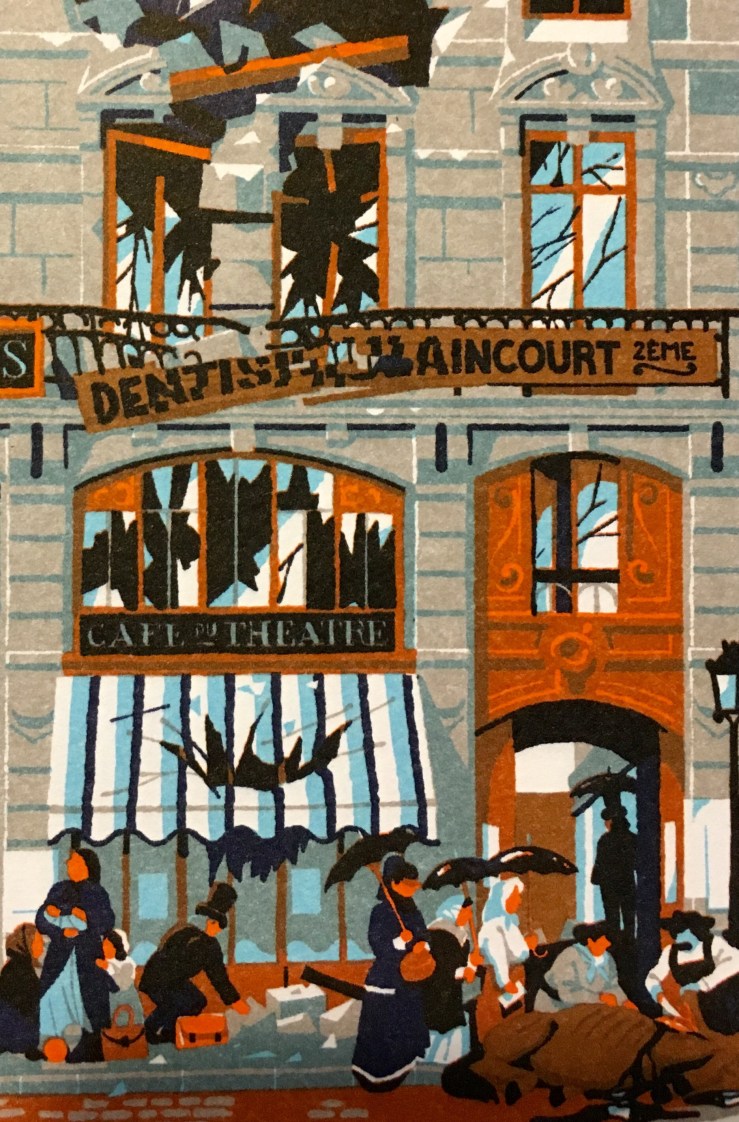
Illustration for Poe’s “The Sphinx,” Fritz Eichenberg

“The Sphinx”

by

Edgar Allan Poe


DURING the dread reign of the Cholera in New York, I had accepted the invitation of a relative to spend a fortnight with him in the retirement of his cottage ornee on the banks of the Hudson. We had here around us all the ordinary means of summer amusement; and what with rambling in the woods, sketching, boating, fishing, bathing, music, and books, we should have passed the time pleasantly enough, but for the fearful intelligence which reached us every morning from the populous city. Not a day elapsed which did not bring us news of the decease of some acquaintance. Then as the fatality increased, we learned to expect daily the loss of some friend. At length we trembled at the approach of every messenger. The very air from the South seemed to us redolent with death. That palsying thought, indeed, took entire possession of my soul. I could neither speak, think, nor dream of any thing else. My host was of a less excitable temperament, and, although greatly depressed in spirits, exerted himself to sustain my own. His richly philosophical intellect was not at any time affected by unrealities. To the substances of terror he was sufficiently alive, but of its shadows he had no apprehension.

His endeavors to arouse me from the condition of abnormal gloom into which I had fallen, were frustrated, in great measure, by certain volumes which I had found in his library. These were of a character to force into germination whatever seeds of hereditary superstition lay latent in my bosom. I had been reading these books without his knowledge, and thus he was often at a loss to account for the forcible impressions which had been made upon my fancy.

A favorite topic with me was the popular belief in omens—a belief which, at this one epoch of my life, I was almost seriously disposed to defend. On this subject we had long and animated discussions—he maintaining the utter groundlessness of faith in such matters,—I contending that a popular sentiment arising with absolute spontaneity- that is to say, without apparent traces of suggestion—had in itself the unmistakable elements of truth, and was entitled to as much respect as that intuition which is the idiosyncrasy of the individual man of genius.

The fact is, that soon after my arrival at the cottage there had occurred to myself an incident so entirely inexplicable, and which had in it so much of the portentous character, that I might well have been excused for regarding it as an omen. It appalled, and at the same time so confounded and bewildered me, that many days elapsed before I could make up my mind to communicate the circumstances to my friend. Continue reading ““The Sphinx” — Edgar Allan Poe”

Flesh — Ivan Albright

Catboy — Eric Fischl

Illustration for Algernon Blackwood’s The Wendigo — Matt Fox

Illustration for Blackwood's "The Wendigo," Matt Fox

Read The Wendigo at Project Gutenberg.

“The Flowering of the Strange Orchid” — H.G. Wells

t_morino_monster_10
Illustration for “The Flowering of the Strange Orchid,” Tatsuya Morino

“The Flowering of the Strange Orchid”

by

H.G. Wells

The buying of orchids always has in it a certain speculative flavour. You have before you the brown shrivelled lump of tissue, and for the rest you must trust your judgment, or the auctioneer, or your good-luck, as your taste may incline. The plant may be moribund or dead, or it may be just a respectable purchase, fair value for your money, or perhaps – for the thing has happened again and again – there slowly unfolds before the delighted eyes of the happy purchaser, day after day, some new variety, some novel richness, a strange twist of the labellum, or some subtler coloration or unexpected mimicry.

Pride, beauty, and profit blossom together on one delicate green spike, and it may be, even immortality. For the new miracle of Nature may stand in need of a new specific name, and what so convenient as that of its discoverer? “Johnsmithia!” There have been worse names.

It was perhaps the hope of some such happy discovery that made Winter-Wedderburn such a frequent attendant at these sales – that hope, and also, maybe, the fact that he had nothing else of the slightest interest to do in the world. He was a shy, lonely, rather ineffectual man, provided with just enough income to keep off the spur of necessity, and not enough nervous energy to make him seek any exacting employments. He might have collected stamps or coins, or translated Horace, or bound books, or invented new species of diatoms. But, as it happened, he grew orchids, and had one ambitious little hothouse. Continue reading ““The Flowering of the Strange Orchid” — H.G. Wells”

Gaaskidi – Navaho (Mask) — Edward S. Curtis

ct01078v

The Souls of Acheron — Adolf Hirémy-Hirschl

Landscape — David Teniers the Younger

The Temptation of St. Anthony — David Teniers the Younger

Eagle Claw and Bean Necklace — Georgia O’Keeffe

Woman Catching a Flea — Georges de la Tour

The Fall of the Rebel Angels (Detail) — Pieter Bruegel the Elder

Screenshot 2015-10-17 at 5.28.11 PM

Beggar with Mandolin — Tamara de Lempicka

The Ray — Jean-Baptiste-Simeon Chardin

The Fall of the Rebel Angels (Detail) — Pieter Bruegel the Elder

Screenshot 2015-10-17 at 5.26.18 PM

Dissection of a Landscape — Jaroslav Serpan