Robert Hughes’s Goya Biography (Book Acquired, 9.21.2012)

20120925-164220.jpg

I’d been wanting to read a biography of Goya for some time now. For a few years now, his art has come occupy a strange space in the back of my subconscious mind—all the pain and violence and horror of it. Maybe it’s all the Roberto Bolaño I’ve been reading. I’m convinced that if you want to understand Bolaño it helps to have Goya as a visual referent. Also, I cut up an oversized Italian collection of color prints from Goya to hang in my office, so they’re always kinda in my visual field.

Anyway, last week I went  by my favorite local used bookstore to pick up a copy of W.G. Sebald’s After Nature that they’d kindly ordered for me and went through the biographies as well to find something on Goya. There were at least half a dozen, but the recently deceased Robert Hughes’s was the most beautiful and most recent, and its opening captivated me: In the first chapter, Hughes describes how a near-fatal car crash in 1999 unlocked the Goya study that he’d been wanting to write for years. The scene unfolds as a bizarre prolonged fever dream, a horrifying narrative informed by Goya’s asylums and bullfights, with the strange layer of modern airport slathered on top.

I’ve read the first 150 pages since then. Hughes’s writing is crisp and the text is rich; Hughes builds a slow case, arguing against Goya’s reputation as a radical but also highlighting the artist’s powers of pathos (not to mention his skill, both raw and refined). Hughes had me hooked with the following paragraph, which could also stand in as a simple description of a decsonstructionist theory of identity:

Goya was in some ways the greatest of all delineators of madness, because he was unrivaled in his ability to locate it among the common presences of human life, to see it as a natural par t of man’s (and woman’s) condition, not as an intrusion of the divine or the demonic from above or below. Madness does not come from outside into a stable and virtuous normality. That, Goya knew in his excruciating sanity, was nonsense. There is no perfect stability of the human condition, only approximations of it, sometimes fragile because created by culture. Part of his creed, indeed the very core of his nature as an artist, was Terence’s “Nihil humanum a me alienum puto,” “I think nothing human alien to me.” This was part of Goya’s immense humanity, a range of sympathy, almost literally, “co-suffering,” rivaling that of Dickens or Tolstoy.

Head of a Stag — Diego Velazquez

A Young Woman Reading — Gustave Courbet

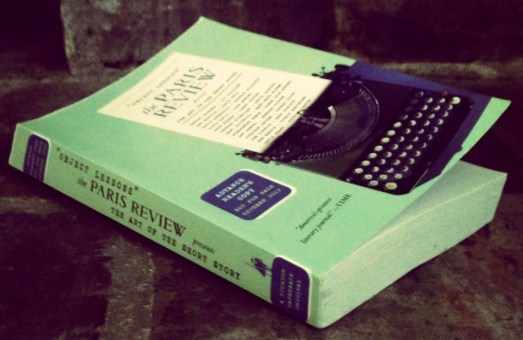
I Review Object Lessons, Where 20 Contemporary Authors Select and Introduce 20 Short Stories from The Paris Review

20120902-135314.jpg

Object Lessons anthologizes 20 stories published in the Paris Review over the past fifty years. “It is not a greatest hits anthology,” advises the brief editor’s note, “Instead, we asked twenty masters of the genre to choose a story from the Paris Review archives—a personal favorite—and to describe the key to its success as a work of fiction.” Hence, we get Ann Beattie introducing Craig Nova’s “Another Drunk Gambler,” Amy Hempel introducing Bernard Cooper’s “Old Birds,” and Sam Lipsyte introducing Mary Robinson’s “Likely Lake.”

Most of the introductions are short—most are fewer than three pages—and each author approaches his or her selection differently. Ben Marcus, prefacing “Several Garlic Tales,” tells us that, “Donald Barthelme was a magician of language, and it would be most respectful, perhaps even ethical, not to look too closely into the workings of his magic.” Marcus proposes a few approaches to find meaning in Barthelme’s surreal tale, but never over-explicates. In contrast, Lydia Davis’s surprisingly long intro to Jane Bowles’s “Emmy Moore’s Journal” is a sentence-to-paragraph close reading; Davis interrogates Bowles’s diction and syntax and concludes her little essay by situating Bowles’s (underappreciated) place in the canon. Davis’s insights are compelling, but one wonders if they wouldn’t be better appreciated after reading the story.

Davis also appears as author of one of the selected stories—Ali Smith picks Davis’s excellent number “Ten Stories from Flaubert.” Smith’s intro is wonderful, explaining the genesis of “Ten Stories,” which “came about when Davis (who is also a translator) was working on a a new translation of Madame Bovary and reading through Flaubert’s letters to his friend and lover Louise Colet.” I’m a huge fan of Lydia Davis, whose work defies easy definition. Smith wonders about her selection: “Are they translations? Are they by Flaubert? Are they by Davis?” The questions are better than answers.

Occasionally an author veers close to spoiling the story he introduces, as does Jeffrey Eugenides when he gracelessly steps all over Denis Johnson’s already-much-anthologized classic “Car Crash While Hitch Hiking.” Elsewhere, Jonathan Lethem mashes and minces misplaced metaphors in his confusing and forgettable introduction to Thomas Glynn’s story “Except for the Sickness I’m Quite Healthy Now. You Can Believe That.” Lethem’s sloppy, unrestrained attempt to dazzle is regrettable. He’s like the warm-up act that tries too hard to show up the headliner and winds up falling on his face.

For the most part though, the introductions simply allow readers new ways to see a story they’ve perhaps read before, as in Aleksandar Hemon’s preface to Jorge Luis Borges’s “Funes the Memorious” or David Means’s preface to Raymond Carver’s “Why Don’t You Dance.” Means suggests that “A great story is like an itch that has to be scratched eternally . . . We’re left with more questions than answers, and more answers than questions; therefore, the paradoxical quality of a good story is that it seems to give us everything we need and yet not quite enough to fulfill a sense of having been shown a full life.” Surprisingly good is Dave Eggers’s intro to James Salter’s “Bangkok,” which reads almost like a loose riff of notes that a harried but talented adjunct might bring to his Creative Writing 101 workshop. Eggers showcases keen intuition about Salter’s narrative coupled with an eagerness that makes one want to read the story.

And what about those stories? If I’ve focused more on the introductions than the stories themselves, it’s perhaps because I’ve taken for granted that the selections are solid for an anthology. Sure, any reader might have his or her gripes, but the range of talent here is undeniable, and the spectrum of stories is satisfying. Object Lessons would make a fine addition to the syllabus of any beginning writing course, and any young person interested in honing her craft could do worse than attending the examples collected here. To be clear, Object Lessons is in no way some master course in How to Write a Short Story, but it does provide the most valuable writer’s tool—good reading.

The Babysitter — Norman Rockwell

The Stranger — Orson Welles (Full Film)

Highwaymen Attacking a Coach — Francisco Goya

St. Antony of Padua – El Greco

Charlie Chaplin’s City Lights (Full Film)

Fable of the Fox and the Heron — Frans Snyders

Autumn — Giuseppe Arcimboldo

The Garden Reading – Mary Cassatt

L’Age D’Or — Luis Buñuel (Full Film)

Virgin and Child (The Tallard Madonna) – Giorgione

William Gass: “Ways of Reading Are Adversaries”

William Gass, in his 1977 Paris Review interview

INTERVIEWER

Is the reader an adversary for you?

GASS

No. I don’t think much about the reader. Ways of reading are adversaries—those theoretical ways. As far as writing something is concerned, the reader really doesn’t exist. The writer’s business is somehow to create in the work something which will stand on its own and make its own demands; and if the writer is good, he discovers what those demands are, and he meets them, and creates this thing which readers can then do what they like with. Gertrude Stein said, “I write for myself and strangers,” and then eventually she said that she wrote only for herself. I think she should have taken one further step. You don’t write for anybody. People who send you bills do that. People who want to sell you things so they can send you bills do that. People who want to tell you things so they can sell you things so they can send you bills do that. You are advancing an art—the art. That is what you are trying to do.

Robert Louis Stevenson and His Wife — John Singer Sargent

Monk in White, Seated, Reading — Camille Corot