
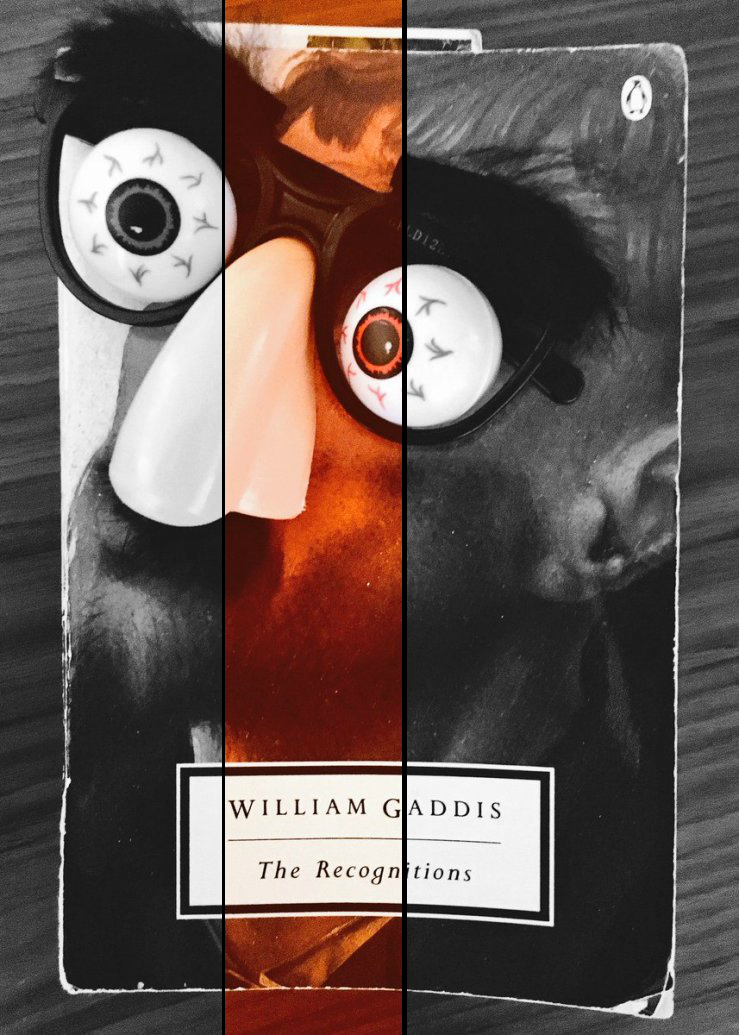
In the epilogue of his 1955 novel The Recognitions, William Gaddis checks in on the book’s enormous background cast, tying up loose ends, but also leaving many of the characters frayed, burned out, or destroyed. There’s a remarkable metatextual moment in this epilogue in which two minor characters are revealed to be carrying copies of a book that bears more than a passing resemblance to The Recognitions itself. These characters are both literary counterfeiters—Mr. Feddle, a faker who forges book jackets with his name in the author’s position and slips them over classic novels, and “the critic in the green wool shirt,” who doesn’t bother to read the books he reviews.
Meeting at a tailor’s shop, Feddle and the critic peer at each other, “fix[ing] the book the other was carrying with a look of myopic recognition.” The passage continues with the following acerbically ironic exchange:
—You reading that? both asked at once, withdrawing in surprise. —No. I’m just reviewing it, said the taller one, hunching back in his green wool shirt.
—A lousy twenty-five bucks. It’ll take me the whole evening tonight. You didn’t buy it, did you? Christ, at that price? Who the hell do they think’s going to pay that much just for a novel. Christ, I could have given it to you, all I need is the jacket blurb to write the review.
The exchange here accurately anticipates exactly how The Recognitions would be received by its contemporary critics—or “hacks,” as Jack Green repeatedly calls them in his infamous 1962 screed Fire the Bastards! For almost 80 pages, Green details the failures of the 55 critics who reviewed the book upon its release. Some of these major failures include—
failing to recognize the greatness of the book
failing to convey to the reader what the book is like, what its essential qualities are
counterfeiting this with stereotyped preconceptions—the standard cliches about a book that is “ambitious,” “erudite,” “long,” “negative,” etc
counterfeiting competence with inhuman jargon
Green’s repeated use of the word “counterfeit” not just here but throughout his tract demonstrates the essential realism of The Recognitions: Gaddis conceived how his novel of counterfeiters, poseurs, plagiarists, and hacks would be misread, misremembered, and misrecognized by counterfeiters, poseurs, plagiarists, and hacks. The green-wool-shirted critic’s declaration that all he needs “is the jacket blurb to write the view” transcends its original satirical contours—it is a prophecy that comes true.
This satirical metatextual prognostication finds fruition in the review of The Recognitions published in The Louisville Courier-Journal. In Fire the Bastards!, Green details how the reviewer plagiarized his review of The Recognitions from the novel’s jacket blurb. The metatextuality here is magical: Gaddis conjures the character of an unnamed counterfeiter critic who will (not-)review a book that appears to be The Recognitions itself; this character becomes real by (not-)reviewing the book in an unsigned review in The Louisville Courier-Journal that plagiarizes the book’s blurb.
But perhaps I’ve neglected to demonstrate that the book that Feddle the faker and the critic in the green wool shirt are both not reading is in fact a version of The Recognitions itself. Here is the next paragraph in the episode:
It was in fact quite a thick book. A pattern of bold elegance, the lettering on the dust
wrapper stood forth in stark configurations of red and black to intimate the origin of design. (For some crotchety reason there was no picture of the author looking pensive sucking a pipe, sans gêne with a cigarette, sang-froid with no necktie, plastered across the back.)
In his invaluable work A Reader’s Guide to William Gaddis’s The Recognitions, Steven Moore gives the following annotation to these lines:
the description is of the first edition of R [The Recognitions]. Martin Dworkin’s photograph of Gaddis “sans gêne with a cigarette, sang-froid with no necktie” appeared in both the Time and Newsweek reviews.
Jack Green is more succinct in Fire the Bastards!: “the book the stubby
poet [Feddle] has is the recognitions [sic] itself.” And what is “the stubby poet” doing with such a bigass book? Reading it?
—Reading it? Christ no, what do you think I am? I just been having trouble sleeping, so my analyst told me to get a book and count the letters, so I just went in and asked them for the thickest book in the place and they sold me this damned thing, he muttered looking at the book with intimate dislike.
At least Feddle’s dislike is “intimate.” If he’d bothered to read it he might have gotten some weird alarming joy from this (meta)Recognitions. Or, even better, he might reread it—which is really the only way to read The Recognitions, I’m convinced, after my second full read. The book is more precise, more artfully constructed—more stuffed with motifs and symbols, doubled, tripled, quadrupled—than I had realized on first reading.
Jack Green made rereading The Recognitions a significant part of his life. He was an evangelist for the text, going so far as to take out a full page ad in The Village Voice in 1962 when the book was reprinted in paperback. His advertisement is five short paragraphs. The second paragraph is a proper, original blurb. The second paragraph is an argument for rereading. Here they are:
“The Recognitions” is a 956-page novel whose main theme is vanity or forgery—of Old Masters, $20 bills, slings, personality, everything. It is like a painting with a few primary figures presented in depth and an army of caricatures in the background. The main characters are unforgettable and, as is usually true, give the book most of its greatness. The minor characters, including the author himself who has a bit part, are very funny.
Like “Ulysses,” Gaddis’s book can be read the first time with enjoyment (my advice: don’t work at it) and then reread for years with increasing fascination. It has an intricate network of thousands of cross-references which give it a unique time-sense: as the connections are gradually recognized on rereading, the book appears to grow like a living being.
“Grow like a living being.” I think that’s about right.






 Biblioklept