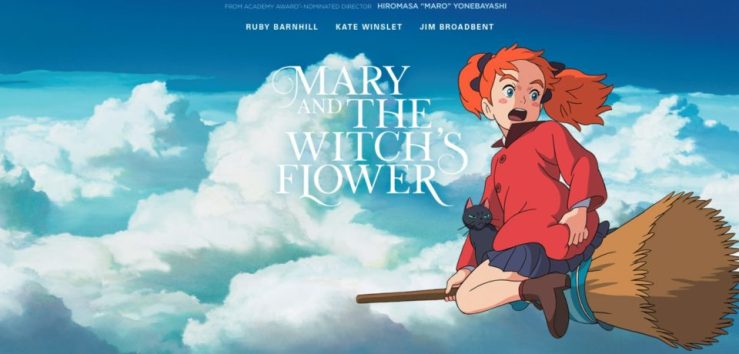
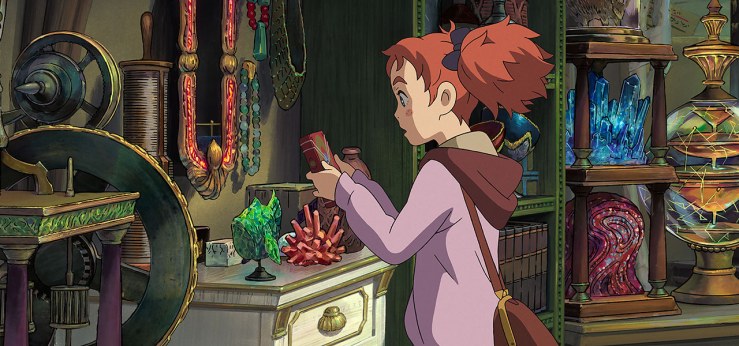
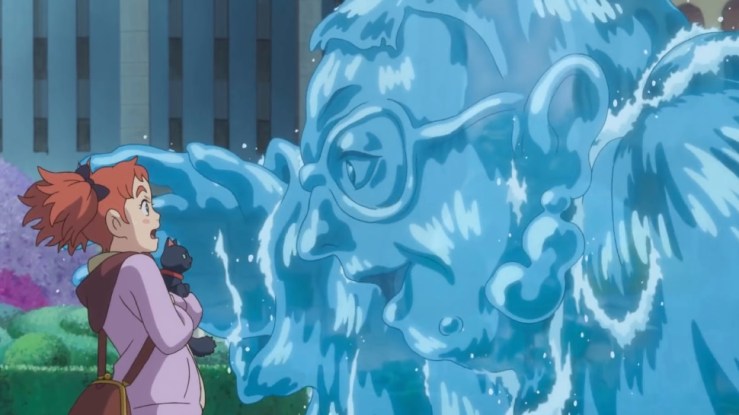
Mary and the Witch’s Flower (2017) tells the story of Mary Smith, a little girl whiling away her time in the English countryside home of her great aunt before school starts. Poor Mary is awfully bored—until she finds a rare flower called the “fly-by-night.” The fly-by-nights, which only bloom once every seven years, bestow magical properties on their user. Mary’s boredom is quickly cured when a flying broomstick whisks her away (black cat in tow) to a magical world above the clouds. She finds herself at the Endor College of Witches, where she’s taken on as a star pupil by the ominous headmistress Miss Mumblechook and her strange partner in scientific magic, Dr. Dee. They take Mary on a tour of Endor College, a visual highlight of a gorgeous film. The tour culminates in Miss Mumblechook’s office, which doubles as a museum of magical artifacts. Here, Mary—somewhat accidentally, but hey—becomes a biblioklept, stealing the headmistress’s book of master spells. Mary then reveals that her power comes from the fly-by-night flower. The film’s plot kicks into a higher gear here, as it becomes clear that Mumblechook and Dee will stop at nothing to get their clutches on the magical flowers.
Mary and the Witch’s Flower is the first film from Studio Ponoc, a production company founded by Yoshiaki Nishimura, who previously worked as a producer for Studio Ghibli. Mary and the Witch’s Flower’s director Hiromasa Yonebayashi is another Studio Ghibli alum; he worked as a key animator on films like Spirited Away (2001), Howl’s Moving Castle (2004), and Ponyo (2008), before directing his own films for the studio—Arrietty (2010) and When Marnie Was There (2014).
Arrietty, while charming, felt like Miyazaki-lite—a small-scale exercise pulled off with aesthetic precision that ultimately lacked the grand emotion that underwrites all the master’s greatest films. In contrast, Mary and the Witch’s Flower isn’t so much Miyazaki-lite as Miyazaki-mega, a love letter composed under heavy anxiety of influence. The film teems with references to Miyazaki’s oeuvre, and Yonebayashi’s visual style is an homage on par with (if not surpassing) the master.
The most immediate comparison viewers might make here is to Miyazaki’s Kiki’s Delivery Service (1989), which Yonebayashi’s film clearly echoes visually with its flying broomsticks and its prominent black cat. However, Mary and the Witch’s Flower has more in common (both in its plot, themes, tone, and visuals) with later Miyazaki films like Ponyo, Howl’s Moving Castle, and Spirited Away. I’m tempted to produce a laundry list here of specific comparisons, but there are simply too many—Yonebayashi delights in larding his film with characters and images that visually resemble Ghibli characters and images, painted in the bright shimmering colors of Miyazaki’s late period. There isn’t a shot in the film that doesn’t crib, even obliquely, from an earlier Ghibli film. (Hell, even composer Takatsugu Muramatsu’s soundtrack sounds like an homage to Joe Hisaishi’s work for Studio Ghibli).
These Easter eggs are most fun to find when Yonebayashi goes beyond the core films that his pastiche derives from, like when we get a shot of a city in the clouds that echoes Castle in the Sky (1986), or when a gray cat is transmuted into a creature resembling something like the gentle creatures from Totoro (1988), or when Yonebayashi’s frame lingers just a second too-long on a pigman chef who bears more than a passing resemblance to the titular hero of Porco Rosso (1992).
Yonebayashi’s melange of Miyazaki is hardly a patchwork of references though. Mary and the Witch’s Flower is rather a loving synthesis of the master’s greatest tendencies. Calling Yonebayashi a copycat simply will not do—he was a key artisan in Miyazaki’s workshop after all, and we see here the same level of technical craftsmanship that made the Ghibli films so special.
What’s missing from the film though is something harder to define. An auteur relies on a company, a workshop, a cohort of skilled artisans to help the auteur realize his or her vision. All auteurs borrow or outright steal from the artists that come before them, but the great artists conjure those ingredients into something new. They overcome their anxiety of influence and synthesize the masterworks that preceded them with their own visions, inspiriting the material with their own sense of soul. Yonebayashi’s film, as I wrote above, is a loving synthesis of Miyazaki’s most magical moments, but what’s missing is Yonebayashi’s own magic, his own vision.
And yet there’s so much promise in the young artist. Yonebayashi is only 44; Miyazaki was around the same age when he made Castle in the Sky, the first Ghibli film, and frankly one of his weakest. Castle in the Sky is best enjoyed now as a work in retrospect, after having traced the auteur’s major themes in grander works like Spirited Away or The Wind Rises (2013). With Mary and the Witch’s Flower, Yonebayashi composed a love letter to the workshop where he honed his craft, and the film will probably be most remembered (and enjoyed) as an homage to all things Ghibli. Let’s hope that Yonebayashi’s next effort sees the young director break free from the anxiety of influence to offer us his own original vision.
How I watched it: On a big TV, rented from iTunes, with full attention, with my family. My daughter gave it a B+; my son gave it a B-.





 Biblioklept