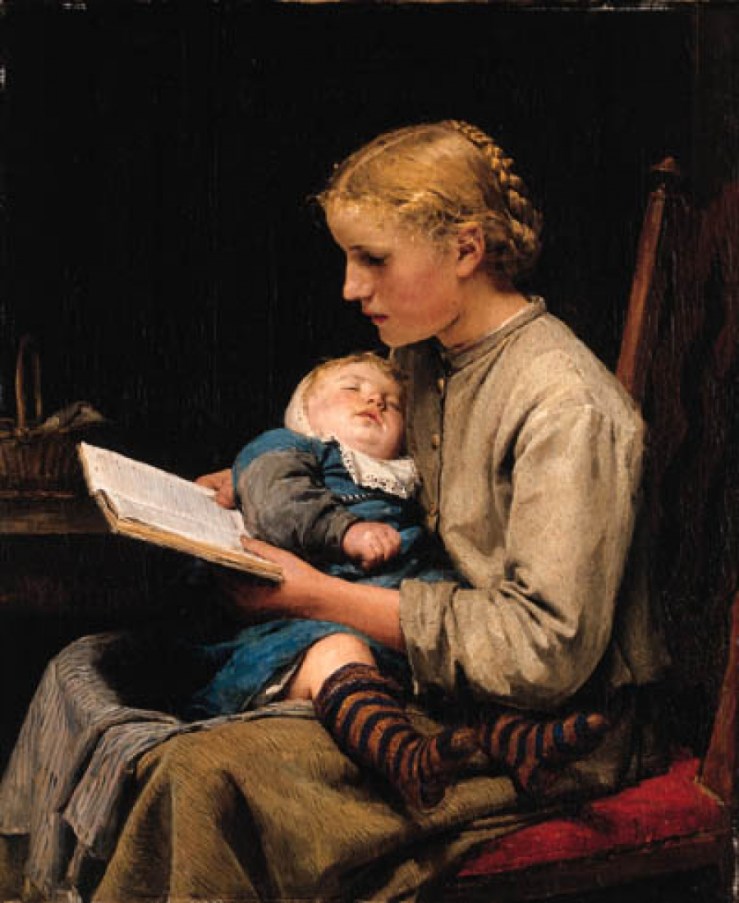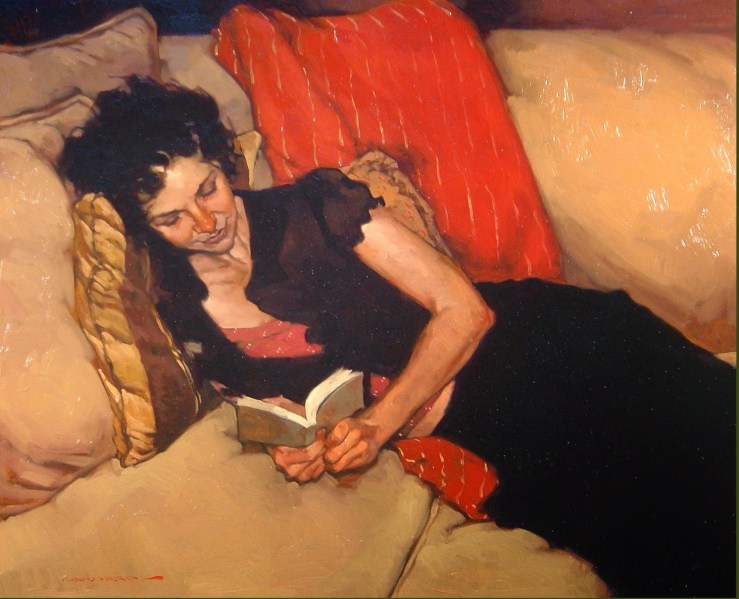
Rosa and Bertha Gugger — Albert Anker

xgagbxws3vwl

They will not do us any good—the good books (William H. Gass)

They will not do us any good—the good books—no—if by good we mean good looks, good times, good shoes; yet they still offer us salvation, for salvation does not wait for the next life, which is anyhow a vain and incautious delusion, but is to be had, if at all, only here—in this one. It is we who must do them honor by searching for our truth there, by taking their heart as our heart, by refusing to let our mind flag so that we close their covers forever, and spend our future forgetting them, denying the mind’s best moments. They extend the hand; we must grip it. Spinach never made Popeye strong sitting in the can. And the finest cookbook ever compiled put not one pot upon the stove or dish upon the table. Here, in the library that has rendered you suspect, you have made their acquaintance—some of the good books. So now that you’ve been nabbed for it, you must become their lover, their friend, their loyal ally. But that is what the rest of your life is for. Go now, break jail, and get about it.

From William H. Gass’s essay “To a Young Friend Charged with Possession of the Classics.” Collected in A Temple of Texts.

Saving Simon (Book Acquired, 9.15.2014)

IMG_3341.JPG

Saving Simon by Jon Katz is new in hardback from Random House. Their blurb:

In this heartfelt, thoughtful, and inspiring memoir, New York Times bestselling author Jon Katz tells the story of his beloved rescue donkey, Simon, and the wondrous ways that animals make us wiser and kinder people.

In the spring of 2011, Jon Katz received a phone call that would challenge every idea he ever had about mercy and compassion. An animal control officer had found a neglected donkey on a farm in upstate New York, and she hoped that Jon and his wife, Maria, would be willing to adopt him. Jon wasn’t planning to add another animal to his home on Bedlam Farm, certainly not a very sick donkey. But the moment he saw the wrenching sight of Simon, he felt a powerful connection. Simon touched something very deep inside of him. Jon and Maria decided to take him in.

Simon’s recovery was far from easy. Weak and malnourished, he needed near constant care, but Jon was determined to help him heal. As Simon’s health improved, Jon would feed him by hand, read to him, take him on walks, even confide in him like an old and trusted friend. Then, miraculously, as if in reciprocation, Simon began to reveal to Jon the true meaning of compassion, the ways in which it can transform our lives and inspire us to take great risks.

This radically different perspective on kindness and empathy led Jon to a troubled border collie from Ireland in need of a home, a blind pony who had lived outside in a pasture for fifteen years, and a new farm for him and Maria. In the great tradition of heroes—from Don Quixote to Shrek—who faced the world in the company of their donkeys, Jon came to understand compassion and mercy in a new light, learning to open up “not just to Simon, not just to animals, but to the human experience. To love, to risk, to friendship.”

With grace, warmth, and keen emotional insight, Saving Simon plumbs the depths of the bonds we form with our animals, and the rewards of “living a more compassionate, considered, and meaningful life.”

The Housemaid — William McGregor Paxton

william-mcgregor-paxton-the-hausmaid-1910

Reading — Clarence Coles Phillip

cole

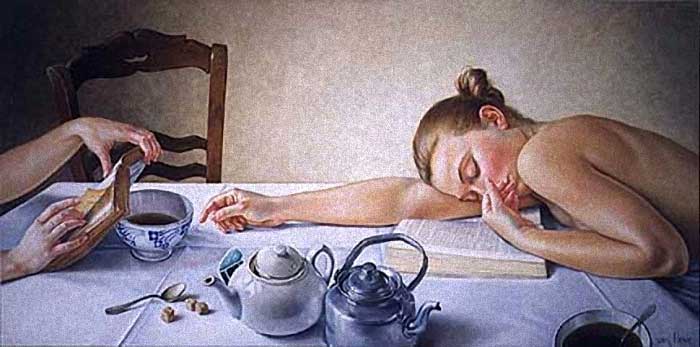
The Small Kettle — Francine Van Hove

fvp

Reviving Álvaro Mutis, Who Died One Year Ago Today

Homenaje-Alvaro-Mutis

The Colombian writer Álvaro Mutis died one year ago today.

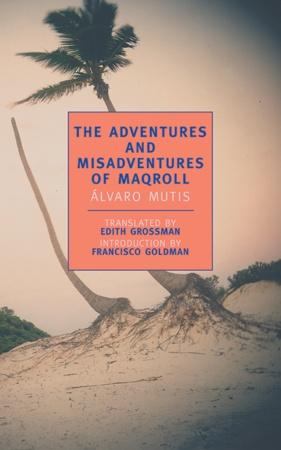
Mutis wasn’t on my radar until a few years ago, when a friend of mine, Dave Cianci, urged me to read the author’s opus, The Adventures and Misadventures of Maqroll, a collection of seven novellas that speak to each other in a loose, rich, intertextual poetics of adventure, romance, and loss. My friend Cianci was so enthusiastic about the book that he reviewed it for this blog (the review convinced me to read it). I’ll crib from that review:

The Adventures and Misadventures of Maqroll is difficult to categorize. It’s an outlaw adventure story populated by men and women who live where and how they must; these are the people who work near shipyards and the banks of unexplored river tributaries, people who value candor and honesty but for whom strict adherence to the law is often inconvenient. The book is a philosophical rumination on friendship and creation, romance and deception, obstinance and poverty.

Later in his review, Cianci characterizes the titular Maqroll—the Gaviero, the “lookout” —as “who we all dream of being when we contemplate throwing everything away.” In one of my own pieces on Maqroll, I described the world that Mutis offers, part fantasy, part nightmare, as

a life of picaresque adventures (and titular misadventures), of loss and gain, of love and despair, drinking, sailing, scheming and plotting—a life full of allusions and hints and digressions. Mutis’s technique is marvelous (literally; he made this reader marvel): he gives us an aging (anti-)hero, a hero whose life is overstuffed with stories and mishaps and feats and enterprises and hazards; he gives us one strand of that life at a time in each novella—but then he points to the other adventures, the other serials of Maqroll that we would love to tune into if only we could.
maq

John Updike explained the attraction to Mutis and Maqroll in his 2003 New Yorker review of NYRB’s Maqroll collection:

The problem of energy, in this enervated postmodern era, keeps arising in Mutis’s pursuit of a footloose, offhandedly erudite, inexplicably attractive shady character. A lowly seaman with some high-flying acquaintances on land, Maqroll is a drifter who tends to lose interest in his adventures before the dénouement is reached. Readers even slightly acquainted with Latin-American modernism will hear echoes of Borges’s cosmic portentousness, of Julio Cortázar’s fragmenting ingenuities, of Machado De Assis’s crisp pessimism, and of the something perversely hearty in Mutis’s fellow-Colombian and good friend Gabriel García Márquez—a sense of genial amplitude, as when a ceremonious host sits us down to a lunch provisioned to stretch into evening. Descriptions of food consumed and of drinks drunk, amid flourishes of cosmopolitan connoisseurship, are frequent in Mutis, even as the ascetic Maqroll goes hungry. North Americans may be reminded of Melville—more a matter, perhaps, of affinity than of influence.

Updike’s review is one of the only prominent and long English-language pieces about Álvaro Mutis that I’ve come across. There’s a good 2001 interview with Mutis in Bomb by Francisco Goldman (who wrote the NYRB edition’s introduction), and a few translated poems of Mutis’s can be found online, but on the whole, despite accolades throughout the Spanish-reading world, his reputation among English-readers seems relegated to “friend of Gabriel Garcia Marquez” (who called Mutis “one of the greatest writers of our time”).

Álvaro Mutis deserves a bigger English-reading audience. NYRB’s collection of his novellas in Edith Grossman’s translation bristles with energy. At once accessible and confounding, these tales that ask us to read them again, like Borges’s puzzles Bolaño’s labyrinths.

Is it tactless to name Bolaño here? Maybe—he’s perhaps too-easy an example: A Spanish-language author whose readership radically expanded after his death. Anyone who follows literary trends (ach!) will see how quickly a writer’s currency elevates after his or her death. (Ach! again). But I think that Mutis should attract fans of Bolaño, whose currency still spends (and will spend in the future, I think). Another comparison I would like to be able to make though would be John Williams’s sad novel Stoner, which, as any one who follows literary trends (ach!) could tell you became an unexpected best seller last yearStoner—also published by the good people at NYRB—had to wait half a century to get its due. I don’t see why the English-reading world should wait that long to embrace Mutis.

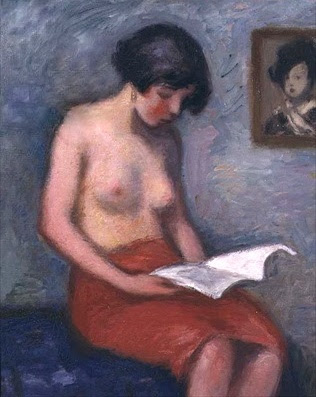
Nude Looking at Pictures — Georges d’Espagnat

Espagnat, George d' (1870-1950) Nude looking at pictures

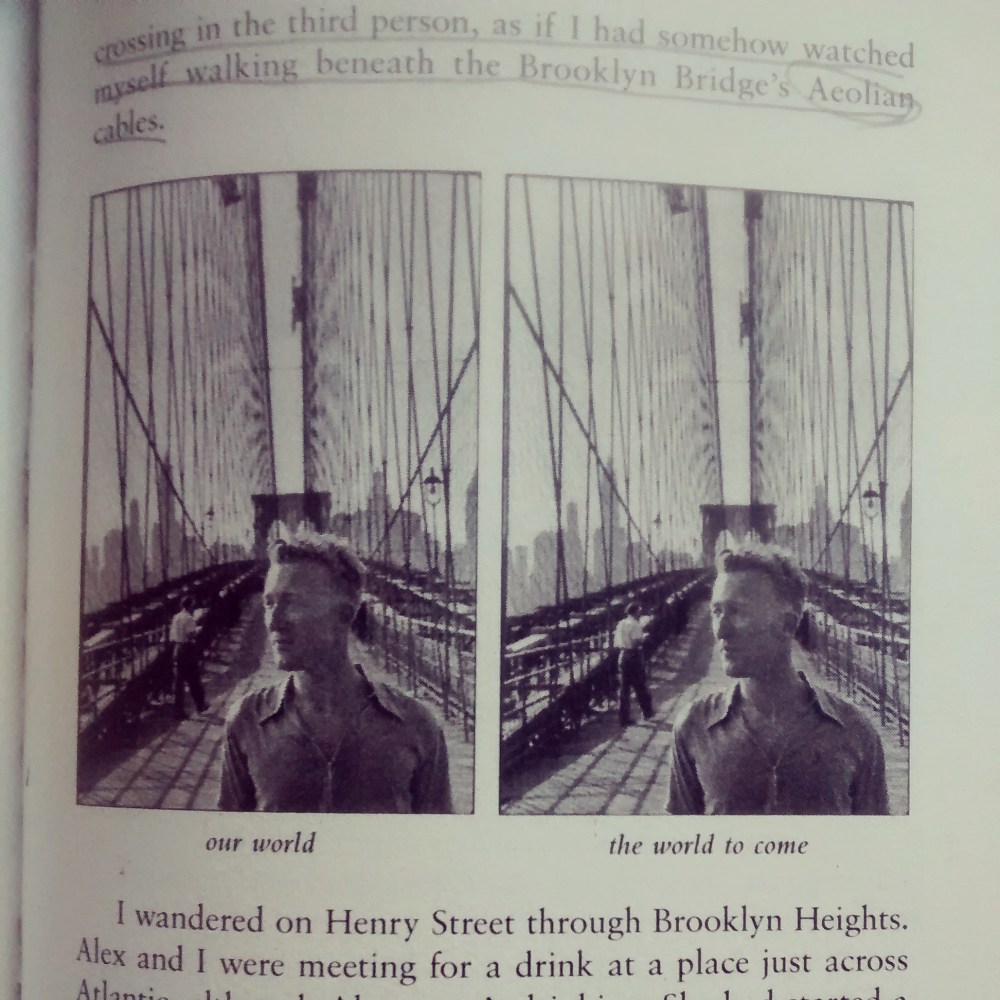
A Conversation about Ben Lerner’s Novel 10:04 (Part 2)

IMG_20140920_084354

[Context/editorial noteThis is the second and final part of a discussion between Biblioklept contributor Ryan Chang and myself about Ben Lerner’s new novel 10:04. You can read the first part of the discussion here, if you like—the gist of that conversation is that I am kinda sorta hating the book, while Ryan makes a strong case for my finishing it. Which I did. — ET].

Edwin Turner: Okay, Ryan, so I’m still having a hard time with the book, and I think that Hari Kunzru pins down why in his (diplomatic) review at The New York Times:

Does [the novel’s] ironic tone (which often feels like a reflex, a tic) preclude sincerity? Is all this talk of community no more than an artful confection, the purest kind of cynicism? The question is impossible to resolve, so each of these episodes — and indeed the book as a whole — takes on a sort of hermetic undecidability.

I find the “hermetic undecidability” not so much unsettling—the proper rhetorical gambit to match the novel’s themes—but rather a dodge, an escape hatch even, to avoid adequately answering to the model that the narrator wants to find in Whitman. There’s this wonderful moment where the narrator says “Art has to offer something other than stylized despair” — and I take this to be something like the mission of the book — but the archness, the cleverness of the book, its frequent retreats away from (what I take to be) Whitman’s project (the kosmos, the roughneck with the unstopped throat) — I just don’t see much but a kind of stylized ennui (if not despair) about the “bad forms of collectivity” our narrator is forced (forces himself) to partake in.

My favorite moments of the book continue to be the essay passages, the art or literary theory that he spackles in—the riff on Peggy Noonan writing Reagan’s Challenger-explosion speech, the elements of borrowed language, etc. (Again, I’m almost the same age as Lerner. I was in Young Astronauts, and our field trip to Cape Canaveral was canceled because of inclement weather, so we watched it in the cafeteria—live. I did not understand what happened, but I remember my teachers crying).

Ryan Chang: Hey man, I just skimmed the NYT review—per the excerpt you provided—because I don’t want Kunzru clouding any of my response. It’s certainly a question I too grapple with, and I think Kunzru is right insofar that the question is “undecidable” but not for the reason(s) he suggests. I agree with you that he dodges the question, whether or not from editorial pressure or a reticence to actually address “hermetic undecidability.”

For one, I’m not sure myself if The Author ever arrives at the Whitmanic model of democracy he posits. I’m also not sure if he is supposed to “arrive” in the sense that a finality is set. I guess I also want to riff a bit on how finality might be described. Is finality then something static; as in, somehow 10:04 transmits–electrocutes, reverberates–through its readership, now coeval (the when negligent, the position of the reader enmeshed in the text is the same at 10 PM here as it is at 5 AM there), the novel’s theses and everything is suddenly Whitmanic? Community successfully reimagined and cemented? That sounds too easy, too convenient, too short-sighted. Or is it a kind of arrival into an embodiment of time that exists outside of conventional literary clocks, which is also a Market-based clock — it’s my sense that the kind of democracy Whitman envisions in his work is one constantly in flux, a “reality in process” and thus in opposition to the capitalist clock? That is, we know we are supposed to “stop” working at 5, the embodiment of the currency-based clock disappears after 5, but it’s a contrasting relationship. Our time outside of the currency then absorbs a negative value (I think The Author only mentions once or twice how we are all connected by our debt, a negativity projected into the future), though the illusion of the clock is that we are “free” in our time. OK: in a literary sense, wouldn’t this be a sense of a text’s world stopping, a suspension that retroactively pauses the whole book? That 10:04 ends not only with a dissolution of prose into poetry, but also The Author into Whitman and thus recasting the first-/third-person narrator into a lyric-poet mode suggests the book’s integration into our, the reader’s, time (and also, retroactively, the entirety of the text). In that sense, for me, the issue whether or not The Author of 10:04 integrates the book fully into a Whitmanic model is not necessarily the point — it is that he, and also we hopefully through him — actively participate in remaking a “bad form of collectivity” less so. Continue reading “A Conversation about Ben Lerner’s Novel 10:04 (Part 2)”

Reading the Sonnet — Joseph Lorusso

Lorusso, Joseph (1966-...) Reading the sonnet

Day-Dreaming — Conrad Kiesel

day-dreaming-conrad-kiesel-1352183696_b

Hollander — Yoshitora Utagawa

Lesender Mann — Albert Anker

Girl in Red with Parasol — Max Pechstein

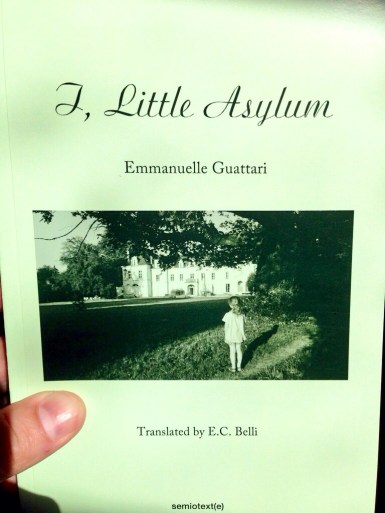
Emmanuelle Guattari’s Memoir (Book Acquired, 9.15.2014)

IMG_3322

I read about half of this yesterday. I, Little Asylum by Emmanuelle Guattari. Publisher Semiotext(e)/MIT’s blurb:

A moment later, Lacan is chattering with me, and giving me some crayons to draw with.
—from I, Little Asylum

Founded in 1951 and renowned in the world of psychiatry, the experimental psychiatric clinic of La Borde sought to break with the traditional internment of the mentally ill and to have them participate in the material organization of collective life. The clinic owed much of its approach to psychoanalyst and philosopher Félix Guattari, who was its codirector with Jean Oury until 1992. In this lyrical chronicle of a childhood at La Borde, Félix Guattari’s daughter Emanuelle Guattari offers a series of impressionistic vignettes drawn from her own experiences.

As a child whose parents worked in the clinic, Emanuelle Guattari (“Manou”) experienced La Borde–which is housed in a castle in the middle of a spacious park–as a place not of confinement but of imagination and play. She evokes a landscape that is surreal but also mundane, describing the fat monkey named Boubou her father kept at the clinic, interactions between the “La Borde kids” and the “Residents” (aka, the “Insane,” feared by the locals), the ever fascinating rainbow-hued “shit pit” on the grounds, and prank-calls to the clinic switchboard. And, of course, there is Félix Guattari himself, at the dinner table, battling a rat, and in his daughter’s dreams. Emmanuelle Guattari’s tale of childlike wonder offers a poetic counterpoint to the writings of her father and his intellectual circle.

The Music Master — Edmund Dulac

Grandmother Reading the Bible — Albert Anker